Buyer Fit Snapshot
| Best fit | Custom Ecommerce Packaging Boxes MOQ projects where brand print, material claims, artwork control, MOQ, and repeat-order consistency need to be specified before quoting. |
|---|---|
| Quote inputs | Share finished size, material target, print colors, finish, packing count, annual reorder estimate, ship-to region, and any compliance wording. |
| Proofing check | Approve dieline scale, logo placement, barcode or warning zones, color tolerance, closure strength, and carton packing before bulk production. |
| Main risk | Vague material claims, crowded artwork, missing packing details, or unclear freight terms can make a low unit price expensive after revisions. |
Fast answer: Custom Ecommerce Packaging Boxes MOQ: Pricing, Specs should be specified like a repeatable production item. The safest quote records material, print method, finish, artwork proof, packing count, and reorder notes in one written spec.
Production checks before approval
Compare the actual filled-product size with the drawing, then confirm tolerance on folds, seals, hang holes, label areas, and retail display edges. Reserve space for logos, QR codes, warning copy, and material claims before decorative graphics fill the panel.
Quote comparison points
Review material grade, print process, finish, sampling route, tooling charges, carton quantity, and freight assumptions side by side. A quote is only useful when the supplier can repeat the same color, closure quality, and packing count on the next order.
Custom Ecommerce Packaging Boxes MOQ: Pricing, Specs
Custom ecommerce packaging boxes moq sounds like a boring line item. It is not. It usually decides whether a launch looks polished or like somebody grabbed the nearest carton and called it strategy. The box itself is rarely the expensive part. The real cost shows up later: crushed corners, extra tape, too much filler, wasted shelf space, and a customer opening the package with the kind of face that says, “Really?” If you are comparing custom ecommerce packaging boxes moq options, the goal is simple. Find the smallest run that protects the product, keeps cash free, and does not leave you buried in boxes you cannot move.
Most buyers start in the wrong place. They chase the lowest generic mailer price, then spend the next month buying inserts, tape, replacement units, and apologies. That is not a savings plan. That is a leak with a purchase order attached. A better decision starts with the product, the shipping method, and how many units you can realistically use before the season changes or the SKU changes or somebody decides the branding needs a refresh. Custom ecommerce packaging boxes moq should work like a planning tool, not a flex.
So this is a buying guide, not a branding sermon. Packaging design matters, but only after the structure works. The useful questions are blunt: How much does setup cost? Which board grade fits the product? Do you need a mailer, a folding carton, or a corrugated shipper? How low can the custom ecommerce packaging boxes moq go before the unit price gets silly? That is the territory that matters.
Custom Ecommerce Packaging Boxes MOQ: Why the First Box Matters
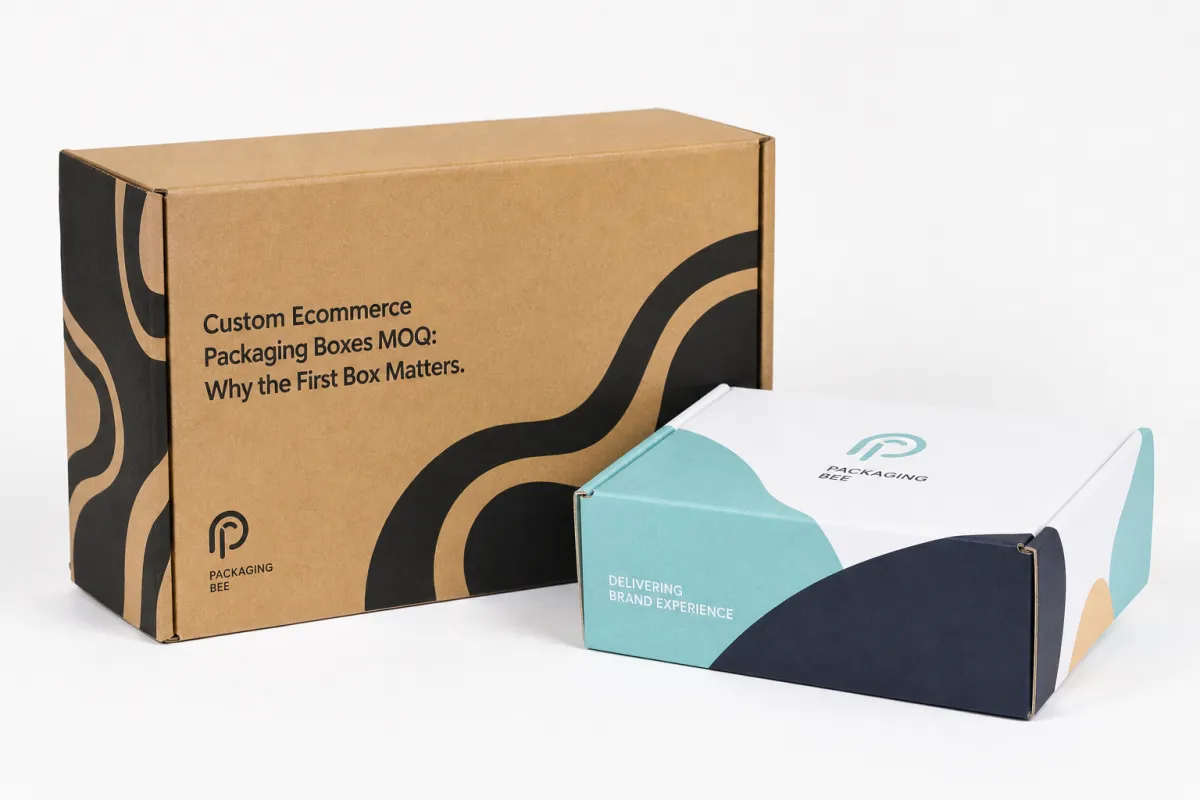
The first box is not just a container. It is the point where your product meets shipping reality. If the structure is wrong, everything gets harder. Product movement increases. Presentation looks improvised. Dented corners and crushed panels start showing up where they should not. For a packaging buyer, custom ecommerce packaging boxes moq is really a way to decide how much risk to carry before the product ever lands in a customer’s hands.
Here is the trap people keep stepping into. A brand picks a stock box because the unit price looks low. Then the box is too large, so filler goes in. The flaps are weak, so more tape gets added. The product shifts, so inserts get added too. Damage rates creep up. Suddenly the “cheap” package is more expensive than a properly spec’d run of custom ecommerce packaging boxes moq. That happens constantly. The invoice for the box is only one line in the math.
Custom ecommerce packaging boxes moq matters because ecommerce packaging does more work than a retail box sitting on a shelf. It has to survive warehouse handling, conveyor drops, parcel sortation, and the customer opening it with a kitchen knife and no patience. Weak structure pays for itself in returns. Oversized structure does the same in freight. A well-chosen MOQ lets you test the box without overcommitting, then scale once the fit is proven.
That first decision affects the rest of the supply chain. A tighter box can reduce corrugated usage, cut filler, and lower dimensional weight on shipping. In practice, that can improve total unit cost even if the printed box itself costs a bit more. Yes, the cheaper-looking option often loses on total cost. Packaging does that a lot. Annoying, but predictable.
For launches, seasonal drops, and new SKU tests, custom ecommerce packaging boxes moq gives you a controlled way to buy enough boxes to learn without stuffing a warehouse. For mature products, it helps lock in repeatable specs so reorders do not turn into a guessing game. If you want a consistent unboxing experience, custom ecommerce packaging boxes moq is the starting point, not the afterthought.
Practical rule: if the box saves two cents but increases damage, filler, or labor, it is not the cheaper box. It is the expensive mistake wearing a discount sticker.
For buyers who need a broader look at formats and finishing options, the Custom Packaging Products page is a useful starting point before you request quotes. It keeps the conversation grounded in actual structures instead of vague “premium” talk, which tends to burn time fast.
Custom Ecommerce Packaging Boxes MOQ: Where the Value Shows Up
The value of custom ecommerce packaging boxes moq shows up in four places: fit, protection, presentation, and operating cost. Fit matters because a tight box reduces movement. Protection matters because fewer damaged deliveries mean fewer replacements and less customer service noise. Presentation matters because branded packaging changes the way a product feels before it is even opened. Operating cost matters because a better structure can save packing time and reduce the amount of filler you buy every month.
For apparel, a custom mailer keeps garments from floating around and arriving wrinkled or sloppy. For cosmetics, a smaller, well-fitted box protects fragile components and gives the brand a cleaner print surface. Supplements often need a structure that keeps bottles stable and easy to scan in fulfillment. Candles need crush resistance plus a layout that protects the jar and label. Small electronics usually need more engineering because the product can be dense, fragile, and unforgiving. Different products, same lesson: custom ecommerce packaging boxes moq is not just about how few you can buy. It is about how well the box solves the product problem.
That is why unit price alone is a weak comparison. A stock box can look cheaper and still cost more once you add fillers, extra labor, and higher return risk. A custom run can lower total spend if it reduces shipping damage and trims material waste. If you are comparing custom printed boxes against off-the-shelf packaging, compare the whole landed cost: box, insert, packing time, freight, and likely replacement rate. The math gets clear fast.
Custom ecommerce packaging boxes moq also gives you control over brand consistency. You can keep colors aligned, panel placement consistent, and packaging sized to the SKU instead of forcing the product into a near-fit compromise. That matters for subscription boxes, launch kits, and giftable products because the box becomes part of the buying experience. Retail packaging lives on a shelf. Ecommerce packaging lives through shipping abuse first.
There is another quiet benefit: easier replenishment planning. Once a format is locked, repeat orders get simpler. The more standardized the structure, the less time you spend rechecking dielines or explaining the same dimensions to a new supplier. That is boring work, which is exactly why it saves money.
For brands focused on package branding, the best run is rarely the most elaborate one. It is the one that sells the product clearly and survives shipping without drama. Custom ecommerce packaging boxes moq should support that outcome, not distract from it with unnecessary bells and whistles.
Product Details: Box Styles, Materials, and Print Options
There are a handful of box styles that show up again and again in ecommerce. Mailer boxes are popular because they are sturdy, ship flat, and work well for unboxing. Folding cartons are lighter and suit smaller retail-style products. Corrugated shippers are the workhorses for shipping protection. Tuck-end boxes are common for retail packaging and lighter ecommerce items. Rigid presentation boxes sit at the higher end and work when the unboxing experience matters more than pure shipping efficiency. Each format changes how custom ecommerce packaging boxes moq gets priced.
Material choice is where buyers often oversimplify. E-flute corrugate gives a smoother print surface and works well for lighter products and sharper graphics. B-flute is thicker and tends to give better crush resistance. Paperboard is useful for lighter items, inserts, and display-style packaging, but it is not the same as corrugated protection. If the product is heavy or fragile, using thin board is a bad bargain. Better to use the right structure once than redesign after broken shipments. I have seen that mistake more than once, and it never gets less irritating.
Materials That Make Sense
For many ecommerce programs, 18pt to 24pt paperboard is enough for light products, while 32 ECT to 44 ECT corrugated board is more common for shipping boxes. That is not a law. It depends on weight, product geometry, and how much abuse the parcel will take. If you are shipping candles, glass jars, or dense electronics, the board spec should reflect reality, not optimism. Optimism does not survive transit, and neither does a cracked bottle.
There is also a difference between what looks “strong enough” on a screen and what behaves correctly in a warehouse. Board caliper, flute profile, fold memory, and score quality all affect performance. A box that crushes cleanly in production is a bad box. A box that resists but stays neat on the line is doing its job.
Print Choices That Move the Price
CMYK printing is the workhorse for custom ecommerce packaging boxes moq because it handles full-color art without turning the job into a science project. Spot colors help when brand consistency is strict or the design depends on a signature ink. Inside printing adds presentation but also adds cost. Foil, embossing, and debossing can look sharp, but they push the order into a more complex quote tier. Matte finish usually feels softer and more premium. Gloss can pop visually, but it shows scuffs more easily. None of these are automatic wins. They have to earn their place.
The economics change fast once special effects enter the picture. A plain printed mailer may stay in a lower MOQ tier. Add foil or a multi-step finish and the job often needs more setup time, more handwork, or a higher minimum to make the run worth producing. That is why custom ecommerce packaging boxes moq should be discussed alongside the finish plan, not after it. If you decide on the finish first and the budget second, the quote will probably teach you a lesson.
For a quick comparison, here is how common options usually stack up in both structure and price pressure.
| Box Type | Best For | Typical MOQ Pressure | Common Unit Cost Range | Notes |
|---|---|---|---|---|
| Mailer box | Apparel, beauty, subscription kits | Lower to moderate | $0.75-$2.25 | Good branding surface; strong enough for many DTC shipments |
| Folding carton | Light retail and ecommerce goods | Low to moderate | $0.18-$0.85 | Efficient for lighter items; less protective than corrugated |
| Corrugated shipper | Fragile or heavier products | Moderate | $0.90-$2.80 | Better for shipping abuse; print can be simple or premium |
| Rigid box | Premium sets and presentation kits | Higher | $2.50-$8.00+ | Strong presentation, but setup and freight can climb quickly |
Those ranges are not a promise. They are a practical starting point for comparing custom ecommerce packaging boxes moq quotes without pretending every supplier prices the same way. If a quote sits far outside those bands, there is usually a reason: thicker board, higher coverage, unusual structure, inserts, or freight doing the damage instead of the box.
If you need packaging aligned with standard testing and material expectations, the ISTA testing standards are worth knowing. They do not choose your box for you, but they give a useful frame for ship-testing and damage reduction. For fiber sourcing and paperboard discussions, FSC certification is also a sensible benchmark if your brand cares about responsible sourcing.
Specifications That Change MOQ, Fit, and Waste
Box dimensions matter more than most people expect. A few millimeters can decide whether the project fits a standard board sheet or forces a larger die, more waste, and a higher quote. Custom ecommerce packaging boxes moq rises quickly when the structure turns into a one-off size that no supplier can nest efficiently. If the box has to be reworked to match the product, inserts, or freight constraints, the minimum almost always gets less friendly.
Buyers should have six things ready before quoting: product dimensions, product weight, fragility level, shipping method, nesting or stacking needs, and whether the box is for retail display or ecommerce abuse. That list sounds basic because it is. The number of quotes that get delayed because someone forgot to mention the product has a glass lid or a thick magnetic closure is still ridiculous. The box cannot be engineered around missing facts. Guessing is not a spec.
Custom inserts are one of the fastest ways to raise both price and MOQ. A paperboard insert is usually easier than molded pulp or foam, but any insert adds tooling, setup, and assembly steps. Multi-color coverage does the same thing. So do window cutouts, unusual openings, and specialty coatings. The more the design drifts from a standard structure, the harder it becomes to keep custom ecommerce packaging boxes moq low.
What to Standardize First
If you want a realistic MOQ, standardize the parts that do not need to be custom. Keep the internal dimensions close to the product needs, but avoid overcomplicated panel shapes or decorative cut lines unless they genuinely help the product. Choose one finish. Limit the number of print sides that need full coverage. Use the lightest structure that still passes shipping abuse. That is how buyers keep custom ecommerce packaging boxes moq from turning into an expensive art project.
Another small but useful move: align your box to the product family, not just one hero SKU. If three bottle sizes can share the same outer structure with a different insert, you have a shot at better purchasing efficiency. If each SKU gets its own bespoke carton, MOQ climbs, inventory gets messy, and reorders get annoying fast.
What Usually Raises Waste
Wasted board usually comes from poor fit, oversized bleed areas, and structures that ignore how cartons are actually laid out on a sheet. Packaging design that looks neat on a screen can be wasteful in production if the die does not nest cleanly. A supplier should be able to tell you whether the layout is efficient. If they cannot, that is a warning sign, not a style preference.
There is also the shipping side of the equation. A box that is just a little too large can raise dimensional weight and increase parcel charges. A box that is too small can crush the product or make packing painfully slow. The best custom ecommerce packaging boxes moq balance fit, material use, and freight efficiency. None of those factors live alone. They all pull on each other.
For many projects, the best move is a conservative spec first, then a refinement after the initial run. That protects cash and cuts risk. The point is not to build the perfect box on day one. The point is to get a box that performs, then improve it with real data instead of guessing.
Pricing & MOQ: How Quotes Are Built
Pricing for custom ecommerce packaging boxes moq is built from a few predictable pieces: material grade, print setup, finishing, tooling, inserts, and freight. The material is obvious. The setup is what catches people off guard. A simple box with one-color print is very different from a box that needs multiple inks, special coating, a custom insert, and a more complex shipping carton. Each choice adds labor somewhere in the chain.
The part that matters most for unit cost is the setup spread. Once the producer has to create plates, tooling, proofing, and machine adjustments, those costs need to be divided across the order. That is why a higher run usually gives a better per-unit number. There is no free lunch, though. If you order too many, the savings get swallowed by storage, cash tied up in inventory, and the risk that the product or branding changes before you use it all.
Someone will always say, “But the quote is only a little higher.” Sure. And a little higher multiplied by a lot of boxes is still real money. Packaging math is rude like that.
How to Read a Quote
A useful quote should tell you the material spec, print coverage, dimensions, finishing, insert details, sample cost, lead time, and freight assumptions. If it does not, the quote is basically a guess with a logo on it. For custom ecommerce packaging boxes moq, compare apples to apples: same board, same print sides, same finish, same insert, same delivery point. Otherwise the cheapest line looks clever for about ten seconds and then falls apart under scrutiny.
Ask whether the quoted MOQ is a hard floor or a production preference. Those are not always the same thing. Some suppliers can run below their preferred number if the structure is simple, while others need the full minimum to make setup worthwhile. That distinction matters when you are budgeting for a launch and do not have a spare pallet room sitting around.
Here is a practical way to think about pricing tiers:
- Lower MOQ: best for launches, testing, or seasonal demand; unit cost is higher because setup is spread across fewer boxes.
- Middle run: often the sweet spot for stable SKUs; unit cost improves enough to matter without loading you with too much inventory.
- Higher volume: best when demand is steady and warehousing is cheap; unit cost drops, but cash flow and storage become the bigger issues.
That pattern shows up in almost every packaging program. The trick is deciding which side of the tradeoff hurts less. A buyer with limited warehouse space might prefer a slightly higher unit cost if it avoids a giant pallet stack in the corner. Another buyer may want the lowest possible unit cost and can justify the storage. Both decisions can be smart. The wrong one is ordering like the box has no shelf life.
Hidden costs are where comparisons get messy. Proofing can add time. Samples can add cost. Dielines may be billed separately. Inserts may need their own tooling or extra handwork. Split shipments can change freight enough to wipe out the savings from a lower unit price. Custom ecommerce packaging boxes moq is only useful if the landed cost makes sense, not just the factory price.
Clean quote rule: ask for three tiers if possible. A low MOQ, a middle run, and a volume price give you a much better read on real unit cost than a single number ever will.
Packaging supply buyers also benefit from comparing lead times alongside price. A box that is a little cheaper but arrives too late is not a savings. It is a delay with a logo.
Process & Timeline for Custom Ecommerce Packaging Boxes MOQ
The production process is straightforward, but only if the buyer hands over complete information. The usual flow is quote request, structure confirmation, dieline approval, artwork proof, sample if needed, production, then freight. Custom ecommerce packaging boxes moq can move quickly through that chain when the product specs are clear. When they are not, the order stalls in back-and-forth and every day gets more expensive.
Simple printed mailers tend to move faster than rigid boxes or heavily finished cartons. That is not a mystery. Fewer parts, fewer steps. Once you add custom inserts, coating, foil, or a nonstandard fold, the project often needs extra proofing and more production time. A realistic range for a straightforward job is often around 12 to 15 business days after proof approval, while more complex projects can stretch longer. Freight time is separate, and it should be treated as separate. People love pretending transit does not count until the boxes are still on a truck.
The fastest projects are the ones where the buyer makes decisions early. Size, quantity, finish, and delivery date should be locked before artwork revisions begin. If the design keeps changing after the quote is approved, the schedule slips. Simple as that. The product may be ready, but the packaging is not. That is how launches get awkward.
For a smoother process, send these items up front:
- Exact product dimensions and weight
- Target quantity and acceptable MOQ range
- Print requirements, including outside and inside decoration
- Material preference, if you already have one
- Need for inserts, coating, foil, embossing, or windows
- Ship-to address and launch deadline
Those six details cut out a lot of guesswork. They also help the supplier decide whether custom ecommerce packaging boxes moq can stay in a lower tier or needs to move up because the job is more complex than it looked at first. Clear specs make better quotes. Better quotes make cleaner purchasing decisions.
There is also a quality control angle. Good vendors will check fit, print placement, folding logic, and board behavior before the run goes out the door. That matters because a box that looks fine in a rendering can still behave badly on a real line. If you want consistency, ask about sample approval and whether the supplier can test against common shipping expectations such as compression and drop performance. That is not overkill. It is normal due diligence.
One more thing: if you are managing a launch calendar, give the packaging team a little breathing room. Rushed approvals are where preventable mistakes happen. And then everybody acts surprised that a dieline error became a production fire. Wild.
For extra context or general packaging questions, the FAQ page is a useful companion while you sort through quotes and timelines.
Why Choose Us for Custom Ecommerce Packaging Boxes MOQ
What makes a packaging partner useful is not fancy language. It is whether they help you pick the right structure, quote the job cleanly, and tell you the truth about MOQ, price, and lead time. For custom ecommerce packaging boxes moq, a good supplier should give you low-friction quoting, sample support, and practical structure advice instead of pretending every project belongs in a premium tier. That kind of honesty saves money.
There is real value in working with someone who understands packaging design as a production problem, not just a graphic exercise. The best recommendation is not always the prettiest one. Sometimes it is a simpler mailer, a different board grade, or a smaller print area that keeps the order inside a sensible MOQ. That kind of guidance matters more than lofty talk about brand magic. The box has to work first.
For ecommerce buyers, the useful vendor traits are pretty simple. They should communicate clearly, quote multiple volume breaks, keep the structure stable across reorders, and understand that unit cost only makes sense in the context of storage and shipping. They should know when custom printed boxes need a stronger board, when retail packaging can stay lighter, and when a custom insert is worth the added expense. That is the job.
Practical packaging thinking also means knowing when not to overbuild. A candle box does not need to behave like industrial equipment. A lightweight skincare kit does not need a rigid presentation case unless the product and margin justify it. A smart supplier should be able to explain why a structure fits the product instead of pushing the most expensive option out of habit. That is how custom ecommerce packaging boxes moq stays realistic.
If you are gathering quotes, use a simple checklist:
- Collect product size, weight, and fragility details
- Decide whether the box is for ecommerce, retail, or both
- Pick the finish level before requesting pricing
- Ask for two or three quantity tiers
- Compare total landed cost, not just unit price
That checklist keeps the conversation grounded. It also makes it easier to compare suppliers fairly. A quote that looks expensive at first may actually be cheaper once you account for freight, inserts, and waste. A quote that looks low may hide extra charges or a flimsy structure. Packaging pricing loves to hide in plain sight.
One last point. Custom ecommerce packaging boxes moq should fit your product and your cash flow, not a random number someone threw into an email. If the run is too small, setup costs crush the budget. If it is too large, inventory sits around eating space and money. The right answer sits in the middle, where the packaging protects the product, supports the brand, and keeps the business moving. That is the entire point of custom ecommerce packaging boxes moq.
FAQ
What is the typical MOQ for custom ecommerce packaging boxes?
MOQ depends on the box style, board type, and print method. Simple mailers usually sit lower than rigid boxes or heavily finished cartons. Smaller runs make sense for product launches, seasonal drops, and SKU tests, while higher runs are better once demand is stable. Ask for several quote tiers so you can compare unit cost against storage and cash tied up in inventory. There is no universal floor, which is why one supplier’s “minimum” can look very different from another’s.
How can I lower the MOQ for custom ecommerce packaging boxes without ruining quality?
Use standard dimensions where possible and keep the structure simple. Limit print complexity, special finishes, and custom inserts unless they solve a real shipping problem. Choose materials that protect the product without overbuilding the box. A clean, well-fitted mailer often beats a fancy setup that drives the MOQ up for no good reason. If the product allows it, reducing the number of unique components is usually the easiest way to keep the order practical.
What drives the price of custom ecommerce packaging boxes MOQ the most?
Material grade, print coverage, and finishing usually move the price fastest. Dieline complexity, inserts, and special shapes can raise both setup cost and MOQ. Freight can also change the landed cost more than buyers expect, especially on bulky cartons. The cheapest factory quote is not always the cheapest order. I have seen “low price” quotes get very un-low once the extras are added back in.
How long does production take after I approve the design?
Simple orders move faster than complex structures with special finishes or inserts. Proofing and sample approval can add days if artwork or measurements are not ready. A straightforward printed mailer may take roughly 12 to 15 business days after proof approval, while more involved jobs often take longer. Freight time is separate, so build that into your launch schedule. If the deadline is tight, say so early, because nobody enjoys a surprise rush order.
Do custom ecommerce packaging boxes come with inserts?
Yes, inserts are available when the product needs extra protection or a tighter fit. Inserts can improve presentation and reduce damage, but they usually increase cost and may affect MOQ. Use them only when the product shape, weight, or fragility actually needs them. There is no prize for adding parts nobody asked for. If a box works without an insert, that is often the cleaner and cheaper route.
Custom ecommerce packaging boxes moq works best when it is treated like a business decision, not a packaging vanity project. If you get the dimensions right, Choose the Right structure, and compare quotes on total landed cost, the box starts doing its job instead of draining margin. The practical move is to lock the product specs first, request three quantity tiers, and approve a sample before you commit to volume. Do that, and custom ecommerce packaging boxes moq becomes a planning tool instead of a headache.

