Buyer Fit Snapshot
| Best fit | Custom Mailer Boxes MOQ projects where brand print, material claims, artwork control, MOQ, and repeat-order consistency need to be specified before quoting. |
|---|---|
| Quote inputs | Share finished size, material target, print colors, finish, packing count, annual reorder estimate, ship-to region, and any compliance wording. |
| Proofing check | Approve dieline scale, logo placement, barcode or warning zones, color tolerance, closure strength, and carton packing before bulk production. |
| Main risk | Vague material claims, crowded artwork, missing packing details, or unclear freight terms can make a low unit price expensive after revisions. |
Fast answer: Custom Mailer Boxes MOQ: Pricing, Specs, and Process should be specified like a repeatable production item. The safest quote records material, print method, finish, artwork proof, packing count, and reorder notes in one written spec.
Production checks before approval
Compare the actual filled-product size with the drawing, then confirm tolerance on folds, seals, hang holes, label areas, and retail display edges. Reserve space for logos, QR codes, warning copy, and material claims before decorative graphics fill the panel.
Quote comparison points
Review material grade, print process, finish, sampling route, tooling charges, carton quantity, and freight assumptions side by side. A quote is only useful when the supplier can repeat the same color, closure quality, and packing count on the next order.
Custom Mailer Boxes MOQ: Pricing, Specs, and Process
The cheapest quote for Custom Mailer Boxes moq is usually not the cheapest order. That’s the trap. Setup, board yield, die cutting, print prep, and freight all get spread across the run. On a short order, those fixed costs bite harder. A slightly larger quantity or a simpler spec can drop the unit cost more than a shiny price sheet ever will.
For launches, subscription kits, seasonal branded packaging, or a new SKU that still needs real market feedback, the actual question is not just “What is my MOQ?” It is, “What order size protects cash flow without leaving me with a warehouse full of optimism?” That sounds blunt because it is.
From a packaging buyer’s point of view, Custom Mailer Boxes moq means finding the smallest practical run that still gives you a stable structure, decent print quality, and enough margin to keep the business sane. That balance shifts with board grade, box size, insert design, print coverage, and shipping destination. A modest run can be the right move if you want to test a packaging concept before committing to a bigger production schedule. No drama. Just smart buying.
Custom Mailer Boxes MOQ: What a Small Run Really Buys
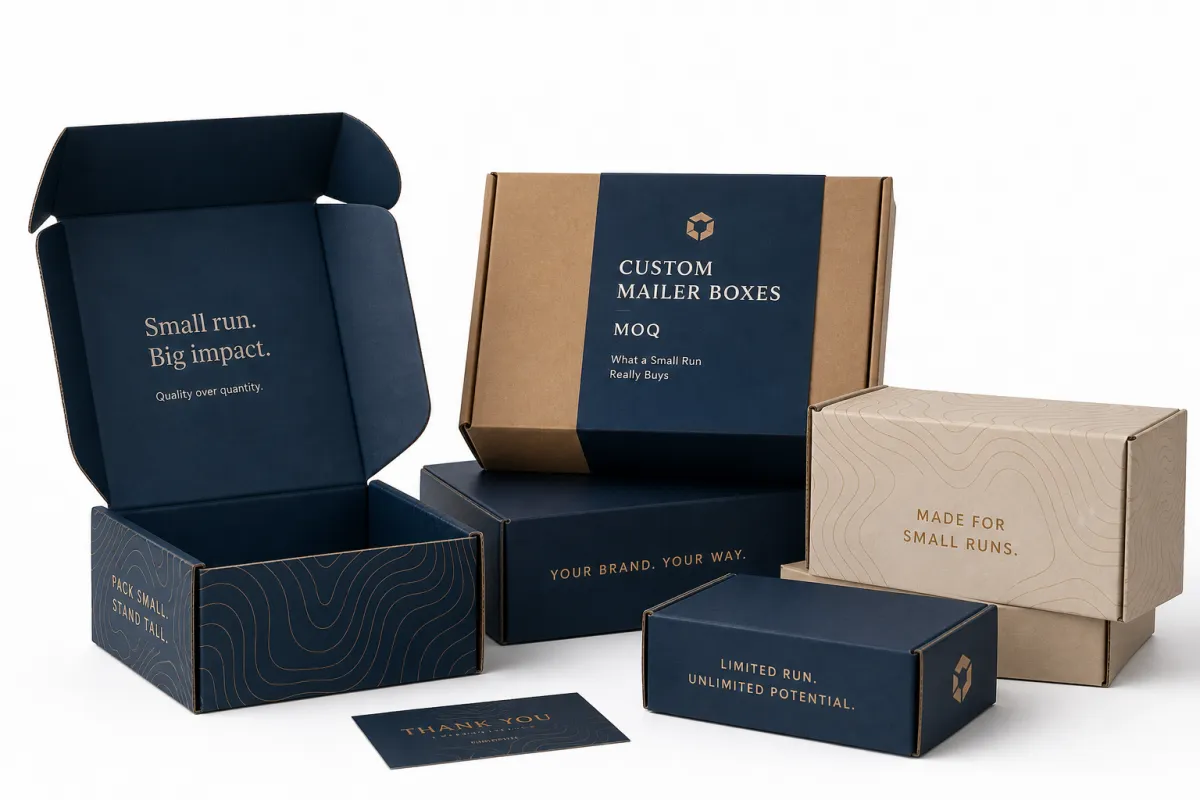
Custom Mailer Boxes moq is the smallest order a manufacturer will accept, but the number by itself does not tell you much. A factory sets a minimum because every job has setup work attached to it: tooling or die prep, sheet planning, print calibration, and line changeover. If the run is too small, those fixed steps get spread across too few boxes, and the unit cost climbs fast. A 250-piece run can feel absurdly expensive next to a 1,000-piece run, even when the box itself barely changes.
The value of a smaller MOQ shows up in real business situations. A startup launching a candle line does not need 5,000 printed shippers sitting in storage while the market decides whether the product is any good. A seasonal promo needs packaging for a short window, not a year-long commitment. Subscription brands often want a fresh look for one cycle, then tweak the next round after customer feedback comes in. In those cases, custom mailer boxes moq lowers inventory risk, and that matters just as much as the headline price.
The lowest-priced run is not always the order that protects margin. A box that is too loose, an insert that flexes, or print setup that wastes board can save a little on the invoice and cost more later through damaged product, extra void fill, or an unwanted reorder. That kind of “savings” is expensive in disguise.
The better move is to balance MOQ against shipping reality and brand presentation. I’ve seen brands spend an extra few cents per unit and save themselves from cracked glass, crushed corners, and a customer-service mess that eats the whole margin anyway. Not glamorous. Very effective.
Practical rule: the best small run is the one that fits the product cleanly, survives parcel handling, and does not force a second order before the launch has even had time to prove itself.
Before you request a quote for custom mailer boxes moq, have these details ready:
- Finished dimensions of the packed product, not just the product on its own.
- Approximate weight of each kit or item after inserts and accessories are added.
- Insert needs, such as corrugated retention, paperboard dividers, or no insert at all.
- Print coverage, including whether the outside, inside, or both need artwork.
- Ship-to destination, because freight can matter almost as much as the box price on short runs.
If you are still sorting out the broader packaging mix, our Custom Packaging Products page is a good place to compare structures before you lock in a format. If your order may be better served by lightweight shipping materials rather than rigid cartons, compare the job against Custom Poly Mailers early. That saves time and avoids pretending every product belongs in a box just because boxes look nicer.
Product Details: Mailer Box Styles, Inserts, and Print Options
Not every mailer behaves the same way in transit, and the style you choose changes both appearance and performance. A self-locking mailer with a roll-end tuck front, often used for ecommerce and subscription kits, gives a clean opening experience and decent stackability. A stronger roll-end tuck front style can handle more weight and usually keeps its shape better under carrier handling. For softer goods or lighter contents, a simpler mailer can do the job, especially if the branding is carrying most of the visual weight.
In practical terms, custom mailer boxes moq gives you room to match construction to use case. If the customer is opening a premium gift set, the box should feel deliberate in the hand and on the shelf. If the package is mostly a shipper, the design should focus on compression resistance, closure security, and efficient packing. Good packaging design is not decorative gymnastics. The box should do its job without wasting board or forcing filler into a job that should have been built around the product from the start.
Print options shape the final result as much as the structure does. A plain kraft exterior signals a natural, practical look and can fit a sustainability-minded brand. A white exterior gives ink more brightness and usually feels cleaner for retail packaging. Full-color exterior printing is the stronger choice when the box itself is part of the customer experience. Interior print adds a lift during unboxing, but it adds cost too, so it should have a purpose beyond looking busy in a mockup.
Insert design is where a lot of the useful decisions happen. A custom insert can stabilize fragile items, reduce motion inside the carton, and make the unboxing feel tighter. Common insert styles include:
- Die-cut corrugated inserts for bottles, jars, devices, or products that need firm retention.
- Paperboard partitions for sample kits, cosmetics, or multi-item assortments.
- Retention tabs and folds for simpler, lower-cost holds when the product shape is predictable.
- No insert when the item already packs tightly and the box is mainly protecting and presenting the contents.
That choice is one reason custom mailer boxes moq can feel oddly flexible. A clean box without an insert usually lands at a different price point than a built kit with custom die-cut retention. If you are building sampling programs, ecommerce starter packs, or retail-ready presentation sets, the right insert can raise perceived value fast. If the job is a low-margin replenishment item, a simpler structure may be the better call. Packaging does not get a prize for being complicated.
One useful way to think about the build:
| Mailer Style | Best Use | Visual Impact | Typical Cost Pressure |
|---|---|---|---|
| Kraft self-mailer | Natural brands, inner protection, simple ecommerce shipping | Moderate | Low to moderate |
| White exterior printed mailer | Bright graphics, retail packaging, premium feel | High | Moderate |
| Fully printed outside and inside | Subscription kits, influencer packs, premium unboxing | Very high | Higher |
| Mailer with die-cut insert | Fragile or multi-item product packaging | High | Moderate to higher |
Choosing the right version is less about chasing the fanciest spec and more about buying the structure that supports the product without creating waste. Good custom printed boxes do that job well, and a practical MOQ lets you test those choices before you commit to a bigger production calendar.
Specifications: Materials, Sizes, and Structural Choices
The material stack behind a mailer box sounds technical, but the logic is simple enough. Most shippers use corrugated board, and the flute profile matters because it affects stiffness, print surface behavior, and crush resistance. A single-wall structure can be enough for lightweight kits and retail packaging that will not take a rough trip. If the product is heavier or the box needs stronger stacking performance, a higher-grade board or thicker flute may be the right answer. The liner choice matters too, especially if you want a cleaner print face or a better recycled-content story.
Size selection should start with the product, not the box catalogue. Measure the longest side, the widest side, and the tallest point of the assembled item. Then add the clearance needed for inserts, tissue, bubble wrap, or protective space. Oversizing a mailer sounds harmless until freight costs rise, shipping efficiency drops, and the package starts looking lazy. A well-sized mailer is one of the easiest ways to improve product packaging without piling on cosmetic extras that do little for the customer.
custom mailer boxes moq also depends on how efficiently your size nests on the sheet. A smart dieline can improve yield, while an awkward dimension can waste board and push the unit cost up. Experienced packaging buyers ask for a dieline review before artwork is finalized for a reason. It is a lot easier to adjust the structure early than to learn, after the fact, that the box is fighting the carton layout or the print sheet.
Printing choices affect both appearance and production behavior. CMYK artwork is the usual route for full-color graphics, but spot colors can help if the brand depends on exact logo consistency or if the design uses a very simple palette. Inside print can create a strong unboxing moment, yet it also demands careful registration and more production attention. Coatings such as aqueous or soft-touch lamination change the feel and appearance of the package, but they also affect drying, scuff resistance, and lead time. Those details are worth discussing before you approve the final spec for custom mailer boxes moq.
For transit performance, think like a shipper rather than only a designer. Parcel networks subject packaging to compression, vibration, drops, and edge wear. If the box is meant to move through normal carrier handling, ask how the construction supports that duty. Industry groups such as ISTA focus on transport testing, and that mindset is useful even when you are not running a formal lab program. For fiber sourcing, many buyers ask for FSC documentation through FSC so brand claims do not wander into nonsense. You can also review packaging and waste guidance from the EPA if source reduction and recyclability matter to your program.
Structural choices that deserve attention include:
- Stacking strength if cases will sit on pallets before fulfillment.
- Crush resistance if the box will travel through parcel networks.
- Closure security if adhesive or locking tabs must hold under movement.
- Assembly speed if the packing team needs to build boxes quickly.
- Panel layout if logos, barcodes, or instructions must land in the right place.
These are not abstract concerns. A box that looks great in a mockup can still fail a live ship test if the board is too light, the insert is loose, or the closures do not hold. That is why custom mailer boxes moq should be discussed with the structure in mind, not just the artwork.
Custom Mailer Boxes MOQ: Pricing, Minimums, and Cost Drivers
The minimum order for custom mailer boxes moq is usually tied to setup time, die cutting, print changeovers, and sheet yield. Those are real production expenses, not random numbers pulled out of a hat. A factory may be able to handle smaller runs when the structure is simple, the artwork is efficient, and the press setup is straightforward. If the job needs multiple colors, a complex insert, or a specialty coating, the MOQ often rises because the line needs more time to run cleanly and profitably.
The biggest cost drivers are easy to spot once you know where to look:
- Box size, because larger cartons use more board and ship more expensively.
- Board grade, since heavier or stronger materials cost more.
- Print coverage, especially if the box is fully wrapped in color.
- Finish complexity, such as soft-touch, foil, or special coatings.
- Insert design, which can turn a simple mailer into a built kit.
- Freight to destination, which can become a major line item on bulky orders.
For buyers comparing custom mailer boxes moq at different quantities, ask for several quote bands. A request for 250, 500, and 1,000 units gives a clear picture of how much the unit cost drops as the run gets longer. That comparison shows the real breakpoints. Sometimes 500 units is the best balance of cash flow and per-box price. Sometimes jumping from 500 to 1,000 creates a big enough unit-cost drop to justify the storage space. The right answer depends on sell-through speed, not just the number printed on the quote.
| Quantity Band | Typical Use | Illustrative Unit Cost Trend | What Usually Happens |
|---|---|---|---|
| 250 units | Testing, samples, small promo runs | Highest, often around $1.35-$2.75 each depending on spec | Strong flexibility, limited economy of scale |
| 500 units | Early launch orders, short seasonal programs | Often around $0.95-$1.80 each | Better balance between MOQ and inventory risk |
| 1,000 units | Established SKU, recurring ecommerce orders | Often around $0.62-$1.25 each | More favorable sheet use and lower setup burden per box |
| 3,000+ units | Stable demand, repeat programs, broader rollouts | Often around $0.42-$0.90 each | Lowest unit cost, but higher inventory commitment |
Those numbers are only illustrative, because every spec changes the math. A plain kraft mailer with simple graphics lands very differently from a white, fully printed box with an insert and special finish. Freight can swing the picture too if the boxes are bulky. That is why a good quote for custom mailer boxes moq should spell out board, print, finish, insert details, and destination separately instead of burying them in one vague number and calling it a day.
There are also practical ways to lower cost without gutting the brand. Simplify the artwork so it uses fewer heavy ink areas. Standardize insert sizing across several SKUs. Avoid overbuilding the box if the product is light. Use dimensions that nest well on the sheet. If the goal is elegant branded packaging, the answer is not always more decoration; sometimes it is cleaner structure and sharper proportion. That sounds boring. It also saves money.
When buyers ask for custom mailer boxes moq, I usually tell them to think in tradeoffs: a modest unit price increase may be worth it if it removes a serious risk, but a complex spec should earn its cost through presentation or protection. Cheap packaging that damages goods is not cheap. Expensive packaging that helps the product arrive cleanly, present well, and sell faster can be the better commercial decision.
Process & Timeline: From Quote to Delivery
A clean process keeps custom mailer boxes moq from turning into a chain of avoidable delays. The best jobs follow a simple path: inquiry, quote, dieline review, artwork setup, proof approval, production, packing, and shipment. Each step has a job to do. The inquiry confirms size, quantity, and use case. The quote translates that into material and print choices. The dieline review checks that the design fits the structure. The proof locks in panel layout, logos, and any inside print. Production starts only after those pieces are approved. Miracles are not part of the schedule.
The details that speed up the job are usually the practical ones. Exact dimensions help the structural team avoid guesswork. Final artwork files reduce proof cycles. A clear ship-to ZIP code makes freight planning more accurate. If you need delivery by a specific launch date, say it early. That one detail can affect how the factory schedules your run and whether the order needs to be split between production and transit windows. For custom mailer boxes moq, clarity is worth more than urgency.
Common delays are predictable. Late changes to artwork can push back approval. A structural revision can require a new dieline. Specialty coatings may add drying or finishing time. Inserts often need their own confirmation because the fit has to be right. If the job includes a branded interior, the printer may need a more careful setup than a plain exterior run. These are normal production realities, not drama, but they do need to be managed.
One thing buyers sometimes miss is that production time and transit time are different. A run might take 12-15 business days after proof approval, yet freight can add several more days depending on destination and service level. That distinction matters for launch planning. If you are building a product release calendar around custom mailer boxes moq, budget time for both legs of the order. A box that ships on schedule but arrives late still misses the point.
A typical planning sequence looks like this:
- Confirm product dimensions, weight, and insert needs.
- Choose a box style and board grade that matches the shipment.
- Request a quote with a few quantity bands.
- Review the dieline and place artwork correctly.
- Approve the proof only after checking copy, colors, and panel placement.
- Allow for both production and freight time before inventory is needed.
If your order is still in a comparison stage, review the broader FAQ material on our FAQ page and line up the shipping format with the product itself. Not every item needs a rigid carton. Some lightweight goods are better suited to a mailer alternative, which is why a direct comparison with Custom Poly Mailers can be useful before you settle on the final packaging format.
Why Choose Us: Clear Specs, Honest MOQ Guidance, Next Steps
Good packaging support should do more than write up a quote. It should translate the brand goal into a manufacturable spec and tell you plainly where the tradeoffs sit. That matters with custom mailer boxes moq, where the wrong assumption about size, finish, or insert design can create needless cost or a package that looks fine on screen and falls apart in the real world. Practical guidance matters because the box has to function outside the presentation deck.
Most buyers want the same three things: a box that fits, a price that makes sense, and a schedule that can be trusted. A partner who works that way asks the right questions early. How heavy is the product? Does the contents need extra retention? Is the goal branded packaging for unboxing, or a tougher shipper for regular fulfillment? Will the box sit flat in the warehouse, or get packed immediately after delivery? Those details shape the answer more than a generic catalog ever could.
Here is the most useful next-step checklist for custom mailer boxes moq:
- Gather exact product dimensions and the packed weight.
- Decide on a quantity range, not just one number.
- Send artwork files or at least a clean logo and brand guide.
- Note insert requirements, if any.
- Provide the ship-to ZIP code and delivery deadline.
- Tell us whether the box is for ecommerce, retail packaging, sample kits, or a promo mailing.
That information helps narrow the spec quickly and keeps the quote useful. It also makes the production path smoother, because the structure, print, and freight can be aligned from the start. If you are comparing more than one solution, use Custom Packaging Products to see how different styles fit your product packaging strategy before you commit to a run.
For many buyers, the smartest move is to start with a tighter custom mailer boxes moq that validates the design, then scale into a larger repeat order once demand is clearer. That is disciplined buying, which is rare enough to deserve a mention. A small run gives you real feedback on shipping performance, how the graphics read in the hand, and whether the retail presentation matches the brand promise. When the next order comes, you can adjust with confidence instead of hope.
So if you are pricing out custom mailer boxes moq, send the dimensions, print goals, insert needs, and shipping destination together. The more complete the request, the better the recommendation will be. A good MOQ decision is not about chasing the lowest number on paper; it is about choosing the smallest run that still protects the product, supports the brand, and gives you room to learn from the first batch. That is the move that actually holds up.
What is a typical custom mailer boxes MOQ?
MOQ depends on size, board grade, and print method rather than one universal number. Smaller runs are possible when the structure is simple and the print setup is efficient. Ask for quantity bands so you can compare unit cost against cash flow and inventory needs, especially if your custom mailer boxes moq plan is tied to a launch or short promotional window.
Can I order custom mailer boxes MOQ with full-color printing?
Yes, but full-color coverage usually raises setup and production cost at lower quantities. Keep the artwork efficient by limiting unnecessary coverage, heavy ink builds, or complex special finishes. Request a proof so colors, logos, and panel placement are confirmed before production starts, because that is the cleanest way to protect a small custom mailer boxes moq run from avoidable changes.
How do I choose the right size for mailer boxes?
Measure the product, then add clearance for inserts, protection, and easy packing. Avoid oversizing, because extra empty space can increase freight cost and reduce shipping performance. If needed, request a sample or dieline check before approving the final spec so the box fits the product packaging plan instead of forcing the packing team to make it work later.
What affects the price the most at low quantities?
The main drivers are setup time, material thickness, print coverage, finishing, and insert complexity. Freight can matter more than expected when boxes are bulky or need to ship long distances. A clean structure with standard materials usually gives the best balance of cost and presentation, which is why a smart custom mailer boxes moq decision often starts with simplifying the box before adding decoration.
How long does production take after I approve the proof?
Production starts only after artwork and structure are approved, so fast proof feedback shortens the schedule. Simple builds move faster than jobs with custom inserts, coatings, or special print requirements. Plan for separate transit time once the order ships, especially for launch-sensitive inventory, because a smooth custom mailer boxes moq project still needs shipping time to land on schedule.

