Buyer Fit Snapshot
| Best fit | Custom Ecommerce Product Packaging projects where brand print, material claims, artwork control, MOQ, and repeat-order consistency need to be specified before quoting. |
|---|---|
| Quote inputs | Share finished size, material target, print colors, finish, packing count, annual reorder estimate, ship-to region, and any compliance wording. |
| Proofing check | Approve dieline scale, logo placement, barcode or warning zones, color tolerance, closure strength, and carton packing before bulk production. |
| Main risk | Vague material claims, crowded artwork, missing packing details, or unclear freight terms can make a low unit price expensive after revisions. |
Fast answer: Custom Ecommerce Product Packaging: Material, Print, Proofing, and Reorder Risk should be specified like a repeatable production item. The safest quote records material, print method, finish, artwork proof, packing count, and reorder notes in one written spec.
Production checks before approval
Compare the actual filled-product size with the drawing, then confirm tolerance on folds, seals, hang holes, label areas, and retail display edges. Reserve space for logos, QR codes, warning copy, and material claims before decorative graphics fill the panel.
Quote comparison points
Review material grade, print process, finish, sampling route, tooling charges, carton quantity, and freight assumptions side by side. A quote is only useful when the supplier can repeat the same color, closure quality, and packing count on the next order.
Custom Ecommerce Product Packaging: How to Plan It Right
A one-inch shift in custom ecommerce product packaging can push a parcel into a pricier shipping bracket, increase the chance of breakage, and change the first impression a customer forms in seconds. Packaging is not a decorative afterthought. It sits at the intersection of logistics, branding, and cost control, and it behaves like all three at once.
For a packing team, the difference between a smart structure and a poor one shows up fast. A box that is too large burns through cardboard, void fill, and freight dollars. A box that is too tight creates scuffs, crushed corners, and avoidable rework. The best custom ecommerce product packaging has to do three jobs together: protect the item, fit the fulfillment line, and make the brand look deliberate rather than improvised.
I have sat in enough packaging reviews to know the same mistake keeps repeating: teams fall in love with the render before they have tested the box. A sample can look elegant on a screen and still fail the moment a warehouse associate tries to pack it at speed. That is why many teams begin by reviewing Custom Packaging Products to narrow the practical format before they commit to artwork or tooling. Structure comes first. Decoration comes second. If the package cannot survive carrier handling or sit neatly on a warehouse table, no amount of print finish is gonna rescue it.
Think of custom ecommerce product packaging as a stack of functions, not a single box. It often includes the outer mailer or carton, an internal cushioning layer, inserts, seals, labels, and branded pieces such as tissue, cards, or a printed sleeve. Each layer does a different kind of work. Remove the wrong one and the package starts failing elsewhere, which is why custom ecommerce product packaging should be treated as a system from the start.
What Does Custom Ecommerce Product Packaging Cover?
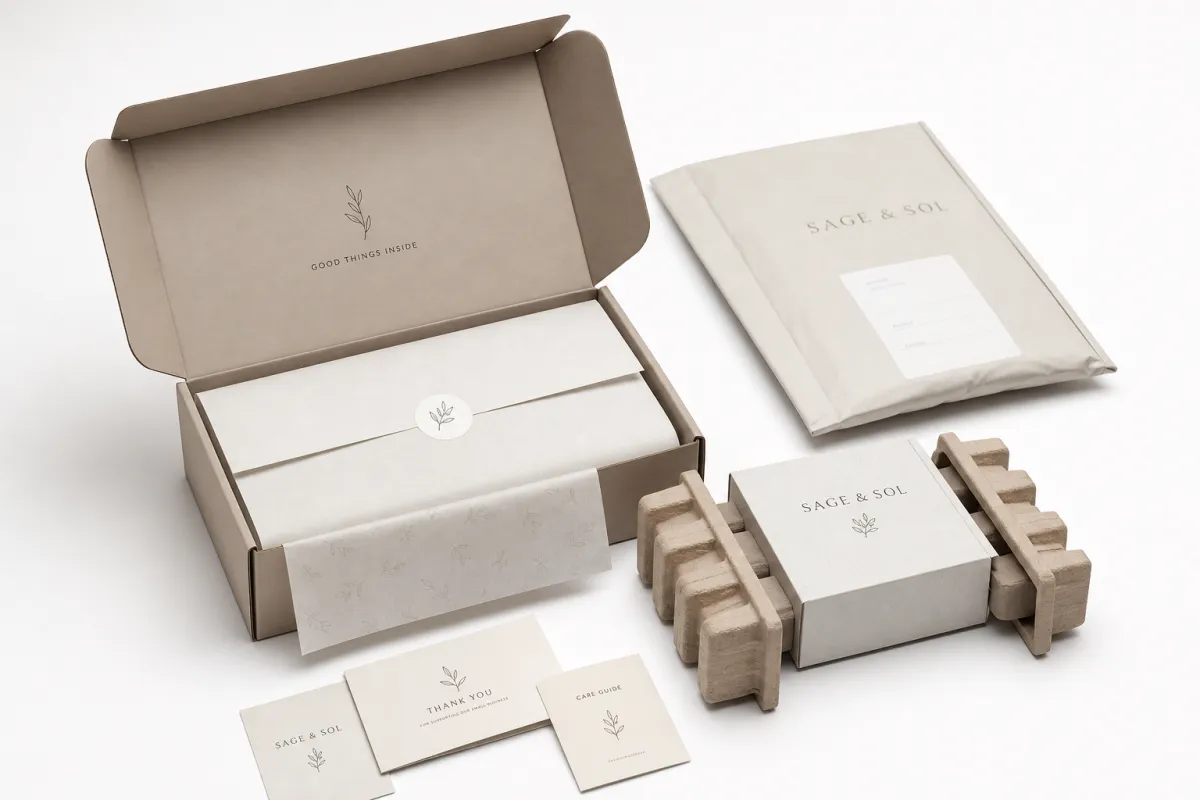
At its simplest, custom ecommerce product packaging covers everything a parcel needs between the shelf and the customer's hands. The phrase sounds broad because the job really is broad. The outer shipper might be a mailer, a folding carton, or a corrugated box. Inside that, you may need a paper insert, molded pulp tray, foam cradle, or a simple protective wrap. Around all of it, there may be tape, labels, tamper evidence, and branded messaging. Every component affects the others.
Ecommerce packaging behaves differently from retail packaging for a reason people often miss. Retail packaging usually fights for attention on a shelf. Ecommerce has a harsher assignment. It has to survive drops, vibration, compression, and humidity swings while still arriving with a tidy, intentional look. A package can be beautiful in a studio and fail in a parcel network. That is why custom ecommerce product packaging cannot be judged by appearance alone.
From a packaging buyer's point of view, the most valuable question is not "Does it look premium?" but "What happens after 14 miles of conveyor belts and one bad corner drop?" That is where good design earns its keep. A package that keeps a serum bottle from rattling or a candle from punching through the lid saves money in returns and customer service as much as it saves reputation.
Custom ecommerce product packaging also sends a brand signal customers notice almost instantly. If the box is oversized, flimsy, or difficult to open, the brand feels careless. If the structure is snug, the print is clean, and the first unboxing moment feels considered, the customer reads that as competence. That is not a soft metric. Repeat purchase behavior is shaped by small operational details far more often than teams like to admit.
Another useful way to frame custom ecommerce product packaging is as a contract between operations and marketing. Operations wants speed, consistency, and low damage rates. Marketing wants brand expression, shareable unboxing, and a clear story. Custom ecommerce product packaging is where those priorities meet. Better planning reduces compromise later, and in packaging, that matters more than polished language ever will.
One practical way to map the stack is this:
- Outer layer: mailer, folding carton, or corrugated shipper
- Protection layer: inserts, tissue, paper cushioning, molded pulp, or a bubble alternative
- Brand layer: print, sleeve, label, thank-you card, or interior message
- Control layer: seals, tear strips, tamper evidence, and SKU labels
The list looks simple. The decisions underneath it are not. Each line affects freight, labor, and the customer experience. If the package becomes too complex, packing slows down. If it is too minimal, damage rises. The sweet spot is usually a modest, well-fitted structure with enough branded packaging detail to feel deliberate without producing waste. That balance is the real work of custom ecommerce product packaging.
How Custom Ecommerce Product Packaging Works
The process starts with data, not color choices. Good custom ecommerce product packaging begins with product dimensions, weight, fragility, finish, leak risk, and order volume. A bottle with a matte coating behaves differently from a box of apparel. A glass diffuser behaves differently from a powder supplement. Even two items with the same footprint can require different structures if one has sharp corners or a high center of gravity. The strongest packaging teams get specific early.
After the product profile, the next question is fulfillment. Is the order packed by hand or on a semi-automated line? Does the parcel sit in a warehouse for a few hours or a few weeks? Does it ship in one region or across long zones? Those details matter because custom ecommerce product packaging is partly an operations design exercise. A package that looks compact on a mockup may be awkward to assemble 10,000 times. A package that saves six seconds per pack-out can matter more than an expensive print finish.
Structural choice usually follows from those inputs. A mailer suits lightweight goods and fast pack-out. A folding carton can work well for retail-style presentation inside an outer shipper. A rigid setup box may be justified for premium gifts or high-value items. Inserts can be paperboard, molded fiber, corrugated, or a more protective material if the item is fragile. The right answer depends on movement control, shipping cost, and the brand's tolerance for damage.
The prototype stage is where custom ecommerce product packaging stops being a concept and starts behaving like a real project. Teams review dielines, artwork proofs, sample builds, and fit checks with actual product units, not placeholders. That matters because an insert that seems fine in CAD may pinch a label, crush a cap, or slow down the packing line when an operator tries to use it. Small errors are expensive in packaging. A 2 mm tolerance issue can become a production headache. I have seen a box pass three rounds of internal approval and still fail because the bottle neck sat just a touch too high in the tray.
Testing should be practical, not theatrical. If the pack needs tape reinforcement, that should appear in the sample. If the lid pops open at a certain angle, it should be fixed before production. A simple sequence keeps the work grounded:
- Define the product and shipping profile.
- Choose the structure and insert style.
- Create a dieline and artwork layout.
- Build samples and fit-test the real SKU.
- Revise for protection, speed, and presentation.
- Approve the final structure and prepress files.
- Run production and verify the first cartons.
That timeline usually stretches longer than people expect once the structure changes. Artwork-only updates move faster, but structural updates need engineering time, sample review, and sometimes transit testing. For fragile goods, teams often compare sample performance against common transit protocols such as ISTA methods, especially when damage claims or carrier stress are part of the risk profile. A full test suite is not always necessary, but a recognized framework keeps the conversation grounded.
Custom ecommerce product packaging also continues after production approval. It includes kitting, storage, replenishment, and the handoff to fulfillment. If cartons arrive flat-packed but are awkward to store, the warehouse pays for that later. If the artwork file is approved but the print tolerance is loose, the brand pays for that later. The package only works when the full chain works.
The Key Factors That Shape Performance
The first factor is protection. A package must handle the product's weight, fragility, finish, and movement tolerance. A rigid cosmetic jar has a different risk profile from a soft garment or a liquid supplement. Custom ecommerce product packaging should be designed around the worst realistic transit condition, not the best-case scenario. That usually means checking corner crush, internal movement, and whether the product can survive a 3-foot drop without damage.
The second factor is branding. Customers still judge package branding the instant they open the box. There is a large difference between a blank brown shipper with a sticker and a thoughtfully branded package with interior print, a clean opening sequence, and a well-fitted insert. That does not mean every package needs expensive decoration. It means the visual story should match the brand promise. If the product is premium, the package should not feel generic. If the brand is minimal and utility-driven, the box should still feel intentional.
The third factor is fulfillment speed. Good custom ecommerce product packaging has to fit the labor model. Manual packing lines care about fold sequence, tape usage, part counts, and stackability. Semi-automated lines care even more about repeatability. If the structure requires too many touches, the cost rises. If the package can be assembled in one motion, the operation becomes more stable. That is one reason many companies prefer a simple folding carton with a well-designed insert over a more elaborate structure that looks better but packs slower.
The fourth factor is sustainability, but only if the claim is real. Teams should look at recyclable materials, material reduction, right-sizing, and the practical trade-offs between protection and waste. A package that uses less material but drives more damage is not a win. A package that adds a premium insert that cannot be recycled may be acceptable if the product value justifies it, but the decision should be explicit. For sourcing questions, FSC chain-of-custody standards provide a useful reference point for responsibly sourced fiber products, and their guidance is available at FSC.
The fifth factor is category expectation. Cosmetics, supplements, apparel, electronics, and gifts do not want the same thing. Apparel can tolerate a lighter, flatter structure. Electronics often need more internal stabilization. Gift items often need a more polished reveal. Supplements and liquids need leakage control. Custom ecommerce product packaging works best when the category's normal failure points are understood before the artwork gets locked.
Here is a useful comparison that shows how different formats tend to behave:
| Format | Best For | Typical Unit Cost Range | Strengths | Watchouts |
|---|---|---|---|---|
| Mailer box | Apparel, lightweight kits, sample sets | $0.55-$1.10 at 5,000 units | Fast pack-out, good print area, clean unboxing | Can become costly if oversized or heavily printed |
| Folding carton | Cosmetics, supplements, small consumer goods | $0.18-$0.42 at 10,000 units | Flexible graphics, efficient storage, strong shelf presence | Needs an outer shipper for many ecommerce use cases |
| Rigid setup box | Premium gifts, high-value items, launch kits | $1.75-$3.50 at 1,000 units | Premium feel, sturdy structure, strong package branding | Higher freight, storage, and labor cost |
| Printed corrugated shipper with insert | Fragile items, mixed-SKU bundles, subscription kits | $0.95-$2.25 at 3,000 units | Strong protection, flexible customization, good transit performance | Can become bulky if the insert is overbuilt |
Those numbers are directional, because print coverage, board grade, size, and quantity move pricing quickly. Still, the pattern is useful. Custom ecommerce product packaging is rarely a simple unit-price decision. It is a trade-off between protection, labor, freight, customer perception, and return rate. A lower unit cost can still be the wrong choice if it increases damage or slows pack-out.
"If the structure needs rescue tape, extra filler, and a second carton, the design is already too expensive."
That rule holds up in far more packaging reviews than people expect. The best package is usually the one that prevents extra handling. Better fit often beats more material. Better insert geometry often beats more void fill. Better planning beats a prettier box that arrives dented. A pretty box that fails in the mail is just expensive confetti.
Custom Ecommerce Product Packaging Pricing Explained
Pricing starts with material type. Paperboard, corrugated board, rigid chipboard, molded pulp, and specialty finishes do not sit in the same cost band. Custom ecommerce product packaging can move from economical to expensive very quickly if you add soft-touch lamination, foil, embossing, magnetic closures, or complex inserts. Even modest embellishments matter. A clean one-color print on a simple mailer is a very different cost structure from a full-coverage, multi-pass print job with a custom insert.
Quantity matters just as much. Short runs usually carry higher unit costs because setup is spread over fewer pieces. Tooling, die cuts, plates, and prepress work all need to be absorbed somewhere. That is why minimum order quantities can feel frustrating, but they are not arbitrary. The supplier is recovering setup time and production efficiency. Custom ecommerce product packaging with a 1,000-unit run will almost always cost more per piece than the same structure at 10,000 units.
The real budget conversation should include landed cost, not just unit price. Freight, storage, replacement inventory, spoilage, and the cost of a damaged shipment all belong in the equation. A box that looks cheap on the quote sheet can become expensive once dimensional weight charges and extra void fill enter the picture. Right-sizing is a hidden savings lever. A smaller carton or tighter insert can trim dimensional weight, reduce filler, and make the unboxing feel more refined at the same time.
That is where custom ecommerce product packaging starts paying back. If the package is sized to the real product, the carrier sees less wasted volume. The warehouse sees less dunnage. The customer sees a package that feels deliberate. Those gains are incremental, but across thousands of orders they add up quickly. In some programs, a half-inch reduction in each dimension changes the shipping bracket on a meaningful share of parcels, especially on long-zone deliveries.
To compare quotes properly, ask every supplier to price the same assumptions. That includes board grade, ink coverage, insert material, quantity, lead time, finishing, and whether the quote includes freight to one location or multiple fulfillment centers. If one quote includes a die, a sample set, and tape application while another excludes them, the lowest number is not the most useful number. Custom ecommerce product packaging should be compared on equivalent terms, or the decision will be distorted.
Use this checklist when reviewing proposals:
- Exact internal and external dimensions
- Board grade or material spec
- Print method and color count
- Finishing, coatings, and special effects
- Insert material and assembly method
- Quantity tiers and reprint thresholds
- Lead time from proof approval to shipment
- Freight terms and packaging for shipping the blanks
Another practical point: do not forget the cost of change. If the branding team updates artwork every few months, the package should be designed to absorb that rhythm. A structure that forces new tooling for every campaign can become an administrative burden. By contrast, a more flexible platform with changeable sleeves, labels, or inserts can keep custom ecommerce product packaging fresh without resetting the whole supply chain each time.
That is why a supplier conversation should feel more like an engineering review than a simple quote request. Ask how the package will be die-cut, how the inserts will be nested, how the blanks will ship, and how long replenishment usually takes. A strong proposal should make the actual workflow easy to picture. If it does not, the risk stays with the buyer later.
Step-by-Step Packaging Development Process
The best custom ecommerce product packaging programs begin with a hard look at the current system. Damage rates, return reasons, customer complaints, packing time, and freight spend all tell a story. If product breakage is low but labor is high, the structure may be too complex. If labor is fast but return rates are climbing, the package may not be protecting the item well enough. Start with facts, not assumptions.
After the audit, define the requirements. What should the package do? Protect a fragile item? Support a premium reveal? Reduce plastic? Pack faster? Fit one fulfillment node or several? A useful brief for custom ecommerce product packaging should name the product dimensions, acceptable movement inside the pack, brand goals, budget ceiling, and sustainability expectations. Without that brief, design conversations drift fast.
Next comes concept development. This is the stage where the team should sketch several structural options instead of locking onto the first idea. One option may favor speed. Another may favor lower freight cost. Another may create a better unboxing moment. A fourth may split the difference. Good packaging design is comparative work. You need a short list of structures before you make a final choice.
Sample early. Do not wait for perfection on paper. A physical sample shows more in one minute than a dozen meetings can show in an hour. Place the real product inside. Shake it. Drop it. Open it with gloves on if the warehouse uses gloves. Check whether the corners catch on the insert. Check whether the operator needs extra tape. That is how custom ecommerce product packaging becomes useful instead of theoretical.
For fragile items, testing should include both transit and handling. Many teams use a mix of internal drop tests and standard references, then compare results against what the carrier network actually does. A good packaging program does not need to be academic, but it should be disciplined. If the package is going through repeat shipments, compression and vibration deserve attention too. In simple terms, the package needs to survive what the box sees, not what the slide deck claims.
Once the structure is set, artwork moves into final approval. This is where many projects lose time. The print file needs to match the dieline, the barcode needs to scan, the warnings need to be legible, and any legal or recycling marks need to sit in the right place. If your team handles multiple SKUs, keep version control tight. One mislabeled file can create a warehouse headache that lasts for weeks. Custom ecommerce product packaging rewards careful prepress.
The production stage should include a clear quality checkpoint. Confirm the first run against the approved sample, inspect print accuracy, and verify that the fold lines, gluing, and cuts are correct. Do not assume the first shipment is fine because the file was approved. Ask for sample cartons from the run if the program is important. Then confirm the launch checklist with marketing, operations, and fulfillment before the packaging goes live.
There is also a strong case for rolling the system out in phases. Start with one high-volume SKU or one product family. Measure damage, pack time, and customer feedback. Then expand. A phased launch reduces risk and gives the team real learning before the full catalog is locked into the new standard. That kind of discipline is one of the strongest habits in custom ecommerce product packaging.
Common Mistakes to Avoid
The most common mistake is oversizing. A box that is only a little too large looks harmless, but it increases board usage, raises shipping cost, and often makes the brand look less thoughtful. Extra empty space can also allow the product to shift during transit. In custom ecommerce product packaging, a small dimensional mistake can create a surprisingly large financial penalty across thousands of shipments.
The second mistake is designing for the photo shoot and not the carrier network. A package can look wonderful on a styled table and still fail in transit. If the closure is weak, if the insert does not lock the item, or if the corners are exposed, the customer will discover the problem first. That usually means the returns department becomes the real test lab. A better rule is simple: if the package survives handling by people who do not know the product, it is probably on the right track.
Another error is skipping insert design. Inserts are easy to treat as an afterthought, but they control movement, orientation, and presentation. A poorly designed insert leads to rattle, abrasion, chipped edges, and customer complaints. In custom ecommerce product packaging, inserts often carry more functional weight than the outer print. They are the difference between a product that sits still and one that arrives looking like it had a rough trip.
Teams also underestimate storage and replenishment. A beautiful package that arrives in huge cartons, needs special handling, or fills up half the back room creates a hidden cost. If demand spikes and reorders are not planned, stockouts can hit right when marketing is working hardest. Packaging should never be treated as a one-time creative win. It is an inventory item, and inventory needs planning. That is especially true for custom ecommerce product packaging that supports launches, gifting, or seasonal demand.
Another issue is unclear communication with suppliers. If the board grade, print coverage, exact dimensions, or insert thickness are vague, the sample stage will drift. Then the production run will drift. Then the project manager ends up trying to fix a problem that started as a vague email attachment. A clear spec sheet solves more than people expect. Good suppliers can work quickly when the brief is clean.
Finally, some teams forget to test real-world feedback after launch. The first run should teach you something. Maybe customers love the print but struggle to open the lid. Maybe the box looks excellent but is too costly to store. Maybe the product sits perfectly but the branding feels too muted. Custom ecommerce product packaging improves fastest when the team treats launch as the beginning of the learning cycle, not the end of it.
Here is a short way to keep the biggest errors in view:
- Avoid oversized cartons and unnecessary void fill
- Avoid decorative choices that weaken the structure
- Avoid inserts that do not lock the product in place
- Avoid vague specs and unapproved artwork versions
- Avoid skipping storage, reorder, and replenishment planning
Expert Tips and Next Steps for Custom Ecommerce Product Packaging
If the goal is better performance with less guesswork, build a scorecard before you choose a structure. A simple matrix that weighs protection, cost, pack-out speed, sustainability, and brand impact will keep the discussion grounded. That approach works well for custom ecommerce product packaging because it forces trade-offs into the open. You may discover that a slightly more expensive box saves enough labor to justify itself, or that a less flashy insert performs better in transit.
Another useful habit is to request samples with the actual product weight inside. A mockup with no load can mislead even experienced teams. A sample with real weight shows whether the walls flex, whether the insert supports the item, and whether the opening feel matches the intended brand experience. For custom ecommerce product packaging, reality beats renderings every time.
It also helps to start small. Launch the new system on one high-volume SKU before rolling it across the full catalog. That gives operations a chance to learn the fold sequence, gives marketing a chance to review the customer response, and gives procurement a chance to confirm reorder timing. Once the process is stable, the rest of the rollout becomes easier. A pilot run is far less expensive than a full-scale mistake.
If you are preparing to request quotes, gather the essentials first: exact dimensions, weight, product photos, shipping zones, current damage rate, current pack-out time, sustainability priorities, and a shortlist of must-have features. If the team already knows the likely structure, review Custom Packaging Products and note which formats are closest to the fit you need. Better inputs make better proposals, and better proposals make better decisions.
A good brief for custom ecommerce product packaging should answer three questions clearly: What must the package protect? What must it cost? What must it say about the brand? Everything else is a detail, but those details are what turn packaging from a commodity into a competitive tool. The package is not only there to hold the product. It is there to carry the promise.
Before a final approval, ask one last operational question: will this be easier or harder to fulfill at scale? That simple question can prevent expensive surprises. If the answer is "harder," the design probably needs another round. If the answer is "easier," the brand is in good shape. That is the real test of custom ecommerce product packaging.
For teams looking to get the balance right, the next step is straightforward: document the product, define the risk, compare sample structures, and ask for quotes that include all the hidden costs. Then choose the option that protects the item, keeps pack-out moving, and fits the way your warehouse actually works. Done well, custom ecommerce product packaging reduces damage, controls freight, improves packing speed, and makes repeat purchases more likely. That is a strong return for a box that started as a simple shipping decision.
Frequently Asked Questions
How much does custom ecommerce product packaging usually cost?
Pricing depends on material, size, print complexity, inserts, and quantity, so unit cost can move a lot from one SKU to another. A simple folding carton may sit well under a dollar at scale, while a rigid premium box can climb into a few dollars per unit. Ask for both unit price and total landed cost, including freight, storage, and any setup or tooling fees. The cheapest quote is not always the lowest-cost option if it creates more damage, slower packing, or higher shipping charges. For custom ecommerce product packaging, the quote sheet is only part of the picture.
What is the typical timeline for custom ecommerce packaging?
A simple artwork-only update is usually faster than a new structural design that needs dielines, samples, and testing. In practice, a structural project often needs time for prototype review, internal approvals, and drop or transit testing, especially if the product is fragile. Many programs move in stages rather than one straight line. Ask suppliers for a stage-by-stage schedule so you can spot delays before they affect launch dates. That kind of visibility matters more than a vague "fast turnaround" promise, especially with custom ecommerce product packaging.
How do I choose the right size for custom ecommerce product packaging?
Start with the product's exact dimensions, then allow only the space needed for protection and easy packing. The smallest package that still protects the item is usually the best option, provided the pack-out process stays efficient. Right-sizing can cut dimensional weight charges and make the unboxing feel more polished. If the package needs inserts, account for their thickness early so the fit is not lost in the final stage. That is one of the most reliable ways to improve custom ecommerce product packaging.
Can custom ecommerce product packaging be both branded and sustainable?
Yes, but the strongest results usually come from reducing material first, then choosing recyclable or responsibly sourced options. Branding can live in print, structure, inserts, and messaging without adding unnecessary layers. A well-designed branded package does not need to be wasteful to feel premium. The key is balancing presentation with real-world shipping performance and waste reduction, rather than treating those goals as opposites. In practice, good custom ecommerce product packaging often does both jobs at once.
What should I test before launching custom ecommerce packaging?
Test fit, drop resistance, compression, and how the package behaves under normal fulfillment handling. Check whether the packaging slows down packing labor or creates confusion on the warehouse floor. Review customer feedback on unboxing, damage, and returns after the first production run so you can improve quickly. If the package is part of a subscription or replenishment model, include repeat-use conditions in the test plan too. Those checks keep custom ecommerce product packaging honest once it reaches the real world.

