Buyer Fit Snapshot
| Best fit | Custom Edge Protectors Wholesale for Safer Shipments projects where brand print, material claims, artwork control, MOQ, and repeat-order consistency need to be specified before quoting. |
|---|---|
| Quote inputs | Share finished size, material target, print colors, finish, packing count, annual reorder estimate, ship-to region, and any compliance wording. |
| Proofing check | Approve dieline scale, logo placement, barcode or warning zones, color tolerance, closure strength, and carton packing before bulk production. |
| Main risk | Vague material claims, crowded artwork, missing packing details, or unclear freight terms can make a low unit price expensive after revisions. |
Fast answer: Custom Edge Protectors Wholesale for Safer Shipments should be specified like a repeatable production item. The safest quote records material, print method, finish, artwork proof, packing count, and reorder notes in one written spec.
Production checks before approval
Compare the actual filled-product size with the drawing, then confirm tolerance on folds, seals, hang holes, label areas, and retail display edges. Reserve space for logos, QR codes, warning copy, and material claims before decorative graphics fill the panel.
Quote comparison points
Review material grade, print process, finish, sampling route, tooling charges, carton quantity, and freight assumptions side by side. A quote is only useful when the supplier can repeat the same color, closure quality, and packing count on the next order.
A pallet rarely gives up in the middle. It usually fails at the edge, where strap tension, stacking pressure, and forklift contact all hit the same weak line. That is exactly why custom edge protectors wholesale matters for distributors, manufacturers, and brands shipping the same SKU week after week. One bad corner can turn into claims, rework, or a rejected load. And nobody in shipping needs more drama.
At Custom Logo Things, the business case stays pretty plain: protect the edge, protect the shipment, and keep the packaging system consistent. custom edge protectors wholesale is not about tossing more material at a problem and hoping it behaves. It is about reducing damage without rebuilding the whole pallet, carton, or product packaging flow from scratch. That part matters more than the sales copy ever will.
Custom Edge Protectors Wholesale: Why Damage Starts at the Edge
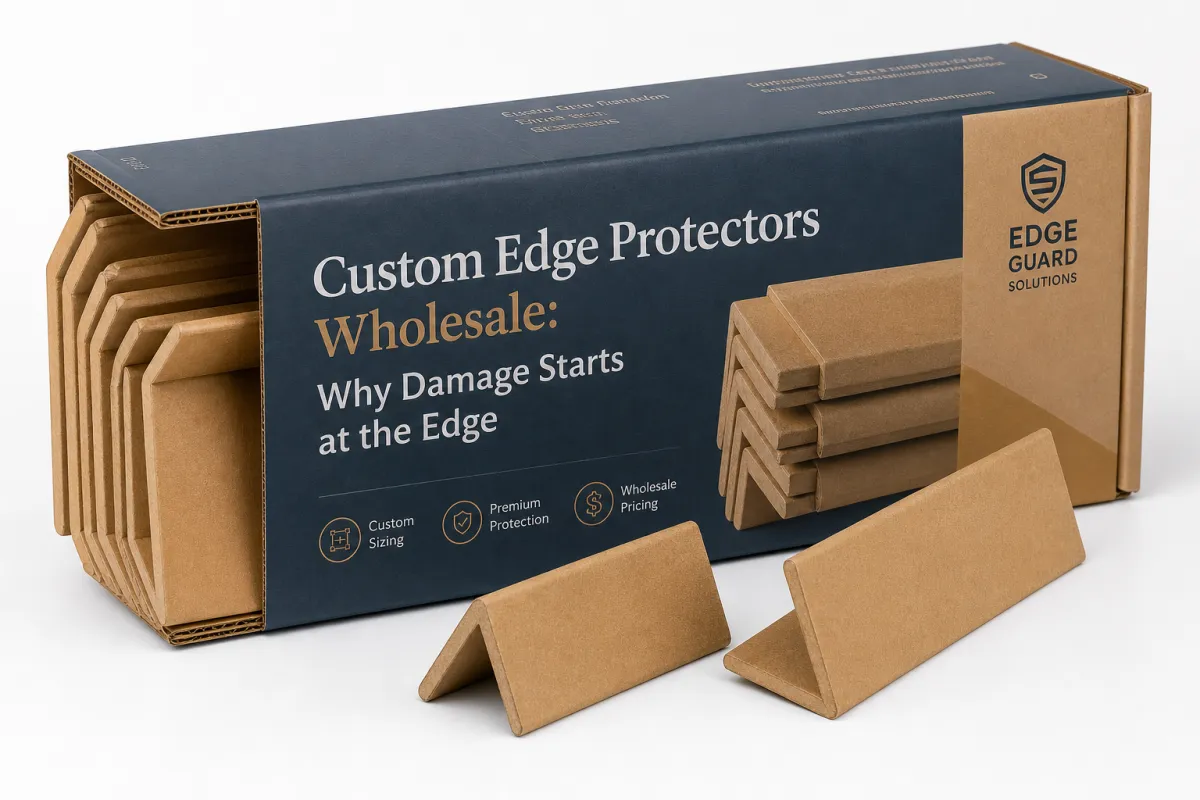
Most shipping damage does not begin with a dramatic crash. It starts with pressure that looks harmless until it repeats across a full truckload. A strap bites into a carton stack. A top layer shifts under compression. A forklift tine clips one corner during staging. The edge takes the abuse first, which is why custom edge protectors wholesale has become a practical choice for buyers who want fewer surprises in transit.
The failure chain is easy to follow once you have seen it a few times. A small corner split spreads through a pallet stack, loosens stretch wrap, and lets the load lean. Once that starts, the rest of the unit loses structure fast. I have watched a load of clean, expensive parts get rejected over a single crushed corner because the edge board was too light for the strap tension. That kind of mistake costs more than the protector ever did. Procurement teams know that story well. It is never just the corner.
Wholesale purchasing matters because most companies do not ship once and walk away. They ship in cycles. They move product between warehouses. They need the same dimensions, the same compression behavior, and the same branding standard every time. custom edge protectors wholesale makes sense for repeat shipments because consistency is where the savings show up. A one-off fix might save one pallet. A repeatable spec helps every pallet after that.
If the edge fails, the pallet usually fails with it.
Edge protection also belongs in the full packaging system, alongside strapping, wrap, carton design, and Custom Printed Boxes. When those pieces work together, the load stays intact longer. When they do not, the strongest film in the building will not save a crushed corner from spreading damage through the stack. Wishful thinking is not a packing method. It is just a fast way to pay for mistakes twice.
There is also a branding angle that gets ignored far too often. Clean, intact shipments make branded packaging and package branding look intentional instead of improvised. Bent corners, torn outer layers, and crushed edges drag down the impression before anyone opens the box. For companies that care about retail packaging presentation or installation-ready freight, custom edge protectors wholesale quietly protects the customer experience before the first flap is lifted.
For buyers who want to understand how edge protection fits into a larger sourcing strategy, our Wholesale Programs page is a useful starting point. It separates repeat-order products from one-time packaging experiments, and that distinction matters. The economics of custom edge protectors wholesale get much better when the spec stays fixed and the reorder pattern stays predictable.
Custom Edge Protectors Wholesale Product Types and Uses
Buyers usually ask about four formats first. The standard L-shaped edge protector covers exposed corners on cartons, palletized goods, and sheeted materials. The U-channel protector wraps farther around the edge where more contact support is needed or where a board edge has to sit under strap pressure. The heavy-duty corner board is built for stronger compression and longer shipping lanes. The laminated option adds strength and moisture resistance for rougher handling.
custom edge protectors wholesale matters because stock sizes do not fit every product line. Standard lengths can leave a gap at the end of a panel, create overhang on a shorter box, or interfere with automatic strapping equipment. Custom sizing fixes that. A proper fit sits tight against the edge, supports the load, and works with stretch wrap instead of fighting it. Small difference on paper. Very obvious on the dock.
Use case matters more than the label on the spec sheet. Cartons with moderate stacking pressure often do well with lighter paperboard protectors. Sheet goods, door panels, cabinets, and furniture parts usually need a stronger profile because the load edge carries weight across a longer span. Appliances and metal parts often need a spec that tolerates tighter straps and sharper handling zones. Construction materials can need both edge buffering and stronger moisture resistance. custom edge protectors wholesale gives buyers room to match the build to the freight.
The practical filter is simple. Define the load shape, the handling method, and the compression the shipment will face. A hand-loaded pallet needs a protector that is easy to place and hard to misalign. An automated line needs dimensions tight enough for machine application. A stack sitting in a warehouse before dispatch needs compression resistance more than anything else. That is the kind of thinking that keeps custom edge protectors wholesale from turning into another line item no one really owns.
For buyers sourcing multiple packaging categories, it helps to compare protector specs alongside Custom Packaging Products. Edge boards, cartons, and branded inserts should not be ordered in separate silos. When the whole system is aligned, product packaging gets easier to standardize and faster to replenish. That matters even more for brands balancing retail packaging presentation with industrial shipping demands.
Think of the edge protector as a structural accessory, not a decorative add-on. In a well-built package branding system, the protector has one job: keep force away from the vulnerable edge so the rest of the package can do its job. That applies whether the shipment is one boxed item or a full pallet of components. custom edge protectors wholesale supports that discipline by giving operations teams one consistent spec to buy, stock, and reorder.
Materials, Strength, and Specification Details
Spec sheets matter here. Buyers should ask for leg length, thickness, board grade, length tolerance, moisture resistance, and any print or branding options up front. Those details decide how the protector fits, how it bends, and how much pressure it can carry before it deforms. custom edge protectors wholesale should never be quoted like every corner board is the same, because light board and reinforced laminated board behave very differently under load.
Recycled paperboard is often the most economical choice for everyday shipments. It works well for cartons, retail packaging, and lower-risk pallet loads. Heavier goods usually push buyers toward thicker board or laminated constructions that raise compression strength. A light-duty protector might sit around 2 mm to 3 mm thickness, while heavier builds may run from 4 mm to 6 mm or higher depending on load and strap tension. custom edge protectors wholesale works best when the board construction matches the actual freight stress, not a guess made from across the conference table.
Moisture is the variable that gets underestimated until a load sits in a humid dock for two days and the board starts acting like tired cardboard. Export lanes, cold storage, and long warehouse dwell times all change how paperboard performs. A protector that looks fine in a dry staging area may lose stiffness after exposure to humidity. If the shipment moves through a wet dock, ocean freight, or a refrigerated environment, ask whether the material includes treatment or lamination. Buyers shipping by export route should also ask for test data or sample sheets before placing a larger custom edge protectors wholesale order.
Standards help keep the conversation grounded. Transit testing aligned with ISTA methods gives buyers a way to think about vibration, compression, and handling risk in a more disciplined way. Material sourcing can matter too. If a program uses FSC-certified paperboard, that can support sustainability claims and procurement requirements without changing the basic function of the protector. For broader packaging context, packaging.org offers useful industry perspective on materials and supply chain expectations.
The rule is simple: the harsher the lane, the tighter the spec needs to be. Long-haul freight, stacked warehouse storage, export shipments, and strap-heavy unitization all push the protector differently. A board that works for local pallet movement may fail on a cross-country route. That is why experienced buyers treat custom edge protectors wholesale as a technical purchase, not a commodity buy with a nice-looking quote attached.
- For cartons: focus on fit, low waste, and clean application with wrap.
- For sheet goods: prioritize compression resistance and edge coverage.
- For pallets: make sure the protector supports strap tension without splitting.
- For branded shipments: ask about print quality, logo placement, and inside-facing branding.
If the goal includes branded packaging or package branding, printing can be added without turning the protector into a billboard. Logos, handling instructions, part numbers, and warehouse codes all have a place. Keep the print spec aligned with the load purpose, though. A corner board is still a structural item first. custom edge protectors wholesale works best when branding helps operations instead of distracting from them.
Custom Edge Protectors Wholesale Pricing, MOQ, and Total Cost
Price is usually the first number buyers ask for, but it should not be the only number they compare. In custom edge protectors wholesale, the quote usually shifts based on material grade, dimensions, custom print, order volume, and packing format. Wider legs, thicker board, and laminated finishes raise unit cost. Special die cutting does too. So do tighter tolerances and branded artwork. Order quantity matters because setup cost gets spread across the run.
Minimum order quantity, or MOQ, makes more sense once you look at production efficiency. Cutting time, setup time, packing labor, and carton or pallet configuration all shape the floor. For many custom programs, MOQ can start in the low thousands and move up or down depending on size and construction. For repeated custom edge protectors wholesale orders, higher volume usually unlocks better pricing and smoother replenishment because the supplier can run longer batches with fewer interruptions.
The bigger issue is total cost. A lower unit price does not always win if the protectors fail more often, slow the packing line, or force manual rework. Damage reduction, fewer claims, less repack labor, and stronger load stability can change the equation fast. From a procurement point of view, the smartest way to evaluate custom edge protectors wholesale is to compare cost per shipped unit, not just the invoice line.
| Option | Typical Use | Indicative Unit Price | Strength Profile |
|---|---|---|---|
| Light paperboard edge protector | Cartons, retail packaging, light pallet loads | $0.10-$0.18 at 5,000 pieces | Good for moderate handling and low compression |
| Reinforced recycled board protector | General freight, boxed goods, mixed product packaging | $0.18-$0.32 at 5,000 pieces | Balanced option for everyday shipping pressure |
| Laminated heavy-duty corner board | Sheet goods, appliances, export lanes | $0.30-$0.55 at 5,000 pieces | Higher compression resistance and better edge control |
| Printed or branded protector | Package branding, internal codes, handling marks | $0.24-$0.48 at 5,000 pieces | Depends on board grade and print coverage |
Those numbers are directional, not universal. A narrow protector in a high-volume run can cost less than a broad laminated board in a short run. Print coverage matters. Freight packing format matters. Even how the pieces are boxed or palletized can shift cost. That is why buyers should ask for quotes on identical specs before comparing suppliers. custom edge protectors wholesale is much easier to evaluate when every supplier is bidding on the same dimensions, same board grade, and same carton count.
A useful quote request includes three things: exact dimensions, target quantity, and expected monthly usage. If you have a recurring order pattern, say so. If the protectors must fit a certain strap width or wrap schedule, mention that too. When the supplier sees the full use case, the price tends to get more accurate and the sample stage gets shorter. That is the practical advantage of treating custom edge protectors wholesale like a production spec instead of a rough sketch on a spreadsheet.
Order Process, Sampling, and Lead Times
The order process should be simple if the supplier is set up correctly. Start by sending dimensions, load photos, product weight or board weight if relevant, shipping method, and any special requirements such as hand application or automation. Then confirm the material, review the quote, approve a sample, and move into production. For custom edge protectors wholesale, clean input is the fastest path to a usable result. Vague input usually creates revisions, and revisions burn time.
Clear drawings help a lot. So do photos of the load in context. A protector that looks fine on paper can end up too long for a carton stack, too short for a panel edge, or too stiff for the operator to place quickly. If the shipment will face stretch wrap, straps, or both, say that up front. If the protectors need to work on an existing line, that matters too. custom edge protectors wholesale is often won or lost on fit, not price.
Sampling is where good procurement saves money. Ask for a sample run before full production, especially for fragile, high-value, or export shipments. A sample tells you whether the protector sits flush, whether the board springs back too much, and whether the edges resist crush under the load you actually ship. It also shows whether the branding, if any, sits in the right place. A sample is gonna tell you more than a glossy spec sheet ever will. I have seen buyers skip this step and pay for it later in rework. The sample stage is small. The downstream cost of a bad fit is not.
Lead times should be broken into stages. Sampling may take a few business days. Setup may add another slice of time if the dimensions or print need adjustment. Production then depends on order size and the current queue. Delivery adds transit and packing time. A realistic timeline for many custom edge protectors wholesale orders is often 10-20 business days from approved spec to ship date, with samples sometimes faster if the construction is standard and materials are available. Rush options may exist, but only when the spec is already locked and stock material is on hand.
One procurement detail gets missed all the time: ask for both the earliest ship date and the full timeline. The first number is production-only. The second includes packing and transit. If your warehouse closes early on Fridays or your receiving dock has limited hours, that difference matters. custom edge protectors wholesale should support the schedule you actually run, not the schedule that looks best in an email subject line.
- Send exact dimensions and target quantity.
- Include load photos and shipping method.
- Confirm whether the protectors will be hand-applied or machine-applied.
- Request a sample or prototype before full production.
- Compare earliest ship date and full delivery timeline.
Why Buyers Choose Our Custom Edge Protectors Wholesale Program
Wholesale buyers do not pay for novelty. They pay for consistency. That is the main reason teams return to a supplier that delivers repeatable sizing, stable quality, and replenishment they can trust. Our custom edge protectors wholesale program is built around that reality. The goal is not to sell a clever corner board once. The goal is to support ongoing shipping programs where the protector performs the same way on batch after batch.
Operations teams also care about speed of response. Fast quoting, practical design support, and clear communication on specs and lead times reduce friction. If a buyer needs a protector that works with strapping, stretch wrap, or a particular pallet layout, the conversation should be direct. The better the fit at the start, the fewer surprises later. That matters even more for companies handling multiple sites or juggling both product packaging and industrial freight from the same procurement team.
Consistency matters more than flash because packaging failures rarely explode in one dramatic moment. They pile up. A loose fit here. A split edge there. A board that varies just enough from lot to lot that operators notice. Over time, those small deviations turn into labor waste and quality complaints. custom edge protectors wholesale protects against that drift by keeping the construction, cut, and fit stable across reorders.
What should buyers look for in a supplier? Experience with industrial freight is one sign. Another is the ability to talk about measurable packaging performance instead of vague quality language. A useful supplier can discuss compression behavior, fit tolerance, board grade, and the handling conditions the protector is meant to survive. That is the difference between a packaging vendor and a packaging partner. custom edge protectors wholesale deserves the second kind of conversation.
It helps when the supplier understands how edge protectors sit inside a larger branding and packaging system. If your company uses custom printed boxes, retail packaging inserts, or branded packaging across channels, the edge protector should complement that structure rather than fight it. A clean, well-sized protector can carry internal codes, handling notes, or discreet branding while still doing the main job: protecting the edge.
For teams that want a broader view of sourcing options, the same approach applies across Custom Packaging Products. Buyers managing multiple package formats usually get the best results when they standardize specs and reorder rules together. That is where custom edge protectors wholesale becomes part of an efficient procurement routine instead of an isolated purchase.
Custom Edge Protectors Wholesale: Next Steps to Order
If you are ready to quote, start with the basics: measure the edge length, note the board or product weight, identify the shipping method, and confirm whether the protector needs to work with straps, stretch wrap, or both. That short list gives the supplier enough information to recommend the right construction. It also keeps the first quote tied to the actual use case. custom edge protectors wholesale works best when the buyer specifies the lane, not just the size.
Next, request pricing against exact dimensions and expected monthly usage. If you ship the same product line every month, say so. If the order is a one-time export run, say that too. Volume changes the economics, and so does the chance of repeat replenishment. A buyer who shares realistic usage data usually gets a more useful proposal than a buyer asking for a generic estimate. That is especially true when the quotation includes print, special board treatment, or mixed pack configurations.
Order a sample run before you commit to a larger wholesale order, especially if the goods are fragile, high-value, or heading overseas. One sample can tell you whether the protector loads cleanly, whether the dimensions are right, and whether the board resists crush under real handling. For many teams, that one test saves a lot of expensive guessing. custom edge protectors wholesale is a low-friction way to reduce damage, but only if the spec is verified before volume starts.
There is a broader payoff too. Better edge protection can make the whole freight system easier to manage. Fewer claims. Less repack labor. More predictable receiving. Cleaner presentation at the end customer. When a shipment arrives intact, the rest of the packaging system gets to do its job. That is why this product category keeps showing up in purchasing reviews, not because it is flashy, but because it saves time and money without making a scene.
For brands balancing package branding with shipping protection, that efficiency matters even more. The load still has to survive the dock, but it also has to look intentional when the customer opens it. In that sense, custom edge protectors wholesale supports both logistics and presentation, which is a rare combination in packaging.
If your team is comparing options now, the next move is simple: gather measurements, define the shipping lane, and ask for samples. With the right data, custom edge protectors wholesale becomes a controlled purchasing decision instead of a reactive fix. That is the difference between absorbing damage and preventing it.
What sizes are available for custom edge protectors wholesale?
Sizes are usually built around your product edge length, board thickness, and required leg height. Custom sizing helps avoid overhang, loose fit, or interference with strapping and wrap. In most programs, custom edge protectors wholesale can be matched to cartons, panels, pallet corners, and mixed freight shapes without forcing the load into a stock dimension.
How do I choose the right material for custom edge protectors wholesale?
Match the material to shipment weight, stacking pressure, and transit distance. Heavier loads usually need stronger laminated or thicker board constructions. If the freight crosses humid lanes or export routes, ask whether moisture resistance is part of the spec. That one detail can make custom edge protectors wholesale perform much better in the field.
What is the typical MOQ for custom edge protectors wholesale orders?
MOQ depends on size, material, print requirements, and production setup. Higher-volume repeat orders usually qualify for better pricing and smoother replenishment. For many buyers, the real question is not the absolute MOQ; it is whether the run size matches their reorder pattern. That is where custom edge protectors wholesale becomes easier to manage over time.
How long does production usually take for custom edge protectors wholesale?
Lead time depends on sampling, approval, order size, and current production queue. Rush timelines are sometimes possible if specs are confirmed and materials are in stock. A practical plan is to allow time for sample approval first, then production, then transit. That staged approach keeps custom edge protectors wholesale aligned with warehouse schedules.
Can custom edge protectors wholesale be printed or branded?
Yes, many buyers add logos, handling instructions, or internal item codes. Branding is useful when the protectors move through multiple warehouses or contractors. It can also support package branding on the outer shipment without interfering with the structure of the board. For that reason, custom edge protectors wholesale often fits neatly into broader branded packaging programs.
For repeat shipments, custom edge protectors wholesale works best when the buyer locks the dimensions, matches the board to the lane, and approves a sample before volume starts. That is the practical move. Everything else is just noise.

