Buyer Fit Snapshot
| Best fit | Custom Embossed Boxes Wholesale projects where brand print, material claims, artwork control, MOQ, and repeat-order consistency need to be specified before quoting. |
|---|---|
| Quote inputs | Share finished size, material target, print colors, finish, packing count, annual reorder estimate, ship-to region, and any compliance wording. |
| Proofing check | Approve dieline scale, logo placement, barcode or warning zones, color tolerance, closure strength, and carton packing before bulk production. |
| Main risk | Vague material claims, crowded artwork, missing packing details, or unclear freight terms can make a low unit price expensive after revisions. |
Fast answer: Custom Embossed Boxes Wholesale: Premium Packaging should be specified like a repeatable production item. The safest quote records material, print method, finish, artwork proof, packing count, and reorder notes in one written spec.
Production checks before approval
Compare the actual filled-product size with the drawing, then confirm tolerance on folds, seals, hang holes, label areas, and retail display edges. Reserve space for logos, QR codes, warning copy, and material claims before decorative graphics fill the panel.
Quote comparison points
Review material grade, print process, finish, sampling route, tooling charges, carton quantity, and freight assumptions side by side. A quote is only useful when the supplier can repeat the same color, closure quality, and packing count on the next order.
Custom Embossed Boxes Wholesale: Premium Packaging can lift shelf value before a shopper reads a single line of copy. That matters more than most buyers expect, because a raised mark changes how a carton feels in the hand, and feel is often the first sales signal.
For a packaging buyer, flat print and embossing do not play the same role. One relies on ink and layout, while the other uses depth, touch, and shadow to change how the package reads in the hand. That difference affects perceived price, retail packaging performance, and how quickly a brand starts to feel premium in a crowded category. Custom embossed boxes wholesale gives you that tactile edge at scale without loading the design with extra graphics, heavy foil, or unnecessary ornament.
The commercial logic is straightforward. A raised logo can make the same structure feel refined instead of routine, and a clean emboss often does more for package branding than a louder layout ever could. The rest of this piece breaks down what to compare before you place a wholesale order: structure, stock, die depth, finish compatibility, unit cost, tooling, and lead time. I have stood through enough press checks to know this part matters; when the board, die, and finish are in sync, the sample looks calm and expensive, and when they are not, it kinda announces the problem right away.
"If the emboss is doing its job, the customer notices the pack before they consciously decode the logo."
Why Custom Embossed Boxes Wholesale Outperform Flat Print
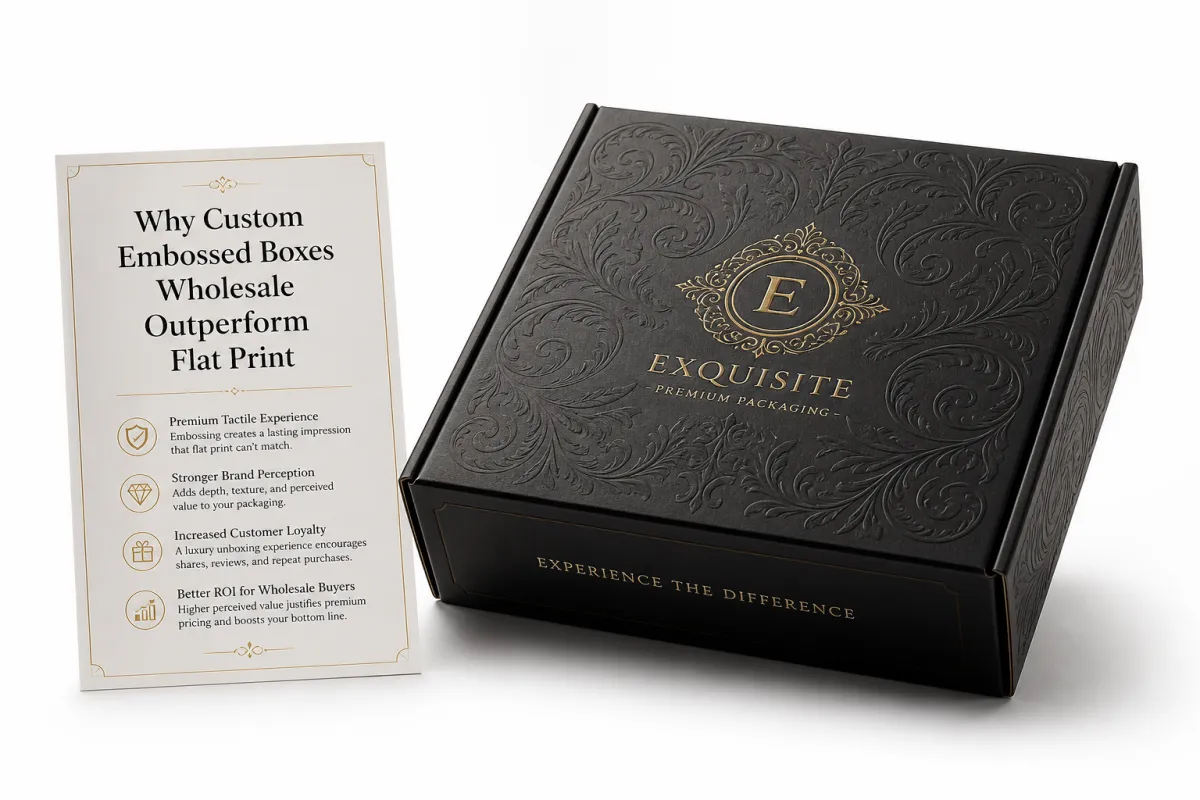
Custom embossed boxes wholesale outperform flat print because texture creates immediate contrast. In a retail aisle, the eye has to do work. In e-commerce, the hand does the work during unboxing. A raised mark interrupts that routine. It turns a normal carton into a small physical event, and that is why embossed packaging shows up so often in branded packaging for cosmetics, specialty food, wellness, and giftable consumer goods.
The real advantage is not only visual. Embossing adds a second layer of communication. A flat logo says the brand is there. An embossed logo says the brand is worth touching. That distinction sounds subtle, but buyers feel it fast. Two boxes can share the same dimensions, the same print file, and the same insert. One looks like standard product packaging. The other reads as premium because the surface tells a different story.
There is also a practical sales reason to consider custom embossed boxes wholesale instead of stacking on more color or heavier graphics. More print coverage can raise ink costs, complicate proofing, and make registration harder on some substrates. Embossing lets the structure do part of the work. That is useful when you want a clean front panel, a stronger gift appeal, or a more elevated shelf stance without moving into expensive multi-effect decoration.
From a packaging design point of view, embossing works best when the hierarchy stays disciplined. One focal point. One crisp raised mark. Maybe a secondary pattern if the layout can carry it. Push too much into the same space and the result loses clarity. That is where many buyers go wrong with custom embossed boxes wholesale: they try to make the box do everything at once, then wonder why the effect feels muddy instead of premium.
For brands comparing Custom Packaging Products, the sharper question is not "Can we emboss this?" It is "What does embossing change in the customer's mind?" If the answer is stronger recall, better gifting appeal, or a cleaner price-positioning story, the economics usually make sense. If the effect is being added just to fill space, the spend is harder to defend.
That is especially true in wholesale. The per-unit cost of custom embossed boxes wholesale falls as volume rises, while the perceived value can stay high across every piece in the run. The spread between cost and value is where the margin story lives.
Custom Embossed Boxes Wholesale: Product Details That Matter
Not every structure handles embossing the same way. Custom embossed boxes wholesale can cover tuck boxes, folding cartons, rigid boxes, mailer boxes, and product sleeves, but each format behaves differently under pressure. Folding cartons usually deliver crisp detail on logos, seal marks, and short phrases. Rigid boxes can support deeper, more luxurious impressions because the board is stiffer. Sleeves work well when you want a tactile accent without changing the whole package.
Blind emboss, registered emboss, and multi-level embossing are the three formats most buyers compare. Blind emboss leaves the surface raised without ink alignment. Registered emboss lines the emboss precisely under a printed element. Multi-level embossing builds depth across several elevations. For custom embossed boxes wholesale, blind emboss is often the safest choice for small logos and clean branding. Registered emboss makes sense when the artwork is simple and the print tolerance is controlled. Multi-level embossing is more expressive, but it also asks more from the artwork and the die.
Placement matters as much as style. The most effective locations are logo panels, lid centers, flap closures, and repeating textures on a side panel. If the emboss is too close to a fold, it can distort. If it sits on a busy image area, the tactile effect gets lost. Good packaging design keeps the emboss on a field where the eye can rest.
There is a technical ceiling too. Fine lines, tiny text, and dense gradients do not emboss well on many paperboard and rigid formats. A customer may request all three in one design, but that usually works against clarity. For custom embossed boxes wholesale, the cleanest results usually come from bold shapes, medium-weight type, and enough white space around the raised area so the press can create a clean impression.
Typical buyers use embossing for three reasons: to support a luxury price point, to improve retail packaging differentiation, and to make product packaging feel more deliberate in hand. None of those goals requires a giant visual overhaul. Sometimes the strongest move is one raised mark, done well.
That is why many companies ordering custom embossed boxes wholesale ask suppliers to show the emboss on the exact stock they plan to use, not on a generic sample. Small changes in board stiffness, coating, or liner quality can shift the result enough to matter. A sample that looks perfect on a presentation board can feel different once it is wrapped, glued, and creased into the actual box structure.
Materials, Dies, and Finishes: Specification Checklist
The substrate is where embossing succeeds or fails. Custom embossed boxes wholesale usually performs best on sturdy paperboard, SBS, CCNB, kraft board, or rigid chipboard. Stiffer boards hold shape and preserve crisp edges, while softer or heavily textured stocks can blur the raised impression. That does not make those stocks unusable. It just means the design has to respect the material instead of fighting it.
For folding cartons, common board choices sit around 250gsm to 400gsm depending on size and product weight. Rigid boxes often use chipboard in the 1.5mm to 3mm range, then wrap it with printed paper. That extra rigidity helps custom embossed boxes wholesale keep the impression sharp, especially when the logo is centered on a lid or front panel. Kraft can look excellent if the design is simple, but the natural fiber texture may soften very fine detail. That is not a flaw so much as a material truth, and buyers should plan around it instead of pretending the substrate will behave like coated art board.
Die requirements should be reviewed before production starts. Embossing normally uses matched male and female dies, and the art file has to be prepared with the right registration and depth expectations. A clean file reduces guesswork later. Buyers should ask for confirmation on line weight, minimum text size, and the estimated impression depth. In many cases, a raised detail around 0.5mm to 1.5mm is enough to feel premium without stressing the stock. That range depends on the board, the design, and the surface finish.
Finish compatibility is another place where custom embossed boxes wholesale can surprise people. Matte lamination often works well because it reduces glare and lets the texture show. Soft-touch coating can look beautiful, but if the coating is too heavy it may mute the definition. Uncoated stock can be attractive for artisanal branding, though the emboss may feel less dramatic. Foil stamping and spot UV can pair with embossing, but only when the composition has enough spacing and registration control. Otherwise, the box starts competing with itself.
Here is a practical checklist buyers should confirm early:
- Exact box dimensions and tolerance range
- Board thickness and surface finish
- Emboss placement and impression depth
- Whether the design is blind, registered, or multi-level
- Insert compatibility and inner clearance
- Shipping carton fit for distribution and warehousing
- Whether repeat orders will reuse the same die
That last point saves time. If the die can be reused, repeat runs of custom embossed boxes wholesale become easier to forecast and more consistent in output. If not, tooling has to be budgeted again, which changes the economics.
There is also a sourcing angle worth keeping in view. If fiber responsibility matters to your brand, ask about FSC-certified stock and chain-of-custody documentation. For shipping performance, some companies also validate package behavior against ISTA test methods, especially when the box will move through parcel networks. Those standards do not make a pack premium by themselves, but they do reduce surprises after launch.
Custom embossed boxes wholesale works best when structure, board, finish, and die all support the same goal. If one of those pieces is off, the effect drops fast.
Cost, Pricing, and MOQ for Custom Embossed Boxes Wholesale
Pricing for custom embossed boxes wholesale is driven by a short list of variables that buyers can actually control. Box style comes first. Then board type, print coverage, emboss complexity, finish combination, insert requirements, and the total run length. Tooling matters too. A simple blind emboss die costs less than a deep multi-level design, and a registered emboss adds setup sensitivity because it has to align with print.
MOQ is tied to that setup. Lower quantities mean higher unit cost because the same prepress, die, and press setup charges are spread across fewer boxes. That does not mean small runs are impossible. It means the economics shift. Many wholesale programs for custom embossed boxes wholesale begin around 500 to 1,000 units for simpler structures, while more premium rigid work may justify a lower MOQ if the size is standardized and the finishing is straightforward.
To compare quotes properly, ask for landed cost, not just a unit price. Freight, tooling, coatings, and add-on finishing can change the real number quickly. A quote that looks cheaper on paper can become more expensive once shipping and setup are added. Strong suppliers will break out the cost drivers so you can see exactly where the money goes. That level of transparency is part of trust, and frankly, it is the difference between a clean buy and a headache later.
| Option | Typical MOQ | Estimated Unit Price at 5,000 Units | Best Use | Notes |
|---|---|---|---|---|
| Flat print folding carton | 1,000-3,000 | $0.18-$0.42 | General retail packaging | Lowest setup cost, but less tactile distinction |
| Blind emboss folding carton | 500-2,500 | $0.28-$0.65 | Clean branded packaging | Good value when the artwork is simple |
| Emboss + foil | 1,000-3,000 | $0.48-$0.95 | Premium gift and cosmetic lines | Higher visual impact, tighter registration needed |
| Rigid embossed box | 300-1,500 | $1.20-$3.80 | Luxury product packaging | Higher board and wrap cost, stronger shelf presence |
Those numbers are planning ranges, not promises. Actual pricing for custom embossed boxes wholesale changes with board choice, print coverage, closure style, inserts, and freight lane. Still, the table shows the pattern buyers need to see: simplify the structure, trim unnecessary effects, and the economics improve fast. Add more finishes, and the price climbs in predictable steps.
Savings usually come from a few practical decisions. Use a standardized size. Keep the print palette tighter. Choose one strong emboss instead of several decorative effects. Avoid unnecessary die-cut complexity. If the logo can do the brand work on its own, the pack often looks more confident and costs less to make. That is where custom embossed packaging earns its keep.
For companies comparing Wholesale Programs, it is worth asking for multiple volume tiers. A 1,000-unit quote, a 3,000-unit quote, and a 5,000-unit quote often show a clear break point where the cost per unit improves enough to justify a larger buy. That comparison can be more useful than trying to guess the "right" volume from the start.
Production Steps, Process, and Timeline From Proof to Delivery
The best custom embossed boxes wholesale orders move through a defined process. First comes the quote and specification review. Then artwork and dieline approval. After that, the emboss proof is checked, raw stock is sourced, press time is scheduled, finishing is applied, the job is inspected, and the cartons ship. Each stage matters because a mistake early in the chain can multiply later.
Timelines usually depend on five variables: die creation, proof approval speed, paper or board availability, press scheduling, and whether the order combines print with emboss, foil, spot UV, or structural changes. Straightforward custom embossed boxes wholesale work can often ship in 12 to 18 business days after proof approval. More complex projects can stretch longer, especially if a new die has to be machined and tested before full production starts.
Delays tend to show up in the same places. Artwork gets revised after approval. A dieline dimension is missing. The team decides to change board thickness at the last minute. Someone asks for foil after the emboss proof is already locked. Those changes are manageable, but they consume time. The fastest orders are usually the ones where the buyer gives clean files, clear dimensions, and a firm launch date from the beginning.
In one press room I worked with, a team added a subtle second emboss pass after the proof had already been signed off. The effect looked nicer, sure, but it also pushed the schedule and forced a recheck of the entire stack-up. No drama, just reality. Packaging has a way of reminding you that the order of operations is not optional.
- Quote review: confirm size, quantity, substrate, finish, and emboss style.
- Artwork setup: place logo, copy, and the emboss area on the dieline.
- Proof stage: check alignment, text size, impression location, and color expectations.
- Tooling: create or reuse the emboss die and verify depth.
- Production: print, emboss, finish, cut, fold, and glue as required.
- Inspection: check registration, edge quality, glue bond, and consistency.
- Shipment: pack in shipping cartons and release against the agreed timeline.
That process is not glamorous, but it protects quality. In custom printed boxes, the biggest losses often come from rushed approvals rather than from the press itself. A clear workflow gives the supplier room to catch issues before the run starts. It also helps the buyer plan photography, retail rollouts, and inventory receipts with fewer surprises.
For high-value product packaging, some teams ask for a pre-production sample or a soft proof before the full order is released. That adds a step, but it can be smart when the emboss sits close to a closure, a brand mark, or a special finish. Custom embossed boxes wholesale is a tactile product. Seeing it in hand is worth more than staring at a PDF.
One practical note: if the boxes will be shipped through parcel carriers or used for subscription delivery, ask whether the structure should be checked against the expected transit profile. A box can look excellent on a desk and still fail under vibration or compression if the board or closure is under-specified. That is where standard test thinking, including ISTA methods, can save money later.
Why Buy From Us: Quality Control, Support, and Scalability
Buyers usually come back to the same supplier for one reason: consistency. Custom embossed boxes wholesale only delivers real value when the impression depth, color, edge finish, and glue integrity stay stable from one run to the next. If one shipment looks sharp and the next one looks flat, the brand pays for inconsistency in a very visible way.
Quality control should start with the emboss area. Check the impression depth. Check registration against the printed artwork. Check whether the raised shape is clean or crushed at the edges. Check the folds and glue lines too, because the best emboss in the world cannot rescue a box that opens poorly or arrives with a weak seam. Strong wholesale packaging is not just about looks. It is about the package holding up from carton to customer.
Support matters in prepress as well. A good packaging partner should flag artwork issues early, suggest a better substrate when the emboss is too fine for the current stock, and be honest if a finish pairing will hurt clarity. That kind of guidance saves more money than a low quote ever will. It also keeps the order aligned with the actual product, not just with an idealized mockup.
Scalability is the other piece that many buyers overlook. Repeat orders of custom embossed boxes wholesale should not feel like a new project every time. The die should be documented. Color targets should be kept. Approval records should be easy to retrieve. That is how a brand protects consistency across seasonal runs, reorders, and expansion into new channels.
There is also a margin conversation here. Cheap packaging often looks cheaper in more ways than one. It can show glue flaws, inconsistent emboss depth, and color drift that hurts premium positioning. When that happens, the hidden cost is not just scrap. It is the drag on perceived value. For a brand trying to hold a higher shelf price or improve package branding, that matters more than a small savings on the quote.
From a sourcing standpoint, request material guidance tied to your use case. A rigid presentation box for a gift set should not be specified like a mailer. A folding carton for light cosmetics should not be overbuilt just to feel expensive. The right supplier will help you balance the box style, the product weight, and the shipping environment. That is the kind of practical support that keeps custom embossed boxes wholesale commercially useful instead of just attractive.
If you want to compare build paths, a strong starting point is a value version, a premium version, and a fastest-turnaround version. The differences are usually structural, not philosophical. One uses less finish. One uses a better board. One simplifies the emboss placement. Those tradeoffs are easier to judge once you see them side by side.
Next Steps: Order Custom Embossed Boxes Wholesale with Confidence
The cleanest way to buy custom embossed boxes wholesale is to begin with a tight specification sheet. Confirm the box dimensions, the product weight, the target quantity, the board type, and the emboss placement before you ask for quotes. If you already have a budget, share it. If you have a reference pack, share that too. The better the brief, the more accurate the options.
When buyers send reference images, they usually get better recommendations. A supplier can tell quickly whether the design needs a blind emboss, a registered emboss, or a simpler raised mark on a single panel. The same is true for finish choice. Matte lamination, foil stamping, spot UV, and uncoated stock all behave differently under pressure. A clear direction keeps the project aligned with your real brand goal, not just with an attractive sample.
It also helps to compare three versions before you decide. One can be a value build focused on function. One can be a premium build with a stronger tactile result. One can be optimized for faster turnaround and lower risk. That simple comparison often exposes which features actually matter and which ones are only adding cost. For many orders, the best outcome is not the most decorated box. It is the one that supports the product and stays consistent across the full run of custom embossed boxes wholesale.
If you are ready to move, request a sample, approve the dieline, and lock the production slot as soon as the artwork is stable. That sequence protects timing and reduces back-and-forth. It also gives your team a physical reference for retail review, photography, and internal sign-off. In practice, that is what separates a smooth packaging rollout from a stressful one.
Custom embossed boxes wholesale works best when the structure matches the product, the finish matches the brand, and the schedule matches the launch. Start with the box structure, then confirm the stock, then decide how much tactile impact the design really needs. Get those three pieces right, and the box does more than hold the item. It helps sell it without shouting.
FAQ
What is the minimum order for custom embossed boxes wholesale?
MOQ depends on the box style, the stock, and whether a new emboss die is needed. Many suppliers can support smaller runs, but the unit cost rises because setup and tooling are spread across fewer boxes. Ask for tiered pricing so you can compare starter quantities against more efficient wholesale volumes for custom embossed boxes wholesale.
Can custom embossed boxes wholesale include foil or spot UV too?
Yes. Embossing can pair with foil stamping or spot UV when the layout has enough spacing and the registration is controlled. The best results usually come from clean designs where each effect has a clear job. Before production, the supplier should confirm that the artwork can hold the tolerance required for custom embossed boxes wholesale.
How long do custom embossed boxes wholesale orders usually take?
Timing depends on proof approval, die creation, stock availability, and finishing complexity. Straightforward jobs usually move faster than orders that combine multiple effects or structural changes. If you have a launch date, share it early so the schedule for custom embossed boxes wholesale can be planned with less risk.
Which material is best for custom embossed boxes wholesale?
Rigid board and sturdy paperboard usually give the cleanest emboss detail because they hold shape well. Very soft or heavily textured stocks can weaken the raised effect, especially on small logos or fine lines. The right choice depends on product weight, shipping needs, and the level of premium presentation you want from custom embossed boxes wholesale.
Do I need a new die for every custom embossed boxes wholesale design?
A new emboss die is usually required if the logo, size, or placement changes materially. If you reorder the same design, the existing tooling may be reused, which can reduce setup cost. Keep the approved die file on record so repeat runs of custom embossed boxes wholesale stay consistent.
If you are comparing options now, start with the structure, then narrow the finish, then decide how much tactile impact you need. That order keeps the budget honest and the result premium where it counts. For brands that want branded packaging with a stronger hand-feel, custom embossed boxes wholesale remains one of the most practical upgrades you can make at scale.

