Buyer Fit Snapshot
| Best fit | custom embossed paper cartons for premium branding for packaging buyers comparing material specs, print proof, MOQ, unit cost, freight, and repeat-order risk where brand print, material, artwork control, and repeat-order consistency matter. |
|---|---|
| Quote inputs | Share finished size, material target, print colors, finish, packing count, annual reorder estimate, and delivery region. |
| Proofing check | Approve dieline scale, logo placement, barcode or warning zones, color tolerance, and any recyclable or compostable wording before bulk production. |
| Main risk | Vague material claims, crowded artwork, or missing packing details can create delays even when the unit price looks attractive. |
Fast answer: Custom Embossed Paper Cartons for Premium Branding should be specified like a repeatable production item. The safest quote includes material, print method, finish, artwork proof, carton packing, and reorder notes in one written spec.
What to confirm before approving the packaging proof
Check the product dimensions against the actual filled item, not only the sales mockup. Ask for tolerance on folds, seals, hang holes, label areas, and retail display edges. If the package carries a logo, QR code, warning copy, or legal claim, reserve that space before decorative graphics fill the panel.
How to compare quotes without losing quality
Compare board or film grade, print process, finish, sampling route, tooling charges, carton quantity, and freight assumptions side by side. A lower quote is only useful if the supplier can repeat the same color, closure quality, and packing count on the next order.
Custom Embossed Paper cartons get attention without trying too hard. That is the whole appeal. A raised border, a pressed logo, a surface you can feel with your thumb - those details signal quality before a customer reads a single line of copy. Brands keep choosing custom embossed paper cartons because the box starts doing the selling before the product even comes out.
These cartons are not just paperboard with a fancy look. Custom embossed paper cartons are printed, formed, and then pressed with matched tooling so the surface carries raised or recessed detail as part of the design. That changes the visual finish, sure, but it also changes how the carton handles in production and how it feels in hand. Packaging teams notice that immediately. Brand teams usually notice after the first sample, which is kinda the expensive way to learn it.
I have seen a lot of launches where the visual design was strong and the tactile design was an afterthought. That usually shows. A carton for cosmetics, premium food, retail gifts, or a high-end candle line can use custom embossed paper cartons to create a quiet kind of authority. No shouting. No clutter. Just a surface that feels deliberate. The catch is simple: structure, artwork, and material need to be planned together. Embossing added at the end tends to look like exactly what it is.
A carton only earns its premium price when the touch matches the promise.
If you are comparing structures for a launch, start with our Custom Packaging Products catalog so you can compare board styles, finishes, and quantities before the artwork locks in. Clear goals make it much easier to shape custom embossed paper cartons that feel considered instead of crowded.
What Are Custom Embossed Paper Cartons?
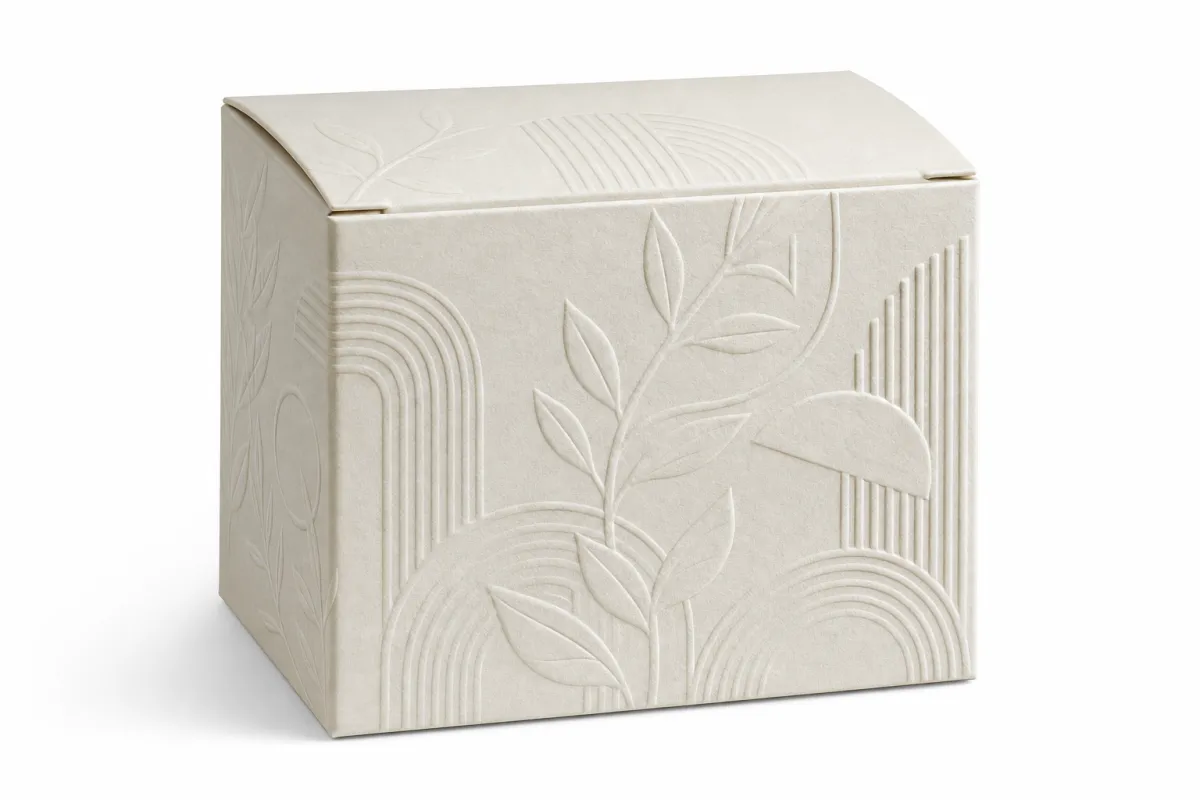
In plain terms, custom embossed paper cartons are paperboard cartons with a raised or pressed surface detail created by tooling. The effect can be bold, subtle, or somewhere in between. It depends on emboss depth, board selection, and whether the design centers on a logo, border, pattern, or one accent panel. The point is not just decoration. The point is physical texture.
That texture is different from print, coating, or foil stamping. Print adds color. Coating changes sheen and can help protect the surface. Foil stamping reflects light. Embossing changes the board itself. When done well, custom embossed paper cartons feel more crafted because the detail is pressed into the material rather than sitting on top of it. That small shift matters more than people think, especially in premium retail packaging.
There is a practical side too. Custom embossed paper cartons can do a lot of branding work without making the design loud. A raised logo on matte stock may carry more shelf presence than a busy carton that tries to cram in every possible signal of value. Buyers remember tactile packaging because the interaction sticks. The box becomes part of the memory, not just the container.
For custom printed boxes and branded packaging alike, embossing gives a cleaner premium cue than many teams expect. The finish says someone cared about the details. That signal can matter just as much as color saturation or photography. In crowded categories, that tactile cue can be the thing that gets the carton picked up instead of passed over.
Think of custom embossed paper cartons as part of the packaging system, not a decorative extra. The surface treatment should match the product position, the unboxing experience, and the amount of shelf time the carton will get. A skincare carton, a confectionery box, and a luxury candle carton may all use embossing, but they rarely use it the same way.
How Custom Embossed Paper Cartons Are Made
The embossing process starts before production. Artwork gets prepared. The dieline gets approved. The emboss area gets mapped so the raised detail lands where the structure can support it. In custom embossed paper cartons, matched male and female tooling transfers the shape into the board under pressure. That means the design has to be clean enough to read and strong enough to survive the press.
Prepress files matter more than many teams expect. Line weight, logo size, spacing from folds, and the size of tiny counters all affect the result. If the type is too fine, the emboss can break it apart. If the logo sits too close to a fold line, the carton may crack, flatten, or distort once it is scored and folded. That is why custom embossed paper cartons usually benefit from a packaging designer who understands both graphics and structure.
The board itself matters just as much. A 300gsm sheet behaves differently from a 400gsm sheet, and coated paperboard reacts differently from uncoated stock. Pressure, grain direction, and caliper all influence how sharply the detail holds. In many custom embossed paper cartons, a smoother, more stable board gives a cleaner raised mark, while a softer board produces a gentler and less defined effect.
Embossing can stand alone or sit inside a layered finish plan. Some projects pair custom embossed paper cartons with foil stamping, matte lamination, spot UV, or soft-touch coating. That can look beautiful. It can also raise handling complexity, extend drying time, and push cost up fast. More effects do not automatically mean a better carton. Sometimes they just mean a more expensive one.
Here is the sequence most teams follow:
- Brand brief and structural review.
- Dieline and artwork placement.
- Tooling approval for the emboss area.
- Sample or proof review.
- Production run with print and finishing.
- Final folding, gluing, packing, and shipment.
The sequence sounds simple. It rarely is. On custom embossed paper cartons, relief depth, carton wall strength, and finish sequence all have to work together. If they do not, the file looks great and the finished box looks merely fine. Nobody asked for merely fine.
If you want a broader packaging reference while planning requirements, the ISTA testing standards are a useful reminder that packaging is more than a visual exercise. Surface detail, carton construction, and transit durability all affect whether the box arrives and performs as intended. That matters even more for custom embossed paper cartons that need to travel through distribution before a customer ever touches them.
Key Material, Design, and Finish Factors
Paperboard choice is one of the biggest drivers of how custom embossed paper cartons will look and feel. A stable board with enough stiffness helps the embossed detail stay crisp. A stock that is too soft can blur the shape or collapse under pressure. Surface quality matters too. Smoother stocks let the raised detail read more clearly across the carton face.
Design scale is another major factor. Large flat emboss areas create a dramatic tactile effect, but they can show stress or waviness if the stock is not prepared correctly. Small logo marks are safer and more refined, but they demand tighter accuracy in the tool. With custom embossed paper cartons, the best-looking result is often the one that respects what the board can actually handle instead of trying to sculpt cardboard like clay.
Font size and spacing deserve real attention. If the lettering is too fine, the emboss can go muddy after folding and gluing. If the mark sits too close to the edge, the carton may deform. I usually tell teams to leave generous clear space, especially on custom embossed paper cartons meant for premium retail packaging. The surface needs room to breathe. Crowding it usually makes the box feel cheaper, not richer.
Finish choice changes the impression too. Matte finishes tend to emphasize the shape of the emboss because they cut glare. Soft-touch coatings add a velvety feel that can make custom embossed paper cartons feel luxurious, although they also raise cost and can affect scuff resistance. Gloss can work in some categories, but it often competes with the tactile detail instead of supporting it.
Uncoated stocks behave differently again. They usually give a natural, paper-forward appearance that pairs well with understated package branding. For food gifts, craft cosmetics, and some specialty retail goods, custom embossed paper cartons on uncoated board can feel honest and refined at the same time. The effect is quieter, which is exactly why it works.
Material choices that usually work well
- 350gsm to 400gsm artboard for a balanced premium feel and stable emboss response.
- FSC-certified paperboard when sustainability claims need documentation and sourcing discipline.
- Matte or soft-touch lamination when the goal is to highlight touch and reduce glare.
- Uncoated premium board when the brand wants a natural, more artisanal surface.
If sustainability is part of the brief, the material conversation should include chain of custody and end-of-life expectations. The FSC system can support responsible sourcing claims, but the carton still needs to be designed carefully so the premium effect does not fight recyclability goals. Custom embossed paper cartons can be elegant and responsible at the same time. They just need a spec that respects both.
For retail packaging, the use case should steer the finish decision. A carton for a serum bottle may need a cleaner, more restrained look so the embossed logo reads instantly. A gourmet gift box can handle a broader pattern or deeper relief. The smartest custom embossed paper cartons are the ones that match the product's actual selling environment, not the mood board somebody liked on Tuesday.
One of the most useful checks is a simple hand sample. In many cases, the fastest way to judge the detail is to hold a mockup and feel the board. On screen, custom embossed paper cartons can look almost identical across several options. In hand, the difference between acceptable and genuinely premium becomes obvious in seconds.
| Finish Option | Look | Touch | Typical Use | Cost Impact |
|---|---|---|---|---|
| Emboss only | Clean and restrained | Strong tactile lift | Logo marks, borders, minimal branding | Moderate tooling, controlled production cost |
| Emboss + foil | High contrast and premium | Raised detail with reflective accent | Luxury retail packaging, cosmetics, gifting | Higher setup and finishing cost |
| Emboss + soft-touch | Muted, elegant surface | Velvety and refined | Skincare, wellness, premium custom printed boxes | Medium to high depending on coverage |
| Emboss + spot UV | Contrast between matte and gloss | Textural contrast plus shine | Modern branded packaging with a graphic edge | Higher process complexity |
Custom Embossed Paper Cartons: Cost, Pricing, and Value
Pricing for custom embossed paper cartons comes down to a few main drivers: tooling, board choice, carton size, print coverage, order quantity, and the number of finishing steps. Tooling is usually the first cost that surprises people because the emboss die has to be created before production can start. A simple carton keeps that cost in check. A design with multiple raised zones or precise foil alignment pushes it up fast.
Order quantity changes the picture a lot. With lower volumes, setup is spread over fewer cartons, so the unit price climbs. With larger volumes, the per-carton cost usually improves because the same setup is divided across more pieces. That is why custom embossed paper cartons often make the most financial sense once the product has stable demand or a real launch plan instead of a hopeful spreadsheet and a prayer.
For planning, many buyers use rough ranges to frame the discussion rather than lock a quote. Depending on board, size, print coverage, and finish complexity, a premium carton might land around $0.18-$0.28 per unit at 5,000 pieces, while a more elaborate embossed-and-foiled structure can go higher. Those numbers are not a promise. They are a useful starting point for comparing custom embossed paper cartons against margin and shelf value.
The real question is not only what the carton costs. It is what it replaces. A well-executed embossed surface may reduce the need for dense ink coverage, extra decoration, or a complicated panel layout. In that sense, custom embossed paper cartons can add value by simplifying the artwork while still making the packaging feel premium. That matters a lot in categories where the package helps justify the price.
Revisions are another hidden cost. If the structure changes after tooling is made, or if the emboss depth proves too strong once the carton is sampled, the project can lose time and money quickly. With custom embossed paper cartons, early approval of the dieline, logo scale, and finish plan protects the budget better than trying to patch the problem after the tool is already cut.
A useful way to think about value is to compare packaging cost against product value, margin target, and expected retail impact. A $12 serum, a $28 candle, and a $65 specialty gift product do not need the same carton strategy. For lower-margin goods, custom embossed paper cartons may be best kept to a small logo mark or a single accent zone. For higher-value products, more visual and tactile detail can be justified more easily.
If the carton is part of a broader branded packaging system, the emboss should be evaluated with the rest of the line. The same structure might be used across a family of custom printed boxes with only small changes in finish or panel art. That kind of system can reduce artwork complexity and keep custom embossed paper cartons consistent across product tiers.
Step-by-Step Process and Timeline From Brief to Delivery
The workflow for custom embossed paper cartons usually starts with a brief that covers product dimensions, retail channel, target audience, and finish expectations. From there, the structural concept is reviewed, the artwork is placed on the dieline, and the emboss area is checked for spacing and print compatibility. If the box shape is unusual, that first phase takes longer. It also saves headaches later, which is a nice trade.
Once the design is aligned, tooling approval becomes the next gate. This is where the shape, depth, and location of the emboss are locked in. If the mark is too deep, the board may crack. If it is too shallow, the effect may disappear under print or lamination. Custom embossed paper cartons depend on this step being handled carefully, because fixing it later costs more and usually looks worse.
Sampling is where the team learns the most. A proof can show alignment, but a sample shows reality: how the paper reacts, how the fold behaves, how the surface catches light, and whether the tactile detail reads properly. For custom embossed paper cartons, that sample stage is where many brands decide whether to simplify or strengthen the design before the final run starts.
Typical lead times vary by supplier, but a realistic planning window often runs 12-15 business days from proof approval for straightforward work and longer for cartons with more complex finishing or larger quantities. Once tooling, proofing, and packing are included, the schedule can stretch further. That is why custom embossed paper cartons should be booked early if the launch date is fixed.
The approval chain matters too. Marketing should sign off on brand appearance. Operations should approve pack-out and transit expectations. Procurement should confirm budget and volume. If those approvals happen in order, the process stays cleaner. If they happen out of sequence, custom embossed paper cartons can get trapped in revision loops that add cost without improving the result.
Packaging standards can also influence the schedule if the carton needs to support drop-testing or shipping performance. The more the carton interacts with transit, the more carefully the structure has to be reviewed. For that reason, teams planning custom embossed paper cartons for e-commerce or distribution-heavy channels should build in buffer time for sample adjustments and pack tests.
A practical launch schedule might look like this:
- Week 1: brief, dimensions, and carton concept.
- Week 2: dieline review and artwork placement.
- Week 3: tooling signoff and sample prep.
- Week 4: sample review and minor corrections.
- Week 5-6: production and finishing.
- Week 7: packing, freight, and receiving.
That schedule is not excessive. It is just realistic. When a launch matters, custom embossed paper cartons reward the teams that leave room for proofing instead of trying to bulldoze past it.
Common Mistakes That Reduce Impact or Raise Cost
One of the most common mistakes with custom embossed paper cartons is overcomplicating the artwork. Fine lines, tiny type, and dense textures can look good in a rendering, but they often lose clarity on real board. A simpler mark usually survives production better and feels more premium because the relief is clean instead of crowded.
Another issue is choosing the wrong stock. If the board is too thin, too soft, or too heavily coated for the intended effect, the emboss may flatten or crack. I have seen brands fall in love with a concept board and then discover the carton cannot hold the detail after folding. That is why custom embossed paper cartons need material testing before the design is locked.
Placement mistakes are expensive too. Avoid running the emboss across folds, glue seams, or corners that take stress during assembly. The carton has to stay structurally sound, and the premium effect should work with the build rather than against it. In custom embossed paper cartons, the best emboss zones are usually the broad, stable panels where the board can stay calm under pressure.
Budget errors show up when a team signs off on a visual without asking about tooling, finish sequence, or minimum quantity. The concept may be beautiful. The production reality may not fit the budget. That gap is one of the biggest reasons custom embossed paper cartons need a packaging-spec conversation before artwork approval, not after.
Communication gaps between design and packaging teams create another layer of risk. If the dieline is interpreted incorrectly, or if finish notes are not written clearly, the carton may need rework. With custom embossed paper cartons, even a small misunderstanding can affect registration, emboss depth, or the way the carton folds on the line.
Here are the mistakes I would watch most closely:
- Using type that is too small for the chosen emboss depth.
- Placing tactile detail too near a fold or seam.
- Choosing a board that is too weak for the relief.
- Approving artwork before confirming tooling cost.
- Skipping a physical sample and relying only on a digital proof.
If the carton also needs to be environmentally responsible, avoid layering on finishes that conflict with the brand's claims. The EPA offers useful public guidance around packaging and waste reduction at EPA recycling resources. The goal is not to strip the carton of character. The goal is to make sure custom embossed paper cartons support the brand without creating a sustainability mismatch.
Expert Tips and Next Steps for Better Carton Specs
If you want custom embossed paper cartons to feel truly premium, begin with the brand goal rather than the effect. Ask what the carton is supposed to do: stop a shopper, reinforce a higher price, create a memorable unboxing moment, or distinguish a product family on shelf. Once that goal is clear, the emboss becomes a tool instead of a decoration.
My first recommendation is to request a sample or mockup early. Feeling the surface in hand often tells you more than a screen mockup ever will. A raised mark that looks elegant digitally can feel too weak physically, and a bold emboss can suddenly look more refined than expected. With custom embossed paper cartons, the hand sample is the fastest decision-making tool you have.
Second, compare embossing against nearby options like debossing, foil stamping, or a clean print-only carton. Sometimes the best answer is a subtle raised logo. Sometimes the better answer is a combination of finishes. Sometimes the smartest move is restraint. The right custom embossed paper cartons decision should come from the product story and margin structure, not from trend pressure.
Third, write a stronger brief. Include carton dimensions, product weight, retail setting, audience, finish preference, quantity, and any structural constraints. The more precise the brief, the easier it is to estimate cost and lead time. For custom embossed paper cartons, a clear brief saves more money than almost any last-minute revision ever can.
A practical checklist before you approve production
- Define the premium cue you want the carton to deliver.
- Confirm the board grade and surface finish.
- Decide whether the emboss should be subtle or highly visible.
- Verify spacing from folds, seams, and corners.
- Ask for a physical sample before full production.
- Review quantity, budget, and launch timing together.
For brands building a broader packaging line, it also helps to think in systems. A product family may use the same board and structure with different colors, textures, or print accents across the range. That creates consistency without making every carton identical. Done well, custom embossed paper cartons can sit comfortably alongside other branded packaging formats, including custom printed boxes and retail packaging kits, while still keeping the premium cue unmistakable.
If you are mapping the next step, start with a spec review, ask for a mockup, and check the timeline against your launch date before anything goes to tooling. That order keeps the project grounded in real production limits, which is where the best custom embossed paper cartons are usually won. When the carton, the board, and the finish all line up, the result feels intentional in the hand and credible on shelf.
For teams that want a carton to do more than carry the product, custom embossed paper cartons remain one of the strongest ways to build tactile brand value without overcomplicating the design. If the structure is sound, the artwork is disciplined, and the production plan is realistic, the carton can do exactly what premium packaging should do: make the product feel worth the price before the box is even opened.
Bottom line: choose one tactile focal point, confirm the board can hold it, and sample it before tooling. That simple order saves money, keeps the finish honest, and gives custom embossed paper cartons the premium feel they are supposed to deliver.
FAQ
What are custom embossed paper cartons best used for?
They work well for products where touch matters as much as visual appeal, such as cosmetics, specialty retail goods, gift items, and premium consumer packaging. Custom embossed paper cartons add a refined tactile cue without relying on heavy ink coverage, which keeps the design clean and focused. The best use cases are cartons that need stronger shelf presence or a more memorable unboxing moment.
How much do custom embossed paper cartons usually cost?
Pricing depends on board choice, carton size, run quantity, and whether embossing is combined with foil, coating, or other finishing steps. Tooling and setup are often the biggest upfront cost, while unit price usually improves as the order quantity increases. A quote for custom embossed paper cartons should be reviewed alongside product value and packaging goals, not just the lowest per-carton number.
How long does the custom embossed paper cartons process take?
The timeline usually includes briefing, structural and artwork prep, tooling, sample or proof approval, production, and final delivery. Extra time is often needed if the emboss depth, artwork placement, or carton structure changes after the first round of review. Planning for approval delays and sample adjustments helps prevent avoidable rush charges and missed launch dates for custom embossed paper cartons.
What materials work best for custom embossed paper cartons?
A stable paperboard with enough stiffness usually gives the cleanest emboss detail. Very thin or overly soft stock can lose definition, while some heavily coated surfaces may reduce the tactile effect. The best material for custom embossed paper cartons depends on how deep the emboss needs to be and how much structural support the carton must provide.
Can custom embossed paper cartons be combined with other finishes?
Yes, embossing is often paired with foil stamping, spot UV, matte or soft-touch coatings, and print effects for a layered premium look. Each added finish affects cost, production sequence, and how clearly the emboss reads on the final carton. The best combinations for custom embossed paper cartons are the ones that support the brand story without making the carton feel crowded or overworked.


