A sticker can do four jobs before lunch. The same small piece of printed vinyl can identify a helmet, support a pancake breakfast fundraiser, mark a fire prevention campaign, and turn a station logo into something residents remember. That is why custom fire department stickers deserve more scrutiny than they usually get during ordering.
Most sticker failures are not design failures. They are specification failures. A decal expected to sit on a pickup window for three years needs a different build than a giveaway sticker handed to children at an open house. Different adhesive. Different face stock. Often a different finish.
Price matters, but only after the job is defined. A cheap indoor sticker used outdoors is not a bargain. It is a replacement order waiting to happen.
What Custom Fire Department Stickers Do for Crews and Communities
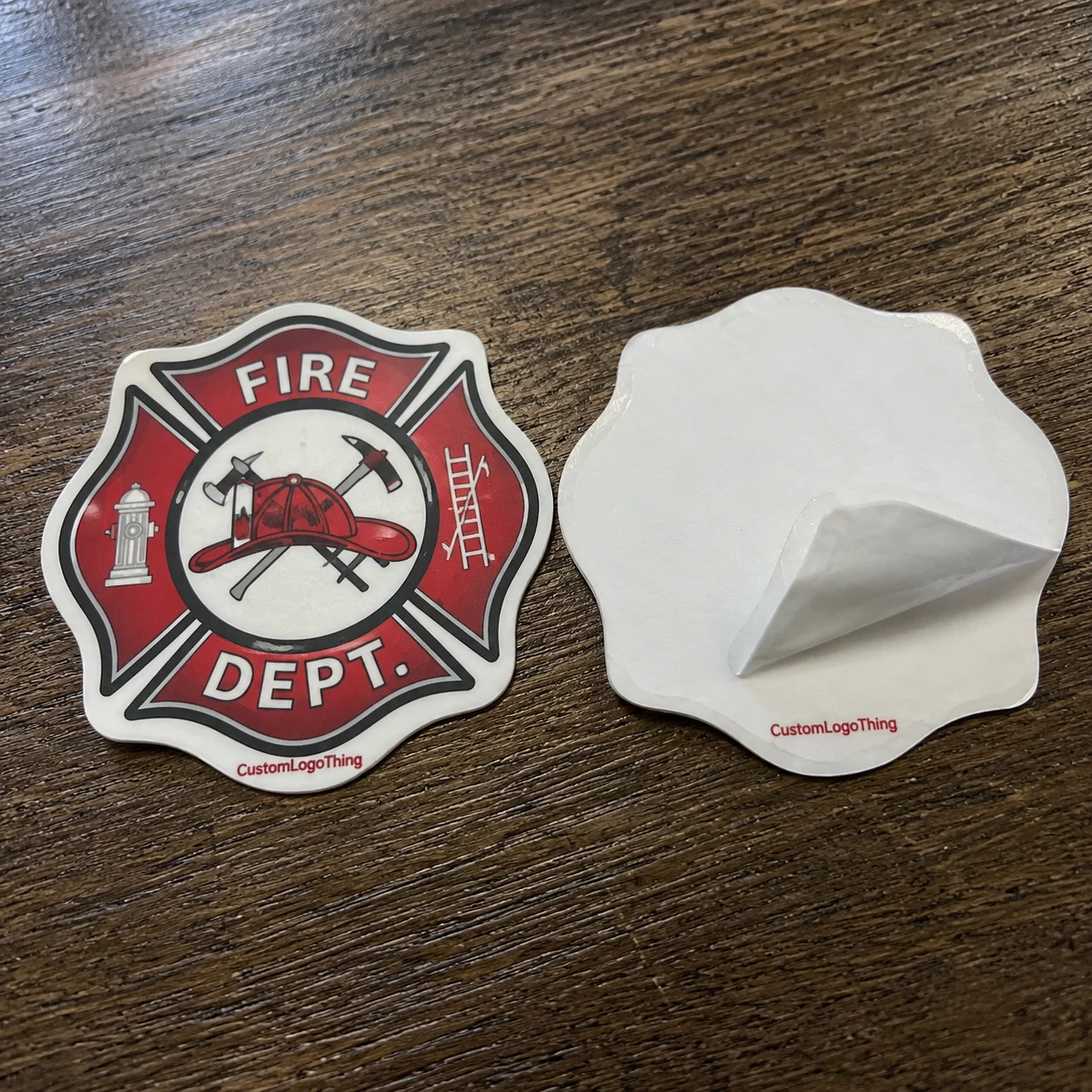
Custom fire department stickers are printed adhesive graphics made for station branding, apparatus details, gear labeling, community outreach, junior firefighter programs, memorials, recruitment drives, event giveaways, and donor appreciation packs. Some are promotional. Some are functional labels. A few behave more like small-format public safety signage.
The vocabulary gets muddy, and that mud can affect the quote. A decorative sticker is usually built for visibility and pride: laptops, water bottles, notebooks, toolboxes, or fundraiser packs. A functional label carries information, such as inspection dates, station numbers, inventory IDs, or safety reminders. A decal usually implies outdoor durability, shaped cutting, or application to glass, metal, plastic, or painted surfaces. A badge-style emblem presents the department seal, Maltese cross, mascot, or association mark as a collectible or premium piece.
Those differences are not semantic trivia. A 3-inch logo sticker for school visits can often use standard white vinyl with a gloss coating. A 5-inch apparatus window decal should usually move up to outdoor vinyl, UV-resistant ink, and a protective laminate. Helmet stickers require separate judgment because heat, curvature, cleaning chemicals, and department policy all matter.
Common uses include helmet stickers, hard hat decals, vehicle window decals, water bottle stickers, laptop giveaways, inspection labels, safety campaign handouts, recruitment booth materials, memorial run packets, and donor thank-you envelopes. Some departments also pair stickers with Custom Labels & Tags for storage bins, event kits, training materials, or station inventory.
Buyer reality check: Start with the surface and exposure, not the lowest unit price. Glass, painted apparatus, plastic helmets, cardboard mailers, and stainless cabinets do not behave the same way.
How Fire Department Decals Are Built: Materials, Adhesives, and Finishes
A sticker is a small laminate system. The basic stack is face stock, printed ink, adhesive layer, release liner, and sometimes a protective laminate or coating. The face stock gives the sticker its body. Ink creates the image. Adhesive decides whether it stays put. The liner keeps it clean before application. Laminate protects the print from sun, water, abrasion, road salt, smoke residue, and repeated washing.
Paper stickers are economical for indoor handouts, mailers, classroom packets, and event inserts. They are poor candidates for rain, helmets, toolboxes, or vehicle windows. Standard vinyl is a better general-purpose choice for water bottles, laptops, notebooks, and promotional use. Premium outdoor vinyl is the usual pick for decals that need one to five years of exterior service, depending on film grade, laminate, ink system, climate, and cleaning routine.
Reflective vinyl is useful for high-visibility identification, safety messaging, and certain apparatus or vehicle applications. It costs more, can be stiffer, and may require simpler artwork because reflective stock changes how fine detail appears. Thin outlines, tiny type, and subtle shading tend to suffer first.
Clear film works well on glass or smooth product packaging where the background should show through. Light colors may disappear unless the printer adds white ink underneath them. Static cling suits temporary glass displays, such as open house notices or recruitment signs, but it is not a substitute for permanent adhesive decals.
Adhesive choice is just as important as the visible material. Permanent adhesive supports long-term outdoor use. Removable adhesive fits temporary campaigns where residue is a concern. Low-tack adhesive belongs indoors or on short placements. Specialty adhesives can help with textured plastic, powder-coated metal, or difficult surfaces, though testing is wise because no adhesive performs perfectly on every substrate.
Finish changes both appearance and service life. Gloss boosts color and gives reds, golds, and blacks more punch. Matte reduces glare on helmets, gear cabinets, and equipment cases. Soft-touch feels premium but is usually better for indoor or fundraiser pieces than field abuse. UV coating adds a protective layer; film lamination provides stronger resistance for outdoor decals that will be washed, handled, or exposed to sun.
Shape affects production too. Circle, square, rectangle, and oval cuts are efficient. Die-cut designs follow a Maltese cross, shield, mascot, or truck silhouette. Kiss-cut stickers stay on a backing sheet and peel out cleanly. Rolls are practical for repeated labeling. Individually cut stickers feel more substantial for fundraisers, recruitment fairs, donor packs, and memorial events.
For broader packaging and transport testing context, the International Safe Transit Association publishes standards and protocols at ista.org. Sticker durability is a different test category, but the lesson transfers: real use conditions beat assumptions made at a desk.
Key Specs for Custom Fire Department Stickers Before Ordering
Before requesting artwork or samples, lock down the essentials: size, shape, material, adhesive, finish, quantity, color requirements, application surface, and expected lifespan. Basic, yes. Also where many orders drift.
One buyer wants a helmet decal. Another imagines a truck window emblem. A designer builds a crest that only works at 6 inches wide. By the time proofing starts, everyone is using the same word for different products.
Size is the first filter. Small helmet or gear labels often land around 1 to 2 inches. General-purpose logo stickers usually sit near 3 inches. Larger window, apparatus, or display decals often start at 4 inches and go up from there. A detailed crest with crossed axes, a flag, station number, founding text, and thin Maltese cross outlines may look strong on a monitor but turn muddy at 1 inch.
Artwork format affects production speed and print quality. Vector files such as AI, EPS, or production-ready PDF are preferred because they scale cleanly. High-resolution PNG files can work for simpler artwork if they are large enough, sharp, and built with a transparent background when needed. Fonts should be outlined. Department seals should be clean. Screenshots rarely hold up.
Color matching deserves attention. Fire departments often rely on red, navy, gold, black, white, silver, or municipal brand colors. If official colors exist, provide Pantone references, CMYK builds, or approved brand documentation. A “close red” may be acceptable for a school giveaway. It may not pass review for a city-approved recruitment campaign, association fundraiser, or public education mailer.
Public-safety graphics appear at fundraisers, school programs, recruitment booths, station tours, memorial events, and sometimes on vehicles seen by thousands of residents. Consistency builds recognition. The same logic used in packaging design and package branding applies here: repeated visual cues make an organization easier to remember.
| Use Case | Typical Size | Recommended Material | Finish | Practical Note |
|---|---|---|---|---|
| School visit giveaway | 2.5 to 3 inches | Standard white vinyl or coated paper | Gloss coating | Economy matters because quantities can reach 500 to 2,000 pieces. |
| Helmet or gear label | 1 to 2 inches | Durable vinyl matched to surface | Matte or gloss laminate | Check helmet manufacturer guidance and department policy first. |
| Vehicle window decal | 4 to 6 inches | Premium outdoor vinyl | UV-resistant laminate | Built more like a small outdoor sign than a handout sticker. |
| Fundraiser emblem | 3 to 4 inches | Premium vinyl or specialty film | Gloss, matte, metallic, or reflective | Higher perceived value can justify a higher unit cost. |
Process and Timeline: From Department Logo to Finished Stickers
The production path is usually straightforward: inquiry, artwork review, quote, proof, approval, printing, cutting, quality check, packing, and shipping. The bottleneck is often not the press. It is the artwork review.
Clean vector art can move through quoting and proofing quickly. A low-resolution phone photo of an old embroidered patch can require reconstruction before anyone should print it. That reconstruction may be worth doing, especially for a heritage mark or memorial design, but it should be treated as design labor rather than a production detail.
Proofing is the buyer’s quality-control checkpoint. Check spelling, department name, association name, station number, unit number, trim line, bleed, line thickness, colors, and whether the sticker is die-cut or printed on a standard shape. If the sticker includes a memorial name, academy class, event date, or sponsor, slow down. One typo can turn a full run into scrap.
Timelines vary by supplier and workload, but a practical framework helps. A simple repeat order with approved art may move in several business days after proof approval. A new design with cleanup, custom die-cutting, reflective vinyl, multiple versions, or a large quantity can run longer. Twelve to fifteen business days from proof approval is a common planning window for custom printed work, though rush capacity, freight, and material availability can change that.
Lead time also depends on proof approval speed, order volume, finishing choice, shipping distance, and whether specialty film is in stock. Reflective vinyl, metallic effects, clear film with white ink, and individually packed stickers add steps. Multi-design orders add another layer, especially if each station or unit wants a different count.
Build in extra time before open houses, recruitment fairs, parades, fire prevention events, fundraisers, memorial runs, academy graduations, and citywide safety campaigns. A sticker is small. The approval chain may not be. Chiefs, association boards, union representatives, city communications teams, and event sponsors may all care about the final look.
Approve the proof with the final user in mind. If firefighters will apply decals to lockers, confirm the size suits the locker face. If parents and children will receive them at a school program, make the design readable at arm’s length. If a city office needs consistent public materials, treat the sticker like branded packaging rather than a throwaway.
Cost and Pricing Factors That Change the Sticker Quote
Sticker pricing is shaped by quantity, size, material, finish, cut complexity, color requirements, proofing work, packing, and shipping. Unit cost usually drops as quantity rises because setup, artwork handling, printing, and cutting are spread across more pieces. That is why 1,000 stickers rarely cost twice as much as 500.
As a broad planning range, simple 3-inch vinyl logo stickers may land around $0.35 to $0.85 each at 1,000 pieces, depending on coverage, cut, finish, and supplier. At 5,000 pieces, a straightforward design may drop closer to $0.18 to $0.35 each. Laminated outdoor decals, reflective decals, metallic effects, or intricate die-cut emblems can push pricing higher. These are directional ranges, not promises, because material grade and finishing choices swing the math.
Minimum order quantities matter. A department ordering for one community event may prefer a smaller batch, even with a higher unit cost. A union, association, annual campaign, or regional recruitment effort may benefit from a larger run. If storage is clean, dry, and temperature-stable, extra inventory can make sense. If the design includes event-specific information, overbuying can become waste.
Hidden cost drivers include rushed production, multiple designs in one order, individual packing, specialty materials, metallic effects, reflective stock, white ink under clear film, heavy artwork reconstruction, and split shipments. Shipping can also surprise buyers because rolls, sheets, and individually cut stacks pack differently.
For a more accurate quote, provide the final size, quantity, material preference, use case, deadline, artwork file, shipping destination, and whether the stickers need to be weatherproof. If the sticker will go into mailers, retail-style fundraiser kits, or product packaging, mention that too. Packing method may change the estimate.
The cheapest sticker is often expensive in disguise. If a decal peels after a month, the department pays twice: replacement cost and labor. There is also the quieter cost of inconsistent branding. A durable decal on a firefighter’s vehicle or a donor’s laptop can produce hundreds of useful impressions; a flimsy one dies in the glovebox.
Common Ordering Mistakes That Make Department Stickers Fail
The biggest mistake is ordering based on appearance alone. A glossy proof on screen cannot tell you whether the adhesive will tolerate heat, UV exposure, water, abrasion, wax, oil, or curved plastic. The environment decides whether the sticker survives.
Indoor-grade stickers fail outdoors because paper fibers swell, coatings break down, inks fade, and adhesives soften or dry out. Vehicle windows, toolboxes, helmets, equipment cases, and exterior doors face sun, road spray, temperature swings, and cleaning products. A decal that survives on a laptop may fail quickly on a rear window parked outside all summer.
Low-resolution artwork is the second repeat offender. Screenshots, social media images, and photos of embroidered patches often carry blur, shadows, thread texture, compression artifacts, or distorted angles. A designer can sometimes rebuild the mark, but that adds time and cost. Better input produces better output.
Oversizing and undersizing create their own problems. A sticker that looks bold on a computer screen may overwhelm a helmet or look awkward on a water bottle. A crest shrunk to 1 inch may lose the station number, tools, flag, and outer text.
Print a paper mockup at actual size before approving a complicated design. It is a cheap test, and it catches more than people expect.
Surface preparation also gets ignored. Apply decals to clean, dry, room-temperature surfaces when possible. Dirt, oil, wax, moisture, cold metal, textured plastic, and recently painted surfaces can all interfere with adhesion. For painted apparatus or specialty coatings, ask about compatibility before committing to a large run.
Proofing mistakes are painful because they are preventable. Station names, unit numbers, sponsor names, and memorial text need a second reader. Design clutter deserves the same scrutiny. Too many slogans, icons, flags, axes, dates, and tiny lines can turn a meaningful emblem into visual noise.
Expert Tips for Better Durability, Visibility, and Brand Consistency
Choose material by lifespan. Short-term event handouts can use economical materials. Medium-term promotional stickers should step into vinyl. Long-term outdoor decals need premium film, UV-resistant printing, and laminate. If the sticker must survive washing, sun, rain, and road salt, specify that plainly.
Simplify small designs. Prioritize the department name, station number, Maltese cross, mascot, or one strong graphic element. Red and gold may feel traditional, but contrast still matters. Thin gold text on red can disappear at arm’s length. Black text on white, white text on navy, and bold outlines often perform better than ornate color combinations.
Ask for a sample or physical proof when the design includes reflective stock, clear film, metallic effects, or a detailed crest. Screens do not show reflectivity accurately. Clear film also behaves differently depending on the background surface. White ink may be needed to keep light colors visible.
Keep a reusable spec sheet for future orders. Include size, material, adhesive, finish, Pantone or brand colors, quantity, approved artwork file name, and previous order notes. This is the sticker version of disciplined package branding. The same habit helps departments that also order banners, event mailers, Custom Packaging Products, or custom printed boxes for fundraising kits.
Distribution format affects use. Sheeted stickers work well for events because volunteers can hand out full sheets or peel individual pieces. Rolls work well for repeated labeling at a desk, station office, or inspection table. Individually cut stickers feel more premium for fundraisers, donor appreciation packs, and recruitment bags.
For sustainability-minded departments, ask about paper sourcing, liner waste, and recyclable packaging options. The Forest Stewardship Council explains chain-of-custody certification at fsc.org. Not every vinyl sticker has a clean recycling path, so the practical sustainability move is often ordering the right spec once rather than replacing failed decals twice.
Next Steps Before You Place a Sticker Order
Before contacting a supplier, confirm the use case, surface, lifespan, size, quantity, artwork file, deadline, and budget. Write it down. A clear spec saves emails, avoids wrong assumptions, and makes quotes easier to compare.
Separate orders by purpose if needed. One durable outdoor decal may be right for apparatus windows or firefighter vehicles. One economical sticker may be right for school visits and prevention handouts. One premium emblem may be right for a fundraiser, memorial event, or association donor pack. Forcing one sticker to do every job usually creates compromise.
Gather the department logo, crest, station number, association name, official colors, and any municipal approval requirements before proofing begins. If the mark has multiple versions, identify the approved file. If a city communications office controls public-facing graphics, involve them before the proof stage rather than after printing.
Pick two or three practical sizes and compare them against real objects: helmets, laptops, water bottles, turnout gear lockers, mailers, clipboards, or display boards. A 3-inch circle may look generous on a screen and cramped on a fundraiser envelope. A 5-inch decal may be perfect on glass but too large for a gear cabinet.
Ask direct supplier questions: Will this survive outdoor exposure? What adhesive is used? Is laminate included? What is the minimum order quantity? How long is production after proof approval? Can this file print cleanly without rebuilding? Specific questions get specific answers.
If you are ordering custom fire department stickers, send complete specs instead of vague artwork and a rushed deadline. The quote will be cleaner, the proof will be easier to approve, and the finished stickers will be more likely to do their real job: carry the department’s identity clearly, durably, and professionally.
Frequently Asked Questions
What are the best materials for custom firefighter decals used outdoors?
Outdoor vinyl with UV-resistant printing and a protective laminate is usually the best fit for vehicle windows, equipment cases, and long-term exterior use. Reflective vinyl is useful when visibility matters, but it costs more and should be reserved for specific safety, apparatus, or high-impact branding needs. Paper or basic indoor materials are better for short-term handouts, not harsh field conditions.
How much do custom fire department logo stickers usually cost?
Cost depends on quantity, size, material, finish, cut shape, artwork complexity, and turnaround needs. Simple 3-inch vinyl stickers may fall around $0.35 to $0.85 each at 1,000 pieces, while larger orders can reduce the unit cost. Specialty films, laminate, reflective stock, metallic effects, and rush production increase the quote.
Can custom fire station stickers be used on helmets or turnout gear?
They can be used on some helmets, lockers, and gear-related surfaces, but the adhesive and material must match the surface and exposure level. Departments should check helmet manufacturer guidance, safety policies, and local rules before applying any decal to protective equipment. For turnout gear, many departments prefer approved labels or identification methods rather than standard promotional stickers.
What artwork file is best for fire department sticker printing?
Vector files such as AI, EPS, or production-ready PDF are preferred because they scale cleanly and preserve sharp crest details. High-resolution PNG files can work for simpler designs if the image is large enough and not blurry. Screenshots, social media images, and photos of patches often need cleanup before printing.
How long does it take to produce custom fire department stickers?
Timeline depends on artwork readiness, proof approval, material choice, order size, finishing, and shipping. A clean repeat order can move faster than a new design requiring artwork cleanup or specialty materials. As a planning window, many custom printed sticker orders need roughly twelve to fifteen business days after proof approval, with rush options and material availability varying by supplier.