Buyer Fit Snapshot
| Best fit | Custom Foam Packaging Inserts Order projects where brand print, material claims, artwork control, MOQ, and repeat-order consistency need to be specified before quoting. |
|---|---|
| Quote inputs | Share finished size, material target, print colors, finish, packing count, annual reorder estimate, ship-to region, and any compliance wording. |
| Proofing check | Approve dieline scale, logo placement, barcode or warning zones, color tolerance, closure strength, and carton packing before bulk production. |
| Main risk | Vague material claims, crowded artwork, missing packing details, or unclear freight terms can make a low unit price expensive after revisions. |
Fast answer: Custom Foam Packaging Inserts Order: Pricing and Process should be specified like a repeatable production item. The safest quote records material, print method, finish, artwork proof, packing count, and reorder notes in one written spec.
Production checks before approval
Compare the actual filled-product size with the drawing, then confirm tolerance on folds, seals, hang holes, label areas, and retail display edges. Reserve space for logos, QR codes, warning copy, and material claims before decorative graphics fill the panel.
Quote comparison points
Review material grade, print process, finish, sampling route, tooling charges, carton quantity, and freight assumptions side by side. A quote is only useful when the supplier can repeat the same color, closure quality, and packing count on the next order.
Custom Foam Packaging Inserts Order: Pricing and Process
Need a custom foam packaging inserts order that protects the product without blowing up the budget review? That conversation usually starts after a few damaged shipments, once returns, replacements, and customer complaints have already started chewing into margin. A custom foam packaging inserts order does more than fill empty space inside a carton. It keeps the item centered, limits movement, cuts down repack labor, and gives every box a repeatable internal structure. For branded packaging and retail packaging, that repeatability matters almost as much as the look of the outer box. A custom foam packaging inserts order should act like a quiet control point: the product sits in the same place every time, the carton closes the same way every time, and the unboxing feels deliberate instead of improvised.
From a packaging buyer's point of view, the insert line item is rarely the real expense. Replacement stock, customer service time, freight claims, and the time spent explaining why a premium product arrived loose inside a premium box often cost more than the foam itself. In a lot of projects I've reviewed, the first thing people want to trim is the insert, and that is usually the wrong place to save a few pennies. If the insert prevents even one return, the math can already tilt in favor of the custom foam packaging inserts order. Fragile goods, luxury kits, electronics, medical devices, and presentation-grade product packaging all benefit from that kind of protection. The right foam does the protection job without making the package feel industrial.
Teams that buy packaging well usually treat the custom foam packaging inserts order as a design decision, not a last-minute fill-material purchase. The insert has to work with the carton size, outer graphics, product finish, and warehouse handling. Move one of those variables and the fit can change. Get the design right and the package feels composed. Get it wrong and even expensive custom printed boxes can look rushed.
Why a Custom Foam Packaging Inserts Order Protects Margins
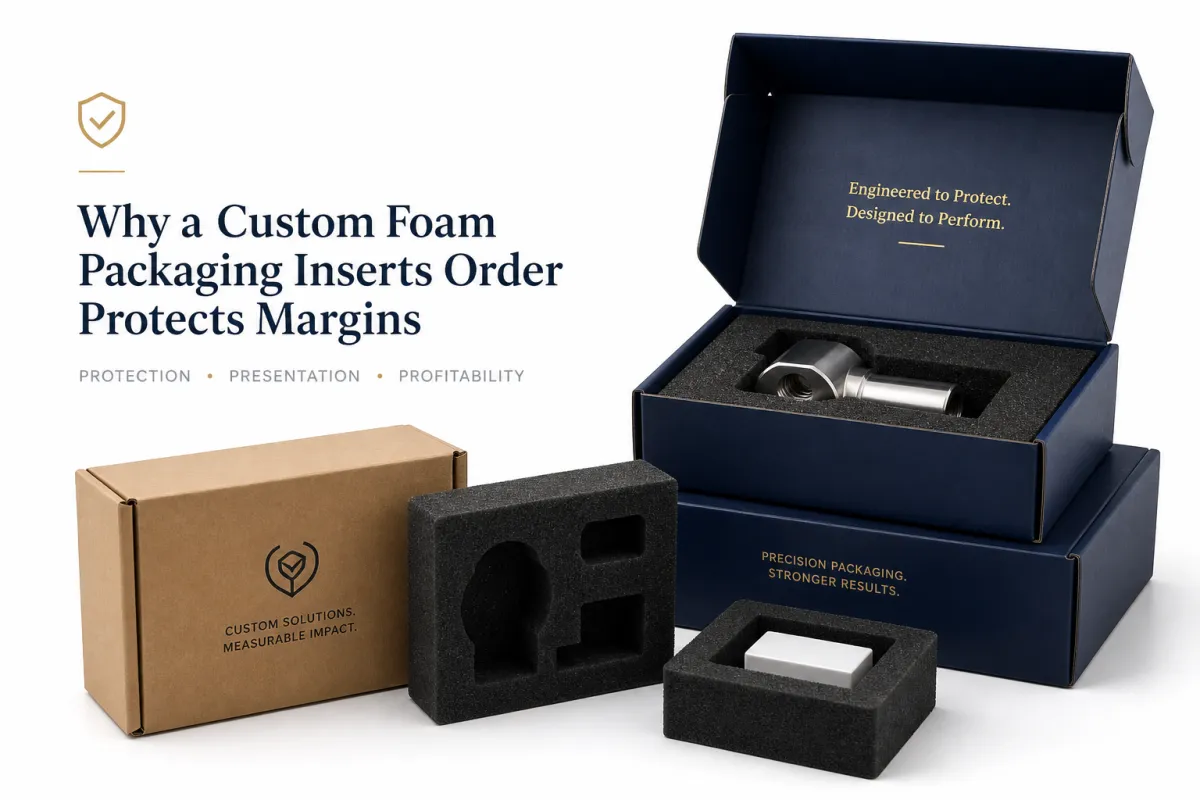
A damaged shipment costs more than the lost item. The obvious hit is the product itself, but the less visible costs often add up faster: refund processing, shipping resends, claim handling, inspection time, and the lost future order from a disappointed customer. A custom foam packaging inserts order lowers that exposure by keeping the product stable, centered, and cushioned in a way that can be repeated across the run. That matters for glass, polished metal, instruments, bottled products, and any multi-piece kit where components can strike each other in transit.
Warehouse flow changes too. A well-designed insert makes pack-out more predictable. Staff do not need to guess which end of the product faces up or which accessory belongs where. A custom foam packaging inserts order turns the process into a set motion. That may save only a few seconds per unit, but on a large production run those seconds become real labor savings and fewer packing errors. That is the kind of thing operations teams notice pretty quickly.
"A single breakage event can cost more than the insert that would have prevented it." That is not marketing language. It is a routine margin problem for any team shipping fragile product at scale.
Foam also acts as a control tool. A custom foam packaging inserts order does not simply absorb impact; it limits motion, stabilizes presentation, and helps the carton handle the variation that comes with real-world shipping. Products move through fulfillment, parcel sorting, truck transfer, and last-mile delivery before they reach the end customer. That is a rough trip, and it is usually rougher than buyers expect. For teams that want a testing benchmark, ISTA methods are a useful reference for drop and vibration performance because they reflect the kind of handling a package often sees before it arrives.
Here is the business logic in practical terms. A fragile kit can carry a healthy margin, yet even a small damage rate can trigger replacements, service time, and rush re-ships that chip away at profit. A better custom foam packaging inserts order may reduce claims, overtime, emergency replacements, and customer frustration all at once. That matters more than trimming a few cents from the foam.
Many teams spend heavily on finishes, outer graphics, and custom printed boxes, then under-spec the interior. The result is a polished shell with a product that slides around inside it. A better move is to align the outer package and the foam insert so the whole system tells one packaging story instead of two disconnected ones.
There is also a less obvious trust factor. When a customer opens a box and sees the product cradled properly, the package signals care before the product is even touched. That signal is part protection and part brand promise, and if the interior looks sloppy, the whole thing starts to feel kinda unfinished.
Custom Foam Packaging Inserts Order: Product Options
The foam type you choose changes the outcome of the custom foam packaging inserts order. Polyurethane foam is the softest common choice and works well for lighter cushioning, presentation pieces, and products that need a gentler touch. Polyethylene foam feels firmer and holds its shape well, which makes it a solid fit for heavier items, tools, and electronics. EVA foam sits between those two for many buyers, with a dense, clean feel that often suits projects where presentation and precision both matter. Anti-static foams are useful for electronics, components, and any item that should not build charge during handling.
A custom foam packaging inserts order can also take different forms. Die-cut foam is common for repeat production because it gives crisp cavity definition and stable dimensions. Waterjet-cut foam can handle more intricate shapes, tighter corners, and complex contours around irregular products. Layered foam works well when product depth changes, since each layer can be added or removed to create a stepped pocket. Pick-and-pluck foam is convenient for short runs or variable assortments, yet it rarely delivers the same presentation quality or tolerance control as a cut insert made for the product.
The foam should follow the product, not the other way around. Cosmetic kits often need cutouts for bottles, jars, droppers, and compacts while still looking polished in retail packaging. Medical devices need stable placement and easy removal without forcing the user to dig for the item. Tool sets benefit from firmer foam that reduces rattle and keeps each part visible. Electronics may call for anti-static protection, scratch resistance, and routing space for cords or accessories. A well-planned custom foam packaging inserts order can handle those needs in one layout.
Common use cases include:
- Cosmetics and fragrance kits with bottle cutouts and accessory pockets
- Medical device trays that need repeatable placement and clean removal
- Tool sets that require deep cavities and secure edge retention
- Glassware and ceramic items that benefit from wider shock-absorbing walls
- Electronics and accessories where anti-static foam is a better fit
- Promotional kits and sample boxes where presentation affects perceived value
Design details matter too. Finger notches make removal easier. Beveled edges can soften the visual cut line and make the insert feel more finished. Multi-depth layouts let one insert hold the main item and its accessories without wasting space. For a buyer comparing options in Custom Packaging Products, the strongest choice is usually the one that keeps pack-out simple for fulfillment while still making the opening experience feel intentional.
Surface texture deserves attention as well. If the product has a polished finish, plated surface, or soft coating, a rough foam can leave marks. A finer foam may raise cost a little, but it can preserve the finish and reduce complaints. That is why a custom foam packaging inserts order should be discussed alongside product packaging requirements before the product is fully approved, not after.
And yes, the finish can matter more than people first think. I have seen buyers approve a cavity based on dimensions alone, then discover the first production sample scuffs the coating because the surface is too aggressive. That is a fixable problem, but it is a lot easier to catch before the order ships.
Material and Fit Specifications That Matter Most
Buyers often ask for "a foam insert" before they have the measurements that make the quote accurate. That usually leads to revisions. A cleaner custom foam packaging inserts order starts with a proper spec sheet: product dimensions, product weight, quantity per carton or kit, overall carton size, and whether the insert holds one item or several components. If the product is asymmetrical, photos from multiple angles help a lot. If the assembly includes cables, chargers, literature, or small accessories, those pieces should be included in the pack-out plan from the beginning.
Fit tolerance is where foam work becomes technical. If the cavity is too tight, insertion slows down and the product can compress or scuff. If the cavity is too loose, the item shifts during transit. A solid custom foam packaging inserts order usually allows just enough compression to hold the item without forcing it. That balance depends on foam density, product finish, vibration expected in transit, and even how the product sits in the master carton. The best fit is rarely the smallest possible cavity. It is the one that protects the product while still keeping the pack-out efficient.
For many projects, the key specifications include:
- Density for cushioning strength and shape retention
- Thickness for vertical protection and tray depth
- Durometer or firmness for compression resistance
- Surface texture for scratch risk and presentation
- Color for branding and visual cleanliness
- Flame resistance where the end use requires it
- Static control for electronics and sensitive assemblies
Many buyers get caught by lot variation. A coating change, a slightly rounded corner, or a taller cap can alter the fit more than expected. In a custom foam packaging inserts order, exact dimensions matter, but the real product finish matters too. A matte bottle and a gloss bottle do not always behave the same way inside the same cavity.
Compression set matters for reusable packaging. If foam stays compressed after repeated use, it may stop supporting the item the way it should. That becomes a real issue for service kits, field kits, and promotional packaging intended to travel more than once. The insert should hold its shape long enough to justify the unit cost. A good custom foam packaging inserts order accounts for that from the start rather than waiting for the first shipment cycle to reveal the problem.
From a sourcing angle, it helps to think beyond the foam itself. If the insert sits inside a paperboard tray or a carton made with certified fiber, some teams prefer materials aligned with FSC sourcing goals for the overall pack. That is not a foam requirement, but it can matter to procurement and sustainability reporting. A strong custom foam packaging inserts order should fit into the whole packaging system, not just the insert cavity.
There is also the matter of assembly flow. If the insert is too stiff, packers slow down. If it is too soft, the product may seat differently from unit to unit. The sweet spot is usually found by looking at the product, the outer carton, and the line speed together, not as separate decisions.
Custom Foam Packaging Inserts Order Pricing, MOQ, and Quotes
Pricing for a custom foam packaging inserts order depends on a handful of repeatable variables. Material choice comes first. Polyurethane usually costs less than denser specialty foams, while polyethylene and EVA can move higher depending on firmness and finish. Cut complexity matters as well. A plain rectangular cavity is simpler than a multi-level insert with cable channels, finger notches, and tight radii. Thickness, footprint, quantity, and whether the job requires setup, tooling, testing, or samples all influence the quote.
In lower volumes, the unit cost can look high because setup is spread across fewer pieces. At higher quantities, the same custom foam packaging inserts order often drops in unit price because the engineering and setup effort gets distributed across more pieces. That is why procurement teams should ask for price breaks at several quantities instead of stopping at a single number. A useful quote often shows the step-down at 250, 500, 1,000, and 5,000 pieces if the run is large enough to justify those tiers.
The table below shows how buyers often compare foam options before approving a custom foam packaging inserts order. These are working ranges rather than fixed prices, because region, cut method, and finish can shift the number either way.
| Foam type | Best use | Relative price level | Strengths | Watchouts |
|---|---|---|---|---|
| Polyurethane | Light cushioning, presentation kits, softer goods | Lower to mid | Easy to cut, good visual finish, flexible fit | Less firm for heavy items; may compress sooner |
| Polyethylene | Tools, electronics, heavier products | Mid to higher | Firm, durable, good shape retention | Can cost more and may feel less plush |
| EVA | Retail packaging, premium kits, tight presentation | Mid to higher | Dense feel, clean edges, strong appearance | Not always the cheapest choice for basic protection |
| Anti-static foam | Electronics, circuit boards, sensitive components | Higher | Helps control static, protects delicate surfaces | Must be matched to the product and handling conditions |
For many buyers, a realistic budget at low volume may land somewhere around $1.50 to $6.00 per insert depending on size and complexity, while higher volumes can come down substantially once the design is locked in. A straightforward custom foam packaging inserts order for a simple cavity may cost less than that, while a premium multi-component kit can cost more. That is why any clean quote should list the foam type, thickness, cut method, and quantity in writing.
Minimum order quantity depends on the material and the process. Some foam jobs can move in smaller runs if the design is simple and standard tooling is not required. Others need a higher MOQ because setup time is the real cost driver. A custom foam packaging inserts order can be quoted quickly when the dimensions are clear and the layout is straightforward. It takes longer when the supplier needs sample approval, engineering review, or a revision cycle. If you are comparing options through Wholesale Programs, ask how the price changes with volume, because the spread can become meaningful once the run gets larger.
To keep the quote process clean, send this checklist the first time:
- Product dimensions and weight
- Carton or case dimensions
- Quantity per pack
- Preferred foam type, if known
- Product photos or a sketch
- Shipping destination
- Sample request or approval deadline
- Any brand or finish requirements
A detailed request shortens the back-and-forth. It also helps the supplier avoid quoting a custom foam packaging inserts order that looks fine on screen but fails in real pack-out conditions.
One practical caution: the cheapest quote is not always the best quote. If one supplier is ignoring product finish, compression, or carton tolerance, that lower number can disappear the first time a damaged shipment hits the books.
Custom Foam Packaging Inserts Order: Process and Timeline
The process should stay direct. A buyer sends the product specs, the supplier reviews the application, and the team confirms whether the custom foam packaging inserts order is best handled with a sample, a proof, or a full production build. After that comes the engineering check. That stage is where dimensions, tolerances, wall thickness, and cut feasibility get confirmed. If the product is unusually fragile or oddly shaped, the supplier may recommend a sample before production. That is not delay for its own sake. It is protection against an expensive mistake.
Timing depends on the design. A straightforward custom foam packaging inserts order with clear dimensions and a standard material can move faster than a multi-part insert with several accessories and a custom carton size. The biggest timeline variables are sample approval speed, revision count, material availability, and how quickly the buyer confirms the proof. Routine jobs often move from approval to shipment in business days rather than weeks. Complex jobs can take longer if testing or tooling changes are needed.
Good preparation shortens the schedule. Clear files help, yet not every buyer has CAD on hand. Photos, sketches, and a sample unit can still make the project much easier to quote and cut. If the product has moving parts, retractable features, or accessories that need to nest beside the main item, those details should be visible before the custom foam packaging inserts order reaches production. A supplier cannot engineer around dimensions that were never shared.
Here is the workflow most teams should expect:
- Inquiry - send dimensions, quantity, and product photos
- Review - confirm foam type, cavity layout, and carton fit
- Quote - receive pricing, MOQ, and lead time
- Sample or proof - validate fit and presentation
- Approval - sign off on the final specification
- Production - cut, inspect, and pack the insert run
- Shipment - send the order to the destination
Each checkpoint matters. A buyer who skips the proof stage may save a few days, but the risk rises if the tolerances are tight. A stronger custom foam packaging inserts order usually includes a fit check before release, especially for presentation items where the customer sees the insert the moment the box opens.
Communication should stay specific. Ask whether revisions are included, whether the sample represents the final foam, and whether the quote includes freight to your warehouse or dock. If the project depends on launch timing, say so early. Delays often happen because the team assumed the supplier understood the deadline. Put it in writing and confirm it before production starts.
That discipline pays off. A measured custom foam packaging inserts order protects the schedule as much as the product. A rushed order with missing details usually costs more than expected, not because the foam is expensive, but because the wrong details force a second round of work.
Why Choose Us for Precision Foam Inserts
Buyers do not need a supplier who says yes to everything. They need one who knows where the fit will fail, where the material will stretch too far, and where the packaging design should change before the quote is finalized. That is the difference between a commodity source and a practical partner. For a custom foam packaging inserts order, the most valuable service is not a sales promise. It is a clear recommendation grounded in production reality.
We focus on consistent tolerances, fast quote response, and sample support that reflects how the insert will actually be used. If the product needs firmer retention, we say so. If the cavity is too shallow for safe pack-out, we say that too. A custom foam packaging inserts order should not be forced into a design that looks good on paper but slows the line or leaves the product exposed in transit.
There is also a packaging operations gain. When the insert is engineered properly, the assembly team spends less time adjusting the pack-out. The end customer receives a cleaner presentation. The brand sees fewer claims. That helps product packaging, and it also strengthens package branding because the interior looks as considered as the exterior. For buyers comparing broader FAQ guidance with product options, the better question is not "Can foam hold the item?" It is "Can the whole system hold the item at scale, without constant exceptions?"
Our process is built for repeatability. That matters if you plan a second run, a seasonal refresh, or a wider rollout through retail packaging channels. A good custom foam packaging inserts order should be easy to reorder with the same fit, the same cavity map, and the same pack-out logic. That reduces training time and keeps the carton consistent from one batch to the next.
For teams that need premium presentation, the details become even more visible. Sharp cavity lines, even foam edges, and a balanced layout can make a simple box feel premium without adding unnecessary cost. The insert becomes part of the product experience. In that setting, a custom foam packaging inserts order is not just a protective component. It is part of the selling surface.
The outside still matters too. If the project includes branded packaging, custom printed boxes, or a display-ready carton, the insert has to match that standard. A rough interior inside a refined exterior is a mismatch buyers notice immediately. Our approach stays simple: align protection, presentation, and pack-out so the package works as one system.
Trust also comes from being honest about tradeoffs. Some materials look nicer but compress faster. Some firmer foams protect better but feel less plush in a luxury kit. We do not pretend there is a perfect material for every use, because there isn't. The right answer depends on the product, the transit profile, and the look you want the customer to see.
Next Steps to Place Your Custom Foam Packaging Inserts Order
If you are ready to move, start with the specs that make a custom foam packaging inserts order quote accurate. Send product dimensions, product weight, quantity, carton size, foam preference, and target ship date. If you have a prototype, include photos. If the product has fragile surfaces or unusual geometry, send a sample or a sketch. That small step can prevent the kind of revision that adds cost and stretches lead time.
Before you approve anything, check the details that usually cause trouble: foam type, color, thickness, tolerance, sample requirements, and whether revisions are included. A clean custom foam packaging inserts order usually comes from good preparation, not just good cutting. Ask for the itemized quote, compare the options by function rather than only by unit price, and confirm that the insert fits the pack-out you actually plan to use.
Once the sample or proof looks right, release production and lock the spec. That is the point where the project becomes easy to manage. If your team wants a broader sourcing view, the Custom Packaging Products page can help you match the insert to the outer packaging, while Wholesale Programs can be useful if the order will repeat at volume.
The fastest path stays simple: gather the data, request the quote, approve the sample, then release production. A disciplined custom foam packaging inserts order saves time, lowers risk, and gives your product a cleaner, more consistent presentation from shipment to shipment. If you want the quote to be accurate on the first pass, send the product, the carton, the target quantity, and a photo of how the item currently ships; that is the detail set that keeps the whole thing moving.
FAQ
What do I need to request a custom foam packaging inserts order?
Send product dimensions, weight, quantity, carton size, and the foam type or finish you prefer. Photos, sketches, or a sample product help the quote match the actual pack-out instead of a rough estimate.
How long does a custom foam packaging inserts order usually take?
Timing depends on design complexity, sample approval speed, and material availability. Simple projects move faster; projects that need revisions, testing, or tooling changes usually take longer.
Which foam type is best for a custom foam packaging inserts order?
Polyurethane works well for softer cushioning, polyethylene for firmer protection, and EVA when presentation and tighter fit matter. Anti-static foam is the better choice for electronics and other sensitive components.
Is there a minimum order quantity for custom foam inserts?
MOQ depends on the foam type, cut method, and whether setup is needed. Higher quantities usually lower the unit price, while small runs often cost more per insert because setup is spread over fewer pieces.
Can I revise the design after approving the sample?
Yes, but revisions after approval can affect cost and lead time because the fit or cut program may need updates. It is faster and cheaper to confirm tolerances and carton specs before final sign-off.

