Flat tags look polished until the brief expands: size information, care instructions, material notes, a barcode, a QR code, maybe a short brand story. At that point, custom Folded Hang Tags stop feeling like an upgrade and start feeling like the only practical way to keep the layout readable. One panel is rarely enough for a product that has to persuade, inform, and comply all at once.
From a packaging buyer’s perspective, the best tag is the one that earns its place without making the product look cluttered. Folded tags create more usable print space, separate brand messaging from functional details, and usually give the final piece a more considered retail presence. They are not always the lowest-cost option. They are often the cleaner one.
Why Folded Hang Tags Solve the “Too Little Space” Problem
A flat hang tag works well for a logo, a price, and maybe a short slogan. Then the actual product requirements show up. You still need sizing, wash or care symbols, fiber content, ingredient notes, compliance language, collection details, or a QR code linked to product packaging or a landing page. A small rectangle can only absorb so much before it starts looking busy and cheap.
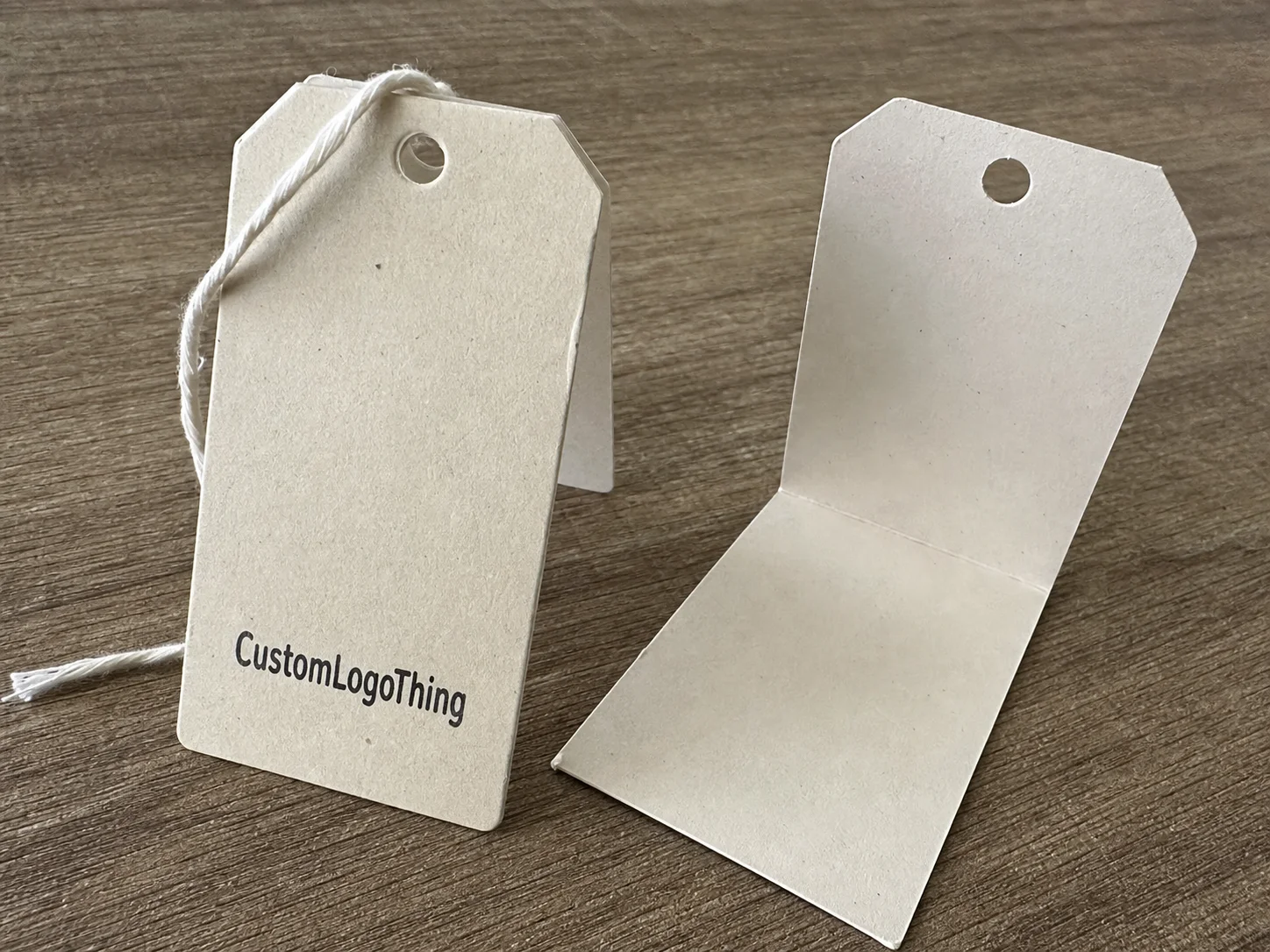
Custom Folded Hang Tags solve that problem by turning one surface into multiple panels. That matters for apparel, jewelry, cosmetics, gift items, subscription products, and coordinated product lines where the tag is doing part of the branding work. The format lets you put the front-facing message on one panel and move the practical content to another, which makes the whole piece easier to read and easier to handle.
There is also a subtle presentation benefit. A folded tag tends to feel thicker and more deliberate in the hand. That does not make it luxurious by default, but it does help the item read as finished rather than improvised. In retail packaging, those small cues matter more than many buyers expect.
Still, folded is not automatically better. If the tag only needs a logo and SKU, a flat tag is faster, cheaper, and less fussy. Folded tags are worth the added setup when the content genuinely needs the extra space or when the brand wants a more structured presentation.
“If the tag has to explain the product, care for the product, and sell the product, give it more than one panel. Otherwise you are asking a single card to do three jobs badly.”
How Custom Folded Hang Tags Are Made and Finished
Most custom Folded Hang Tags move through the same basic stages: stock selection, print, scoring, folding, trimming, punching, and finishing. The workflow is straightforward, but the quality outcome depends on details that are easy to overlook. A fold that is off by a millimeter, or a score that is too shallow, can make a premium design look rushed.
The typical build includes the following components:
- Stock selection: paperboard, textured paper, recycled stock, coated artboard, or a heavier premium sheet.
- Print method: digital for short runs, offset for larger quantities, or specialty printing for custom effects.
- Fold style: half-fold, gate-fold, or tent-style depending on panel count and usage.
- Finishing: matte, gloss, soft-touch, foil, embossing, debossing, spot UV, or rounded corners.
- Attachment: pre-punched hole, string, elastic loop, or pin attachment.
Half-fold tags are common because they are simple and readable. They give you a front panel and an inside spread, which is enough for most product facts and a short brand story. Gate-fold tags feel more presentation-heavy and work well for premium launches or higher-end items. Tent-style formats are less common, but they can work when the tag needs to stand upright or communicate on multiple visible faces.
Panel order matters more than many buyers realize. A good layout places the strongest branding on the front, supporting information inside, and functional details like barcode, SKU, or legal copy on the back or lower inside panel. If the sequence feels awkward, the tag will feel awkward. Customers may not be able to explain why, but they notice the difference immediately.
Finishes change the tone of the tag, but they also change how it behaves in use. Matte reduces glare and usually reads as modern or restrained. Gloss increases color saturation and works well for bright fashion, gift, or promotional items. Soft-touch feels premium, although it can show handling marks. Foil and spot UV can lift a design, but only if the composition is clean enough to support them. Heavy effects on a crowded layout just produce expensive clutter.
If you also need other Custom Packaging Products, it helps to align the tag style with the rest of the range. A tag should look related to the box, insert, or label system beside it. It does not need to match every surface exactly, but it should clearly belong to the same family.
Key Specs That Change Cost, Feel, and Durability
The quickest way to control cost is to understand which specifications actually move the quote. Not every premium option matters equally. Some are visually useful. Some are mostly invoice decoration.
Material choice is the first major lever. Paperboard in the 300gsm to 400gsm range is common for folded hang tags because it has enough stiffness to hang neatly while remaining printable and easy to score. Heavier stocks, roughly 450gsm to 600gsm, feel more substantial, but they can be harder to fold cleanly and may need more careful scoring to avoid cracking. Coated artboard usually gives the sharpest color reproduction. Textured stock adds tactile character. Recycled stock supports sustainability messaging, though it may slightly soften print contrast depending on the fiber mix.
Size matters, but panel count often matters more. A compact three-panel tag can cost more than a larger two-panel design because every extra fold adds setup, scoring, and labor. The shape may look modest on paper, but the production steps are doing more work behind the scenes.
Finishes have their own tradeoffs. A practical comparison looks like this:
| Spec | Best For | Typical Cost Impact | Tradeoff |
|---|---|---|---|
| Matte lamination | Clean, modern retail packaging | Moderate | Less color pop than gloss |
| Gloss coating | Bright fashion or gift items | Low to moderate | More glare under store lighting |
| Soft-touch lamination | Premium branded packaging | Moderate to high | Can scuff with heavy handling |
| Foil stamping | Luxury cues and accent branding | High | Best used sparingly |
| Embossing or debossing | Tactile package branding | High | Needs proper stock thickness and clean artwork |
Durability depends on where the tag will live. If it hangs in-store for weeks and gets handled repeatedly, laminated or heavier stocks hold up better. If it ships inside a box and gets brief use, a lighter paperboard can be enough. For products that move through distribution and handling as part of a larger packout, it is sensible to think in terms of basic packaging durability, and standards like ISTA are useful when the tag is part of a broader package system.
Attachment style also affects both durability and assembly time. Pre-punched holes are fastest. Stringing improves presentation but adds labor. Elastic loops can look tidy for some products and awkward for others. Safety pins are practical for certain garments, although they rarely feel elegant. The right choice depends on how quickly your team needs to apply the tag and how much the attachment should contribute to the final look.
Custom Folded Hang Tags Pricing: What Drives the Quote
The price of custom folded hang tags usually comes down to five things: quantity, stock, fold complexity, print coverage, and finishing. Add more panels or more decoration, and the number rises. That is not a hidden penalty. It is simply what happens when setup and labor increase.
Small runs cost more per piece because setup expenses are spread across fewer tags. A run of 250 or 500 pieces can sit in a much higher unit-cost range than 5,000 or 10,000 pieces. Larger quantities lower the per-unit price, but they raise the upfront spend. Buyers usually dislike that part until they compare the unit math and realize the numbers are behaving exactly as production economics would predict.
A realistic budgeting framework looks like this:
- Basic folded tag: simple stock, one or two colors, minimal finishing.
- Mid-range tag: better stock, full-color print, matte or gloss finish, pre-punched hole.
- Premium tag: thicker stock, foil, embossing, soft-touch, custom die cut, or stringing.
When requesting a quote, confirm whether these items are included:
- die cutting or scoring
- proofing fees
- stringing or attachment assembly
- packaging for shipment
- freight or delivery charges
Minimum order quantities vary. Some suppliers support lower-MOQ folded tags for launches or seasonal collections, which is useful when inventory risk is still unknown. Lower minimums usually mean a higher unit cost. That tradeoff is reasonable if you are testing a design. If the format is already locked and the volume is predictable, a larger run tends to deliver a better price point.
One practical way to protect the budget is to spend on the visible panels and simplify the hidden ones. Keep the front panel polished, use the inside for required details, and avoid unnecessary effects where they will not be seen. That tends to produce a better result than spreading the budget thinly across every surface.
For most buyers, the real price question is not “What is the cheapest tag?” It is “Which version does the job without creating rework, delay, or a weak presentation?” That distinction matters.
Production Steps and Timeline: From Artwork to Delivery
The production flow is orderly, but there are enough moving parts to create delays if the artwork is not prepared properly. A standard job runs through file review, proofing, print production, scoring and folding, finishing, quality control, packing, and shipping. Miss one step or rush the wrong one, and the schedule starts slipping.
Most delays happen before press time. Common problems include missing dielines, low-resolution images, unclear fold direction, or last-minute changes to panel order. If the printer has to infer which side is the front, the project is already in trouble.
Lead times depend on complexity and quantity. Simple digital runs can move quickly, often around 7 to 10 business days after proof approval. More involved jobs with foil, embossing, heavier quantities, or special die cuts can take 12 to 18 business days, sometimes longer if the artwork needs multiple revisions. Shipping time sits on top of that. International freight, custom packing, and seasonal congestion can stretch the calendar more than anyone prefers.
Plan backward from the launch date. Leave room for proof review, internal approvals, and the possibility of a correction. If the tag is tied to a product launch, compare the schedule against the rest of the product packaging timeline so the tags do not arrive after the goods do. That mistake is still common, and it is never convenient.
Rush production can work for simple layouts. It becomes a poor bet when the project has multiple finishes, tight color requirements, or a complicated fold sequence. Complexity and urgency tend to fight each other.
For brands that care about sustainability claims, paper sourcing and certification language should be checked early. If FSC-certified stock is part of the brief, ask for documentation rather than assuming the claim is available by default. The FSC site is a useful reference for understanding the terminology and what the certification actually covers.
How to Order the Right Folded Tag Without Rework
The best starting point is the product use case. Is the tag for retail display, gifting, compliance, storytelling, or price display? That answer should shape the fold, the panel count, the hierarchy, and the finish. Good design serves the job. It does not try to look impressive at the expense of function.
For custom folded hang tags, the panel plan usually works best when it follows a simple structure:
- Outside front: brand name, logo, collection title, or hero message.
- Inside panel: story, care instructions, sizing, ingredients, or product facts.
- Back panel: SKU, barcode, QR code, legal copy, or distributor info.
Artwork should be built on the correct dieline. Include bleed, safe zones, and exact panel order. If fold direction is wrong, the tag may open awkwardly or print upside down on one side. That is not a minor correction. It turns an expensive job into a reprint risk.
Before comparing prices, define the finish requirements. If one supplier quotes soft-touch and another quotes matte, those are not equivalent offers. Ask for a like-for-like comparison so the numbers mean something. Otherwise, the cheapest option may simply be a different product.
If the tag includes regulatory details, sizing, or brand-critical copy, request a digital proof and, where the project justifies it, a printed sample. For anything tied to compliance or a product line that must stay consistent over time, one proof can prevent a full reprint. That is cheap insurance.
If the tag is part of a broader line, it helps to keep it visually connected to your Custom Labels & Tags. Consistency across branded packaging usually makes the collection feel more intentional, even if customers never articulate why.
Mistakes That Waste Money on Folded Hang Tags
The costliest tag mistakes are usually ordinary ones. The first is overcrowding small panels with too much text. If the copy cannot be read once the tag is folded and attached, it is not helping the product. It is just taking up space.
Another common issue is pairing a premium finish with weak visual contrast. Gold foil on a busy background can look rich or unreadable, and those two outcomes are uncomfortably close. If the finish hides the message, the finish is doing too much.
People also forget about hole placement and attachment length until the artwork is already approved. Then the tag hangs too low, folds oddly, or covers part of the product. That is a layout problem, not a manufacturing mystery.
Fold direction deserves more attention than it usually gets. If the panel sequence is wrong, the brand story opens in the wrong order and the tag feels clumsy. Customers may not know the technical reason, but they feel the friction.
Approving a quote without checking setup fees, proof charges, assembly, and shipping is another expensive habit. The invoice arrives, and suddenly everyone discovers that “unit price” was only part of the story. Read the full quote. It is not exciting, but it is usually cheaper than guessing.
Expert Tips for Better Results and a Cleaner Buy
Use the outer panels for the strongest branding and the inner panels for detail. That gives the customer a strong first impression and a useful second read. The structure is simple, and simple tends to print cleanly.
Keep the hierarchy tight: one primary message, one secondary message, one functional section. More than that and the tag starts behaving like a brochure. If a brochure is actually needed, make one. A tag should still read like a tag.
Ask for stock swatches or finish samples when texture and color matter. Screen previews are useful, but paper has weight, sheen, and touch. Those things affect perception, especially for premium branded packaging and higher-end package branding.
If the budget is tight, simplify the structure before cutting print quality. A clean two-panel design on solid stock usually outperforms a complicated three-panel layout with weak finishing. Good hierarchy, good stock, good print. That is often enough.
Think beyond artwork. How does the tag open? Does it hang straight? Does it photograph well for online listings and social content? Does it support the product experience, or does it simply exist? Those are practical questions, and practical questions save money.
If you are ordering custom folded hang tags alongside custom printed boxes, keep the visual language consistent. The tag does not need to match every surface exactly, but the family resemblance should be obvious.
For first-time buyers, the safest process is straightforward: define the message, choose the fold around that message, then let the finish support the design instead of trying to rescue it. That approach tends to produce a tag that looks intentional, prints cleanly, and avoids unnecessary revisions.
What are custom folded hang tags used for?
They provide extra panel space for branding, care instructions, story content, pricing, or barcodes without making the tag overly large. They are especially useful for products that need a premium feel or more information than a flat tag can hold comfortably.
How much do folded hang tags usually cost per piece?
Unit cost depends on quantity, stock thickness, fold style, and finishing, but smaller runs usually cost more per tag. Specialty coatings, foil, or embossing increase cost quickly, while simpler stocks and finishes keep pricing more manageable.
What file format do I need for folded tag artwork?
A print-ready vector file with the correct dieline is ideal, usually PDF, AI, or EPS depending on the printer. Include bleed, safe zones, and panel order so the fold prints correctly the first time.
How long does production usually take for folded hang tags?
Simple jobs can move quickly, but specialty finishes, larger quantities, and proof revisions extend the schedule. Build in time for artwork review, proof approval, printing, folding, finishing, and shipping.
Are folded hang tags better than flat tags?
They are better when you need more space, a more structured presentation, or separate areas for story and compliance details. Flat tags still make more sense when simplicity, speed, and lower cost matter more than extra content.