Buyer Fit Snapshot
| Best fit | Custom Folding Carton Manufacturers projects where brand print, material claims, artwork control, MOQ, and repeat-order consistency need to be specified before quoting. |
|---|---|
| Quote inputs | Share finished size, material target, print colors, finish, packing count, annual reorder estimate, ship-to region, and any compliance wording. |
| Proofing check | Approve dieline scale, logo placement, barcode or warning zones, color tolerance, closure strength, and carton packing before bulk production. |
| Main risk | Vague material claims, crowded artwork, missing packing details, or unclear freight terms can make a low unit price expensive after revisions. |
Fast answer: Custom Folding Carton Manufacturers: Material, Print, Proofing, and Reorder Risk should be specified like a repeatable production item. The safest quote records material, print method, finish, artwork proof, packing count, and reorder notes in one written spec.
Production checks before approval
Compare the actual filled-product size with the drawing, then confirm tolerance on folds, seals, hang holes, label areas, and retail display edges. Reserve space for logos, QR codes, warning copy, and material claims before decorative graphics fill the panel.
Quote comparison points
Review material grade, print process, finish, sampling route, tooling charges, carton quantity, and freight assumptions side by side. A quote is only useful when the supplier can repeat the same color, closure quality, and packing count on the next order.
Custom Folding Carton manufacturers are the people who turn a flat spec into a box that survives shipping, stacks cleanly, and still looks intentional on shelf. That matters more than most brands expect, because the carton often does more visible work than the label, the insert, and sometimes even the product photo. A well-built carton can lift perceived value in one glance; a weak one can make a good product feel bargain-bin before anyone opens it.
From a packaging buyer's point of view, the difference between a generic printer and Custom Folding Carton manufacturers is not subtle. A printer may deliver ink on board. A packaging partner helps with structure, board selection, coating, folding logic, glue placement, and the plain reality of whether the box will run well in production and hold up in transit. That is a bigger job than decoration. It is product packaging engineering dressed up as branded packaging, and the brands that treat it that way usually avoid expensive surprises later.
I have sat in enough packaging reviews to know this: the sample that looks prettiest is not always the carton that wins. Once the line speed, freight conditions, and retailer handling come into view, a few millimeters and a few points of board can matter more than the artwork. A carton can be technically beautiful and still be the wrong choice if it crushes in a case pack or scuffs the first time it slides across a warehouse belt. That is the kind of detail Custom Folding Carton manufacturers live in every day.
There is another reason this category matters. Retail packaging has to compete on shelf, but ecommerce packaging has to survive corrugated shipping, conveyor handling, and consumer roughness that no studio mockup can fully predict. A carton that looks sharp in a render can still fail if the board is too light, the score is off, or the closure is too loose for repeated handling. Custom folding carton manufacturers sit at the intersection of design, manufacturing, and logistics, and that intersection is where launches either stay on schedule or unravel.
"A carton is not just a shell. It is a control point for presentation, protection, and production efficiency."
That is the practical lens this guide uses throughout. If your team is evaluating custom folding carton manufacturers, the right questions are rarely about color alone. They are about fit, stiffness, print accuracy, shipping durability, line compatibility, and whether the supplier can explain tradeoffs without hiding behind sales language. Good packaging design is visible. Good packaging execution is measurable.
What Do Custom Folding Carton Manufacturers Really Do?
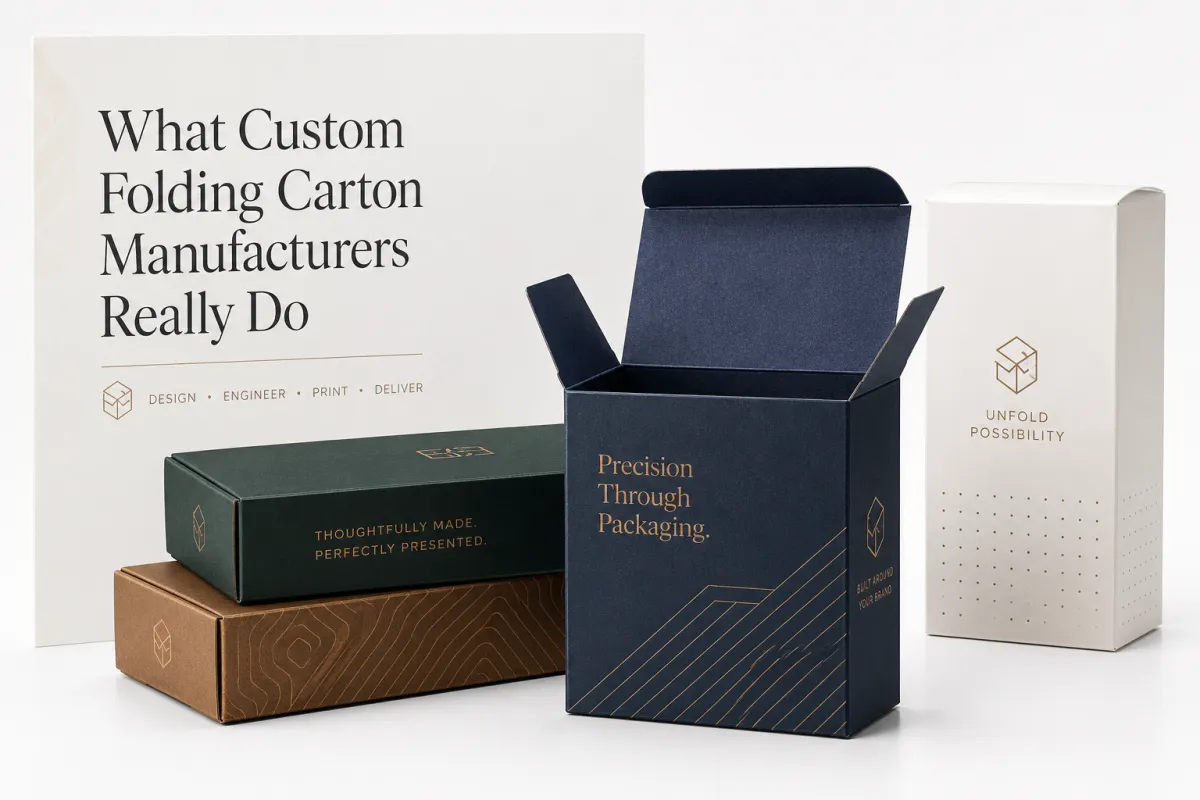
Custom folding carton manufacturers take a product brief and convert it into a physical carton system. That sounds simple until you break down the moving parts. They help determine the board grade, the caliper, the structure, the print method, the coating, the die line, the fold sequence, and the glue pattern. They also need to think about what happens after the box leaves the converting line. Will it tuck cleanly? Will it stand up under stacking? Will it scuff in transit? Will the graphics still read clearly under retail lighting?
In practice, the best custom folding carton manufacturers do more than print logos on paperboard. They translate a brand's visual goals into a box that can actually be manufactured at scale. A premium cosmetics carton might need a 14 pt or 16 pt SBS board with soft-touch lamination and a precise tuck flap. A supplement carton might need a more durable board with a stronger glue seam and clearer regulatory copy. A food carton may need FSC-certified board, grease resistance, or a coating compatible with distribution conditions. Different products demand different decisions, and that is why packaging design has to start with function, not decoration.
There is also a real difference between a box that looks right on screen and one that converts well in the plant. Custom folding carton manufacturers understand score depth, grain direction, shrink behavior, and how a slight change in ink coverage can affect fold memory. That sounds technical because it is. A 1 mm error in a panel can create a fit issue that shows up only after 5,000 units are printed. At that point, the issue is no longer theoretical. It becomes waste, rework, or delayed inventory.
For brands selling through retail packaging channels, the carton is often a brand ambassador. For ecommerce, it is part of the damage-control strategy. For club or bulk retail, it may need to survive pallet stacking and repeated consumer handling. Custom folding carton manufacturers help solve all three problems at once, which is why the best ones are closer to package engineering partners than commodity vendors. If you also need related components such as sleeves, inserts, or promotional cartons, reviewing Custom Packaging Products early can help your team compare structural options before artwork is locked.
A useful way to think about it is this: a generic printer can reproduce an image, but custom folding carton manufacturers are expected to reproduce a system. That system includes shelf presence, mechanical performance, and repeatability. The supplier's job is not just to make one perfect sample. It is to make the same box thousands of times without drifting in color, glue quality, or fold accuracy.
Common carton capabilities
- Structural design and dieline development
- Offset, digital, or flexographic printing
- Matte, gloss, aqueous, UV, or soft-touch coatings
- Window patches, inserts, foil stamping, embossing, and debossing
- Die cutting, folding, gluing, and pack-out support
That capability mix matters because not every supplier owns the same equipment. Some custom folding carton manufacturers print well but outsource finishing. Others are strong in converting but weak in structural guidance. A good buyer notices that difference quickly. The right supplier does not just say yes; they explain what is feasible, what is risky, and what will increase cost without improving the final pack.
How Custom Folding Carton Manufacturers Turn Specs Into Boxes
The production flow usually starts with a brief. Custom folding carton manufacturers need dimensions, product weight, quantity, print intent, finish preferences, and a delivery window before they can quote responsibly. Once that information is in hand, the supplier may recommend a structure, draft a dieline, and flag any concerns about strength, closure style, or carton orientation. That first conversation often reveals whether the project is straightforward or more technical than the buyer expected.
After intake comes the structural stage. Many custom folding carton manufacturers will create a mockup or blank sample before the graphics are approved. That is not bureaucracy; it is a safeguard. A sample can expose a panel that is too tight, a tuck that opens too easily, or a board choice that feels flimsy in hand. It can also reveal whether the package fits automated packing lines, tray loading, or hand assembly. A pretty carton that does not run efficiently is still a problem.
Next comes artwork setup and proofing. The manufacturer checks bleeds, barcode placement, type size, legal copy, and dieline alignment. That review is where many avoidable issues get caught. In one common scenario, a brand sends beautiful artwork that places critical text too close to the fold. Another project might use dark solids that are fine visually but reveal scuffing once the coating is applied. The earlier custom folding carton manufacturers catch those issues, the cheaper they are to fix.
Sampling can happen at several levels. A digital proof checks layout and copy. A structural mockup checks the box shape and size. A press proof checks color behavior. A pre-production sample, sometimes called a golden sample, becomes the reference point for the live run. Good custom folding carton manufacturers do not rush this chain, because every skipped step increases the odds of a surprise later. The goal is not just approval. The goal is predictable production.
Once the job reaches press and converting, the supplier manages print registration, sheet varnish or coating, die cutting, stripping, scoring, folding, and gluing. This is where material choices become visible. Board caliper affects stiffness. Grain direction affects folding. Coating affects rub resistance. Glue pattern affects speed and bond strength. Custom folding carton manufacturers that understand all of this can recommend a solution that is easier to run and more consistent to inspect.
The strongest teams also run quality checks at several points, not just at the end. They look for print variation, fold cracking, glue squeeze-out, damaged corners, and carton squareness. For buyers, that consistency matters more than most spec sheets admit. A carton that looks identical across a run of 50,000 pieces protects the brand in a way that no ad campaign can.
For packaging teams that need a technical benchmark, standards from organizations like ISTA are useful for transit testing, while FSC helps frame responsible sourcing discussions. Not every carton needs the same certification path, but competent custom folding carton manufacturers should be able to explain which standards apply to your application and which do not.
It also helps to think about how this process reduces risk. A carton that looks fine in a PDF may still fail if the fold order creates memory problems, if the printed coverage causes cracking, or if the closure is awkward for the packaging line. Custom folding carton manufacturers earn their keep by catching those problems before full production starts, not after.
Key Factors That Affect Cost and Pricing
Pricing is where many buyers get misled, because two quotes can look similar while hiding very different assumptions. Custom folding carton manufacturers usually price around size, board grade, print coverage, finishes, quantity, and how much setup the job needs. A small reverse-tuck carton with light ink coverage is usually cheaper than a large carton with full flood coating, specialty varnish, and a window patch. That sounds obvious, but in practice buyers still compare only the headline unit cost and miss the details that drive total spend.
Quantity changes everything. Smaller runs carry heavier setup cost per unit because plates, die lines, press make-readies, and changeovers are spread over fewer cartons. On a 2,500-piece order, the unit price might feel high; on a 50,000-piece order, the unit price often drops because the setup is diluted. The smartest custom folding carton manufacturers explain where those thresholds sit instead of hiding them. That lets brands decide whether to buy less and pay more per piece, or buy more and reduce the long-run unit cost.
Board choice also moves price. A premium 18 pt SBS board, recycled CRB, or specialty coated stock may perform differently in print and conversion. Caliper affects stiffness and folding behavior, while coating affects scuff resistance and appearance. If a carton needs strong shelf presence, the supplier may recommend a heavier board or a more durable finish. If the job is purely functional, a lighter structure may be enough. Custom folding carton manufacturers that can explain those tradeoffs help buyers spend money where it actually shows.
Special finishes are easy to underestimate. Foil stamping, embossing, debossing, soft-touch lamination, spot UV, and windowing all add labor or tooling. Some features also introduce extra reject risk. A window patch can look elegant but adds another converting step. Foil can elevate package branding, yet it may slow production or complicate registration. Good custom folding carton manufacturers will price those items transparently and tell you which effects are worth the cost for your channel.
There are also hidden cost drivers. Tooling, plates, dielines, prepress time, freight, storage, and extra QC all affect the real invoice. If a supplier needs to hold cartons longer because your warehouse is not ready, storage fees may appear. If the carton must be packed in a very specific way for automated equipment, labor can rise. If the spec changes after proof approval, there may be rework charges. These are not minor details; they often decide whether a project stays on budget.
The table below gives a practical pricing lens. These are illustrative ranges only, not quotes, but they help buyers compare options on a realistic basis rather than hoping for one universal number from custom folding carton manufacturers.
| Carton Type | Typical Best Use | Approx. Unit Range | Common Cost Drivers |
|---|---|---|---|
| Straight tuck carton, simple print | Cosmetics, supplements, light consumer goods | $0.16-$0.24 at 5,000 units | Board grade, print coverage, basic aqueous coating |
| Reverse tuck carton, four-color print | Retail packaging with stronger presentation needs | $0.22-$0.38 at 5,000 units | Artwork coverage, finishing, folding complexity |
| Window carton with patch | Items that benefit from product visibility | $0.30-$0.55 at 5,000 units | Window film, patching, extra converting step |
| Premium carton with foil or embossing | High-end branded packaging and gift sets | $0.45-$0.90 at 5,000 units | Tooling, specialty finishes, stricter QC |
One useful rule: the cheapest quote is not always the lowest-cost outcome. If two custom folding carton manufacturers are within 10% of each other, the real decision often comes down to quality control, response speed, and how clearly they explain the spec. A slightly higher quote can save money if it prevents damage, rejects, or a reprint. On the other hand, an unusually low price can signal thin board, vague assumptions, or a supplier planning to charge back later for changes that should have been visible from the start.
For brands building a packaging budget, a strong RFQ should ask for line-item clarity. Request separate pricing for structure, print, coating, inserts, shipping, and any tooling. Ask whether the quote includes proofs and sample rounds. Ask whether freight is included. Ask whether the supplier assumes a particular carton orientation or pack-out method. Custom folding carton manufacturers that answer these questions directly usually save everyone time.
Step-by-Step Guide: Timeline and Process
Lead time is another area where expectations can drift. Custom folding carton manufacturers usually need more time than a stock-box supplier because the process includes structural work, artwork approval, sampling, and production scheduling. A simple carton with no special finish may move from quote to delivery in roughly 10 to 15 business days after proof approval, but more complex jobs can take several weeks once sampling and freight are included. Those ranges depend on material availability, quantity, and the supplier's current load.
The first timeline milestone is the initial brief. If the dimensions are clear, the product is stable, and the print requirements are simple, the quote can move fast. If the product is fragile, needs inserts, or must fit within a strict retail tray, the process takes longer. Custom folding carton manufacturers often ask for a target product sample or a target dieline because that reduces uncertainty early. A little detail upfront can save days later.
Sampling is usually the next gate. Structural mockups may take a few days. Artwork proofs can be turned quickly, but revisions are what slow things down. The biggest delay is often not the manufacturer; it is internal approval. Someone notices a compliance line needs adjusting. Marketing wants a larger logo. Operations wants a stronger closure. That is normal, but each change resets part of the clock. The best custom folding carton manufacturers tell buyers where those approval points live so the calendar stays realistic.
Production itself can be efficient once the job is approved, but only if the specification is stable. Material sourcing is a major variable. Specialty board, coated stock, or FSC-certified material may need lead time. Finishes like foil, embossing, or window patching may require separate scheduling. If the carton must align with a product launch, build the timeline backward from the ship date rather than forward from the first quote. That approach gives room for proof revisions, testing, and freight delays.
Many packaging teams forget the final mile. A carton that leaves the plant on time is not necessarily ready for launch. Transit, receiving, warehouse put-away, and contingency stock all need buffer time. If the cartons travel cross-country, add freight days. If they are entering a co-packer or fulfillment center, add receiving and inspection time. Custom folding carton manufacturers can meet a production schedule and still miss the launch if the rest of the supply chain is not aligned.
A practical timeline often looks like this:
- Brief and quote request with dimensions, quantity, and finish goals
- Structural recommendation and dieline draft
- Artwork placement, proofing, and copy review
- Sample approval or revision round
- Press setup, print, die cut, fold, and glue
- Quality check, pack-out, freight, and receiving
That sequence seems straightforward, but each step can expand if the spec is unclear. A buyer who understands the workflow will ask sharper questions and avoid reactive decisions. Custom folding carton manufacturers prefer that too, because it reduces churn and protects the calendar. And if the product launch is tied to a retail reset, a promo calendar, or a trade show, the margin for error gets even smaller.
For teams looking at packaging design alongside sourcing, a smart move is to align structure, artwork, and logistics in one review rather than three separate ones. That is especially true for custom folding carton manufacturers who are expected to support not just print output, but retail packaging performance, machine compatibility, and shipping efficiency.
How to Evaluate Custom Folding Carton Manufacturers
Here buyers can separate marketing language from real capability. Custom folding carton manufacturers should be judged on several practical criteria: structural support, print quality, converting precision, certifications, communication, and consistency across repeat runs. A polished website matters less than the ability to explain how a carton will behave after 30,000 folds, how the board will perform under stacking, or how a last-minute artwork change will affect the schedule.
Communication quality is one of the best early indicators. If a supplier is slow, vague, or evasive during quoting, that pattern often continues during production. If they ask detailed questions about size tolerance, fill weight, shipping environment, and finish expectations, they are probably thinking like a packaging partner. Strong custom folding carton manufacturers do not just answer questions. They ask the right ones before the job is accepted.
Look closely at technical support. Can the supplier help with dieline refinement? Can they advise on board caliper? Do they know how fold style changes line speed or carton memory? Can they suggest a better closure if the original design is too loose? These details matter because a carton is both a branding surface and a physical object. The best custom folding carton manufacturers understand that dual role and can speak to both.
I have seen projects go sideways because everyone admired the artwork and nobody asked how the carton would behave under pressure. A seal that opens too easily, a panel that bows under load, or a varnish that shows scuffing after one distribution cycle can turn a good concept into a headache. That is why evaluating custom folding carton manufacturers has to include the boring questions too. The boring questions are often the expensive ones.
What to inspect in samples
- Color consistency: Are solids even, or do they show banding and variation?
- Scuff resistance: Does the coating hold up under handling?
- Fold quality: Do the creases crack or whiten?
- Glue strength: Do seams stay closed after pressure or handling?
- Fit: Does the product sit securely without forcing the carton open?
Sustainability also belongs in the evaluation. Buyers increasingly want recycled board, FSC sourcing, and lower-impact coatings. Not every project needs the same environmental profile, but responsible custom folding carton manufacturers should be able to discuss material options honestly. If a carton needs food-contact compliance, retail regulatory copy, or a specific claim structure, those requirements should be stated before production begins. That is not overcautious. It is normal risk control.
The right supplier also has a plan for consistency at scale. A beautiful sample is useful, but a beautiful repeat order is better. Ask whether the same press setup, board source, and QC approach will be used on future runs. Ask how deviations are handled. Ask what tolerance range is acceptable for critical dimensions. Custom folding carton manufacturers that can answer those questions clearly are usually safer long-term partners than those who rely on broad promises.
If you are comparing vendors for Custom Printed Boxes, use a scorecard. Rate each supplier on price, sample quality, structural help, communication, timeline realism, and problem-solving. That turns a fuzzy sales process into a decision you can defend internally. It also helps a brand team avoid the trap of choosing a supplier because the quote arrived fastest instead of because the carton will actually perform.
For a company like Custom Logo Things, that practical comparison is the point. A buyer exploring About Custom Logo Things can pair supplier research with the broader product range, then decide whether the packaging needs a premium finish, a simpler build, or a different insert strategy. The more specific the brief, the more useful the quote.
Common Mistakes When Choosing a Manufacturer
The first mistake is comparing only unit price. Custom folding carton manufacturers do not all include the same board quality, coating, or QC discipline. A low quote can hide thin board, weak glue, or a production approach that creates more rejects than it should. If the carton is going to sit on a retail shelf or ride through fulfillment, that difference shows up fast. The cheapest box is often the one that creates the most downstream cost.
The second mistake is vague specifications. A brief that says "premium box" or "high-end packaging" leaves too much room for interpretation. Good custom folding carton manufacturers need dimensions, product weight, print coverage, target finish, and packaging environment. Without those details, they are forced to guess. Guessing leads to re-quotes, sample revisions, and delays. It also makes it hard to hold anyone accountable later because the original scope was too soft.
The third mistake is skipping structural testing. If a carton holds a heavy product, ships in multiples, or includes an insert, the structure needs to be checked before the full run. That may mean a mockup, a drop test, or a simple fit test with the actual product. For ecommerce packaging especially, custom folding carton manufacturers should know whether the carton needs additional protection, stronger board, or a different closure style. A shelf-ready carton and a shipping-ready carton are not always the same thing.
The fourth mistake is ignoring artwork discipline. A design that looks great on a monitor can fail once it hits the die line. Fine text near a fold, heavy coverage on a crease, or poorly placed barcodes can cause trouble. A strong packaging design workflow keeps production in the room early. The best custom folding carton manufacturers will review these elements, but the buyer still needs to confirm that the artwork team and the manufacturing team are looking at the same spec.
The fifth mistake is under-planning inventory. A carton launch needs more than just a production date. It needs buffer stock, receiving time, and a backup plan if sales move faster than expected. If a product takes off, a second carton order may need to be placed before the first one is fully consumed. That is another reason to work with custom folding carton manufacturers who can repeat a build consistently. A one-off sample is not enough if the program will run for months.
There is also a softer mistake: assuming all packaging suppliers are interchangeable. They are not. Some excel at branded packaging for luxury retail. Some are better at practical retail packaging with clean structure and efficient pack-out. Some are strongest on high-volume repeat work. Others shine on specialty decoration. Choosing among custom folding carton manufacturers is less about finding the single "best" supplier and more about matching the supplier's strengths to the job.
If a project includes multiple components, review the full package architecture before you place the order. A carton that needs inserts, labels, or a secondary mailer can shift cost and timing quickly. That is why experienced buyers often compare custom folding carton manufacturers against the broader packaging plan, not just the carton itself.
Expert Tips and Next Steps for Shortlisting
The easiest way to improve your sourcing results is to prepare a tighter RFQ. Before you contact custom folding carton manufacturers, gather the essentials: carton dimensions, product weight, quantity, target launch date, shipping destination, print goals, finish preferences, and any compliance or sustainability requirements. If you already have a product sample or a rough dieline, include that too. A little discipline upfront makes the quote more accurate and the timeline more credible.
Ask for more than a price. Request a clear spec sheet, a sample if possible, and a line-item breakdown that separates structure, print, finishing, tooling, and freight. This is the difference between evaluating packaging and evaluating sales talk. Good custom folding carton manufacturers should be comfortable giving you the information needed to compare offers on equal terms.
Then score the responses. Price matters, but so does communication, sample quality, timeline realism, and problem-solving. If one supplier is cheaper but evasive, that is a warning. If another is slightly higher but catches a fit issue before the first proof, that can be the stronger buy. From a packaging buyer's point of view, a supplier's value is measured by how many problems they prevent before production starts. That is especially true for custom folding carton manufacturers working on time-sensitive product packaging programs.
Use physical samples to compare side by side. Hold them, fold them, stack them, and check them under real light. Compare panel stiffness, coating feel, fold memory, and print clarity. For premium programs, ask whether the carton will run cleanly through the co-packer or fulfiller's process. For more technical programs, ask whether the structure aligns with transit testing or internal QC standards. A carton is not just a visual asset. It is a mechanical one.
Finally, schedule a technical call before you commit. The goal is to confirm assumptions before money is spent on tooling or plates. Talk through board choices, coating options, finish risks, and any potential revisions. If the supplier cannot explain the consequences of a design decision, that is useful information. Custom folding carton manufacturers should bring clarity, not fog.
For brands comparing packaging partners, a simple three-step path usually works best: gather your specs, request three quotes, and compare sample cartons side by side before you place the order. That process is slower than clicking the lowest price, but it is far safer. It also gives your team a cleaner internal case for the choice. If you need adjacent packaging formats, reviewing Custom Packaging Products alongside carton options can make the shortlist more efficient.
One final observation: the best custom folding carton manufacturers are not trying to win by noise. They win by making the carton do its job quietly and consistently. In branded packaging, that often looks effortless. Under the hood, it is anything but. A stable carton helps a product look credible, ship better, and sell with less friction. The clearest next step is not to hunt for the flashiest quote; it is to define the carton tightly enough that the sample tells you the truth.
FAQ
What do custom folding carton manufacturers need to quote accurately?
They need carton dimensions, product weight, quantity, board preference, print coverage, finishes, and the delivery location. A dieline or a target product sample makes the quote more accurate because it reveals fit risks early. If you have compliance needs, FSC sourcing goals, or transit requirements, include those from the start so the quote reflects the right material and testing assumptions.
How long do custom folding carton manufacturers usually take?
Lead time depends on sampling, artwork approval, material availability, and production load. A simple carton with no special finish can move faster than a complex structure with windows, inserts, or premium decoration. Build in buffer time for proof revisions and freight so your launch date does not depend on best-case timing.
Are custom folding carton manufacturers better than general print shops?
Packaging-focused suppliers usually bring stronger structural design, converting, and production controls. They are more likely to understand retail durability, automation needs, and carton performance in shipping. A print shop may be fine for very simple projects, but packaging-specific expertise matters when fit, function, and repeatability are critical.
What affects pricing the most when working with custom folding carton manufacturers?
Quantity, board stock, print complexity, coatings, inserts, and finishing steps are the biggest price drivers. Setup costs matter more on smaller runs, while material efficiency matters more at scale. Freight, storage, and revision cycles can also change the real total cost, even if the unit price looks attractive at first.
Can custom folding carton manufacturers help with design and structure?
Yes, many can help refine the dieline, folding style, board choice, and carton performance before production. That support is especially useful when the box must protect a product, fit a display, or work with packing lines. Ask whether structural engineering is in-house or outsourced so you know how design changes will be handled.
The right custom folding carton manufacturers do more than deliver boxes. They help translate product intent into packaging that looks good, runs cleanly, and holds up where it matters. If you start with clear specs, realistic timing, and sample-based comparisons, you will choose better, spend more intelligently, and avoid the kind of packaging mistakes that only show up after the launch is already live.