Buyer Fit Snapshot
| Best fit | Custom Garment Bags Wholesale projects where brand print, material claims, artwork control, MOQ, and repeat-order consistency need to be specified before quoting. |
|---|---|
| Quote inputs | Share finished size, material target, print colors, finish, packing count, annual reorder estimate, ship-to region, and any compliance wording. |
| Proofing check | Approve dieline scale, logo placement, barcode or warning zones, color tolerance, closure strength, and carton packing before bulk production. |
| Main risk | Vague material claims, crowded artwork, missing packing details, or unclear freight terms can make a low unit price expensive after revisions. |
Fast answer: Custom Garment Bags Wholesale: Film, Print, MOQ, and Carton Packing should be specified like a repeatable production item. The safest quote records material, print method, finish, artwork proof, packing count, and reorder notes in one written spec.
Production checks before approval
Compare the actual filled-product size with the drawing, then confirm tolerance on folds, seals, hang holes, label areas, and retail display edges. Reserve space for logos, QR codes, warning copy, and material claims before decorative graphics fill the panel.
Quote comparison points
Review material grade, print process, finish, sampling route, tooling charges, carton quantity, and freight assumptions side by side. A quote is only useful when the supplier can repeat the same color, closure quality, and packing count on the next order.
Custom Garment Bags Wholesale: What Buyers Need to Know
Custom garment bags wholesale is not just a packaging line item. It affects how a garment hangs, how it travels, how clean it looks when it arrives, and how much extra handling the team has to do before the piece is ready for display or delivery. I have seen a well-cut suit look flat-out tired simply because the bag was too thin at the shoulders or too weak at the zipper. The garment may be perfect, but if the cover fails the basics, the first impression gets dragged down right away.
Custom Garment Bags Wholesale: The Hidden Cost of Wrinkled Product
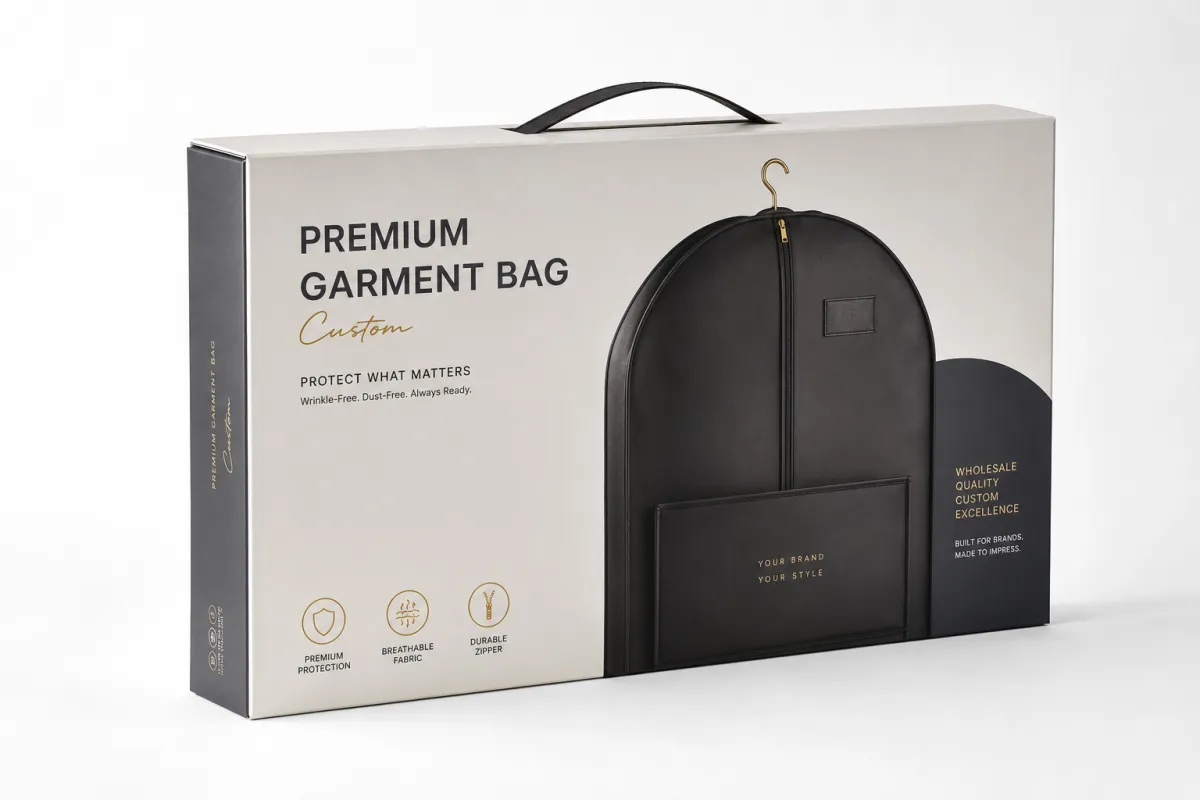
Most buyers start with protection, then realize custom garment bags wholesale is really about the entire handling path from packing to handoff. A low-cost bag may keep dust off the fabric, but if it collapses on the hanger, traps moisture, or shifts the shoulder line during transit, it has already created work for someone else. The package should support the garment, not fight it.
Warehouse teams notice this faster than anyone. A better bag can save a few seconds on each unit, and that sounds small until you are moving hundreds or thousands of garments through receiving, storage, or store replenishment. Better zipper glide, clearer size labeling, and cleaner hanger access all trim friction. That kind of practical improvement is why custom garment bags wholesale is often chosen for programs that need consistency more than flash.
The business case is easy to follow. Better presentation can reduce complaints tied to dust, crushed hems, or mixed-up sizing. It also helps seasonal apparel programs stay organized, which is why buyers handling suits, uniforms, bridal wear, outerwear, and travel collections often move toward custom garment bags wholesale instead of a one-size-fits-all option. The right spec keeps bulk apparel programs easier to receive, store, and ship.
From a packaging buyer's point of view, garment bags belong in the broader branded packaging system. If a company already invests in package branding, product packaging, or custom printed boxes, the garment bag should feel like part of the same family. That does not mean every piece needs to look identical. It does mean the material feel, print style, and level of protection should make sense together.
"A garment bag should protect the silhouette first and present the brand second. If it does neither, it is costing money in both directions."
In practice, custom garment bags wholesale works best when the buyer defines the job before asking for quotes. Is the bag meant for display, storage, transit, travel, or some mix of those? Does the program need breathability, moisture resistance, or a more premium look? Those answers change the material, closure, and decoration choices, and they change the price too. There is no magic formula here, just a smart match between use and construction.
Custom Garment Bags Wholesale Materials, Closures, and Branding Options
Material choice drives most of the feel and a big share of the cost in custom garment bags wholesale. Non-woven polypropylene is a common starting point because it gives a clean, structured look at a practical price. PEVA works well for buyers who want a smoother surface with more water resistance. Cotton and canvas move the bag into a more premium lane, with a softer hand and a reusable feel that suits bridal, boutique, and special-event programs. Recycled blends are showing up more often as buyers want a sustainability story without giving up everyday performance.
Closures matter just as much. A full-length zipper gives the easiest access and usually feels the most familiar to users. Two-way zippers help on longer bags. Fold-over tops are simpler and can reduce hardware cost, while gusseted bodies create room for wider shoulders, uniforms, or garments with more volume. Reinforced seams, a properly sized hanger opening, and a clean bottom finish are not minor details; they decide how well custom garment bags wholesale performs after repeated handling.
| Material | Best Fit | Typical Feel | Approx. Wholesale Range |
|---|---|---|---|
| Non-woven polypropylene | Suits, uniforms, value-focused retail packaging | Structured, lightweight, practical | $1.10-$2.60 per unit |
| PEVA | Travel garments, outerwear, moisture-sensitive storage | Smooth, slightly water-resistant | $1.60-$3.40 per unit |
| Cotton | Bridal, premium boutiques, reusable programs | Natural, softer, elevated | $2.40-$5.80 per unit |
| Canvas | Heavy-duty or long-life garment storage | Sturdy, premium, reusable | $3.50-$7.20 per unit |
| Recycled blend | Eco-forward branded packaging | Balanced, modern, practical | $1.40-$3.30 per unit |
Branding choices can stay simple or become highly tailored. Screen printing is a practical match for logos with clear shapes and limited colors. Heat transfer works well for detailed marks or smaller runs. Woven labels, color panels, contrast piping, and custom trims can turn custom garment bags wholesale into a stronger package branding statement without depending on full-surface print coverage. If the logo needs to read from across a showroom, a bold panel and a restrained print often look cleaner than a busy all-over layout.
The bag should also match the product category. Businesswear usually needs a balance of structure and breathability. Bridal garments often need extra length, softer finishing, and careful zipper placement so lace and beadwork are not snagged. Uniform programs need repeatable sizing and easy identification. Outerwear benefits from more room at the gusset, while travel pieces may need a lighter build that folds down cleanly. That part is kind of obvious once you say it out loud, but it still gets missed in procurement all the time.
For buyers comparing material systems, it helps to think beyond garment bags alone. A line that uses matching branded packaging, custom printed boxes, and coordinated product packaging often creates a stronger shelf presence than any single item can deliver. That is where custom garment bags wholesale becomes part of a larger retail packaging decision rather than an isolated purchase.
For additional references on packaging materials and sourcing concepts, the Sustainable Packaging Coalition at packaging.org and the general testing guidance at ista.org are both useful starting points. They will not pick the right bag for you, but they do help ground the conversation in real materials and transit expectations.
Fit and Protection Specs for Garment Bags
Fit decides whether custom garment bags wholesale works in the real world. Measure the garment while it hangs, not only when it is folded flat. A long dress, a suit coat, or a uniform set can spread wider once it is on a hanger, especially at the shoulders and sleeve points. The bag should let that shape stay natural. If the shoulders are compressed, wrinkles become more likely and the customer notices immediately.
The simplest sizing rule is straightforward: measure the full hanging length, then add room for the hanger, top clearance, and bottom movement. Width matters too, but gusset depth is what keeps the bag from pinching the garment inward. For many custom garment bags wholesale orders, a buyer who ignores gusset depth ends up with a bag that looks fine in a sample photo but fails during packing. That gap between sample and use is where the hidden cost shows up.
Sizing and structure details that matter
- GSM or fabric weight: A heavier non-woven fabric usually feels more stable and hides the garment better, while a lighter material may work for temporary storage.
- Zipper quality: Smooth zipper action reduces repacking friction and keeps the bag from snagging during fulfillment.
- Seam reinforcement: Reinforced side and bottom seams help the bag hold shape after repeated use.
- Hanger opening: A clean top opening keeps the hanger accessible without leaving too much exposed fabric at the shoulder.
- Ventilation: Small vent features or breathable materials help where garments may be stored for longer periods.
- Top or bottom structure: A rigid top section or reinforced base can improve presentation for premium retail packaging programs.
Protection needs shift with the application. Dust resistance is the priority for showroom or backroom storage. Moisture management matters more for warehouse handling, cross-docking, or mixed freight. A premium-looking opaque body protects the garment visually, while a slightly translucent or windowed panel can help staff identify contents faster. That tradeoff is common in custom garment bags wholesale, because operations teams often want speed and merchandising teams want a cleaner display.
For shipping-heavy programs, buyers should think in terms of handling, not only appearance. ISTA testing standards are often used as a reference point for package movement and transit expectations, especially when a garment bag is part of a larger parcel or carton system. If your brief includes paper-based components or outer cartons, FSC-certified materials can support a sourcing story without changing the bag's core function. That is where the packaging choice becomes part of the operational design, not just the look. The role of custom garment bags wholesale is to protect the garment through every touchpoint, from hanging storage to final handoff.
Practical distribution details make a difference too. Fold-and-pack layouts reduce carton bulk. Clear size labels save time in multi-style programs. Department codes help chains that ship to many locations. Some buyers also ask for a hang hole, a barcode panel, or a simple content window so staff can identify the bag without opening it. Those features look minor on a spec sheet, but they reduce errors when the volume gets high.
Custom Garment Bags Wholesale Pricing, MOQ, and Quote Factors
Pricing for custom garment bags wholesale is shaped by more than the fabric itself. Size, gusset depth, print coverage, zipper type, trim, packing format, and order quantity all feed into the final unit cost. A plain non-woven bag with a one-color logo will usually price lower than a cotton garment bag with a color-matched zipper, woven label, and reinforced seams. Buyers often compare quotes by unit price alone, but the smarter view is total landed cost.
MOQ works the way wholesale buyers expect: setup costs are spread across the run, so smaller orders generally cost more per unit. That is normal. A few hundred custom garment bags wholesale pieces may need nearly the same design prep, pattern work, cutting setup, and print setup as a much larger order. Once the volume climbs, the unit price usually improves because the fixed work is diluted across more bags. The range depends on construction, but buyers usually see better economics once they move into larger production runs.
| Order Size | Typical Cost Behavior | Buyer Advantage |
|---|---|---|
| 200-500 pieces | Higher unit price due to setup and handling | Useful for trials, launches, or niche programs |
| 1,000-3,000 pieces | Moderate pricing with more design flexibility | Good balance of cost and customization |
| 5,000+ pieces | Lower unit price if specs stay consistent | Best for chain retail, uniforms, and repeat replenishment |
Quote details deserve a close read. Sample charges may or may not be credited back on a large order. Artwork revisions can add time and sometimes cost. Tooling or plate fees may appear for print methods that need them. Packing specifications matter as well; a bag packed flat in cartons costs differently than one packed in sets or bundled by size. Freight terms should be clear from the start, along with whether duties, destination fees, or last-mile charges are included.
Buyers should also ask how the supplier handles shortages and overruns. A good wholesale partner will explain acceptable tolerance ranges, the inspection standard, and how replacement pieces are managed. Custom garment bags wholesale should not leave the buyer guessing about quality control. If the order is intended for multiple locations, make sure the quote covers carton counts, outer labels, and any special pallet requirements before approval.
Here is the honest view: a slightly higher quote can be the better deal if the supplier uses stronger seams, steadier decoration, and a clearer packing method. One damaged zipper or one batch of misprinted logos can erase the savings fast. That is why serious buyers compare material grade, print method, logistics, and service, not just the sticker price.
Custom Garment Bags Wholesale Process, Timeline, and Lead Time
The best custom garment bags wholesale orders move through a clear sequence. First comes the inquiry, where the buyer shares dimensions, quantity, material preference, closure style, and artwork. Next comes the quote, which should spell out the spec, the MOQ, the unit cost, and any extra charges. After that, the supplier prepares a proof or sample for review. Once the buyer approves it, production begins, then inspection, then packing, then shipping.
That process sounds simple, yet delays usually come from the same few places. Missing artwork files are a common one. Last-minute specification changes are another. If the logo file is low-resolution, the proof stage takes longer. If the buyer changes the zipper style after sample approval, the schedule moves. Peak-season production queues also matter, especially for custom garment bags wholesale orders tied to retail resets, trade shows, or holiday apparel launches.
Where timelines usually stretch
Simple builds can move quickly because the materials are common and the decoration is straightforward. Custom colors, unusual sizes, specialty hardware, or heavier fabric weights extend the schedule. Larger orders need more cutting, stitching, printing, and inspection time. International freight adds its own variable, especially if a buyer is coordinating several product packaging items at once. A bag that is ready in production still needs to travel safely and on time.
"The fastest order is the one with a complete spec sheet. Missing dimensions and unclear artwork usually cost more time than the actual manufacturing step."
For planning purposes, many buyers should think in terms of a proof-to-production timeline rather than a single turnaround promise. Simple custom garment bags wholesale runs may complete in a few weeks after artwork approval, while more complex orders can take longer depending on materials and freight method. Buyers should always build extra time into the calendar so the bags arrive before the apparel launch, the showroom opening, or the seasonal fulfillment window.
That planning habit matters because garment bags often sit inside a wider merchandising package. If the same program also includes custom printed boxes, inserts, and other branded packaging, the launch has to line up across every item. A late garment bag can slow the entire presentation even if the clothing itself is already finished.
As a practical rule, approve the sample early, confirm the carton count, and lock the schedule before production starts. That keeps custom garment bags wholesale from becoming a rush order, and rush orders are where mistakes usually show up.
Why Choose Us for Custom Garment Bags Wholesale
Custom Logo Things is built for buyers who want a practical partner, not just a price sheet. The best wholesale programs begin with the right construction for the garment type. A suit bag should not be forced into the same format as a bridal cover, and a uniform run should not be handled like a boutique display piece. We help buyers match the bag to the use case so custom garment bags wholesale feels intentional from the first sample onward.
Repeatability matters too. Once a buyer approves a sample, the next order should match the dimensions, seam behavior, zipper function, and print placement as closely as possible. Consistency is what protects the brand over time. When reorder batches drift, the result is obvious on the rack and in the carton. Our approach to custom garment bags wholesale focuses on steady quality checks so the approved spec stays the approved spec.
Clear communication is another reason wholesale customers stay with a supplier. Buyers should get direct answers about material limits, print options, pack configurations, and realistic timelines. No guessing. No vague promises. If a logo needs to be adjusted for print size, that should be explained early. If a certain closure adds cost or lead time, that should be spelled out before the order is placed. That kind of transparency saves back-and-forth and keeps the order moving.
For buyers who need a broader packaging partner, our Wholesale Programs page is a useful place to start, and our Custom Packaging Products catalog shows how garment bags can work alongside other branded packaging items. Many programs benefit when the bag, the box, and the label feel like they belong to the same product family. That coordination strengthens package branding without forcing a one-note look.
Clients return to a reliable wholesale source for a simple reason: fewer specification mistakes. That means cleaner presentation, smoother replenishment, and less time spent fixing what should have been correct the first time. Custom garment bags wholesale should support the operation, not complicate it, and that is the standard we aim to keep.
How to Order Custom Garment Bags Wholesale Without Delays
The fastest custom garment bags wholesale orders start with complete information. Before requesting a quote, gather the garment measurements, preferred quantity, material choice, closure style, logo artwork, packing preference, and target delivery date. If the buyer can state the job clearly on day one, the supplier can narrow the options quickly and avoid the back-and-forth that slows approval.
It also helps to rank priorities before the first conversation. Is cost the main concern, or does the bag need a more premium feel? Does the program need moisture resistance, breathability, or visual opacity? Will the bags sit in a showroom, move through a warehouse, or travel with the customer? Once those priorities are clear, custom garment bags wholesale becomes easier to spec because the right tradeoffs are obvious.
Before production begins, approve a sample or proof and confirm the carton count, freight method, and packing format. If the order ships to multiple stores or distribution centers, make sure the labels and case pack details are aligned. A lot of delays in custom garment bags wholesale come from simple administrative gaps rather than manufacturing problems. A precise spec sheet solves more than people expect.
Here is a short buyer checklist that keeps the process moving:
- Measure the garment on its hanger and record full length, shoulder width, and expected volume.
- Choose the material based on appearance, breathability, and handling needs.
- Confirm closure style, zipper direction, and any gusset requirement.
- Prepare vector artwork in AI, EPS, or editable PDF whenever possible.
- State whether the order needs size labels, barcode panels, or custom packing.
- Set the delivery deadline before the sample is approved.
That checklist is simple, but it prevents most avoidable issues. If a buyer is also building a broader merchandising rollout, it is smart to align the garment bag order with the rest of the product packaging schedule so the brand launches as a complete set. Coordinated branded packaging looks more deliberate, and deliberate presentation usually sells better.
Custom garment bags wholesale works best when the buyer leads with specifics and the supplier responds with clear options. That is the quickest path to a useful quote, a realistic lead time, and a bag that supports the apparel instead of distracting from it. For teams that want the order done right the first time, custom garment bags wholesale should begin with a complete spec sheet and end with a product that arrives ready to hang.
What is the usual MOQ for custom garment bags wholesale?
MOQ depends on material, size, and print complexity, but custom garment bags wholesale orders often start at a few hundred pieces rather than single-carton quantities. Higher quantities usually lower the unit price because setup, cutting, and printing costs are spread across more bags.
Which material works best for custom garment bags wholesale orders?
Non-woven polypropylene is a common choice because it balances cost, structure, and presentation. PEVA, cotton, and canvas are better if the buyer wants a different look, extra breathability, or a more premium hand feel.
How long does custom garment bags wholesale production usually take?
Lead time depends on proof approval, sample needs, quantity, and shipping method. Simple custom garment bags wholesale orders move faster, while custom sizes, special prints, and peak-season production queues add time.
Can I order multiple sizes in one custom garment bags wholesale run?
Yes, but mixed sizes can affect pricing and MOQ because each size may need separate setup and packing. It helps to group sizes by garment type and estimate volume for each one before requesting a quote.
What artwork files are best for custom garment bags wholesale printing?
Vector files such as AI, EPS, or editable PDF are usually preferred because they keep logos sharp at production size. A supplier can also review color references, placement notes, and print-area dimensions before proofing.

