Buyer Fit Snapshot
| Best fit | Custom Holiday Packaging Ideas That Boost Seasonal Sales projects where brand print, material claims, artwork control, MOQ, and repeat-order consistency need to be specified before quoting. |
|---|---|
| Quote inputs | Share finished size, material target, print colors, finish, packing count, annual reorder estimate, ship-to region, and any compliance wording. |
| Proofing check | Approve dieline scale, logo placement, barcode or warning zones, color tolerance, closure strength, and carton packing before bulk production. |
| Main risk | Vague material claims, crowded artwork, missing packing details, or unclear freight terms can make a low unit price expensive after revisions. |
Fast answer: Custom Holiday Packaging Ideas That Boost Seasonal Sales should be specified like a repeatable production item. The safest quote records material, print method, finish, artwork proof, packing count, and reorder notes in one written spec.
Production checks before approval
Compare the actual filled-product size with the drawing, then confirm tolerance on folds, seals, hang holes, label areas, and retail display edges. Reserve space for logos, QR codes, warning copy, and material claims before decorative graphics fill the panel.
Quote comparison points
Review material grade, print process, finish, sampling route, tooling charges, carton quantity, and freight assumptions side by side. A quote is only useful when the supplier can repeat the same color, closure quality, and packing count on the next order.
Custom Holiday Packaging Ideas That Boost Seasonal Sales
The package is part of the gift long before anyone opens it, and that is exactly why Custom Holiday Packaging ideas matter to brands selling during the seasonal rush. A package has three jobs at once: protect the product, sell the product, and make the customer feel like they bought something worth giving. If it only does one of those jobs, it is underperforming. Plain and simple.
If you are comparing custom holiday packaging ideas for a launch, a gift set, or a retail promotion, the hard part is not making something look festive. The hard part is making it seasonal without turning fragile, overpriced, or miserable to produce at scale. That balance is where good packaging design earns its keep, especially for branded packaging that needs to feel gift-ready the second it lands. I have seen gorgeous concepts collapse the minute production got real. Pretty on screen is nice. Pretty after freight, folding, and fulfillment is better.
Teams building custom printed boxes, gift sleeves, mailers, and display cartons usually get the best results from clear structural choices, realistic timelines, and print plans that work with the material instead of fighting it. If you are sorting through options now, you can also browse Custom Packaging Products to compare how different box styles map to real product packaging needs. It is a practical way to stop guessing and start narrowing the field.
What Do Custom Holiday Packaging Ideas Really Solve?
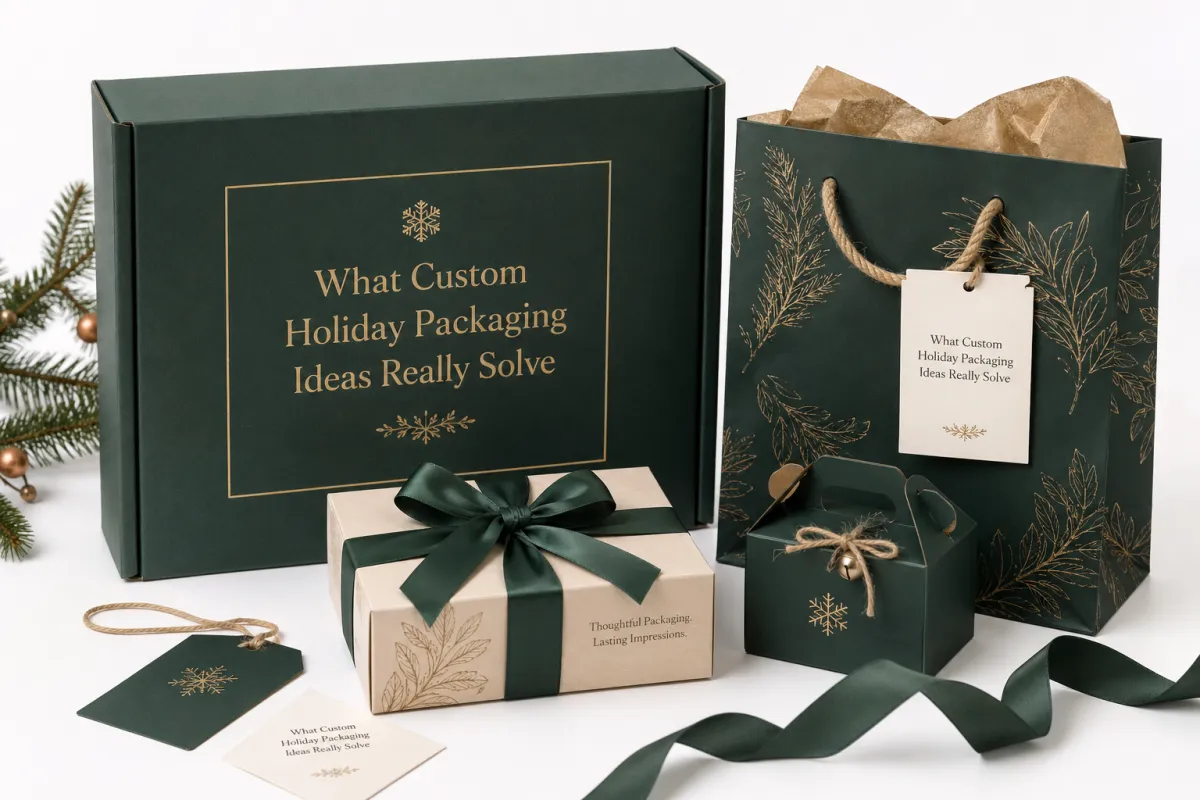
People love to talk about seasonal packaging like it is just decoration. That misses the point. Custom holiday packaging ideas usually solve a stack of practical problems at once. They make a product feel giftable, give the brand a sharper presence, and cut down on the extra wrapping a customer has to do later. That matters whether the item ships direct to the consumer, sits on a retail shelf, or moves through a holiday bundle for a corporate order.
From a buyer’s perspective, packaging can shape the sale before the sale is even complete. A stiff sleeve with a restrained foil hit can make a routine item feel premium without screaming about it. A printed mailer can turn an ordinary ecommerce shipment into something that feels intentional. Even a basic folding carton can look more expensive when the proportions, surface finish, and color system are chosen with care. That is why custom holiday packaging ideas are not just seasonal graphics; they are a branding decision tied to conversion, gifting convenience, and perceived value.
I see holiday packaging fail for two predictable reasons. It is either too plain and disappears, or it tries so hard to feel festive that it becomes cluttered and expensive. The strongest custom holiday packaging ideas usually live in the middle. One seasonal cue. One solid structure. One material that can survive production, packing, and shipping without drama. That is the sweet spot, even if it is not the flashiest one.
"The best seasonal package does not need to shout. It needs to feel ready, credible, and easy to give."
That is the lens I would use. If the box, sleeve, or mailer does these three things, it is pulling its weight:
- It protects the product during handling and transit.
- It makes the product feel like a holiday purchase, not a stock item.
- It keeps packing and fulfillment efficient enough for real order volume.
For many brands, custom holiday packaging ideas also remove friction at the point of gifting. No one wants to buy a present and then spend another hour wrapping it, trimming paper, and hunting for tape. A well-built package can eliminate that extra work. That is especially true for custom printed boxes, gift-ready mailers, and rigid cartons with insert trays that keep everything neatly in place.
There is a commercial side here too, and it is not subtle. Seasonal packaging can support retail packaging plans by boosting shelf visibility and nudging impulse buys. It can support ecommerce by lowering damage claims and return headaches. It can support holiday promotions by making limited editions feel different enough to justify a higher price point. Custom holiday packaging ideas are not just aesthetic choices; they are part of the margin conversation.
When I walk a brand through seasonal packaging, I usually ask one blunt question: if the customer sees this box from six feet away, do they instantly know it belongs in December and not in the warehouse backroom? If the answer is no, the design probably needs more clarity and less decoration.
How Custom Holiday Packaging Ideas Are Developed
The process starts with a blunt question: what does the package need to do in the real world? A display box for a boutique shelf behaves differently from a corrugated mailer built for direct-to-consumer shipping. A rigid gift box for a premium set has different cost and assembly implications than a folding carton for a lightweight cosmetic or food item. Strong custom holiday packaging ideas are built from the use case backward, not from a mood board forward.
That is why early planning should cover product size, pack-out, channel, and shipping method. If the package is going to retail, the board strength can lean toward shelf presentation and easy case packing. If it is going to ship long distance, structure matters more than ornament, especially during a season when carriers are not exactly handling parcels with velvet gloves. If the package is a gift set, then inserts, compartments, and opening experience may matter just as much as the outer graphics. You cannot fake your way through those details for long.
In actual packaging development, the path usually looks like this:
- Measure the product carefully, including closures, caps, and fragile protrusions.
- Choose the format: folding carton, sleeve, corrugated mailer, rigid box, or hybrid kit.
- Review a dieline so artwork, folds, and glue areas are visible before production.
- Build a structural mockup or sample so fit and opening style can be checked.
- Approve print proofing for color, copy, and placement.
- Lock the schedule for production, assembly, and freight.
That sequence is basic for a reason. It prevents expensive mistakes. A design may look perfect on a screen and still fail once it is folded, glued, and packed. A soft-touch coating may feel great, but if the artwork needs heavy foil coverage, the substrate may need to change. A magnetic closure may read as premium, then slow assembly enough to wreck fulfillment speed. Good custom holiday packaging ideas account for those details before they become problems.
Sampling is especially valuable during seasonal planning. A quick mockup can expose a loose fit, a closure that pops open too easily, or a printed area that sits too close to a fold. It can also show how embellishments behave on the chosen stock. Glitter, heavy foil, and textured varnishes can look gorgeous in a concept file and then act very differently on coated paperboard or corrugated board. I have had samples look perfect until the first fold line cracked. Happens more than people like to admit.
For shipping programs, many teams align testing with ISTA transit testing guidance so the package is not judged only by appearance. Smart move. Holiday order volumes amplify weak design choices fast. A package that survives one careful sample shipment may not survive fifty thousand units moving through a busy parcel network.
Machine compatibility matters too. Some custom holiday packaging ideas are lovely but slow to assemble. Others fold quickly but fail to create enough visual impact. The goal is to find a structure that works with your packing line, your labor team, and your timeline. If you are building a holiday program with several SKUs, that balance can save hours of labor per run. And yes, hours add up faster than people expect.
For brands that need a starting point, Custom Packaging Products is a practical place to compare formats before locking a direction. It forces the conversation out of theory and into actual construction choices. That is usually where the good decisions start.
Key Factors That Shape Materials, Print, and Finishes
Material choice drives a huge part of the outcome. A folding carton, a corrugated mailer, a rigid box, and a paperboard sleeve all create very different experiences, even if the artwork is similar. That is why custom holiday packaging ideas should never start with color alone. Start with structure, move into the substrate, then decide on finishes.
For lightweight items that need shelf impact, folding cartons made from 300-350gsm C1S or SBS paperboard are common because they print cleanly and fold neatly. For ecommerce or heavier products, corrugated mailers and trays provide much better crush resistance. For premium gift sets, rigid boxes deliver a stronger unboxing feel and thicker walls, although they also cost more and take up more space in storage and freight. The paperboard choice is not glamorous, but it changes almost everything.
Here is a simple way to think about the most common options:
| Packaging Type | Typical Use | Approx. Unit Cost Range | What It Does Well |
|---|---|---|---|
| Folding carton | Light retail items, cosmetics, candles, food gifts | $0.18-$0.45 at 5,000 units | Good print quality, compact storage, easy shelf display |
| Corrugated mailer | Ecommerce shipments, subscription kits, shipped holiday sets | $0.55-$1.25 at 5,000 units | Better transit protection and fast pack-out |
| Rigid box | Premium gifting, luxury sets, high-value presentation | $1.80-$4.50+ depending on size and finish | Strong presentation, thicker walls, high perceived value |
| Sleeve or wrap | Limited editions, seasonal branding overlays, bundle programs | $0.12-$0.38 at 5,000 units | Flexible branding and lower material use |
Those ranges are directional, not universal. Print coverage, size, insert style, and run length can move pricing quite a bit. Still, they give buyers a useful starting point. If you are comparing custom holiday packaging ideas, it helps to know whether you are working in a folding carton budget, a corrugated budget, or a rigid presentation budget before artwork gets too far along.
Finishes are another big decision. A soft-touch coating can make a package feel warmer and more tactile, which suits winter gifting nicely. Foil stamping can create a strong seasonal accent, especially in gold, silver, copper, or a deep red metallic. Embossing adds depth and works well on logos or ornaments. Spot varnish can separate a matte background from a glossy illustration and keep the design from feeling flat. Used with restraint, these effects can elevate custom holiday packaging ideas without making the build messy.
A premium finish only helps if it fits the substrate and the budget. Heavy foil coverage on small text can hurt readability. Embossing over a tight fold can crack or flatten. Lamination choices can also affect recyclability and downstream sorting. If sustainability is part of the brief, ask whether the package can use recycled content, right-sized dimensions, and removable decorations instead of mixed-material extras that are difficult to separate. That conversation is boring, maybe, but it matters a lot.
For brands that care about certified fiber, FSC-certified material guidance is worth reviewing during material selection. It is not a magic answer, and it does not make a package sustainable by itself, but it gives procurement teams a clearer path when they need chain-of-custody documentation.
Seasonal color is more strategic than many people think. Holiday packaging does not need to be red and green to feel festive. Deep navy with silver foil, evergreen with kraft textures, matte black with a small copper accent, or warm cream with illustrated winter patterns can all feel seasonal without looking cliché. That is often the difference between generic seasonal graphics and package Branding That Actually strengthens identity.
The strongest custom holiday packaging ideas usually use color restraint. One dominant background, one support color, one accent finish. That keeps the design legible on shelf and easier to reproduce across multiple formats. It also helps when the same visual system needs to stretch across cartons, sleeves, inserts, and shipping mailers.
Custom Holiday Packaging Ideas: Cost and Pricing Factors
Budget is where holiday plans become real. Custom holiday packaging ideas can look great on a concept board, but the final price depends on more than artwork. Material grade, size, print coverage, finishing methods, die complexity, and assembly labor all shape the number on the quote.
Volume matters because setup costs are spread across the run. A 1,000-piece order and a 10,000-piece order may use the same dieline, but the larger run often delivers a much lower unit cost. That matters in seasonal packaging, where some brands need shorter runs for limited editions while others need enough inventory to cover a whole selling window. If you are weighing several custom holiday packaging ideas, compare total landed cost, not just the printed carton price. The sticker price can be misleading in a hurry.
There are also hidden cost drivers that buyers miss on the first pass:
- Custom inserts: die-cut pulp, paperboard, or foam can raise cost and lead time.
- Specialty coatings: soft-touch, anti-scuff, and high-build varnish can add both material and process expense.
- Hand assembly: rigid boxes, ribbon pulls, and complex sleeves often need more manual labor.
- Kitting labor: multi-item holiday bundles can add packing time at fulfillment.
- Rush production: compressed schedules may force premium freight or overtime.
That is why the cheapest quote is not always the right answer. A low-cost mailer that crushes in transit can end up costing more once returns and replacements get counted. A decorative rigid box that takes too long to assemble can slow a packing line during the busiest weeks of the year. Good custom holiday packaging ideas support margin, not just appearance.
Here is a practical comparison of how format choices tend to behave in holiday programs:
| Factor | Folding Carton | Corrugated Mailer | Rigid Box |
|---|---|---|---|
| Best for | Retail shelves and lighter products | Shipping and subscription orders | Premium gifting and presentation sets |
| Assembly speed | Fast | Fast to moderate | Moderate to slow |
| Perceived value | Moderate to high with strong graphics | Moderate to high with print and structure | High |
| Typical budget pressure | Lower | Moderate | Higher |
| Holiday impact | Excellent for seasonal shelf appeal | Strong for giftable ecommerce | Excellent for premium unboxing |
If you are presenting options to a finance team, this comparison helps frame the tradeoffs. Custom holiday packaging ideas should be judged by unit price, yes, but also by breakage risk, pack-out time, freight density, and how much extra value they create in the customer’s mind. That last part is hard to quantify, yet it is often the reason seasonal packaging can support a higher average order value. Finance people may roll their eyes, but the lift shows up.
Another pricing reality: shorter holiday windows make every delay more expensive. If artwork changes late, the schedule may require expedited proofing, rush freight, or a backup material. Those costs rarely show up in the first quote, but they appear quickly once the calendar tightens. That is why disciplined planning around custom holiday packaging ideas usually saves money even when the package looks more elaborate.
If your team is narrowing down custom holiday packaging ideas, a useful next step is to compare your target budget against the packaging type, the finish layer, and the expected run length. That combination tells you a lot more than a single sticker price ever will. You can also review Custom Packaging Products to match your budget with the right format before artwork is finalized.
Step-by-Step Timeline for Custom Holiday Packaging Ideas
The calendar is usually the hardest part of holiday packaging. People underestimate how long it takes to move from concept to printed, packed, and delivered boxes. Custom holiday packaging ideas need to be scheduled early because each phase depends on the one before it, and small revisions can ripple into freight delays or production bottlenecks.
A realistic seasonal timeline often looks like this:
- Discovery and brief: 2-5 business days to define product, channel, budget, and launch date.
- Structure and dieline review: 3-7 business days depending on box complexity.
- Artwork development: 5-10 business days, longer if multiple stakeholders need approval.
- Proofing and revisions: 2-6 business days for color, copy, and layout adjustments.
- Sampling or prototype review: 3-10 business days depending on material and method.
- Production: often 12-15 business days from proof approval, sometimes more for specialty finishes.
- Freight and receiving: 3-14 business days depending on origin and shipping mode.
That timeline can compress or expand based on material availability, finishing complexity, and whether the order is domestic or imported. The biggest delays usually come from two places: late artwork changes and slow approval cycles. A holiday package that waits three days for one executive sign-off can lose more time than a production team can recover later. That is one reason custom holiday packaging ideas work best when the approval path is tight and everyone knows the launch date from the start.
It also helps to build a buffer for assembly and quality checks. The package may arrive on time, but it still has to be inspected, kitted, and stacked for fulfillment. If the item is sold through retail, the merchandising team may need time to confirm shelf fit and carton counts. If it is sold through ecommerce, the warehouse may need training on fold direction, insert placement, or closure sequence. None of that is glamorous, but it is where seasonal packaging either succeeds or slips.
Many brands benefit from setting a hard internal cutoff for artwork changes. After that point, no one should be moving logos, changing copy, or swapping seasonal colors unless the change is absolutely necessary. That discipline keeps custom holiday packaging ideas aligned with production reality instead of turning them into a moving target.
For organizations managing several SKUs, the best move is to rank packaging needs by risk. Products that ship farthest, break most easily, or represent the highest value should get sampled first. Low-risk items can follow once the system is proven. That sequencing gives the team a better chance of catching problems before they affect the full program.
One more practical tip: confirm the exact holiday launch window before ordering. "November" is not a schedule; it is a range. If the package needs to be on hand for photography, retail setup, or pre-sale fulfillment, that date should be set before production starts. The strongest custom holiday packaging ideas are built around a deadline, not around optimism.
Common Mistakes to Avoid With Holiday Packaging
Most holiday packaging failures are predictable. They come from rushing, guessing, or designing for the camera instead of the carton line. I see the same mistakes over and over, and every one of them is avoidable with a little discipline. The best custom holiday packaging ideas are usually simpler than the failed ones, not more complicated. Kind of annoying, honestly, but true.
The first mistake is designing only for appearance. A package may look beautiful in a mockup and still fail in transit because the board is too weak, the closure is too loose, or the insert leaves too much movement inside the box. That creates damage, replacements, and customer frustration. If the package is part of a direct-to-consumer order, that failure can spread quickly through reviews and support tickets.
The second mistake is ignoring measurements. A few millimeters can matter a lot, especially when a product has a pump, a cap, a handle, or a fragile accessory. If the dieline is built on estimated dimensions instead of verified ones, the final fit can be off in expensive ways. Good custom holiday packaging ideas account for closure tolerances, material thickness, and any extra space needed for inserts or nesting.
The third mistake is adding too many seasonal elements. Foil on every panel, multiple ribbons, heavy embossing, shaped windows, and layered inserts may sound impressive, but they can slow assembly and inflate cost very quickly. The package starts festive and ends clumsy. A cleaner system with one or two strong accents often looks more premium and is easier to reproduce across a full seasonal run.
The fourth mistake is waiting too long. Seasonal production windows close fast. If a brand delays until the last minute, the team may have to accept limited material choices, rushed artwork approvals, and premium freight charges. That is not a fun place to be, and it almost always puts pressure on quality. The more successful custom holiday packaging ideas are usually the ones that start earlier than everyone thinks they need to.
There is also a subtler error: assuming one format will solve every channel. A carton that works beautifully on a shelf may not survive parcel shipping without an outer shipper. A gorgeous rigid box may be too slow for a warehouse that needs to pack hundreds of orders a day. A corrugated mailer may protect well but not deliver the premium look a gift program requires. The right answer depends on how the package moves through the supply chain.
Here is a quick way to pressure-test custom holiday packaging ideas before they move into production:
- Drop the sample from realistic heights and check for edge crush.
- Shake the filled pack and listen for movement.
- Open and close it several times to test the closure life.
- Measure the actual pack-out time for one unit.
- Check whether the graphics still read well after folds and glue tabs are introduced.
That kind of testing is not overkill. It is what separates a polished seasonal package from one that only looks good in the render. If you want the package to support retail packaging goals, ecommerce goals, and gifting goals all at once, the real-world checks matter just as much as the creative concept.
Expert Tips to Turn Custom Holiday Packaging Ideas Into Action
If you want a simple rule, start with one clear objective. Do not ask every package to be the cheapest, the prettiest, the strongest, and the fastest to assemble all at once. Pick the primary job first. Is the goal premium gifting? Shelf presence? Shipping protection? Faster fulfillment? Once that is clear, the rest of the custom holiday packaging ideas become easier to judge.
I also recommend building a packaging brief that is more specific than most brands prepare. It should list product dimensions, order volume, target cost, channel, launch date, brand color limits, and any must-have finish. If a holiday campaign has multiple SKUs, the brief should say which items need the same system and which can vary. That clarity helps packaging vendors recommend the right structure instead of guessing. It also keeps the team from changing direction three times in a week, which is the fast track to everybody being miserable.
Then test a small set of concepts. Two or three strong directions are usually enough. Compare them for fit, assembly time, shelf impact, and total landed cost. If one concept is slightly more expensive but cuts labor in half, it may be the better business choice. If another concept is cheaper but weak in presentation, it may not help your brand much during the season. Good custom holiday packaging ideas are chosen with both the spreadsheet and the shelf in mind.
Another useful tactic is to keep the seasonal change focused. You do not need to reinvent the entire package every year. A stable base structure with a rotating graphic panel, sleeve, belly band, or insert card can keep production efficient while still making the package feel current. That approach works especially well for package branding because the brand system stays recognizable, even when the holiday artwork shifts.
For buyers who want a premium look without overspending, the most efficient places to spend are usually the first-touch areas: the lid, the front panel, the insert, or the outer mailer. That is where the customer notices texture, contrast, and structure first. It is usually better to spend on one excellent finish than on five average ones. A strong foil logo on a matte box often does more than a crowded mix of decorations.
A few final practical habits make a real difference:
- Request a structural sample before artwork is fully locked.
- Confirm print specs and substrate finish before proof approval.
- Ask how the package will be packed, nested, and shipped to your facility.
- Set the schedule early enough for receiving, inspection, and kit assembly.
- Keep one backup option ready in case a finish or material becomes unavailable.
If you follow those steps, custom holiday packaging ideas stop feeling like a seasonal gamble and start acting like a controlled part of the merchandising plan. That is what successful brands tend to do well: make the package look festive, then build it like a production tool.
For teams ready to move forward, the next move is straightforward: choose one packaging format, request a structural sample, confirm the print and finish plan, and lock the production schedule before the seasonal window tightens. If you want to compare formats as you narrow the options, Custom Packaging Products can help you line up the structure, material, and presentation style that fit the job. That is how custom holiday packaging ideas turn into Packaging That Actually ships, sells, and feels worth giving.
Frequently Asked Questions
What should I include in custom holiday packaging ideas for a small product line?
Focus on one box style or mailer format, one seasonal color system, and one finishing method so the design stays affordable and easy to produce. Include product dimensions, shipping method, and whether the package must work for retail display, gifting, or direct-to-consumer fulfillment. Small lines do best when the system is simple enough to repeat without extra setup. For small brands, custom holiday packaging ideas should make the product look intentional without creating a production headache.
How do custom holiday packaging ideas affect pricing?
Pricing changes based on material choice, print coverage, box complexity, decorative finishes, and whether inserts or multiple parts are needed. Lower quantities usually raise unit cost, while rushed timelines can add setup or freight expenses. If the package has hand assembly or specialty coatings, those line items will show up fast. That is why custom holiday packaging ideas need a budget check before artwork gets too polished to change.
How early should I start custom holiday packaging ideas for seasonal launches?
Start early enough to allow for concepting, sampling, artwork approval, and production, because holiday schedules tighten quickly. Build in extra time for revisions, supply delays, and final quality checks before fulfillment begins. In practice, earlier planning gives you better material choices and less pressure on the approval chain. The best custom holiday packaging ideas are rarely the ones created at the last minute.
What materials work best for custom holiday packaging ideas?
The best material depends on the product and channel: folding carton for lightweight retail items, corrugated for shipping, and rigid Packaging for Premium gifting. Choose materials that match protection needs, print quality goals, and sustainability requirements. If the package has to travel far, transit performance should carry as much weight as visual appeal. Strong custom holiday packaging ideas match the material to the job instead of forcing one format to do everything.
How can I make custom holiday packaging ideas feel premium without overspending?
Use a strong structure, thoughtful color blocking, and one or two well-placed finishes instead of adding decoration everywhere. Prioritize tactile or visual details that customers notice first, such as foil accents, embossing, or a well-designed insert. A controlled design often feels more expensive than a crowded one, even when the spend is modest. That is usually the sweet spot for custom holiday packaging ideas that need to look premium and stay practical.