Buyer Fit Snapshot
| Best fit | Eco-Friendly Packaging Options Comparison for Brands projects where brand print, material claims, artwork control, MOQ, and repeat-order consistency need to be specified before quoting. |
|---|---|
| Quote inputs | Share finished size, material target, print colors, finish, packing count, annual reorder estimate, ship-to region, and any compliance wording. |
| Proofing check | Approve dieline scale, logo placement, barcode or warning zones, color tolerance, closure strength, and carton packing before bulk production. |
| Main risk | Vague material claims, crowded artwork, missing packing details, or unclear freight terms can make a low unit price expensive after revisions. |
Fast answer: Eco-Friendly Packaging Options Comparison for Brands should be specified like a repeatable production item. The safest quote records material, print method, finish, artwork proof, packing count, and reorder notes in one written spec.
Production checks before approval
Compare the actual filled-product size with the drawing, then confirm tolerance on folds, seals, hang holes, label areas, and retail display edges. Reserve space for logos, QR codes, warning copy, and material claims before decorative graphics fill the panel.
Quote comparison points
Review material grade, print process, finish, sampling route, tooling charges, carton quantity, and freight assumptions side by side. A quote is only useful when the supplier can repeat the same color, closure quality, and packing count on the next order.
Eco-friendly packaging options comparison for brands is not a sticker exercise. It is a real business decision with real consequences: damage rates, freight cost, shelf appeal, customer confusion, and whether the package can actually be opened, sorted, and disposed of without making everyone grumpy. A serious eco-friendly packaging options comparison should show which material works, which one only sounds green in a sales deck, and which one quietly eats margin after launch.
That matters because the "best" option changes fast depending on the product. A paper mailer can be perfect for apparel, useless for a fragile serum bottle, and awkward for a heavy accessory that needs edge protection. A corrugated box may look plain, but if it cuts two return shipments per hundred orders, that is not plain at all. A molded pulp insert can make a gift-ready presentation feel more deliberate, yet it may be overkill for a basic subscription shipment. The right eco-friendly packaging options comparison keeps those tradeoffs visible instead of hiding them behind buzzwords and recycled-looking graphics.
Brands usually start with the wrong question. They ask, "What is the greenest package?" The better question is, "Which package protects the product, supports branding, fits the budget, and gives customers a disposal path they can actually use?" That is the lens here. If you are comparing recycled paperboard, corrugated cardboard, molded pulp, paper mailers, compostable films, bioplastics, or reusable systems, this guide gives you a practical framework that does not fall apart the second the project gets real.
Eco-Friendly Packaging Options Comparison: What It Actually Means
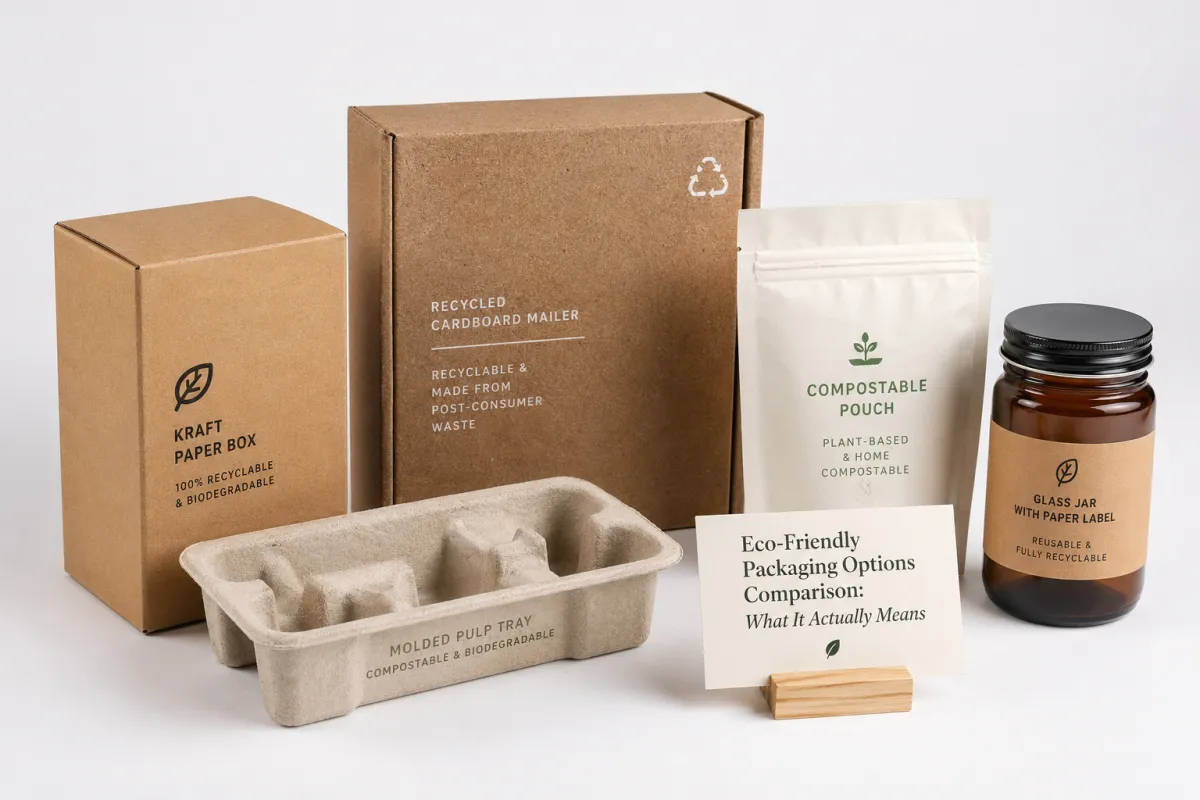
An eco-friendly packaging options comparison starts with a reality check: a package can look responsible and still be the wrong choice if it fails in transit, uses more material than necessary, or creates confusion at disposal. I have watched teams spend extra on a compostable-looking structure only to discover that the product needed more protection than the material could provide. That is not sustainability. That is expensive optimism.
"Eco-friendly" covers several different goals, and they do not always point to the same material. Recycled content lowers demand for virgin fiber. Recyclability gives the package a second life if the local system accepts it. Compostability sounds appealing, but only works if the customer has access to the right facilities. Source reduction means using less material in the first place. Reusable formats can make sense for some subscription or closed-loop operations. Lower-impact production can also come from cleaner inks, fewer coatings, smarter sizing, and shorter freight lanes. A proper eco-friendly packaging options comparison should include all of that, not just one label on a sales sheet. It should also account for life cycle assessment, post-consumer recycled content, and what happens in the material recovery facility after the box is opened.
One-size-fits-all advice falls apart fast. E-commerce brands care about shipping efficiency and return rates. Retail packaging needs a strong shelf presence and a tidy unboxing experience. Food packaging may need grease resistance, moisture control, or direct contact compliance. Cosmetics often need a premium feel with tight tolerances around inserts and closures. Fragile goods need real shock absorption, not a green story told by a broken bottle. So the comparison has to reflect the use case, not some abstract ideal.
Here is the practical frame I use for an Eco-Friendly Packaging Options Comparison: material, protection, branding, cost, disposal, and supply chain fit. If a format wins on sustainability but loses on protection, it is a bad trade. If it protects beautifully but doubles freight or makes recycling impossible in your main market, it is a bad trade too. Packaging design is always a balancing act, and pretending otherwise just produces prettier mistakes.
Take a simple example. You need packaging for a glass face serum. You could choose a paper mailer with a molded pulp insert, a small corrugated box with paper cushioning, or a rigid paperboard carton with a formed insert. Each option has a different feel, cost profile, and waste footprint. The right eco-friendly packaging options comparison shows you how each one performs in the real world, not just on a spec sheet. The spec sheet is useful. It is just not the whole story.
For reference, trade groups and public agencies publish useful guidance on materials, recovery, and recycling behavior. Two worth bookmarking are packaging.org and the EPA's recycling page at epa.gov/recycle. Those sites will not choose your box for you, but they do help ground claims in actual systems instead of marketing language with a plant icon.
How Does an Eco-Friendly Packaging Options Comparison Work?
The cleanest way to handle an eco-friendly packaging options comparison is to start with product requirements, then layer in sustainability goals, then check budget and branding constraints. That order matters. If you reverse it, the result is usually a beautiful sample that collapses under a bottle, leaks around a cap, or looks cheap once the print runs hit production. Pretty packaging that fails is still a fail.
Most brands do best when they compare the main material families side by side. Recycled paperboard works well for cartons, sleeves, and lightweight retail packaging. Corrugated cardboard is the workhorse for shipping boxes and outer protection. Molded pulp gives structure and cushioning, especially for inserts and trays. Paper mailers are useful for soft goods and low-fragility shipments. Compostable films may fit certain flexible formats, though they need careful scrutiny. Bioplastics can help in specific applications, but they are not a blanket solution. Reusable packaging can work in controlled systems, but it asks a lot from the logistics side.
The tricky part is that "recyclable" in theory does not always mean recyclable in practice. A package may be technically recyclable but still fail in common municipal systems because of mixed materials, heavy coatings, or contamination issues. A paper-based mailer with a plastic window looks simple enough until the local recycling stream rejects it. A compostable film is only as good as the collection and processing system available to the end user. This is why eco-friendly packaging options comparison has to include end-of-life reality, not just material chemistry.
Certifications and sourcing matter, but they are not a magic stamp of virtue. FSC-certified fiber can support responsible sourcing. Post-consumer recycled (PCR) content can reduce virgin demand. ASTM standards can help clarify compostability claims, especially where the material and intended recovery method match the standard. But if the structure is oversized, the print is overdone, or the supply chain stretches across the globe for a package that ships a local product, the problem is still there. A smarter eco-friendly packaging options comparison looks at the whole system, from raw material to customer disposal behavior.
That systems view helps avoid vague claims. A brand can say it wants eco-friendly packaging, but the real question is whether the package is right for the job. Is the goal to reduce carbon footprint, improve recyclability, remove plastic, or cut damage rates? Those are different objectives. Sometimes one material serves two of them well. Sometimes it does not. Good packaging design is honest about that. No romance. Just results.
If you are ordering Custom Printed Boxes or branded packaging, the comparison should also include print method and finish. A kraft surface can feel natural and premium with the right typography and ink coverage. A white-lined board may support sharper imagery. A matte uncoated finish can look elevated without extra coatings. The point is not to force every package into the same eco-friendly mold. The point is to match product packaging to the brand and the product without making the disposal path a guessing game.
One useful rule: compare what the package does, not what it claims to be. A paper mailer that tears in a humid warehouse is not helping you. A rigid box that uses too much board for a low-value item is not helping either. The best eco-friendly packaging options comparison makes those tradeoffs visible before you place a production order. That is the part that saves money and embarrassment.
Key Factors in Eco-Friendly Packaging Options Comparison
Price is the first factor most buyers ask about, and for good reason. But the unit price only tells part of the story in an eco-friendly packaging options comparison. You also have tooling, minimum order quantities, freight, storage, artwork setup, and the hidden cost of damage or returns. A package that saves three cents on paper but adds a one-percent damage rate is not cheaper. It is just cheaper to buy and more expensive to own.
Durability is the next big variable. The cheapest sustainable option is useless if it gets crushed, leaks, or collapses under stacking pressure. A lightweight paperboard carton may be perfect for a retail kit but weak for a shipping scenario with vibration and drop risk. Corrugated cardboard usually outperforms paperboard in compression and shock resistance. Molded pulp can protect delicate components surprisingly well, but it depends on fit and thickness. For any eco-friendly packaging options comparison, the right question is not "Is it green?" It is "Will it survive your actual supply chain?"
Branding matters more than some teams admit. Eco-friendly packaging options comparison is not only about disposal, but also about how the package looks and feels in a customer's hands. Can the material support full-color printing? Does it work with embossing or a foil alternative? Will the brand look intentional on uncoated kraft, or will the design disappear into the background? A package can be structurally sound and still miss the point if it makes the product feel generic. That is especially true for retail packaging, where package branding does a lot of the selling before the customer opens the box.
Weight and shipping efficiency also deserve attention. Less mass usually means lower freight emissions and lower transport cost, though the relationship is not always clean. A lighter package that fails more often can create more waste through returns and replacements. A heavier but right-sized box may actually perform better overall if it reduces void fill and protects the product with less drama. That is why a real eco-friendly packaging options comparison has to include both material weight and total shipped volume.
Disposal behavior is where good intentions go sideways. Customers do not always read instructions. They may not separate components, and they may not have access to composting facilities. If a package depends on perfect user behavior to be "green," it is fragile in a different way. Recyclable paper-based packaging often works better in practice because the path is familiar. Compostable packaging can be right for some foodservice or local-market programs, but it should be chosen with real infrastructure in mind. Otherwise the label is just decoration.
Here is the blunt version: sustainability claims are easy. Packaging performance is harder. The best eco-friendly packaging options comparison respects both. It measures what matters in production, shipping, and disposal, then makes the tradeoffs visible instead of hiding them in a sales brochure.
- Cost: unit price, MOQ, tooling, freight, and damage risk.
- Protection: drop resistance, stacking strength, moisture resistance, and fit.
- Branding: print quality, finish, tactility, and shelf presentation.
- Weight: shipping efficiency and material usage.
- Disposal: recyclability, compostability, reuse, and local acceptance.
Eco-Friendly Packaging Options Comparison: Cost and Pricing Tradeoffs
On pricing, the market usually behaves in predictable bands, though every project bends a little. Recycled corrugated is often the lowest-cost sustainable structure for shipping boxes. Paper mailers sit in a similar range for light goods, especially when you are not asking for heavy print coverage. Molded pulp is often mid-range because tooling and form complexity affect pricing. Specialty compostable films and high-performance bioplastics tend to sit higher, especially in smaller runs. Reusable systems can be cost-effective in closed-loop models, but the operational setup can be costly up front. That is the real shape of an eco-friendly packaging options comparison: not one material is cheap or expensive forever, but some sit in friendlier zones for certain uses.
Pricing shifts come from surprisingly ordinary things. Custom sizing can raise cost faster than material choice. Heavy print coverage can add more than people expect. Barrier coatings, inserts, special die cuts, and premium finishes all move the number. Small production runs can make any sustainable format look overpriced because setup costs get spread across fewer pieces. This is why the first quote should never be the final answer in an eco-friendly packaging options comparison. Ask for multiple quantities. Ask for blank and printed pricing. Ask what happens when you change dimensions by a quarter inch. Boring questions save money.
Here is the bigger tradeoff: upfront unit cost versus total landed cost. A package that costs a little more per unit can still win if it reduces returns, cuts breakage, or eliminates unnecessary filler. A design that fits the product tightly may lower shipping dimensional weight enough to offset a more premium material. A slightly better carton can also reduce customer complaints, which is one of those "soft costs" that finance teams love to ignore until they become very real. Then everybody suddenly remembers the spreadsheet.
| Option | Typical Cost Band | Protection | Branding Potential | Best Use Case |
|---|---|---|---|---|
| Recycled corrugated box | Low to mid | Strong | Good with print | Shipping, e-commerce, subscription kits |
| Recycled paperboard carton | Low to mid | Light to moderate | Very good for retail | Cosmetics, supplements, lightweight retail items |
| Molded pulp insert | Mid | Good cushioning | Clean, natural look | Fragile items, inserts, trays |
| Paper mailer | Low to mid | Moderate | Limited but clean | Apparel, soft goods, flat items |
| Compostable film or bag | Mid to high | Variable | Good for some categories | Flexible formats, certain food or specialty uses |
| Reusable packaging system | High up front | Can be excellent | Strong brand story | Controlled returns, closed-loop programs |
If you are trying to keep costs under control, the cheapest move is often not switching materials. It is removing waste. Right-size the box. Cut unnecessary layers. Reduce void fill. Simplify the insert. A good eco-friendly packaging options comparison often reveals that a smarter structure beats a fancier substrate. That is especially true if you are looking at Custom Packaging Products for a product line with multiple sizes, because standardization can lower both production complexity and storage headaches.
For brands that want a cleaner retail presence, a modest upgrade in packaging design may be enough. A recycled kraft carton with sharp typography can look intentional without extra finishing. You do not need to throw premium coatings at every item just to signal responsibility. Frankly, a well-sized box with disciplined printing usually outperforms a bloated "sustainable" package that still wastes space.
One more buying rule: do not let the lowest quote win by default. If a cheaper option increases damages by even a fraction of a percent, the math can flip quickly. I would rather see a brand spend a little more on a dependable structure than explain another round of reorders and customer complaints. Eco-friendly packaging options comparison should protect the margin, not just the image.
Process and Timeline for Eco-Friendly Packaging Options Comparison
A practical eco-friendly packaging options comparison follows a simple workflow. First, define the product: dimensions, weight, fragility, surface sensitivity, and shipping method. Second, set the sustainability target: recycled content, recyclability, compostability, source reduction, or reusable format. Third, set the budget and branding boundaries. Only then should you request samples. If you ask for samples too early, you get pretty objects instead of useful decisions. Pretty is nice. Useful pays the bills.
Realistic timelines depend on the material. Off-the-shelf recycled boxes can move quickly if the sizes are standard and the artwork is simple. Custom packaging with printed surfaces, inserts, or specialty material structures usually takes longer. Sampling can take a few business days for simple formats and longer for custom tooling or complex print matching. After that, you still need review time, revisions, and production scheduling. In many cases, an eco-friendly packaging options comparison takes one to three weeks just to get to a confident choice, and production can add another one to three weeks depending on quantities and finishing.
Delays tend to show up in the usual places. Custom tooling takes longer than people hope. Print proof approvals get stuck in the endless "one more tweak" loop. Compliance review can slow things down if the package touches food, cosmetics, or regulated claims. Specialty materials may have supply constraints that make your first-choice option unavailable for a lead time you did not budget for. This is why the best eco-friendly packaging options comparison includes a fallback plan. If your first pick slips, you need a second path that still works.
Testing should be practical, not theatrical. Run a drop test. Check stacking strength. Look for crush points. Expose the package to humidity or moisture if the product will live in a warehouse or cross climates. Put the real item inside, not a dummy weight that behaves nicely. Then inspect print quality after handling. If the package is retail-facing, make sure the shelf presentation still looks crisp after transit. Those checks are not fancy. They are just honest. And honesty beats polished nonsense every time.
For some shipments, ASTM and ISTA methods are useful references. ISTA's test standards are especially helpful for understanding distribution hazards and packaging performance under real shipping conditions. If your team wants to read the source material rather than trust a random opinion, the International Safe Transit Association is a useful place to start: ista.org. Standards do not replace business judgment, but they do keep the comparison grounded.
Timing also affects sustainability. That sounds obvious until a launch team panics and accepts a package that is "good enough" because the calendar got tight. I see this a lot with packaging design projects: the team wants one thing, the deadline wants another, and the factory schedule gets the final vote. You can avoid that by building the eco-friendly packaging options comparison into the launch plan early, not after the product pages are already live and the sample box is getting approved at 11:47 p.m.
- Define product specs and shipping conditions.
- Shortlist 3 materials or structures.
- Request samples with real dimensions and artwork.
- Test protection, print, and handling.
- Compare pricing at multiple quantities.
- Approve the version that balances performance and disposal reality.
If you need a broader packaging lineup beyond one format, start by browsing a range of custom printed boxes and related packaging structures. That makes it easier to compare materials on the same product rather than chasing samples from five different directions. And yes, that saves time. Which is rare enough in packaging that it deserves a little respect.
Common Mistakes in Eco-Friendly Packaging Options Comparison
The first mistake is treating compostable, recyclable, and biodegradable as if they are interchangeable. They are not. A package can be biodegradable and still not be suitable for local collection. It can be compostable and still require an industrial facility many customers cannot access. It can be recyclable and still get tossed because the structure is too mixed or the instructions are unclear. A sloppy eco-friendly packaging options comparison turns those words into a haze. A good one separates them.
The second mistake is over-packaging with better materials. Brands sometimes swap plastic for paper, then keep the same oversized box, the same thick insert, and the same filler. That is not a sustainability win. It is just a more expensive version of the same waste. Source reduction matters. Right-sizing matters. A cleaner structure usually matters more than a premium material with no functional reason to be there.
The third mistake is ignoring local disposal rules and customer behavior. I know, shocking: people do not all sort waste perfectly. A package that depends on the customer reading three instructions and finding a special facility is fragile in practice. If your audience is broad, recyclable paper-based packaging often travels better as a public-facing choice. In an eco-friendly packaging options comparison, the best option is often the one that ordinary people can handle without a tutorial.
The fourth mistake is skipping real-product testing. A blank sample on a desk is not the same as a packed unit on a conveyor, in a truck, and on a porch. Real product packaging has to survive handling, vibration, temperature swings, and the occasional drop. If you do not test with the actual item, you are guessing. And guessing is not a strategy. It is a slow-motion tax.
The fifth mistake is chasing the lowest unit price and pretending that means the lowest total cost. It usually does not. Reorders, breakage, damage claims, and bad reviews eat savings fast. An eco-friendly packaging options comparison should help you avoid that trap by looking at performance and disposal together, not just the quote.
"The most sustainable package is not the one with the prettiest claim. It is the one that reaches the customer intact, uses the right amount of material, and lands in the right waste stream without drama."
That line sounds simple because it is. Most packaging problems are not mysterious. They are usually the result of skipping the unglamorous middle steps: testing, sizing, and checking disposal reality. The brands that do better are usually the ones that compare patiently instead of choosing by vibe. Vibes are not a specification.
Expert Tips for Eco-Friendly Packaging Options Comparison
Start with the product's weakest point. Is it moisture, shock, weight, heat, or presentation? Pick the material that solves that first. A package that is beautiful but weak at the exact failure point will not stay beautiful for long. This sounds obvious, but plenty of eco-friendly packaging options comparison projects ignore it because the samples look nice on a table and everybody gets distracted by the texture.
Compare at least three options side by side. Not one. Three. That gives you a lower-cost baseline, a middle option, and a premium or specialized option. Once you see the difference in protection, print quality, and landed cost, the decision gets much easier. And if the first quote is somehow perfect, great. That happens occasionally. Not often enough to build a strategy around it, though.
Ask for samples with real artwork and real product weight. A blank board sample tells you almost nothing about final appearance. A printed sample tells you more, but only when it includes the actual dimensions and the actual load. This matters for branded packaging and retail packaging alike, because the final impression depends on the full system, not an isolated sheet of paper.
Create a simple scorecard. Keep it blunt. Give each option a score for cost, protection, sustainability, and brand fit. Add notes for lead time, MOQ, and disposal clarity. You do not need a 40-tab spreadsheet with color coding from a finance thriller. You need a defensible way to compare options and explain the decision internally. A good eco-friendly packaging options comparison should be easy to revisit six months later when someone asks why the team chose that format.
Keep designs modular. That means building a packaging system that can swap materials later without rebuilding everything from scratch. If your box, insert, and sleeve are all locked together in one custom-only structure, future changes get expensive. If you keep dimensions and structural logic flexible, you can adapt. That is smart packaging design, especially for growing brands that may need to shift substrates or suppliers without wrecking the whole line.
One more practical tip: think in ranges, not absolutes. A paperboard carton might be the best choice for a lightweight product in one market and a terrible choice for the same product in a humid warehouse or long-distance ship lane. A molded pulp insert might be the right answer for a premium kit, while a paper mailer handles a soft item at a lower price point. Eco-friendly packaging options comparison is not about declaring a winner for all time. It is about choosing the best fit for the current product, channel, and budget.
If you are working with a packaging supplier or internal team, ask for a decision matrix that shows where each option wins and where it fails. That keeps the discussion honest. It also helps avoid the usual brand meeting spiral where everyone says they want sustainability, speed, low cost, and luxury presentation, then acts surprised when the package cannot be all four at once. Packaging, like most things in production, does not care about wishful thinking.
Next Steps for Your Eco-Friendly Packaging Options Comparison
Turn the comparison into action. Choose your top two materials, request samples, and test them with the real product and real shipping method. If you are comparing a paper mailer, a corrugated box, and a molded pulp insert, put them through the same test conditions. Same weight. Same drop pattern. Same handling path. Same print requirements. That is the only way an eco-friendly packaging options comparison becomes useful instead of decorative.
Create a shortlist that includes one lower-cost option and one premium option. That makes the tradeoffs obvious. If the premium option only adds a little more protection and a lot more cost, the case may be weak. If the lower-cost version increases damage, the case may be worse than it looks. A good comparison tells you exactly where the line sits, not just which sample looked nicer in the meeting.
Review Supplier Lead Times, MOQ, and print capabilities before you commit. A format that looks perfect on paper can become a problem if the minimum order is too large or the print process cannot match your branding needs. This is especially true for custom printed boxes and Product Packaging That need consistent colors across multiple SKUs. The best eco-friendly packaging options comparison includes production reality from the start, not as an afterthought the night before approval.
Build a final decision matrix with cost, performance, disposal, and brand goals. Keep it simple enough that the sales team, operations team, and marketing team can all understand it without a translator. If the package scores well on all four, you probably have a strong answer. If one category is weak, you should know why and whether that weakness is acceptable.
Need the decision to move faster? Start from the product, not the slogan. Then compare the materials on actual performance and real disposal paths. That is how you pick the right package instead of the loudest one. And yes, that is the whole point of an eco-friendly packaging options comparison: not to find the greenest-sounding material, but to choose the one that genuinely fits the product, the brand, and the supply chain.
For brands trying to balance sustainability and commercial reality, the best outcome usually comes from a clean eco-friendly packaging options comparison, a short list of viable materials, and a willingness to reject the pretty option if it fails the hard tests. That is not cynical. It is how good packaging gets made.
What is the best eco-friendly packaging options comparison for shipping boxes?
For most shipping boxes, recycled corrugated is the baseline because it balances cost, strength, and recyclability. If the product is fragile, add Molded Pulp Inserts or paper-based cushioning instead of plastic fillers. Choose coated or specialty materials only when moisture, grease, or premium presentation actually requires it.
Which eco-friendly packaging option is cheapest without looking cheap?
Usually recycled kraft paperboard or corrugated with minimal print gives the best mix of low cost and clean presentation. Simple structures save money more reliably than fancy materials with heavy finishing. The cheapest-looking option is often the one with bad sizing, so right-size the box before chasing a lower material grade.
How do I compare compostable vs recyclable packaging options?
Compare where the package will actually be disposed of, not just what the label says. Recyclable options are often easier for customers to handle, while compostable options depend on access to the right facilities. If your audience cannot dispose of compostables correctly, recyclable paper-based packaging may perform better in practice.
What should I test before choosing an eco-friendly packaging option?
Test drop resistance, stack strength, moisture exposure, and print readability with the actual product inside. Run samples through your real fulfillment process, not an idealized tabletop version. Check whether the packaging still protects the product after temperature swings, rough handling, and transit vibration.
How do I keep eco-friendly packaging costs under control?
Use standard sizes where possible, because custom tooling and oversized formats push costs up fast. Reduce unnecessary layers, inserts, and void fill before upgrading materials. Ask suppliers for pricing at multiple quantities so you can see where the real breakpoints are.


