Buyer Fit Snapshot
| Best fit | Custom Holiday Packaging Boxes Order projects where brand print, material claims, artwork control, MOQ, and repeat-order consistency need to be specified before quoting. |
|---|---|
| Quote inputs | Share finished size, material target, print colors, finish, packing count, annual reorder estimate, ship-to region, and any compliance wording. |
| Proofing check | Approve dieline scale, logo placement, barcode or warning zones, color tolerance, closure strength, and carton packing before bulk production. |
| Main risk | Vague material claims, crowded artwork, missing packing details, or unclear freight terms can make a low unit price expensive after revisions. |
Fast answer: Custom Holiday Packaging Boxes Order: Specs, Pricing should be specified like a repeatable production item. The safest quote records material, print method, finish, artwork proof, packing count, and reorder notes in one written spec.
Production checks before approval
Compare the actual filled-product size with the drawing, then confirm tolerance on folds, seals, hang holes, label areas, and retail display edges. Reserve space for logos, QR codes, warning copy, and material claims before decorative graphics fill the panel.
Quote comparison points
Review material grade, print process, finish, sampling route, tooling charges, carton quantity, and freight assumptions side by side. A quote is only useful when the supplier can repeat the same color, closure quality, and packing count on the next order.
Holiday packaging has a habit of getting pushed to the edge of the calendar. The campaign is approved, the product is ready, and then someone notices that the boxes are still a sketch, a mockup, or a half-finished dieline. I have seen teams lose two or three weeks that way. A Custom Holiday Packaging boxes order keeps that scramble from starting in the first place, because it forces the structure, timing, and quantity decisions early enough to matter.
From a packaging buyer's point of view, a Custom Holiday Packaging Boxes order is not just a print job. It is a control point for production, fulfillment, and presentation. If the box spec is correct, handling improves, the unboxing feels deliberate, and the brand gets a cleaner seasonal launch. If the spec is loose, the box becomes the thing everybody blames later, which is never a fun meeting.
"Holiday launch dates do not move just because the packaging file is late."
If you are comparing formats, browse Custom Packaging Products for a wider view of box styles and finishes, or check the FAQ if you need quick answers before requesting a quote.
Custom Holiday Packaging Boxes Order: Why Timing Matters
Most seasonal packaging problems begin with good intentions and bad sequencing. The concept gets approved first. The product team signs off. Marketing asks for a stronger visual cue. Then packaging gets pulled in after the calendar is already crowded. That is usually the moment where a custom holiday packaging boxes order either brings order to the process or exposes how much is still unresolved.
The pressure is not abstract. Retail teams need floor-ready cartons before merchandising windows close. Ecommerce teams need packaging aligned with pick-pack schedules and carrier cutoffs. Corporate gifting teams need kits ready before client delivery dates lock. When those deadlines overlap, the smallest delay in artwork, sample approval, or material choice can ripple through the whole season. A one-day slip in proofing can turn into a lost ship window a week later. That sounds dramatic, but it is kinda how the math works.
Holiday packaging also carries a brand-value effect that is easy to underprice. Seasonal packaging can raise perceived product value, especially in crowded categories where giftability matters as much as utility. A disciplined custom holiday packaging boxes order reduces transit damage, supports first-unbox quality, and makes the product feel intentional before the customer even touches it. That matters for ecommerce gifts, subscription kits, retail displays, and B2B holiday sets alike.
One practical rule helps here: gather the facts before the quote request, not after. Quantity, internal dimensions, product weight, insert requirements, print coverage, finish direction, and delivery target all belong in the first brief. If those pieces are missing, the estimate is only a placeholder. A real custom holiday packaging boxes order needs real inputs, or the schedule starts guessing on your behalf.
There is also a planning reason to move early. Holiday freight is tighter, warehouses are fuller, and every production queue gets longer as the season closes in. A packaging buyer who locks the spec early usually gets more options on structure, better control over finish tradeoffs, and fewer emergency substitutions. That is not magic. It is just a better place to stand.
Product Details for a Custom Holiday Packaging Boxes Order
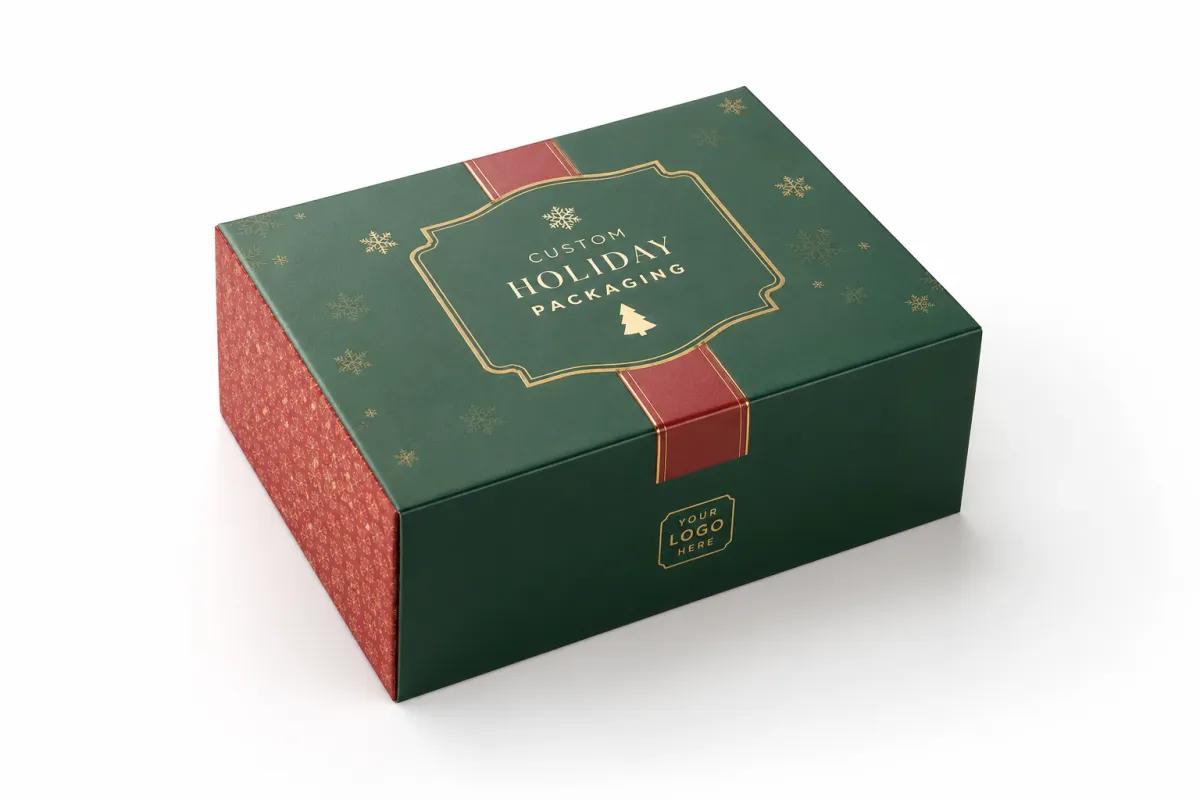
Box style should follow the product, not the trend cycle. A custom holiday packaging boxes order for a luxury candle set needs a different structure than one for a snack bundle or a subscription drop. Rigid gift boxes carry premium weight and make sense for presentation-first gifting. Mailer boxes suit ecommerce because they survive stacked shipping better. Folding cartons work well for cosmetics, candles, and lightweight retail items where print quality matters more than high crush resistance. Sleeve-and-tray formats create a staged reveal without the cost of a fully rigid build. Magnetic Closure Boxes signal premium intent, but only if the board, magnet strength, and wrap quality are all handled cleanly.
Finish choices can shift perception almost as much as structure. Foil stamping catches warm retail light and gives seasonal graphics a sharper edge. Embossing adds a tactile cue that people feel before they register it consciously. Spot UV can pull attention to logos or illustrated details without flooding the whole surface with gloss. Soft-touch lamination gives a velvety hand-feel, though it can show wear differently depending on handling and stack pressure. Window cutouts work best for products that already sell visually, like ornaments, food gifts, and mixed sets. If the packaging is going to sit on a shelf next to ten other seasonal SKUs, those details matter more than the copy on the back panel.
Inserts deserve more respect than they usually get. I have reviewed holiday packaging samples where the exterior looked polished and the interior let the product drift half an inch in transit. That is how broken corners, scratched surfaces, and ugly returns happen. Paperboard dividers are clean and efficient for grouped SKUs. Molded pulp supports sustainability goals while holding shape well enough for many seasonal goods. EVA foam is useful for fragile sets that cannot move at all. PET trays can present items crisply and repeat well across cycles. A custom holiday packaging boxes order is not fully designed until the insert controls movement, pressure, and fit.
Holiday graphics do not need to scream the season to feel festive. Deep red and metallic gold remain reliable signals, but muted winter tones, dark green, charcoal, and cream can create a more restrained premium effect. That approach is often stronger for brands that want the box to last beyond December. A custom holiday packaging boxes order can feel seasonal without tipping into theme-park territory. That distinction matters if the product is sold in multiple channels or needs a longer shelf life.
Shipping load and brand positioning should be treated as separate decisions. A heavy gift set needs stronger board, tighter inserts, and better corner protection. A premium presentation box needs richer finishing and cleaner closure performance. Those are related, but not interchangeable. If you mix them up, you either overbuild the box or underbuild the experience, and neither outcome is cheap.
For shipping performance, ISTA provides useful test references. For fiber sourcing and responsible paper choices, FSC is a practical reference point. Neither one replaces structural judgment, but both help keep a custom holiday packaging boxes order grounded in standards instead of guesswork.
What Should You Confirm Before a Custom Holiday Packaging Boxes Order?
A custom holiday packaging boxes order lives or dies on the spec sheet. Internal dimensions come first. External size matters for freight and pallet planning, but the product fit depends on the usable inside space. Confirm width, depth, and height with any inserts already accounted for. Then decide how much clearance is actually needed. Fragile goods often need a little breathing room for impact control. Tight gift sets may need a snug fit so the contents do not shift. The difference is small on paper and expensive in the wrong box.
Material selection changes both performance and cost. Paperboard is efficient for light packaging and reproduces color well. Corrugated performs better under shipping stress and abrasion. Rigid chipboard adds weight, stiffness, and a more premium hand-feel. A custom holiday packaging boxes order built on the wrong board grade may look fine in a render and fail in a warehouse. That is a very real gap, and one that buyers see more often than they should.
Print planning should be just as specific. Confirm whether the job uses CMYK, Pantone, or a hybrid. Decide whether every panel is printed or only the key faces. If the substrate is kraft or dark paper, ask whether white ink is needed under the artwork. Foil and specialty coatings need safe zones around folds, cuts, and magnet lines so the finish does not crack or misregister where stress is highest. If you wait until proof review to sort that out, the project is already behind.
Mechanical details matter more than most people expect. Tuck styles change the opening experience. Dust flaps affect edge neatness. Magnet strength influences closure feel and reuse. Sleeve fit determines whether the reveal feels crisp or clumsy. A custom holiday packaging boxes order can technically assemble even with weak mechanics, but the result will feel off. Customers notice that kind of thing fast, even if they cannot explain why.
Compliance should be handled early, not as a late-stage checkbox. Food packaging may need suitable inner liners or contact-safe interfaces, depending on the product and market. Cosmetics should be checked for ink rub resistance, fragrance transfer, and finish compatibility. Glass and ceramic packaging should be tested as a system, not as separate parts sitting on a table. ASTM D4169 and ISTA 3A are useful anchors because they show where packaging fails under real shipping conditions. I would never claim those tests solve every problem, but they do a good job of exposing the bad assumptions.
One more detail saves a lot of grief: confirm carton-to-warehouse fit before signoff. A beautiful box that wastes pallet space can increase freight costs, slow staging, and force repacking later. A custom holiday packaging boxes order should make sense from artwork approval all the way to the dock door. If it does not, the pain just moves downstream.
Pricing & MOQ for Custom Holiday Packaging Boxes Order
Pricing for a custom holiday packaging boxes order depends on a manageable set of variables: structure, board grade, print build, finishing layers, insert complexity, and volume. None of those are mysterious. What gets people is assuming that one upgrade is cheap because it looks small. A foil accent, a custom insert, or a rigid wrap can change the cost profile quickly. The cleaner the spec, the cleaner the quote.
Low-volume orders carry a higher unit cost because setup is spread across fewer boxes. Die creation, prepress, press setup, inspection, and sampling all have to be absorbed somewhere. That is basic production arithmetic. Bigger runs usually lower unit cost, especially when the structure is standard and the print is straightforward. Small runs can still look expensive and polished, but the economics are simply tighter. No supplier can dodge that math for long.
| Box style | Typical MOQ | Common specs | Ballpark unit cost | Best fit |
|---|---|---|---|---|
| Folding carton | 1,000-5,000 | 300-400gsm SBS or C1S, CMYK, aqueous coating | $0.18-$0.45 | Light retail product packaging, cosmetics, candles |
| Mailer box | 500-3,000 | E-flute or B-flute corrugated, full wrap print | $0.65-$1.80 | Ecommerce gifts, PR kits, subscription drops |
| Rigid gift box | 300-2,000 | 1.5-3 mm chipboard, wrapped paper, insert | $1.20-$4.50 | Premium gifts, corporate sets, luxury branded packaging |
| Magnetic closure box | 300-1,500 | Rigid board, magnet flap, soft-touch, foil | $2.00-$6.00 | High-end holiday gifts, VIP kits, presentation boxes |
These ranges are practical, not promises. A custom holiday packaging boxes order with lower quantities and heavy finish work usually lands toward the upper end of the bracket. A streamlined order with standard sizes, limited print, and one finish layer usually sits lower. If a quote looks suspiciously lean, ask what is missing. Hidden assumptions almost always show up later as compromise or delay.
There are also a few costs people forget until after award. Dielines may be included or billed separately if the structure is non-standard. Sampling with custom inserts or unusual materials can cost more than expected. Freight is separate and can swing with carton geometry, warehouse location, and delivery timing. Rush handling adds cost the minute the order jumps the queue. Specialty coatings, metallic stock, and multi-step finishing also add up. None of that is surprising once you have seen a few seasonal runs, but it still catches new teams off guard.
If budget is tight, reduce complexity where the customer will not feel it. Keep structures consistent across similar SKUs. Use one strong finish instead of stacking three decorative effects. Standard sizes cut setup friction and make freight easier to plan. A custom holiday packaging boxes order should be selective, not overloaded. The best seasonal packaging usually spends money where the customer actually notices it.
For brands that manage recurring seasonal programs or multi-location rollouts, Wholesale Programs can help frame larger-run pricing and distribution patterns more clearly.
How long does a custom holiday packaging boxes order take?
The workflow looks simple on paper: inquiry, quote, dieline, artwork setup, proof approval, sample, production, inspection, shipment. The trouble starts when the first brief is incomplete. Wrong dimensions force proof corrections. Wrong proof details create sample risk. Wrong sample assumptions eat production time. Every missing piece pushes the order into a longer and more expensive path. A custom holiday packaging boxes order is only fast when the inputs are clean.
Prepared files shorten the process more than almost anything else. When quantity, structure, artwork, and destination are already confirmed, pricing moves faster and prepress can begin without a trail of clarification emails. Missing one detail does not sound fatal, but it can stall the schedule long enough to matter. I have watched teams lose a shipping lane over a barcode correction that should have been caught before proof approval.
Common blockers repeat across projects. Dimensions are missing or measured inconsistently. Artwork is approved before it is checked against the final dieline. Copy, barcode, or SKU details change after proofing starts. Destination terms arrive late. These issues usually show up when project ownership is split and nobody owns the final signoff. That is how a clean timeline gets muddy.
Lead times also depend on complexity. Folding cartons with clean geometry can often move in about 10-15 business days after proof approval when artwork is production-ready and quantities are moderate. Mailer boxes and basic corrugated builds often run in a similar window. Rigid structures with inserts, foil, coating, or magnetic systems usually need more stages and commonly fall into the 20-35 business day range after approval, depending on volume and finish depth. Sampling can add another 5-10 days. A custom holiday packaging boxes order should always include buffer, because holiday schedules have a way of eating the buffer first.
Freight follows its own schedule and its own headaches. Domestic shipping can still slip because warehouse cutoffs, inland trucking, and holiday congestion compress the available window. International shipments bring port volatility and customs timing into the picture. For a seasonal program, the target should be the date the product must be in stock, not the date the boxes leave the factory. That difference sounds small until a campaign goes live without packaging in hand.
A short final checklist helps before approval: fit, color hierarchy, copy hierarchy, barcode and SKU placement, and closure action. Those checks are mechanical, visible, and easy to verify. Skip them, and you can end up with a beautiful box that works poorly in the real world. Nobody wants to discover that during peak season.
Why Choose Us for Your Custom Holiday Packaging Boxes Order
Execution is the real advantage. A custom holiday packaging boxes order should arrive with the right structure, finish, and timing already accounted for. No fuzzy promises. No inflated lead time explanations. No last-minute surprises dressed up as normal process. What you want is clear specification, practical guidance, and a team that knows how packaging behaves once it leaves the screen.
Good packaging is not a pile of decorative effects. It is a chain of decisions that let manufacturing, fulfillment, and presentation work together. Structure, paper weight, closure style, and finish language all need to support the product story. That is why Custom Printed Boxes outperform improvised packaging. They keep the print dependable, the contents protected, and the customer experience consistent across the season.
Clear technical communication helps because packaging decisions are concrete. A buyer should know whether a sleeve fits one item or three, whether a taller bottle clears the carton height, and whether a curved insert crosses a fold line. Those questions are specific for a reason: they prevent expensive misunderstandings. Once everyone is discussing the same dieline, the tradeoffs get easier to manage.
Quality control matters even more in holiday cycles because the schedule leaves little room for recovery. Registration drift, weak closures, corner distortion, and loose inserts show up quickly in a seasonal run. A consistent control pass across dimensions, print quality, finish consistency, and closure behavior helps prevent reorder waste and customer complaints. If a box is gonna carry a premium perception, it has to survive real handling too.
Trust is built through straight answers. If a design needs simplification to stay within budget, that should be said early. If a finish adds cost without making the product look better, that tradeoff should be visible. A custom holiday packaging boxes order should focus on the campaign outcome, not on decorative excess.
Support in practice means faster quoting, useful sample review, and production advice grounded in manufacturing limits. That approach saves time, but more importantly, it helps the season feel controlled instead of improvised.
Next Steps for Your Custom Holiday Packaging Boxes Order
Before requesting a quote, send the full baseline: product dimensions, target quantity, final artwork files, finish direction, insert strategy, desired delivery date, and destination ZIP or port. A custom holiday packaging boxes order moves faster when the first message already answers the questions production will ask anyway.
Fragile, premium, or irregular products benefit most from a sample or structural prototype. Glass jars, electronics, ornaments, and curated bundles all reveal fit and closure issues early if they are tested physically. Sampling costs time and money up front, but it is still cheaper than printing thousands of boxes only to learn the insert shifts or the closure feels weak. That kind of mistake is avoidable.
The shortest path to an accurate quote is straightforward. Confirm structure. Confirm dimensions. Confirm print method. Confirm insert strategy. Confirm destination. Add budget direction if you have it. That gives the supplier enough information to recommend the right balance of cost and impact without guessing. A custom holiday packaging boxes order becomes a plan instead of an experiment.
Proof approval should follow the same discipline. Check color priority, copy, barcode placement, fold lines, and logo lockups. If the design includes foil, UV, or other specialty finishes, review those callouts before signoff. The goal is simple: a box that protects the product, presents the brand well, and avoids late-stage surprises.
High-volume buyers with multiple SKUs or regional delivery points usually see the biggest benefit from early planning. A custom holiday packaging boxes order with a clean spec set supports better pricing, cleaner fulfillment, and fewer last-mile problems. That is where the work pays off.
Send the brief, secure the price, approve the proof, and keep the schedule moving while the production window is still open. If you want the packaging in hand before the season turns into a sprint, the next step is simple: lock the spec now, before the queue gets longer.
FAQ
What is the minimum custom holiday packaging boxes order quantity?
MOQ depends on structure and print complexity. Folding cartons often start lower because the tooling footprint is lighter than rigid gift boxes. A custom holiday packaging boxes order can be small, but the unit price usually rises as volume drops and setup is spread across fewer units. Ask for the lowest MOQ that still keeps structural stability and production reliability intact.
How long does a custom holiday packaging boxes order usually take?
Simple printed cartons move faster than complex rigid builds with inserts, foil, or magnetic details. The total timeline includes inquiry, artwork approval, sampling where needed, manufacturing, and freight. Missing dimensions, late changes, and repeated proof edits are the main delay drivers for a custom holiday packaging boxes order.
Which box material is best for holiday gift packaging?
Rigid board gives the strongest premium feel and the best presentation value for gift-first packaging. Corrugated performs better for shipping stress and impact-heavy transit. Paperboard is usually the most cost-effective route for lighter SKUs with strong print demands. The right choice for a custom holiday packaging boxes order depends on product weight, distribution method, and the unboxing experience you want to protect.
Can I see a sample before placing a full custom holiday packaging boxes order?
Yes, and for valuable, fragile, or tight-fitting products, you should. A sample confirms fit, closure performance, insert behavior, and print direction before full production locks in cost and timing. Sampling adds cost and time up front, but those checks are cheaper than fixing a large run later.
How do I lower cost without ruining the design?
Use standard dimensions where possible. Keep insert geometry simple and avoid stacking multiple specialty finishes. Quantity increases improve unit economics quickly, especially when small runs spread setup costs too thin. A successful custom holiday packaging boxes order is built on selective upgrades, not a feature parade.