Buyer Fit Snapshot
| Best fit | Custom Jar Labels Wholesale projects where brand print, material claims, artwork control, MOQ, and repeat-order consistency need to be specified before quoting. |
|---|---|
| Quote inputs | Share finished size, material target, print colors, finish, packing count, annual reorder estimate, ship-to region, and any compliance wording. |
| Proofing check | Approve dieline scale, logo placement, barcode or warning zones, color tolerance, closure strength, and carton packing before bulk production. |
| Main risk | Vague material claims, crowded artwork, missing packing details, or unclear freight terms can make a low unit price expensive after revisions. |
Fast answer: Custom Jar Labels Wholesale: Pricing, Specs & Process should be specified like a repeatable production item. The safest quote records material, print method, finish, artwork proof, packing count, and reorder notes in one written spec.
Production checks before approval
Compare the actual filled-product size with the drawing, then confirm tolerance on folds, seals, hang holes, label areas, and retail display edges. Reserve space for logos, QR codes, warning copy, and material claims before decorative graphics fill the panel.
Quote comparison points
Review material grade, print process, finish, sampling route, tooling charges, carton quantity, and freight assumptions side by side. A quote is only useful when the supplier can repeat the same color, closure quality, and packing count on the next order.
Custom jar labels wholesale is not just a bulk purchase. It is a packaging decision with real consequences. The right label system keeps a food line, a beauty line, or a candle line visually aligned across multiple jar sizes, and that kind of consistency matters more than most buyers expect. On a crowded shelf, the jar rarely wins first. The label does.
Custom jar labels wholesale can pay off faster than a lot of packaging upgrades. It cuts rework, simplifies replenishment, and keeps seasonal artwork from turning into a fire drill. For a brand manager, that means fewer rushed files, fewer mismatched materials, and fewer surprises when the next order lands. For a packaging buyer, it means the label spec becomes part of the supply plan instead of a one-time purchase someone forgot to document.
The strongest package branding often comes from the simplest label system. One family of labels can support sample jars, retail packs, and larger refill formats while still looking deliberate on shelf. The result is cleaner product packaging, tighter retail packaging, and a better path for repeat orders. That is the part people miss when they focus only on unit price.
Why Custom Jar Labels Wholesale Pays Off Fast
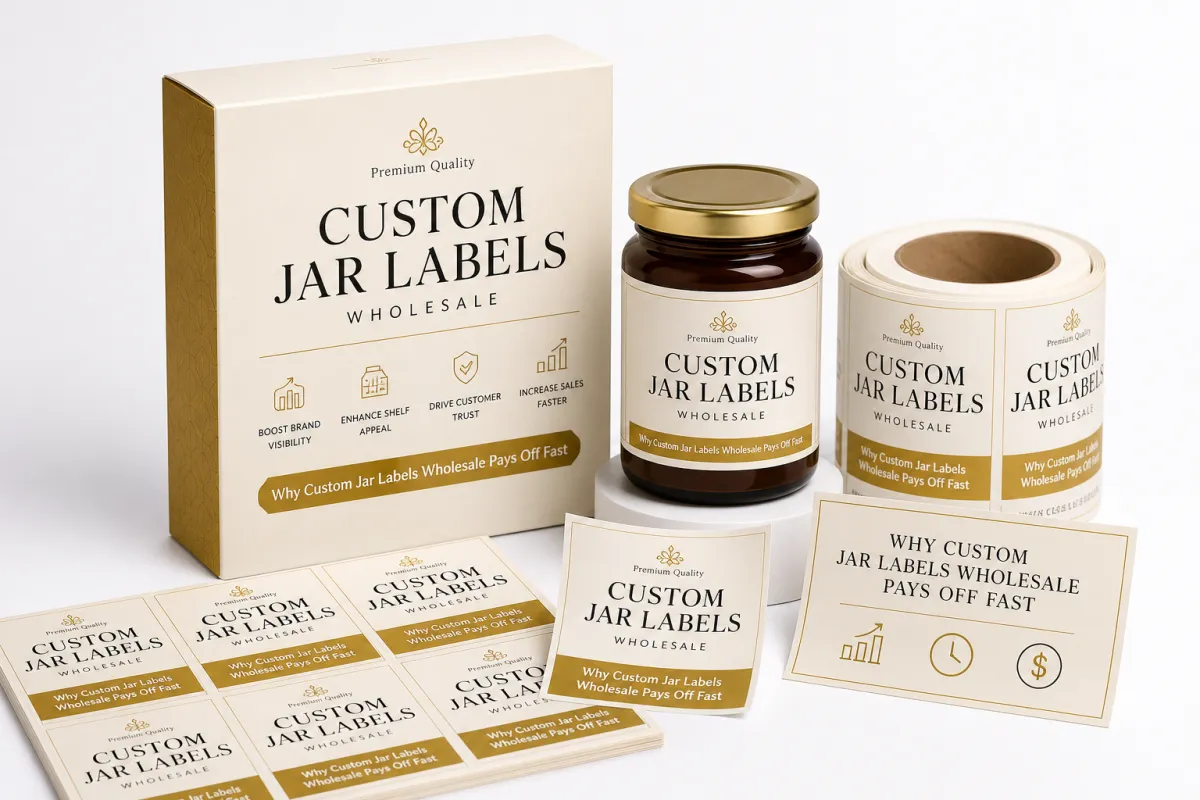
A brand selling salsa, face cream, or scented candles usually does not need a different design language for every jar size. It needs one visual system that scales. That is where custom jar labels wholesale changes the math. One approved look can move across 2 oz, 4 oz, 8 oz, and 16 oz jars with only modest layout changes. That lowers artwork churn and helps the shelf look like a product family instead of a pile of unrelated SKUs.
The practical side gets ignored too often. The more jars you carry, the more chances you have to create packaging problems: wrong label size, inconsistent finish, late reorder, or an old copy deck still floating around in inventory. Custom jar labels wholesale gives a brand one way to plan for all of it at once. The team can map SKUs by jar diameter, storage environment, and reorder cycle instead of buying labels in panic mode. I have watched perfectly good launches get delayed by a label that was three millimeters off. Three millimeters. That sounds tiny until the line starts wrapping like a bad first date.
Shoppers notice surface and color before they read the fine print. That is why labels often influence shelf performance more than the jar itself. A clear jar with a matte label can feel premium. A gloss label with strong contrast can make a small format pop from three feet away. In food and beauty aisles, that first impression is part of the sale, and custom jar labels wholesale lets you control it consistently.
Most brands underbuy on planning and overbuy on guesswork. They chase the lowest unit cost without lining up the label with the actual use case. A better move is to treat custom jar labels wholesale as a coordination tool: one artwork system, one approved material path, and a cleaner reorder process. That helps with seasonal flavors, limited bath collections, and candle launches that share the same jar but need different branding cues.
The cheapest label is not the cheapest order if it curls in storage, smears on the line, or forces a reprint two weeks before launch.
That rule explains why experienced buyers think in batches, not sticker price. Custom jar labels wholesale works best when the brand knows the jar count, the finish target, and the product environment before the quote request goes out. Clear inputs lead to a cleaner quote, a shorter proof cycle, and a simpler reorder path.
The same logic applies to custom printed boxes and other branded packaging assets. Once the label family is set, the rest of the product packaging can follow the same visual hierarchy: logo size, color balance, ingredient placement, and promotional callouts. The whole package looks planned instead of patched together.
Custom Jar Labels Wholesale: Materials and Finishes That Sell
Material choice is where custom jar labels wholesale gets serious. A label that looks sharp in a mockup may fall apart the first time it sees condensation, oil, or a cold shelf. Pick the environment first. Then pick the look. A label on a bath product needs a different performance profile than a label on a dry pantry item, and that should drive the spec from the start.
Paper stock is a common choice for dry, shelf-stable jars. It usually costs less, prints cleanly, and works well for brands that want a natural, straightforward feel. BOPP, or biaxially oriented polypropylene, is the more durable film option. It handles moisture and abrasion better, which makes it a stronger fit for refrigerated foods, shower products, and jars that get opened and closed all day. For custom jar labels wholesale, that durability gap is often worth the price difference.
Clear labels are useful for minimal branding. They let the jar surface show through, which can work well on glass and get messy fast on cloudy or textured plastic. Metallic stock adds reflectivity and a sharper retail presence, but it is not the right answer for every brand. Textured papers support a more artisanal feel, though they are usually better for dry environments than damp storage. Custom jar labels wholesale should not start with the finish. It should start with how the jar will actually live on shelf.
Finish matters as much as material. Matte creates a restrained, premium read. Gloss pushes color and contrast harder. Soft-touch adds a muted, higher-end feel that can lift beauty jars and small-batch gourmet products. Clear stock works for a minimal look, while metallic can signal a more promotional or giftable position. The real buying question is not “what looks nice?” It is “what supports the brand position and survives repeat use?” For custom jar labels wholesale, that question saves money later.
Cost matters too. Paper is usually the most economical route, while film stocks and specialty finishes add cost. The jump is not always dramatic, but it matters on large runs. If a brand is ordering 5,000 or 10,000 labels, a finish choice that adds a few cents per unit can move the budget by hundreds of dollars. That is why custom jar labels wholesale should be priced around the real use case, not around a vague “premium” assumption.
| Material or Finish | Best Use | Durability | Visual Effect | Wholesale Cost Signal |
|---|---|---|---|---|
| Paper | Dry food jars, pantry goods, light-duty retail packaging | Moderate; best away from moisture and oils | Clean, simple, approachable | Lowest |
| BOPP film | Bath products, refrigerated jars, handled frequently | High; resists moisture and abrasion better | Bright print, crisp detail | Moderate |
| Clear film | Minimal branding on glass or smooth plastic | High if applied to the right surface | Floating, understated, modern | Moderate to higher |
| Metallic stock | Gift sets, seasonal runs, premium shelf presence | Good, though surface choice matters | Reflective, sharp, attention-getting | Higher |
| Textured paper | Artisan food, small-batch beauty, specialty candles | Best for dry environments | Tactile, crafted, boutique | Moderate to higher |
For buyers comparing custom jar labels wholesale options across categories, the tradeoff is usually durability versus appearance. A soft-touch matte finish can look excellent, but if the jar sits in a sink area or a refrigerated case, a moisture-resistant film may be the safer commercial choice. That is not true in every case, but it is common enough to respect. Packaging design should serve the shelf, not just the mood board.
For more on industry materials and specification language, the resources at ISTA are useful when shipping and handling performance matters, and FSC-certified paper options can support sustainability claims when paper stock is the right fit.
Wholesale Jar Label Specifications: Size, Adhesive, and File Prep
Custom jar labels wholesale gets expensive when the spec is loose. A label that is even a little too wide can wrinkle at the edge, overlap awkwardly, or miss the jar seam entirely. Straight-sided jars are the easiest case. Curved jars need tighter sizing. Tapered jars need more caution because the face changes as the label wraps. Small-diameter jars are the most sensitive, and they reveal fit problems that larger jars hide.
A practical rule helps here: on a narrow jar, do not overwrap the label farther around the circumference than the surface can forgive. Many buyers keep a seam gap instead of forcing a full wrap that risks edge lift. A clean front panel is usually better than a label trying to do too much. That is one of the oldest lessons in custom jar labels wholesale, and also one of the most profitable.
Adhesive choice matters just as much. Permanent adhesive is the default for most retail labels because it stays put. Removable adhesive works for reusable jars, promotional packs, or products that may need to be reworked later. Cold-fill and refrigerated applications need special attention because condensation can weaken the bond. If the product is going into a fridge, a shower, or a room with heavy moisture, the adhesive should be selected for that environment from the start. For custom jar labels wholesale, that avoids a lot of wasted inventory.
File prep is another place where wholesale buyers save or lose money. The basics are familiar, yet they still get missed: bleed, safe area, resolution, and dieline placement. A 1/8 inch bleed is common for many print jobs, and a clean safe area keeps text from crowding the edge. Artwork should be supplied at the correct size, usually in CMYK, with fonts outlined if requested. Barcode placement needs quiet space around it, and ingredient panels need enough room to stay readable after trimming. In a small-label environment, these details matter more than they do on a carton, because custom jar labels wholesale magnifies every mistake across the full run.
There is a compliance angle too. Food, bath, and cosmetic labels often need ingredient copy, warning statements, batch code space, or scan-ready barcodes. If the label has to support retail scanning, verify barcode size and contrast early. If the brand expects seasonal updates, leave room in the design system for copy changes without rebuilding the whole label. That is where package branding becomes operational, not just visual. Good packaging design does both.
For buyers working across multiple SKUs, one dieline family can reduce revisions. One jar size may need a 2 x 3 inch front label, another may need a 2.5 x 4 inch wrap, and a third may need a smaller neck label or seal. Grouping those sizes under one design system can make custom jar labels wholesale easier to manage, especially if the same artwork needs to support retail packaging and sampler packs.
Digital proofs are usually enough for layout approval. Physical samples become more useful when color, texture, or adhesive performance needs a real-world check. If the jar will see oil, steam, cold storage, or frequent handling, ask for a sample or proof early. In the label world, a good proof is cheaper than a reprint. That stays true for custom jar labels wholesale.
Custom Jar Labels Wholesale Pricing and MOQ Breakdown
Price is rarely just about quantity. A solid custom jar labels wholesale quote should break down material, size, finish, color count, and any special effects. The more transparent those inputs are, the easier it is to see where the money goes. Two labels may look close on screen and still price very differently because one uses clear film, soft-touch lamination, and tight cutting, while the other is a plain paper run with a basic finish.
As quantity rises, unit pricing usually drops. That part is expected. What catches buyers off guard is the effect of setup costs, proofing, and finish selection on the break-even point. A low-volume run can be useful for testing, but it may carry a higher per-label cost than many brands expect. Once the order moves into a stronger wholesale tier, the economics usually improve. That is why custom jar labels wholesale should be quoted at two or three quantity levels whenever possible.
MOQ, or minimum order quantity, deserves a plain explanation. Some suppliers set MOQ by total label count. Others use roll quantity or sheet count. The format matters because it affects storage, handling, and reorder planning. A roll order may be easier for machine application. A sheet order may be better for hand application or small-batch fulfillment. A larger MOQ can lower cost, but only if the brand can store the labels without damage or obsolescence. For custom jar labels wholesale, MOQ is not just a threshold; it is a planning tool.
Here is a practical way to think about pricing bands for custom jar labels wholesale:
- Small pilot run: Best for fit testing, shelf checks, and short launch windows; unit cost is highest.
- Mid-tier wholesale run: Usually the best balance of cost and flexibility for a growing brand.
- Large repeat run: Lowest unit cost, but only sensible if the artwork and product plan are stable.
To put that into buyer terms, a simple paper label in a mid-sized wholesale run may sit in a low single-digit cent-to-tens-of-cents range per piece depending on dimensions, while premium film with specialty finish can move higher. Exact numbers depend on size, print coverage, shape, and finishing requirements, so a quote without jar dimensions is really just a guess. For custom jar labels wholesale, vague inputs produce vague pricing.
That is why the best quote requests are specific. Include the jar diameter, label dimensions if known, finish preference, quantity, application environment, and whether the order is for rolls or sheets. If the jar will be refrigerated, handled with oily hands, or exposed to humidity, say so upfront. A supplier can only price the real job if the real job is described. That is a core rule in custom jar labels wholesale.
Brands comparing wholesale options should think beyond label cost alone. A label that saves three cents per unit but creates a hand-apply bottleneck is not really cheaper. A slightly more expensive label that prints cleanly, applies easily, and reorders predictably may deliver better margin across the full run. The same logic applies across other branded packaging items, from Custom Labels & Tags to full Custom Packaging Products programs. Product packaging always costs more than the sticker price if you only count the sticker.
Production Process and Timeline for Wholesale Jar Labels
Good custom jar labels wholesale work follows a predictable path. Inquiry. Quote. Artwork review. Proof approval. Print, finish, inspect, pack, and ship. It sounds simple, but each step can slow the next one if the inputs are incomplete. Buyers who understand the sequence usually get faster turnaround because they stop treating production like a black box.
Most delays begin before printing starts. Missing dielines, unapproved colors, late legal copy changes, and unclear barcode requirements can all add days. In a tight launch calendar, that matters. If jars, lids, and labels all need to arrive together for co-packing, one late file can throw off the whole schedule. Custom jar labels wholesale rewards brands that treat packaging as a coordinated launch asset instead of a last-minute add-on.
Simple jobs with clean files can move quickly after proof approval. More complex jobs take longer. Special finishes, opaque white layers for clear film, or more involved die cutting can extend the schedule. Shipping also needs to be part of the timeline, not an afterthought. A smart packaging buyer builds in time for proofing and transit, because production speed is only part of the equation in custom jar labels wholesale.
Here is a timeline framework that helps:
- Inquiry and quote: 1-2 business days if the specs are clear.
- Artwork review and proofing: Usually 1-3 rounds, depending on copy readiness.
- Production: Often 12-15 business days after proof approval for standard jobs, longer for premium finishes or larger quantities.
- Shipping: Varies by destination and service level, so build that into the launch plan.
The fastest jobs are not the loudest ones. They are the jobs with clean files and fast approvals. That is especially true for custom jar labels wholesale, where every revision round can affect a pallet-sized run instead of a handful of samples. If a brand is shipping into multiple channels, request proof early and lock the copy before the production window opens.
Testing matters too. If the labels are for a jar that will ship long distance, consider how the finished pack will perform under vibration, humidity, and temperature swings. Industry testing bodies like packaging.org and route-testing methods such as those used by ISTA are useful reference points when packaging has to survive more than a simple shelf placement.
For brands that coordinate labels with cartons or sleeves, the label schedule should line up with the other package components. Wholesale planning helps there. A label run, a carton run, and a refill pouch run can share one visual system while still moving on different timelines. That consistency turns product packaging into a repeatable process instead of a one-off design sprint.
Why Choose Us for Custom Jar Labels Wholesale
For Custom Logo Things, the value of custom jar labels wholesale is not a flashy promise. It is a disciplined process. The job starts with jar type, label use case, reorder rhythm, and finish requirements before the quote is set. That matters because the right spec for a dry pantry jar is not the same as the right spec for a shower product, and a wholesale supplier should know the difference before price becomes the only topic.
Consistent cutting is one of the biggest quality markers in wholesale label work. A label that looks fine in isolation can still cause problems if the cut edge drifts across a production run. Adhesive performance matters too. So does color consistency from one repeat order to the next. Buyers do not just want a label that looks good once. They want custom jar labels wholesale that looks the same on the second run, the fifth run, and the seasonal update after that.
Responsive communication matters as well. Multi-SKU programs move faster when there is a clear path for proof approvals, SKU changes, and replenishment questions. If the artwork needs to be adapted for a different jar size, the supplier should be able to explain the dimensional changes without turning the project into a design guessing game. That is one reason custom jar labels wholesale works better with a packaging partner than with a generic print quote engine.
Brands often compare a supplier only on the first order. That is the wrong comparison. The real test is repeatability. Can the supplier handle a pilot run, then a higher-volume replenishment, then a seasonal artwork change without lowering standards? If yes, the buyer gets a more stable supply chain. If not, the brand pays in rework, delays, and mismatched inventory. In that sense, custom jar labels wholesale is really about supply assurance.
That approach also fits wider branded packaging decisions. If you need a label family that coordinates with cartons, sleeves, or insert cards, it helps to keep the whole visual system under one plan. Our Wholesale Programs page is a useful place to start if the order will repeat, and our Custom Labels & Tags options can support more than one jar size without forcing a design reset.
Material sourcing can matter too. If the brand is making sustainability claims, FSC-certified paper may be the right direction for some lines, while film-based durability may be better for others. There is no one-size answer. The right call depends on product environment, shelf life, and customer handling patterns. That is the kind of practical judgment a serious supplier should bring to custom jar labels wholesale.
Blunt version: the best wholesale label partner does three things well. It prices clearly, it proofs carefully, and it ships predictably. If those three points hold, the rest gets easier. That is a better value proposition than a low quote with hidden variables.
Next Steps for Custom Jar Labels Wholesale Orders
If you are preparing a custom jar labels wholesale request, the fastest way to get a useful quote is to gather the right inputs before you send the file. Start with the jar dimensions. Add the label size if it is already set. Then include the material preference, finish, total quantity, artwork files, and target ship date. If the product is going into a cold chain, a bathroom environment, or a kitchen, say that clearly. Those details change the recommendation.
A simple three-step process works well:
- Measure the jar and confirm the label face or wrap area.
- Choose the material based on moisture, oil, and handling conditions.
- Send artwork for proof review before locking the production run.
If the jar will see condensation, frequent handling, or refrigeration, request a sample or proof before you approve the full order. A small test can reveal adhesion issues, color shifts, or layout problems that are much cheaper to fix early. That is especially true with custom jar labels wholesale, where the first run often becomes the template for future orders.
It is also smart to compare one pilot quantity against one full wholesale quantity before you choose the final tier. Sometimes the savings at the higher tier justify a larger buy. Sometimes they do not, especially if the artwork is still changing or the SKU is still being tested. The right answer depends on storage capacity, launch confidence, and reorder timing. That is the kind of comparison that makes custom jar labels wholesale a disciplined buying decision instead of a gamble.
If you need a broader packaging plan, review the label order alongside the other branded packaging pieces so the design language stays consistent. The same logo size, type treatment, and color strategy can carry across jars, cartons, and inserts. That is where package branding becomes more efficient, and product packaging starts working as a system instead of a stack of separate purchases. For buyers who want to keep the process organized, Custom Packaging Products can serve as the next step after the label spec is set.
Bottom line: custom jar labels wholesale works best when the project moves from vague idea to clear specification. Once the jar size, material, finish, quantity, and use environment are known, the quote gets better, the proofing gets faster, and the reorder path gets cleaner. That is the real advantage of buying wholesale: not just a lower unit cost, but a better packaging process.
FAQ
What is the minimum order for custom jar labels wholesale?
MOQs vary by material, size, and print method, so the first question should be whether the quote is based on rolls, sheets, or total label count. Smaller pilot runs usually cost more per label, but they are useful for testing fit, adhesion, and shelf appearance. If repeat orders are likely, ask for a price break at the next quantity tier before you approve the first run.
Which material works best for custom jar labels wholesale on food or bath products?
Moisture-resistant stock is usually the safer choice for refrigerated food jars, shower products, and anything likely to be handled with damp hands. Paper can work well for dry, shelf-stable products, while BOPP or another film label is often better for durability. If the product sits in a premium category, finish and texture may matter as much as water resistance.
Can one wholesale label order cover multiple jar sizes?
Yes, but each jar size usually needs its own dieline and layout adjustment to keep proportions and barcode placement correct. Ask whether the printer can group similar sizes into one production run or whether separate SKUs will be priced independently. A label family with shared branding can reduce design time even when the physical sizes differ.
How long do custom jar labels wholesale orders usually take?
Timing depends on proof approval, artwork readiness, material selection, and the total quantity being printed. Clean files and fast approvals usually shorten the schedule more than any other single factor. If you have a fixed launch date, build in time for proofing and shipping rather than assuming production starts immediately.
What files do I need for a custom jar labels wholesale quote?
Send jar dimensions, label dimensions if already set, artwork files, quantity, finish preference, and the product's use environment. Include any required legal copy, barcode details, and placement notes so the quote reflects the real production setup. If you do not have a final dieline, ask for one before artwork is finalized so you avoid layout changes later.

