Buyer Fit Snapshot
| Best fit | Custom Jute Bags with Screen Printing projects where brand print, material claims, artwork control, MOQ, and repeat-order consistency need to be specified before quoting. |
|---|---|
| Quote inputs | Share finished size, material target, print colors, finish, packing count, annual reorder estimate, ship-to region, and any compliance wording. |
| Proofing check | Approve dieline scale, logo placement, barcode or warning zones, color tolerance, closure strength, and carton packing before bulk production. |
| Main risk | Vague material claims, crowded artwork, missing packing details, or unclear freight terms can make a low unit price expensive after revisions. |
Fast answer: Custom Jute Bags with Screen Printing: What Matters Most should be specified like a repeatable production item. The safest quote records material, print method, finish, artwork proof, packing count, and reorder notes in one written spec.
Production checks before approval
Compare the actual filled-product size with the drawing, then confirm tolerance on folds, seals, hang holes, label areas, and retail display edges. Reserve space for logos, QR codes, warning copy, and material claims before decorative graphics fill the panel.
Quote comparison points
Review material grade, print process, finish, sampling route, tooling charges, carton quantity, and freight assumptions side by side. A quote is only useful when the supplier can repeat the same color, closure quality, and packing count on the next order.
A printed jute bag keeps working long after the sale that carried it out the door. That is the real strength of custom jute bags with screen printing: the bag stays visible on commutes, at markets, in offices, and at events where the brand gets seen again and again without buying another ad impression.
Jute brings a coarse, natural texture that feels grounded in the hand. Screen printing brings the opposite quality: clean edges, bold contrast, and repeatable color. Together they create packaging that feels considered without pretending to be precious. For a packaging buyer, that balance matters because it sits between retail packaging and reusable product packaging, a space where many branding budgets need to do honest work.
The practical challenge is simple to describe and harder to execute. custom jute bags with screen printing need to look sharp, hold up under real use, fit the brand, and avoid production problems that add cost or slow delivery. A bag can be attractive in a mockup and still fail in production if the artwork is too fine, the print area is too tight, or the fabric construction is too weak. The aim is to make a bag people actually keep carrying, not one that gets folded away after a single errand.
There is also a sustainability reality that deserves a straight answer. Jute is a plant fiber, which gives it a natural-material appeal, but that does not automatically make every bag low-impact. Fiber sourcing, dye chemistry, transport distance, and how long the bag stays in use all affect the overall picture. I bring that up because buyers deserve a truthful view, not a polished one. If the bag is sturdy enough to be reused for months, the environmental story generally gets stronger; if it falls apart after one weekend, the story kinda collapses with it.
Custom jute bags with screen printing: why they stand out
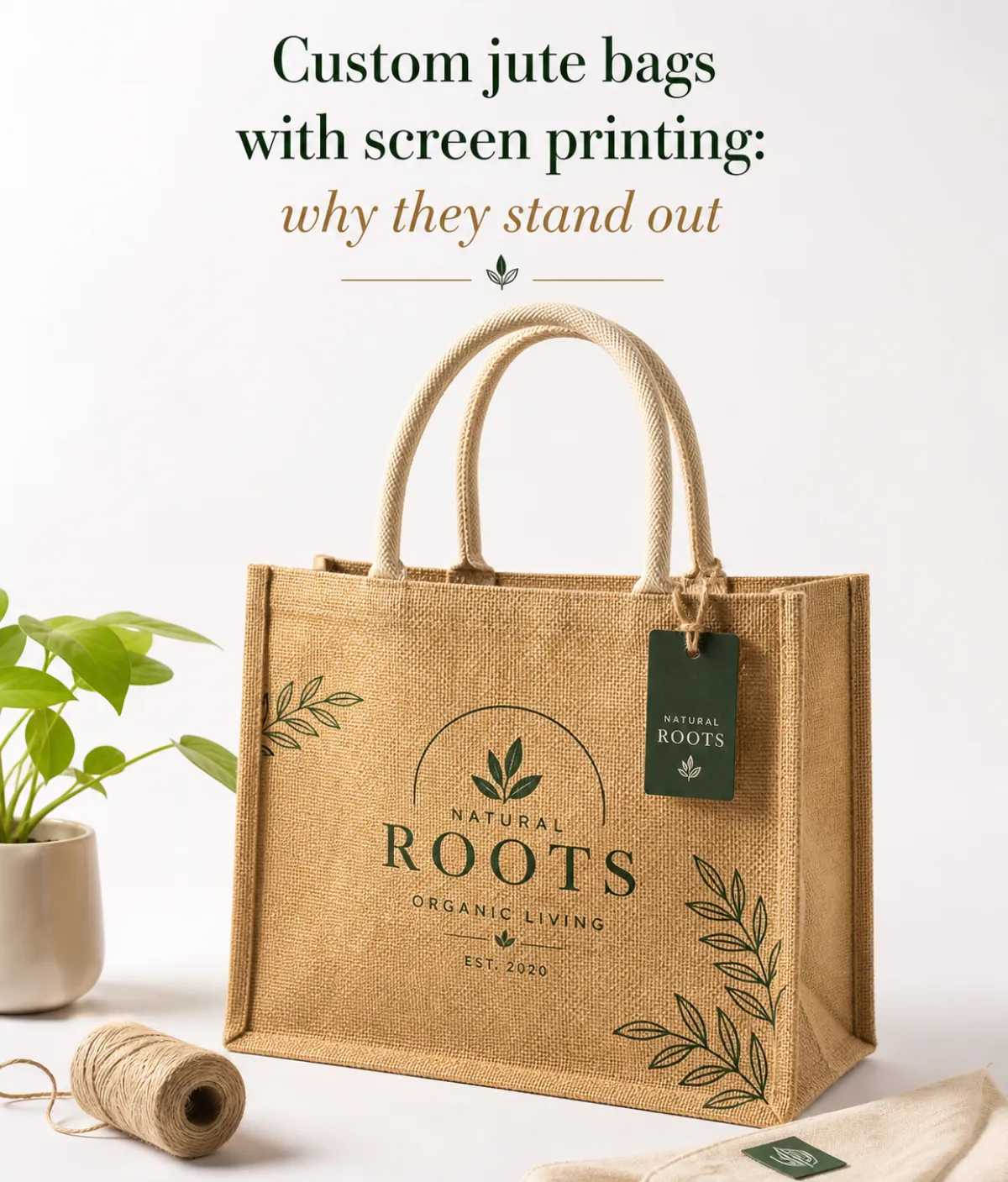
Jute is a natural plant fiber with a tactile surface that carries a slight rustic character. It is not slick like coated paper, and it is not perfectly uniform like molded plastic. That texture is part of the appeal. Shoppers often read the material as more authentic, which can support sustainability positioning in branded packaging and event merchandise. When the bag is well made, it feels like a real extension of the brand instead of a disposable carrier with a logo on it.
There is a retail truth that gets overlooked in early sourcing conversations: the bag can outlast the purchase inside it. A coffee roaster, a farm shop, a bookstore, or a trade show exhibitor may hand over a bag for one transaction, but the bag may stay in circulation for months. That is why custom jute bags with screen printing are often treated less like a throwaway supply item and more like package branding with a second life. Every reuse becomes another impression, another reminder, another small piece of brand visibility in public.
Screen printing strengthens that effect. The method lays down a solid, flat layer of ink that sits clearly on the surface instead of disappearing into the weave. That matters on jute because the material is visually active on its own. A bold logo, a simple type treatment, or a strong icon can still read from a distance, while a busy illustration can vanish into the texture. In practice, the most effective custom jute bags with screen printing usually rely on restraint: one clear message, one balanced placement, and a color choice that respects the brown, tan, or natural base of the material.
Compared with cheaper paper or plastic alternatives, jute shifts the emotional reading of the package. A paper bag can work for a short trip, but it often creases, tears, or softens once it meets weight or moisture. A plastic bag may last, yet it sends a different brand signal and rarely feels intentional. A jute bag adds structure, hand feel, and a clearer sense of value. That tactile quality can matter as much as the print itself, since shoppers judge packaging with their hands before they study the logo.
There is a design lesson hiding in that texture. Because the material already carries visual character, the bag can support a simpler language. That is a useful principle in packaging design: sometimes the best decision is not extra decoration, but sharper editing. A clean one- or two-color screen print on jute can feel more thoughtful than a crowded layout that tries to do every job at once. The strongest custom jute bags with screen printing often look as if the brand knew exactly what it wanted to say and stopped there.
A simple two-color print on a well-made jute bag often feels more premium than a five-color design fighting the weave.
In my own experience reviewing packaging programs, the brands that get the best response usually treat the bag as part of the product, not as a separate giveaway. That means they think about how the handle feels, how the print reads from six feet away, and whether the finish fits the rest of the shelf presence. The details are not glamorous, but they are what make the bag feel intentional.
For brands that already use Custom Packaging Products and Manufacturing Capabilities across cartons, inserts, and carry bags, jute can become a practical extension of the same visual system. It is not just another promotional item. It belongs inside a broader product packaging strategy that helps customers remember the brand long after the first purchase.
How custom jute bags with screen printing works
The production flow is direct, yet each step affects the result. Artwork separation comes first. A supplier or print shop breaks the design into the colors that will be printed, usually spot colors rather than full-spectrum imagery. Screens are then prepared, one for each color. Ink is pushed through the mesh and onto the bag with a squeegee, then cured so it bonds properly with the fiber. After that, the bags are inspected, packed, and shipped. That is the short version. The real work is making every part of the process respect the material.
custom jute bags with screen printing suit flat graphics, solid logos, and concise taglines especially well. The method delivers strong repeatability because the same screen can be used across a full run with limited variation. When the logo uses broad shapes and high contrast, the result tends to stay clean and legible. If the artwork depends on gradients, tiny shadows, or photographic detail, screen printing starts to lose the advantage that makes it attractive in the first place.
The technical side matters more on jute than on smoother substrates. Mesh count controls how much ink passes through and how much detail survives. On a coarser fabric, printers usually choose a mesh and ink system that balances coverage with edge sharpness. Squeegee pressure matters too; too much pressure can force ink into the weave and blur the design, while too little can leave the color patchy. Ink opacity is another variable. On a natural brown surface, a weak white or pale ink can look dull unless the formulation is strong enough to sit cleanly on top of the fiber.
That is one reason custom jute bags with screen printing usually work better for bold, high-contrast branding than for delicate visual work. A simple logo, a short phrase, and a clean typeface are not a compromise here. They are often the smartest choice.
Screen printing also compares well with other decoration methods in a few practical ways:
- Embroidery adds texture and a premium feel, but it can be heavier, more expensive, and less suited to broad printed graphics.
- Heat transfer can carry more complex artwork, though it may not sit as naturally on rough jute and can feel less integrated with the fabric.
- Digital printing helps with short runs or detailed imagery, but on textured material the image can lose crispness and show less of the fabric beneath.
- Screen printing often becomes the best choice when the design is simple, the quantity is meaningful, and consistent branding matters more than photographic fidelity.
That comparison matters in packaging because the same artwork behaves differently across substrates. A design that works on custom printed boxes may not translate cleanly to jute. A solution that succeeds for offset printing on a carton is not automatically the right answer for a reusable carry bag. The substrate changes the rules, and the bag should be designed with that reality in mind.
Think about a retail brand that wants a one-color logo and a short line of text on the front panel. A screen-printed jute bag can make that feel grounded and deliberate. Add a second spot color and the design can become stronger, provided the palette stays disciplined. Once the layout starts chasing gradients or intricate illustration, the benefits begin to fade. That is why custom jute bags with screen printing perform best when the creative team works with the material instead of trying to overpower it.
The other thing I tell buyers is to approve the print as a physical object, not only as a file on a monitor. A logo that looks crisp on a backlit screen can behave very differently on woven fiber, and that gap is where a lot of frustration starts. If the bag is meant for retail, staff use, or event carry-out, the physical sample is the real decision point.
Key factors that shape print quality, durability, and look
The bag itself comes first. Jute weave density, fabric weight, stitching, handle construction, lining, and any lamination all influence how the print appears. A tighter weave usually gives a steadier printing surface, while a very open weave can make ink coverage uneven. A lined bag may hold its shape better, which improves presentation in retail packaging and helps the printed area sit flatter. Handle stitching matters too, because a well-built bag keeps the front panel under less strain during use.
For custom jute bags with screen printing, artwork should be judged against the actual texture, not the preview screen. Tiny text causes the most trouble. Thin strokes can disappear into the weave, especially if the fabric has visible slubs or color variation. Gradients create another trap. They may look impressive in a PDF and then turn muddy once the ink hits a coarse surface. If a logo needs very small legal text, that information usually belongs on a hang tag or insert instead.
Placement can matter more than buyers expect. A front panel may seem large enough in a flat mockup, but the real bag has seams, gussets, and handle attachments that take away usable space. The same logo can feel balanced on one size and cramped on another. For that reason, the print area should be measured against the physical bag dimensions, not guessed from a generic template. That point matters even more when the bag is part of a broader package branding system and needs to stay visually aligned with cartons, labels, and other brand materials.
Ink selection and curing are durability issues, not just finish choices. If the ink does not bond properly, the print may fade, crack, or rub too quickly at folds and edges. That is not always a failure of screen printing itself; sometimes the issue is a mismatch between chemistry and fiber. A good supplier will explain curing temperature, dwell time, and wash or abrasion resistance in plain language. If those basics are hard to get from them, the job deserves a closer look. Industry groups such as ISTA are useful references when you want to think about handling, transit stress, and the way printed goods survive distribution, even if the bag itself is not a lab-tested parcel.
Natural fiber variation is part of the look, not a flaw. Small color shifts, slubs, and unevenness can appear from panel to panel. The smart move is to design around that reality. A warm white, a deep black, a dark green, or a strong navy usually performs better than a pale pastel. Buyers who are used to the uniformity of offset printing or digital printing on paperboard may find that texture unfamiliar at first. Over time, many brands decide that the slight irregularity is exactly what gives the bag its character.
There is also a sourcing question hidden inside the design conversation. A supplier that pays attention to panel consistency, seam quality, and stitching tension is usually more reliable on repeat work. If you are comparing jute tote suppliers against other product packaging vendors, ask the same questions you would ask on a carton project: what is the tolerance, how is the finish controlled, and what happens if a color drifts? That mindset keeps custom jute bags with screen printing on the right side of quality control instead of relying on hope.
For broader packaging references, the Institute of Packaging Professionals is a useful authority for terminology, structural thinking, and packaging education. Even though jute is a different category from corrugated or folding cartons, the same discipline still applies: clear specs, controlled samples, and measurable expectations.
One detail that gets missed a lot is color matching. On jute, exact Pantone replication is less predictable than on a coated paperboard surface, because the weave and natural tone influence how the ink reads. A good printer will aim for close, stable color rather than pretend the material behaves like a plastic substrate. That honesty is a sign of expertise, not a limitation.
Custom jute bags with screen printing cost, MOQ, and quote drivers
Price is usually the first question, and the least useful answer is a shrug. The reason it varies is predictable. Bag size, fabric weight, lining, handle type, print area, number of colors, ink type, packaging format, and freight all shape the quote. If you are ordering custom jute bags with screen printing, the bag construction often matters just as much as the decoration. A simple unlined tote can cost much less than a structured bag with reinforced handles and an internal pocket.
MOQ changes unit cost because setup work gets spread across the run. Screen preparation, artwork separation, and press setup all take time whether you order 300 or 3,000. As quantity rises, the per-piece share of those fixed costs usually falls. That is why buyers often see the biggest price drop between small trial orders and the first meaningful production run. The curve is not linear, and that surprises people who are used to a simple price-per-unit model in digital printing.
To make comparison shopping more useful, separate the unit cost from the total quote. A headline unit price can hide screen charges, sampling, folding or bagging fees, freight, palletizing, and rush costs. The total landed cost is what matters. If two suppliers quote the same bag but one includes proofing and shipping while the other does not, the cheaper headline number is not actually cheaper.
| Order profile | Typical unit range | What is usually included | Best for |
|---|---|---|---|
| 300-499 pieces | $2.20-$4.20 | Single-color print, basic bag construction, setup charges separated | Test programs, small launches, internal events |
| 500-1,999 pieces | $1.40-$3.10 | Better setup amortization, one or two spot colors, standard packing | Retail promotions, seasonal campaigns, trade shows |
| 2,000+ pieces | $1.05-$2.40 | Lower per-piece setup burden, more room for controlled quality and freight planning | Ongoing branded packaging programs and repeat orders |
Those ranges are broad on purpose. They reflect the reality that a heavier bag, a tighter stitch spec, a larger print area, or a second color can move the quote quickly. If the supplier uses lined interiors or premium handles, the price climbs again. A clean single-color mark on a standard natural jute tote often gives the best value because it keeps production simple. That is one of the reasons custom jute bags with screen printing can outperform more decorative options on cost per impression.
If the budget is tight, there are several places to save money without hurting the result:
- Reduce the design to one or two spot colors.
- Keep the print area efficient rather than oversized.
- Use a standard bag dimension instead of a custom build.
- Keep the artwork away from seams and handles so registration stays easier.
- Standardize the bag across multiple SKUs if the same carry format works for different products.
A good buyer checklist helps compare quotes fairly:
- Bag dimensions and fabric weight
- Handle length and reinforcement details
- Print method and number of colors
- Setup or screen charges per color
- Sample approval process
- Packing method and carton count
- Freight terms and destination
- Reorder consistency expectations
If you already buy Custom Packaging Products for other lines, this is the same procurement discipline you would use for cartons, labels, or inserts. The difference is that jute adds texture and textile variables, so you need a sharper eye on handling and print tolerance. That is why custom jute bags with screen printing should be priced as a finished branded item, not as a fabric bag with ink on it.
One more thing on cost: freight can change the whole picture, especially on larger bags that ship with a lot of air around them. I have seen projects that looked inexpensive per piece become less attractive once carton count, cube size, and destination charges were added. Always check the landed number, because that is the figure the warehouse actually feels.
Process and timeline: production steps from art to shipment
A clean schedule starts with a clean brief. The supplier needs the logo file, the bag size, the number of print colors, the target ship date, and the destination. Once those basics are in hand, the work usually moves through a familiar sequence: artwork review, proof approval, screen preparation, bulk printing, curing, quality control, packing, and dispatch. That sequence is ordinary, but the handoff points are where delays build.
For custom jute bags with screen printing, the longest delays are often not in the press room. They happen before production begins. Missing vector files, unclear color calls, last-minute design revisions, and uncertain print placement can all slow the job. If the artwork has to be rebuilt from a low-resolution image, that alone can add days. If the supplier waits for a customer to decide whether the logo should sit centered or slightly higher on the panel, the timeline stretches again.
The production window also depends on quantity and season. A straightforward order with final artwork and in-stock materials may move through the factory in roughly 10-15 business days after proof approval. Bigger runs, specialty finishes, or busy seasonal periods can push that longer. Shipping sits outside that window. Domestic transit may take only a few days, while international freight can add one to four weeks depending on route, customs timing, and whether the bags move by air or sea. That difference matters because a fast factory does not automatically mean a fast arrival.
Approvals matter most during proofing. A five-minute reply on a screen proof can save an entire day, sometimes more. If the supplier sends a physical sample, review it under the lighting where the bags will actually be used. Natural daylight, warehouse fluorescents, and showroom lighting all change how the ink reads on jute. That is not a flaw; it is normal material behavior. It is also one reason buyers who order custom jute bags with screen printing repeatedly tend to keep tighter file discipline from one run to the next.
Planning backward from launch date is the safest approach. Start with the event or retail drop, then subtract transit time, then subtract production time, then leave a buffer for sample approval or a small reprint if needed. A seven-day cushion is modest. A ten-day cushion is better. For high-stakes launches, I would rather see a buyer approve the bag early and let it sit in the warehouse than compress the schedule so tightly that a single freight delay creates a mess.
There is also a packaging-handling angle here. If the bags are being delivered inside cartons with inserts or labels, the packing format should be discussed early. It affects carton count, warehouse storage, and how quickly the goods can be received into inventory. The job is not finished when the print dries. It is finished when the bags are actually usable in the packaging workflow.
A sensible timeline also leaves room for one small truth that is easy to ignore: natural materials vary. Even with the same spec, one batch of jute may print slightly differently than another. That does not mean the supplier did anything wrong. It means the buying plan should include a little breathing room, especially if the order is tied to a launch or seasonal campaign.
Common mistakes that make jute bag printing underperform
The biggest mistake is trying to print too much detail. Ultra-fine text, delicate line work, and tiny symbols can disappear into the weave before the buyer ever sees them in person. On screen, a logo may look precise. On jute, it can read fuzzy or broken. That problem shows up often when the design was originally created for a smooth substrate like a carton, label, or web graphic and then copied over without adjustment. custom jute bags with screen printing reward boldness, not clever complexity.
Another frequent error is over-coloring the design. More colors do not automatically improve the bag. In many cases, they do the opposite. Each additional color adds setup complexity, registration risk, and potential misalignment. A crowded design can also make the bag feel less premium because the natural texture stops acting like a feature and starts acting like noise. For many brands, a restrained palette does more for perceived quality than a busy layout ever will.
Placement mistakes are just as common. A logo that sits too low may fight the gusset. A mark that spreads too wide may be interrupted by seams or handle stitching. A design that looks centered in a PDF may land awkwardly once it is on a three-dimensional bag. That is why buyers should always ask for the actual print dimensions and not assume the template is the final answer. The same discipline applies in packaging design for boxes and labels: the mockup helps, but the physical object tells the truth.
Skipping a sample or proof is risky because natural materials vary. One batch of jute may be smoother, another slightly darker, and the ink can behave differently from one lot to the next. Even a strong supplier cannot remove every shift. What they can do is control it and show enough proof to judge the likely outcome. If your order is for a launch, retail distribution, or a seasonal campaign, a sample is not a luxury. It is inexpensive insurance.
Buyers also sometimes assume that all jute is interchangeable. It is not. Bag construction can change the entire impression. A flimsy bag with weak stitching can make a good print look amateurish. A well-made bag with proper reinforcement can elevate even a simple logo. That is why jute should be treated as part of the brand system, not just the carrier. If the logo sits on a poor bag, the problem is not the logo. It is the whole object.
Here is a useful comparison: offset printing and digital printing are excellent for smooth, controlled surfaces, but they do not automatically translate to textile-style substrates. A buyer who expects carton-level sharpness on rough fiber is setting the bar in the wrong place. Better to design for the material and get a stronger result than to force the material to imitate something else.
Another trap is approving the first proof too quickly because the layout looks clean on paper. I have seen this happen with simple one-color marks, and it is still worth a second look. Once the ink hits the weave, even a small shift in spacing or a slightly too-thin stroke can change the whole read of the bag. That extra review is usually time well spent.
Expert tips and next steps for a stronger order
Start with one bold front-side mark. That is the cleanest path for most custom jute bags with screen printing. If the brand needs a second element, keep it small and functional, such as a website or short tagline. The bag should be visible from a distance, readable in a second, and still pleasant to carry in real life. If it only looks good in a mockup, it is not ready.
Ask for swatches, sample prints, or proof images in real lighting. Do not approve a shade based only on a screen image, because monitor color can mislead even experienced buyers. Natural jute absorbs light differently than coated paper, so a white that feels bright on a display may read softer on the bag. That is normal. The point is to catch it before production, not after delivery.
A sourcing checklist keeps the project organized. Before you request a quote for custom jute bags with screen printing, gather the following:
- Quantity target and acceptable MOQ range
- Bag dimensions and fabric weight
- Handle style and lining requirements
- Logo file format and color references
- Exact print placement and print size
- Required delivery date and destination
- Budget range including freight
- Whether repeat orders must match a previous run
Ask suppliers direct technical questions. How is the ink cured? What screen count do they use for your artwork? What tolerance do they allow on print placement? How close can a reorder get to the original run? Those are not fussy questions; they are the questions that separate a decent vendor from a dependable one. A good supplier will answer clearly because they know that the quality of custom jute bags with screen printing depends on details, not just enthusiasm.
If your packaging program already uses branded packaging, cartons, and inserts, the jute bag should be planned as another touchpoint in the same system. The bag may be carried after the box is recycled, which means its role can extend the life of the campaign. That is an unusually efficient form of brand exposure. It is also why many teams treat the bag as part of the product packaging strategy rather than an add-on promotion.
One last practical point: make time for a sample review before you commit to bulk. The safest path is still straightforward. Gather specs, compare quotes, request proofing, and approve only after the material, print, and placement all make sense together. If you want a bag that gets used every day instead of sitting in a cupboard, custom jute bags with screen printing should be handled with the same care you would give a carton or label system, because the brand still lives in the details.
The clearest takeaway is simple: keep the artwork bold, keep the spec disciplined, and approve a physical sample before the run starts. That one habit prevents most of the expensive surprises and gives custom jute bags with screen printing the best chance to feel durable, useful, and on-brand from the first delivery onward.
FAQ
How many colors work best for custom jute bags with screen printing?
One to two spot colors usually create the cleanest, sharpest result on jute. More colors increase setup complexity and can make the design feel crowded on a textured weave. If the logo depends on gradients or photos, screen printing may not be the best fit for custom jute bags with screen printing.
Are custom jute bags with screen printing durable for daily retail use?
Yes, when the ink is matched to the fabric and properly cured, the print can hold up well through repeated handling. Durability improves when the design uses bold shapes instead of tiny lines that wear faster. The bag construction matters too, so strong stitching and handles matter just as much as the print itself on custom jute bags with screen printing.
What affects the cost of custom jute bags with screen printing the most?
Bag size, material quality, and number of print colors are usually the biggest price drivers. Setup fees, sampling, and freight can change the total quote more than buyers expect. Higher quantities often lower unit cost because the fixed setup work is spread across more pieces, which is why custom jute bags with screen printing become more economical as the run grows.
How long do custom jute bags with screen printing usually take?
The timeline depends on proof approval, screen prep, production slots, and shipping method. Simple orders move faster when artwork is final and the bag size is in stock. Rush orders can be possible, but they often increase cost and leave less room for changes on custom jute bags with screen printing.
Can I print detailed artwork on custom jute bags with screen printing?
You can print detail, but fine text, thin lines, and soft gradients are harder to preserve on jute. Bold shapes and strong contrast usually reproduce better than photo-style artwork. If the artwork is very intricate, ask for a proof and compare it against the actual bag texture before approving custom jute bags with screen printing.
If you are building a reusable packaging program, the safest path is still the most practical one: define the bag, simplify the artwork, verify the proof, and compare suppliers on the full landed cost. That is how custom jute bags with screen printing become a dependable part of branded packaging instead of a one-off purchase.

