If you need a custom kraft bags supplier quote, the first mistake is asking for price before the specification is real. Two bags can look almost the same in a mockup and still land in different cost bands once paper weight, handle style, print coverage, reinforcement, and packing format are fixed. That is not a supplier trick. It is how paper goods behave once they move from concept to production.
Kraft bags look simple from a distance. Up close, they behave more like a short chain of decisions: what the bag carries, how often it is handled, whether it needs to stand upright, and how much visual weight the brand wants on the surface. A buyer who treats the quote as a guess usually gets one. A buyer who gives a complete brief gets something closer to a working number.
That matters because packaging buys rarely fail on one dramatic error. They fail in smaller, duller ways: a handle that feels flimsy, a gusset that is too narrow for boxed product, ink that looks fine in proof but dulls on brown stock, or freight that was never included in the price. The cheapest number can be the least useful one if it leaves out the part that matters in the warehouse.
Why kraft bag quotes change more than buyers expect
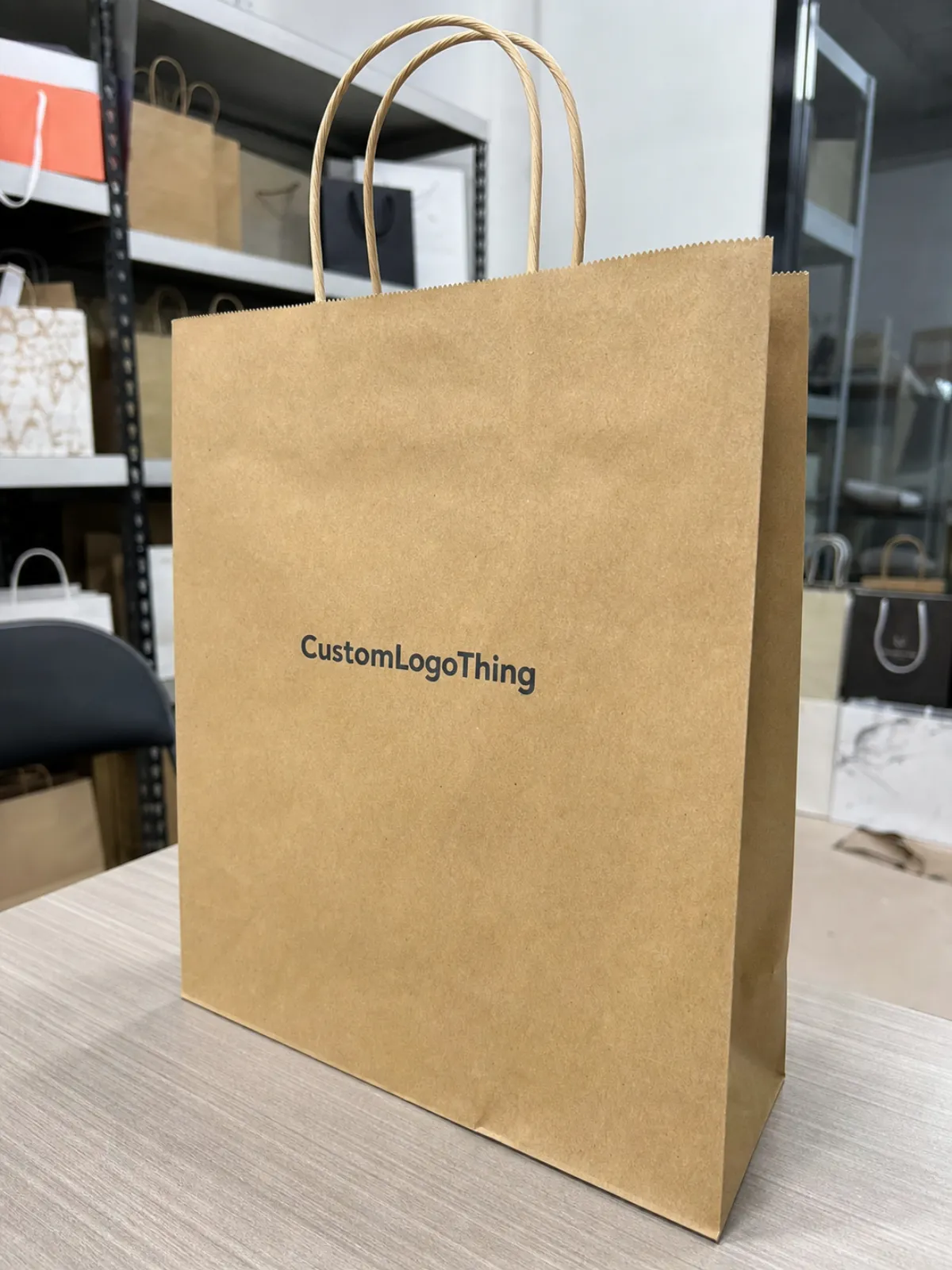
Most buyers think bag size drives cost first. It does, but only after the material and construction choices are settled. A 250 x 90 x 320 mm brown kraft shopping bag with twisted handles may look close to a slightly heavier version on paper, yet the stronger stock, extra reinforcement, and different print setup can shift the quote in a way that is easy to miss if you are comparing mockups instead of specs.
The main drivers are usually paper weight, bag size, handle type, print count, reinforcement, and packaging count. A small takeaway bag with one-color logo print is a different job from a retail bag with full-bleed graphics, white ink, and a reinforced top fold. If the bag needs to carry bottles, jars, or boxed merchandise, the supplier may recommend heavier stock or a wider gusset. Those changes are not cosmetic. They change material use, labor, and waste.
Use the bag in the sentence. Say whether it is for apparel, bakery items, cosmetics, promotional kits, or ecommerce inserts. Mention whether it will be handed over at checkout, stacked on a shelf, or packed inside another parcel. That context helps a supplier decide whether to quote a lighter retail bag or a sturdier carrier with more structure.
Inventory planning also improves when the quote is based on real use. If the supplier knows the order is tied to a fixed launch date and a specific quantity, they can flag whether the timeline is realistic or whether the order should be split. A clear answer early saves more money than a cheap headline price that cannot ship on time.
Bag styles and print options for custom kraft orders
The most common styles are brown kraft, white kraft, twisted handle, flat handle, die-cut, and rope-handle bags. Brown kraft is usually the lower-cost route and gives a natural, matte look that suits food, retail, and event packaging. White kraft feels cleaner and works better for premium branding, although it shows scuffs and handling marks more easily. Twisted handles are common in retail and gift packaging. Flat handles appear often in takeaway and grocery orders. Die-cut styles keep the profile slim and tidy, especially for lightweight products or promo kits. Rope handles are often used when the bag needs a more premium hand-feel.
Print choice changes the quote as much as the bag structure. One or two spot colors are usually the most budget-friendly. Full-coverage artwork, large solids, gradients, and heavy ink coverage raise complexity because they demand tighter setup control and can increase waste during the run. Typical print methods include one- to four-color flexographic printing for simple brand marks, offset printing for sharper multi-color graphics on smoother paper, and hot-foil stamping for metallic accents. If the artwork uses a lot of detail, ask whether it can be simplified without losing the brand identity. That is not a downgrade if the goal is a cleaner, more reliable print result.
Some finishes are worth paying for. Foil, embossing, specialty coatings, and soft-touch lamination can give a premium look, but they only make sense if the product and the distribution channel support them. For event bags, takeaway packaging, or high-turnover retail, a clean logo on good kraft stock usually does the job. Decorative extras are not automatically better packaging; sometimes they just make the bag slower and more expensive to produce.
| Style | Best use | Typical quote impact | Practical note |
|---|---|---|---|
| Brown kraft, twisted handle | Retail, takeaway, events | Lowest to mid | Good for simple branded packaging and faster runs |
| White kraft, twisted handle | Fashion, cosmetics, gift packaging | Mid | Cleaner presentation, but more sensitive to surface marks |
| Flat handle kraft | Food service, grocery, carryout | Low to mid | Functional and usually cost-aware |
| Die-cut kraft | Promotions, boutiques, lightweight products | Mid to higher | Useful for a flatter profile and neat presentation |
If the order is meant to support a product launch, structure should come before decoration. A bag that holds its shape and carries the load is more valuable than a beautiful one that folds badly or fails under weight. That is especially true if the bag is paired with rigid cartons, glass jars, or boxed goods that push on the gusset.
For buyers who care about sourcing discipline, ask whether the paper is FSC-certified and whether the supplier can discuss transport testing or carton strength in practical terms. If the bag uses organic cotton handles, ask for GOTS documentation for the cotton component and OEKO-TEX Standard 100 if any textile cord or label is involved. For recycled content claims, ask whether the supplier can support them with GRS paperwork. For factory social compliance, WRAP or BSCI audit summaries are common requests. That is not overengineering. It is standard diligence. See the FSC resource at fsc.org and transit testing guidance at ista.org.
Paper weight, size, and construction specs that matter
A serious quote should always list the same fundamentals: width, gusset, height, paper weight, handle style, print side count, and pack format. Leave one of those out and the supplier has to make assumptions. Leave out two and the quote becomes a placeholder rather than a usable price.
Paper weight is one of the most common places where buyers underspec the bag. Light retail kraft bags often sit around 80gsm to 120gsm. Heavier shopping bags may move into 120gsm to 180gsm, especially if the bag needs more stiffness or load support. Many buyers will choose 120gsm brown kraft for a standard retail carrier, 150gsm for a more rigid premium bag, and 170gsm to 180gsm when the bag must hold a heavier boxed set or multiple bottles. Thicker paper costs more, but it also improves feel, upright behavior, and resistance to tearing. If the bag will carry bottles or boxed products, weak stock is a false economy.
Size changes the quote because larger bags use more material and often need stronger bottoms or wider gussets. A 120 mm gusset is not a small tweak from 90 mm. It alters how the bag packs, how much volume it holds, and how much paper goes into each unit. More paper means more cost. It can also affect freight, because bulkier cartons take up more space per unit. A small change in gusset can also force a different cutting die, which adds setup time and sometimes die cost.
The smaller construction details are easy to overlook and hard to ignore later:
- Reinforced top fold improves the handle area and helps the bag survive repeated use.
- Bottom board insert improves flatness and keeps the bag stable under load.
- Glue coverage affects how cleanly the bag stands and how long it lasts.
- Handle attachment changes the feel in hand and the risk of failure.
- Inner coating or food-safe treatment may matter for greasy or bakery items.
If the bag will touch food, ask whether it needs grease resistance or an interior treatment. That is not the same as a premium finish. Bakery, fried food, and some takeaway packaging need function first. A nice-looking bag that soaks through is still the wrong bag. If the stock is food-contact grade, request the supplier to state whether the barrier is a clay coating, a water-based grease-resistant treatment, or an uncoated kraft grade approved for dry goods only.
“The cheapest quote is usually the one that forgot something.” That is what matters here: missing a spec tends to move cost later, not disappear it.
Before artwork is approved, a basic checklist prevents most surprises:
- Confirm exact dimensions in millimeters.
- Confirm GSM and whether the stock is brown or white kraft.
- Confirm handle type, handle color, and whether the handle is paper, cotton, or ribbon.
- Confirm print method, number of colors, and whether there is white ink or foil.
- Confirm bottom reinforcement, gusset width, and any coating or food-safe treatment.
- Confirm pack count per carton and target carton weight for shipping.
Custom kraft bags supplier quote: pricing, MOQ, and unit cost
On a real custom kraft bags supplier quote, the price should separate product cost, sample cost, setup cost, and freight. That way you can see what is fixed and what changes with volume. If a supplier gives only one all-in number, ask for a line-by-line split. It is the simplest way to compare offers that are not truly the same.
Typical MOQ ranges are straightforward. Simple brown kraft bags with one-color print often start at 500 to 1,000 pieces. White kraft or twisted-handle retail bags often sit at 1,000 to 3,000 pieces. Premium bags with lamination, foil, embossing, or complex print usually sit closer to 3,000 to 5,000 pieces. If the order includes custom handle colors, unusual sizes, or specialty coatings, the MOQ usually rises because the supplier has to lock in material and machine time.
For unit cost, a practical range is more useful than a headline promise. At 500 MOQ, a simple one-color brown kraft bag may land around $0.38-0.85 per unit, while a white kraft bag with twisted handles may land around $0.55-1.10 per unit. A premium retail bag with lamination, foil, or multiple print stages can reach $2.50-4.00 per unit at 500 MOQ. At 1,000 to 3,000 pieces, the unit price usually drops because setup is spread across more bags. The exact breakpoint depends on the number of colors, handle style, and whether the supplier is making the bag on a manual, semi-automatic, or fully automatic line.
Sample costs should be separate from production cost. A plain white sample or digital proof may be free or low cost, but a finished pre-production sample with the exact paper, print, and handle can cost $30-150 depending on complexity. Many suppliers credit the sample fee back against the production order if the run moves forward. Sample lead time is commonly 3-7 business days for a simple bag and a little longer if plates, foil dies, or special handles are involved.
Ask the supplier to state whether the quote includes printing plates, die-cut tooling, handle insertion, inner board, poly bagging, carton labels, and export cartons. Those items are often the reason a quote jumps after the first draft. A fair quote is not always the cheapest one; it is the one that leaves the fewest surprises.
Production steps, turnaround, and lead time from approval to ship
A clean production flow usually looks like this: artwork confirmation, prepress, sample approval, material intake, printing, cutting, folding, gluing, handle attachment, inspection, carton packing, and dispatch. On a standard order, turnaround is commonly 18-22 business days after artwork approval and deposit. If the order includes lamination, foil stamping, embossed details, or custom handles, the timeline can extend to 25-35 business days.
The sample process matters because it catches dimensional or visual issues before the full run starts. A typical sample flow is:
- Send a spec sheet with dimensions, material, print, and pack count.
- Receive a digital mockup or line drawing for placement confirmation.
- Approve a physical white sample or printed pre-production sample.
- Check the sample against the intended load, handle feel, and brand color.
- Sign off on the final proof before plates, tooling, and full production begin.
The machines and processes behind the order are usually straightforward but important. A supplier may use a flexographic press for simple logo work, an offset press for sharper multi-color artwork, an automatic bag-making machine for folding and side-gusset formation, a handle-pasting station for twisted or flat handles, and a die-cut press for custom shapes. Water-based inks are common on kraft bags because they dry well, suit paper stock, and reduce odor. Hot-melt or water-based adhesives are typically used for side seams, top folds, and handle bonding.
Inspection should not be vague. A good factory will check:
- Incoming material: paper GSM, caliper, moisture level, and surface consistency.
- Print stage: color density, registration, smudging, and tone consistency across the run.
- Construction stage: gusset width, bottom glue coverage, fold alignment, and handle placement.
- Strength stage: handle pull test, bottom load check, and seam adhesion.
- Final pack-out: carton count, barcode or label accuracy, and random bag sampling.
For higher-risk orders, ask whether the factory works to an AQL standard such as 2.5 for major defects and 4.0 for minor defects. That gives both sides a clear reference for what counts as acceptable. If the bags are for food service or cosmetics, ask for clean-room style handling at the final packing stage, sealed inner polybags if needed, and a moisture-protected outer carton.
How to compare suppliers before you sign off
Once you have two or three quotes, compare them on more than price. Check whether each supplier is quoting the same paper weight, the same handle style, the same carton count, and the same freight basis. A lower unit price can hide a weaker spec, and a higher unit price can include a better machine setup, better print control, or more reliable packing.
Certification claims are useful only when they match the product and the factory function. If the bag uses recycled paper, ask for GRS support documents and the recycled content percentage. If the handles are textile-based, ask whether the textile component can be supported by GOTS or OEKO-TEX Standard 100, depending on the material. If the supplier says they have WRAP or BSCI, ask whether the audit is current and what scope it covers. For paper-only bags, FSC is often the most relevant material claim, while WRAP and BSCI speak more to factory labor and management systems.
Also ask how the supplier handles rework and defects. A useful answer includes a clear replacement policy, photo evidence of the issue, and a defined time limit for reporting damaged cartons or print errors. If the supplier cannot explain how they isolate a bad batch, they probably have not documented the process carefully enough.
Good comparison questions include:
- Is the quote based on 500, 1,000, or 3,000 pieces?
- Does the price include plates, tooling, and carton packing?
- What is the approved color standard and how is it checked?
- Which certifications are current and relevant to this exact bag?
- What is the defect threshold for final inspection?
If one supplier can show a complete spec sheet, sample approval flow, and inspection checkpoints while another can only give a number, the first quote is usually the safer one. That is true even when the second price looks lower.
What to send for the fastest next step and a cleaner quote
The fastest quotes come from buyers who send a finished brief instead of a vague request. The best starter package is short but specific: exact dimensions, paper weight, handle style, artwork file, target MOQ, shipping destination, and target delivery date. If you already know the bag will carry heavy product, say so. If the bag will touch food, say that too.
Helpful details to include:
- Width x gusset x height in millimeters.
- Brown kraft or white kraft, plus GSM target.
- Handle type: twisted paper, flat paper, cotton, ribbon, or die-cut.
- Print method and number of colors.
- Target quantity, sample requirement, and desired lead time.
- Any required certification, such as GRS, GOTS, OEKO-TEX Standard 100, WRAP, or BSCI where relevant.
If you want a cleaner quote, attach the artwork as vector PDF or AI, plus a simple reference image for logo placement. If you have a retail packaging standard, add it. If the bag needs a specific carton count, state that early. A supplier can quote faster when they do not have to guess whether the bag is for light retail use or a heavier carrier with real load requirements.
One more detail saves time: say what must not change. If the paper tone, handle color, logo placement, or inside print needs to remain fixed, write that down. That prevents unnecessary revision rounds and keeps the quote tied to the real order.
FAQ
What is a realistic MOQ for custom kraft bags?
Most standard custom kraft bags start at 500 to 1,000 pieces. Premium bags with foil, lamination, or custom handles often need 3,000 pieces or more.
How much does a custom kraft bag usually cost?
A simple bag can start around $0.38-0.85 per unit at 500 MOQ. A more premium version with extra finishes can reach $2.50-4.00 per unit at 500 MOQ. The exact price depends on size, paper weight, handle type, and print coverage.
How long does production usually take?
Standard production is commonly 18-22 business days after artwork approval and deposit. Complex bags with special finishing can take 25-35 business days.
What sample steps should I expect?
A typical flow is digital mockup, white sample or printed sample, then pre-production approval. Sample lead time is often 3-7 business days, and a finished sample may cost $30-150 depending on complexity.
Which certifications matter most?
For paper bags, FSC is often the most relevant material claim. For recycled-content claims, ask for GRS. For textile handles or labels, GOTS and OEKO-TEX Standard 100 can be relevant. For factory social compliance, WRAP and BSCI are common requests.
What should the final inspection cover?
At minimum, check paper GSM, print alignment, handle bond strength, bottom glue coverage, bag dimensions, carton count, and pack condition. For more controlled runs, ask whether the supplier uses an AQL 2.5/4.0 standard.

