Custom Kraft Cartons Wholesale: Buy Direct for Bulk Runs
custom kraft cartons wholesale is one of those packaging purchases where the line-item quote can be misleading. A carton that looks inexpensive on paper can still cost more once freight, packing labor, damage rates, and repeat ordering are counted. The better question is not whether the box is cheap. It is whether the carton fits the product, the production line, and the shipping route without adding hidden costs later.
That matters because kraft packaging sits at the intersection of structure and presentation. It has to hold shape, absorb handling abuse, and still look intentional on a shelf or in a mailer stack. If the board, print, and closure are chosen well, a kraft carton can protect margin instead of eating into it. If the spec is vague, the order usually gets more expensive in small but steady ways: extra insert work, reprints, crooked folds, or a box that is technically correct and practically awkward.
For buyers comparing sourcing paths, the landed-cost view is more useful than the unit-price view. Freight cube, storage space, and assembly time can swing the real cost more than the carton itself. If you need a broader sourcing overview, our Wholesale Programs page explains how bulk packaging orders are handled, while our Custom Packaging Products catalog shows the formats that can be built around kraft board.
Why custom kraft cartons wholesale lowers total pack cost
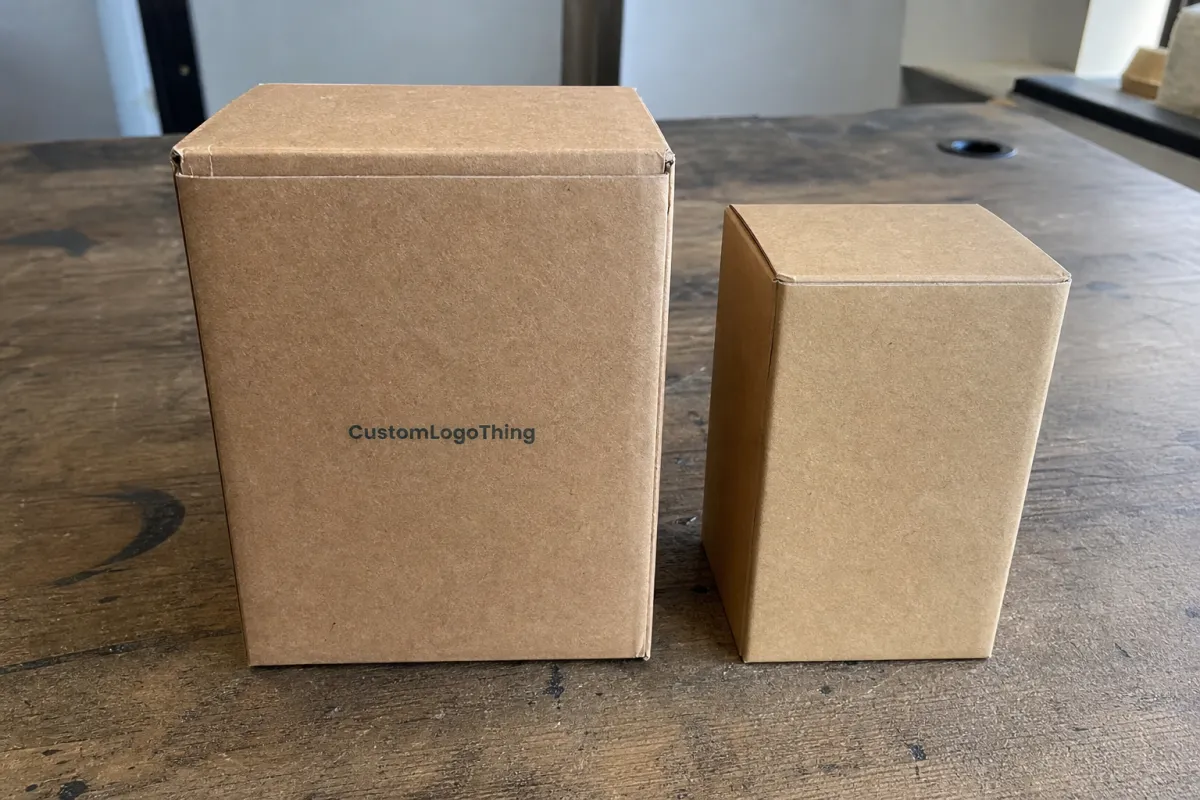
The obvious savings are rarely the biggest ones. A carton that costs a few cents more can still lower total pack cost if it uses the board more efficiently, packs faster, or eliminates a secondary shipper. That is why custom kraft cartons wholesale works best when the structure is designed around the product instead of adapted after the fact.
Kraft board helps here because it is adaptable. It can be used for light retail cartons, mailer-style boxes, sleeves, and heavier corrugated builds. One shell can sometimes be shared across several SKUs with a divider or insert change, which reduces tooling duplication and keeps inventory simpler. That is not a small benefit once reorder cycles start stacking up. Fewer active dies mean fewer opportunities for mismatch and fewer chances that one version of the box goes out of date while the product remains in the market.
The real cost comparison should include three things: protection, presentation, and process. If a lighter box saves money but collapses in transit, the claim rate will erase the savings. If a more rigid board lets the carton survive shipping without an outer shipper, the quote may look higher even as the total pack cost falls. And if the box takes too long to assemble, the labor cost can swamp the material savings. Packaging buyers see this often enough to treat it as a pattern, not a surprise.
Kraft also behaves differently from coated white board. The natural surface shows fiber movement, absorbs ink more readily, and makes very dark solids look slightly softer unless the press is set up carefully. That texture is part of the appeal, but it also means the print plan has to be realistic. A logo with moderate coverage often looks cleaner on kraft than a full-panel flood that fights the material.
For transport-heavy programs, transit testing is worth referencing early, not after the first damage report. The guidance published by the International Safe Transit Association is useful when the carton must survive compression, vibration, and drop handling. It does not replace a prototype, but it gives the team a common language for performance.
In practice, the best wholesale order is rarely the most elaborate one. It is the box that folds cleanly, holds its shape, and repeats the same result at piece 5,000 that it delivered at piece 50.
Carton styles, board grades, and finish options
Structure comes first because it determines everything downstream. Folding cartons suit lighter retail goods, cosmetics, and accessories. Mailer-style cartons make more sense for ecommerce and subscription programs where the box itself is also the shipper. Lock-bottom styles are useful when the base needs to carry more weight. Sleeves can improve shelf appearance without changing the core structure. Rigid-look kraft cartons sit at the premium end, though they cost more in both material and labor.
Board selection should match the load, not the mood board. A lighter retail carton often uses 14pt to 18pt kraft paperboard or an equivalent paper stock, depending on the product and how much print coverage it carries. Shipping cartons usually need corrugated construction. E-flute is thinner and better for print detail and shelf presentation. B-flute gives more crush resistance and is often the safer choice when cartons will be stacked or handled roughly. If the product is dense, uneven, or fragile, extra stiffness becomes more than a preference; it becomes insurance.
Finish choices should do a job, not just add line items. Uncoated kraft keeps the surface natural and tactile. Matte protection helps reduce scuffing. A light aqueous coat or varnish can improve rub resistance without killing the look of the board. Spot color often does enough work on kraft if the typography is disciplined. Window patches, tear strips, and partition sets are useful when the package has to communicate more while protecting less forgiving contents such as glass, tools, or multi-piece kits.
Natural kraft is not a blank canvas in the usual sense. It is a moving substrate with visible fiber, minor shade variation, and a tendency to make some inks dry differently across the sheet. Buyers who expect photographic saturation on every panel usually end up disappointed. Buyers who design around the material often get a stronger result because the box looks like itself rather than a paper imitation of another board.
| Carton option | Best use | Typical bulk price range | Notes |
|---|---|---|---|
| Folding kraft carton | Retail display, light product packaging | $0.18-$0.38 per unit at 5,000 pcs | Good for lighter loads, fast packing, and simple branding |
| Mailer-style kraft carton | Ecommerce, subscriptions, direct ship | $0.42-$0.88 per unit at 5,000 pcs | Useful for stacking, shipping, and insert-driven presentation |
| Lock-bottom retail carton | Heavier items, more secure base | $0.24-$0.52 per unit at 5,000 pcs | Stronger base lock, slightly more assembly complexity |
| Rigid-look kraft presentation box | Premium sets, gifting, launch kits | $1.20-$3.50 per unit at 1,000 pcs | Higher material and labor cost, better shelf impact |
If fiber sourcing is part of your procurement rules, ask whether the board can be supplied with FSC-certified content. The Forest Stewardship Council is the reference many buyers use for that documentation, especially when retail programs or enterprise procurement teams need records for sustainability claims.
Sizing, print limits, and structural specs to confirm
The most expensive quote is usually built on incomplete information. Before anyone prices custom kraft cartons wholesale, the internal dimensions need to be final. Outside measurements matter later for pallet planning and freight calculations, but the product fits inside the box, so the brief should start with inside length, width, and depth. Add product weight, and if the item shifts, specify how much clearance the insert needs to stabilize it.
Board thickness should be part of that same conversation. A carton for a 120-gram cosmetic set has different needs than one carrying a 2.5-kilogram hardware kit. Closure style changes the geometry as well. Tuck flaps, lock tabs, glued bottoms, crash-lock bases, sleeves, and magnet closures all affect the die line and the usable interior space. A few millimeters can matter more than expected once the product, protective wrap, and insert tolerances are all stacked together.
Print limits deserve the same discipline. Artwork should be placed on a dieline with color count, bleed, barcode location, and warning text already decided. If the box will be scanned at retail, the barcode needs a quiet zone and enough contrast to read reliably against natural kraft. Dense ink coverage changes how the board looks and feels, so any design that depends on exact color tone should be proofed before production. A digital proof can catch placement issues; a print proof can show how the ink actually sits on the kraft surface.
Assembly workflow is another spec that gets skipped too often. Will the carton ship flat? Is it hand-folded, machine-folded, or assembled by a co-packer? Does the pack need a window patch, a tear strip, a divider, or a reinforced base? Those details affect the quote as much as the box size does. A packaging spec that ignores the packing line usually gets revised after the fact, which is the expensive way to learn where the friction is.
Grain direction is easy to overlook and hard to ignore later. If the board grain runs against the primary fold, the carton may spring open or resist crisp folds. Glue lines can fail if the adhesive area is too narrow or if the board has a coating that changes the bond. These are small technical details, but they separate boxes that feel manufactured from boxes that feel improvised.
- Inside dimensions: final fit for product and insert
- Board grade: paperboard, E-flute, B-flute, or rigid structure
- Closure style: tuck, lock-bottom, mailer, sleeve, or custom closure
- Print area: logo panels, barcode zone, warning copy, and bleed
- Assembly method: flat-packed, pre-glued, hand-folded, or machine-folded
Cost, pricing, and MOQ: what drives the quote
Pricing for custom kraft cartons wholesale tends to follow a predictable pattern. Size is one of the biggest drivers because larger cartons use more board and more freight volume. After that come print complexity, finishing, die cutting, and tooling. A single-color kraft carton with a standard fold can be priced very differently from a four-color retail box with a die-cut window, a matte varnish, and a custom insert.
MOQ is tied to setup economics. Factories need to account for plate work, cutting setup, machine calibration, waste allowance, and quality inspection. A smaller order can still be produced, but the unit price rises because those fixed costs are spread across fewer cartons. Once a run moves into the thousands, the price usually drops more quickly than first-time buyers expect. Shared structure across product lines helps too, because the same die and print setup can serve multiple SKU variations if the artwork and inserts are planned intelligently.
A quote becomes much more useful when the buyer sends the right inputs upfront:
- Inside dimensions and product weight
- Carton style and closure method
- Artwork count, ink colors, and print coverage
- Quantity for the first run and expected repeat volume
- Shipping destination and target delivery date
- Priority order: lowest price, faster turnaround, or stronger board
Experienced buyers know the gap between a simple and a complicated carton is wider than it first looks. A mailer that uses one-color print and standard board might sit around $0.42-$0.88 at 5,000 pieces. Add heavier board, special cuts, or a precision insert, and the number climbs. Change the print to include multiple colors, a large flood, or a specialty finish, and the quote changes again. None of that is unusual. It is a reminder that carton price is a function of board, machine time, and handling complexity, not just a measurement on a spreadsheet.
Quality control should be priced into the conversation as well. A lower quote that skips sampling, measures loosely, or allows higher variation often creates more waste later. Look for checks on caliper consistency, score quality, glue draw, fold accuracy, and barcode readability. If the carton has to stack in storage or survive cross-country shipping, ask whether compression or drop testing is part of the development plan. The answer matters more than a polished sales pitch.
Think in landed cost per packed unit, not carton cost alone. If a slightly more expensive structure reduces damage claims, speeds packing, or removes an outer shipper, it can easily be the better buy.
Production steps, proofing, and lead time
The production flow is straightforward once the brief is complete. It usually starts with spec review, then dieline confirmation, artwork placement, proof approval, production, finishing, packing, and freight booking. If any of those steps is vague, the schedule starts to drift. That happens most often with custom printed boxes that need exact barcode placement, a tight insert fit, or a finish that changes how the board behaves.
Delays usually appear in three places. First, the dimensions were never final, so the dieline has to be revised after the art work has already started. Second, the artwork file is missing bleed, copy, or print-safe margins, which blocks proof approval. Third, the finish or board grade changed late, forcing new sourcing or a fresh setup. Each of those problems is avoidable, but they are common enough to deserve a check before any press time is booked.
Lead time depends on complexity, but a realistic planning window for many bulk kraft carton jobs is 12-15 business days after proof approval for straightforward runs. Specialty finishes, larger freight movements, and complex structures can push that longer. Faster sign-off helps, yet material availability still matters. A flat-packed domestic order moves differently than an export shipment or a retail launch tied to a fixed shelf-reset date.
The quickest carton jobs are usually the ones where the spec sheet is complete before the first quote is requested.
That sounds ordinary because it is. The difference is that ordinary process discipline prevents avoidable revisions. A well-run job also includes a prototype or fit sample when the product is fragile, unusually shaped, or intended for stack-heavy shipping. If the supplier cannot explain how the carton will be checked before release, that is a warning sign. Production speed is useful only when the box that arrives is the box that was approved.
For technical verification, ask whether the sample stage includes fold integrity, opening force, glue bond, print registration, and a quick scan test if barcodes are involved. These checks are not expensive compared with rework. They are the sort of quiet precautions that keep a launch from turning into a correction cycle.
What a reliable wholesale packaging partner should prove
A strong supplier does more than print and cut. They should be able to show structural review, clean dielines, proof controls, and repeatable quality across bulk runs. That matters with kraft because board consistency, fold accuracy, and print registration all show up in the final carton. A sample that looks fine flat but bows, opens unevenly, or fights the insert is not production-ready.
The best wholesale partner thinks in process terms. They ask how the carton will be loaded, whether the product is fragile, how many units fit per shipper, and whether the package needs to survive warehouse stacking or retail handling. That is the difference between a printer and a packaging partner. One makes a box. The other helps make sure the box does its job after it leaves the dock.
For kraft packaging, consistency is especially valuable because the substrate itself has small natural variations. A good supplier will tell you when those variations matter and when they do not. They should also know whether a heavier board is needed for the planned load, whether the corners need extra reinforcement, and whether a window cut will weaken the panel too much. Honest answers matter here. A clean quote is useful only if it is backed by a structure that works.
Look for proof that the supplier checks more than appearance. Practical quality-control items include caliper checks, score depth, glue-line adhesion, fold memory, print contrast, and flatness after packing. For cartons carrying retail barcodes, scan verification is a useful final step. For cartons that will travel long distances, compression samples or stack tests are worth asking about. These are ordinary checks in packaging, but they separate mature operations from vendors that are still guessing.
The right partner also knows when not to overbuild. Sometimes a simple carton with a well-chosen insert performs better than a heavier, more expensive structure. A supplier that can explain that tradeoff clearly is usually worth more than the one that keeps adding features to sound thorough.
In packaging terms, the point is not just better product packaging or better retail packaging. It is a carton that stays printable, stackable, and re-orderable without drama.
Common ordering mistakes that slow bulk carton runs
The most common mistake is quoting from outside dimensions instead of inside dimensions. That seems minor until the product arrives and the fit is too tight. Board thickness, glue areas, and fold allowances all reduce the usable space inside the carton. If the pack includes a divider or insert, the margin gets even narrower.
Another issue is design overload. More colors, more finishes, and more structural changes do not automatically make a better box. They often add cost without improving protection or sell-through. Natural kraft usually looks strongest when the typography is controlled and the branding is clear. A restrained layout can feel more premium than a busy one because it respects the material instead of trying to disguise it.
Sampling gets skipped too often. A fit sample or prototype run is worth the time when the carton protects fragile goods, holds a precise insert, or has to stack in transit. It is much cheaper to discover a fold problem or a loose interior dimension on a sample than on 10,000 cartons. For rigid-look builds and specialty inserts, pre-production proofing is not optional if the order is supposed to land on time.
Shipping assumptions cause another layer of trouble. A carton that looks stable on a desk may still fail if the pallet pattern is weak, the outer shipper is undersized, or the route includes long periods of compression and humidity swings. If the box will move through multiple handling points, those conditions belong in the brief. ASTM compression thinking and transit-test planning are practical tools here, not academic ones.
There is also the issue of artwork realism. Dark solids on kraft can print well, but they are less forgiving than they look in a PDF. Fine type can break up if the contrast is too low. A barcode placed too close to a fold or edge may scan poorly. These are not rare edge cases. They are normal packaging problems that show up when the art is approved too early.
- Wrong dimension source: outside size instead of inside fit
- Too many finishes: added cost without better performance
- No sample review: fit and fold issues discovered too late
- Unclear packing method: carton designed without assembly workflow
What to send for a fast quote and first approval
If you want a useful quote quickly, send a clean spec set instead of a loose idea. For custom kraft cartons wholesale, the best starting package includes product dimensions, product weight, carton style, print colors, quantity, delivery address, and the target ship date. If you already have a sample box, photo, or dieline, include that too. Seeing the current structure often saves several rounds of back-and-forth.
It also helps to state the job priority clearly. Do you want the lowest landed cost, the fastest production window, or a stronger board for shipping? Those goals lead to different recommendations, and a good quote should reflect that. If the carton is for retail packaging, say so. If it is for ecommerce or a subscription launch, say that as well. The more clearly the use case is defined, the fewer assumptions the supplier has to make.
For many buyers, the easiest path is to start with the current carton, improve the weak points, and keep the parts that already work. That could mean a cleaner tuck, better print registration, a stronger insert, or a sturdier base rather than a full redesign. Small changes often deliver the best savings because they reduce risk while keeping tooling simple.
If the order is time-sensitive, mention whether the deadline is tied to a launch, a retail reset, or a shipping window. That context matters. A supplier can often adjust scheduling when the constraint is clear from the start; what causes trouble is learning about it after the proof is already moving. A strong brief prevents that kind of late-stage scramble.
In short: send the dimensions, artwork, and packing details together, then ask for a proof against a real structure, not a guessed one. That is the simplest way to order custom kraft cartons wholesale with confidence, avoid the usual revision loop, and get a carton that fits both the product and the budget.
What is the minimum order quantity for custom kraft cartons wholesale?
MOQ depends on carton style, board grade, print complexity, and whether the run uses existing tooling or a new die cut. Lower quantities are possible, but larger runs usually reduce the unit cost and make setup charges easier to absorb. If the structure is standard and the artwork is simple, the minimum can be more flexible than buyers expect.
How long does wholesale kraft carton production usually take?
Timing depends on proof approval, material availability, finishing steps, and shipping distance. A straightforward run may be ready about 12-15 business days after approval, while special structures or larger freight moves can take longer. The fastest jobs are usually the ones where the spec is complete before quoting starts.
Which board choice works best for shipping cartons versus display cartons?
Shipping cartons usually need stronger board and better crush resistance so they can handle stacking, transit vibration, and repeated handling. Display or retail cartons can use lighter structures when the main goal is shelf appearance, print quality, and product presentation. If the package has to do both jobs, the shipping requirement should win.
Can custom kraft cartons wholesale still look premium with a simple print?
Yes. Kraft often looks best with restrained print, clean typography, and one or two strong colors that work with the natural board surface. The strongest premium look usually comes from good structure, precise folding, and disciplined artwork rather than heavy decoration.
What should I send to get an accurate wholesale quote fast?
Send inside dimensions, product weight, carton style, print colors, quantity, and the delivery destination. If you have an existing sample, photo, or dieline, include it so the team can verify fit and flag changes before quoting. The more complete the brief, the fewer surprises later.
For bulk buyers, dependable results usually come from a clear brief, a realistic structure, and a supplier that understands how kraft behaves in print, in packing, and in freight. That is what makes custom kraft cartons wholesale a packaging decision worth planning carefully rather than treating as a last-minute purchase.

