Buyer Fit Snapshot
| Best fit | Custom Kraft Mailers with Inserts projects where brand print, material claims, artwork control, MOQ, and repeat-order consistency need to be specified before quoting. |
|---|---|
| Quote inputs | Share finished size, material target, print colors, finish, packing count, annual reorder estimate, ship-to region, and any compliance wording. |
| Proofing check | Approve dieline scale, logo placement, barcode or warning zones, color tolerance, closure strength, and carton packing before bulk production. |
| Main risk | Vague material claims, crowded artwork, missing packing details, or unclear freight terms can make a low unit price expensive after revisions. |
Fast answer: Custom Kraft Mailers with Inserts: Film, Print, MOQ, and Carton Packing should be specified like a repeatable production item. The safest quote records material, print method, finish, artwork proof, packing count, and reorder notes in one written spec.
Production checks before approval
Compare the actual filled-product size with the drawing, then confirm tolerance on folds, seals, hang holes, label areas, and retail display edges. Reserve space for logos, QR codes, warning copy, and material claims before decorative graphics fill the panel.
Quote comparison points
Review material grade, print process, finish, sampling route, tooling charges, carton quantity, and freight assumptions side by side. A quote is only useful when the supplier can repeat the same color, closure quality, and packing count on the next order.
Custom Kraft Mailers with inserts solve a very specific packaging problem: the product is light enough to avoid a full corrugated box, but still valuable, delicate, or presentation-sensitive enough that it should not slide around in a plain envelope. In that middle ground, custom kraft mailers with inserts do a lot of heavy lifting. They hold the item in place, guide the unboxing sequence, and give the shipment a sense of structure that customers notice the moment they pick it up.
From a practical standpoint, these mailers are about protection. From a brand standpoint, they are about control. The package opens in a deliberate order, the product sits where it should, and the customer gets the feeling that somebody actually thought through the packaging instead of tossing materials together and hoping for the best. I have seen that difference matter more than people expect, especially for compact DTC shipments, subscription kits, and sample sets where the package itself carries part of the product story.
There is also a labor and freight angle. A properly designed insert can reduce void fill, cut down on packing mistakes, and keep the product from moving during transit. That means fewer adjustments on the pack line and fewer surprises after delivery. Strong branded packaging does not need to be flashy; it needs to be deliberate, and this format usually gets there with simple materials and a clean structure.
If your line uses more than one format, it helps to compare this structure with broader Custom Packaging Products and, for lighter mailstream-friendly shipments, Custom Poly Mailers. The right answer usually comes down to product weight, handling risk, and how much the customer will notice the package itself.
What Are Custom Kraft Mailers with Inserts?
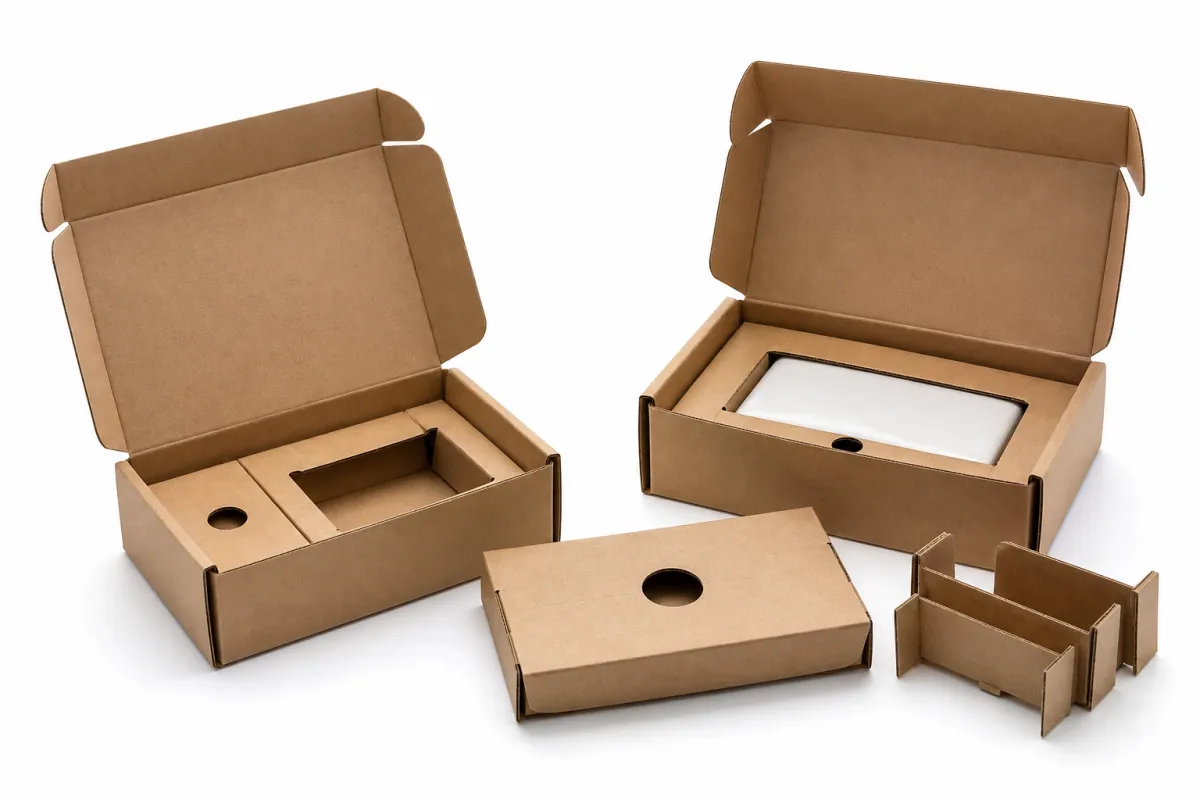
At the simplest level, Custom Kraft Mailers with inserts combine a kraft outer mailer with an interior insert that forms a shaped cavity for the product. The outer mailer provides the shell. The insert provides the seat. Once packed, the item sits inside a controlled space instead of floating around inside a generic envelope, and that change affects both the shipment’s performance and the first impression.
Picture a candle tin, a small glass bottle, or a cosmetics kit sliding loosely in a standard mailer. Even if the mailer makes it through transit, the product can arrive with a scuffed label, a dented corner, or a closure that looks pressed down from the ride. With Custom Kraft Mailers with inserts, the item is stabilized before the package ever moves. The insert keeps it from shifting, which means the outer mailer does not have to absorb every bump and vibration on its own.
Loose filler can reduce movement, but it does not truly control it. An insert sets the shape of the package from the start. The product has a place, the accessory card has a place, and the opening sequence follows a pattern the customer can feel. That is one reason Custom Kraft Mailers with inserts often look more premium than the materials would suggest if you judged them by eye alone.
Several insert styles are common, and the best choice depends on product weight, fragility, and how much hand labor the pack line can absorb:
| Insert Type | Best For | Protection Profile | Branding and Cost Notes |
|---|---|---|---|
| Folded paperboard | Cosmetics, stationery, accessories, sample packs | Good positioning, light-to-moderate protection | Usually the most economical option for a clean presentation |
| Corrugated insert | Heavier small goods, fragile items, stacked kits | Better crush resistance and stacking strength | Adds thickness and cost, but often lowers damage risk |
| Molded fiber | Sustainability-led brands, protected dunnage, fitted trays | Strong containment with a natural look | Useful for recycled-content messaging, though print detail is less crisp |
| Die-cut paperboard | Products that need exact cavities and a polished reveal | Precise fit, moderate protection, clean opening sequence | Strong for presentation; tooling and design complexity can raise cost |
The kraft outer layer does some quiet branding work of its own. Kraft feels familiar, restrained, and practical, which is often the right tone for modern DTC packaging. Then the insert takes over at the point of reveal. That contrast is part of why custom kraft mailers with inserts can look refined without heavy ink coverage or expensive finishing.
They are especially useful when the customer handles the package, opens it, and immediately notices whether the product is centered or drifting inside the mailer. Subscription kits, sample packs, and retail-to-door shipments all benefit from that kind of control. In those settings, custom kraft mailers with inserts give the package a sense of order from the first glance through the final unboxing.
Consistency is another practical advantage. A plain mailer leaves more room for packer judgment, and judgment varies from shift to shift. An insert creates a repeatable packing structure, which matters when hundreds or thousands of units need to leave the building looking and behaving the same way. In product packaging, fewer variables usually mean fewer mistakes.
How Custom Kraft Mailers with Inserts Work
The process starts with the product, not the mailer. A sound insert design begins by measuring the object at its widest, tallest, and deepest points, then accounting for finish, labels, closures, and anything that might catch during insertion. Custom kraft mailers with inserts work best when the product slides in with control and comes to rest without rattling.
The pack-out sequence is usually straightforward. The operator opens the mailer, seats the product into the insert cavity, adds any card, leaflet, sample, or accessory in the designated space, and closes the mailer. The insert resists side-to-side movement and, depending on the design, can reduce vertical bounce as well. That is how custom kraft mailers with inserts keep the shipment neat in the box and stable in transit.
Shipping conditions do more than people expect. Parcels get stacked, dropped, sorted, compressed, and handled by more than one person before they arrive. A good insert helps distribute pressure across the package instead of allowing the product to absorb it directly. A design that looks fine on a bench can still fail if the insert is too soft, too thin, or too loose. Custom kraft mailers with inserts need to be judged against the handling environment, not just the appearance of the sample.
A good insert should disappear in the packing line and reappear as confidence in the customer’s hands. If it slows the packer down or lets the item shift, it is solving the wrong problem.
Design Logic
The geometry behind custom kraft mailers with inserts carries most of the value. The cavity needs to be snug enough to stop movement, but not so tight that the customer has to pry the product free. Fold strength matters too. A weak tab, a thin spine, or a poorly placed crease can collapse when cartons are stacked or when the package takes a hit in transit.
Many teams miss the interaction between the insert and the outer walls. If the insert runs too tall, it can bow the kraft shell and make closure unreliable. If it sits too low, the product can shift during vibration. The outer mailer and the insert should behave like one system. That is the practical advantage of custom kraft mailers with inserts: they are meant to work together, not just occupy the same envelope.
For parcel shipments that need stronger validation, it makes sense to ask whether the package should be evaluated against ISTA testing standards. Not every order needs a full test matrix, but fragile, liquid-filled, or high-value products usually justify the effort. A short testing cycle costs less than repeat damage claims and the cleanup that follows them.
Fulfillment Flow
Assembly speed can matter just as much as material choice. A beautiful insert that takes 45 seconds to fold becomes a problem when the line ships thousands of units every week. Some custom kraft mailers with inserts are meant for hand packing, where an operator can move fast and repeat the motions without friction. Others work better when the insert arrives pre-glued, pre-scored, or flat enough to pop into shape with very little handling.
The more the structure does on its own, the less void fill you need. That matters because it trims steps, lowers weight, and reduces the chance of inconsistent packing from one shift to the next. It also gives the customer a cleaner opening experience. In the best cases, custom kraft mailers with inserts make the pack line easier to run and the shipment feel more deliberate at the same time.
That logic is the same one behind a strong package branding decision. Structure, sequence, and reveal need to match the product and the shipment, not sit as separate design exercises. When they line up, the package feels easy. When they do not, the customer notices the disconnect pretty quickly.
A simple comparison makes the difference clear. A loose mailer can let the product drift, distort the closure, and create visual clutter the moment it opens. A structured version gives the package a clear sequence: outer shell, controlled reveal, secure product, and less cleanup for the customer. That is the practical value of custom kraft mailers with inserts.
Key Factors That Shape Fit, Protection, and Branding
Product dimensions come first, and they matter more than many teams expect. A gap of just 2 to 4 millimeters can change how tightly the cavity grips the item, whether the flaps close cleanly, and how quickly the packer can work. With custom kraft mailers with inserts, the product is the primary spec and the packaging follows from there.
Material choice comes next. Lightweight cosmetics, stationery, accessories, and small apparel add-ons often work well with a formed paperboard insert. Heavier items or parcels that will be stacked usually benefit from corrugated inserts, which carry more crush resistance. Molded fiber can support sustainability messaging, while die-cut paperboard suits tighter presentation goals. The most successful custom kraft mailers with inserts are the ones that match the load, not just the logo.
Branding choices can be subtle and still change the feel of the package. Kraft shade affects contrast. A darker kraft looks warmer and more rustic, while a lighter kraft feels cleaner and more contemporary. Print coverage changes the tone as well. A single-color mark can feel restrained and confident. Heavy coverage turns the mailer into a small billboard. Inside printing can create a reveal moment without adding much noise to the outside surface. That is one reason custom kraft mailers with inserts work so well in branded packaging: the exterior can stay calm while the interior carries the story.
Performance should be checked against the actual shipping environment, not just the artwork. Ask whether the package needs to survive:
- Drop events from parcel handling
- Repeated vibration from transit sorting
- Humidity changes that affect board stiffness
- Corner pressure from stacking or compression
- Longer last-mile courier routes with multiple handoffs
That list is simple, but many packaging problems begin when design decisions are made from appearance alone. A package can look elegant and still fail in the first rough handling cycle. If you want a more disciplined way to think about fit and survivability, ask whether the design should be validated with an ASTM D4169 distribution testing plan, or whether the material sourcing should support FSC-certified fiber traceability if sustainability claims are part of the brief. The point is to connect the structure to the shipment that will actually carry it.
Sustainability deserves a practical read. Recyclability helps, but so does the fact that an insert can reduce the need for void fill. If the structure removes extra tissue, bubble, or loose paper while keeping the product safe, the package becomes leaner in a real sense. In that way, custom kraft mailers with inserts can support a lower-material approach without sounding forced or promotional.
There is also a retail perception angle. A package that feels stable in the hand often carries more perceived value than one that feels flimsy or improvised. That matters for cosmetics, candles, supplements, and accessories, where the customer is buying an object and the promise around it. Well-made custom kraft mailers with inserts help that promise feel credible before the product is even removed.
Custom Kraft Mailers with Inserts Pricing and Cost Drivers
Price is where many teams start, but it usually makes more sense as the last checkpoint. The real question is not how cheap the unit can be. The better question is what the full pack costs once labor, damage risk, and freight are included. Custom kraft mailers with inserts may cost more than a plain mailer, yet still lower the true cost of getting the product to the customer in one piece.
Several variables move the unit price:
- Mailer size — larger formats consume more material and often increase freight.
- Insert complexity — more folds, tabs, or cavities add tooling and assembly time.
- Print coverage — one-color branding is usually lighter on cost than full coverage or inside printing.
- Board thickness — heavier caliper or flute structure raises material cost.
- Die cuts and specialty shapes — exact cavities and reveal windows can add setup cost.
For rough planning, simple custom kraft mailers with inserts in moderate quantities often land somewhere around $0.18-$0.45 per unit depending on size, print, and structure, while more complex or heavier-duty builds can move higher. That is not a quote. It is a planning band. The difference between a flat paperboard insert and a multi-fold corrugated system can be meaningful, especially when the product needs tight dimensional control.
Volume changes the math. Setup and tooling matter less as quantities rise, which is why larger orders can improve unit economics even when the total spend grows. The strongest savings usually show up in simpler builds where the insert folds efficiently, the mailer is sized carefully, and the artwork does not require multiple passes. In many cases, custom kraft mailers with inserts become more attractive at scale because the per-unit labor and setup burden settles into a narrower range.
| Option | Typical Cost Pressure | Labor Impact | Best Use Case |
|---|---|---|---|
| Plain kraft mailer + loose fill | Lowest material cost, but variable freight and damage risk | More manual adjustment during packing | Very durable, low-value items |
| Standard mailer with generic insert | Moderate material cost | Fast if the product fits loosely enough | Short-run kits or simple accessories |
| Custom kraft mailers with inserts | Higher upfront design and setup, better fit control | Often lower pack-time variance | Fragile, brand-sensitive, or high-margin items |
| Custom printed boxes with molded or die-cut inserts | Usually the highest material and freight cost | Can be efficient at scale if the line is tuned | Premium kits, heavy products, retail-facing shipments |
That table matters because it shows the tradeoff many teams miss. A cheaper component does not always produce a cheaper package. If custom kraft mailers with inserts reduce void fill, lower damage rates, and speed up packing, they can outperform a lower-cost plain format on total cost. Freight is another hidden driver. A package that is only slightly larger than necessary can push dimensional weight in the wrong direction, which is why size discipline matters so much.
Soft costs add up as well. Sampling takes time. Rework from poor fit burns material. A loose insert can trigger returns because customers do not trust the package to have protected the product well enough. Labor is often the biggest silent cost of all. If the insert is awkward to fold or needs a second pair of hands, the math changes quickly. Custom kraft mailers with inserts should always be judged on material, labor, and shipping together, not in isolation.
Honestly, the best buying rule stays simple. Spend more when the product is fragile, high-margin, or brand-sensitive. Simplify when the item is durable, low-ticket, and the shipping path is forgiving. That rule is plain, but it keeps packaging decisions grounded in actual business conditions rather than presentation alone.
Step-by-Step Process and Timeline for Ordering
The first step is a spec sheet. Not a rough note. A real one. List the exact product dimensions, weight, finish, closure style, number of items in the pack, any inserts or cards, and the unboxing sequence you want the customer to experience. For custom kraft mailers with inserts, that early documentation keeps the design from wandering once sampling begins.
Next comes prototyping. A supplier should turn the dimensions into a sample, dieline, or structural drawing so the fit can be checked before production. This is where teams discover whether the cavity is too tight, whether the insert steals space from a leaflet, or whether the mailer flap folds over a corner that should stay visible. The best custom kraft mailers with inserts are usually refined here, not after the order ships.
Revision cycles are normal. A sample may need a deeper pocket, a wider tab, or a different fold line. Changes usually come from the physical behavior of the package rather than the artwork itself: loose fit, slow assembly, weak corners, or a reveal that feels awkward instead of intentional. That is why a sample should always be tested with real inventory, not only with a stand-in object.
A realistic timeline often looks like this:
- Brief and quote — a few business days if the spec is complete.
- Structural sample or dieline — often 5-10 business days for straightforward builds.
- Revisions and approval — 2-7 business days depending on feedback speed.
- Production — commonly 10-15 business days after approval for simpler orders, longer for complex print or tooling.
- Freight and receiving — depends on destination, carton count, and shipment method.
That timeline stretches when the project needs specialty finishes, heavy ink coverage, or a new insert tool. It can also compress when the structure is simple and the supplier already has a similar format in production. The useful habit is to treat the schedule as a chain, not a single date. Custom kraft mailers with inserts rarely become a rush job without cost somewhere else.
Launch Checklist
Before the full rollout, check the pack line. Make sure the team knows how the insert folds, where the product sits, and how many motions the assembly requires. A pilot run of 25 to 100 units can expose an awkward step that would be invisible on a sample bench. The goal is to make custom kraft mailers with inserts easy enough that the process stays stable over a long shift.
It also helps to receive a small carton count first and verify the shipment against the approved sample. That catches print alignment issues, fold memory problems, or freight damage before the full lot is deployed. If the mailer is part of a broader launch with other product packaging formats, the pilot run becomes even more useful because it shows how the new structure fits into the larger packaging design system.
For seasonal launches or multi-SKU programs, packaging, inventory, and assembly training should be coordinated together. The package should not be treated like a side task. It sits inside the customer experience, and custom kraft mailers with inserts only perform as well as the process that fills them. That part is kinda easy to overlook until the line gets busy.
Common Mistakes When Specifying Inserts
The first mistake is an over-tight fit. A cavity that grips too hard can scratch a finish, dent soft packaging, or make returns harder because the customer cannot reinsert the item cleanly. With custom kraft mailers with inserts, a little friction is useful. Too much turns into a usability problem.
The second mistake is under-engineering for weight or stacking pressure. This happens often when a product looks light but carries a dense center of gravity, such as glass, metal hardware, or layered kits. The outer mailer can look fine while the insert compresses internally and allows the contents to shift. That is how corners get crushed, and why custom kraft mailers with inserts need testing instead of guesses.
Branding can go too far as well. Too many cutouts, excessive print, or decorative openings can weaken the structure and raise cost without making the package easier to use. There is a point where package branding stops helping the product and starts competing with it. A restrained approach often wins because it keeps the structure strong and the reveal clear. That restraint is one reason custom kraft mailers with inserts often outperform heavily decorated alternatives.
Skipping shipping tests is another common miss. A package that looks perfect on a table can behave very differently after vibration, compression, or temperature swings. Products sensitive to moisture, pressure, or movement should be tested along the real distribution path. In practical terms, that means multiple handling scenarios, not a single quick drop. The strongest custom kraft mailers with inserts are validated against the way parcels actually move.
Labor gets ignored too often. A beautiful insert that is hard to fold can quietly reduce throughput. One extra second per pack seems small until it is multiplied by thousands of units. If the insert needs fiddly alignment, a second tap to seat the product, or a special closing sequence, the savings on material can disappear. Experienced packaging teams keep asking a plain question: does this make the pack line faster, slower, or just prettier?
One mistake gets less attention than it should: failing to match the insert to the customer’s post-purchase behavior. If the customer is likely to store, gift, or reuse the package, the structure should open cleanly and close neatly. If the product is meant to be torn open and discarded, other choices may be smarter. Custom kraft mailers with inserts should fit the life cycle of the item, not only the shipping leg.
Expert Tips and Next Steps for a Better Launch
If you are choosing between two or three versions, test them side by side. One may protect better. Another may pack faster. A third may feel better in the hand. The strongest answer is rarely the one that wins on a single metric. The best custom kraft mailers with inserts usually balance protection, speed, and perceived value without leaning too hard in one direction.
A simple scorecard helps keep the decision grounded. Rate each prototype on fit, protection, brand impact, pack time, and shipping efficiency. Use a 1-to-5 scale and compare the totals after the packing test, not before. That makes it easier to explain why a slightly more expensive structure can still be the better choice. With custom kraft mailers with inserts, data usually settles the argument faster than opinion.
Ask for a dieline or structural drawing early. Then verify that the measurements match the actual product, including any outer sleeves, seals, labels, or accessory cards. If the supplier cannot provide a physical sample, slow down. The point of custom kraft mailers with inserts is to remove uncertainty, not shift it into production.
From there, the next steps stay fairly direct:
- Finalize exact product dimensions and weight.
- Request a sample or structural mockup.
- Estimate unit cost alongside packing labor and freight.
- Approve a small pilot run before scaling.
- Train the pack line on the final assembly sequence.
That sequence is not complicated, but it is disciplined. The brands that get the best results resist the urge to skip sampling because the first concept looks fine on paper. Paper is not the shipping lane. The shipping lane is where custom kraft mailers with inserts either prove their value or expose a weak spec.
The biggest advantage of this format is how neatly it combines structure and story. The outer kraft layer keeps the package calm and economical. The insert holds the product steady. The reveal gives the customer a sense that the brand paid attention to the details. For small, fragile, or high-margin items, custom kraft mailers with inserts can be the difference between a controlled arrival and a complaint that never needed to happen.
If you are building a new mailer program, start with the product measurements, then choose the insert style based on how the item is packed, handled, and opened. That order keeps the design grounded in real use, which is the part that matters most.
FAQ
What products work best in custom kraft mailers with inserts?
Small to medium products that need both presentation and positioning tend to benefit the most, including cosmetics, candles, supplements, apparel accessories, stationery, and subscription kits. Items with loose parts or fragile surfaces are especially strong candidates because custom kraft mailers with inserts keep components aligned during transit. Very heavy or highly crush-sensitive products may need a stronger corrugated structure rather than a lighter paperboard insert.
How do I choose the right size for custom kraft mailers with inserts?
Measure the product at its widest, tallest, and deepest points, then add only enough clearance for the insert material and any protective wrap. The item should not rattle when the package is shaken, and it should not require forceful insertion that slows packing or risks damage. Always request a physical sample before production so the fit can be checked with actual inventory instead of numbers on a spec sheet.
Are custom kraft mailers with inserts expensive?
They can cost more than a plain mailer, but the added value often comes from reduced void fill, better protection, and lower damage rates. Higher quantities usually improve unit pricing, while thicker materials, complex die cuts, and heavier print coverage raise cost. The most useful comparison is total pack cost, not just material price, because labor and shipment efficiency can outweigh a small increase in the price of custom kraft mailers with inserts.
How long does it take to produce custom kraft mailers with inserts?
Simple projects can move quickly once the specs are approved, but sample development, revisions, and print complexity can add time. A realistic workflow includes briefing, prototyping, approval, production, and shipping rather than treating the first quote as the finish line. A pilot run is smart before full rollout, especially if the insert has multiple folds or the product fit is tight.
What should I ask a supplier before ordering custom kraft mailers with inserts?
Ask about material options, insert styles, minimum order quantities, sample availability, and whether a dieline or structural drawing is available. Confirm how the supplier handles print alignment, pack-line assembly, and freight so hidden costs do not show up later. Request a sample that reflects the final product weight and dimensions, not a generic mockup, because that is the only way to know whether custom kraft mailers with inserts will hold up in your real operation.

