Buyer Fit Snapshot
| Best fit | Custom Laminated Boxes Wholesale for Shipping Brands projects where brand print, material claims, artwork control, MOQ, and repeat-order consistency need to be specified before quoting. |
|---|---|
| Quote inputs | Share finished size, material target, print colors, finish, packing count, annual reorder estimate, ship-to region, and any compliance wording. |
| Proofing check | Approve dieline scale, logo placement, barcode or warning zones, color tolerance, closure strength, and carton packing before bulk production. |
| Main risk | Vague material claims, crowded artwork, missing packing details, or unclear freight terms can make a low unit price expensive after revisions. |
Fast answer: Custom Laminated Boxes Wholesale for Shipping Brands should be specified like a repeatable production item. The safest quote records material, print method, finish, artwork proof, packing count, and reorder notes in one written spec.
Production checks before approval
Compare the actual filled-product size with the drawing, then confirm tolerance on folds, seals, hang holes, label areas, and retail display edges. Reserve space for logos, QR codes, warning copy, and material claims before decorative graphics fill the panel.
Quote comparison points
Review material grade, print process, finish, sampling route, tooling charges, carton quantity, and freight assumptions side by side. A quote is only useful when the supplier can repeat the same color, closure quality, and packing count on the next order.
Custom Laminated Boxes Wholesale for Shipping Brands
Custom laminated boxes wholesale get picked for practical reasons, not because anyone feels like writing a love letter to packaging. A laminated surface keeps print looking sharp longer, takes the sting out of scuffs, and holds up better when cartons are stacked, dragged, restacked, and generally treated like they owe somebody money. That matters for shipping brands. The box is part of the product, part of the freight path, and part of the customer’s first impression. It has a job. A real one.
I have seen plenty of boxes look perfect on a screen and then show up in the real world with corner wear, fingerprints, and tired-looking graphics before the customer even gets the tape off. That is the part people forget. Custom laminated boxes wholesale give brands more control over that outcome. The finish protects the surface while the structure does the heavy lifting. For companies shipping apparel, kits, premium goods, or mixed inventory across retail and e-commerce channels, that kind of consistency is not a nice-to-have. It saves money and keeps the brand from looking sloppy.
If you are sorting through packaging options, stop thinking only about appearance. Ask what the box has to survive after production. Does it need to sit in a warehouse for weeks, move through a courier network, or travel on pallets between facilities? Good custom laminated boxes wholesale are built around those realities. They can cut down on damage, limit replacement shipments, and reduce the pile of customer complaints that always seems to show up right when the team is busiest. If you are comparing formats, our Custom Packaging Products page is a useful starting point, and our Wholesale Programs page can help you compare larger-order buying structures.
One more thing: packaging is not magic. A laminated box can improve surface durability, but it will not fix a weak board spec or a bad fit. If the product rattles around inside the carton, the finish is basically a fancy jacket on a busted frame. So the goal is not just a nicer-looking box. It is a box that survives the route and still looks like it belongs to the brand when it gets there.
Why Custom Laminated Boxes Wholesale Are a Better Shipping Value
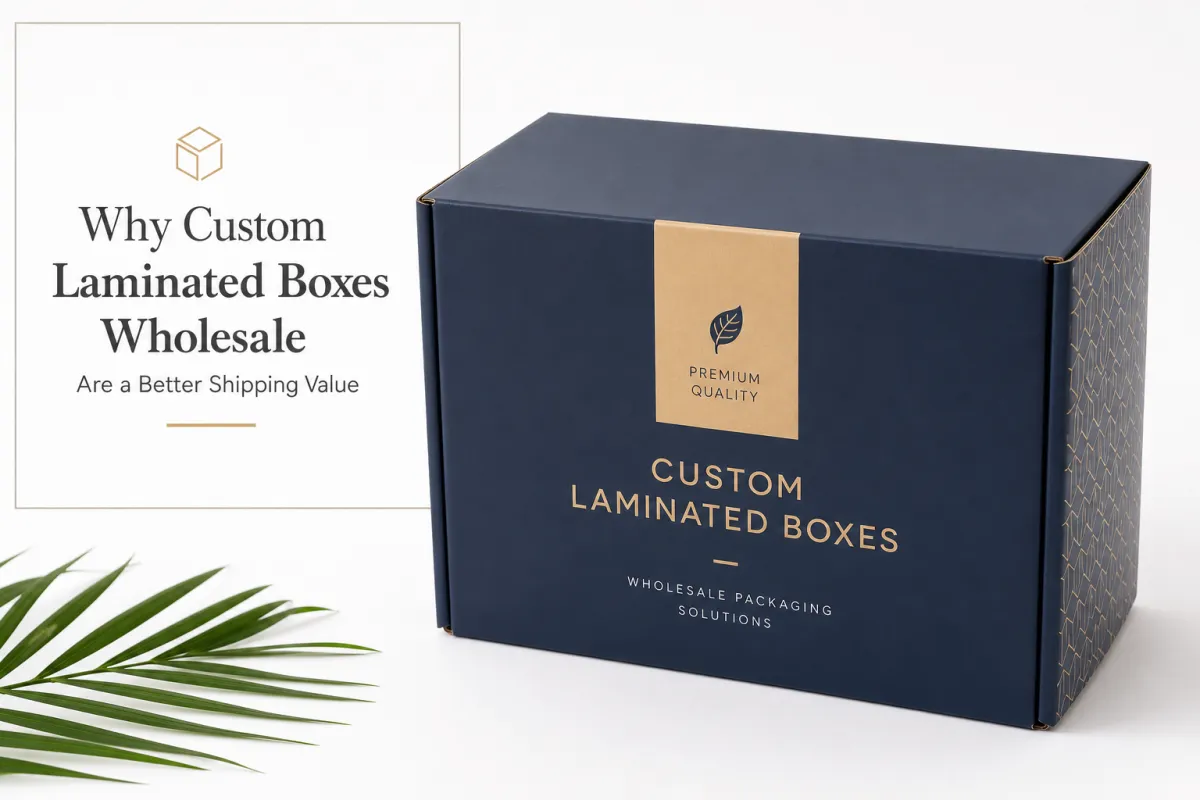
The first practical edge of custom laminated boxes wholesale is simple: the surface works harder than uncoated print. Lamination helps shield graphics from moisture, rub, and everyday abrasion, which is usually where shipping packages start to look rough. The board may still be fine. The print face tells a different story. Customers notice that. They may not know why, but they notice it fast.
Wholesale buying matters because the math gets friendlier once the build is locked. When the structure, artwork, and finish are set, the unit price becomes more efficient as volume rises. A 1,000-piece run carries a lot of setup pain. A 10,000-piece run spreads those fixed costs in a way that makes much more sense. That is why custom laminated boxes wholesale often ends up being the smarter value than buyers expect after the first quote lands.
There is another benefit that gets missed during early packaging conversations. A laminated surface keeps the carton looking cleaner through storage, picking, packing, and transit, so the box presents more consistently across the whole run. That matters in e-commerce fulfillment, retail packaging, and subscription programs. The box is getting touched. A lot. If the finish can hide normal operational abuse, the brand gets to look more intentional and less apologetic.
The value is not just in the box itself. It is in the mess the box prevents. Fewer replacement shipments. Fewer complaints about scuffed graphics or dinged corners. Less rework in the warehouse. Better brand presentation without forcing the product into packaging that is fancier than it needs to be. That is why smart buyers choose custom laminated boxes wholesale instead of a standard printed carton that saves a little on paper and costs more later in damage and customer service headaches.
A shipping box should protect the product, keep the print intact, and still look like it belongs to the brand.
Good packaging decisions come from shipping behavior, not wishful thinking. If the box needs to handle both product protection and presentation, laminated boxes usually sit in the sweet spot. They are not trying to be luxury theater. They are trying to work. For a lot of brands, custom laminated boxes wholesale is the most sensible way to get durability and a clean finish without buying overbuilt packaging just to feel fancy.
And yes, the finish matters more than people admit. Gloss can make color pop. Matte can make handling wear less obvious. Anti-scratch can save a run that is going to get abused in transit. None of that is glamorous, but it is the stuff that keeps a warehouse from shipping boxes that already look old. That is the job.
Custom Laminated Boxes Wholesale: Materials, Finishes, and Build Options
Most custom laminated boxes wholesale start with a board substrate, then add printed graphics and a protective laminate layer. The substrate might be paperboard for lighter products or rigid board for heavier, presentation-driven packaging. That base choice does a lot of the work. A 16pt or 18pt carton behaves very differently from a 2mm or 3mm rigid setup box, even before the finish gets involved.
For shipping brands, the first real decision is usually folding carton or rigid construction. Folding cartons are compact, efficient, and easy to pack in volume. They work well for lighter goods, accessories, and some retail-ready SKUs. Rigid boxes cost more, but they resist crushing better and carry more perceived value. They are often the right fit for kits, fragile items, and premium packaging. A supplier worth talking to should explain that tradeoff plainly instead of trying to push every order into the highest-cost structure. That is just common sense.
The laminate finish is where the look and handling meet. Gloss brings strong color pop and a bright, clean finish. It also shows fingerprints and marks more easily. Matte feels quieter and hides handling wear better. Soft-touch adds a richer feel and works well for premium product packaging, though it costs more and is not always the best call for shipping-heavy programs. Anti-scratch lamination earns its keep when the cartons will be stacked, slid, and handled more than once before the customer sees them.
Material choice matters too. FSC-certified paperboard or recycled content can support sustainability claims, but only if the spec actually matches the story. If the brand wants to say the material is responsibly sourced, it should be able to prove it. FSC certification details are available at FSC. Packaging buyers should care about that kind of thing. Slapping a green message on a box with no material backing is a quick way to look unserious.
The inside build matters just as much as the outside. Inserts, partitions, and folded supports keep the product from rattling around during transit and improve pack-out consistency. A box that looks polished but lets the item bounce inside is bad packaging with a nice haircut. For custom laminated boxes wholesale, the strongest build usually balances three things: product weight, distance traveled, and how much warehouse handling the carton will take before delivery.
Here is a simple way to think about finish selection:
| Finish | Best Use | Handling Behavior | Practical Note |
|---|---|---|---|
| Gloss | High-color retail packaging and bold package branding | Bright, reflective, easy to notice | Can show fingerprints and rub more quickly |
| Matte | Shipping brands that want a restrained, clean look | Hides minor marks better | Often a strong balance for wholesale orders |
| Soft-touch | Premium product packaging and presentation sets | Velvety hand feel, higher perceived value | Usually costs more and deserves careful testing |
| Anti-scratch | Boxes that will be handled repeatedly in transit or storage | Improves surface durability | Smart choice when appearance must stay consistent |
Comparing custom laminated boxes wholesale gets easier when the question changes from “Which finish is best?” to “Which finish matches the product, the ship path, and the presentation goal?” That is the useful question. Not the glossy one. The one that keeps you from paying for a finish that looks nice and solves nothing. If the box also needs to work as branded packaging for shelf display, the finish should support both retail presentation and rough handling.
There is no perfect material stack for every brand. A light kit sold through retail does not need the same build as a fragile item shipped in bulk to a fulfillment center. The right setup depends on the route, the product, and how much abuse the box will take before it reaches the customer. That answer is boring. It is also the one that holds up.
Specifications to Lock In Before You Request a Quote
The best quote starts with the cleanest spec sheet. For custom laminated boxes wholesale, the first things to confirm are inside dimensions, product clearance, and board thickness. A box can only be made accurately if the supplier knows the actual packed size, not just the product size. That gap matters once inserts, wrap, and loading tolerances enter the picture. They always do.
Artwork details matter just as much. Before asking for pricing, confirm whether the file is print-ready, how many colors are involved, whether PMS matching is needed, and whether the laminate covers the whole exterior or only selected panels. Full-coverage graphics require different prepress work than a simple logo layout. In wholesale production, those details affect both cost and schedule. Surprise is not a pricing strategy.
Closure style is another spot where buyers lose money by being vague. Tuck depth, flap reinforcement, windows, magnetic closures, and edge structure all influence the final build. If the carton needs to open cleanly for retail and still ship securely in a case pack, that needs to be stated early. The same goes for internal support. An insert or product cradle may look tiny on a sketch, then change the die line and finishing steps enough to affect price and turnaround.
Wholesale shipping details belong in the request too. Case pack count, palletization, stacking height, and expected storage duration help the supplier understand how the cartons will move through the operation. If the boxes will sit in a warehouse for months, the finish should be chosen for storage durability as well as presentation. If the order is going straight to a fulfillment center, compression resistance and consistent glue or fold behavior matter more.
A buyer preparing custom laminated boxes wholesale should gather these points before asking for a quote:
- Exact product dimensions: length, width, height, and any irregular shape allowances.
- Pack-out method: whether the product ships loose, sleeved, bagged, or inserted.
- Weight: the finished packed weight, not only the bare product weight.
- Finish preference: gloss, matte, soft-touch, or anti-scratch.
- Print requirements: PMS colors, full-bleed coverage, or limited-panel branding.
- Storage and freight details: pallet count, case pack, and warehouse receiving limits.
- Performance expectations: drop, compression, or transit concerns that need to be addressed.
That last one matters more than most people expect. If the product is fragile or the route is rough, ask whether the box should be built against a recognized transit test such as ISTA methods or related ASTM practices. For general packaging performance references, the ISTA site is a solid place to start. Test language beats vague promises every time, especially for custom laminated boxes wholesale that need to handle real shipping conditions instead of showroom fantasy.
If you are working with a supplier, ask for dimensional drawings before anything gets approved. A dieline catches mistakes that a sales sheet will happily ignore. I have seen a box spec that looked perfect in writing and then fell apart because nobody accounted for an insert lip and a thicker board grade. That kind of miss is annoying, expensive, and completely avoidable.
The quote is only as good as the spec sheet behind it.
Custom Laminated Boxes Wholesale Pricing, MOQ, and Cost Drivers
Pricing for custom laminated boxes wholesale comes down to a few variables buyers can actually control. Quantity is the biggest one because setup and prepress costs get spread across the run. Board grade matters. So does print complexity, laminate type, insert count, and any special finish like foil stamping, embossing, or spot UV. If two quotes are miles apart, the reason is usually hiding in one of those places.
Setup cost is why small runs feel expensive. A die, press setup, lamination pass, and finishing steps all require time and material handling before the first sellable carton exists. Once the order moves into true wholesale volume, unit cost usually gets better quickly. That does not mean larger is always the answer. It does mean the buyer should know the breakpoints where a bigger quantity makes more sense than repeating tiny orders all year.
MOQ is usually a production efficiency decision, not a random wall thrown in for fun. Suppliers set minimums because some processes need a baseline quantity to stay economical. For custom laminated boxes wholesale, that baseline can come from press setup, tooling, cutting, or finishing throughput. A supplier should explain why the MOQ exists and what changes if the quantity moves up or down. If they cannot explain it, they probably do not understand their own quote very well.
Comparing quotes fairly matters. One supplier may include tooling and proofing. Another may separate them. One may quote freight to the door. Another may leave it out. If the board spec, finish, and dimensions are different, you are not really comparing quotes. You are comparing confusion. Buyers who want dependable wholesale packaging should ask for the same structure and finish across every quote, then compare the landed total.
Here is a realistic way to view pricing bands for custom laminated boxes wholesale at around 5,000 pieces, depending on artwork coverage and finish selection:
| Build Option | Typical Use | Indicative Unit Range | What Drives the Cost |
|---|---|---|---|
| Laminated folding carton | Light retail goods, accessories, simple shipping cartons | $0.22 - $0.48 | Board grade, color count, laminate coverage |
| Semi-rigid laminated box | Apparel, kits, branded packaging for mid-weight items | $0.45 - $0.90 | Assembly labor, insert design, finish choice |
| Rigid setup box | Premium product packaging, gift sets, fragile goods | $0.85 - $1.75 | Rigid board, wrap materials, more manual assembly |
| Rigid box with insert and special finish | High-end retail presentation and shipping protection | $1.20 - $2.40 | Foil, embossing, soft-touch, insert complexity |
Those numbers only help if the specs are matched on the same basis. A cheaper quote on a weaker board is not a bargain if the package collapses in storage or arrives scuffed. A slightly higher quote can be the better buy when it reduces damage, protects presentation, and lowers the chance of a costly reorder. That is the real reason many buyers move to custom laminated boxes wholesale after the first round of testing.
If you are weighing premium appearance against a utility-first build, decide what the box has to solve. If the main job is shipping protection with some presentation value, a mid-range laminated structure may be enough. If the box has to function as retail packaging and brand signal at the same time, the better-looking finish may earn its keep. That tradeoff is normal. It is also why custom laminated boxes wholesale should be priced as part of a packaging system, not as a lonely line item no one wants to think about twice.
The honest answer is that wholesale pricing is only predictable when the project is specific. “We need a nice box” is not a spec. “We need a 2mm rigid box with matte lamination, a one-color exterior, and an insert for a 1.5 lb product shipping through a fulfillment center” is a spec. One gets you guesses. The other gets you usable numbers.
Ordering Process and Production Timeline
The ordering path for custom laminated boxes wholesale is simple when the information is complete. First comes the request with dimensions, quantity, artwork, and finish goals. Then the supplier reviews the structure and sends a quote. After that, the buyer confirms the build, checks the proof, and approves production. The whole thing runs smoother when artwork is final and the specs do not need three rounds of interpretation.
Delays usually come from missing details. A box size with no product clearance. Artwork that is not print-ready. A finish that is still under debate after the quote is already in hand. Any one of those can slow the process, and all three together can push the order back more than buyers expect. In wholesale packaging, time saved at the front end usually shows up as time saved at the back end too. Not glamorous, but true.
A practical timeline for custom laminated boxes wholesale often looks like this:
- Sampling or structure review: 3 to 7 business days, depending on complexity.
- Proof approval: 1 to 3 business days if artwork is ready and revisions are limited.
- Manufacturing: commonly 12 to 15 business days after proof approval for standard builds, though special finishes or heavier structures can take longer.
- Freight and receiving: varies by route, pallet count, and warehouse schedule.
Rush work can happen in some cases, but only when the structure is simple, materials are available, and the files are ready. That is not something anyone should promise lightly. A rush run still has to go through die cutting, lamination, folding, and packing with the same quality checks as a standard order. If a supplier says every order can be sped up without tradeoffs, that is your cue to keep asking questions.
For brands with launch dates, the smartest move is to set an internal cutoff for approvals. Give the packaging decision enough room so artwork, proofing, and freight do not collide with launch prep. If the cartons are going into a fulfillment center, ask the receiving team how far ahead they want inbound stock. Those practical questions save more time than most last-minute rush fees ever will.
Some buyers also ask whether custom laminated boxes wholesale should be tested before the production run starts. The answer depends on the product. If the item is light and the route is simple, a structure proof may be enough. If the product is fragile, valuable, or likely to face compression, a test plan is worth discussing early. Packaging partners who understand real shipping conditions can make better recommendations before the wrong build gets ordered.
I would also recommend keeping one internal reference box on hand once the job is approved. It helps the warehouse team, the customer service team, and anyone else who needs to check fit later. Otherwise people start guessing from memory, and memory is terrible under pressure. A reference sample saves arguments. Simple as that.
Why Choose Custom Logo Things for Wholesale Packaging
Custom Logo Things is a practical fit for custom laminated boxes wholesale because the focus stays on materials that perform, communication that is clear, and a build that matches the job instead of pretending every carton needs a parade. That matters in wholesale packaging. Buyers do not need foggy claims and a polished sales pitch with no substance. They need a straight answer about board choice, finish selection, artwork setup, and the structure that will actually protect the product.
Good supplier support should help customers make better packaging design decisions before production begins. That means flagging where the product needs more support, where the finish can be simplified, and where the cost climbs if the request gets too elaborate. In plain terms, good service means helping the buyer Choose the Right Custom printed boxes, not the most expensive ones. That is especially useful for brands that want branded packaging with a polished look but still need the box to survive transit without drama.
For product packaging that has to act like retail packaging too, the supplier should be able to explain the tradeoffs between presentation and protection. A glossy wrap may look strong under lighting but show handling wear faster than matte. A rigid box may elevate package branding, but if the item is light and the shipping route is easy, a semi-rigid build may be the better value. Those are the kinds of calls that separate practical wholesale sourcing from guesswork dressed up as strategy.
Custom Logo Things also makes sense for buyers who want consistency across a broader line. If one SKU needs a simple laminated carton and another needs a deeper insert with a more premium finish, the packaging partner should keep the family look aligned while adjusting the build underneath it. That is how a brand gets visual continuity without forcing every product into the same structure. It is also how custom laminated boxes wholesale can support launch programs and ongoing replenishment without constant redesign.
One thing buyers tend to appreciate is early feedback on feasibility. If the artwork has too many small details, if the closure is awkward, or if the finish choice will complicate the run, it is better to hear that before the order is placed. That kind of directness prevents expensive rework. It also builds trust, which matters more than flashy promises when the goal is a repeatable wholesale process.
For teams comparing packaging vendors, a few questions tell you a lot:
- Can the supplier match the board and finish to the actual shipping route?
- Will the quote clearly separate tooling, proofs, and freight?
- Can the supplier recommend a structure that fits the product weight?
- Is the finish suited to both storage and customer-facing presentation?
- Will the supplier flag artwork issues before production starts?
Those questions are simple, and they reveal a lot. A supplier that answers them cleanly is usually a better long-term fit for custom laminated boxes wholesale than one that only talks about appearance. Packaging should work. It should ship, stack, display, and protect without drama. That is the standard Custom Logo Things is built to support, and it is the standard serious buyers should expect.
For brands that need repeat orders, consistency matters just as much as price. A supplier that keeps the spec stable from run to run saves everyone time later. Fewer surprises, fewer corrections, fewer reprints. That is the kind of boring efficiency that makes a packaging program easier to live with.
Next Steps for Custom Laminated Boxes Wholesale Orders
If you are ready to move forward with custom laminated boxes wholesale, the fastest path is to send complete information the first time. Gather the product dimensions, target quantity, preferred finish, shipping method, and artwork files before requesting a quote. The more complete the brief, the fewer revision loops you will need, and the faster the order can move into proofing.
It also helps to compare at least two or three build options. Do not ask for one price and call it research. Ask for a basic laminated version, a mid-range version, and a premium option if the project allows it. That comparison makes the cost difference visible between simple protection and stronger presentation, and it gives your team a clearer basis for choosing the right structure.
Before you finalize the order, confirm where the cartons will be stored, how they will be palletized, and when they need to arrive. If the boxes are tied to a launch date, build in enough room for proof approval and freight. That planning step sounds small, but it is usually what separates a smooth program from a stressful one. For custom laminated boxes wholesale, the best orders start with exact dimensions and end with a warehouse plan that everyone actually understands.
Use this short checklist before you request pricing:
- Exact inside dimensions and product weight
- Target quantity and reorder expectations
- Desired laminate finish and print coverage
- Need for inserts, partitions, or structural reinforcement
- Case pack, pallet count, and receiving window
- Artwork files and brand color references
- Any drop, stacking, or transit concerns
With those details in hand, the quote process becomes easier to trust. You can compare material grades, finishes, and timelines on equal terms instead of guessing what changed from one supplier to the next. That is the cleanest route to a useful wholesale decision, and it is the most reliable way to buy custom laminated boxes wholesale without wasting time on avoidable back-and-forth.
When the specs are clear, the finish is chosen for the real ship path, and the quantity supports actual wholesale economics, custom laminated boxes wholesale become a smart packaging purchase instead of a guess. Start with the product dimensions, the route, and the handling conditions, then choose the board and laminate that fit those facts. Everything else is noise.
What makes custom laminated boxes wholesale different from standard printed cartons?
Custom laminated boxes wholesale add a protective surface layer that helps resist scuffs, moisture, and handling wear. They also keep the print looking more consistent during storage and shipping, which is useful when the box needs to support both presentation and protection. Standard printed cartons can still work well, but laminated boxes are usually the stronger choice when appearance matters after transit, not just before it.
What MOQ should I expect for custom laminated boxes wholesale?
MOQ usually depends on press setup, die cutting, lamination, and finishing efficiency rather than a random number. Smaller runs are possible, but the unit price often rises because those setup costs are spread across fewer boxes. A good supplier should explain the MOQ clearly and show how custom laminated boxes wholesale pricing changes at different volume levels.
Which laminate finish is best for shipping protection?
Gloss gives strong visual impact, but it can show fingerprints and surface marks more easily than matte or soft-touch options. Matte and anti-scratch finishes are often preferred when the box will be handled frequently in transit or warehouse settings. For custom laminated boxes wholesale, the best finish depends on the product, the handling environment, and whether the box also needs to work as retail packaging.
How do custom laminated box prices change with quantity?
Higher quantities usually lower the unit price because setup and prepress costs are distributed across more boxes. Finishing choices, insert complexity, and print coverage can still raise the price even at larger volumes. The fairest way to compare custom laminated boxes wholesale quotes is to keep the dimensions, board spec, and finish identical across each option.
How long does it take to produce custom laminated boxes wholesale?
Timeline depends on whether artwork is ready, the structure is approved, and the finish is standard or special. Sampling and proof approval can add time before production starts, so fast approvals matter. A supplier should separate sampling, manufacturing, and freight time so you can plan inventory accurately for custom laminated boxes wholesale.
Are laminated boxes always the right choice for shipping brands?
No. If the product is low-risk, low-touch, and not especially presentation-driven, a simpler carton can be the better buy. Laminated boxes make the most sense when the carton needs to look good after handling, or when the route is rough enough that surface wear would be a problem. That honest filter keeps buyers from paying for finish they do not need.

