Buyer Fit Snapshot
| Best fit | Custom Lamination on Recycled Boxes projects where brand print, material claims, artwork control, MOQ, and repeat-order consistency need to be specified before quoting. |
|---|---|
| Quote inputs | Share finished size, material target, print colors, finish, packing count, annual reorder estimate, ship-to region, and any compliance wording. |
| Proofing check | Approve dieline scale, logo placement, barcode or warning zones, color tolerance, closure strength, and carton packing before bulk production. |
| Main risk | Vague material claims, crowded artwork, missing packing details, or unclear freight terms can make a low unit price expensive after revisions. |
Fast answer: Custom Lamination on Recycled Boxes: Benefits and Limits should be specified like a repeatable production item. The safest quote records material, print method, finish, artwork proof, packing count, and reorder notes in one written spec.
Production checks before approval
Compare the actual filled-product size with the drawing, then confirm tolerance on folds, seals, hang holes, label areas, and retail display edges. Reserve space for logos, QR codes, warning copy, and material claims before decorative graphics fill the panel.
Quote comparison points
Review material grade, print process, finish, sampling route, tooling charges, carton quantity, and freight assumptions side by side. A quote is only useful when the supplier can repeat the same color, closure quality, and packing count on the next order.
Custom lamination on recycled boxes: benefits and limits is one of those packaging choices that looks tidy in a mockup and gets a lot more honest once it runs through ink, fiber, humidity, and human hands. A recycled carton or mailer can read as more premium after the right laminate than a heavier uncoated board, because the surface sheen, stiffness, and scuff resistance change the first impression fast. That first impression matters. People judge packaging quickly, and usually without mercy.
Custom lamination on recycled boxes deserves a real conversation, not a slogan. Buyers want stronger product packaging, cleaner package branding, and graphics that survive the trip from press sheet to shelf, but they also need a finish that fits the board, the print method, the fold pattern, and the recycling rules in their market. If you are still shaping the box structure, our Custom Packaging Products page is a useful starting point for comparing carton styles, mailers, and retail-ready formats.
Results usually land in the middle, not at some polished extreme. A finish that looks gorgeous under showroom lighting may turn fragile the second it hits a distribution lane full of rubbing, stacking, and repeat handling. A very tough film can mute graphics or make recovery harder. Custom lamination on recycled boxes lives in that middle ground, where performance, appearance, and sustainability all have to match the actual job instead of the brochure version.
I have seen brands fall in love with a rich matte sample, then panic when the first full run starts showing corner wear from shipping. That is not a mystery. It is just what happens when the finish is chosen for the render instead of the route the box will actually travel.
What Custom Lamination on Recycled Boxes Really Means
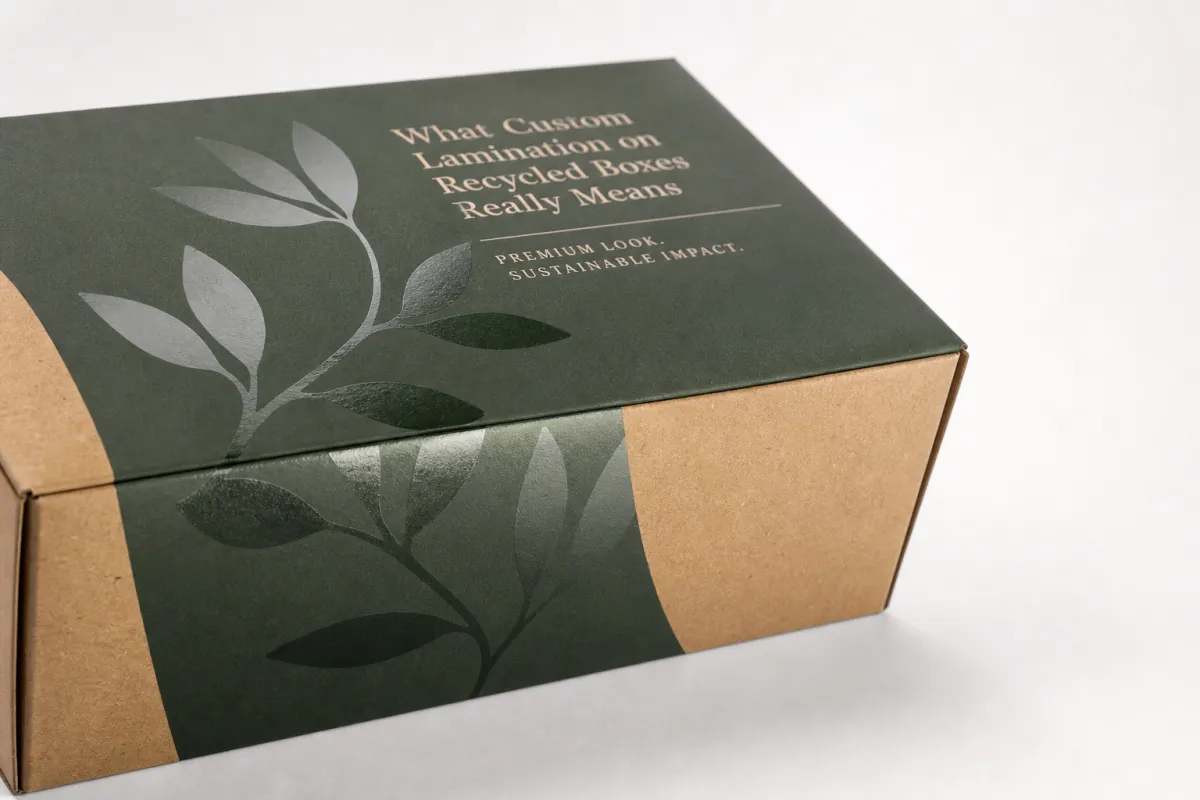
At its core, custom lamination on recycled boxes means applying a protective film over a printed board after the ink has been laid down and dried or cured. That film becomes a thin outer skin. It can add gloss, cut glare, improve rub resistance, and reduce scuffing during converting and shipping. For a lot of custom printed boxes, that one move changes the whole feel of the package, especially when the board already has a natural recycled look underneath.
People mix up lamination with varnish or aqueous coating all the time. They are not the same thing. A varnish or coating is usually a liquid layer applied on press, while lamination is a separate film bonded later with heat, pressure, or adhesive chemistry. That difference matters because custom lamination on recycled boxes creates a thicker, more obvious surface change than a light coating. That can be useful on retail packaging that needs stronger shelf presence and better handling resistance.
Recycled content does not rule out premium finishing. It does change how the board behaves, though. Recycled fiber blends often have different porosity, surface smoothness, and internal stiffness than a virgin-fiber sheet. Ink laydown, adhesive grab, and score-line performance can all shift. If the recycled board is too rough, the film may not lay down evenly. If it is too soft, the box can feel good in hand and still crease harder than expected under stress. Custom lamination on recycled boxes needs to be specified as a system, not as a standalone visual trick.
Here is the simplest way to think about it: the recycled board gives you the structure, the print carries the branding, and the lamination finishes the surface story. When those three parts work together, branded packaging looks intentional instead of patched together. That matters for seasonal sets, ecommerce mailers, and premium product packaging where the customer opens the box and makes a judgment in seconds.
A recycled box does not have to look rustic. With the right film, the right board, and the right converting window, custom lamination on recycled boxes can look clean, premium, and durable without pretending the substrate is something it is not.
There is a real sustainability angle here too. Recycled board can support a premium finish, but every layer of film pushes you to think about the end-of-life path. Local recycling systems vary, and the finish that works for one retail brand may be a poor fit for another. Custom lamination on recycled boxes works best when performance comes first and visual polish comes second. If a box has to survive a long distribution chain, I would rather see a finish that protects the print than a finish that only photographs well for one afternoon.
How Custom Lamination on Recycled Boxes Works
The production flow is fairly direct, but every step can shape the final result. Most custom lamination on recycled boxes starts with printed sheets or rolls that have already been color managed and dried. Those sheets move into the laminating stage, where a film is bonded to the printed face. After that, the laminated board goes through die cutting, stripping, folding, gluing, and packing. A beautiful laminate that fails in die cutting is just expensive waste, so the process has to stay aligned from the start.
- Print and dry: The artwork is printed onto the recycled board with enough cure or dry time for clean handling.
- Select the film: Gloss, matte, soft-touch, or anti-scuff film is chosen based on the use case.
- Apply the laminate: Heat, adhesive, or pressure bonds the film to the printed surface.
- Trim and convert: The laminated sheet is die cut, scored, and prepared for folding or glue-up.
- Inspect the result: Crease cracking, warp, curl, and surface rub are checked before shipment.
The film choice matters more than many buyers expect. Gloss film can brighten color and make imagery pop, which helps high-impact retail packaging and bold packaging design. Matte film cuts glare and gives a calmer, more elevated look. Soft-touch film creates a velvet-like hand feel, which can work nicely on luxury custom printed boxes, though it is not always the best choice if the box will take heavy abrasion. Anti-scuff film is often the practical winner for fulfillment-heavy programs where cartons slide across conveyors, ship in bundles, or get handled repeatedly on shelves.
There is a tiny trap here: the prettiest sample is not always the best performing sample. Soft-touch can feel expensive in the hand and still pick up marks faster than a more restrained matte film. That is fine if the box sits on a vanity shelf. It is a pain if the carton gets shoved through a warehouse and tossed into a tote bag ten times a week.
| Film Type | Best Use Case | Typical Cost Position | Practical Notes |
|---|---|---|---|
| Gloss | Bold graphics, color-rich retail packaging | Lower to mid | Strong shine, better contrast, can show fingerprints more easily |
| Matte | Natural looks, understated branded packaging | Lower to mid | Softens glare, often reads more premium on recycled fiber boards |
| Soft-touch | Luxury product packaging and tactile presentation | Mid to high | Great hand feel, but scuff resistance should be tested carefully |
| Anti-scuff | Shipping-heavy, retail-handled, or stacked cartons | Mid to high | Designed to protect print during transport and shelf wear |
Machine settings matter just as much as the film. Adhesive amount, pressure, heat, and dwell time need to match the board structure and the print surface. Recycled board with a more open fiber structure can absorb or flatten differently than a smoother sheet, so custom lamination on recycled boxes sometimes needs more process tuning than a standard virgin-fiber job. That is not a flaw. It is simply how the materials behave.
Quality control is where the job proves itself or falls apart. A good shop will check adhesion, rub resistance, print registration after converting, warp and curl, and crease cracking at the fold lines. If the lamination bridges too hard across a score, the first failure may not show up until the box is folded. If the film is too loose or the adhesive is not fully compatible, the box may look fine on the flat and still peel at a corner after handling. Custom lamination on recycled boxes has to be tested where the board changes shape, not only on a clean sheet under bright lights.
For teams that want a broader material baseline, the ISTA packaging testing methods are a useful reference when evaluating how a finished box will behave in transit. A laminate that looks great on a light table still has to survive pressure, vibration, and stacking once it leaves the plant.
Key Factors That Shape Results
Board grade is usually the first variable to lock down. Caliper, fiber content, and surface smoothness all shape how well custom lamination on recycled boxes bonds and how the finished package feels in the hand. A heavier board is not automatically better if the fiber structure is rough or unstable. A thinner board can perform well if the score layout, laminate type, and glue zones are planned correctly. Real packaging design discipline matters here, because the finish and the structure have to support each other.
Humidity and storage conditions are another big variable. Recycled paperboard can move more than buyers expect if the warehouse is damp, cold, or hit by temperature swings. That movement affects the laminate and the score lines, especially on larger panels and longer runs. If a box will spend time in refrigerated environments, in a humid backroom, or in a distribution lane with changing temperatures, custom lamination on recycled boxes should be tested under those conditions instead of guessed at from a room-temperature sample.
Brand goals shape the finish choice too. A natural, recycled look often pairs well with matte or soft-touch films that keep the board honest and let the print breathe. A louder retail presentation may call for gloss, sharper contrast, and a more assertive surface. Neither direction is wrong. The point is to make sure the finish supports the brand story instead of fighting it. For some lines, a restrained laminate gives the package more credibility than a flashy surface ever will.
Sustainability needs a straight answer, not marketing perfume. If the carton has broad film coverage, special inks, heavy embellishment, or multiple finishing layers, the final package may be harder to recover in some local paper streams. If the brand is sourcing certified fiber, chain of custody may matter too. For teams that need a formal fiber standard, FSC forest stewardship standards are a useful reference point for responsible sourcing claims. Custom lamination on recycled boxes can support a more durable and premium outcome, but recyclability still depends on the film, the market, and the recovery system in the region where the box ends up.
There is also a useful comparison with other decorative finishes. Embossing can add tactility and depth without covering the whole board, while lamination changes the full surface behavior. In some projects, a light embossing detail plus matte lamination creates a more refined result than a heavy gloss finish. In others, the opposite is true. The right choice is the one that matches the use case, not the one that sounds fancier in a spec sheet.
Bottom line: custom lamination on recycled boxes works best when the board, film, print, and environment are specified together. Treating any one of those in isolation is usually where trouble starts. I have watched otherwise strong packaging programs get knocked sideways by one tiny mismatch, like a board that was just a little too open for the chosen film.
Custom Lamination on Recycled Boxes: Cost and Pricing
Pricing for custom lamination on recycled boxes is shaped by a few predictable drivers: film type, film thickness, coverage area, board selection, run length, make-ready time, and the complexity of the die line. The more intricate the board design, the more careful the converting setup has to be. A simple mailer with broad flat panels is easier to laminate and convert than a carton with tight flaps, heavy score density, or a complex tuck pattern. That difference shows up in cost.
As a rough planning range, many buyers will see lamination add somewhere around $0.08 to $0.35 per unit depending on quantity, coverage, and finish. A simple gloss or matte film on a 5,000-piece run can sit near the lower end of that range, while soft-touch or anti-scuff on a smaller order can move higher. These are not fixed numbers, and they should never be treated as a quote, but they help with early budgeting. Custom lamination on recycled boxes usually gets more attractive as volume rises, because setup is spread across more units.
Small runs tend to cost more per box because setup work does not shrink much. The press still has to be aligned, the film still has to be loaded, and the operator still has to verify adhesion and registration. On a larger run, that make-ready cost gets diluted. That is why premium finishes usually make more business sense for retail programs with repeat volume than for one-off prototypes, unless the prototype is going to secure a high-value sales presentation.
It helps to see the hidden costs that rarely show up in a shallow quote comparison. Poor registration can create spoilage. A board and film mismatch can lead to rework after cracking or curl shows up at the fold. Sampling can eat time if the artwork needs changes after the first physical build. Shipping delay can become a cost if packaging is tied to a launch date or a retail reset. Custom lamination on recycled boxes should be judged on total project cost, not just the headline unit price.
Here is a simple way to compare quotes more fairly:
- Match the same board grade and caliper.
- Ask for the same film type and thickness.
- Confirm the same coverage area, including flap wrap if any.
- Use the same quantity and run format.
- Verify whether printing, die cutting, gluing, and packaging are included.
If those details do not match, the quotes are not really comparable. A lower number can hide a lighter film, a thinner board, or a stripped-down finishing sequence. Custom lamination on recycled boxes is one of those categories where a buyer can save money and lose performance at the same time, so the scope has to be very clear.
| Price Factor | How It Affects Cost | Buyer Question to Ask |
|---|---|---|
| Film type | Soft-touch and anti-scuff usually cost more than standard gloss or matte | Does the finish need premium feel or heavy abrasion protection? |
| Run length | Short runs carry more setup cost per unit | Can the quantity be combined across SKUs? |
| Board selection | Higher-grade recycled board can improve performance but raise material cost | Is the board chosen for appearance, strength, or both? |
| Conversion complexity | Tight scores, complex folds, and glue zones can increase spoilage risk | Does the dieline need simplification? |
Step-by-Step Process and Timeline
Most custom lamination on recycled boxes projects move through the same basic path, though the schedule can stretch or compress depending on artwork changes, sample approvals, and the finish selected. The cleanest projects start with a clear brief: what is the product, how is it shipped, what does it need to survive, and what should the customer feel when they pick it up? That first conversation saves time later because it narrows the board and film choices before anyone cuts a sample.
- Define the use case: Retail display, ecommerce shipment, subscription mailer, or protective outer carton.
- Select the board: Choose the recycled substrate based on strength, printability, and surface feel.
- Choose the finish: Gloss, matte, soft-touch, or anti-scuff depending on handling and brand direction.
- Review the dieline: Check fold lines, glue tabs, cutouts, and any special structural details.
- Produce a physical sample: Confirm color, sheen, scoring, and panel alignment.
- Approve production: Lock the spec before the full run begins.
- Run converting and shipment: Laminate, die cut, glue, pack, and deliver.
For a straightforward order with a stable board and a familiar finish, a timeline of 12 to 15 business days after proof approval is a reasonable planning target. More complex programs, multiple SKUs, or custom structural changes can move that out to 15 to 25 business days or longer. If the board changes after sampling, or if the brand wants another round of color adjustments, the schedule can stretch again. Custom lamination on recycled boxes is not usually delayed by the film alone; it is delayed by the time needed to get the spec right.
Drying or curing time can matter too. If the printing method leaves the surface too wet, the film can trap conditions that affect bond quality. If the inks are not stable, you can get marking or offset during lamination or stacking. That is why a good production team watches the relationship between print, finish, and conversion rather than treating each step as a separate island. A box is a system, not a pile of unrelated tasks.
Physical sampling matters more than digital mockups, especially on custom lamination on recycled boxes. A screen can show a shape and a color, but it cannot show reflection, texture, or the way the laminate behaves across a score line. A sample in the hand tells you whether the matte finish feels too flat, whether the gloss is too reflective, and whether the fold line holds cleanly. If the package will be handled in a store, on a conveyor, or under bright retail lighting, sample review should happen in those same conditions whenever possible.
When teams want to push a package through distribution testing, it helps to align that review with a recognized method rather than relying on a casual shake test. The ISTA packaging testing methods are useful because they mirror the vibration, drop, and compression stresses that can expose weak points before launch. That is especially helpful for custom lamination on recycled boxes that need both visual polish and transit durability.
If a project is moving fast, the biggest mistake is approving a finish on a PDF and assuming the real box will behave the same way. It won’t. Paperboard has opinions, and it is not shy about them.
Common Mistakes to Avoid
The first common mistake is choosing lamination before the board is finalized. I have seen teams fall for a soft-touch sample, then discover later that the recycled board they picked is too open, too flexible, or too prone to cracking at the score. Once the substrate changes, the finish behaves differently. Custom lamination on recycled boxes should always be tested against the final board, not a rough stand-in.
The second mistake is ignoring the fold lines, glue zones, and high-touch edges. Those areas absorb the most stress, and that is where failure usually starts. If a film is too stiff, a score line can crack. If the laminate is too slippery, glue may not hold cleanly in the right place. If the handle area gets rubbed constantly by customers or warehouse staff, the scuff pattern will show there first. Good production planning accounts for those stress points before the order goes live.
The third mistake is comparing suppliers on price alone. A lower quote can hide differences in film thickness, board grade, coverage, or finishing steps. One vendor may include lamination, die cutting, and folding; another may quote only the film application. Those are not comparable numbers, even if the boxes look close in the mockup. Custom lamination on recycled boxes needs a full-scope comparison if the buyer wants a fair decision.
The fourth mistake is overstating sustainability claims. A recycled carton with film on both faces is not the same as an uncoated recycled carton, and real-world recyclability depends on local collection, mill capability, and how the package is used. It is better to say the box uses recycled fiber and a protective laminate than to imply a universal recycling outcome that may not be true in every market. Clear claims build trust; vague claims cause headaches later.
There is also a softer mistake that shows up in brand meetings all the time: treating finish as decoration only. Finish is not just aesthetic. In custom lamination on recycled boxes, the film changes scratch resistance, hand feel, visual depth, and how the box holds up in a warehouse. If the finish is specified as a visual afterthought, the package often underperforms where it matters most. That is the part people usually learn the hard way.
- Do not finalize the finish before the board spec.
- Do not ignore score lines and glue zones.
- Do not compare quotes without matching scope.
- Do not claim recyclability without checking local recovery realities.
Expert Tips and Next Steps for Custom Lamination on Recycled Boxes
If you want a better result, start with a sample made on the exact recycled board you plan to use. That sounds obvious, which is exactly why people skip it. Check the sample for rub resistance, fold quality, and shelf appearance under real lighting, not just in a studio. Custom lamination on recycled boxes can look excellent on a flat sample table and still disappoint once it sees fluorescent retail lighting or a rough shipping lane.
Test the package where it will actually live. If it will sit in a humid stockroom, put the sample there. If it will be stacked in transit, check compression and edge wear. If customers will handle it repeatedly, run a few open-close cycles and look for gloss loss, haze, or edge lifting. The more realistic the test, the more useful the sample becomes. That approach saves money because it lets you solve problems before a full run is printed and converted.
It also helps to put finish coverage, trap areas, glue zones, and sustainability claims in writing. Sales teams, production teams, and compliance teams do not always mean the same thing when they say “matte” or “recyclable.” Written specs remove that ambiguity. If a panel must stay free of film for adhesive performance, say so clearly. If a certification claim needs to match the recycled board source, document it before approving the design. Custom lamination on recycled boxes works best when the details are explicit, not implied.
For buyers building a broader line, it is often smart to compare two or three sample builds before making a final call. One can use matte film on a lighter board, another can use gloss on a heavier board, and a third can test anti-scuff on the exact same structure. Then judge them side by side under the same lighting, with the same handling, and the same distribution assumptions. That is a better decision process than choosing from a render alone. If you need to pair the finish with another format, our Custom Packaging Products collection can help you line up the right structure with the right surface treatment.
Here is the practical takeaway: choose the recycled board first, sample the exact laminate on that board, and stress-test the box under the conditions it will actually see. If the finish cracks, scuffs, or traps glue problems in the sample stage, fix it there. That is a lot cheaper than discovering it after thousands of boxes are already on a truck.
Custom lamination on recycled boxes is worth the effort when it improves durability, supports the brand story, and still fits the end-use reality. Compare two or three sample builds, verify cost on the same board and finish scope, and approve the design only after handling tests show the box can do the job. That is the practical way to get the benefits without getting surprised by the limits.
FAQs
Is custom lamination on recycled boxes still recyclable?
It depends on the local recycling system, the film used, and how much of the box is covered. Light, well-matched finishes are often easier to recover than heavy or highly specialized films, but there is no universal answer. If recyclability matters, ask the supplier how custom lamination on recycled boxes fits paper-fiber recovery in your market.
Which finish works best for custom lamination on recycled boxes?
Matte works well when you want a natural, understated look and reduced glare. Gloss suits bold graphics and stronger color contrast, while soft-touch supports a premium tactile feel. For shipping-heavy or retail-handled boxes, anti-scuff protection can be worth the extra cost, especially on custom lamination on recycled boxes that will see repeated contact.
How much does custom lamination on recycled boxes cost?
Pricing is driven by film type, board choice, coverage area, quantity, and converting complexity. Small runs usually cost more per unit because setup time is spread across fewer boxes. A quote should include lamination, printing, die cutting, and any extra finishing steps so you can compare suppliers fairly when evaluating custom lamination on recycled boxes.
How long does custom lamination on recycled boxes take?
The timeline usually includes spec review, sample approval, printing, lamination, converting, and shipment. Artwork revisions, board changes, and physical testing can extend the schedule, especially on new packaging formats. Complex folds, special finishes, or multiple SKUs need more lead time than a straightforward box program built around custom lamination on recycled boxes.
How do I stop custom lamination on recycled boxes from cracking or peeling?
Match the film to the recycled board and test the exact crease geometry before production. Keep adhesive, pressure, and fold design aligned so stress does not build at the score lines. Also check humidity and storage conditions, because moisture swings can affect adhesion and board movement in custom lamination on recycled boxes.

