Buyer Fit Snapshot
| Best fit | Custom Leather Packaging Boxes Bulk projects where brand print, material claims, artwork control, MOQ, and repeat-order consistency need to be specified before quoting. |
|---|---|
| Quote inputs | Share finished size, material target, print colors, finish, packing count, annual reorder estimate, ship-to region, and any compliance wording. |
| Proofing check | Approve dieline scale, logo placement, barcode or warning zones, color tolerance, closure strength, and carton packing before bulk production. |
| Main risk | Vague material claims, crowded artwork, missing packing details, or unclear freight terms can make a low unit price expensive after revisions. |
Fast answer: Custom Leather Packaging Boxes Bulk: Specs, Pricing should be specified like a repeatable production item. The safest quote records material, print method, finish, artwork proof, packing count, and reorder notes in one written spec.
Production checks before approval
Compare the actual filled-product size with the drawing, then confirm tolerance on folds, seals, hang holes, label areas, and retail display edges. Reserve space for logos, QR codes, warning copy, and material claims before decorative graphics fill the panel.
Quote comparison points
Review material grade, print process, finish, sampling route, tooling charges, carton quantity, and freight assumptions side by side. A quote is only useful when the supplier can repeat the same color, closure quality, and packing count on the next order.
Most teams treat packaging as a final touch, then wonder why premium positioning does not hold across repeat orders. In categories where trust is pre-validated by price and tactile cues, the package is the opening argument, not the closing detail. That is why custom leather Packaging Boxes Bulk belongs in strategy meetings, not just design reviews. I keep seeing this in luxury retail, gifting, and electronics adjacencies: a stable shell architecture usually improves brand clarity and lowers operational volatility.
In our last two jewelry collaborations, this became painfully clear. One launch had a beautiful concept sketch, but every replenishment looked slightly different because each run reset artwork and hardware; the team spent more on revisions than raw materials. The second run used one reusable structure, one validated insert family, and controlled finish variables across four months. Same aesthetic intent, but fewer escalations, faster approvals, and fewer field complaints. That is the practical shape of why Custom Leather Packaging Boxes Bulk is a commercial lever.
Why do custom leather packaging boxes bulk change value perception?
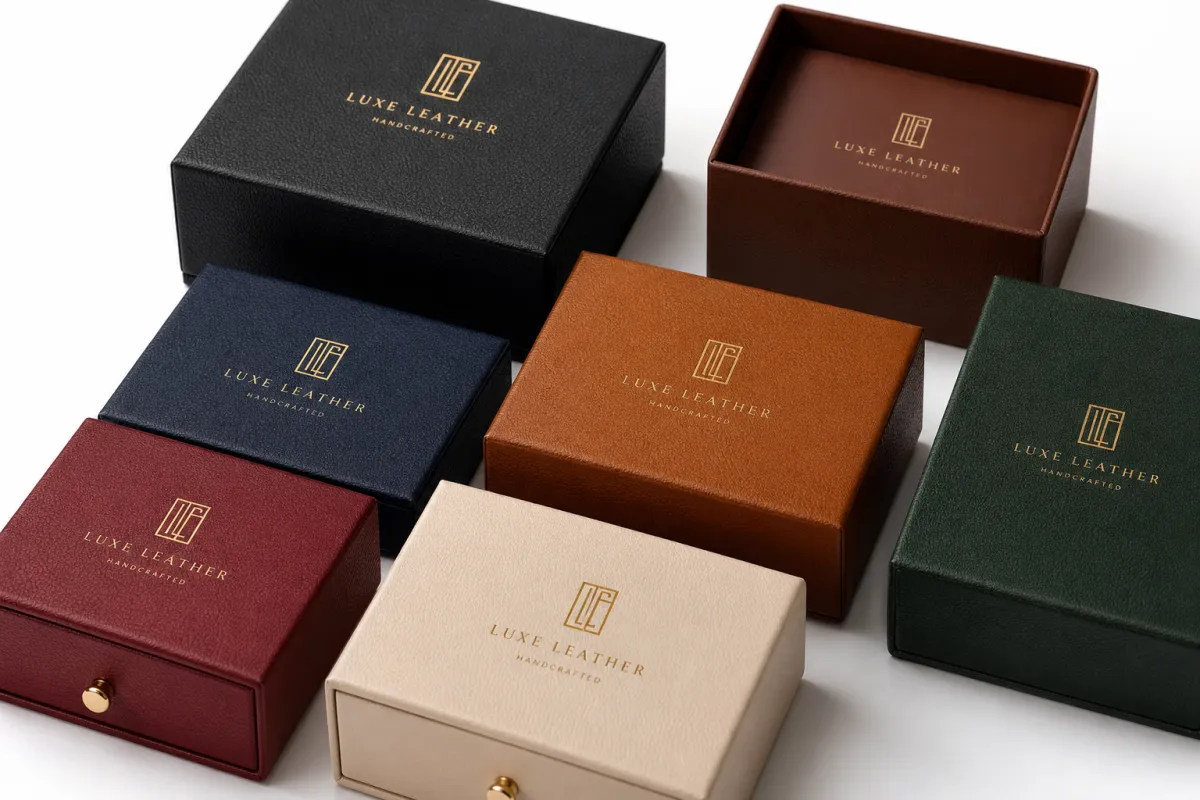
The first signal is psychological, but it is measured, not mystical. Same product, same inventory lane, same insert, different structures: the rigid wrapped option usually communicates higher confidence than lighter alternatives. Buyers read heavier wall feel, firmer edges, and controlled closure timing as proof of care. Those micro-signals reduce perceived risk before anyone opens the box. In premium channels, that can mean fewer abandoned carts and fewer “is this genuine?” questions at the counter.
Commercially, custom leather packaging boxes bulk works because it turns design into a repeatable system. With a fixed architecture, non-recurring engineering is absorbed early and reused, instead of re-created on every launch. Wrapping, printing, and hardware can be planned across cycles, so setup no longer behaves like a recurring tax. The strongest effect appears when teams commit to one shell family for at least two replenishment windows.
Fragmentation is where budgets go to die quietly. I have watched product teams reorder geometry after three weeks, add decorative sleeves a month later, and then complain that unit cost jumped unexpectedly. The content quality did not change; the process did. A mature custom leather packaging boxes bulk workflow keeps core geometry stable and lets teams swap color, foil, and inserts only where the market actually requires it. That small discipline reduces visual noise and keeps margins from evaporating in late changes.
Short runs look sharp in mockups and expensive in execution when handled like craft projects. Temporary wraps, rewrap steps, and late decoration add handling touchpoints, and each one adds delay risk. In one run, we compared a one-step wrapped shell and a sleeve-on-top system with similar graphics: the direct approach cut rework by more than a quarter in a simple transit simulation. The lesson is simple: fewer process nodes usually beat more decorative flourish.
Different categories stress different parts of the package. Jewelry and watches prioritize controlled fit and premium reveal, while cosmetics and fragrance teams care more about contamination control, fragrance-safe contact safety, and impact behavior. Investors ask for evidence in their own language, and premium buyers do the same: if the box is premium, it should also behave like a professional logistics tool. That is exactly the split where custom leather packaging boxes bulk earns its keep.
Luxury perception and durability are not interchangeable. A beautiful shell that scuffs in normal handling is a marketing cost waiting to happen. custom leather packaging boxes bulk should begin as a manufacturing decision, then become a brand expression. Once specs are locked, every team—from design to fulfillment—can work to one consistent benchmark instead of improvising with each shipment.
Product details: construction, leather options, and finish choices
Core structure and mechanics
Most premium programs start with rigid SBS board plus leatherized wrap, and that still makes sense for scale. A 1.5 to 2.0 mm board is common for many products, while 2.5 mm is generally safer for heavier SKUs or harder handling requirements. Closure style drives both comfort and cost. Lift-off lids are practical where repeated opening and closing are normal; they distribute stress more gently than delicate hinge points in some contexts.
Drawer systems can be powerful for showmanship and premium display, but they introduce tighter dimensional discipline. A deeper cavity, cleaner shoulder profile, and stronger internal guidance are needed if you plan to run them repeatedly. In practical terms, drawer structures usually add complexity in the insert stage and require better workflow control. If your forecast is stable and your team can support tighter tolerances, drawers can still be one of the strongest options.
Magnetic closures remain a common default, especially for watch and watch-like cases, but they are not set-and-forget. Force, depth, and keeper alignment matter more than the logo on the box. In smaller shells, 10-14N force can be enough; larger shells often need stronger pull systems and deeper embedding to avoid transit slippage. That is why custom leather packaging boxes bulk is about engineering and consistency first, and aesthetics second.
Leather choice by use case
PU leather is still the favorite in most high-volume programs because surface definition is more stable over long runs. It handles moderate humidity variation with less unpredictability than many alternatives and helps keep color and grain looking consistent across batches. For brands wanting a softer, textile-like feel, microfiber leather is a legitimate alternative, though it demands tighter line checks around edge burn-in and stitch tension consistency. Some teams also use embossed grain or waxed skins, but those variants require strict wrapping tolerances and stronger scrap planning.
Choice should usually begin with logistics risk, not campaign mood. If your shipments cross climate zones, the wrong wrap can show edge cracking or repeated micro-chafe in transit. Over time, “which one looks better in photos” is a weaker decision than “which one keeps tolerance and surface integrity after three handling cycles and two weeks in ambient storage.” That is the discipline that makes custom leather packaging boxes bulk believable to operations teams.
Finish options and brand control
Finish language can either reinforce identity or confuse it. Blind deboss works well when the brand wants depth without reflectivity volatility. Foil still delivers contrast and clear hierarchy, but multi-color foil can lengthen set-up and inspection windows. Tone-on-tone embossing often gives the cleanest visual continuity where visual systems are strict and repeatability is a KPI.
Contrast stitching is often underestimated in reviews because it feels secondary until final images are being produced. A controlled thread contrast can raise perceived quality with limited cost uplift if the stitching spec is clear from day one. Edge wrapping also has a practical function: it hides seam transitions, keeps outlines clean, and reduces visible defects in e-commerce photography. In this sense, custom leather packaging boxes bulk is image architecture as much as it is protective packaging.
Insert and cushioning strategy
Insert type is not a stylistic afterthought; it determines whether the structure performs in distribution. EVA is still common because it balances resilience and weight, usually around 25-35 kg/m3 for many lighter SKUs. Heavier accessories usually need denser support or a shaped insert to prevent load memory over repeated handling. Foam can be excellent for shock absorption, and molded trays remain the default for orientation-critical SKUs where visual display is part of the promise.
Applying one insert formula across unrelated products is usually a hidden cost source. A tiny vial and a heavy fragrance set do not need the same geometry logic. I have seen teams lose time and money when they force-fit everything into one insert template because it looked easier in planning tools. Matching insert depth and load behavior to SKU families improves packaging economy and reduces claims from receiving teams.
Durability under shipping stress
If a package passes one leg and fails the next, the impact is reputational and operational. Bulk planning should include acceptance targets before sampling: scratch thresholds, corner reinforcement plan, and post-wrap edge behavior under repeat opening. For fragile contents, one reinforced edge strategy plus repeated seam bonding checks usually catches issues before full production ramps. These criteria become expensive if ignored because defects scale with volume very quickly.
Dust and lint control often gets moved to phase two and then blamed on logistics when complaints spike. Satin or anti-static linings can reduce visible contamination for sensitive categories, especially where gifting visibility and brand trust are critical. They do add lead-time and handling complexity, so the tradeoff should be approved upfront. A disciplined program asks the hard question first: does this control save service cost over the first two replenishment rounds?
Custom leather packaging boxes bulk: specifications buyers should lock in
Dimensioning and fit controls
Geometry is where most programs lose consistency, and it is almost always a spec-writing failure. Internal dimensions must be fixed early for product and insert, then lid overlap and clearance are added with intentional tolerances. If cartons or mailers require fixed increments, those constraints need to be in the first revision, not during final approval. Packaging that stacks predictably saves floor space, simplifies freight planning, and reduces rejection risk in receiving docks.
Typical geometry data points for a serious program should include:
- Internal product dimensions (maximum and minimum tolerance range)
- Lid clearance at closed position (often 1-2 mm for lift-off; 3-5 mm for hinged types)
- Insert cavity shape, depth, and shoulder profile
- Secondary pack format for retail trays, mailers, or shipping cartons
- Allowed overhang and corner clearance per drop risk scenario
Tolerances are not cosmetic. A wide tolerance band may lower tooling pressure but increases rework in wrapping and inspection. A tighter tolerance increases setup cost, then usually lowers acceptance variance over time, which is often worth it at volume.
Materials and branding decisions
Branding inputs should be finalized before structural freeze or samples become expensive experiments. Logo position, size, foil depth, text scale, and mark hierarchy affect tooling and review effort. Interior branding can add a premium cue for some categories, while exterior-only marking can shorten inspection and improve throughput if you have a strict brand system. For high-control programs, include Pantone references, bleed, varnish profile, and edge behavior in the master technical packet.
Always request physical proof beyond a digital. Grain reversal, foil flattening, and emboss depth loss are visible only at production scale in several cases. A useful color control note is to define whether visual matching is acceptable or whether instrument-based checks are required. That avoids subjective disputes right when schedule pressure is highest.
Functional add-ons that shift cost and schedule
Ribbon pulls, anti-dust features, satin interiors, and seasonal sleeves all sound manageable until they land in calendar planning. Each add-on changes dieline effort, tooling, and finish sequencing, and can move lead-time more than expected. A ribbon hardware set sourced outside baseline suppliers, for instance, can add 1-2 days if not already planned in procurement. Even small seasonal wrappers can complicate edge wrapping and scrap control.
For multi-campaign programs, a variation governance matrix keeps chaos from sneaking into operations. Many teams keep shell architecture fixed for six to twelve months and run variations in logo and finish only. That helps with clean quote comparisons and keeps replenishment planning measurable. The practical upside is less about look and more about repricing predictability.
Spec sheet format that prevents rework
A strong spec sheet is the cheapest risk-control tool in this field. Missing fields create change orders and revision loops that compound across quantity. The minimum document set should include structure, finish, insert, closure, hardware, print, packing logic, and acceptance thresholds.
- Final shell dimensions and exact insert dimensions
- Material stack: board grade, wrap type, lining
- Decoration details: print, foil color, emboss depth, stitch style
- Functional elements: closure type, pulls, anti-dust treatment, inserts
- Quantity logic, SKU mix, and destination packing requirements
- Quality thresholds: scuff limit, color delta, warp and alignment tolerance
- Reference assumptions: ISTA handling logic, optional ASTM D4169 transport profile
Compliance-focused teams should also include FSC chain-of-custody or equivalent sustainability language early. Even where sustainability is not a campaign headline, transparent sourcing reduces friction in audits and supplier reviews. That can matter as much as the finish itself when working with global buyers.
Pricing & MOQ: what drives bulk cost and where savings come from
Pricing for custom leather packaging boxes bulk does not move linearly because every build detail compounds. Structure depth, board grade, wrap, closure, insert complexity, and decoration method each add or remove cost layers. A plain PU lift-off run can stay competitive at modest volume, while a drawer with molded inserts and intricate foil often costs more even when quantity rises. The first quote is usually a direction, not a final cost truth.
MOQ planning is a leverage point, and misunderstanding it creates false urgency. Setup-heavy builds commonly start around 300-500 units for simple shells, while complex insert or hardware configurations often need 800-1,200 units before unit curves stabilize. The larger the architecture consistency, the more likely you can flatten per-unit costs across refill windows.
Use these practical bands as a baseline, not a promise:
- Simple lift-off, PU wrap, one logo placement: MOQ around 300-500
- Magnetic or drawer closures with additional hardware detail: often MOQ around 500-1,000
- Multi-color foil, complex emboss, or mixed finish stack: frequently 1,000+ for most domestic suppliers
These are planning anchors. If your program has strong repeat intent, ask for reorder clauses and incremental pricing logic before final approval so the second or third run does not reset your assumptions.
Typical market profiles still look like this:
| Option | Typical MOQ | Indicative unit price range (USD) | Lead-time sensitivity | Where the cost is really coming from |
|---|---|---|---|---|
| Simple lift-off, PU wrap, one logo placement | 300-500 | $5.80 - $8.90 | Lower | Board, wrapping, one pass finish line |
| Magnetic closure, tone-on-tone emboss | 500-900 | $7.20 - $11.40 | Medium | Hardware matching and repeat closure alignment |
| Drawer with molded insert, mixed color treatment | 800-1,500 | $10.50 - $16.80 | High | Tooling, insert molding, finish complexity |
| Multi-SKU run using one core shell, variant inserts | 1,200+ | $6.80 - $14.20 | Stable | Core setup once, then controlled insert changes |
Important: these ranges vary by country, material source, supplier scale, inspection strictness, and compliance route. The figures are directional and should be validated with full landed-cost assumptions. A low lead quote without freight and handling context is often a trap in a different unit.
Hidden charges usually appear after sampling, not before. Plate revisions, die edits, special lamination, anti-static liners, and freight surcharges can push final pricing up if they are not explicitly split in the quote. A small increase in carton envelope size can trigger a cube jump on international freight, and it is a lot cheaper to model that early. I always separate unit cost, setup, finishing, inspection, freight, and handling reserves so nobody is surprised later.
Some vendors bundle inserts, others decouple them. Either path is valid, but you should request a scenario sheet broken into:
- Base shell with core decoration
- Each insert construction
- Each hardware variant
- Each finish variation
- Freight route with estimated cube treatment
The lowest opening quote can be technically incorrect if cost lines are incomplete; the strongest landed-cost position is the one that shows every variable before commitment.
Teams that choose modular architecture but never enforce that module design usually end up with exactly the same pain as teams chasing novelty. A reusable shell, one validated wrap library, and controlled variation in logo, insert depth, or color lets programs scale without sacrificing timing or margin.
Process & timeline: from brief to delivery
Most timeline risk appears before the production switch flips. A reliable sequence is brief, structural confirmation, proof, sample, approval, pilot run, inspection, and freight booking. Clean data in week one makes almost every later stage cheaper. In my experience, delays are less often machine-time issues than decision gaps and late spec changes. For custom leather packaging boxes bulk, indecision is usually the most expensive input.
A disciplined timeline usually looks like this:
- Brief and dimensions: 2-3 business days
- Dieline and build review: 2-4 days
- Digital proof: 1-2 days for straightforward graphics; 3-5 days for foil, emboss, or precision alignment
- Physical sample: 7-12 days; longer for custom inserts or high-precision closures
- Revisions (if required): 2-7 days
- Mass production: 10-18 days, depending on quantity and finish depth
- Inspection and packing: 3-5 days
- Freight window: highly variable, often 2-10 days to major destinations
Foil testing and complex insert geometry often require additional buffer because defects are usually discovered in physical trial, not digital review. Locked artwork before sample approval shortens project life substantially.
Sample risks and checkpoints
Sample churn comes from unstable detail sets, not from random manufacturing error alone. If logo size changes after signoff, or if stitch direction is altered late, the program can move from “clean sample” to “rework cycle” in one revision. A pre-sample checklist prevents that: color references, vector files, seam direction, stitch direction, corner treatment, and closure behavior. That check is not bureaucracy; it is timeline insurance.
Use explicit approval checkpoints and timestamped versions, especially with distributed teams. My preferred sequence is pre-print sample, pre-lamination shell, post-assembly, and pre-freight sample. When teams are split across geographies, version control also reduces expensive interpretation errors.
Shipping and risk management
Production quality and shipping architecture are linked. Before approval, teams should lock carton assumptions and pack-out counts, including if deliveries go to multiple warehouses or one DC plus one fulfillment partner. Split loading, route assumptions, and pallet pattern should be in the order logic before final commitment. Otherwise, even a good run can miss launch windows due to avoidable routing confusion.
For compliance-aware buyers, align early with ISTA expectations and document transport handling assumptions. Pair that with FSC references where supply chain policy requires it. This combination helps both operations and procurement review the same facts instead of defending different narratives later.
The practical result is a package that is operationally dependable, not just visually polished. custom leather packaging boxes bulk should be tracked as a logistics-ready product from day one.
Why choose us for bulk leather packaging programs
Choosing a partner for repeatable production is really choosing continuity under pressure. The most valuable supplier traits are consistency in seam quality, repeatable dimensions, and transparent versioning, not theatrical one-off concepts. A good partner protects schedule by treating packaging as an end-to-end process, not a design handoff.
Execution quality is often where teams discover the true difference. A dependable supplier links design, sourcing, production, and follow-up with a single change-control path. If a detail changes after sample signoff, there should be a clear note on cost and timing impact. If material delay hits, there should be a documented fallback path, not a scramble thread full of unresolved assumptions.
Quality control also has to be quantitative. A 1% defect rate in 5,000 units means 50 imperfect pieces; if your allowance tolerates minor scraping or seam defects, customer complaints and returns can erase savings quickly. In premium programs, include accepted scratch scale and recheck windows in writing, especially when humidity-shift behavior is part of your market distribution profile.
Scalable programs keep core structure fixed and route change requests through revision logic. That lets teams expand style range without rebuilding everything every quarter. You avoid buyer fatigue and maintain predictability when volume grows from pilot to replenishment.
Custom Packaging Products pages can help compare category options, but operational performance is decided in document discipline, approval routing, and schedule communication. If your team already plans by SKU family, connecting this with Wholesale Programs can reduce reorder volatility and simplify annual planning discussions.
Next steps: how to order custom leather packaging boxes bulk
Start with a concise readiness pass so the first supplier brief is actually actionable. If you are still debating structure, finish, and insert together in one meeting, you are asking for delay later. A one-page brief should include:
- Exact product dimensions and orientation behavior
- Preferred structure (lift-off, drawer, magnetic, hinged)
- Target quantity by SKU and expected reorder cadence
- Branding rules for logo and interior/exterior marks
- Insert and lining requirements by product family
- Required certifications, audit notes, and packaging standards
From there, move into cost-impact decisions: finish system, closure style, logo application, and insert depth. That order of operations is boring, but it usually saves review rounds and avoids expensive guesswork. The cleaner the input, the cleaner the output and the calmer the internal review cycle.
Ask for structured quotes
A complete quote request should include these categories at a minimum:
- Unit price by quantity bands
- Setup charges for plates, dies, and tooling
- Sampling cost and sample lead days
- Freight assumptions and any oversized handling charges
- Lead-time by stage, including revision buffers
Do not treat the headline number as the decision point. Some offers appear competitive by deferring freight treatment or finish variations until late milestones. A clear reorder plan usually unlocks better long-term economics because it makes pricing behavior predictable across replenishment cycles.
From quote to production without damage
The clean sequence is simple: quote, sample, approval, purchase order, production. It sounds procedural, but that sequence keeps cost and timeline visible. Changing dimension or finish after sample signoff can cascade into major rework, especially with complex hardware or textured finishes. Confirm proof and inspection order before signing, because sample acceptance predicts production stability better than most dashboards.
For multi-SKU programs, keep one core shell family and standardize where the variation actually belongs: insert depth, insert density, and hardware family. That model preserves premium signal while making price planning more defendable under market pressure.
Practical rule: lock the spec, request full cost line visibility, then define a revision window before you commit to schedule.
Complete the cycle with one last check: final spec signoff, total-cost comparison, and written acceptance criteria for the first order. That discipline is where custom leather packaging boxes bulk actually starts to outperform. The goal is not a prettier box; it is a scalable system that behaves like a business process.
Conclusion: what a good bulk program actually proves
custom leather packaging boxes bulk is not a luxury garnish. It is a repeatable commercial control framework that combines structure, finish governance, and distribution reliability. When this is done properly, brands improve perceived value and lower operational drag simultaneously. The strongest gains appear once teams pass two replenishment cycles and stop relearning the same setup details.
Many organizations separate design and procurement, then wonder why decisions drift and costs spike. In practice, packaging quality is affected by every department from design signoff to freight planning, so fragmentation is expensive. With ASTM and ISTA-aligned handling assumptions, explicit MOQ strategy, and clear QC thresholds, custom leather packaging boxes bulk becomes a strategic asset instead of a presentation expense.
If you are deciding right now, use this exact, practical step: define dimensions, finish behavior, and insert strategy in one locked spec, then run side-by-side pricing from the same benchmark package before final approval. That single move usually gives you the most reliable outcome. It is not glamorous work, but it is usually the difference between two replenishments that line up and two replenishments that blow up your margin.
Actionable takeaway: your next order should only move forward when shell geometry, finish controls, insert logic, and revision terms are all written, signed, and versioned; everything else is guesswork.
FAQ
What is the usual MOQ for custom leather packaging boxes bulk?
MOQ varies by structure, finish complexity, and insert architecture. Simple rigid programs often begin around a few hundred units, while drawer-heavy or highly engineered builds usually need more volume. A better comparison asks for MOQ by size, finish style, and insert strategy instead of accepting a single global minimum. In practice, tooling load and finish setup, not just unit count, determine the real floor.
How long do custom leather packaging boxes bulk orders take?
Lead time depends on sample complexity, finish depth, and how fast dimensions and artwork are finalized. Some straightforward programs move quickly; embossing-heavy or complex insert designs usually add review and validation time. Always request full milestone timing from sample approval through freight booking, because transport can become the biggest schedule variable. Orders with early approval discipline usually move significantly smoother.
Can I order custom leather packaging boxes bulk with inserts?
Yes, and for most brands that is the default path. EVA, foam, cardboard, and molded trays each solve different structural or visual needs, and each has a cost and fit trade-off. Mature programs often standardize insert families and change only depth or material by product line. That keeps appearance quality intact while preserving scale control.
What finish options work best for premium branding?
Blind deboss and subtle textural systems remain strong choices for consistent premium feel. Foil gives stronger visual contrast but increases tooling and inspection complexity. Contrast stitching and controlled color matching are effective, especially when finishing and inspection are already defined in the brief. Choose based on use context: retail display, gifting, fulfillment, or executive presentation each rewards a different finish profile.
How do I get accurate pricing for custom leather packaging boxes bulk?
Start with exact internal dimensions, quantity bands, finish plan, insert type, and logo placement. Then ask for full cost breakdown by sampling, tooling, production, finishing, pack-out, and freight. If repeat cadence is likely, state it explicitly and ask for scenario pricing by reorder logic. Better briefs produce better quotes, and better quotes produce stronger project outcomes.

