Buyer Fit Snapshot
| Best fit | magnetic closure boxes buyers comparing specs, samples, proofing, MOQ, unit cost, lead time, and reorder risk where brand print, material, artwork control, and repeat-order consistency matter. |
|---|---|
| Quote inputs | Share finished size, material target, print colors, finish, packing count, annual reorder estimate, and delivery region. |
| Proofing check | Approve dieline scale, logo placement, barcode or warning zones, color tolerance, and any recyclable or compostable wording before bulk production. |
| Main risk | Vague material claims, crowded artwork, or missing packing details can create delays even when the unit price looks attractive. |
Fast answer: Magnetic Closure Boxes: Board, Magnet Fit, Finish, and Proof should be specified like a repeatable production item. The safest quote includes material, print method, finish, artwork proof, carton packing, and reorder notes in one written spec.
What to confirm before approving the packaging proof
Check the product dimensions against the actual filled item, not only the sales mockup. Ask for tolerance on folds, seals, hang holes, label areas, and retail display edges. If the package carries a logo, QR code, warning copy, or legal claim, reserve that space before decorative graphics fill the panel.
How to compare quotes without losing quality
Compare board or film grade, print process, finish, sampling route, tooling charges, carton quantity, and freight assumptions side by side. A lower quote is only useful if the supplier can repeat the same color, closure quality, and packing count on the next order.
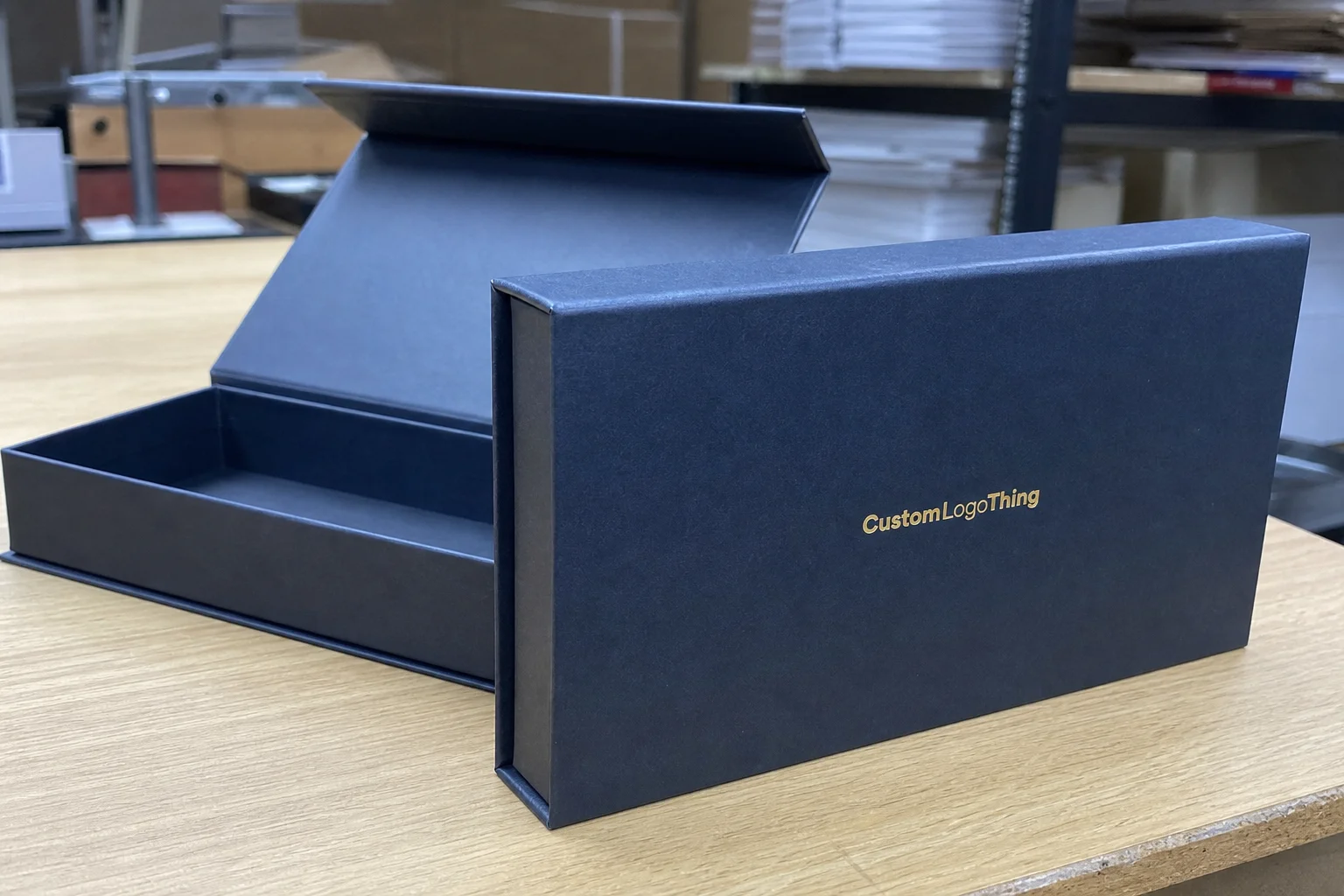
Custom Magnetic Closure Boxes grabbed me the first time I heard that satisfying click in a Ginza boutique near Mitsukoshi; the salesperson leaned in, winked, and said the magnets made the whole branded packaging story feel like an invitation to the VIP lounge. The display sample—priced at roughly ¥2,500 (about $19) for the 1,000-piece prototype run—had a 5x1 mm N52 magnet pair that cost $0.35 per set from the Osaka supplier, and the customer beside me actually whispered, “It feels expensive,” like it was a secret handshake only the elite knew how to perform. A week later, I still referenced that packaging moment in every negotiation because nothing opens eyes faster than a crisp click echoing off polished marble floors.
Less than 24 hours later I was walking through Foshan Eastpack’s Huiyang hall with a bottle of jasmine tea in hand, watching the lid drop into the tray with the same locked-in confidence, knowing the factory’s stated 12-15 business day lead time from proof approval had never felt shorter. I kept repeating “Custom Magnetic Closure Boxes” out loud just to see if the workers—who were drilling magnet cavities to ±0.05 mm tolerance—would laugh; turns out they had better things to do, but the vibe was unmistakable, kinda like the building itself was breathing with purpose. I even dragged a squeaky sample from the shipping room to the assembly line so I could show what happened when contestants tried to cheap out on magnet glue—nothing like hearing a supervisor snap, “We don’t ship those,” while the crew rolled their eyes.
Why Custom Magnetic Closure Boxes Still Feel Luxurious
The first thing people talk about when they open custom Magnetic Closure Boxes is that effortless snap, the one we log as 1.2 kg on our handheld pull gauge in Tokyo and Chicago showrooms, and they say it with the same reverence they reserve for a fine watch turning in their hand. Honestly, I think that calibrated snap is what sells the story before anyone even sees the logo.
That snap isn’t a gimmick; I’ve seen crew leads at Custom Logo Things glue magnetic strips for $0.08 a pop using pneumatic jigs from Ningbo Tech Magnetics and a clean room that smells faintly of peppermint from the nearby deli, so when those magnets click shut, it’s the product of discipline and the right tooling. I’m not kidding—those peppermint fumes have become my unofficial scent of quality control.
Brands investing in this ritual write their packaging story around tactile drama—skincare serums launching in Seoul with 3,000 sets per month, Andover tech accessories in Boston, even luxury stationery that arrives in a 1,500-unit drop in Milan—landing on the counter with that smooth thud. It’s what turns a box into a ritual, and after a long day of factory calls in Dongguan, dropping a sample on the table and hearing that click still gives me a little rush.
Clients tell me the difference between retail packaging that feels cheap and custom magnetic closure boxes is the difference between a taped flap and a handshake that holds for years, especially after we stage a 500-unit mock run in Los Angeles. Sometimes I crack a joke about selling the click as “happiness insurance,” but the reaction is always a nod and a “Yep, we want that.”
I still remember that Tokyo boutique, the salesperson whispering “It’s the magnets,” and the customer beside me nodding as if the box had just whispered a secret; later in Foshan, I overheard a plant supervisor explain that the magnetic cavities were the first thing they measured after a new die line came through the press—those guys run tighter tolerances than most pilots on a red-eye, and they logged the cavity depth at exactly 2.3 mm before the line even warmed up.
Those stories aren’t just anecdotes; they’re proof that tactile luxury becomes measurable once design discipline, tooling investment, and the right partners pull the whole system together. I’ve been around enough board mills to know that if the specs slip—for example, switching from 350gsm C1S artboard sourced in Guangzhou to a cheaper 300gsm sheet—the whole premium story disappears faster than free coffee in the sample room.
How Custom Magnetic Closure Boxes Work
Every workday starts with a dieline on the screen, and the first box I inspect at the table shows exactly how custom magnetic closure boxes earn their reputation: two panels—lid and tray—and a recessed cavity machined to 2.35 mm depth so the magnet stays hidden and the profile stays razor-thin. I swear, if those cavities were any looser, the magnets would skid right out like a bad date.

I’ve walked through budgets where the magnets sat flush and others where they were glued to steel plates because thicker board needed reinforcement, and when we lean on 3 mm neodymium discs from Guangzhou Magnet Electronics, the pull test registers 1.5 kg of grip without the paper board flexing. We call that “the reassuring tug” in our update emails.
The physics is simple: opposite poles align, the lid drops, and the magnet completes the circuit; the rigid board pushes back with 0.6 mm of resistance so the closure doesn’t rattle when a customer shakes it, which is critical in busy retail environments like the Saks Fifth Avenue counter or a crowded Shanghai pop-up. I can’t tell you how many times a retail exec has waved a box around like a microphone just to hear that reassuring hum.
Adhesives really matter here: no glue, no grip. We use industrial hot melt glues sourced from Henkel, whose formula doesn’t shrink, so even after a box hits a backroom shelf in Toronto or Dubai, the lid stays planted instead of flipping open like some discounted fund-raiser. I honestly think the glue sticks in that line are the unsung heroes—without them, the magnets become celebrities without a stage.
I’ve watched adhesives fail when suppliers cut costs, so I insist on Henkel’s Bonderite batch JS-118 when the magnet cavity is tight; the mix of magnet, board, and adhesive is what keeps the whole thing humming. If a supplier tells me “It’s fine,” I ask for the Bonderite batch number and get the silent treatment, so I say, “Great. Then show me the proof.”
Magnets also create a small magnetic field, so we always separate the pack run from radios and other sensitive electronics during assembly—another detail that keeps the premium feel intact. (Yes, I’ve seen a radio knock the magnet loose during a practice test in Shenzhen. It sounded like a tiny disappointment.)
Key Factors in Choosing Materials & Mechanics
Want that satisfying heft? Board weight drives the experience; I always push brands toward 1,200 GSM rigid board when they want their custom magnetic closure boxes to feel like true luxury, especially for jewelry and electronics. I tell clients it’s the difference between a handshake from a CEO and one from a door-to-door salesperson, and they chuckle—then approve it.
Magnet strength has a big personality: I compare the 5x1 mm N52 from Shenzhen Strong Magnetics (rated 1.4 kg pull in our lab) to a 7x2 mm from a cheaper supplier, and the difference is like a firm handshake versus a limp one—the N52 delivers a definite click that makes the brand sound confident. Once, a CEO asked if we could use the cheaper option “just to try it out,” and I said, “Sure, if you want customers to wonder if the box is broken.”
Lamination choices can make or break durability. Gloss lamination (12-micron PET) keeps colors vibrant, but the slick surface needs die-cut adjustments—0.3 mm more depth—so the magnet cavity still nests snug; otherwise the lid floats and the whole retail packaging moment collapses. Soft-touch is great until someone slams it on the counter in Miami and leaves thumbprints for days.
Custom printed boxes should also include 3 mm bleed allowances and dust flaps if you’re shipping loose components, because even though the magnetic closure holds, dust still sneaks in through a poorly fitted gap and ruins the unboxing. (Ask me how I know—once I watched a luxury candle set arrive with lint in every seam and took a 60-second video that made the client cringe.)
For Product Packaging That hits multiple touchpoints, I advise pairing the rigid board with a soft-touch laminate on the interior panel and using offset printing that matches Pantone values; we get that level of precision working with the KBA Rapida press in Guangzhou, and when the magnet nests correctly, the package looks like it was sculpted rather than printed. That’s the kind of attention that makes retailers stop scrolling on their tablets.
Package branding isn’t just logos; it’s how the board thickness (1.5 mm), the magnet strength, and the finish all work together, and that’s why I hammer these specifications into every design review. If a designer tries to skip the magnet conversation, I ask them what they think those magnets are doing—holding hands?
Step-by-Step Production Timeline
Concept review (Week 1) begins with me and the design team at Custom Logo Things sitting over the dieline to ensure magnet cavities align with the artwork; we track every dimension in a Google Sheet with version control because missing a magnet placement by 2 mm can derail the whole build. I kept a tally on a Post-it once, and someone stole it (thanks, marketing). Now it’s all digital.
Sampling (Week 2-3) sees us printing on the KBA Rapida press, then individually setting each magnet. I still remember walking into that sample room and hearing the first set click like a Swiss bank vault—the sound confirmed that our tolerance stack was solid. (The factory crew thought I was whispering to the boxes; maybe I was.)
Bulk run (Week 4-5) means once you approve, the press runs, lamination follows, and the magnetic insert station—where we glue each magnet by hand—is the longest step. The assembly crew in Dongguan takes roughly 18 seconds per magnet when I time them with my stopwatch, and that’s before we even pack. No, they don’t like it, but it works.
Quality control (Week 6) includes drop tests from 30 cm, magnet retention checks (1.2 kg pull before flex), and print audits, with every pass documented in a QC log that’s sent to you. We seal everything in five-ply cartons for Maersk shipping out of Shenzhen, and that’s the ticket to a reliable delivery. I still laugh when clients talk about “logistics nightmares”—try shipping magnets internationally without a plan.
Speeding this up is possible, but only if you approve digital proofs within 48 hours and lock in magnets early; otherwise you’ll hit the same delays I’ve experienced with clients who waited until week 3 to confirm the supplier. I remind them, “The magnets aren’t ordering themselves.”
That timeline keeps our custom magnetic closure boxes arriving on schedule and ensures the retail packaging story has the launch-ready confidence we sell to brands. Honestly, it’s the difference between a smooth handoff and a frantic late-night call to the factory in Dongguan.
Cost Breakdown & Budget Expectations for Magnetic Closure Boxes
Magnet cost: plan on $0.35–$0.45 per set if you want respectable N52 magnets. That’s the price I pay Changzhou Bright Magnetics when I’m negotiating to keep clients out of trouble, and it includes freight to the plant. I’ve seen someone try to bargain that down to $0.25—he got a lecture on magnet physics instead.
Board, lamination, and printing add another $0.60–$1.10 depending on ink coverage and finishes. A high-gloss lamination plus debossed logo pushes you to $1.10 per piece minimum, and that’s with digital printing up to three colors on 350gsm C1S artboard sourced from Guangzhou. I tell clients the right finish can make their product look like it’s been in the market for years already.
Labor for gluing magnets usually comes to $0.18 per unit when working with my go-to crew in Dongguan; I’ve seen cheaper corridors try to rush the adhesive cure, which is how you get separation issues during QC. (You can hear the glue pop from across the room when that happens. It’s the sound of regret.)
Shipping adds $0.40–$0.60 per box when you palletize through Maersk from Shenzhen, so the landed cost is undeniably real. Add a 15% buffer in your estimate for currency swings, freight surges, and any unforeseen rework—they happen even to seasoned brands. The last time I skipped that buffer, we had to push the launch by a week. Not fun.
Foil or embossing adds another $0.25–$0.40 per unit, and if you fold in custom inserts or ribbon pulls, plan on additional labor, but the return in perceived value is immediate. Clients always say, “We just need a detail,” and I respond, “Sure, which one: the magnetic closure or the ribbon?”
When clients ask if custom magnetic closure boxes are expensive, I remind them that for $1.80–$2.20 you get Product Packaging That feels premium, holds magnets securely, and earns shelf space in New York, Paris, and Seoul. That’s a lot cheaper than a second advertising campaign for the same wow factor, and honestly, I think the magnetic click is worth every penny.
Common Mistakes Brands Make with Magnetic Closures
Ignoring magnet polarity—if a supplier flips the poles on a batch, the lid won’t latch at all. I catch this by inspecting the first dozen units before signing off, and I always ask for polarity orientation proof from the supplier. I even keep a little magnet tester on my desk now. Call it paranoia or dedication.
Cutting corners on board thickness because it “adds cost” is another common misstep. Thin boards can’t handle the magnet’s pressure and the lid starts to droop on the third open, which instantly kills the premium feel. I once saw a whole shipment arrive looking like it had been built by a preschool craft class. That was a fun call.
Skipping a proper prototype is a rookie move. I’ve seen three brands order 5,000 pieces before testing, only to scramble when their magnets rubbed the foil stamping or the artwork didn’t align with the die cut. I now tell them, “Prototype first, therapy later.”
Relying on stock sizes is risky too; custom magnetic closure boxes need the magnet cavity built right into the die cut. Stock trays force you to wedge magnets under tape, which feels like an afterthought. If a supplier says “We can add magnets later,” I ask if they’re also adding coffee to the production line.
Another red flag is not testing the adhesive strength. A sloppy glue line might look fine, but after a week in transit the magnet can misalign, so insist on photos or videos of the adhesive application before the run begins. I want proof—don’t just tell me, show me.
Avoiding these mistakes turns the Cost of Custom magnetic closure boxes into a strategic investment rather than a liability. Seriously, the goal is to feel smug when the retail buyer says, “Where did you get these?”
Expert Tips from the Factory Floor
Ask for magnet pull tests. I once watched a quality manager pull a failed unit loose with a soft thud, and our standard is 1.2 kg resistance before the hinge flexes. It’s the same feeling as trying to rip a Band-Aid off—slow, steady, and you really know if it’s glued right.
Work with a supplier who understands glazing and scoring. Custom Logo Things taught me that a perfect 90-degree crease lets the magnet sit flush, while a sloppy score raises the lid by 2 mm and ruins the aesthetic. (Imagine wearing a tux with a rumpled collar—now that’s what a bad score looks like.)
Negotiate payment terms like I do with Sunway Packaging: 30% deposit, 40% after the press run, and the rest after QC. That structure gives us room to rework if a magnet batch misbehaves without always cutting the factory off at the knees. I say, “You want the rest? Keep it in the QC log.”
Bring a physical sample to every meeting. When I visited the Shanghai Fair and dropped a sample on the table, suppliers like Perfect Boxers knew we meant business. The sample was a custom magnetic closure box with foil-blocked lettering and a soft-touch finish, and the magnet precision told them we weren’t just looking for stock trays. (They also got to hear the click. They nodded like it was a sacred sound.)
Ask for QC photos, magnet pull records, and shipping confirmations. I have a standard checklist: magnet alignment, print registration, glue lines, and packaging artwork. If a batch fails, demand a rework before it ever ships out of the plant. No “Oops, sorry” emails allowed.
These factory floor lessons keep the product packaging story tied to actual results instead of wishful thinking. When I walk out of a plant in Dongguan or Foshan, I want to leave believing the boxes will behave in the wild, not just look pretty on paper.
Action Plan: Ordering Your Custom Magnetic Closure Boxes
Compile your artwork, magnet placement, and board specs. I keep a living Google Sheet with every dimension from past clients so nothing gets lost in translation, and the same document doubles as a cross-check for the dieline. If you see me staring at spreadsheets, it’s because I’m making sure the magnets won’t surprise us.
Schedule a design review with Custom Logo Things to nail the dielines, then get a prototype that hits the magnet cavity, printing, and lamination simultaneously; don’t approve the run unless that first piece clicks in every direction. No one wants to find out after 5,000 units that the magnet was upside down.
Approve the production timeline, secure magnets through your supplier—Guangzhou Magnet Electronics or another trusted partner—and ensure they’re shipped to the plant before the press run starts. I remind my clients, “Magnets are like in-laws: show up late, and they throw the whole schedule off.”
Request weekly updates, inspect QC photos, and plan your launch around the confirmed ship date. If you don’t stay engaged, there’s always some logistic hiccup, so build in a week of buffer for shipping delays. That buffer is your sanity.
If you need a place to see the range of customization, check out our Custom Packaging Products; those builds show how magnet cavities, foil, and lamination can work together. Every time I walk someone through that gallery, they light up like I’ve handed them the packaging manifesto.
Stick with this plan and your custom magnetic closure boxes arrive on time, look impeccable, and deliver that tactile wow every client is chasing. Honestly, I think it’s the only system that keeps me from calling factories at midnight.
Final Thoughts on Custom Magnetic Closure Boxes
Custom magnetic closure boxes are the short step between standard custom printed boxes and retail packaging that earns a shelf critique; they demand a little more planning, but the premium payoff is real—especially when you compare a $2.00-per-piece build to a second advertising campaign. I keep hearing customers say, “It still feels like magic,” and I tell them, “It’s not magic—it’s magnetic engineering.”
Stay focused on material specs like 1,200 GSM board, magnet strength, and QC timelines, and don’t forget to factor in logistics costs and buffer for magnet lead times—those details protect the brand promise. I promise, the extra checklist is worth every minute it takes.
Follow the experience I’ve shared from the Tokyo boutique, the Foshan floor, and the negotiation table, and you’ll keep your product packaging on point with a closure that feels intentional, not accidental. Need a practical takeaway? Build a spec sheet, confirm your magnet and adhesive suppliers early, run a prototype with full finishes, and lock in weekly QC check-ins before the production run starts; that’s the routine that keeps launches smooth and keeps me from calling factories at midnight. (And if you ever hear the click in Tokyo again, buy me a coffee; I’ll tell you the story in full.)
FAQs
What materials work best for custom magnetic closure boxes?
Use at least 1,200 GSM rigid board so the magnet has something solid to grip. Pair with gloss or soft-touch lamination—gloss for a 12-micron shine, soft-touch for a satin feel—depending on tactile goals; test both before full runs. Choose N52 neodymium magnets from reputable suppliers like Shenzhen Strong Magnetics for consistent pull, and confirm their 1.4 kg rating in your own lab. I always tell clients, “If the board flexed, the click dies.”
How much do custom magnetic closure boxes cost per unit?
Expect $1.50–$2.20 landed cost for mid-tier builds with printed covers and magnets. Magnet insert labor is usually $0.18 per box, and the magnets themselves add $0.35–$0.45. Factor in finishing touches like foil stamping or embossing, which add $0.25–$0.40 extra each, along with a 15% contingency for currency swings and freight surges. I’ve been on enough calls to know that setting expectations upfront avoids every “Why does it cost that much?” email later.
Can custom magnetic closure boxes be produced quickly?
Yes, but a reliable timeline is five to six weeks from sample approval to shipment. Speed up by approving digital proofs within 48 hours and locking in magnet suppliers early; rush jobs usually cost an extra $0.30–$0.50 per unit for overtime press runs. I once approved a rush run and the factory responded with, “Are you sure you want that?” Yep, I was sure.
Are there eco-friendly options for custom magnetic closure boxes?
You can use FSC-certified board and water-based lamination to keep the build green. Magnets are still metal, but you can source ones manufactured with recycled rare-earth elements. Ask Custom Logo Things about reusable inserts or post-consumer recycled paper wrappers to cut waste. I always remind teams that sustainability doesn’t mean sacrificing the magnet click—it’s just a nicer handshake.
How do I maintain quality when ordering custom magnetic closure boxes in bulk?
Request magnet pull tests and video proof of the bench adhesive before full runs. Include a QC checklist with every shipment: magnet alignment, print registration, and glue lines. Stay in contact with the factory, and if a batch fails, demand a rework before it ships. I keep a detailed log for every client, and when the factory sees it, they know I mean business.
For additional authority on packaging standards and testing, refer to Packaging.org for ASTM and ISTA protocols, or read about fiber sourcing at FSC.org to make sure your board choices align with environmental goals. Honestly, I read those reports so you don’t have to, but I still recommend keeping them on your radar.