Custom mithai boxes do more than carry sweets from one counter to another. They set the price expectation before the lid opens, and they can make a modest assortment feel considered, festive, and worth gifting. A good box also protects fragile pieces from scuffing, syrup transfer, and movement during transport, which matters just as much as the first impression.
Buyers usually judge these packs on three things: presentation, protection, and practicality. If the structure fails any one of those, the whole pack feels weaker, even if the sweets inside are excellent. That is why packaging decisions for mithai are rarely just visual decisions. They are sales decisions, storage decisions, and quality decisions at the same time.
Why custom mithai boxes sell better than plain cartons
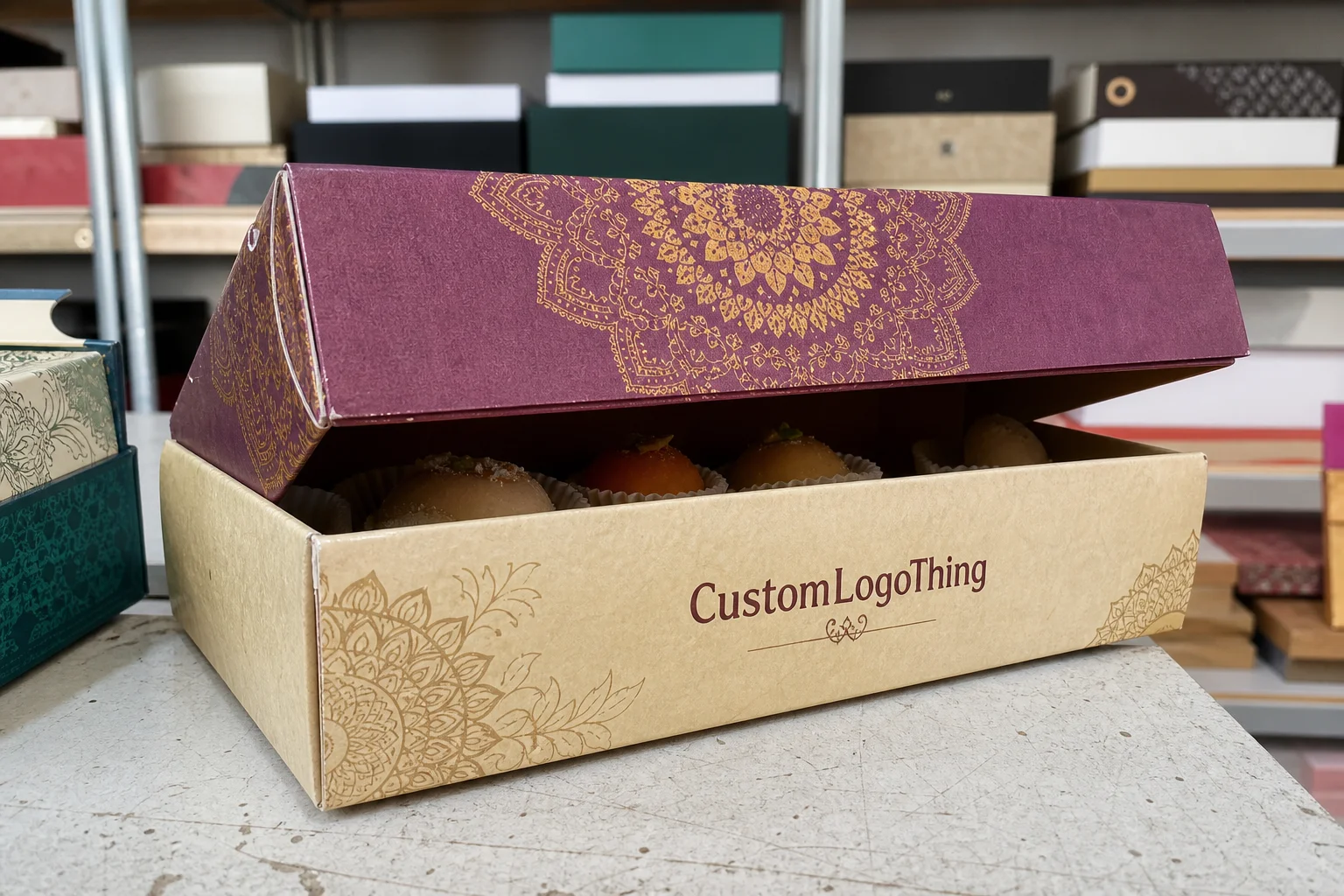
Mithai is a fast-read product. The customer sees the color, the print, the closure, and the shape before they taste anything. In retail counters, festive gifting, and wedding orders, that first read carries real weight. Custom mithai boxes turn the sweets into a gift rather than a generic purchase, which is often the difference between a basic sale and a higher-margin one.
The category covers more than one format. Folding cartons work well for everyday retail and lighter assortments. Rigid gift boxes suit premium gifting and corporate hampers because they carry more structure and tend to stack better. Tray-and-sleeve packs feel more deliberate when you want a tidy unboxing experience, while window boxes make sense if the sweets are visually strong and cleanly arranged.
Material choice matters as much as the format. A carton made from 300 to 350 gsm board can be sufficient for lighter packs, especially when the sweets are boxed in small quantities and do not need heavy protection. Rigid boxes usually use a wrapped board structure around 1.5 to 2 mm thick, which adds weight and cost but gives a stronger, more premium feel. Neither is automatically better. The right choice depends on the sell price, handling conditions, and how often the box will be stacked or carried.
There is also a practical brand effect. A thoughtfully printed box tells the customer the sweets are freshly prepared, gift-worthy, and part of a deliberate range. It can help a shop hold its price point without relying on discounts. That is one of the clearest reasons custom packaging keeps showing up in this category: it supports value without needing much explanation.
My practical view is simple. The structure should be chosen first, the size should be locked second, and the print treatment should come after that. Beautiful packaging in the wrong size is still poor packaging.
How custom mithai boxes work in production
The production path starts with dimensions. The outer size, the inner cavity, the number of compartments, and the final closure all need to be defined before artwork is finalized. That sounds obvious, but many delays start here. A design can look finished on a screen and still fail once the sweets are physically loaded into the pack.
For assorted sweets, inserts are often the difference between a clean delivery and a messy one. Dividers, trays, and cavities prevent pieces from sliding, touching, or smearing. This matters even more for soft sweets, syrup-heavy items, and decorated pieces with fragile toppings. If the box is meant to travel any distance, the insert should be treated as part of the structure, not an optional extra.
Print method depends on volume and required consistency. Digital print is useful for shorter runs, artwork changes, or seasonal testing. Offset or litho-lam is usually better for larger quantities, especially if the brand relies on stable color and a consistent finish. If a supplier says the color “will match closely,” ask what standard they are using and whether a printed proof or press proof is included. Color drift is common enough to deserve direct discussion.
Finishing should support the product, not compete with it. Matte lamination gives a calm, refined surface and usually hides handling marks better than gloss. Gloss can help festive colors feel brighter. Soft-touch adds a velvet-like feel, but it also raises cost and can show wear if the box is handled repeatedly. Foil stamping and embossing can work well on mithai boxes, but they are best used with restraint. Too many effects in one layout can make a pack look busy rather than premium.
Food-contact setup needs a separate check. If sweets will touch the board or inner tray directly, the supplier should confirm the liner, coating, or food-safe barrier being used. For buyers who need traceable sourcing claims, references such as FSC-certified paper sourcing and shipment testing frameworks like ISTA transport testing are useful benchmarks. They do not replace product-specific compliance, but they help you separate serious suppliers from vague ones.
The best package performs well on the shelf, in storage, and in transit. It should open neatly, close securely, survive stacking, and arrive without crushed corners or damaged sweets. A box that looks good but fails in the vehicle is not a good box. It is just an expensive disappointment.
Key factors that change cost, MOQ, and unit cost
Most pricing differences come from a short list of variables: structure, board thickness, size, print coverage, finishing, and quantity. The quote is rarely random. It reflects setup time, material use, conversion steps, and how much manual handling is required during assembly or packing.
MOQ, or minimum order quantity, is mostly about production economics. Setup costs have to be spread across enough units to make the run worthwhile. Simple folding cartons often allow lower minimums than rigid boxes because they convert faster and use less manual labor. Rigid gift boxes can sometimes be ordered in lower quantities, but the unit cost is usually higher. A buyer comparing the two as if they are interchangeable will get misleading numbers.
Volume changes unit cost in a predictable way, but storage risk rises at the same time. Ordering 15,000 boxes for a short festival run might improve the per-box price, yet it can also create warehouse pressure, inventory aging, and cash tied up in packaging that will sit longer than planned. That tradeoff is worth thinking about early.
Size is another cost driver that gets underestimated. Extra empty space increases board usage, raises shipping weight or carton size, and often creates movement inside the box. A tighter fit usually works better for sweets, especially for assortments with fragile decoration. Over-sizing to feel generous often ends up causing damage.
Artwork complexity matters too. Full-coverage print, metallic inks, multiple spot colors, heavy flood coats, and custom patterns all add production time or cost. Sometimes the more effective design is a restrained one-color or two-color layout with a single foil logo. That approach can feel cleaner and more expensive than a crowded composition with too many effects competing for attention.
| Box Type | Typical Use | Relative Cost | Buyer Notes |
|---|---|---|---|
| Folding carton | Retail counters, mid-volume gifting | Lowest | Good for lighter sweets, easier to store flat, faster to convert |
| Tray-and-sleeve | Festive gifts, premium assortments | Medium | Better presentation, more controlled opening experience |
| Rigid gift box | Corporate hampers, high-value sets | Highest | Stronger structure, higher freight volume, more premium feel |
| Window box | Retail display, visual sales | Medium | Useful when the sweets themselves are uniform and visually strong |
For quote comparisons, keep every variable aligned. Compare the same dimensions, the same insert count, the same finish, the same board grade, and the same shipping terms. If one supplier is quoting a 2 mm rigid board with foil and another is quoting a lighter wrapped board with no insert, the numbers are not competing with each other. They are describing different products.
Quality checks before sign-off
A sample is not just for approval. It is the moment to test how the box behaves in the real world. Before signing off, check the fit with actual sweets, not just dummy weights. Bars, laddoos, barfi, and mixed assortments each create different pressure points, and a structure that seems perfect with one sweet can be awkward with another.
Look closely at the corners, folds, and closure strength. For folding cartons, the lock tab should hold without tearing the paper fiber. For rigid boxes, the lid should sit square without gapping or bowing. If there is a window, check the seal, the clarity, and whether the cut edge looks clean. Small flaws become obvious once the boxes are stacked in a shop or handed to customers.
Ink rub is another useful check. Printed surfaces should not mark easily when rubbed by hand, especially if the boxes will be packed in bulk or moved through warm conditions. Lamination usually helps, but it is worth testing rather than assuming. A soft-touch or matte finish can look elegant and still show handling marks if the production setup is weak.
Drop testing does not need to be complicated to be useful. A short drop from counter height, plus a simple shake test with the actual sweets inside, will often reveal whether the insert is doing its job. If pieces shift, tilt, or smash against the lid, the structure needs adjustment before the full run goes ahead.
These checks save money because they expose problems before printing and conversion are complete. A rejected sample is an annoyance. A rejected production run is a budget problem.
Custom mithai boxes: process and timeline from quote to delivery
The order flow is usually predictable: inquiry, quote, dieline confirmation, artwork prep, sampling, approval, production, packing, and shipment. What changes the timeline is structure complexity. A straightforward folding carton can move quickly. A rigid box with a custom insert, foil stamping, and specialty lamination takes longer because more steps need approval and more handwork is involved.
For practical planning, simple printed cartons may take about two to four weeks after artwork approval, depending on quantity and shipping method. Rigid or highly finished boxes often need more like four to eight weeks, and complex launches can take longer if sampling or tooling is involved. Those ranges are not guarantees, but they are useful for planning a season without stress.
Sampling deserves real time in the schedule. If color accuracy matters, or if the fit is tight, a physical sample is worth waiting for. It is much cheaper to adjust a cavity depth, liner thickness, or lid fit during sampling than after a full production run. Skipping that stage to save a few days often costs more later.
Artwork changes are the most common delay point. Once the dieline is approved and the layout is locked, late revisions create friction everywhere else. That is especially true for packaging tied to a launch date or a holiday window. The more people who comment late, the less predictable the timeline becomes.
Festive seasons create their own pressure. Production slots fill early, freight gets tighter, and anything labeled urgent becomes expensive. If the boxes are coming from overseas, build in extra time for transit, customs, and local delivery. Missing a festival launch by a week can undo the value of the whole order.
Design choices that make the box feel premium without blowing the budget
The strongest packaging usually looks calm rather than crowded. Clear logo placement, balanced typography, and one well-placed embellishment often do more than layers of effects. A clean print layout helps the sweets feel intentional and gives the brand more room to breathe.
If the goal is a premium feel, choose one standout treatment and let it carry the design. That might be a foil-stamped logo on a matte surface, a rich brand color on a rigid lid, or a simple window that shows off the assortment. Adding foil, embossing, spot UV, ribbons, and multiple substrates to the same box rarely improves perception in proportion to the added cost. It often just adds noise.
Window cut-outs work best when the sweets are neatly arranged and consistently shaped. They are less forgiving when the assortment is irregular or sensitive to light and humidity. Opaque boxes are the safer choice for products that need more protection or a more formal gift feel. The right answer depends on what is inside and how the pack will be sold.
Practical details matter too. The box should open without tearing, close without force, and store efficiently in the back room. Ingredient panels, allergen information, and flavor labeling should be easy to read. If the retailer handles multiple assortments, a coherent box family saves redesign effort and makes the range easier to manage.
- Keep the outer print legible from arm’s length.
- Match insert depth to the sweet type and syrup level.
- Use one strong visual cue instead of several competing effects.
- Choose a finish that supports handling, not only shelf appearance.
There is one more practical point. Not every surface needs to work equally hard. Sometimes a plain tray inside a well-designed sleeve is enough, especially if the sweets themselves are the main visual asset. Spending where the customer can actually see and feel the difference usually delivers a better result than finishing every hidden surface.
Common mistakes buyers make when ordering custom boxes
The most common mistake is getting the internal size wrong. Too much space lets sweets move during transit. Too little space crushes corners, smears decoration, or makes the box difficult to close. This is one of the fastest ways to turn a premium pack into a complaint.
Another frequent problem is approving artwork before confirming the print setup. Dieline, bleed, safe zones, color mode, and file resolution all matter. Screen colors are not print colors, and a file that looks fine in preview can still fail on press. If the supplier asks for a specific file format or proofing step, that request usually exists because somebody has already paid for skipping it.
Food-contact assumptions create avoidable trouble too. An attractive outer box is not automatically suitable for direct contact with sweets. Board, coating, tray, and liner all need to be checked. If the confectionery will touch the packaging directly, the contact layer should be confirmed before production begins.
Price-only sourcing is another trap. A very low quote can hide thinner material, less reliable finishing, or weaker tolerances. Once the boxes are in use, those savings tend to disappear through damage, rework, or slower packing. Comparing only the price is a fast way to buy the wrong specification.
Finally, too many buyers leave production too late. Seasonal demand exposes weak planning immediately. Rush orders can sometimes be saved with faster production or air freight, but that usually eats margin and removes control. A better schedule leaves room for sample approval, print correction, and delivery buffers.
Expert tips for buying the right box on the first try
Start with the product, not the artwork. List the sweet count, shape, finish, syrup level, and whether the pack is handled by staff, customers, or both. That information tells a supplier more than a vague request for “something premium.” Good packaging specs begin with the contents.
Ask for a sample whenever the structure is new, the insert is custom, or the sweets are delicate. Even a rough prototype can reveal problems in cavity depth, board stiffness, or closure strength. The earlier the test happens, the cheaper the correction.
Request a Quote that separates printing, finishing, inserts, and shipping. Bundled prices hide the real cost drivers and make comparisons harder. A clean quote also helps you decide whether to simplify the structure, reduce a finish, or change quantities to improve the unit cost.
Choose materials according to the sales channel. Folding cartons are efficient for counters and higher-volume retail. Rigid boxes fit gifting and higher ticket items better. There is no universal winner. The right structure is the one that matches the economics of the sale and the handling conditions of the product.
Use a visual system that can stretch across more than one season. A base design that can adapt from Diwali to wedding gifting to corporate hampers saves redesign time and keeps the range coherent. Freshness is useful, but consistency helps the brand feel established.
A good mithai box does not try to win by noise. It wins by fitting the sweets properly, surviving the journey, and making the gift feel worth opening.
Plan backward from the launch date. Allow time for approval, sampling, production, and delivery. Packaging is one of the few parts of the launch that can be controlled tightly if the schedule is respected. Once the sweets are ready, the box should already be waiting for them.
What to prepare before requesting quotes
A clean spec sheet saves time and reduces back-and-forth. Include the exact dimensions, sweet count, box style, expected quantity, preferred finish, and whether you need inserts or a food-safe liner. If you already know the sales channel, add that too. A box for counter sale behaves differently from a box built for courier delivery or corporate gifting.
It also helps to include reference images, not as copy instructions but as visual targets. A supplier can usually work faster when the desired level of formality, color density, or closure style is clear. Vague direction often produces vague results.
Ask for two quantity levels if you are uncertain about demand. That gives a clearer view of how MOQ affects the unit price and whether a larger run is worth the storage commitment. Sometimes the better choice is a smaller test order. Sometimes the price break justifies a fuller run. You need both numbers to see the difference.
If the sweets are sensitive to heat, scuffing, or movement, say so early. That detail affects the board, insert, and finish choices. It is much easier to design for the product correctly than to fix a weak structure after approval.
The simplest rule is also the most useful one: build the box around the sweet, not the other way around. That is what makes custom mithai boxes work in practice instead of only on a mockup.
What size should custom mithai boxes be for mixed sweets?
Base the size on the actual assortment, not a rough guess. Leave enough room for the insert and protective liner, but avoid extra empty space that lets pieces move during delivery.
Are custom mithai boxes food-safe for direct contact?
Not automatically. Food safety depends on the board, coating, and inner liner or tray. Many buyers use a barrier layer or a food-safe insert so the sweets never touch the outer printed surface directly.
What is the typical MOQ for custom mithai boxes?
MOQ depends on the structure and print method. Folding cartons usually allow lower minimums than rigid gift boxes. In practical terms, many buyers see simpler carton runs starting around 500 to 1,000 units, while rigid boxes often carry higher setup costs even when the minimum is lower.
How long do custom mithai boxes take to produce?
Timelines vary by structure, finish, and quantity. Straightforward printed cartons can often be produced faster than rigid Boxes with Inserts, foil, or specialty lamination. Sampling and shipping should be added to the schedule, especially during festive periods.
How can I reduce the cost of custom mithai boxes without losing quality?
Use a standard structure where possible, keep the size efficient, and limit expensive finishes to one strong brand detail. Compare quotes on identical specifications, otherwise the cheaper price may only reflect a lighter build or a weaker finish.