Printed Custom Plastic Garment Bags Quote for Fitness
Why Fitness Apparel Needs Bags That Survive the Hand-Off
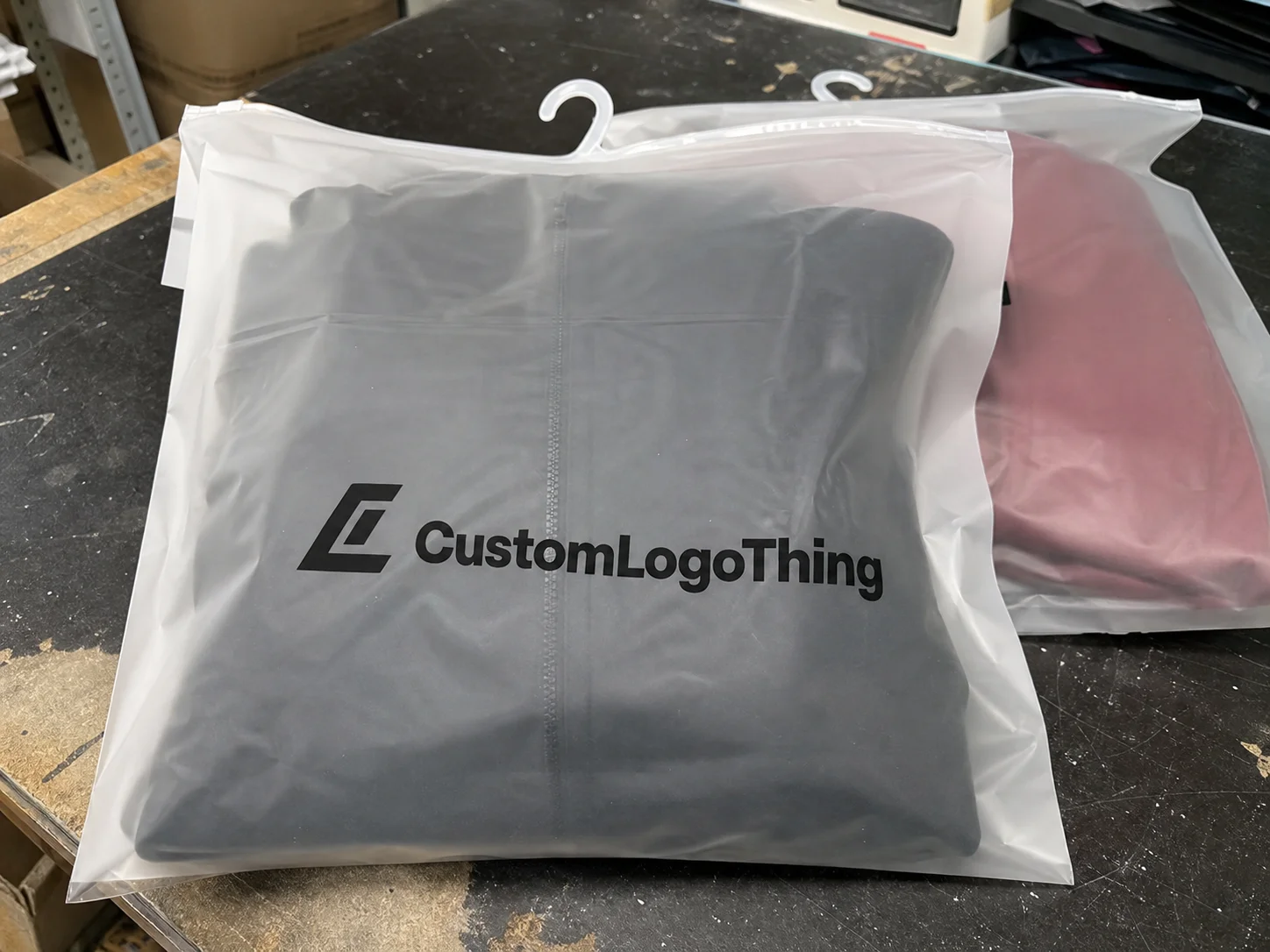
A hoodie bought after an early class does not stay pristine for long. It gets folded at a counter, carried under an arm, dropped into a gym bag, and sometimes left in a warm car until the afternoon. Buyers asking for a printed Custom Plastic Garment Bags quote for fitness are usually trying to solve more than packaging. They need protection, a cleaner hand-off, and a bag that does not create more labor than it saves.
Fitness apparel has a harder packaging profile than many teams expect. A cotton event tee is one thing. Leggings, compression tops, sports bras, joggers, and fleece hoodies introduce stretch fabrics, zippers, drawcords, elastic, coatings, and darker dye loads that can show scuffing or dust more easily. In a busy fulfillment flow, that garment may be touched by receiving staff, decorators, quality checkers, packers, retail associates, and the final customer before it is worn.
Plain poly bags can do the basic job. Printed bags do that too, but they also support size identification, order sorting, and packaging consistency. That matters for gyms, studios, race organizers, athletic departments, apparel brands tied to supplements or training programs, and online sellers shipping branded fitness wear. A clean logo on the bag is not the point by itself. The point is reducing friction in the pack-out and in the customer’s first impression.
Many brands underweight this step. They will spend heavily on the garment and then put it in a bag that tears at the flap, hides the size label, or forces staff to open and reseal it repeatedly. That kind of packaging does not fail in a dramatic way. It just adds small annoyances, and those become visible at scale.
Custom Logo Things treats a printed custom plastic garment bags quote for fitness as a specification exercise. Film, size, gauge, closure, and print setup all affect the number. That is not bureaucratic detail. It is the difference between a bag that fits the workflow and one that creates waste.
Bag Formats That Fit Fitness Apparel Workflows
Start with the garment, not with a generic bag catalog. A folded T-shirt, a pair of leggings, a sports bra, a hoodie, a jogger set, a staff uniform, or a launch bundle all behave differently once packed. A 10 x 12 inch bag may work for a thin performance tee. A heavyweight hoodie may need 14 x 18 inches or more, plus extra clearance so the fold does not fight the bag during insertion.
Flat poly garment bags are the most common option for folded shirts, tanks, leggings, and lightweight tops. They are fast to pack, easy to stack, and efficient for storage. For ecommerce orders, buyers often add an adhesive flap and a suffocation warning. For retail hand-off, a bag with a more finished presentation can feel better, especially for boutique gym merchandise or premium studio apparel.
Resealable flap bags are worth a close look. Fitness apparel often gets checked more than once: size confirmation, barcode scan, color check, bundle assembly, and final picking. If staff need to reopen the bag several times, a permanent seal can slow the line. A resealable closure usually costs more, but it can save labor and reduce damaged packaging during rework.
Gusseted bags help when the pack is bulky. Oversized hoodies, launch bundles, or sets that include socks, shaker bottles, resistance bands, or inserts may need side or bottom expansion. A gusset can be cleaner than forcing the item into a flat bag that is too small in depth and too loose in width. The result is usually better shape retention and less wrinkling.
Retail hand-off and warehouse protection rarely need the same format. Warehouse packing values speed and consistency. Retail packaging wants the bag to look deliberate. Race-day distribution prioritizes quick sorting by size and team. Influencer seeding may justify stronger branding because the bag becomes visible in photos and unboxing content. The right format depends on how the bag will be touched, stacked, shipped, and opened.
A vague request for “custom fitness bags” can create a quote that swings widely. A specific line such as “12 x 15 inch LDPE adhesive flap bag, one-color logo, 10,000 pieces, for folded gym shirts” is much easier to price correctly and much less likely to be revised three times before production.
Film, Thickness, Print, and Closure Specifications
A useful printed custom plastic garment bags quote for fitness starts with a clean spec list. Bag width. Bag length. Gusset, if needed. Film thickness. Material type. Film color. Closure. Print coverage. Ink count. Quantity. Delivery location. Leave two or three of those out and the quote becomes a placeholder instead of a buying number.
LDPE is the common choice for soft, flexible garment bags. It has a smoother feel and is forgiving when folded apparel needs to slide in without snagging. HDPE is lighter and crisper, and it can work when lower material weight matters more than a soft hand. Recycled-content or recyclable structures may be available, but the claim has to match the actual film and ink system. Plastic packaging is often described loosely, and that is where buyers get surprised later. A recycling claim should be checked against the full structure and the destination market, not assumed from the word “plastic.”
Thickness is important, but heavier is not automatically better. For single event shirts or lightweight tanks, a lighter gauge can keep the unit cost down and still protect the garment from dust and abrasion. Mid-weight film is a safer choice for leggings, sports bras, and performance tops that are handled several times. Hoodies, joggers, and bundled sets usually need heavier film because seams, drawcord tips, and folded bulk create stress points at the seal and corners.
| Use Case | Typical Bag Style | Common Thickness Direction | Practical Buying Note |
|---|---|---|---|
| Single event shirt | Flat open-top or adhesive flap | Lighter gauge | Good for fast packing and clear size sorting when handling is limited. |
| Leggings or compression tops | Flat or resealable flap | Mid-weight gauge | Allow enough clearance so stretch fabric does not fight the bag during insertion. |
| Hoodies and joggers | Larger flat bag or gusseted bag | Heavier gauge | Bulk, zippers, drawcords, and fleece thickness raise tear risk. |
| Retail hand-off | Drawstring, handle, or branded flap bag | Mid to heavier gauge | Presentation and carry strength matter more than minimum material cost. |
Print choice affects both price and appearance. One-color printing is usually the most economical and can look very sharp with bold logos, size marks, or simple brand identifiers. Two-color printing can make sense for retail packaging where contrast matters. Full-coverage or multi-color printing may fit premium drops, subscription kits, or apparel launches where the bag appears in social content. The tradeoff is artwork control. Flexible film is less forgiving than paperboard, so the design has to be built for the substrate rather than adapted from a box layout.
Closure choice also changes labor. Open-top bags are fastest for bulk packing. Adhesive flaps are common for ecommerce and stockroom control. Zip-style closures make the bag reusable and more polished, though they cost more. Drawstrings or die-cut handles fit event distribution and retail counters where the package is also the carry method.
Practical rule: over-specifying thickness can inflate cost, while under-specifying it can lead to torn bags, returns, and a poor hand-off at the exact moment the customer is judging quality.
For buyers who want standards-aware packaging, testing and transit language often comes up. Distribution packaging is sometimes discussed against protocols from organizations such as ISTA, especially when damage during shipment is a concern. For broader sustainability programs, paper-based components may also be reviewed against standards such as FSC. The relevant standard depends on the full packaging system, not the garment bag alone.
Pricing, MOQ, and Unit Cost Drivers for Custom Garment Bags
Pricing for Custom Garment Bags depends on quantity, dimensions, film thickness, print method, number of ink colors, closure style, material selection, packing method, and shipping destination. That sounds like a long list because it is. Packaging quotes are rarely a single number; they are the result of several manufacturing assumptions.
Most custom printed plastic garment bags need a production minimum because setup work has to be spread across the run. Film setup, plate or cylinder preparation, ink mixing, print registration, press time, inspections, and carton packing all happen before the first sellable bag generates value. A 5,000-piece order and a 50,000-piece order may share nearly the same setup effort. That is why larger quantities usually lower the per-unit cost even though the total invoice is higher.
As a planning range, a simple one-color LDPE garment bag for folded apparel may land around $0.08 to $0.20 per unit at higher quantities. Smaller runs, heavier film, specialty closures, or broader print coverage can push the number into the $0.18 to $0.40 range or above. Freight can change landed cost sharply, and rush timing can do the same. These are estimate ranges, not promises, because size and specification choices move the price quickly.
A buyer requesting a printed custom plastic garment bags quote for fitness can often improve pricing by reducing ink colors, choosing a standard film gauge, staying near a common size, or grouping multiple apparel sizes into one coordinated run. That does not mean every SKU should use the same bag. It means the order can be structured so setup work is not duplicated unnecessarily.
| Cost Driver | Lower-Cost Direction | Higher-Cost Direction | Buyer Risk to Watch |
|---|---|---|---|
| Print colors | One-color logo or simple size mark | Two or more colors, full-panel coverage | Fine detail may lose clarity on flexible film. |
| Film thickness | Lighter gauge for single shirts | Heavier gauge for hoodies or bundles | Too thin can tear; too thick can waste budget. |
| Bag size | Standard flat dimensions | Oversized or gusseted structures | Poor sizing slows packing and wrinkles garments. |
| Closure | Open-top or basic adhesive flap | Zip-style, drawstring, handle, specialty flap | Cheap closures can fail during repeated handling. |
| Quantity | Larger coordinated runs | Small separate runs by SKU | Unit cost rises when setup is spread over fewer bags. |
The cheapest bag is not always the least expensive choice. If it tears at the gym counter, hides size information during fulfillment, adds five seconds to every pack-out, or forces repacking before shipment, the unit price is only part of the real cost. Labor and error rates belong in the quote conversation.
For a tighter number, send Custom Logo Things the apparel type, packed dimensions, target quantity, artwork file, number of print colors, closure preference, delivery location, and deadline. If you are comparing garment bags with other Custom Packaging Products, mention that early. Coordinating branded packaging across bags, mailers, labels, and Custom Printed Boxes can reduce visual inconsistency and make reorder planning cleaner.
Process, Timeline, and Proofing Before Production
The production path is usually direct when the inputs are clean: inquiry, specification review, quote, artwork check, digital proof, approval, production, quality review, packing, and shipment. Delays tend to appear when a buyer requests pricing before the packed size is known, or when artwork built for a box or label has to be rebuilt for flexible plastic.
Artwork review is more technical than it first appears. The print team checks logo resolution, line thickness, ink color requirements, print placement, imprint area, and contrast against the bag color. Small text is a common problem. A slogan that reads well on a paper insert may fill in or break apart on film, especially if it is reversed out of a dark ink area or printed too close to a fold line.
A digital proof confirms layout, size, orientation, imprint area, and color callouts before production starts. It is not a formality. It is the buyer’s chance to catch a logo that sits too close to the flap, a size mark facing the wrong direction, or an imprint that will be hidden once the garment is folded inside.
Timeline depends on the final spec. Standard printed garment bags may move in a few weeks after proof approval. Custom material, heavy print coverage, unusual dimensions, specialty closures, high-volume orders, and long freight routes can add time. Air freight can solve a deadline problem, but it can also damage margin. Ocean freight may protect cost on larger runs, but it needs earlier approval and more stable planning.
Fitness buyers should quote packaging early for launch drops, gym openings, races, tournaments, seasonal apparel releases, and staff uniform rollouts. Apparel production usually gets attention first, and packaging becomes a late add-on. That sequence creates pressure. If garment grading changes, the folded dimensions may change too. If the launch date is fixed, there is less room to correct the bag spec later.
A complete printed custom plastic garment bags quote for fitness request reduces revisions, artwork delays, and last-minute production changes. That is the real benefit of sending enough information up front: the estimate reflects the actual job instead of a placeholder assumption.
Fitness Packaging Mistakes That Quietly Raise Costs
The first mistake is quoting from flat garment dimensions instead of packed dimensions. A shirt that measures 20 inches wide when laid flat may fold into a compact rectangle. A fleece hoodie may do the opposite. The hood, pocket, and ribbed waistband can turn what looks manageable into something bulkier than expected. Measure the garment as it will ship.
The second mistake is treating every SKU the same. A tank top, a compression legging, and a heavyweight hoodie do not need identical bag sizes or gauges. One standard bag may simplify ordering, but it can create wasted film, poor presentation, and slower packing if smaller items swim inside oversized bags.
The third mistake is using artwork from another substrate without adjusting it. Packaging designed for boxes, hang tags, and labels does not always translate to flexible film. Fine lines, gradients, tight registration, and low-contrast marks can lose clarity. Stronger shapes usually print better. Fewer colors often look more deliberate than a complex design that strains the process.
The fourth mistake is ignoring fulfillment labor. A closure that looks premium in a sample photo may slow staff during a 12,000-unit launch week. Add three seconds per bag and the math gets ugly: that is about 10 labor hours across 12,000 units before rework, sorting errors, or supervisor time are counted.
The fifth mistake is forgetting regulatory or safety language. Some orders may need suffocation warnings, recycling marks, country-of-origin coordination, barcode visibility, or retailer-specific label space. Requirements depend on the distribution method, the destination, the bag opening size, and the buyer’s channel. Not every bag needs every mark, but the decision should be made before proof approval.
There is also a false economy in chasing the lowest line item. A bag that costs $0.03 more but packs faster can be cheaper at scale than a lower-priced option that adds seconds to every unit. A clearer size mark can reduce pick errors. A stronger closure can prevent returns. A better film choice can protect dark performance fabrics from dust and abrasion during handling.
From a packaging buyer’s point of view, the right recommendation should come from the product, the pack-out method, and the deadline. That is the level Custom Logo Things should be working from, not a generic “give me the cheapest option” brief.
What to Send Now for an Accurate Fitness Apparel Bag Quote
If you want pricing that means something, gather five items before requesting a quote: garment type, packed dimensions, desired quantity, artwork file, and preferred delivery date. Those details answer the core manufacturing questions. They also help the supplier catch mismatches before they become expensive.
- Garment type: T-shirt, legging, sports bra, hoodie, jogger, uniform kit, event shirt, or bundle.
- Packed dimensions: Width and length after folding, with the garment shaped as staff will actually pack it.
- Desired quantity: Total bags needed, plus quantity by size if several bag dimensions are being quoted.
- Artwork file: Vector artwork is preferred for clean printing; include brand colors if they must be matched.
- Delivery date: Include the date the bags need to arrive, not only the apparel launch date.
Optional details can tighten the estimate further. Share closure preference, film color, number of print colors, whether the bags should include recycled content or a recyclable structure, and whether the use is ecommerce, retail, events, influencer seeding, or internal distribution. Product packaging for a Shopify order has different priorities than packaging handed to a member at a front desk.
To measure properly, fold the garment exactly as it will be packed. Measure width and length. Add enough clearance for easy insertion, usually more for thick fleece and less for thin shirts. If multiple items go into one bag, stack the full kit before measuring. Do not size the bag from the apparel spec sheet alone.
Reference photos help. If you have an existing bag you like, a competitor sample you want to improve, or a past order that packed poorly, send images with a ruler or the product beside the bag. That context can reveal issues that numbers miss, such as a flap landing over a logo or a size label being hidden by the fold.
For direct help, send the details through Contact Us and include any related packaging needs, such as mailers, labels, inserts, or Custom Printed Boxes. A printed custom plastic garment bags quote for fitness works best when the packed size, order quantity, artwork, closure choice, and deadline are all stated clearly.
FAQ
What information do I need for a custom printed fitness garment bag quote?
Send packed garment dimensions, apparel type, target quantity, logo file, print color count, closure preference, delivery location, and deadline. If size is uncertain, provide the folded garment measurement and a photo of the pack-out so the bag can be sized with proper clearance.
What is the typical MOQ for printed plastic garment bags for fitness apparel?
MOQ depends on bag size, material, print method, and customization level. Custom printed plastic garment bags usually require a production minimum because setup, proofing, and press preparation must be spread across enough units to make the run practical. Larger orders generally lower unit cost.
Can I get different bag sizes for shirts, leggings, and hoodies in one order?
Yes. Multiple sizes can often be quoted together, especially when they share the same artwork style and material. Each size may still have separate setup and production considerations, so list expected quantities by garment type and packed size.
How many print colors should a fitness brand use on plastic garment bags?
One-color printing is usually the most cost-efficient and works well for bold logos, size labels, and simple brand marks. Two or more colors can be worthwhile for premium retail presentation, launch kits, or apparel drops where package branding is part of the customer experience.
How long does production take after approving a printed garment bag proof?
Lead time varies by quantity, material, print complexity, closure type, and shipping method. Approving artwork quickly and confirming all specifications before production helps avoid timeline drift. For launch drops, gym openings, races, and seasonal apparel releases, quote early so packaging does not become the final bottleneck.


