Buyer Fit Snapshot
| Best fit | Custom Outer Cartons Branding projects where brand print, material claims, artwork control, MOQ, and repeat-order consistency need to be specified before quoting. |
|---|---|
| Quote inputs | Share finished size, material target, print colors, finish, packing count, annual reorder estimate, ship-to region, and any compliance wording. |
| Proofing check | Approve dieline scale, logo placement, barcode or warning zones, color tolerance, closure strength, and carton packing before bulk production. |
| Main risk | Vague material claims, crowded artwork, missing packing details, or unclear freight terms can make a low unit price expensive after revisions. |
Fast answer: Custom Outer Cartons Branding: Design, Cost, and Process should be specified like a repeatable production item. The safest quote records material, print method, finish, artwork proof, packing count, and reorder notes in one written spec.
Production checks before approval
Compare the actual filled-product size with the drawing, then confirm tolerance on folds, seals, hang holes, label areas, and retail display edges. Reserve space for logos, QR codes, warning copy, and material claims before decorative graphics fill the panel.
Quote comparison points
Review material grade, print process, finish, sampling route, tooling charges, carton quantity, and freight assumptions side by side. A quote is only useful when the supplier can repeat the same color, closure quality, and packing count on the next order.
Custom outer cartons branding looks simple from a distance, then starts asking for decisions the moment quoting, sampling, and freight show up. The outer carton is often the first physical touchpoint for a buyer, a warehouse lead, or a retail partner, so custom outer cartons branding has to do more than carry a logo. It needs to protect the product, stay readable after real handling starts scuffing the edges, and still make the brand feel deliberate.
I have stood on packing floors where a carton looked polished on screen and then immediately revealed its weak spot at the fold line, the glue seam, or the barcode panel. That is usually the moment the work gets real. A box is never just a box once it has to survive a pallet move, a courier drop, and a hurried receiving crew. Custom outer cartons branding sits right in that pressure point, where design, print method, board selection, and logistics all collide.
"If the outer carton looks generic, the brand starts at a disadvantage before the product is even opened."
A clean, well-made carton can make a modest product feel more deliberate and trustworthy, while a plain carton can pull a premium item down a notch before anyone has read the label. That reaction is not marketing poetry. Buyers make fast judgments, and they usually do it with their eyes before they do it with specs. The job of custom outer cartons branding is to earn that first glance, then keep earning trust once the carton is stacked, labeled, and shipped across a few more hands.
What custom outer cartons branding actually does
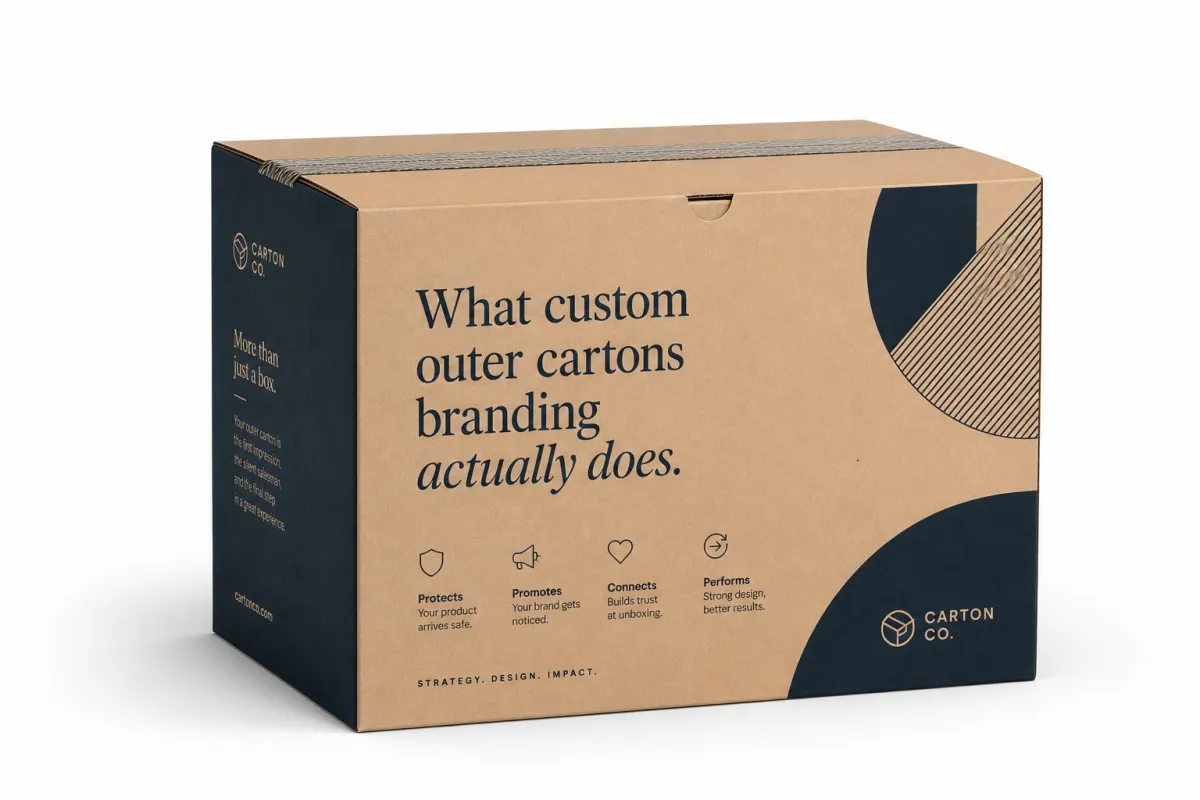
Custom outer cartons branding does three jobs at the same time. It protects the product, it keeps the supply chain organized, and it tells people what they are holding and who made it. If one of those jobs fails, the carton stops being an asset and starts acting like a problem. That is why custom outer cartons branding should never be treated as a decorative pass at the end of the project.
From the packaging buyer’s side, the outer carton is often a wholesale handshake. It may never sit on a shelf in front of shoppers, yet it still shapes how distributors, warehouse crews, retail buyers, and fulfillment staff read the brand. A branded outer carton gives the product a sense of order from the receiving dock all the way to the back room.
There is a useful distinction here. A plain shipping box protects. A branded carton protects and communicates. That communication might be as modest as a one-color logo, a SKU panel, and handling marks, or as developed as full-surface graphics with interior print and a color-coded system for different product lines. Either way, custom outer cartons branding lets the carton do more than absorb weight.
The outer carton still matters when the end customer never sees a polished retail opening. Wholesale presentation counts. E-commerce teams notice it. Retail packaging teams notice it. Warehouse staff notice it too, because clear identification saves time and cuts mistakes. A carton that can be recognized at a glance is doing real work, not vanity work.
Years ago, I watched a fulfillment team sort two nearly identical cartons, and the only difference was a clearer side panel and a bigger SKU block. The one with the better panel moved faster through the line every single time. That kind of detail sounds small until it saves time on every pallet, every week.
Strong custom outer cartons branding also helps a product family stay consistent. If the line includes multiple sizes, shades, or formulas, the carton can carry repeatable rules for colors, icons, and placement. That kind of system becomes the backbone of brand identity in product packaging, and it matters more than most teams admit when they are trying to scale.
For brands comparing outer cartons with other packaging formats, the full system matters more than any single piece. A carton may work with Custom Labels & Tags for lot control, or it may sit inside a broader rollout of Custom Packaging Products that covers retail and shipping formats together. If you want to see how those pieces come together in different projects, the Case Studies page gives a clearer picture than a spec sheet ever will.
Custom outer cartons branding is not just a logo application. It is a packaging decision, a logistics decision, and a perception decision rolled into one. Miss any one of those, and the carton starts working against you.
How custom outer cartons branding works from dieline to delivery
The workflow begins with a brief, not artwork. Good custom outer cartons branding starts by answering plain questions: What does the product weigh? How will the carton move through the chain? Does it need to survive pallet stacking, parcel transit, or rough backroom handling? Those answers shape the structure long before anyone opens a design file.
Carton style comes next. A regular slotted carton, a mailer-style box, a tray-and-sleeve, a foldable shipper, or a more rigid structure may all make sense depending on load and presentation needs. Custom outer cartons branding changes with the format because each structure offers different printable surfaces, folds, and seam positions.
The dieline is the map. If the map is wrong, the whole project gets messy fast. It shows dimensions, flaps, glue areas, folding lines, and bleed zones, which means it controls where custom outer cartons branding can sit and how the artwork wraps around corners. A logo that feels centered on a screen can land squarely on a seam in production. That is how avoidable mistakes become expensive.
Branding can live in several places on the carton:
- Outside panels for logos, product names, and category colors
- Flaps for handling marks, compliance text, or internal sorting notes
- Interior surfaces for a reveal moment or product instructions
- Side panels for SKU codes, barcodes, lot numbers, and shipping data
- Top panels for receiving labels or retail routing information
That mix matters because custom outer cartons branding has to serve appearance and function at the same time. A carton that looks great in a mockup but leaves no room for a barcode is unfinished. It is cosmetically polished and operationally awkward.
Proofing usually happens in layers. Digital mockups confirm layout, text placement, and color logic. Physical samples confirm structure, board thickness, fold performance, and print behavior. A final pre-production approval locks the job before the mass run starts. If a supplier skips any of those steps, the reason deserves a careful question, because the answer usually affects cost and quality.
Good custom outer cartons branding should also be tested against the abuse it will actually see. Folding, stacking, scuffing, vibration, and rough handling are not rare exceptions. They are the job. For shipping and transit performance, many brands reference ISTA test methods, and for broader packaging material and sustainability questions, Packaging Corporation of America and similar industry resources are helpful reference points. Standards may not be glamorous, but they prevent a lot of waste.
One more practical point: an approved artwork file is not the same thing as a production-ready carton. The printer, die cutter, folder-gluer, and pack line all need to agree on the same reality. Custom outer cartons branding works best when design, operations, and purchasing stay aligned, instead of hoping a nice file and a hopeful email can carry the whole job.
Key factors that shape custom outer cartons branding
Material choice is usually the first real quality and cost decision. Corrugated board handles shipping and stacked loads well, which is why it remains the workhorse for outer cartons. Rigid board brings a more elevated feel, though it is usually too expensive or too heavy for high-volume transit. Paperboard sleeves work for lighter goods and presentation-led cartons. Custom outer cartons branding changes noticeably depending on whether the surface is kraft, white-lined, coated, or uncoated.
White-lined corrugated board usually gives sharper graphics and cleaner color reproduction than brown kraft. Kraft has its own appeal; it can feel natural, sturdy, and honest. It also mutes color and adds a rustic tone that does not suit every brand. That is a tradeoff, not a statement of quality. The right choice depends on the category, the shipping environment, and the kind of visual signal the brand wants to send.
Color and typography need to be designed for distance, not just close inspection. A carton sitting on a warehouse rack needs contrast, readable type, and a clear hierarchy. If custom outer cartons branding relies on tiny text or thin lines, the result may look elegant on a screen and useless in a backroom. Warehouses are not art galleries, and cartons need to earn their place in a working space.
Finishes matter, though they can push budgets around fast. Aqueous coating adds basic protection and a smoother surface. Matte lamination gives a quieter, more controlled look. Gloss brings brightness and surface shine. Soft-touch feels premium, though it usually makes more sense on presentation cartons than on rough transit shippers. Spot UV and foil can add visual weight, but they also add cost and may do little for a carton that spends most of its life on pallets.
Board grade is where a lot of teams get tripped up. A print spec can look great, but if the flute profile or liner weight is wrong, the box will dent, buckle, or bow under load. That is not a design issue in the narrow sense; it is a carton engineering issue. Custom outer cartons branding has to live inside that engineering reality whether the mood board likes it or not.
| Option | Typical Use | Approx. Unit Cost Impact | Best For |
|---|---|---|---|
| Single-color corrugated print | Shipping cartons, warehouse cartons | Low, often the most efficient route at 5,000+ units | Simple custom outer cartons branding with strong legibility |
| Two- to three-color print | Branded outer cartons, retail support cartons | Moderate, usually tied to setup and ink coverage | Brand identity without heavy finishing costs |
| Full-color printed corrugated | E-commerce cartons, marketing-forward shipments | Higher, especially with white-top board and dense coverage | Custom printed boxes that need stronger shelf or unboxing appeal |
| Special finish add-ons | Premium launches, display cartons | Highest, often adds noticeable setup and unit cost | Selective projects where tactile feel matters |
Structural format matters just as much as graphics. A tuck-top carton gives a different branding field than a mailer. A tray-and-sleeve brings a more theatrical presentation, but closure and sealing are not as simple. A foldable shipper can save freight and storage, which helps when cartons arrive flat and get packed on demand. Custom outer cartons branding should follow the structure, not fight it.
Operational detail is where many projects get sorted out. Product weight determines board grade. Stack load determines flute choice and wall thickness. Shipping method determines how much abrasion the print must survive. E-commerce brings parcel-drop risk. Wholesale brings pallet pressure. Retail packaging brings consistency demands. If one carton has to serve all three, the spec usually gets more expensive, not less.
For sustainability, the cleanest answer is often the simplest one: right-size the carton, avoid unnecessary laminations, and specify recyclable materials where possible. If you need a reference point for recycled content, compostability, or fiber sourcing, the FSC standards are a useful benchmark. Certification still does not replace a carton that actually protects the product.
The strongest custom outer cartons branding decisions are rarely dramatic. They are disciplined. A clear logo, readable copy, the right board, and a finish that fits the handling environment usually beat a flashy box that is trying too hard. That can feel a little less exciting during the design review, but it usually ages better in the field.
Custom outer cartons branding process and timeline: from brief to approval
The process starts with discovery. You share product dimensions, weight, shipping method, target quantity, print coverage, finish preferences, and deadline. If you already know whether the carton needs to hold a single unit, a multipack, or a master case, say that early. Custom outer cartons branding moves faster when the use case is clear and slows down when everyone is guessing.
After discovery, the structure gets confirmed. Standard cartons move quickly. Custom sizes, inserts, and unusual locking tabs take longer. Once the carton format is selected, the dieline is issued or checked against the product size. That is the moment custom outer cartons branding stops being theoretical and starts turning into something the production team can actually build.
Artwork setup follows. This is usually the stage where design teams remember, sometimes the hard way, that folds are not optional. Panel breaks, glue flaps, and seams all affect the finished look. If the project includes multiple SKUs or versioned colorways, the artwork system should be defined now. Otherwise every reorder turns into a fresh cleanup exercise.
Sampling comes next. A plain structural sample confirms fit and closure. A printed sample confirms artwork placement and color. For more sensitive programs, a pre-production sample is worth the extra time because it catches issues digital proofs often miss, like barcode size, registration drift, or a logo placed too close to a fold.
A practical planning rule helps here: a standard printed carton can often move from brief to approval in roughly 10 to 15 business days if the artwork is ready and the structure is simple. Add another week or two if you need new tooling, special finishes, or several sample rounds. Custom outer cartons branding with foil, soft-touch, or complex inserts can take longer, and pretending otherwise only creates pressure later.
Time usually disappears in the same places:
- Missing vector artwork or low-resolution logos
- Unclear barcode specs or incorrect code placement
- Late copy changes from legal, sales, or operations
- Color approvals that drag across too many people
- Sample feedback that arrives in fragments instead of one clean round
That is why custom outer cartons branding benefits from one person owning the approval path, or at least one person who can consolidate the feedback. More voices do not always improve the result. Sometimes they turn a packaging job into a committee sport that never ends well.
Build a buffer into the schedule. One revision round is normal. Two is common. Three starts eating into launch dates. If the cartons have to arrive for a trade show, product drop, or holiday shipment, work backward and lock specs early. A delayed carton can stall the entire product packaging timeline, which is a very expensive way to learn that lead time is real.
It also helps to keep one practical rule in mind: if the supplier cannot explain the production path in plain language, stop and ask more questions. A clean timeline is not fancy, but it is dependable. And dependable matters a lot more than glossy promises when the pallets are already booked.
Custom outer cartons branding cost, pricing, and MOQ drivers
Pricing for custom outer cartons branding comes down to five main variables: carton size, board grade, print coverage, finishing, and quantity. Add structure complexity and the quote can shift faster than people expect. A simple one-color shipper can be economical. A full-color carton with coating, inserts, and custom die tooling will not behave like a budget mailer, no matter how carefully anyone phrases the estimate.
MOQ matters because setup costs do not shrink just because the order is small. Plates, tooling, press setup, sample labor, and waste all need to be covered. With a small run, those fixed costs get spread across fewer cartons, which raises the unit price quickly. The arithmetic is not dramatic, but it is the arithmetic that exists.
For a typical run, a basic single-color corrugated carton at 5,000 units might land around $0.18 to $0.35 per unit depending on size and board. Add more coverage, and the number can move toward $0.40 to $0.70. Premium finishes or more complex structures can go much higher. Those are not promises. They are practical ranges that help with planning, which is what buyers actually need.
Unit cost should never be the only number on the page. A low unit price can hide expensive freight, storage, and reorders. A slightly higher unit price with better stack performance may save money on damaged goods, rework, and customer complaints. Custom outer cartons branding should be judged on landed cost and operational performance, not just the factory quote.
Here is the part teams sometimes skip: the carton that looks cheaper on paper can cost more once it is handled ten thousand times. If the board is too light, you pay for damage. If the print is too busy, you pay in reading errors. If the carton arrives in awkward pack counts, you pay in labor. The quote is only the starting line.
| Order Size | Typical Setup Pressure | Unit Cost Trend | Practical Comment |
|---|---|---|---|
| 500-1,000 units | High | Highest | Small runs carry setup overhead hard; simplify specs if possible |
| 2,000-5,000 units | Moderate | Starts improving | A common range for first-time custom outer cartons branding |
| 10,000+ units | Lower per unit | Better economies | Good for stable SKUs and repeat production |
| Split batches | Mixed | Depends on storage and reprint needs | Useful if you want to reduce inventory risk |
Freight and storage deserve attention too. A carton that ships flat saves space, but a job that needs palletized storage may add carrying cost. If your supplier is quoting multiple production locations or split shipments, compare the delivered price, not just the ex-factory number. That is where some projects quietly become more expensive than the spreadsheet suggested.
If budget control matters, there are a few sensible places to save. Reduce print coverage. Drop from full-color to one or two spot colors. Use standard carton dimensions where possible. Skip premium finishes on cartons that spend most of their life in shipping lanes. Those choices protect the budget without turning custom outer cartons branding into a thin compromise.
Ask for tiered quotes. Serious buyers should request pricing at 1,000, 3,000, 5,000, and 10,000 units if the project volume might change. That makes breakpoints visible. Sometimes the cost drop at one threshold is large enough that ordering a little more is the cheaper move. Packaging math can be blunt like that.
If you are comparing quotes, make sure every supplier is pricing the same artwork coverage, the same board spec, and the same delivery point. Otherwise the numbers are a little misleading, even when they look clean on the page. Honest comparisons save a lot of back-and-forth later.
Common mistakes in custom outer cartons branding
The first mistake is designing for a flat screen instead of a folded carton. It sounds obvious until a logo gets split by a seam or a key message runs straight into a tuck flap. Custom outer cartons branding needs a dieline-aware layout, not a presentation slide with a few box outlines dropped on top.
The second mistake is choosing finish before function. A carton can have matte lamination, soft-touch coating, or foil accents and still perform badly if the board is too light or the structure is weak. If it crushes in transit, nobody cares how refined the surface feels. It arrived broken, and that ends the argument quickly.
Unreadable copy causes trouble just as often. Small text, low contrast, and crowded panels look tidy in mockups and muddy in production. Barcodes need the correct quiet zone. SKU details need legibility. If the carton is used in a warehouse or retail backroom, clear information matters more than decorative density. Custom outer cartons branding should help people move faster, not make them slow down to decode the box.
Overdoing effects is another common habit. Heavy gloss, too much foil, or excessive coverage can make a carton look expensive while adding very little operational value. If the box is mostly handled by logistics teams, durable print and easy identification usually win. Package branding should support the route the carton actually takes, not the route the render implied.
The last major mistake is approving a sample without testing the real workflow. A carton can look polished on a desk and fail on the packing line. If the team loads product at speed, test the exact sequence: fill, close, tape, label, stack, and move. That is where custom outer cartons branding either holds up or falls apart. There is no elegant workaround for a bad production reality.
One more caution: sustainability claims should not be treated as decoration. If you are making recycled-content or recyclable claims, make sure the board specification and finish actually support them. Packaging teams are better at spotting vague green language than they used to be, and regulators are not especially forgiving about sloppy claims. If the carton is meant to communicate responsibility, the materials need to back that up.
Another issue I see is inconsistency across reorders. A line may start with a crisp prototype, then drift over time because no one preserved the approved file set, the exact board grade, or the finishing notes. Keep the approved spec in one place. That simple habit prevents a lot of annoying surprises.
Expert tips and next steps for custom outer cartons branding
Start with end use, not mood. Decide whether the carton is mainly for shipping, retail presentation, or warehouse handling. Then choose the structure and print method that fit that job. Custom outer cartons branding performs best when the carton is built around the route it actually takes, not around the fantasy route someone sketched during a branding meeting.
Keep the system simple enough to repeat. Use a consistent logo lockup, a repeatable color family, and predictable panel hierarchy across sizes. That strengthens brand identity and reduces mistakes on reorder. The best branded packaging often feels calm because the rules behind it are clear.
Ask for a sample that proves three things at once: structure, print, and handling performance. A pretty visual proof is useful for layout review, but it is not enough by itself. You want to know whether the carton folds correctly, closes cleanly, and survives the stress it will actually see. That difference separates paper confidence from operational confidence.
A practical quote request should include:
- Carton dimensions and product weight
- Board preference or required strength target
- Print coverage, colors, and finishing
- Expected quantity tiers
- Barcode, compliance, or handling text requirements
- Deadline and delivery location
That checklist saves time and cuts down on back-and-forth. It also makes custom outer cartons branding easier to compare across suppliers because everyone is quoting the same job instead of three different interpretations of one vague email.
My advice is simple. Review the cartons you already use. Mark the weak spots: poor graphics, weak corners, bad sizing, slow packing, or unclear labeling. Then request two or three routes, not one. Compare cost, lead time, and durability side by side. That is a far better decision process than falling in love with the first fancy sample that lands on your desk.
Done well, custom outer cartons branding pays off in fewer damages, better presentation, faster handling, and a stronger sense of quality. That is the real return. Not the sticker shock. Not the mockup. The carton working in the field exactly the way it should.
Before you approve a run, check the board, the dieline, the barcode placement, and the handling path one more time. That one pass usually tells you whether the carton is ready or whether it is still only a pretty drawing. If you get those fundamentals right, the rest tends to behave.
Custom outer cartons branding can look beautiful, and beauty that survives stacking, shipping, and receiving is the kind that earns its keep.
FAQ
What is custom outer cartons branding used for?
It makes shipping or secondary packaging feel intentional instead of generic, which improves brand recognition and perceived value. It also supports logistics with labels, handling marks, and SKU information while still carrying brand visuals.
How much does custom outer cartons branding usually cost?
Cost depends on size, material, print coverage, finish, and quantity, with setup fees hitting smaller runs harder. Ask for multiple quantity quotes so you can see how the unit cost changes as the run gets larger.
What is the typical MOQ for custom outer cartons branding?
MOQ varies by factory and print method, but custom cartons usually require enough volume to cover setup and material waste. If your order is small, expect a higher per-unit price or ask about simplified print specs to lower the threshold.
How long does the custom outer cartons branding process take?
Timeline depends on sample needs, artwork readiness, and production load, but the longest delays usually come from approvals and revisions. Build extra lead time if you need a new structure, special finish, or exact color matching.
What should I send to get an accurate custom outer cartons branding quote?
Send carton dimensions, product weight, board preference, print details, finish preferences, quantity, and target delivery date. If you already have artwork, include editable files and note any barcodes, compliance text, or special handling requirements.

