Buyer Fit Snapshot
| Best fit | Custom Packaging Factory Lead Time projects where brand print, material claims, artwork control, MOQ, and repeat-order consistency need to be specified before quoting. |
|---|---|
| Quote inputs | Share finished size, material target, print colors, finish, packing count, annual reorder estimate, ship-to region, and any compliance wording. |
| Proofing check | Approve dieline scale, logo placement, barcode or warning zones, color tolerance, closure strength, and carton packing before bulk production. |
| Main risk | Vague material claims, crowded artwork, missing packing details, or unclear freight terms can make a low unit price expensive after revisions. |
Fast answer: Custom Packaging Factory Lead Time: What Really Delays It should be specified like a repeatable production item. The safest quote records material, print method, finish, artwork proof, packing count, and reorder notes in one written spec.
Production checks before approval
Compare the actual filled-product size with the drawing, then confirm tolerance on folds, seals, hang holes, label areas, and retail display edges. Reserve space for logos, QR codes, warning copy, and material claims before decorative graphics fill the panel.
Quote comparison points
Review material grade, print process, finish, sampling route, tooling charges, carton quantity, and freight assumptions side by side. A quote is only useful when the supplier can repeat the same color, closure quality, and packing count on the next order.
Product launches have a bad habit of looking finished right up until the box enters the room. The SKU is locked, the sales team is smiling, retail wants a ship date, and then custom packaging factory lead time becomes the number that decides whether the launch stays organized or turns into a fire drill. Packaging loves to do that. Quietly. Rudely.
From a buyer’s point of view, custom packaging factory lead time is the total time from an approved brief to finished cartons leaving the plant. Not just press time. Not just artwork time. The whole chain. That matters because branding, operations, procurement, and logistics are all staring at the same calendar. Read the number wrong, and you miss a retail window, delay a content shoot, or pay for rush freight that wipes out the savings from ordering a nicer box.
I’ve sat through enough packaging reviews to know the same mistake keeps showing up: people treat the lead time printed on the quote like gospel without checking what it actually includes. Some quotes cover production only. Some include proofing and sampling. Some quietly leave transit out. If you are comparing custom printed boxes, branded packaging, or retail packaging options, schedule matters as much as unit price. Sometimes more.
There is also a trust issue here. A supplier can be honest and still give you a number that is only true under clean conditions. That is not fraud. That is how factories quote. The problem is usually the buyer’s side of the table assuming the clean-condition number is the whole story. It rarely is.
Custom Packaging Factory Lead Time: What It Really Means
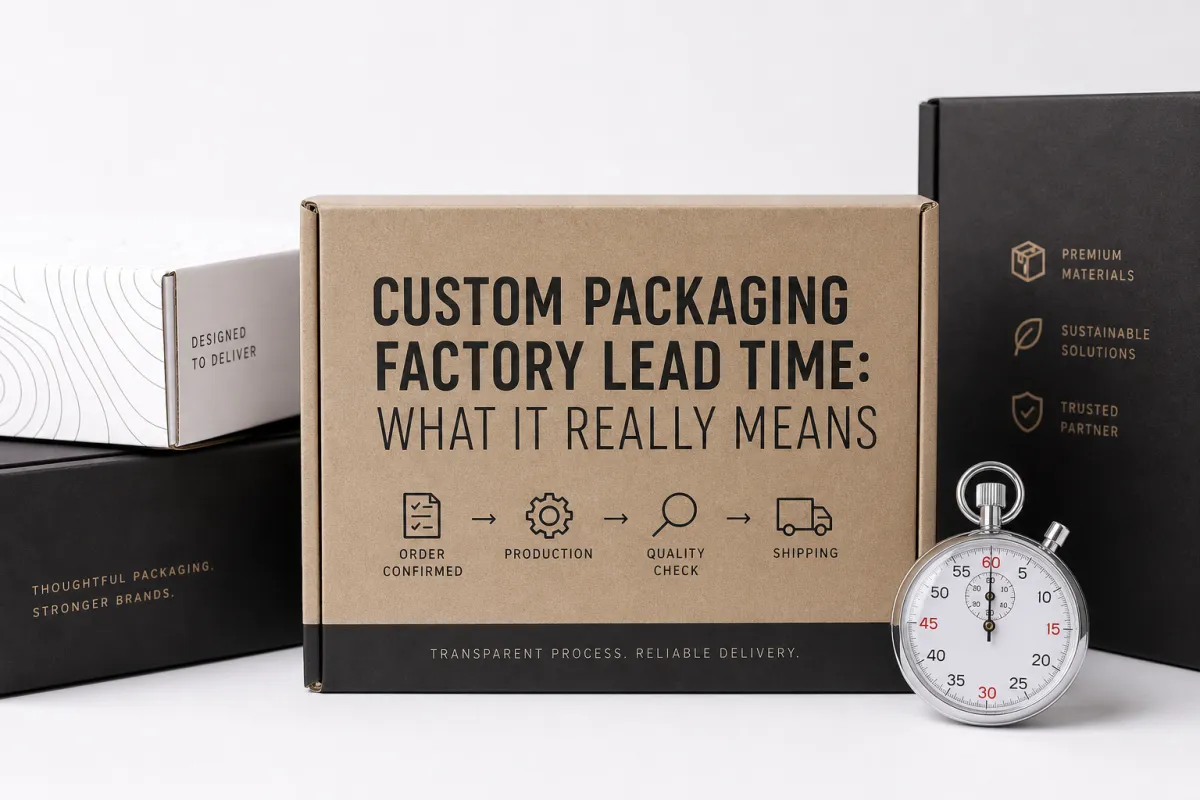
Custom packaging factory lead time gets misunderstood because people use it like it means one simple thing. Usually, it means the full factory-side timeline from a complete, approved order package to shipment readiness. That can include dieline confirmation, artwork setup, digital proofing, physical sampling if needed, material allocation, tooling, cutting, finishing, quality inspection, packing, and handoff to a carrier. If packaging is part of a launch, that full view is the one that actually helps.
Here is the clean distinction that saves trouble. Quoted lead time is the number the supplier expects under normal conditions. Production time is the time the plant spends making the order. Transit time is the carrier’s part after the cartons leave the dock. Those three numbers get mashed together all the time, and that is where surprises begin. A factory may promise a 12-business-day production window, but if you need ocean freight or a cross-border truck route, your real calendar is much longer. That part is on you to model properly.
That matters because packaging touches several teams at once. Creative wants room to play. Sales wants a firm date. Operations wants certainty. Finance wants predictable cash flow. A realistic custom packaging factory lead time keeps those groups aligned instead of forcing ugly last-minute trade-offs. A short lead time looks great until you realize it came from skipping sampling, trimming finish options, or pushing freight risk into launch week. That kind of shortcut usually comes back with interest.
If the packaging carries the brand story, the lead time also changes design choices. A team that knows the custom packaging factory lead time early can decide whether foil stamping, embossing, soft-touch lamination, or a standard matte varnish actually fits the schedule. If the window is tight, you can keep the core package branding and cut the decorative extras. That is not a downgrade. It is a sane decision.
Practical note: The best packaging projects match design ambition to the schedule instead of pretending the clock does not exist. That is how custom packaging factory lead time stays under control.
For buyers comparing Custom Packaging Products, the first question should not be “What is the cheapest quote?” It should be “What exactly does this custom packaging factory lead time include?” That one question usually exposes whether the quote is truly comparable or just looks cheaper on the surface.
And yes, sometimes the answer is messy. A factory may have a beautiful quoted timeline on paper and still warn you that one specialty finish could add a week if the line gets backed up. That is not a red flag by itself. That is real manufacturing.
How Custom Packaging Factory Lead Time Actually Works
The factory sequence is usually more orderly than people expect, but every step has its own delay point. A clean custom packaging factory lead time often starts with inquiry and quotation, then moves through dieline confirmation, artwork setup, digital proofing, physical sampling if needed, production, finishing, inspection, and shipment booking. Each stage has a decision gate. If one gate stalls, the whole chain waits.
The first bottleneck is usually not the machine. It is the brief. Missing dimensions, vague substrate choices, or a loose finish request can force the factory to stop and ask questions. If the structural template does not match the artwork, the proof comes back marked up. That means another review. Another day. Sometimes two. In a busy season, that delay can hurt more than any single manufacturing step.
Good factories compress the calendar by running tasks in parallel. While the artwork team finalizes the proof, procurement may reserve board stock, check coating availability, or prepare tooling. That matters because a custom packaging factory lead time is rarely a straight line. It is a stack of overlapping steps. The better the brief, the more overlap the plant can safely build.
Think of the timeline in three layers:
- Pre-production: brief, quote, dieline, artwork, proofing, and sampling.
- Production: printing, die-cutting, converting, gluing, finishing, and inspection.
- Post-production: packing, palletizing, dispatch, and transit booking.
Only the middle layer feels like manufacturing, but the other two layers are what make or break custom packaging factory lead time. A standard folding carton with a familiar structure can move quickly because the plant already knows the setup. A rigid box with specialty lining, magnetic closure, and foil detail needs more coordination before the first sheet gets cut.
That is also why sampling matters. A sample is not just a smaller version of the final product. It is a decision tool. If the sample confirms the board thickness, print density, fold integrity, and insert fit, production can move without hesitation. If it exposes a mismatch, the schedule may need rework. That is not failure. That is the system catching the problem before expensive stock gets burned. Still, it affects custom packaging factory lead time, and buyers should plan for it.
For packaging buyers, the cleanest timeline is the one with fewer open questions. The more you settle before the factory starts, the more predictable the custom packaging factory lead time becomes. Simple idea. Harder than it sounds.
What Changes Custom Packaging Factory Lead Time and Pricing
Lead time and price move together more often than buyers expect, but not always in the same way. A complex design can add days before it adds dollars. Tooling can add dollars before it adds scale. A rush order can add both. That is why custom packaging factory lead time should always sit next to the quote, not off to the side like an afterthought.
Structure is the biggest driver. A simple mailer box or standard folding carton usually has a shorter custom packaging factory lead time than a multi-panel display box, shoulder box, or insert-heavy kit. Why? Because a familiar structure lowers setup risk. The dieline is known. The folding sequence is known. The plant does not need to test whether the box locks, stacks, or closes properly.
Print method matters too. Offset, digital, flexographic, and screen processes all behave differently. Digital can move faster on small runs because it skips plates, but special ink coverage and finishing can still slow things down. Offset can be cost-efficient at scale, yet plate setup and color matching may extend the schedule. So custom packaging factory lead time is not some fixed number that applies to every print method. It shifts with the production method.
Finishing has the same effect. Foil stamping, embossing, debossing, spot UV, soft-touch lamination, and specialty varnishes can all improve the shelf appeal of custom printed boxes, but they add setup steps. Some finishes need separate tools. Some need extra drying or curing time. In many cases, the delay shows up in the factory calendar before it shows up in the quote total.
Material availability matters too. If the exact board grade is in stock, the schedule can stay tight. If the factory has to source a specific SBS, kraft, or corrugated spec, the timeline stretches. A sheet shortage looks small on a spreadsheet. It is not small in real life. It can move the whole custom packaging factory lead time, especially if your order is not large enough to get priority from suppliers.
Order quantity changes the picture in two directions. A smaller run may reduce machine time, but it does not remove proofing, setup, or procurement. A larger run may improve unit economics while extending press time and drying time. In other words, quantity affects cost and lead time in different ways. Many buyers assume a small order is always faster. Not always. Sometimes smaller just means fewer boxes, not fewer steps.
| Packaging option | Typical structure | Lead time pressure points | Price tendency |
|---|---|---|---|
| Standard folding carton | Single-wall paperboard, tuck end | Low if the dieline is approved and artwork is clean | Usually lower |
| Mailer box | Corrugated, self-locking or tab closure | Moderate if print coverage or inserts are added | Mid-range |
| Rigid setup box | Chipboard wrapped with printed paper | Higher due to hand assembly and finishing | Usually higher |
| Multi-part custom kit | Box plus inserts, trays, sleeves, or dividers | Highest because multiple components must align | Highest |
That table hides a lesson buyers learn the hard way: the cheapest option is not always the fastest, and the fastest option is not always the cheapest. A factory may quote a lower unit price for a complex build if the order volume is large, but the custom packaging factory lead time can still run longer because the structure needs more labor, more inspection, or more finishing passes.
Pricing inputs deserve their own scrutiny. Plate costs, die-cut tooling, sampling charges, labor, freight, and rush fees all change the picture. A quote that looks expensive may actually be more complete. A quote that looks cheap may leave out sampling or delivery. If you are buying branded packaging for a launch, the real comparison is not just dollar per unit. It is dollar per unit at the right custom packaging factory lead time.
For buyers who care about standards, it helps to ask whether the packaging will be tested against shipping conditions such as ISTA protocols or modeled against real transit stress. The ISTA framework matters because a box that looks good but fails in transit is an expensive mistake. The same goes for material sourcing. If responsible fiber matters to your brand, FSC certification may matter too. Those choices can influence the quote, and they also affect the true custom packaging factory lead time because approved materials are easier to schedule than last-minute substitutions.
Step-by-Step: Planning a Faster Custom Packaging Project
If speed matters, the first job is not to ask the factory to move faster. It is to give the factory less ambiguity. A faster custom packaging factory lead time starts with a strong brief. Include dimensions, substrate, quantity, print colors, coating preference, insert needs, pack format, destination, and launch date. The more complete the brief, the fewer clarification loops you create.
Step one is to lock the dieline early. Design teams sometimes want the structure adjusted after the visuals look good. Fair enough. It still pushes the schedule backward. If the dieline is final before artwork begins, the design can be built around real folds, glue areas, and safety margins. That means fewer proof corrections and a cleaner custom packaging factory lead time.
Step two is to set one approval owner. Not a committee. Not a rotating “final eyes” group. One decision maker. Every extra approval layer adds lag, and lag is often the hidden cost inside custom packaging factory lead time. If the factory sends a proof at 10:00 a.m. and no one replies for two days because legal is still looking at it, the production schedule slips even if the plant is ready.
Step three is to work backward from launch. If the product must be in market on a certain date, subtract freight, customs if relevant, buffer time, production time, proofing time, and sample review. Then set internal deadlines earlier than the real one. That sounds conservative. It is. Conservative scheduling is what keeps retail packaging projects from becoming emergency projects.
Here is a practical order of operations:
- Confirm product dimensions and packaging purpose.
- Choose the structure and material family.
- Request a dieline and build artwork to spec.
- Review the proof within one business day if possible.
- Approve samples only after checking fit, color, and finish under real lighting.
- Book freight before production ends, not after.
This sequence matters because a custom packaging factory lead time is easier to manage when the factory has a clear path from design to shipment. Change the structure after artwork is approved, and the process can jump backward. Change the finish after sampling, and you may need another proof or another sample. Delay freight booking, and cartons can sit in a warehouse while the launch clock keeps ticking.
For fast-moving teams, a simple rule helps: approve what can be approved early. Board type, print coverage, box style, insert layout, and shipping method are much easier to settle in advance than in the final week. That keeps custom packaging factory lead time realistic and usually cuts the chance of expensive rework.
And yes, the brand still matters. A faster project does not have to look plain. Strong packaging design can come from a proven structure, a disciplined color system, and one or two smart finishes instead of five. That is how many brands protect both timing and shelf presence.
One detail I see people miss: internal packaging signoff often takes longer than factory production on straightforward jobs. That sounds backwards until you watch it happen. Ten people comment on a proof. Three ask for copy changes. One wants to move a logo. Nobody wants to be the last reply. The factory waits while everyone tries to feel safe.
Common Mistakes That Stretch Custom Packaging Factory Lead Time
The biggest mistake is assuming the factory quote includes every handoff from design review to doorstep delivery. It often does not. Some quotes cover production only. Others exclude sampling, inserts, tooling, or international freight. When the quote and the real schedule are not aligned, custom packaging factory lead time turns into friction instead of a planning tool.
Artwork problems are another frequent delay. Missing fonts. Low-resolution images. A dieline exported the wrong way. Text too close to a fold. A barcode sitting where a seam will land. These issues can force another proof cycle, and each cycle adds time. The annoying part is that most of this is avoidable with a print-ready file check before submission. The factory can help, but it should not be expected to fix every packaging design problem after the clock has started.
Late structural changes are especially expensive. If a buyer decides to add foil, embossing, or a custom insert after the proof is approved, the plant may need to revisit tooling, scheduling, or material sourcing. That can push custom packaging factory lead time out by days or even weeks, depending on the complexity. The same goes for switching from a simple dust flap to a magnetized closure or from a plain sleeve to a full wrap with spot UV and foil accents.
Another mistake is overlooking transit and customs. This one shows up all the time in overseas production. The cartons may leave the factory on schedule, but the total timeline still slips because the shipping lane was not booked early, paperwork was incomplete, or customs review added time. If your supply chain crosses borders, custom packaging factory lead time has to include the delivery leg, not just manufacturing.
Buyers also underestimate seasonality. Plants get busy during promotional peaks, retailer reset windows, and holiday build periods. A quote given during a quiet week may not reflect the lead time available during peak load. That is not a flaw in the factory. It is capacity reality. If you are ordering custom printed boxes or other branded packaging during a busy period, ask whether the schedule is based on current capacity or average capacity.
Finally, many teams forget that small revisions can multiply. A tiny color tweak may look harmless in the design file, but if the proof, sample, and print setup all need updates, the delay compounds. One revision is minor. Three revisions can reshape the whole custom packaging factory lead time. It kinda sneaks up on you if nobody owns the timeline.
Packaging buyers who avoid these traps usually share one habit: they treat every quote as a schedule document, not just a price document. That mindset improves decisions on product packaging, especially when multiple suppliers are fighting for the same launch window.
Expert Tips to Reduce Custom Packaging Factory Lead Time
If the goal is speed without trashing the brand, start with proven structures. A standard tuck-end carton, mailer box, or well-known rigid format usually moves faster than a highly customized build. You still get room for strong package branding, but the factory does not need to spend time validating an unusual construction. That is often the simplest way to reduce custom packaging factory lead time.
Use familiar materials when possible. If a supplier already stocks the board grade you want, the schedule gets easier. That is true for kraft, SBS, coated artboard, and corrugated board. The same logic applies to finishes. A clean matte or gloss varnish is usually easier to schedule than a stack of effects that includes foil, embossing, soft-touch lamination, and spot UV. Every extra finish can lengthen custom packaging factory lead time, especially if the factory has to coordinate separate stations.
Batch related SKUs together if the structure allows it. That can reduce changeovers and help the press line stay productive. The less often the plant has to stop, reset, and test, the more likely your custom packaging factory lead time stays close to the original estimate. For brands with multiple flavors, sizes, or colorways, that can be a quiet but real efficiency gain.
Response speed matters more than many teams admit. If the factory sends a proof and it sits for 48 hours, that delay can cost the same amount of time as an equipment hiccup. A 24-hour approval window is a realistic target for teams that want a tight schedule. Faster review cycles do more than protect time. They protect momentum. Momentum matters in packaging.
Ask which steps can run in parallel. Can the factory reserve materials while the proof is under review? Can insert samples be prepared while print setup is underway? Can freight options be quoted before production ends? These are simple questions, but they show whether the plant is managing custom packaging factory lead time actively or just waiting for each step to finish before starting the next one.
It also helps to ask for an itemized schedule. Not every supplier offers one, but the better ones can separate proofing, sample approval, production, finishing, packing, and dispatch. Once you see those stages broken out, you can decide where speed matters most. Maybe you are willing to pay more for faster production, but not for faster freight. Maybe the reverse. Without a stage-by-stage view, that call is guesswork.
One more useful tactic: compare Custom Packaging Products using the same variables. Same dimensions. Same finish. Same quantity. Same delivery term. That is the only fair way to judge whether one custom packaging factory lead time is actually faster or just described more loosely.
Packaging teams that care about operational discipline often keep a short internal checklist:
- Final dimensions confirmed.
- Dieline approved.
- Artwork print-ready.
- One approver assigned.
- Finish choices limited to the essentials.
- Freight plan confirmed before production starts.
That list looks basic. It works because it reduces uncertainty, and uncertainty is what stretches custom packaging factory lead time most reliably.
If you need one blunt rule, it is this: the more decisions you make before the factory starts, the less drama you buy later. Not sexy. Very effective.
Next Steps to Protect Your Custom Packaging Factory Lead Time
The next move is simple: gather your specs, confirm the dimensions, finalize artwork, and ask for a written timeline before you lock design. That timeline should show what the factory owns, what the buyer owns, and where the handoffs sit. If the supplier cannot separate production from transit, push for clarification. A useful custom packaging factory lead time is a schedule you can manage, not a number that sounds nice in a quote.
Then compare quotes on equal footing. If one supplier promises a shorter custom packaging factory lead time but excludes sampling, freight, or specialty finishing, it may not be cheaper in practice. A slower quote that includes every step can be the better business call because it exposes fewer hidden costs. For branded packaging, predictability often beats a slightly lower unit price.
A solid pre-order checklist should cover materials, finish, quantity, approval owner, shipping method, and buffer time. If you need a sample, add that too. If the project has a retailer deadline, add that. If customs clearance is involved, add a separate cushion. The point of the checklist is not to make the project feel heavy. It is to keep custom packaging factory lead time visible from brief to dock.
There is one final habit that separates strong packaging programs from reactive ones: they map the launch backward. Not forward. Backward. Start with the date the product must be available, then subtract freight, production, proofing, sample review, and internal approval. That reverse plan usually exposes how much slack, if any, you really have. If the answer is “not much,” simplify the design before the schedule gets painful.
The real lesson is pretty plain. custom packaging factory lead time is not a mystery number. It reflects how many decisions you have already made, how clearly they are documented, and how much complexity you have asked the plant to absorb. Get those variables under control, and the schedule gets easier to trust. Ignore them, and custom packaging factory lead time stays the thing that keeps changing after everyone else thought the box was already done.
Actionable takeaway: lock the dieline, assign one approver, confirm materials, and ask for a stage-by-stage schedule before artwork is final. Do those four things early and the lead time stops behaving like a surprise.
How long is custom packaging factory lead time for a standard folding carton?
A simple carton can often move from approved proof to production in a few weeks, but the full timeline depends on setup, sampling, and freight. Standard materials and a familiar dieline usually move faster than a new structure with special finishes or insert components. Ask the factory to separate production time from transit time so you can plan the launch date accurately. That is the cleanest way to read custom packaging factory lead time.
What usually makes custom packaging factory lead time longer than expected?
The biggest culprits are incomplete artwork, slow approvals, custom structural changes, and specialty finishes that need extra setup. Material shortages and factory peak seasons can also stretch the schedule even when the design is ready. Overseas shipping and customs clearance often add time after the packaging leaves the factory floor, so custom packaging factory lead time should always include the delivery leg.
Does ordering a smaller quantity reduce custom packaging factory lead time?
Not always, because most of the early steps, such as proofing and setup, still take the same amount of coordination. A smaller run can shorten press time, but it does not remove dieline review, color approval, or finishing setup. If speed matters, ask whether the factory already has the substrate and tooling available. That question often tells you more about custom packaging factory lead time than the order size does.
How should I compare cost and custom packaging factory lead time in the same quote?
Request an itemized quote that separates tooling, sampling, unit price, rush fees, and shipping so you can see where time and money are linked. A faster schedule may cost more if it requires overtime, premium freight, or nonstandard materials. Compare quotes only after confirming the same dimensions, finishes, quantity, and delivery terms. Otherwise, the quoted custom packaging factory lead time is not a fair comparison.
What can I do to shorten custom packaging factory lead time without hurting the branding?
Use a proven structure, send print-ready files, and keep the number of special effects to a minimum. Assign one approver and set a fast review window so proofs do not sit idle. Ask the factory which parts of the process can run in parallel and build your launch schedule around that answer. That approach usually protects both the brand look and custom packaging factory lead time.


