Buyer Fit Snapshot
| Best fit | Custom Packaging Price for Startups projects where brand print, material claims, artwork control, MOQ, and repeat-order consistency need to be specified before quoting. |
|---|---|
| Quote inputs | Share finished size, material target, print colors, finish, packing count, annual reorder estimate, ship-to region, and any compliance wording. |
| Proofing check | Approve dieline scale, logo placement, barcode or warning zones, color tolerance, closure strength, and carton packing before bulk production. |
| Main risk | Vague material claims, crowded artwork, missing packing details, or unclear freight terms can make a low unit price expensive after revisions. |
Fast answer: Custom Packaging Price for Startups: Production Spec, Color Control, and Delivery Risk should be specified like a repeatable production item. The safest quote records material, print method, finish, artwork proof, packing count, and reorder notes in one written spec.
Production checks before approval
Compare the actual filled-product size with the drawing, then confirm tolerance on folds, seals, hang holes, label areas, and retail display edges. Reserve space for logos, QR codes, warning copy, and material claims before decorative graphics fill the panel.
Quote comparison points
Review material grade, print process, finish, sampling route, tooling charges, carton quantity, and freight assumptions side by side. A quote is only useful when the supplier can repeat the same color, closure quality, and packing count on the next order.
I remember a founder in Austin opening two quotes on her MacBook and looking personally offended by the gap. Same product, a 120 ml serum bottle. Same launch date, 21 days out. Same shipping lane from Shenzhen to Los Angeles. Yet one Custom Packaging Price for startups came in 18% lower after she changed a rigid insert to a simpler 350gsm C1S paperboard cradle. That is packaging in the wild: unforgiving, practical, and strangely honest. The first number you hear is rarely the one that survives contact with the dieline.
At Custom Logo Things, I keep seeing the same pattern. A startup locks onto a $1.40 box and ignores the real issue, which is usually a bloated structure, too many finishes, or a dimension that grew by 3 mm because someone eyeballed the product on a Tuesday afternoon in a coworking space. I have seen founders request a 2 mm rigid setup for a $28 candle and then wonder why the quote looks swollen. Early-stage brands do not need luxury packaging by default. They need packaging that protects the product, looks credible, and does not chew through launch cash like a hungry raccoon with a freight account.
Structure comes first, then finish, then print. I am opinionated about that because the order changes the math. The custom packaging price for startups shifts the second dimensions, board grade, and artwork coverage become real instead of hypothetical. Get those three pieces right and the rest of the project stops feeling like a $5,000 guessing game. On a 1,000-unit run, that difference can mean the gap between a launch that lands and one that stalls.
I have stood on enough factory floors in Dongguan, Shenzhen, and Ningbo to know the difference between a quote that is clean and one padded with noise. A converter in Shenzhen once priced a "premium" mailer at $0.92 per unit for a 500-unit run. The actual cost dropped to $0.63 after we removed unnecessary full-wrap print and moved to standard E-flute board with a 1-color logo. Nothing flashy. No magic. Just a better decision. Packaging tends to be like that. The savings hide in ordinary choices, which is inconvenient because everyone wants dramatic savings and nobody wants to hear, "Actually, it was the board spec."
If you are comparing the custom packaging price for startups across vendors, skip the question about the cheapest box. Ask which box protects the product, fits the margin, and still looks ready for the market. That question slices through sales theater faster than any pitch deck ever could, especially when your shipment is moving from Guangzhou to a 3PL in Ontario, California.
What affects the custom packaging price for startups?
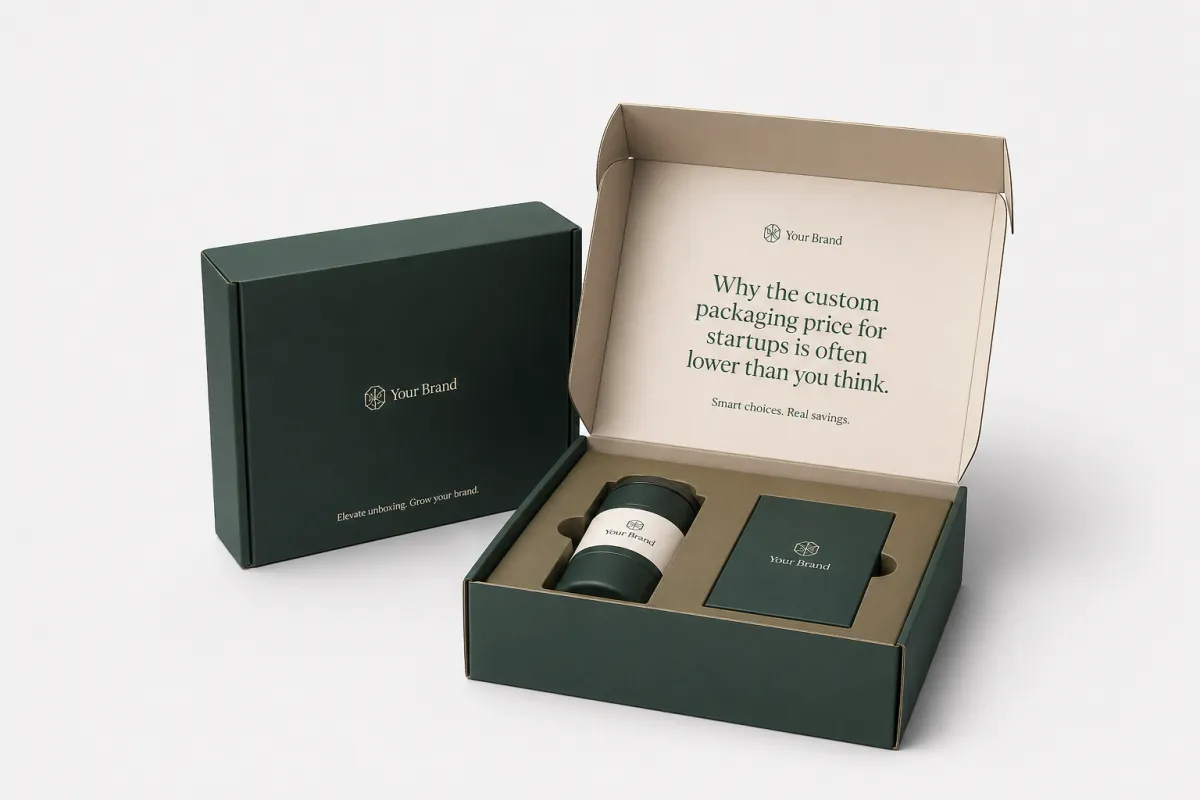
The biggest drivers behind the custom packaging price for startups are structure, size, material, print coverage, finishing, and quantity. If you only compare the box price, you miss the parts that usually move the quote the fastest. A startup can save money by trimming one dimension, switching to a standard board grade, or dropping a finish that does not change how the customer buys. That is why a quote should be read like a bill of materials, not a single number with a smile attached.
A few factors deserve extra attention. Mailer boxes and folding cartons tend to cost less than rigid boxes because they use less labor and fewer premium materials. CMYK printing is usually the easiest path for startup packaging, while foil stamping, embossing, and soft-touch coating add cost. MOQ matters too, because a lower run almost always raises the unit price. Freight, duties, sample charges, and rush fees can also change the landed number in ways that surprise first-time buyers. Those are the parts that make the custom packaging price for startups feel simple right up until the invoice arrives.
The practical question is not, "What is the cheapest box?" It is, "What box protects the product, supports the brand, and leaves room for margin?" Once a founder asks that, the custom packaging price for startups becomes easier to control. The conversation shifts from opinion to spec, and spec is where the savings usually live.
Why the custom packaging price for startups is often lower than you think
The custom packaging price for startups often drops when the design stops chasing prestige and starts solving a shipping problem. I have watched founders request a rigid box, satin ribbon, custom foam tray, and foil-stamped sleeve for a $28 product that ships in a 9 x 6 x 3 inch parcel. That is not branding. That is a margin leak with a bow on top. A cleaner folding carton with a 350gsm insert would have done the job, and the customer would still have felt the product had value. Honestly, I think packaging gets too much credit for looking expensive and not enough credit for behaving intelligently.
The cheapest box is not automatically the right box. The priciest one usually is not either. Better quotes tend to come from reducing waste, choosing a standard footprint, and removing one or two decoration steps that do not change conversion. A startup once saved $0.19 per unit by switching from die-cut foam to folded paperboard for the insert. At 3,000 units, that put $570 back into the budget. Real money. Not presentation money. The kind of money that buys an extra month of ads or keeps the founder from texting the manufacturer at 11:48 p.m.
The custom packaging price for startups also falls when the packaging follows the product instead of the founder's ego. A 120 ml skincare bottle does not need a 2 mm board fortress unless the shape is unstable or the shipping route is unusually rough. A candle in a glass jar may need more protection than a serum bottle, but that does not automatically mean rigid packaging. An E-flute mailer with a tight insert can outperform a heavy presentation box on cost and damage rates at the same time. That kind of tradeoff is where the real story lives, especially on routes from Ho Chi Minh City to Sydney or from Shanghai to Chicago.
I learned that lesson in a cosmetics meeting in Los Angeles where the founder wanted gold foil on every surface. We sampled both versions. The fully wrapped box looked loud under the factory lights, while the restrained version with one 18 x 18 mm foil logo and a matte laminate looked more expensive on the shelf. Cleaner proportions do that. The customer spent less, the box cost less, and the brand looked sharper. I will take that trade every time. The alternative was, frankly, a shiny headache with a $0.24 per unit premium.
Customer economics makes the point even harder to ignore. If your acquisition cost is $18 and your gross margin is only $14, a packaging overspend of $0.60 matters. It matters a lot. The custom packaging price for startups should support the sale, not eat into it. Good product packaging raises perceived value, reduces damage claims, and improves the unboxing moment without forcing a luxury spend that the launch cannot carry. I have seen a 4% return rate drop to 1.5% after a stronger insert and a better flap lock.
"If the box survives a 36-inch drop and still looks sharp, I do not care if it has one less foil stamp." That came from a founder I worked with after we reworked her mailer from a rigid setup to a lighter corrugated build in Dongguan. She said it while holding the test box like it had personally insulted her, which, fair enough. The sample had already passed an ISTA-style drop test from 30 inches, so her complaint was mostly emotional.
For ecommerce brands, branded packaging has to do three jobs at once: protect, present, and price correctly. Miss one of those, and the custom packaging price for startups turns from a smart investment into dead weight. Small changes in board grade, print coverage, or insert style can swing the quote by $0.11 to $0.39 per unit much faster than most founders expect. Packaging is less like a logo reveal and more like an engineering memo in disguise, usually written with a ruler and a freight invoice.
What goes into custom packaging price for startups
The custom packaging price for startups comes from a handful of moving parts, and each one can move the number in a noticeable way. Packaging type, size, material, print method, finishing, and insert complexity drive most of the cost. If a supplier sends one number without showing the pieces behind it, that is not a quote. That is a guess wearing a blazer, and I have seen plenty of those come out of factories in Shenzhen and Yiwu.
Structure sits at the center of the math. Mailer boxes, folding cartons, rigid boxes, sleeves, and inserts live in different cost bands because they use different materials and levels of labor. A mailer box made from E-flute corrugated board is usually cheaper than a rigid box wrapped in printed paper and assembled by hand. Rigid packaging needs more manual labor, more adhesive, and more surface finishing. Folding cartons can be very efficient at volume, especially when the layout stays simple and the print uses one pass with a standard coating. I have seen founders treat these as aesthetic choices, but the factory sees labor hours, board consumption, and setup time. The factory is usually less romantic, which is refreshing.
Print changes the story too. CMYK is the default and usually the easiest starting point for startups. Spot color gives tighter control when brand colors need precision, especially for a Pantone 186 C red or a Pantone 3435 C green. Foil, embossing, debossing, and UV varnish raise the price because each one adds setup, tooling, or another machine pass. A matte lamination on 350gsm C1S artboard can still look polished without sending the quote into dangerous territory. I have seen a box look more premium with one clean matte finish than with three decoration tricks fighting each other for attention. Sometimes restraint looks like confidence, and sometimes it just looks like the team ran out of budget. The good news is that customers rarely know the difference, especially from 3 feet away on a retail shelf.
The clearest way to read the custom packaging price for startups is line by line. Ask what is included and what is not. A proper quote should say whether dielines are included, whether sampling costs extra, whether freight is separate, and whether Custom Printed Boxes need plates or tooling. If the vendor cannot split manufacturing from logistics, clarity is missing. That is not a small problem. It is the difference between a real budget and a mirage that looks friendly right up until invoice day. I always want to see the numbers for sample production, main production, and freight as three separate lines.
Here is the framework I use when a startup needs to choose a box style:
- Mailer box: good for subscription, ecommerce, and shipped retail packaging that needs structure and print area, usually in E-flute or B-flute board.
- Folding carton: good for light products, small electronics accessories, cosmetics, and shelf-ready retail packaging, often built from 350gsm C1S artboard or CCNB.
- Rigid box: good for gift sets, high-margin SKUs, and package branding that needs a premium hand feel, usually with 1.5 mm to 3 mm greyboard.
- Sleeve: good for layering over stock packaging or giving a simple product a more finished look, especially for 1,000 to 5,000 unit launches.
- Insert: good when the product is fragile, oddly shaped, or likely to rattle inside the carton, whether it is paperboard, molded pulp, or EVA foam.
On a visit to a corrugated plant in Dongguan, an operator showed me how a 3 mm change in box depth altered board usage enough to change the quote on a 1,000-unit run. That sort of detail gets missed when people only focus on the total. A slightly smaller dieline can reduce board consumption, lower shipping volume, and improve the way the product sits inside the package. Those three changes can bring the custom packaging price for startups down without sacrificing presentation. It is a nice reminder that tiny dimensions can have very un-tiny consequences, especially when a carton is moving through a 12,000-mile supply chain.
If you are still choosing the product packaging structure, browse Custom Packaging Products first. It is easier to price a build once you know whether you are looking at a mailer, a carton, or a rigid presentation box with a 2 mm board wrap.
Specifications that change the quote fast
The custom packaging price for startups moves fast when the specs change, and the sharpest jumps usually come from size, material, or finishing. Size sounds dull until you look at the math. A box that is 8 mm shorter and 5 mm narrower uses less board, ships more efficiently, and feels tighter in the hand. That is not a theory exercise. I watched a Shenzhen converter rebuild a dieline three times because the founder had not measured the product with the insert included. The corrected version saved enough board to cut unit cost by 9%. The founder was not thrilled about the extra revision. The spreadsheet, however, was delighted.
Material choice carries real weight. C1S artboard is a common pick for folding cartons because it prints cleanly and stays budget-friendly. CCNB works well when you want a recycled liner with a solid print surface. Kraft brings a natural look that fits eco-minded branded packaging, but dark art and pale logos behave differently on brown stock. E-flute corrugated board is a strong option for shipping protection. Rigid board gives a stronger premium feel, but it brings more labor and more freight weight. One small decision can swing the custom packaging price for startups by $0.20 to $1.80 per unit depending on volume and finish. That range is exactly why founders should stop saying, "It is just a box." It is never just a box.
Print coverage is another quiet budget trap. Full-bleed CMYK across every panel costs more than a two-color design that uses white space well. If the brand can survive a smaller print area, use it. I would rather see one sharp logo, one clean brand line, and a balanced layout than six graphics competing for attention like interns at a hot office. A 2-color layout on 350gsm C1S can look cleaner than a full-wrap art job on 400gsm board, and it can shave $0.07 to $0.15 per unit at 1,000 units. That is packaging design, not wallpaper.
Finishing affects both feel and cost, and the most expensive option is not always the most convincing one. Soft-touch coating adds a velvety surface, but it also raises the quote and can show fingerprints. Matte lamination is often more practical for retail packaging that passes through warehouse teams and customer hands. Spot UV can create contrast on a logo panel. Foil stamping works when it is tight and deliberate. Embossing adds depth. The problem starts when all of them show up at once like a checklist. That is how a decent box turns into an expensive mess that looks like it was designed by committee after too much coffee, usually from a 9 a.m. meeting in Guangzhou.
Structural complexity is where many new founders get caught off guard. Magnet closures, window cutouts, custom inserts, pull tabs, and unusual shapes usually increase labor and tooling. A window on a folding carton sounds harmless until the die-cut, PET film, glue line, and extra packing step enter the conversation. I have seen a brand add a tiny cutout to show a candle wick and unknowingly raise the custom packaging price for startups by 12%. Small idea. Large cost. Very classic startup behavior, honestly, especially on a 500-unit first run.
For shipping and test planning, the standards used by the industry are still useful. The ISTA transit test framework helps you think about drop, vibration, and compression in a realistic way, and FSC sourcing can matter if your buyer cares about responsible fiber. The FSC label is not decoration; it is a trust signal when your branded packaging sits beside a dozen lookalike competitors. I have watched buyers read a certification mark faster than they read five lines of copy. That does not mean the copy is useless. It means attention spans are short and packaging has to earn its keep quickly, usually in under 4 seconds on a crowded shelf.
Fragile products deserve one extra rule: the cheapest box is the one that survives the shipment the first time. A damaged unit costs more than a slightly better insert. I have seen a startup save $0.08 on packaging and lose $4.20 on replacement, shipping, and support time. That is a bad trade and a common one. Someone always says, "But we have insurance." And yes, technically you do. Emotionally, no one wants to file a claim for a product that arrived looking like it lost a fight with gravity on a 1,200-mile lane.
The smarter way to think about the custom packaging price for startups is as a design problem. Change the spec and the quote changes. Change the shape and the freight changes. Change the finish and the shelf appeal changes. Good package branding grows out of those tradeoffs, not wishful thinking. A 1 mm change in board thickness can sound tiny until it affects the insert fit, the carton close, and the shipping cube all at once.
Custom packaging price for startups: MOQ, unit pricing, and hidden costs
The custom packaging price for startups and MOQ are locked together. Lower quantity usually means a higher unit price because the factory still has to cover setup, proofing, and production overhead. That is not a penalty. It is basic arithmetic. A 500-unit run can cost much more per box than 1,000 or 3,000 units, especially when the job needs custom printing, specialty board, or a hand-assembled insert. I know that sounds like the sort of line someone says while pointing at a calculator, but the math really is that plain.
Here is a practical way to think about startup pricing. These are directional bands, not promises, because the specs can move them quickly:
| Packaging type | Typical MOQ | Estimated unit price range | What drives the cost |
|---|---|---|---|
| Simple folding carton | 500 to 1,000 | $0.28 to $0.85 | Board grade, CMYK coverage, coating |
| E-flute mailer box | 500 to 2,000 | $0.65 to $1.40 | Box size, print area, insert type |
| Rigid presentation box | 300 to 1,000 | $1.80 to $5.50 | Board wrap, assembly labor, finishes |
| Sleeve with insert | 1,000 to 3,000 | $0.22 to $0.78 | Material choice, die-cut complexity, print coverage |
Those ranges explain why the custom packaging price for startups can look modest in one quote and expensive in another. A 500-unit rigid box will never behave like a 3,000-unit folding carton. Different labor. Different material. Different waste. Different freight weight from Shenzhen, Dongguan, or Ho Chi Minh City. There is no mystery there, only scale, and scale is usually the part everyone wants to skip discussing until it starts affecting cash flow.
Hidden costs bruise new buyers. Sampling can cost money, especially when multiple prototype rounds are needed, often $25 to $85 per sample depending on the build. Tooling or plates may be added for some print methods. Freight can surprise you if the supplier quotes ex-works and leaves shipping to your team. Duties and import taxes are real. Warehousing fees matter if the cartons are not going straight to a fulfillment center. Rush production adds a premium that can make a "cheap" order oddly expensive. I have seen a 500-unit sample-to-production cycle add $220 in freight before the first box even reached a 3PL in Texas.
A startup once celebrated a $0.54 mailer quote until freight, carton packing, and a rushed approval schedule were added. The landed number ended up at $0.79 per unit. Still usable. Just not the fantasy number that looked so tidy on the first email. That is why I push founders to budget with all-in thinking. The custom packaging price for startups is not just a factory price. It is a landed cost, and landed cost is the number that actually answers the question. If you want the true answer, compare the carton price, the freight line, and the duties together.
My rule of thumb is simple. Use low MOQ to test the offer, the size, and the unboxing experience. Do not use low MOQ as a permanent strategy unless the volume is truly uncertain. Once sales settle, reprice at a higher quantity and compare the savings. A move from 500 to 2,000 units can cut unit cost enough to pay for a better insert, better print, or better shipping protection. I have watched that switch save enough money to fund an extra product photo shoot in Brooklyn, which is the sort of thing founders appreciate after they stop panicking.
Storage is another detail people skip too quickly. If you order 5,000 boxes but only need 800 in the next 90 days, the excess sits somewhere. Maybe it is a garage. Maybe it is a 3PL in New Jersey. Maybe it is your cash flow. The custom packaging price for startups should be judged against how fast the cartons will move, not just the factory sticker price. A lower unit cost is lovely until your hallway turns into a cardboard canyon.
Low MOQ is useful. It is not usually the cheapest long-term way to buy packaging. The smarter path is to test small, learn fast, then scale once demand is real and artwork is locked. A 1,000-unit pilot with a clean dieline tells you more than a 100-unit vanity order ever will.
Process and timeline: from quote to delivery
The custom packaging price for startups makes more sense once the process is visible. It usually begins with a request for specs: box style, dimensions, quantity, board preference, print coverage, finish, and delivery location. A solid supplier should answer with a line-item quote, not a vague range dressed up as help. After that comes the dieline, sample approval, artwork confirmation, production, quality control, and freight. Every step is normal. Every step can also become a speed bump if the brief is fuzzy. I like seeing the first reply include a 1-page spec sheet and a target delivery window, such as 12-15 business days from proof approval.
Timeline is where startup mistakes turn expensive. A simple folding carton can move quickly if the artwork is ready and the specs are clear. A rigid box with foil stamping, a custom insert, and a two-piece structure takes longer because each step adds a point where something can go wrong. If the launch date is fixed, the packaging schedule needs room to breathe. I usually tell founders to allow 10 to 15 business days for sample work, then another 12 to 20 business days for production, plus freight time based on route and shipping method. Complex builds and peak seasons need more cushion. Packaging does not care that your investor wants a demo on Thursday.
The easiest way startups create delays is by changing dimensions after the dieline is approved. I saw a founder shift bottle height by 4 mm after the artwork had already been set. The insert had to move, the box depth changed, and the layout needed another review. Another common problem is sending print files that are not press-ready. Low-resolution images, missing bleed, broken font embedding, and color settings that do not match the finish all slow the job down. A small delay can push the custom packaging price for startups upward if rush production or express freight becomes necessary. One extra air shipment from Shenzhen to Chicago can add $300 to $900 to a modest order.
Here is the workflow I recommend:
- Share product dimensions, quantity, and target budget.
- Confirm the box type and board grade.
- Review the quote line by line, including freight and sample costs.
- Approve the dieline and check the artwork against it.
- Order a physical sample if the product is fragile or high value.
- Lock production only after the sample passes fit and print review.
- Plan delivery with at least one buffer week before launch.
That process keeps the custom packaging price for startups from creeping upward through avoidable rework. It also keeps the box tied to the product instead of drifting away from it. I visited a production line in Dongguan where the team had to stop a carton run because the logo sat 7 mm too low on the front panel. Seven millimeters sounds trivial until 2,000 boxes are already stacked and waiting. Then it becomes very not-trivial. That is why sample approval matters.
One client meeting sticks with me. The founder wanted a launch in 21 days, but the artwork file was still a Canva export and the insert dimensions were unconfirmed. We stripped the brief down to a standard mailer, one-color print, and a stock kraft insert. The result looked deliberate, not cheap. More important, it shipped on time. That is the difference between a packaging plan and a panic order. I would rather see a simple, well-executed box than a "premium" concept that misses launch and leaves everyone pretending that is fine.
Packaging gets easier once the details stop moving. The custom packaging price for startups stays sane when the approval process is tight. Once the structure is locked and the files are clean, production behaves like a machine. Until then, every change is a negotiation with reality, and reality is not known for accepting late-stage mood boards from a founder on a red-eye flight.
Why choose us for startup packaging that stays on budget
The custom packaging price for startups should come with straight answers, not theater. That is how we work at Custom Logo Things. I do not believe in sales fluff or fake range quotes that hide the landed cost. If a 1,000-unit folding carton will land at $0.46 before freight, I say that. If the same job climbs to $0.73 because the founder wants foil, embossing, and a custom insert, I say that too. No smoke. No confetti. No mysterious line called "value add." I have always found that phrase suspicious, especially when the sample arrives from a plant in Guangzhou and the invoice arrives from somewhere else entirely.
My edge is not only quoting. It is factory-side experience. I have spent enough time with mills, converters, and freight teams to know where the real pressure sits. One supplier will be strong on board pricing but weak on finishing. Another will print beautifully and miss the lead time. A third will promise the moon and miss the sample window by two weeks. The job is to match the spec to the right production path so the custom packaging price for startups stays realistic without damaging the look. That balancing act is where a lot of budgets quietly survive or quietly die, and it usually depends on whether the job is printed in Shenzhen or assembled in Dongguan.
Line-item transparency matters as well. If a quote separates structure, print, coating, insert, freight, and setup charges, comparison becomes possible. If everything is buried in one number, it is hard to tell whether you are paying for good product packaging or for a salesperson's confidence. Startups deserve better than that. They need apples-to-apples comparisons, not apples-to-mystery-fruit comparisons, and certainly not a "special one-time rate" that appears on every email. I like seeing setup, proofing, and main production split cleanly, even if the total is only $1,800.
During one factory visit in Dongguan, a converter pushed a startup toward a heavier board because it sounded safer. It was safer for the factory, not for the brand. The heavier board raised freight, added waste, and made the carton harder to close neatly. We changed the board spec, kept the print clean, and dropped the landed cost by $0.11 per unit. That sort of move does not happen by accident. It comes from having seen enough production runs to know what matters and what is just expensive habit dressed up as good judgment.
We also keep the focus on retail Packaging That Feels credible in the hand. That means proportions that sit well, paper stocks that print cleanly, and finishes that fit the brand instead of hiding weak packaging design. Sometimes the right answer is a simple box with excellent package branding. Sometimes it is a sleeve over a stock carton. Sometimes it is a custom printed box with one premium detail and three cost-saving choices beneath it. There is no prize for overbuilding. There is only the invoice, and the invoice never forgets. A 350gsm C1S carton with a single foil logo can often outperform a fully wrapped 2 mm rigid box at half the cost.
If you are still comparing structures, Custom Packaging Products is the fastest way to see what is available before you commit to a quote. Pricing gets better when you already know whether the product needs a mailer, a carton, or a rigid presentation box. That one decision can save a week of back-and-forth and a surprising amount of budget.
The value is in follow-through. I do not like pricing a box and disappearing. I prefer to help a founder catch issues before they get expensive, whether that means tightening the dieline, simplifying the insert, or shifting print coverage to a cleaner panel. That is how the custom packaging price for startups stays under control while the box still looks like it belongs next to much larger brands. A 2 mm tweak to the insert or a 4 mm trim on the width can matter more than a fancy mockup ever will.
Actionable next steps to get your custom packaging price for startups
If you want an accurate custom packaging price for startups, send usable information the first time. That sounds obvious, yet half the quotes I see start from guesswork because the product size is missing or the artwork is still "rough." Rough is not a spec. It is a delay in a trench coat. Give us the product dimensions, quantity, target budget, shipping destination, and launch deadline. That alone can shave days off the quote cycle, and it can keep the sample from bouncing back and forth between California and Guangdong.
Before you ask for pricing, gather these details:
- Product dimensions: length, width, height, and any irregular shapes.
- Quantity: 500, 1,000, 3,000, or whatever your realistic first run is.
- Packaging type: mailer, folding carton, sleeve, rigid box, or insert-only.
- Material preference: kraft, C1S, CCNB, E-flute, or rigid board.
- Print needs: CMYK, spot color, foil, embossing, or plain print.
- Deadline: sample date, production date, and delivery date.
The custom packaging price for startups is easier to solve when you request two versions: one lean option and one upgraded option. That gives you a real comparison. You can see how much a matte laminate costs versus a soft-touch finish, or how much a paperboard insert saves versus molded foam. I have watched founders make better decisions in five minutes with two clean quotes than in five weeks with ten half-baked guesses. Decision fatigue is real. Packaging should not make it worse, especially when one quote lands at $0.41 per unit and the other lands at $0.58.
ROI matters too. A box that costs $0.22 more but reduces breakage, improves shelf perception, or increases repeat purchase is often the stronger buy. I have seen a founder switch to a cleaner retail packaging layout and get stronger feedback from buyers because the package looked like the product had a real plan behind it. That is not vanity. That is package branding doing its job. There is a difference between pretty and persuasive, and the market feels that difference very quickly, often in the first 10 seconds of an unboxing video.
If you are unsure where to start, send the current carton size, a photo of the product, and the best estimate you have for monthly volume. I can usually get a much tighter range from that than from a vague request that says "need something nice, not too expensive." Nice is subjective. Not too expensive is a budget. They are not the same thing, and pretending they are only wastes time. A photo and a 1,500-unit monthly estimate are enough to narrow the quote far more than a mood board ever could.
Do not wait for the art to be perfect before asking for numbers. The custom packaging price for startups improves when the project starts early, because early conversations expose the expensive choices before they get locked in. Send the specs, ask for the line-item quote, and compare the lean version against the upgraded version. That is how you buy packaging with your eyes open instead of your fingers crossed. If the first sample takes 12 business days and the second revision takes 5 more, that is still better than discovering a problem two days before launch.
If you want the honest version of the budget conversation, I will give it to you. The best custom packaging price for startups comes from clear specs, sensible materials, and a supplier who tells the truth before the invoice arrives. That usually means a 350gsm carton, a realistic MOQ, and a lead time everyone can actually hit.
FAQ
What is the typical custom packaging price for startups on a small first order?
Small startup orders usually cost more per unit because setup, printing, and labor are spread across fewer boxes. A simple folding carton might land in the $0.28 to $0.85 range at low volume, while a mailer box can sit closer to $0.65 to $1.40 depending on size and print coverage. The cheapest route is usually a plain structure with limited print and no premium finishing. A line-item quote is the only honest way to compare the custom packaging price for startups, because a board change or one extra finish can move the number quickly. I have watched that happen on an email chain while everyone was still acting optimistic.
How does MOQ affect custom packaging pricing for a startup brand?
Lower MOQ usually means a higher unit price because the factory still has to cover setup and production overhead. When quantity increases, the custom packaging price for startups often drops sharply, especially if the same material and print setup can be reused. A startup should test at a manageable MOQ first, then reprice at a larger run once demand is proven. That is the cleaner way to manage risk without paying the highest possible per-box cost forever. It is also the easier way to keep your finance team from developing a permanent eye twitch.
Which packaging type is usually cheapest for startups?
Simple mailer boxes and folding cartons are often cheaper than rigid boxes because they use less material and less manual labor. Kraft or uncoated board with basic print is usually more budget-friendly than foil, embossing, or specialty coatings. The cheapest option still has to protect the product, or the business pays for damage later. In my experience, the best custom packaging price for startups usually comes from a structure that matches the product instead of a package built to impress other designers. That may sound slightly rude to designers, but I say it with affection and a 1,000-unit quote in hand.
Can I lower my custom packaging price without making the box look cheap?
Yes. Reduce print coverage, simplify the structure, and choose a standard board spec before you cut brand cues completely. A minimalist box can still look premium if the proportions, typography, and finish are controlled. It is smarter to spend on one strong detail than to add five weak ones that inflate cost. That is how many startups get a better custom packaging price for startups while keeping the box sharp enough for retail packaging, ecommerce, and unboxing videos. The trick is restraint, not austerity.
How long does it take to get startup packaging made and delivered?
Timing depends on sample approval, production complexity, and shipping method, so there is no honest one-size answer. Simple boxes move faster; rigid or highly finished packaging usually takes longer. Startups should build in buffer time for artwork changes, sample review, and freight delays so launch dates do not get wrecked. If you plan poorly, the custom packaging price for startups can rise because rush freight and rework are never cheap. I have seen a "quick" launch turn into a month-long apology tour. Nobody enjoyed that.
If you want a direct quote for the custom packaging price for startups, send the specs, choose one lean option and one upgraded option, and let the numbers tell the truth. That is still the fastest way I know to buy packaging that fits the product, fits the launch, and does not waste money on fluff. A good quote should take 1 business day, and a clean sample cycle should usually run 12-15 business days from proof approval. The takeaway is simple: lock the structure early, keep the finishes disciplined, and budget on landed cost, not wishful thinking.

