Buyer Fit Snapshot
| Best fit | Custom Padded Paper Mailers projects where brand print, material claims, artwork control, MOQ, and repeat-order consistency need to be specified before quoting. |
|---|---|
| Quote inputs | Share finished size, material target, print colors, finish, packing count, annual reorder estimate, ship-to region, and any compliance wording. |
| Proofing check | Approve dieline scale, logo placement, barcode or warning zones, color tolerance, closure strength, and carton packing before bulk production. |
| Main risk | Vague material claims, crowded artwork, missing packing details, or unclear freight terms can make a low unit price expensive after revisions. |
Fast answer: Custom Padded Paper Mailers: Film, Print, MOQ, and Carton Packing should be specified like a repeatable production item. The safest quote records material, print method, finish, artwork proof, packing count, and reorder notes in one written spec.
Production checks before approval
Compare the actual filled-product size with the drawing, then confirm tolerance on folds, seals, hang holes, label areas, and retail display edges. Reserve space for logos, QR codes, warning copy, and material claims before decorative graphics fill the panel.
Quote comparison points
Review material grade, print process, finish, sampling route, tooling charges, carton quantity, and freight assumptions side by side. A quote is only useful when the supplier can repeat the same color, closure quality, and packing count on the next order.
Custom padded paper mailers have a simple job that turns out to be pretty unforgiving. They need to protect the product, carry the brand, and not become a waste problem the second the customer opens the parcel. That sounds neat on paper. In practice, a bad fit, weak closure, or flimsy construction can turn a good product into a dented disappointment before the box even leaves the carrier network. I have seen a compact shipped in a loose sleeve arrive looking like it lost a fight with a forklift. Not ideal.
For ecommerce brands, custom padded paper mailers sit in a useful middle lane. They look cleaner than plain poly, take less space than a box, and can fit better with paper-forward sustainability goals. They also make the brand visible the second the parcel lands on a desk, porch, or warehouse floor. Good packaging does not need to shout. It just needs to look intentional. That alone separates it from the usual “we had to ship this somehow” energy.
They are not a cure-all, though. No mailer can fix a bad pack-out, the wrong size, or a product that really should be in a more structured shipper. The right choice depends on weight, shape, fragility, and how much abuse the shipment is likely to take on its route. If the job is light protection with a tidy presentation, custom padded paper mailers make a lot of sense. If the product needs serious crush resistance, more internal support, or protection from impact, a box or a different format is probably the better move.
Custom Padded Paper Mailers: What They Are and Why They Matter
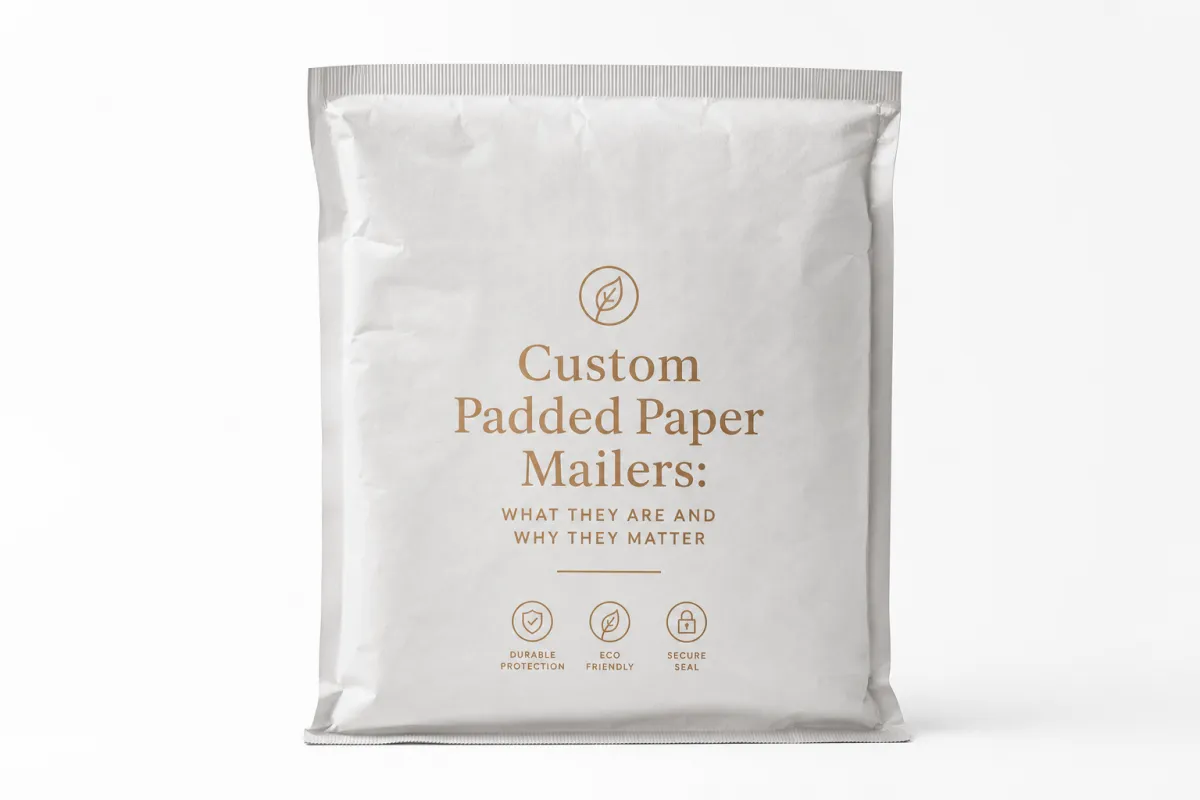
At the simplest level, custom padded paper mailers are paper-based shipping mailers with a cushioning layer built into the wall structure. The outside is usually printable paper, the inside contains padding or a paper-based cushioning layer, and the closure is often a self-seal flap or adhesive strip. “Custom” can mean a branded exterior, a size tuned to the product, a different flap style, or a specific material recipe that fits the brand’s sustainability targets better than a stock option ever would.
The difference between stock and custom is not just decoration. Stock mailers are made for general use, which means the dimensions are generic and the print is usually limited or nonexistent. Custom padded paper mailers can be built around the actual product size, which cuts down on void space, reduces movement, and usually improves the unboxing experience. Less dead air inside the package also helps shipping efficiency. Nobody wants to pay freight on a bag of emptiness.
From a buyer’s point of view, the business case is pretty straightforward. Better fit usually means fewer damages. Better branding usually means a better first impression. Better material choices can support recycling goals and make the product story feel cleaner for branded packaging. Customers notice when the packaging looks deliberate instead of improvised. They might not say it out loud, but they notice.
There is also a practical retail packaging angle. If a brand ships apparel, books, stationery, small accessories, or light cosmetics, custom padded paper mailers can create a more consistent presentation than bouncing between boxes, generic poly, and random sleeves for odd-sized SKUs. Consistency is underrated. It makes operations easier and the brand looks like it has a plan. Which, honestly, is rarer than it should be.
Custom is not automatically better than stock. A brand shipping lightweight tees does not need the same structure as a company shipping glass droppers or metal hardware. The product should drive the format, not the other way around. That sounds obvious, yet plenty of bad packaging decisions happen because someone liked the sample more than the item it had to protect.
Pretty packaging that fails in transit is just expensive recycling.
How Custom Padded Paper Mailers Work
Custom padded paper mailers protect products through a mix of surface protection, cushioning, and shape control. The outer paper layer resists scuffing and gives the mailer a printable face. The padding absorbs smaller impacts, cuts friction, and softens the force from drops or stacking. The flap and seams keep the package closed while it moves through sorting systems, truck loads, and last-mile delivery. None of that is glamorous. All of it matters.
The structure usually has four basic parts. The outer paper face carries the print and takes the visual wear. The inner cushioning layer gives the mailer its padded feel and impact buffer. The seams and folds keep the mailer from splitting under pressure. The closure holds the whole thing together until the customer opens it. If any one of those pieces is weak, custom padded paper mailers stop acting like protective packaging and start acting like decorative paper.
Shipping damage is often less about one huge hit and more about repeated small abuse. Parcels get sorted, stacked, dropped, pinned, and compressed over and over. A mailer that survives a short fall can still fail after sitting under a heavier package for hours. Good custom padded paper mailers are built around that reality. They do not need to be indestructible. They need to stay intact long enough to survive a normal distribution path. That is the whole game.
Material choice shapes performance. Recycled paper content can support sustainability goals, but the build still has to work. Paper-based padding, embossed cushioning, and air-pocket paper structures all behave a little differently. Adhesives matter too. A closure that peels open under stress is not a closure. It is a polite suggestion. Buyers should ask about material composition, adhesive type, and whether the mailer structure fits the recycling systems in the markets they serve.
For product categories, the sweet spot is pretty clear. Custom padded paper mailers work well for apparel, books, accessories, stationery, cards, and light retail packaging where scratches, scuffs, and minor impact are the main risks. They can also work for some beauty and wellness items if the product is not overly fragile and the inner pack already handles most of the protection. I would not toss a delicate glass item into one and hope for the best, because hope is not a shipping spec.
Limits show up fast with the wrong use case. Moisture can weaken paper-based construction. Sharp corners can punch through. Heavy items can crush the cushioning and create seam stress. Oversized products leave too much room to move. If a SKU has any of those traits, test it before assuming custom padded paper mailers are the answer. Good packaging design starts with the product, not the pretty mockup.
Industry testing standards help here. For shipping validation, teams often look at ISTA procedures and ASTM test methods to simulate real transit hazards. You do not need a full lab program for every order, but you do need some kind of drop, compression, or pack-out testing before you commit to scale. A few sample shipments to actual addresses usually reveal the weak points fast.
Key Factors That Affect Cost and Performance
Pricing for custom padded paper mailers depends on more than print and size. Material thickness, padding style, closure system, order quantity, artwork coverage, and even how the mailers are packed for freight all affect the final number. A simple one-color logo on a standard size may be efficient. Full-coverage art, interior printing, a custom dimension, and a specialty flap will cost more. Packaging budgets are like everything else in manufacturing: the details collect charges.
For small runs, unit pricing is usually higher because setup costs get spread over fewer pieces. A short order of custom padded paper mailers might land in the rough range of $0.40-$0.90 per unit depending on size, print coverage, and structure, with setup or plate charges adding another chunk. At larger volumes, often around 5,000 to 10,000 pieces and up, the same mailer might drop into the $0.22-$0.55 range, again depending on complexity. Those are planning numbers, not promises. If a supplier gives you a quote far below that without a clear material spec, read the fine print twice.
| Packaging Option | Typical Unit Cost Range | Protection Level | Best Use Case |
|---|---|---|---|
| Stock paper mailer | $0.18-$0.40 | Light | Simple shipments with low branding needs |
| Custom padded paper mailers | $0.22-$0.90 | Light to moderate | Apparel, books, accessories, beauty items |
| Custom poly mailers | $0.10-$0.30 | Light | Low-cost shipping where paper recyclability is not the main goal |
| Rigid box with void fill | $0.65-$1.80 | Moderate to high | Fragile or premium product packaging |
The cheapest option is not always the least expensive in practice. If a lower-grade mailer causes a 2% bump in damage, that cost can wipe out the savings fast. Returns, replacements, customer service time, and negative reviews all eat into margins. A penny saved on custom padded paper mailers is not a win if it creates a headache on the back end. Cheap packaging gets expensive in a hurry once failures start showing up.
Lead time also affects cost. Rush production, rushed proofs, and air freight all add money. A standard custom order usually needs time for quoting, dieline confirmation, artwork prep, sampling, approval, production, and shipping. If the supplier has to compress that into a short window, the quote usually reflects it. That is fair. Speed costs money. Pretending otherwise is how brands end up overpaying for panic.
Sustainability can improve both cost control and perceived value if it is handled properly. Recycled content may help procurement goals. Right-sized construction can reduce shipping waste. A single-material or paper-forward structure may be easier for customers to understand and dispose of correctly. For broader environmental reference points, the EPA recycling guidance is a decent starting place for understanding why material simplicity matters.
If you are comparing custom padded paper mailers against Custom Poly Mailers, look at total package economics, not just the unit price. Poly may be cheaper upfront. Paper may win on brand fit, customer perception, and sustainability positioning. The right answer depends on whether your packaging strategy wants the lowest material cost or a cleaner branded presentation. Those are not always the same thing.
How to Choose the Right Custom Padded Paper Mailers
The right custom padded paper mailers start with the product spec, not the supplier catalog. Measure length, width, and height. Record weight. Note whether the item scratches easily, bends, crushes, or absorbs moisture. Then decide what the mailer has to do: prevent scuffs, absorb impact, hold shape, or simply create a cleaner presentation than a plain bag. You cannot Choose the Right structure if you have not defined the problem.
Size fit matters more than most brands admit. A mailer that is too large lets the product slide around. A mailer that is too tight stresses seams and can distort the item. Good custom padded paper mailers match the product with a little tolerance, not a swamp of empty space. That reduces motion, improves shipping efficiency, and makes the parcel feel more considered when it arrives.
Closure style is another decision point. Some brands want a simple peel-and-seal flap. Others want tamper-evident behavior. Some need a wider adhesive zone for better hold. If the product ships through humid regions or long carrier routes, closure strength matters even more. The best custom padded paper mailers do not just look closed. They stay closed.
Branding strategy should be deliberate. A clean logo placement can beat full-surface artwork. One strong brand color, one clear mark, and a neat message on the inside flap often outperform busy graphics that look like they were approved by committee after a long lunch. That is especially true for retail packaging and ecommerce packaging, where the goal is a sharp first impression without drowning the product in design noise. Restraint can look expensive. Annoying, but true.
Here is a practical comparison of how custom options usually stack up:
| Factor | Minimal Branding | Full-Coverage Branding | Best For |
|---|---|---|---|
| Print cost | Lower | Higher | Budget-conscious launches vs. strong package branding |
| Visual impact | Clean and restrained | Bold and obvious | Premium basics vs. high-recognition campaigns |
| Production complexity | Lower | Higher | Fast-moving SKUs vs. controlled brand rollouts |
| Best fit | Custom padded paper mailers with one-color print | Custom padded paper mailers with full-bleed artwork | Simple product lines vs. signature branded packaging |
Supplier questions should be blunt. Ask for sample availability. Ask for the paper source and recycled content. Ask whether the material construction is actually recyclable in common curbside streams or only theoretically recyclable in a perfect universe. Ask about minimum order quantity, repeat-order consistency, and whether the supplier can hold the same spec across production runs. If they cannot answer in plain English, that is a warning sign. Good packaging partners know their numbers.
For some brands, the right choice may still be a box. Custom padded paper mailers are not a replacement for every structure. Heavy sets, fragile glass, or premium gift packaging may need a box with internal support. If your products need more crush resistance, compare against custom printed boxes before deciding. A box is not automatically overkill. Sometimes it is exactly the right tool.
Custom Padded Paper Mailers Process and Timeline
Ordering custom padded paper mailers is usually a step-by-step process, and skipping steps is how people create delays for themselves. It often starts with a quote request. Then comes size confirmation, material selection, artwork prep, sampling, approval, production, and freight booking. That sequence is boring until a missing detail costs a week. Packaging schedules are not mysterious. They are just unforgiving.
Timeline depends on volume and complexity. A simpler custom run may move through proofing and production in roughly 12-20 business days after approval, while larger or more complex orders can take longer, especially if the order needs special print treatment, imported materials, or a freight method that adds transit time. The useful rule is this: if the launch date matters, start the packaging conversation before the product spec is frozen. Waiting until the last minute is how brands end up paying for rush freight and compromises they did not want.
The artwork phase is where many orders stall. Logo files need the right format. Colors need to be defined. Print zones need to be clear. If the supplier provides a dieline, treat it seriously. Do not hand off a loose idea and expect the sample to read your mind. Custom padded paper mailers may look simple, but clean artwork setup still matters. A bad logo placement can make a premium item feel like a rushed prototype.
Here is a practical planning checklist that avoids most headaches:
- Measure the product and record a packed size, not just the naked product size.
- Confirm weight and any sharp or fragile points that need protection.
- Prepare logo files, brand colors, and any print copy before requesting samples.
- Decide whether the mailer needs recycled content, a specific paper tone, or a special closure.
- Ask the supplier for a realistic timeline that includes proofing and freight.
Sample testing should not be skipped. Even a good-looking mailer can fail in use if the product shifts, the flap lifts, or the surface scuffs too easily. A few shipped samples to real destinations tell you more than a tidy render ever will. If the mailer survives a short test route, repeated handling, and a couple of rough drops, you are closer to a real decision. If it fails, you save yourself from a much larger mistake.
Brands that use custom padded paper mailers alongside other packaging lines should keep the system organized. That might mean one SKU uses mailers, another uses Custom Packaging Products, and a third uses rigid packaging for higher-value items. A smart packaging design system does not force every product into the same container. It chooses the right container for the job. Radical, I know.
Common Mistakes With Custom Padded Paper Mailers
The biggest mistake is choosing custom padded paper mailers because the sample looks nice, then hoping the structure can make up for weak sizing or a fragile product. It usually cannot. Good-looking packaging can still fail if the dimensions are off or the cushioning is too light for the route. Pretty does not equal functional. People keep learning that the hard way.
Oversizing is another easy way to waste money. A mailer that is too big increases material use, raises freight volume, and lets the product move around. Underpadding is the opposite problem. The item looks snug on paper, then arrives dented because the cushioning collapsed under pressure. Both mistakes are common. Both are avoidable. Custom padded paper mailers work best when the product fit matches the actual shipping hazard.
Humidity and moisture get overlooked more than they should. Paper construction can soften, warp, or lose strength if it sits in damp conditions over time. That does not mean paper mailers are a bad choice. It means they need to be selected with the shipping lane in mind. If your parcels move through wet climates or long storage periods, ask for performance details instead of assuming the build will behave like a dry-room sample.
Sustainability claims get messy fast. A mailer advertised as recyclable is not automatically recyclable in every place. Mixed materials, heavy coatings, liners, and certain adhesives can complicate disposal. If the supplier cannot explain the structure plainly, the claim is too vague to trust. A responsible buyer should ask for a clear material breakdown and, where possible, align the design with FSC guidance or other recognized sourcing standards. Good sustainability claims need more than green ink.
Branding mistakes happen too. Some teams cram too much copy onto the mailer, use tiny text that disappears at arm’s length, or choose colors that look rich on screen and muddy on paper. Others build custom padded paper mailers that look premium from ten feet away but feel flimsy in the hand. That mismatch hurts trust. Product packaging should feel like it belongs to the product, not like it wandered in from a different price bracket.
One more thing: do not ignore repeat-order consistency. A first run can be perfect. A second run can drift if the spec was never nailed down. For brands scaling from niche orders to higher volume, consistency matters as much as the first prototype. That is especially true if your branded packaging is part of the customer experience and your team expects the same look across every reorder.
Expert Tips for Better Sustainable Packaging Results
If the goal is better sustainable packaging, start with performance testing before you talk philosophy. Use drop tests, pack-out tests, and a small sample shipment to real addresses. A few routes in the wild will show you how custom padded paper mailers behave under actual handling. It is a lot cheaper to learn from five sample shipments than from five hundred customer complaints.
Balance sustainability against protection. The lightest build is not always the best build. If a slightly sturdier paper structure prevents damage, the lower return rate can make the overall system cleaner. That is the part people skip when they focus only on raw material counts. Good packaging design is not about winning a purity contest. It is about reducing waste across the full shipping cycle.
Use branding with restraint. A strong logo, one clear message, and a tidy visual system are often enough. Not every piece of custom padded paper mailers needs full-coverage art. In many cases, simple printing looks more confident than noisy artwork. That is especially true for premium basics, beauty products, stationery, and other categories where the packaging should support the product instead of stealing the show.
Track data after launch. Watch damage rates, customer complaints, return reasons, and any comments about the unboxing experience. If the new mailer reduces damage but customers say it feels too flimsy, that is a signal. If the mailer looks fantastic but the product still arrives bent, that is a different signal. Good custom padded paper mailers should improve both operational and brand results, not just one side of the ledger.
Compare suppliers on more than price. Ask who can hold spec across repeat runs. Ask who can provide samples quickly. Ask who can explain material construction without hiding behind vague sustainability language. In practice, the best supplier is often the one that reduces risk, not the one that wins the first quote by a few cents. A cheap quote is only cheap until the first failure shows up.
For brands that want to build a broader system, think about how custom padded paper mailers fit alongside other retail packaging choices. Some products need mailers. Some need boxes. Some need inserts. A smart line uses each format where it makes sense instead of forcing everything into one category. That is how packaging becomes a system instead of a pile of random SKUs.
And yes, you can still use custom padded paper mailers as a branding tool while keeping the structure practical. That is the sweet spot. A clean exterior, a reliable closure, and a size that actually fits the product are not glamorous features. They are the reason the packaging works. Fancy is optional. Functional is not.
Next Steps for Ordering Custom Padded Paper Mailers
If you are ready to order custom padded paper mailers, start with the basics: measure the product, define the shipping conditions, set a realistic budget, and ask for samples from at least two or three suppliers. Comparing one quote against another is useful. Comparing quote details line by line is better. Unit price alone can hide setup fees, freight differences, material changes, and spec drift.
Start with one SKU or one product line if the catalog is broad. That keeps the test manageable and gives you real data before a wider rollout. If the first production run performs well, you can scale the spec with more confidence. If it reveals a weakness, you only have one package format to fix instead of a warehouse full of the wrong thing.
Use the first run as a live test. Check fit. Check seal strength. Check print quality. Check how the customer reacts when the parcel arrives. Good custom padded paper mailers should feel easy to open, stable in transit, and aligned with the brand’s visual tone. If you are seeing damage, awkward fits, or noisy complaints, adjust before you lock in a bigger order.
For brands building a broader packaging system, it helps to map how custom padded paper mailers fit next to Custom Poly Mailers and more structured boxes. That comparison usually clarifies the decision faster than any sales pitch. Sometimes paper is the right answer. Sometimes poly is better for a specific route. Sometimes the right move is custom printed boxes. The best packaging choice is the one that solves the product’s actual shipping problem.
If you want a practical rule, use this one: finalize the product spec first, then finalize the packaging. Reverse that order and the mailer often gets designed around hope. Hope is not a shipping spec. Custom padded paper mailers work best when they are chosen with the product, the route, and the brand story in mind. Get those three lined up, and the packaging stops being a cost center you resent and starts being a piece of the customer experience that actually earns its keep.
FAQ
Are custom padded paper mailers recyclable?
Usually yes if the structure is mostly paper and does not rely on a problematic plastic lining or a mixed-material layer that local recycling systems reject. The catch is that “recyclable” is not the same as “recycled everywhere.” Ask for a plain-language material breakdown, then check local rules before you make a claim on the package.
How much do custom padded paper mailers cost?
Price depends on size, print coverage, order volume, material thickness, and any special padding or closure requirements. Small runs usually cost more per unit, and setup fees can matter more than buyers expect. A better way to judge cost is total packaging expense after damage, returns, and shipping efficiency are included.
What products work best in custom padded paper mailers?
They work best for light to moderate-weight products that need scratch protection and moderate impact resistance. Common fits include apparel, books, cosmetics, accessories, cards, and non-fragile retail items. Sharp, heavy, or highly breakable products need careful testing before you commit.
How long does it take to produce custom padded paper mailers?
Plan for quoting, sampling, artwork approval, production, and shipping. A straightforward custom order can move in roughly 12-20 business days after approval, while more complex orders can take longer. The usual delays are artwork revisions, dieline changes, and freight decisions made too late.
What should I ask before ordering custom padded paper mailers?
Ask about material composition, recyclable design, minimum order quantity, sample availability, print limitations, and repeat-order consistency. Request test data or examples from similar products if you want a better read on real-world performance. Confirm lead time and freight terms before you sign off.

