Buyer Fit Snapshot
| Best fit | Custom Pallet Wrap Labels Wholesale projects where brand print, material claims, artwork control, MOQ, and repeat-order consistency need to be specified before quoting. |
|---|---|
| Quote inputs | Share finished size, material target, print colors, finish, packing count, annual reorder estimate, ship-to region, and any compliance wording. |
| Proofing check | Approve dieline scale, logo placement, barcode or warning zones, color tolerance, closure strength, and carton packing before bulk production. |
| Main risk | Vague material claims, crowded artwork, missing packing details, or unclear freight terms can make a low unit price expensive after revisions. |
Fast answer: Custom Pallet Wrap Labels Wholesale: Pricing & Specs should be specified like a repeatable production item. The safest quote records material, print method, finish, artwork proof, packing count, and reorder notes in one written spec.
Production checks before approval
Compare the actual filled-product size with the drawing, then confirm tolerance on folds, seals, hang holes, label areas, and retail display edges. Reserve space for logos, QR codes, warning copy, and material claims before decorative graphics fill the panel.
Quote comparison points
Review material grade, print process, finish, sampling route, tooling charges, carton quantity, and freight assumptions side by side. A quote is only useful when the supplier can repeat the same color, closure quality, and packing count on the next order.
A pallet does not need torn film, crushed corners, or a damaged box to create a delay. One lifted label edge, one barcode that refuses to scan, and a receiving team can lose ten minutes on a load that should have been through the dock in under one. I have seen that kind of slowdown turn into a full scramble, and it rarely starts with the pallet itself. More often, it starts with the label. That is the practical value of custom pallet wrap labels wholesale: they give warehouse teams a steady point of reference for identification, scanning, and handling before the pallet ever reaches the dock door.
For a packaging buyer, the logic stays simple. Volume buying lowers unit cost, the label format stays consistent across repeated shipments, and the small errors that drain labor in distribution centers and 3PL facilities get pushed down. A pallet label is not decoration. It has to stay readable on stretch film, resist scuffing, and apply the same way across a long production run. If it cannot do those things, the label is kinda missing the point.
That same thinking carries through the rest of the packaging system. Strong package branding does not stop at retail packaging or custom printed boxes; it also shows up on the dock through clear pallet identification. Packaging design is not only about shelf appeal. It also has to work after product packaging leaves the line, gets wrapped, gets moved, and gets scanned. The best labels respect that reality instead of pretending the warehouse is a clean studio set.
A pallet label has one job: stay readable after the wrap is pulled, tucked, scanned, and handled again. If it cannot do that, the design is not finished.
The cost of a weak label usually hides in the work around it. A repick, a delayed receiving event, a missed scan, an extra walk back to the dock, and a few minutes spent explaining which pallet is which can add up fast. Buying custom pallet wrap labels wholesale is often the cleanest way to reduce that risk while keeping branding, data, and handling instructions aligned. The savings are not always obvious on the quote, but they show up in the warehouse pretty quickly.
For broader packaging testing context, the ISTA organization is a useful reference point, especially when loads move through a long chain of touchpoints and surface durability matters. Material sourcing follows a different track, but if your procurement team watches fiber origin, FSC can matter when paper facestocks are part of the build. Those references do not replace a real trial on your own floor, but they help frame the conversation with a little more discipline.
Custom pallet wrap labels wholesale product details and material options
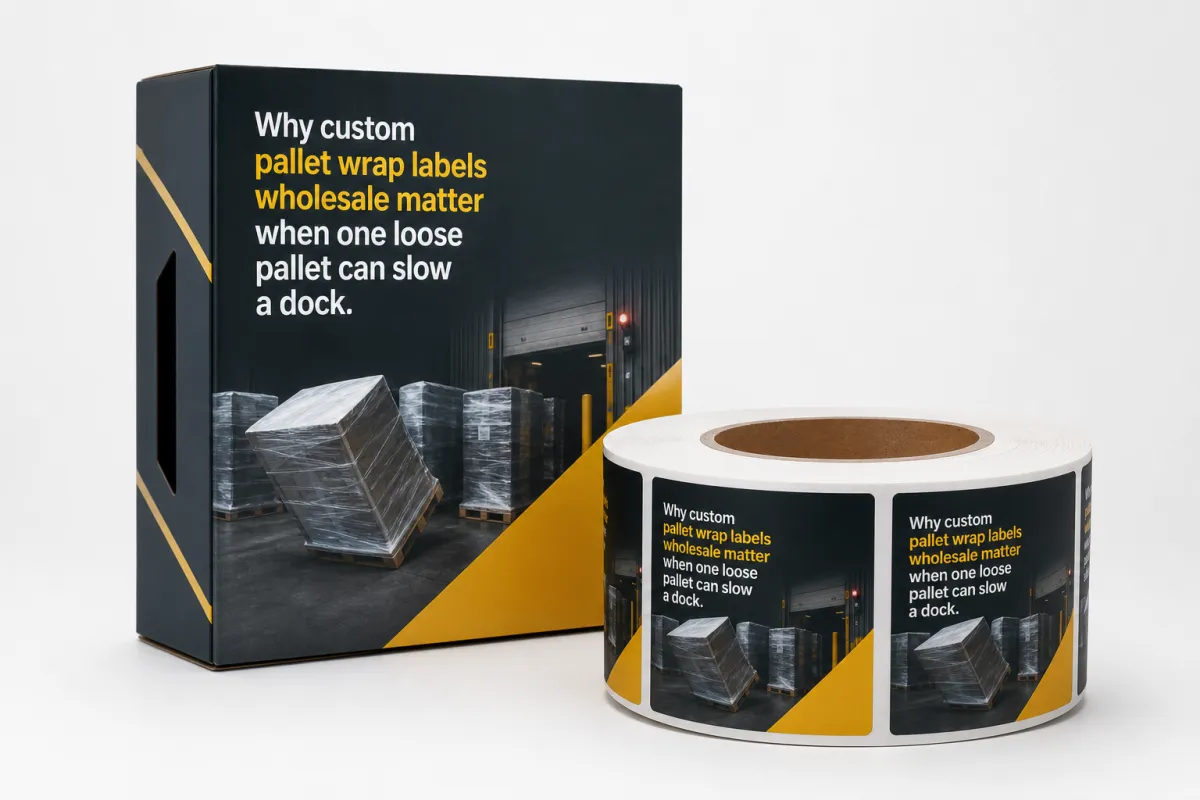
custom pallet wrap labels wholesale products are built for one basic task: hold to stretch film, pallet wrap, or another secondary packaging surface without peeling too soon, smearing under handling, or turning unreadable when the load gets moved. That sounds ordinary, but the result depends on the right facestock, adhesive, coating, and print setup. A label that looks perfect on a proof sheet can behave very differently once it meets a warm warehouse, a cold trailer, or a rough receiving table.
Paper, BOPP, and other synthetic facestocks make up the most common material choices. Paper can work well in dry indoor environments with short transit windows. BOPP brings better moisture resistance and stronger durability when pallets face abrasion, light condensation, or repeated handling. Specialty adhesives help when the wrap surface is slick, the load is chilled, or the label needs to hold through a longer distribution cycle. For custom pallet wrap labels wholesale, those construction details matter more than a fancy finish, because the floor always finds the weak point sooner or later.
| Material | Best use | Typical strength | Wholesale note |
|---|---|---|---|
| Paper facestock | Dry warehouses, short handling paths | Good print clarity, lower cost | Best when budget and basic scan needs matter most |
| BOPP | Longer transit, more abrasion, light moisture exposure | Better tear resistance and surface durability | Often chosen for recurring custom pallet wrap labels wholesale runs |
| Temperature-tolerant construction | Cold-chain or fluctuating environments | Improved hold on difficult surfaces | Useful when pallets travel through coolers or exterior staging |
| Removable or repositionable adhesive | Reusable totes, changeable staging IDs | Cleaner removal, less residue | Not always the cheapest option, but helpful for controlled reuse |
Finish choices matter as well. Matte surfaces reduce glare and help barcodes scan cleanly under bright dock lights. Gloss can bring more visual presence for package branding, but if scanner readability carries the real weight, too much shine can get in the way. Good custom pallet wrap labels wholesale setups balance print clarity with handling reality. That usually means strong contrast, bold type, and a finish chosen for function first, not whatever happens to look nicest in a mockup.
Variable data is another major feature. Sequential numbering, lot numbers, carton counts, QR codes, internal location codes, and handling instructions all fit neatly into a pallet label system when the layout is planned with purpose. A warehouse label does not need the visual complexity of consumer packaging. It needs hierarchy. The largest item should be the one the dock team needs first. That might be a route code, a receiving number, or a destination identifier, depending on how the facility works.
There is a design lesson in that. The same discipline that shapes branded packaging applies on the dock: contrast, spacing, and message priority. A pallet label does not need illustration work the way a retail package might, but it does need order. Clean typography, a restrained color set, and a layout that survives fast reading under pressure will usually outperform a crowded label. Even a small shift in spacing can make a label feel more trustworthy at scan time.
If your shipment stream includes other formats, the Custom Labels & Tags page is a useful place to compare options, while Custom Packaging Products can help if labels need to coordinate with tapes, mailers, or other packout materials. For recurring buyers, Wholesale Programs can be a practical starting point when the label order sits inside a larger replenishment plan.
Specifications to confirm before you order custom pallet wrap labels wholesale
custom pallet wrap labels wholesale orders move more smoothly when the specs are settled early. The first items to confirm are the obvious ones: width, height, core size, roll diameter, and whether the labels are wound face-out or face-in. Those details may look small, yet they determine how the labels load on dispensers, how fast operators can apply them, and whether the roll format fits the equipment already on the line.
Adhesive choice usually comes next. A hand-wrapped pallet in a dry warehouse is not the same as a machine-wrapped load sitting in cool staging before shipment. Neither behaves like a pallet moving through humidity, refrigeration, or outdoor dock exposure. custom pallet wrap labels wholesale buyers should match adhesive tack to the actual surface and handling cycle, not to a generic packaging assumption. Too weak and the label peels. Too aggressive and it can wrinkle the film or make rework a headache. There is a sweet spot, but you only find it by matching the label to the load instead of guessing.
Barcode structure deserves careful attention too. Quiet zone, bar width, contrast, and placement all affect scan success. A label can look fine to the eye and still create trouble at a scanner if the barcode sits too close to a fold, prints too small for the viewing distance, or lands over a reflective area. The same applies to human-readable text. If the receiving team cannot identify the pallet quickly, the label is not doing its job. For custom pallet wrap labels wholesale, usability beats decoration every time.
Performance specs should be discussed before production starts. Ask about abrasion resistance, moisture behavior, and the temperature range the label is expected to tolerate. If a pallet can be rewrapped in transit or stored for days before unpacking, the label should still hold its shape and remain legible. That is where a sample test becomes useful. A proof tells you whether the layout is right. A sample tells you whether the label actually behaves the way the warehouse needs.
- Size: Confirm finished label dimensions and any bleed allowances.
- Roll format: Specify core size, outer diameter, and unwind direction.
- Adhesive: Match tack level to wrap film, cold chain, or dry storage.
- Data: Verify barcodes, lot numbers, sequential IDs, and receiving fields.
- Durability: Ask about moisture, abrasion, and temperature expectations.
Internal operations matter just as much as label artwork. If pallet identification connects to inventory software, dock scheduling, or cross-dock routing, the field names should match the warehouse process. A label that includes a truck lane, store code, or lot sequence can save a lot of manual checking. In some operations, that field structure matters more than the visual style. That is a useful reminder that custom pallet wrap labels wholesale is a supply chain tool first and a design item second.
For transit-sensitive shipments, packaging teams often think in terms of ASTM or ISTA-style handling exposure, even if the label itself is not being certified the same way as a full shipper. The point stays practical: if a pallet is going to vibrate, rub, and shift through multiple touches, the label should be specified for that reality. A clean proof and a quick sample test can save a larger run from avoidable rework, and that is the kind of detail people remember when a rollout gets busy.
Cost, pricing, MOQ, and quote details for custom pallet wrap labels wholesale
Pricing for custom pallet wrap labels wholesale follows a short list of variables, and the clearer those variables are, the better the quote will be. Label size, material, print coverage, quantity, version count, adhesive choice, and finishing all affect cost. A simple one-color warehouse label on paper stock is not priced the same way as a multicolor synthetic label with variable data and a specialty adhesive. That difference is expected, not a problem.
Wholesale pricing improves as volume rises because setup work gets spread across more labels. The lowest unit price is not always the lowest total cost, though. If a slightly better adhesive prevents relabeling, or if a more readable format reduces dock errors, the operational savings can outweigh the price gap. That is especially true for recurring custom pallet wrap labels wholesale orders, where consistency matters across many shipping cycles. Buyers who only compare unit cost sometimes miss the larger labor bill sitting behind the scenes.
| Order profile | Typical unit range | What drives the price | Best fit |
|---|---|---|---|
| Small wholesale run, 2,500 pieces | $0.14-$0.28 | Setup spread across fewer labels | Pilot launches and test shipments |
| Mid-volume run, 5,000 pieces | $0.09-$0.19 | Better absorption of press setup and proofing | Recurring warehouse use |
| Larger run, 10,000 pieces | $0.06-$0.14 | Lower per-unit cost from higher quantity | Stable SKUs and steady replenishment |
Those ranges are planning numbers, not fixed quotes, and they move based on material and print complexity. A label with heavy coverage, multiple colors, variable data, or special die cutting will land higher. A simpler custom pallet wrap labels wholesale order with standard dimensions and a clean spec usually comes in more efficiently. The right comparison is like-for-like, not a price check before the spec exists.
MOQ depends on the production method and the number of versions. Digital workflows can support lower minimums for proofing or short runs, while flexographic or larger roll jobs often benefit from higher quantities. Many wholesale buyers see minimums in the low thousands per SKU, though that can shift when a job uses a stock adhesive, a specialty face, or several data versions. Three pallet label variants can make the total order large even when each version stays moderate, so the final quantity should be reviewed as a program, not as three unrelated orders.
A strong quote request saves time on both sides. Include the finished size, the artwork file, the expected quantity, the adhesive preference, the roll format, and the shipping destination. If you already have an existing label, a photo or sample helps a great deal because it shows what the current system does well and where it wastes labor. That is especially useful for custom pallet wrap labels wholesale programs that need to replace an old format without disrupting the dock.
Budget planning should account for labor and error reduction, not just material cost. If a better label format cuts receiving confusion, the real savings show up in the warehouse. If the adhesive makes rewraps cleaner, pallets can move faster. That is the practical side of custom pallet wrap labels wholesale buying, and it is often the part that gets overlooked during a simple unit-price comparison. The strongest purchasing decision usually balances price, handling efficiency, and repeatability, even if the cheapest option looks tempting at first glance.
Process and timeline for custom pallet wrap labels wholesale orders
The production path for custom pallet wrap labels wholesale stays straightforward when the inputs are clean. It usually starts with an inquiry, then a specification review, artwork check, proof approval, production, finishing, packing, and shipment. Each step serves a clear purpose. The spec review keeps the label build aligned with the actual surface. The proof keeps the data and layout correct. Production and finishing turn the approved plan into a warehouse-ready roll or sheet format.
Speed depends on how much decision-making is still open. Clean artwork, confirmed dimensions, and one person who can approve the proof quickly will shorten the timeline. If the label needs several SKUs, barcode checks, or a custom adhesive, expect a longer cycle. custom pallet wrap labels wholesale jobs do not usually slow down because they are difficult; they slow down when details keep changing after the quote has already been requested. The press cannot guess what the spec will be tomorrow.
Sampling is worth the extra step when the label will be used on stretch film or in a high-touch environment. A sample can answer the real questions: does the label hold, does it scan, and does it dispense the way the warehouse expects? That is far more useful than guessing from a screen mockup. A proof is about content. A sample is about behavior. For custom pallet wrap labels wholesale, both matter. One tells you the design is right; the other tells you the design survives work.
Timeline planning should also follow the business calendar. If a SKU launch, warehouse move, or seasonal shipment peak is getting close, the label order should be scheduled backward from the receiving date, not forward from the artwork deadline. That leaves room for proof review, corrections, and transit time. It also prevents the common mistake of treating a warehouse label like a last-minute print task when it is actually part of the operational launch plan. Nobody wants a dock team waiting on labels the morning freight starts rolling.
- Inquiry: Share size, quantity, substrate, adhesive, and use case.
- Proof: Review layout, barcode, and variable data before production.
- Sampling: Test adhesion and scan performance if the application is critical.
- Production: Run the approved spec with the correct roll format.
- Shipping: Plan receipt against your dock schedule and launch date.
Lead time depends on volume and complexity, so it is better to confirm the date after proof approval rather than assume a standard answer. Simple orders can move quickly, while jobs with multiple versions or specialty materials need more careful planning. That is normal in wholesale packaging work. The key point is transparency from the start, especially when custom pallet wrap labels wholesale needs to support a receiving schedule or a customer delivery commitment.
One more operational detail deserves attention: roll packing. If your team uses dispensers, the cores, outside diameter, and unwind direction need to fit the station. If labels arrive in a format that forces extra handling, the warehouse pays for it in time. The production plan should respect how the labels are applied, not just how they are printed. That is how a wholesale label order earns its keep, because the best packaging supply is the one operators barely have to think about.
Why choose us for custom pallet wrap labels wholesale
Buyers looking for custom pallet wrap labels wholesale usually do not want a flashy pitch. They want clean specs, dependable print quality, and labels that hold up in actual warehouse conditions. That is the standard we aim for. The goal is not merely to make something that looks good on a proof. The goal is to supply a label that stays legible from dock to destination and supports the way your team already works.
Practical support matters most. If the adhesive needs to change, if the barcode is too small, if the roll format needs to fit a dispenser, those details should be caught early, not after production. A good packaging partner does not treat custom pallet wrap labels wholesale as a simple print job. It is a spec-driven purchase, and the quality of the final result depends on clear communication before the press starts running.
Wholesale buyers also care about repeatability. If an order runs every month or quarter, the labels need to return with the same dimensions, same placement, and same handling performance. That consistency builds trust across receiving teams, line operators, and shipping coordinators. It is the same reason procurement teams value dependable branded packaging and stable packaging design across other items in the supply chain. Nobody wants to relearn a label system every time a reorder hits.
For buyers building a broader system, we can also help coordinate label formats with related packaging needs. If you are assembling a kit that includes secondary packaging, warehouse identifiers, or ship-ready components, the combined view can save time. That is where the broader mix of Custom Packaging Products and Custom Labels & Tags becomes useful. If your company buys on a recurring basis, Wholesale Programs can help structure the order around replenishment instead of one-off buying.
Clear quoting adds value too. Accurate pricing depends on exact size, quantity, material, and adhesive, and it should be presented that way. No guessing. No vague promises. Just a clear path from spec to proof to production. That is especially helpful for custom pallet wrap labels wholesale orders that need to support warehouse launches, customer programs, or seasonal shifts in shipping volume. When the answer is specific, the order tends to go right the first time.
custom pallet wrap labels wholesale should feel dependable because the job itself is practical. The label has to communicate fast, survive handling, and stay aligned with the receiving process. If it does that, it has done its job. If it also supports package branding and the broader product packaging system, that is a bonus. The core value stays the same: fewer errors, clearer identification, and a label built for the way pallets actually move.
Next steps for ordering custom pallet wrap labels wholesale
If you are ready to move forward with custom pallet wrap labels wholesale, gather the basics first: finished size, artwork, quantity, substrate, adhesive preference, and whether the labels will be hand applied or machine applied. Those details shape the quote more than any generic product description can. If you already have a current label in use, a photo or sample helps the most because it lets the production team see the real application and not just the stated spec.
It also helps to confirm the data before proof approval. Barcodes, lot numbers, receiving fields, and internal location codes should be checked by the team that actually uses them. That avoids the common delay where the label looks correct but the warehouse wants one field moved or resized. For custom pallet wrap labels wholesale, proof time is the place to solve those questions, not after the run is complete. Fixing a field on paper is easy; fixing it after production is not.
- Request a quote with full specs and artwork.
- Review the proof for layout, data, and scan readability.
- Approve the material and adhesive construction.
- Schedule production against your receiving or launch date.
That path works because it keeps the order tied to real handling conditions. The best custom pallet wrap labels wholesale programs are planned around the dock, the scanner, the wrap film, and the shipment schedule, not just around artwork. When the spec is right, the label becomes one less thing for the warehouse to worry about. That kind of quiet efficiency is what buyers remember, and it is usually where the strongest value shows up.
If you are comparing options now, send the details, ask for a proof, and request pricing for custom pallet wrap labels wholesale with the exact quantities and materials you plan to use. That is the fastest way to lock in a label that works in the warehouse, supports your packaging system, and keeps future reorders consistent. It also gives you a clean baseline for future runs, which makes the next order much easier to place.
Frequently asked questions
What information do I need to quote custom pallet wrap labels wholesale accurately?
Provide label dimensions, quantity, material preference, adhesive needs, artwork files, and whether the labels need variable data or barcodes. It also helps to include the application method, because hand wrap and machine wrap can call for different constructions and roll formats. If possible, send a photo or sample of the current label so the quote reflects the real use case instead of a guess. The more the quote matches the floor conditions, the less likely you are to get surprised later.
Can custom pallet wrap labels wholesale be made for stretch film surfaces?
Yes, they can be built with adhesives and facestocks selected specifically for stretch wrap and pallet film surfaces. The right construction depends on whether the load is wrapped by hand, machine, or stored in changing temperatures. A proof or sample test is the best way to confirm adhesion and scan quality before a larger run. That small test is often the difference between a smooth rollout and a stack of rework.
What affects the unit cost of custom pallet wrap labels wholesale?
Material choice, print coverage, size, quantity, and the number of label versions all influence unit cost. Setup requirements and special finishing can also change pricing, especially when multiple SKUs are involved. Buying in larger quantities usually lowers the per-label cost, but the best quote comes from confirming all specs together. A cheap label that slows your dock is not really cheap.
How long does production usually take for a wholesale label order?
Timeline depends on proof approval speed, quantity, material selection, and whether the labels include variable data. Simple orders with confirmed artwork move faster than multi-version jobs or specialty constructions. Ask for lead time after the proof is approved so your warehouse schedule and receiving date stay aligned. That keeps the order grounded in the real calendar instead of a hopeful estimate.
Do wholesale pallet wrap labels need to meet barcode or warehouse standards?
Often yes, especially if the label will be scanned at receiving or used for inventory tracking. Barcode size, contrast, quiet zone, and placement should be checked before production. If your operation has internal standards, share them early so the label structure is built to match them. A label only works if the people using it can trust it without second-guessing the scan.

