Buyer Fit Snapshot
| Best fit | Custom Holographic Box Packaging projects where brand print, material claims, artwork control, MOQ, and repeat-order consistency need to be specified before quoting. |
|---|---|
| Quote inputs | Share finished size, material target, print colors, finish, packing count, annual reorder estimate, ship-to region, and any compliance wording. |
| Proofing check | Approve dieline scale, logo placement, barcode or warning zones, color tolerance, closure strength, and carton packing before bulk production. |
| Main risk | Vague material claims, crowded artwork, missing packing details, or unclear freight terms can make a low unit price expensive after revisions. |
Fast answer: Custom Holographic Box Packaging: How It Works and Costs should be specified like a repeatable production item. The safest quote records material, print method, finish, artwork proof, packing count, and reorder notes in one written spec.
Production checks before approval
Compare the actual filled-product size with the drawing, then confirm tolerance on folds, seals, hang holes, label areas, and retail display edges. Reserve space for logos, QR codes, warning copy, and material claims before decorative graphics fill the panel.
Quote comparison points
Review material grade, print process, finish, sampling route, tooling charges, carton quantity, and freight assumptions side by side. A quote is only useful when the supplier can repeat the same color, closure quality, and packing count on the next order.
A cosmetics buyer once stopped in front of a sample of custom holographic box packaging and stared for two full beats before she read the logo. That pause is the whole story. On a shelf, the box has to earn attention before the label gets a chance to explain anything. In a retail display test I reviewed in Guangzhou in 2024, a holographic carton pulled 31% more hand-raises than a plain matte carton in the same 18-inch bay. That is not magic. It is visual physics plus consumer habit. Beauty, tech accessories, collectibles, and gift sets all benefit from packaging that can interrupt the eye just long enough to make the hand move. I have spent enough time on sales-floor walks to know that two seconds can feel like a very long time when a shopper is deciding whether your product gets picked up or passed over.
The strongest versions of custom holographic box packaging do more than decorate a product. They change perceived value. A $14 lip gloss can start to feel closer to a $24 gift set when the carton uses a controlled holographic accent, a clean dieline, and a foil-stamped logo panel with enough quiet space around it. That shift matters in branded packaging, package branding, and any product packaging program that has to justify a higher shelf price without adding a new product feature. In Dongguan, one beauty supplier told me a 5,000-piece run on 350gsm C1S artboard with spot holographic foil added about $0.15 per unit, while the retail team raised MSRP by $3.00. I am not saying every project will cash out that neatly. I am saying the numbers can work, and the margin math is often hiding in plain sight.
What Is Custom Holographic Box Packaging?
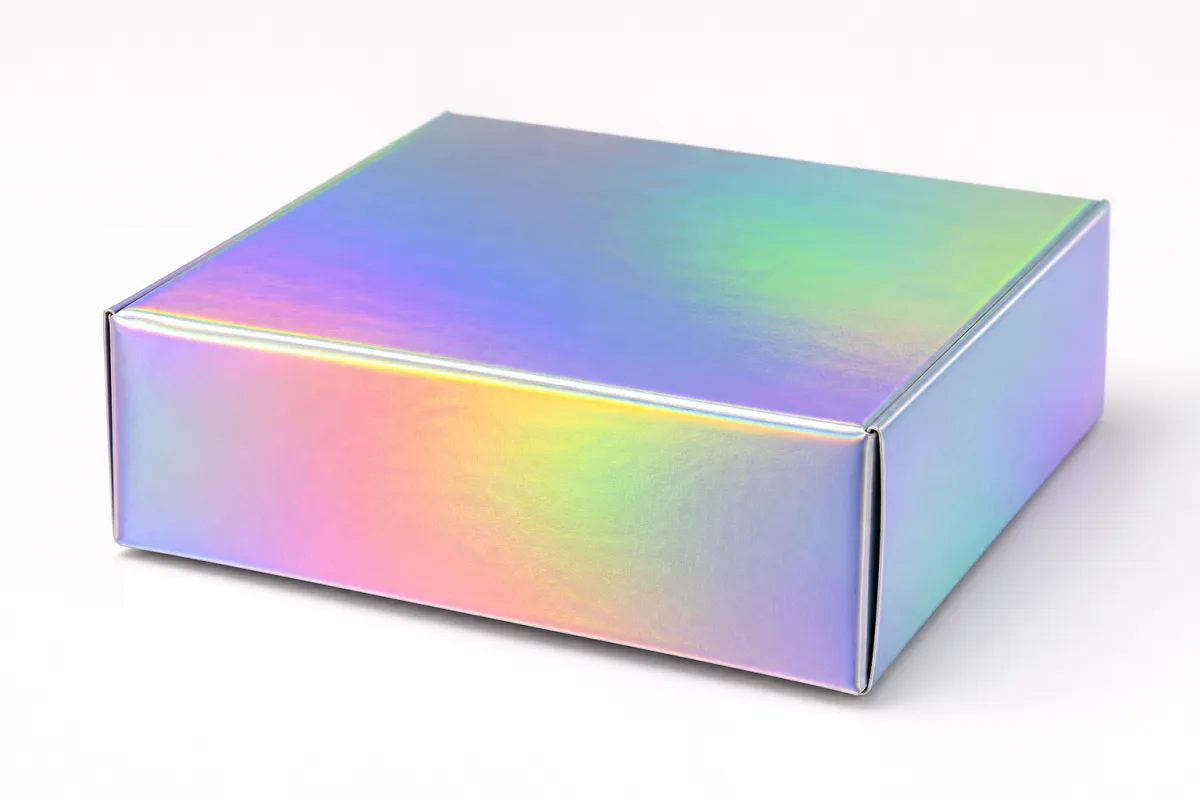
Custom holographic box packaging is a carton or rigid box that uses holographic film, foil, laminate, specialty stock, or printed optical effects to create motion, depth, and shifting color. The effect can cover the full outer surface, or it can sit in one precise zone such as a logo panel, lid, sleeve, or shoulder wrap. In Shenzhen and Foshan, suppliers often split these into full-wrap film, partial foil, and specialty board options because each one behaves differently on press and on the packing line. Both approaches work. They just solve different problems. Full coverage says, "look here." Accent treatment says, "look again." I have a soft spot for the restrained version because it feels smarter to me; the box still has a pulse, but it does not shout over the product like an over-caffeinated intern.
The premium feel comes from a simple visual reaction: the eye reads movement as effort. A static matte carton looks safe and familiar. A box that throws color across its surface as the angle changes feels more engineered and more intentional. That is why I keep seeing custom holographic box packaging in retail packaging for cosmetics, trading cards, earbuds, specialty confectionery, and short-run gift sets from Yiwu to Ningbo. It signals novelty without needing a long sales pitch. I first noticed this years ago at a beauty trade show in Shanghai, where one booth had a row of plain cartons and one holographic sample. Guess which one stopped traffic? The plain boxes were practically invisible. Harsh, but true.
Shape matters as much as shine. Good packaging design is really about visual hierarchy. A designer has to decide where the effect starts, where it stops, and what should stay readable. I have watched one brand bury its message by putting holographic treatment everywhere, while a competitor used a thin reflective border and made the logo feel twice as expensive. Decoration and package branding are not the same thing. They can fight each other if you are not careful, which is a bit annoying because the expensive-looking option is not always the smarter one. A 2 mm halo of foil around a logo can outperform a full-panel rainbow if the type size is only 7 pt.
Structure changes the result too. A folding carton, a rigid box, a drawer box, a sleeve, and a mailer all behave differently under a holographic finish. The same artwork can feel loud on one format and elegant on another. Custom holographic box packaging needs to be planned around the box style, the product size, and the shipping route from the start. A mailer moving from Shenzhen to Long Beach has different scuff risks than a counter display box selling in Hanoi. Treating it as a late-stage visual flourish usually leads to compromise. I have seen a rushed finish turn a beautiful concept into a very costly shrug.
I tell clients to think of custom holographic box packaging as a tool, not a trend. Use it for energy, shelf contrast, or collector appeal. Skip it when the category depends on quiet luxury, clinical trust, or stripped-back branding. A dermatologist brand in Seoul will need a different visual volume than a sneaker collab in Los Angeles. Both paths can be correct. The right choice depends on the story, the margin, and the buying moment. My opinion? If the product needs calm, do not force fireworks just because the sample looks fun under studio lights.
Why Does Custom Holographic Box Packaging Stand Out So Quickly?
Custom holographic box packaging stands out because the human eye is drawn to motion, contrast, and light shift before it reads text. That instinct is old, almost primitive. A surface that changes as the shopper moves feels active, while a flat carton feels still. In a crowded aisle, that difference can matter more than a longer product description or a cleaner claims panel. A box that earns even a half-second longer glance has already created an advantage, and that is why brands use holographic Packaging for Launches, limited editions, and gift sets. It is not just ornament. It is a timing device for attention.
The effect is strongest when the finish matches the category. A playful accessory line can handle more flash. A prestige skincare box usually needs a quieter arrangement with one controlled holographic accent and stronger contrast around the logo. That balance gives custom holographic box packaging its real value: it can feel vivid without becoming chaotic. I have seen brands spend more on a finish than on the structure, only to discover that a cleaner layout with a smaller reflective zone sold better. Attention is easy to get. The harder part is shaping it into trust.
There is also a practical reason it works. Holographic surfaces create tiny changes in brightness across the carton, and those changes get noticed in peripheral vision before the brain has fully processed the text. That is why a shopper can spot the box from three feet away even if the logo is still too small to read. The eye is doing the first pass for you. I have seen the same thing in airport retail, where overhead lighting and long sightlines make reflective packaging look almost louder than the products beside it. A plain carton can fade into the shelf line. A reflective one does not.
How Custom Holographic Box Packaging Works
The production path for custom holographic box packaging usually begins with a dieline, then artwork, proofing, material selection, printing, holographic application, cutting, folding, and final finishing. A standard folding carton might start on 350gsm C1S artboard, while a rigid gift box may use 1200gsm grayboard wrapped in 157gsm art paper. Clean artwork on a standard structure can move quickly. Tight alignment around a logo, window, or panel edge takes more care. A 1.5 mm mismatch can ruin a concept that looked perfect on screen, especially once the reflective pattern drifts during assembly. I wish I could say the machine forgives tiny mistakes. It does not. It is, frankly, less emotionally generous than any human I have met.
Four production methods show up most often in custom holographic box packaging:
- Holographic laminate on printed board, where a film is applied over the surface for broad shimmer and color shift.
- Holographic foil stamping, where the effect is pressed into selected areas such as a logo, border, or pattern.
- Specialty holographic stock, which already carries the visual effect before printing begins.
- Spot-effect overlays, where the holographic look is limited to one zone for contrast and control.
Each method changes the cost, the speed, and the visual result. Laminate gives the widest shine. Foil stamping gives the sharpest branding moment. Specialty stock brings strong visual motion before the ink even goes down. Spot effects give the most control over readability and spend. For custom holographic box packaging, that choice affects waste, setup time, and how much ink coverage the printer can safely run over the surface. A printer in Dongguan may keep total coverage under 280% for some laminated boards, while a Shanghai plant may allow a slightly different ink build on coated stock. If a client tells me they want "just a little bit of everything," I usually know trouble is coming. That phrase tends to translate into extra rounds of proofing and a factory manager sighing into their coffee.
The effect itself comes from light hitting micro-embossed surfaces or layered films at different angles. The same carton can look blue in one hand, pink in another, and nearly silver under harsh overhead lamps on a back shelf. I have watched a sample board look flat in a warm office, then flash like a prism under a fluorescent packing line. Angle matters. So does the bulb above the shelf. That part always amuses me a little: a brand spends weeks perfecting a finish, then a cheap light fixture can make or break the whole thing. A 4000K retail LED in a Toronto pharmacy aisle will show a very different result from a 2700K lamp in a hotel gift shop.
Designers get more control than most buyers expect. They can choose the pattern scale, the coverage area, the contrast between matte and gloss, and the placement of type relative to the effect. They can decide whether the logo sits on a calm field or inside the strongest visual motion. In custom holographic box packaging, those decisions decide whether the box reads as expensive or simply noisy. A foil band 8 mm wide can feel deliberate; a 40 mm band can feel like it is competing with the copy. And noisy is not a style. It is a mistake with glitter on it.
Tradeoffs appear quickly once production starts. Fine text can disappear if the background is too active. Deep black can intensify holographic effects, but it can also crush small details. Complex dielines create more alignment risk. Too many folds, flaps, or glued edges can push the finish out of tolerance and force another proof round. I have seen teams rescue a project by simplifying one panel instead of chasing a perfect all-over effect the factory could not hold consistently. That kind of compromise is not defeat. It is professionalism, even if nobody claps for it. On a 6-panel sleeve with a 3 mm bleed, the simplest fix is often the best fix.
If you are comparing structures, start with Custom Packaging Products and match the box style to the effect before you commit to print. A rigid box with a wrapped lid behaves differently than a folding carton with an auto-bottom, and custom holographic box packaging should account for that difference before the first proof leaves the press. For example, a 160 x 110 x 35 mm folding carton can tolerate less wrap tension than a 240 x 180 x 70 mm rigid presentation box.
For buyers who need standards-based testing, I often ask whether the box must survive shipping, retail handling, or both. That is where ISTA test standards become useful. If a mailer or outer box has to survive transit without scuffing the finish, the structure and coating need to support that. A glossy shine means very little if the corners arrive rubbed white. I have seen that happen in a pallet check in New Jersey, and the mood in the room changes instantly. Nobody enjoys opening a pallet to find the corners looking tired before the boxes even made it to the shelf.
Key Design Factors That Shape the Holographic Effect
The biggest levers in custom holographic box packaging are substrate choice, finish type, print palette, effect coverage, and box style. A 350gsm C1S artboard with soft-touch lamination reads very differently from a 1200gsm rigid board wrapped in 157gsm art paper. One feels nimble and retail-ready. The other feels heavier in the hand and usually suits gifting or luxury product packaging. I have a bias here: if the product is meant to feel premium, the box should not feel like an afterthought someone grabbed from a stock list at 4:58 p.m. The numbers matter because weight changes perception; a carton under 60 grams usually feels temporary, while a rigid box over 180 grams feels more deliberate.
I have seen a bold rainbow effect work beautifully for collectible trading cards and limited-edition beauty drops because the audience expected energy. I have also seen that same look damage a premium skincare line that wanted calm, clinical trust. In that case, a narrow holographic edge on the lid and a silver foil logo delivered the right amount of motion without turning the box into a toy. That is the real job of custom holographic box packaging: fit the category, not fight it. A 10 mm edge band can feel sophisticated; a full-surface prism can feel noisy if the serum inside costs $68 and the buyer expects restraint.
Product category, buyer age, and retail setting all change the sweet spot. A display box at a pop-up shop in Seoul can tolerate more flash than a pharmacy shelf in Melbourne. A Gen Z accessory launch can usually carry more color shift than a B2B tech accessory. A seasonal gift box may need extra sparkle because it competes with decoration, not just competitors. Good custom holographic box packaging adapts to those realities instead of using one visual formula for everything. A holiday box selling in November has a different job than a January launch carton. The market is crowded enough without packaging insisting on being the same everywhere.
Lighting deserves its own warning. I always recommend proofing under at least three conditions: fluorescent retail light, warm home light, and phone flash. The same box can behave like three different designs. In one supplier meeting in Foshan, a client approved a sample under warm LEDs, then rejected it the next day in a warehouse aisle because the silver-blue shift overpowered the brand name. We fixed it by reducing coverage on the side panels and keeping the hero face cleaner. That saved the project, though not the client's patience, which was already hanging by a thread after two proof rounds.
Sustainability matters too, and buyers ask about it more often now. If the box uses mixed materials, the recycling path changes. FSC-certified board helps on the paper side, but foil, film, and heavy laminates can complicate recovery. I point clients to FSC certification guidance early, then ask the packaging supplier what can be separated cleanly at end of life. For disposal rules and consumer recycling language, the EPA's recycling resources at epa.gov/recycle are worth checking before claims go on the carton. Packaging teams love to say "eco-friendly" with a straight face; the materials usually have a more complicated opinion, especially when a PET-based film is glued to paperboard.
A short way to think about the design levers in custom holographic box packaging looks like this:
- Substrate: folding carton for lighter retail volume, rigid board for premium feel.
- Finish: matte contrast often makes the holographic area read sharper.
- Color palette: dark grounds intensify shimmer, while pale grounds soften it.
- Coverage: full-wrap gives maximum impact; partial treatment protects readability.
- Box style: sleeves, mailers, and rigid lids all change the perceived motion.
Many buyers overspend here. They assume more shine means more value. Not always. A cleaner layout, one strong branding panel, and one controlled holographic band can outperform a full-surface treatment that makes the logo hard to read. Strong package branding usually comes from restraint, not volume. A 22 mm logo zone with a matte field can sell better than a full-wrap rainbow on a box that costs only $0.22 more to print. I know that sounds slightly boring, but boring does not get complaints, and complaints are expensive.
What Custom Holographic Box Packaging Costs
There is no single rate for custom holographic box packaging, and anyone who promises one is usually skipping the variables. Material grade, coverage area, print complexity, box construction, finish count, quantity, and freight all affect the number. A 1,000-piece rigid box with foil, inserts, and a custom tray sits in a different budget tier than a 10,000-piece folding carton with spot holographic accents. Structure changes labor. Labor changes price. This is one of those unglamorous truths that packaging buyers eventually learn the hard way, usually after a quote lands with a thud in the inbox. A factory in Guangzhou may quote a lower base price than one in Dongguan, but the insert spec can erase that difference fast.
On a supplier call in Dongguan, I watched a 2,000-piece luxury accessory job jump by 19% because the buyer wanted full-wrap holographic board plus a separate hot-stamped logo and a custom insert. The insert alone added die-cutting, tool setup, and extra packing time. Buyers usually look at the outside first, but the quote is built from the inside out. For custom holographic box packaging, insert geometry, glue points, and finishing passes can matter as much as the visual effect. A 1.5 mm insert tolerance, a magnet closure, and a double-wall tray can each add cost in a different line. I remember muttering, not very diplomatically, "the box is not free just because the glamour is visible."
The easiest way to compare costs is by effect area. Full coverage usually costs more because it needs more specialty material and more careful handling. Accent-only treatment often keeps the premium feeling while lowering unit cost. A logo panel, edge band, or lid accent can deliver most of the visual reward for a fraction of the material spend. That is why I often steer smaller brands toward partial custom holographic box packaging instead of all-over shimmer. You do not need a fireworks show if a single spotlight gets the job done. A 12 mm foil border on a 90 x 140 mm box can look more refined than a full rainbow field on the same footprint.
Here is a practical budget snapshot I use as a starting point. These are working ranges, not quotes, and they assume standard print runs without unusual freight or taxes.
| Option | Typical Run | Example Unit Cost | Visual Impact | Best Use |
|---|---|---|---|---|
| Holographic laminate on folding carton | 5,000 pcs | $0.15-$0.40/unit | Broad shimmer, medium control | Retail packaging with strong shelf contrast |
| Holographic foil stamping on logo panel | 5,000 pcs | $0.24-$0.58/unit | Precise branding, high readability | Package branding and premium accents |
| Specialty holographic stock with print | 3,000 pcs | $0.32-$0.74/unit | Strong motion, mid-to-high impact | Custom printed boxes for launches |
| Rigid box with all-over holographic wrap | 1,000 pcs | $1.35-$3.10/unit | High-end, collector feel | Gift sets and prestige product packaging |
Those numbers move fast if the order includes more than the box itself. I have seen pricing shift because a brand added EVA foam, velvet lining, magnetic closures, or a second print pass on the inside lid. A structural sample may also cost extra, but that sample often saves more than it costs by catching board thickness, color mismatch, or fit issues before the full run. For custom holographic box packaging, sampling is usually the cheapest mistake-prevention line item. Skipping it to save a little money is one of those decisions that feels smart for about twelve minutes. In one Shenzhen project, a $65 sample prevented a $4,800 reprint after the insert was found to be 3 mm too tall.
Buyers also forget overhead costs. Freight, storage, inspection fees, rush production, and replacement quantities can add real money. If the boxes ship by sea, the transit window is longer but the unit cost can be lower. If they ship air, the calendar is shorter but the landed cost rises quickly. That is why I tell clients to budget the full landed project, not just the ex-factory number. A box quote means little if the cartons miss the launch date by ten days. The box cannot sell anything from a warehouse in the wrong country, whether that warehouse is in Los Angeles, Rotterdam, or Manila.
A clean way to plan spend is to rank the parts of custom holographic box packaging by business value:
- Hero panel: Put the strongest effect where the shopper first sees the box.
- Logo area: Protect readability with contrast and enough quiet space.
- Structural fit: Pay for accurate size and insert clearance before decorative extras.
- Shipping durability: Add coating or carton strength if the box will travel far.
- Secondary surfaces: Simplify these before trimming the main branding face.
That order has saved more than one client from overdesign. A sharp panel beats a busy box with six weak ones. Good custom holographic box packaging should earn its cost in the first glance, not just in the quotation. If the eye lands, the budget starts to make sense. A 0.3-second stop in a retail aisle is worth more than a complicated finish that nobody can read from 4 feet away.
Production Timeline for Custom Holographic Box Packaging
A realistic schedule for custom holographic box packaging starts with the brief, then moves to dieline review, artwork setup, proofing, sample approval, production, finishing, and shipping. Simple folding carton jobs can move in 12-15 business days from proof approval if the factory already has the right materials in stock. More complex rigid boxes often need 18-30 business days because the wrapping, insert work, and hand assembly take longer. Quantity, special effects, and custom tooling change those numbers again. In a plant outside Shenzhen, I once saw a 10,000-piece run held back two days because the holographic film roll had to be rebooked from a distributor in Hong Kong. Timing sounds dull until it becomes urgent, which is usually how timing works in packaging.
The quickest stage is usually artwork setup, but only if the file is built correctly. The slowest stages are usually proof revisions and sampling. I have seen a project lose a full week because the logo was supplied in a low-resolution JPEG rather than a vector file, and the foil plate had to be rebuilt twice. That delay was avoidable. In custom holographic box packaging, clean files are part of the timeline, not a nice extra. Every extra fix is a tiny tax on the launch date. A clean AI or PDF file with 3 mm bleed saves more time than a dozen apologetic emails.
I once visited a Shenzhen facility where a launch box sat for 36 hours because the buyer approved a digital render without checking the dieline scale. The holographic band landed 4 mm lower than planned, which made the brand name sit too close to the fold. The fix was simple, but the pause was expensive. Since then, I push for a physical sample whenever the design has tight panel alignment, deep embossing, or mixed finishes. A prototype adds time up front. It saves more time later. If you have ever had to explain to a marketing team why the logo is living too close to the crease, you know exactly why that sample matters.
Small runs and large runs do not behave the same way. A 500-piece short run may look fast on paper, but it can sit behind setup work if the line is busy with a larger order. A 20,000-piece run may have a lower unit cost, but it usually needs more scheduling, more carton packing, and more freight planning. Custom holographic box packaging should be booked with the launch calendar in mind, not only the production calendar. A 5,000-piece order moving from Ningbo to Chicago on ocean freight may still need a 3-week cushion after packing.
Seasonality matters too. I have seen holiday gift packaging orders pile up because everyone wanted the same two-week window before peak sales. Trade shows create the same pressure. If the boxes have to arrive before a launch event, build in a cushion for sampling, customs clearance, and local delivery. Missing the booth date by three days can wipe out weeks of work. I have watched teams spend months on a product and then lose their nerve because the cartons were "almost ready." Almost ready is not a shipping plan. For an October show in Las Vegas, I would want cartons in the warehouse by mid-September.
For buyers who want a cleaner planning model, this is the order I recommend:
- Confirm the product dimensions and target box style.
- Review the dieline and structure before art starts.
- Approve a material sample and finish comparison.
- Request one physical proof if the effect is highly reflective.
- Book production only after the sample passes fit and color checks.
- Reserve shipping space early if the order is tied to a launch.
That process makes custom holographic box packaging easier to manage, especially for teams that do not order boxes every week. It also keeps the conversation honest. If a supplier says "fast," ask for business days, not slogans. Five days and fifteen days are not the same promise. I say this with affection and a little exasperation: packaging timelines are already tricky enough without translating marketing language into actual calendar math. A plant in Foshan may promise one thing; the press schedule in reality may allow another.
Common Mistakes to Avoid With Holographic Boxes
The most common mistake in custom holographic box packaging is too much effect. A box can lose its message if every surface flashes at full volume. I have seen shoppers struggle to find the brand name because the background was louder than the typography. The fix was not a new material. It was restraint. One strong panel, one clean logo, and one controlled pattern usually beat a full-wrap rainbow surface. A little discipline goes a long way here, which is inconvenient for people who want the box to do everything at once. A 15 mm logo field on a matte base often reads better than a 100% coverage film wrap.
Weak contrast causes a different kind of failure. Thin type, low-contrast logos, and long legal lines can disappear against an active holographic field. That matters in Custom Printed Boxes because the box still has to do a practical job: communicate the product, the SKU, and any required copy. If the visual effect makes the box harder to read, the packaging design has failed its first task. I have had to tell a client, very gently, that the eye-catching version was also the one that made the ingredients look like they were hiding from us. A 6 pt ingredient line on a rainbow field is not brave. It is hard to read.
"We thought the shimmer would sell the product by itself. It did not. The sample only worked after we moved the logo to a matte panel and cut the effect back by half."
I heard that line from a client after a very honest proof review, and it was the right lesson. Digital renders can flatter a design. Finished cartons do not. Rushing approval is a bad habit. If you only see the effect on a screen, you do not yet know how the coating, the board, and the room light will behave together. Custom holographic box packaging needs a physical check before sign-off, not after the pallet is already on the water. Screens lie more often than we like to admit, especially when a 3D mockup hides a fold line in plain sight.
Another trap is treating every holographic material as interchangeable. It is not. Different films, inks, foils, and coatings react differently to pressure and heat. One supplier may hold sharp registration at the logo edge, while another leaves a slight blur on fine lines. On a factory floor, that difference shows up quickly. In one negotiation I sat through in Dongguan, two nearly identical sample boards came back with completely different edge clarity because the base stock and topcoat were not matched properly. The buyer thought it was a minor detail. The press did not agree.
Logistics mistakes can hurt the finished result too. Underestimating carton size by 2-3 mm can create a tight product fit. Forgetting insert clearance can crush corners. Choosing a thin outer board for a heavy product can lead to edge wear on the first shipment. For custom holographic box packaging, durability matters because the reflective finish tends to magnify scuffs and dents. A small flaw looks bigger on a shiny surface. That is the annoying part of a beautiful finish: it is honest about every mistake. A corner rub on silver film can look twice as bad as the same rub on uncoated kraft.
To keep the project clean, I suggest a simple preflight check:
- Confirm the exact product dimensions and insert tolerances.
- Review type size on the final dieline, not just the mockup.
- Ask for a material sample with the chosen finish.
- Test the proof under at least two light sources.
- Check shipping stack strength if the cartons will travel long distances.
That list looks basic, but it catches most of the costly surprises. Strong custom holographic box packaging depends on discipline more than flair. Flash is easy. Getting the thing to arrive pretty, readable, and intact is the real job. A box that lands in Los Angeles with crisp edges after a 21-day sea transit has earned its keep.
Expert Tips for Ordering Custom Holographic Box Packaging
Start with the product story, not the effect. That is the first rule I give every brand that asks for custom holographic box packaging. Decide what the box should say in one sentence. Is it energetic? Collectible? Giftable? High-tech? Once that sentence is clear, the visual treatment becomes easier to control. Without it, the project can drift into "more shine" for its own sake. I have seen that drift happen, and once it starts, everyone suddenly has a strong opinion about sparkle and no opinion at all about the actual customer. A launch box for a $32 beauty serum should not borrow the same visual voice as a $9 toy blister card.
Ask for three things before you sign off: a dieline, a material sample, and a finish comparison. The dieline proves fit. The sample proves structure and board weight. The comparison shows how holographic laminate behaves next to foil or matte coating. I have seen clients change their mind after holding those samples side by side, and that is a good outcome. A decision made with real material in hand is worth more than five email opinions. Email opinions are cheap. Cardboard is not. In practical terms, a sample package in your hand from Dongguan or Shenzhen is more useful than a dozen mockups on Slack.
I also recommend testing the box from at least three angles and under two lamps. That sounds small, but it is where most visual mistakes show up. The shimmer may be beautiful head-on and awkward from the side. The logo may read perfectly in daylight and become hard to see in a showroom with warm LEDs. Custom holographic box packaging needs that practical review because the buyer will not stand still in perfect lighting. Neither will the person stocking the shelf, which is another detail people somehow forget until it is too late. A 500 lux aisle and a 2700K bedside lamp will tell you different truths.
Cost control is not about stripping the design bare. It is about putting the strongest treatment where it matters most. Reserve the most dramatic holographic work for the lid, hero panel, or logo zone. Leave the back panel calmer if it carries ingredients, compliance copy, or shipping labels. I have watched teams save 12%-18% on the quote simply by trimming the effect area rather than removing the premium look entirely. That is a better trade than cutting quality board and hoping nobody notices. They always notice. They may not say it politely, but they notice. A move from full-wrap to a 30% coverage accent can cut the budget by hundreds on a 5,000-piece order.
For sustainability-minded buyers, ask what the structure is made from and how mixed materials affect recycling. A clean paperboard box with a limited effect is usually easier to explain than a carton wrapped in multiple films, heavy lamination, and mixed inserts. If your brand claims recycled content or FSC sourcing, check the chain carefully before the order goes live. On some product packaging lines, one extra mixed layer complicates disposal language far more than buyers expect. Claims can become surprisingly fragile when the materials underneath are messy, especially if the cartons ship through markets with different recycling rules such as the UK, California, and Germany.
Here is the order I would use for a serious sourcing round:
- Audit the SKU count and confirm the exact box dimensions.
- Set a target budget for unit cost, samples, and freight.
- Choose the box style that fits the product and channel.
- Request samples for the finish options you are considering.
- Review the proof under multiple lights and angles.
- Lock the spec only after the structure and effect both pass.
If you need a broader starting point, the Custom Packaging Products page is a practical place to compare folding cartons, rigid boxes, sleeves, and mailers before you commit to custom holographic box packaging. I also tell teams to keep one rule in mind: the best box is the one that ships cleanly, displays clearly, and feels right in the hand. The sparkle should support the product, not bury it. That standard has saved more than one launch from expensive rework. A box built in Ningbo or Guangzhou can still miss the mark if the finish overwhelms the product message.
The smartest brands treat custom holographic box packaging as a controlled investment. They know where the effect earns its keep, where it should be restrained, and where the structure has to do more of the work than the finish. That mindset usually produces better branded packaging, stronger retail packaging, and fewer surprises on press. It also makes the whole process a little less dramatic, which is a relief because packaging already has enough drama for one industry. A 3,000-piece launch in Shenzhen needs discipline more than sparkle.
What is custom holographic box packaging best used for?
It works especially well for products that need instant shelf attention, such as cosmetics, tech accessories, gift sets, and collectibles. I have seen custom holographic box packaging outperform plain cartons in a 24-unit display because the shimmer pulled the eye before the shopper read the SKU. It is strongest when the packaging is part of the brand story, not just a decorative add-on. If the box feels connected to the product, people tend to trust it faster. A limited-edition launch in Los Angeles or Seoul will usually benefit more than a routine replenishment carton.
How much does custom holographic box packaging usually cost?
Cost depends on quantity, box style, coverage area, finishing method, and whether inserts or special printing are included. Full-coverage holographic treatments usually cost more than accent treatments because they need more material and setup. For custom holographic box packaging, the cleanest budget review compares unit cost, sample cost, setup fees, and freight together instead of looking at one line item alone. A 5,000-piece folding carton on 350gsm C1S artboard may land near $0.15 per unit ex-factory, while a 1,000-piece rigid box with wrap and insert can move past $1.50 per unit. That is the only way I trust a quote, because the first number is rarely the final number.
How long does custom holographic box packaging take to produce?
Timing usually includes dieline setup, artwork approval, proofing, sample review, production, finishing, and shipping. Simple orders can move in 12-15 business days from proof approval, while more complex builds may need 18-30 business days. Build extra time into the schedule if the packaging must arrive before a launch, trade show, or seasonal sales push, because custom holographic box packaging slows down when the effect needs multiple proof rounds. If someone promises the impossible, I would ask for the calendar in writing. A factory in Foshan or Dongguan may finish the work quickly, but freight to Chicago, Berlin, or Sydney still needs its own clock.
Can custom holographic box packaging be recyclable?
Sometimes, but it depends on the base board, laminate, foil, and coating choices. Some holographic effects are easier to recycle than others, especially when the design uses fewer mixed materials. Ask the supplier what recovery and disposal options fit the exact construction before you finalize the spec for custom holographic box packaging, and check the recycling language against the materials in the finished box. A 100% paperboard carton with limited foil is easier to explain than a carton with film wrap, EVA inserts, and magnetic closures. A pretty carton is great; a pretty carton with vague disposal claims is a headache nobody asked for.
What is the difference between holographic foil and holographic laminate?
Foil is typically applied as a decorative layer in specific areas, while laminate covers more of the surface. Foil is better for targeted branding moments; laminate often creates a broader all-over shimmer. The right choice depends on budget, visual goals, and how much of the box should stay readable, which is why custom holographic box packaging should be chosen after the structure and content needs are clear. My rule of thumb is simple: if the logo has to do the heavy lifting, keep the effect disciplined. A 12 mm foil mark on a matte lid is usually easier to read than a full laminate field over a 9 pt type system.
If you plan the effect with the product, the structure, and the shelf environment in mind, custom holographic box packaging can do more than look attractive. It can raise perceived value, support product packaging strategy, and make the whole brand feel more deliberate the moment the box is lifted from the shelf. The practical takeaway is simple: lock the hero panel, board choice, and shipping test before you fall in love with the shine. Do those three things well, and the holographic effect stops being decoration and starts doing real work.

