A custom pillow box has a simple shape, but that simplicity is part of the appeal. The curved profile gives small products a more finished presence without adding much weight, setup time, or storage burden. It is the kind of packaging that can make a modest item feel intentional, which is often all the lift a brand needs at point of sale.
Buyers usually consider this format when they need presentation, economy, and fast assembly in the same package. It ships flat, folds quickly, and suits lightweight items that do not need heavy structural protection. For gift cards, jewelry, cosmetics, tea sachets, promotional inserts, and seasonal giveaways, the format is practical rather than flashy, which is exactly why it keeps showing up in retail packaging plans.
The strongest use cases are the ones where the box has to do a little selling. A pillow box is not meant to replace a rigid gift box or a protective mailer. It works best when the product itself is small, the branding has to be clear, and the budget cannot absorb unnecessary material or labor.
What a custom pillow box is and where it fits best
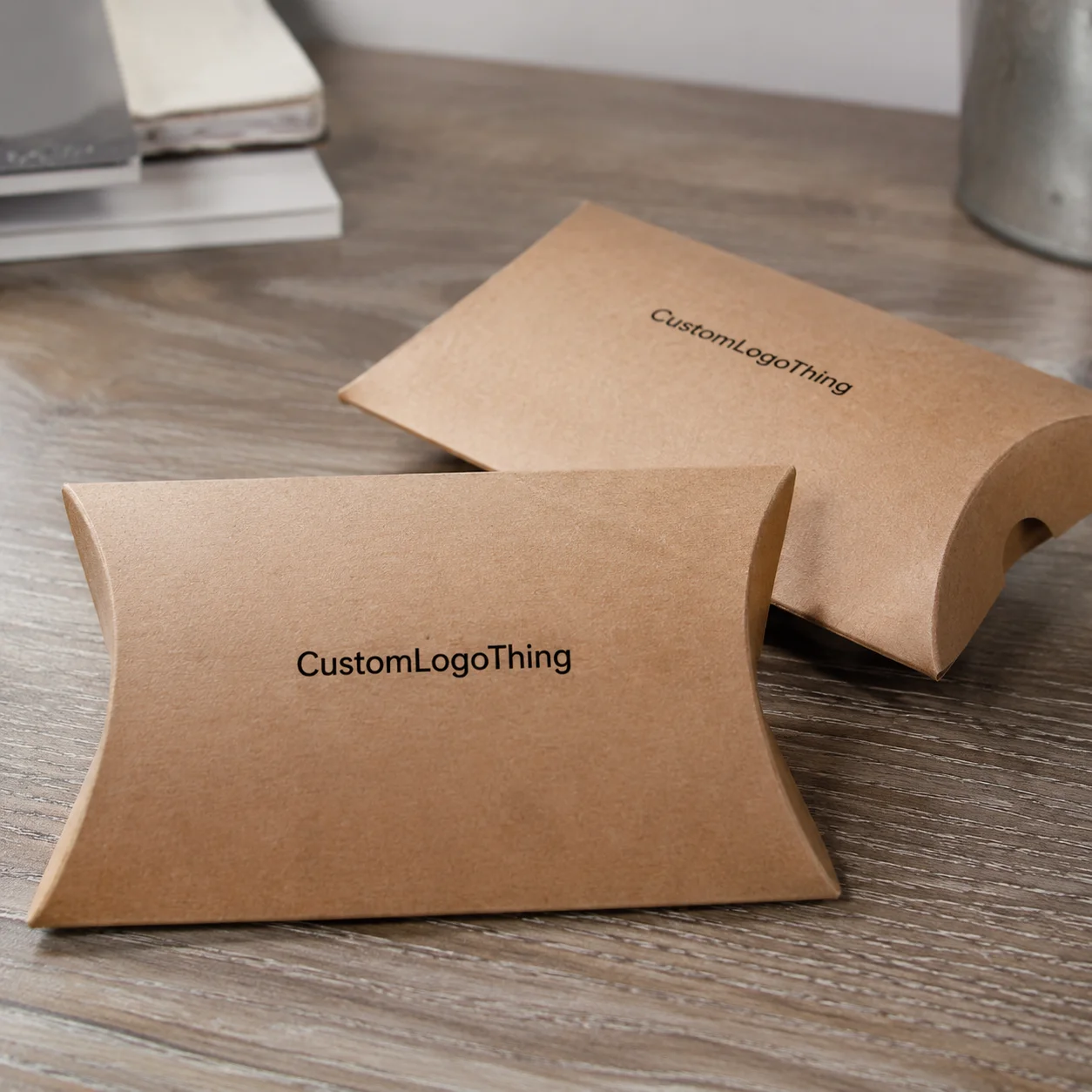
A pillow box is a die-cut paperboard package with concave sides and tuck-in ends. Once folded, it forms a rounded body that closes at both ends without requiring glue in the basic structure. That gives it a clean silhouette and a familiar opening action, which shoppers often read as gift-ready even before they handle it.
Most versions are made from paperboard in the 250gsm to 400gsm range, depending on product weight and how much stiffness the buyer wants. Lighter stock can work for gift cards, samples, and small accessories. Heavier stock is better when the package needs to feel substantial in the hand or resist flattening during handling. The format is not designed for heavy products, and pushing it too far usually ends in bowed sides, loose closures, or crushed corners.
That limitation is not a weakness if the product is chosen correctly. For compact goods, the format can look more refined than a pouch and less expensive than a rigid box. It also stores efficiently because the blanks arrive flat, which matters for seasonal programs and any line that needs replenishment without swallowing warehouse space.
Visual discipline matters more on a small package than on a large one. There is less room to hide clutter, weak typography, or off-balance color placement. If the logo is oversized, the layout can feel cramped. If the artwork is too minimal, the package can look unfinished. A good custom pillow box usually succeeds by keeping the graphic system clear and the material honest.
“Small-format packaging exposes sizing and print decisions immediately. If the dieline is off by a few millimeters, you see it as soon as the box is folded.”
For brands comparing packaging styles across multiple SKUs, it helps to review other Custom Packaging Products before settling on one structure. A pillow box is efficient, but it is not the right answer for every item. The best package is the one that fits the product, the channel, and the packing workflow without forcing extra material into the chain.
How the structure is made and assembled
Production typically starts with a dieline, then moves into print, finishing, die-cutting, and folding. The dieline defines the cut line, fold line, and tuck geometry, so it is the technical core of the whole job. When the dieline is clean, assembly is easy. When it is not, the box can sit slightly twisted or close unevenly, even if the artwork looks fine on screen.
Printing methods depend on quantity and turnaround. Offset printing is common for larger runs because it delivers stable color and sharp detail across a full batch. Digital printing is often the better fit for short runs, rapid sampling, or jobs that may still need artwork changes. For buyers, the practical difference is not just speed; it is also how closely the final boxes match the proof and whether small text remains legible after folding and finishing.
Coating and finishing change the feel immediately. Aqueous coating adds basic scuff resistance and gives the surface a cleaner look. Matte lamination softens reflections and can make the box read as more restrained or premium. Gloss lamination brightens color and increases contrast. Spot UV can highlight a logo or pattern, while embossing and debossing add depth at the cost of extra tooling and tighter registration checks.
Assembly is usually manual or semi-manual. That is one reason this format works well for compact retail packaging. Workers can fold and pack it quickly, and the ends tuck in without complicated locking steps. On a busy line, that time savings is real. For automated packing, the fit and closure depth should still be tested, because a box that folds nicely by hand may behave differently once filled at speed.
The product inside matters as much as the box itself. A loose item can shift, open up the ends, and make the package look sloppy even if the box dimensions are technically correct. Inserts, tissue, or a shallow tray can help keep the item centered. That becomes especially important for small cosmetics, paired gift items, and anything with uneven weight distribution.
A custom pillow box also tends to reward clear pack-out decisions. If the product ships as a single unit, the cavity can be tighter. If it holds a bundle, a wrapped item, or a promotional set, the structure needs a little more allowance. Buyers who account for handling tolerance early usually avoid the rework that comes from discovering, too late, that the box “fits” only when the item is forced into place.
Specs that drive fit, strength, and print quality
Dimensions are the first decision that affects whether the package performs in the real world. Measure the product at its widest point, then add space for any insert, closure depth, and handling tolerance. The difference of a few millimeters can determine whether the ends tuck neatly or fight the product inside. That is especially true with rigid items, delicate products, or pieces that have an irregular edge.
Board thickness comes next. A thinner stock can work for lightweight samples and low-stress retail items, but heavier goods usually need a sturdier sheet. In practice, 300gsm is often used for lighter presentation packaging, while 350gsm to 400gsm gives more stiffness and a better feel for premium small items. The right choice depends on how much the box has to support the product during handling and display, not just how it looks in a mockup.
Color and artwork placement deserve more attention than they often get. Because the box curves inward on the sides, a design that looks balanced on a flat proof can shift slightly after folding. Logos should be placed with the structure in mind, not just centered by instinct. Small text needs enough quiet space around it to remain readable once the box is assembled. For brands that already use defined colors elsewhere, asking for a proof against a standard reference is much safer than relying on a rough visual match.
Finishes should earn their place. A matte or gloss surface is usually enough for many applications. Soft-touch lamination can work well for premium gifting, but it can also show handling marks if the box is overhandled. Foil and embossing add visual weight, yet they bring extra setup time and stricter alignment requirements. On a small format, decorative effects can improve the package quickly, but they can also push the design into clutter if used without restraint.
Window cutouts create a direct product view, which can help in retail settings. They also reduce some structural strength and add a layer of complexity in finishing. For products that are oily, delicate, or meant to stay protected from touch, a window is not always the better choice. Sometimes a strong front-panel graphic does more than a cutout ever could.
Sustainability is best treated as a production decision, not a slogan. Recyclable paperboard, FSC-certified stock, and limited ink coverage are straightforward ways to keep the package more responsible. The Forest Stewardship Council explains certification and responsible sourcing at fsc.org. Right-sizing the carton often matters more than any printed environmental message because it reduces board use, freight volume, and waste from oversize packaging.
There is a cost angle to that too. A box that uses fewer coatings, fewer special effects, and less board is often cheaper to make and easier to recycle. That combination is not guaranteed, but it is common. The cleanest design solution is often the one that does the job without extra material doing nothing.
Pricing, MOQ, and the main cost drivers
Pricing usually comes down to material, print coverage, finishing, tooling, and quantity. A plain run on standard stock is one thing. A full-color box with lamination, foil, or embossing is another. With a small format like this, setup can weigh heavily on the per-unit number, especially when the order is short.
As a practical range, simple pillow boxes at larger quantities may land around $0.18 to $0.35 per unit, while premium versions with specialty finishes can move into the $0.40 to $0.85 range or higher. That spread is normal. The more useful question is not whether the box is cheap, but whether the spec matches the value of the product inside.
MOQ changes the price structure quickly. A run of 1,000 pieces usually carries more setup cost per box than a run of 5,000 or 10,000, because the press make-ready, proofing, and converting labor are spread over fewer units. That is not a pricing trick; it is how production economics work. Once buyers understand that, the quote conversation gets easier and less frustrating.
The comparison below shows the usual tradeoff between cost and finish level:
| Option | Typical Use | Relative Cost | Notes |
|---|---|---|---|
| Plain kraft or white stock | Samples, promos, entry-level retail | Lowest | Best when the brand can stay simple and the schedule is tight |
| Full-color printed stock | Retail launches, branded kits | Moderate | Good balance of presentation and cost for most small items |
| Printed with matte or gloss coating | Cosmetics, gifts, premium accessories | Moderate to higher | Adds scuff resistance and a more finished surface |
| Printed with specialty finish | Premium gifting, seasonal campaigns | Highest | Foil, embossing, soft-touch, and windows add setup and inspection time |
There are ways to keep cost under control without stripping out the brand. Use fewer colors if the design allows it. Avoid stacking multiple specialty finishes on one package. Keep the die layout efficient so sheet usage stays clean. If foil does not help the product sell, skip it. A sharp layout and a good stock choice usually matter more than decorative additions.
Shipping needs to be considered as part of the total landed cost. Flat cartons are efficient, but freight still affects the final number, especially on larger runs. A low unit quote can stop being attractive if the packing configuration is poor or if the shipment has to be split. Buyers should ask what the quote includes, how cartons are packed, and whether the freight assumptions are realistic for the destination.
Turnaround: from dieline to delivery
The usual workflow begins with a brief that covers product size, quantity, market, artwork goals, and packing method. From there, the supplier confirms or creates the dieline, then moves into proofing, printing, finishing, die-cutting, and final inspection. The order of operations is straightforward, but the schedule can still drift if approvals are slow or the artwork file is not ready.
Most delays happen before the boxes ever reach press. Missing logo files, unclear brand colors, repeated artwork edits, and late dieline changes can all slow a job down. Specialty finishes add more checkpoints, and each one needs careful alignment. A run that looks quick in planning can stretch if the file is still moving after the technical layout has already been approved.
Simple production runs often fall in the 12-15 business day range after proof approval. More detailed orders, especially those with multiple finishes or window work, may take 18-25 business days or more. That does not include transit time. If the boxes support a seasonal launch or product release, the production calendar needs a cushion. Schedules rarely get looser later.
Shipping method matters just as much as manufacturing time. Air freight cuts transit time but increases cost. Sea freight lowers shipping cost but requires more lead time and a stronger plan for customs and arrival. For a fixed launch date, it helps to work backward from the shelf date instead of forward from the moment the artwork is finalized.
Testing can be useful even when the box is mainly a presentation package. The International Safe Transit Association outlines common shipment testing methods at ista.org. If the box will travel through a distribution chain, those tests can expose closure issues, insert movement, or crush risk before a full run is committed. That is especially helpful when the product inside is fragile or the package has to arrive looking clean.
For teams that ship in volume, the cost of one failed run is usually much higher than the cost of a sample and a test pack. It is far cheaper to catch a weak closure in preproduction than to learn about it after a pallet is already in transit.
Ordering checklist for first-time buyers
Start with the product. Measure the item at its widest and tallest points, then note whether it is rigid, fragile, liquid-sensitive, or irregular in shape. Record the way it will be packed too: single unit, paired set, wrapped item, or sample bundle. Those details determine the board choice, the cavity size, and whether an insert is needed.
Then decide what the box has to do. Is it for retail shelves, a promotional drop, a gift set, or an ongoing replenishment program? Each use case changes the balance between cost and finish. A short seasonal campaign may justify a richer visual treatment. A recurring order usually needs simpler production so the price stays stable over time.
When requesting quotes, send clear information:
- Finished product dimensions and any accessory dimensions
- Quantity target and acceptable MOQ range
- Preferred stock, such as kraft, white board, or coated paperboard
- Print colors, logo files, and reference artwork
- Finish preferences, including matte, gloss, soft-touch, foil, or embossing
- Packing details, including inserts, bundling, and shipper requirements
Compare more than the price. Ask whether the quote includes dieline support, a printed proof, and any finishing setup. Some suppliers quote a low number and add support services later. Others include the technical help up front. The second quote may be better value once the real production work is counted.
Artwork files deserve the same attention as the box spec. Vector logos are cleaner than low-resolution artwork. Bleed, safe area, and barcode placement should be confirmed before approval. If the packaging needs regulatory text, batch information, or retail marks, make sure the layout has enough room for them without crowding the design. A packed panel can make a simple box look overworked very quickly.
Before full production, approve fit, finish, and timeline together. One without the others is not enough. A box that looks good but arrives late still causes a problem. A box that ships on time but does not close properly creates a different one.
Common mistakes and how to avoid them
The most common mistake is sizing the box around the product body alone. Buyers forget about tuck depth, insert thickness, closure friction, and how the item behaves once packed. A box can seem right on a screen and still feel awkward on a packing table. A physical sample is the safest way to check fit when the item is rigid, fragile, or unusually shaped.
Another issue is overbuilding the finish. It is easy to make a render look premium by stacking foil, embossing, heavy ink, and a window on the same layout. That approach often creates more production friction than brand value. On a small box, restraint usually works better. Clean typography and smart color blocking can do most of the visual work without turning the package into a project of its own.
Vague specifications create avoidable quote confusion. Words like “premium” or “nice finish” do not tell a supplier what board to use, how many colors are needed, or whether the surface should be matte or gloss. Clear specifications shorten the quote cycle and make supplier comparisons more reliable. They also reduce the chance of paying for assumptions you never wanted.
Last-minute artwork changes are another frequent source of delay. Once the dieline is approved, even a small move in the logo or barcode can require a new proof. That can add days to the schedule and, in some cases, extra cost. A stable file is usually more valuable than a slightly improved layout that arrives too late to use.
Barcode placement deserves its own check. If a code sits too close to a fold, a texture-heavy finish, or an embossed area, scanning can become unreliable. Keep functional elements on flat, low-interference panels whenever possible. That small decision saves time later in the packing and retail process.
“The best correction is the one you make before production starts. Once the run is printed, every small mistake gets expensive.”
Mockups help with presentation, but they can hide problems that only show up in hand. A physical sample tells the truth about stiffness, closure feel, ink density, and whether the package survives real handling. That is especially important for a custom pillow box, because the format is simple enough that any flaw in sizing or finishing becomes obvious very quickly.
In many cases, the best result comes from a well-balanced spec rather than an elaborate one. A properly sized box on a decent board, printed clearly and finished with restraint, will often outwork a more expensive design that was overcomplicated during sampling.
FAQ
What size should a custom pillow box be for small retail items?
Measure the product at its widest point, then add room for any insert, closure depth, and packing tolerance. If the item is rigid, fragile, or irregularly shaped, a sample fit is the safest check before committing to production. A box that is too tight can bow during assembly and close poorly.
Is a custom pillow box strong enough for lightweight products?
Yes, if the stock matches the product weight and the box is used as a presentation package rather than a protective shipper. It works well for lightweight cosmetics, accessories, gift cards, sample packs, and small promotional items. Heavier products usually need thicker board or a different structure with more support.
What drives custom pillow box pricing the most?
Material, print coverage, finishing, tooling, and quantity are the main cost drivers. MOQ matters because setup work gets spread across the run. Simpler artwork and fewer specialty finishes usually lower the unit cost.
How long does custom pillow box production usually take?
Simple runs often take about 12-15 business days after proof approval, while more complex jobs may take 18-25 business days or longer. Artwork revisions, specialty finishes, and shipping method all affect the final timeline. Build in extra time if the boxes support a fixed launch or seasonal schedule.
What should I send when requesting a quote?
Send finished dimensions, target quantity, preferred stock, print colors, finish options, and packing requirements. Include artwork files or reference images so the quote reflects the real spec, not a guess. The clearer the brief, the fewer revisions you usually need later.