Choosing a custom plastic retail bags supplier is simple only when the order is generic. In real retail, the bag has to carry the product safely, support checkout speed, and still look right when the customer leaves the store. If the film is too thin, the handles stretch, or the print is off, the bag fails on both function and brand presentation.
That is why price alone is not enough. A low quote can still be the wrong choice if the bag does not match the product, the loading weight, or the way your staff uses it. The best buying decisions start with a clear spec, not a vague request for “nice bags.”
Buyers who get better results usually ask for the basics first: size, material, thickness, handle style, print method, quantity, and delivery timeline. That is the shortest path to accurate quotes and fewer revisions. For a clean first quote, include artwork in vector format, the target pack-out weight, and whether you need retail-ready bundling such as 100 pieces per bundle and 10 bundles per carton.
What a custom retail bag really needs to do
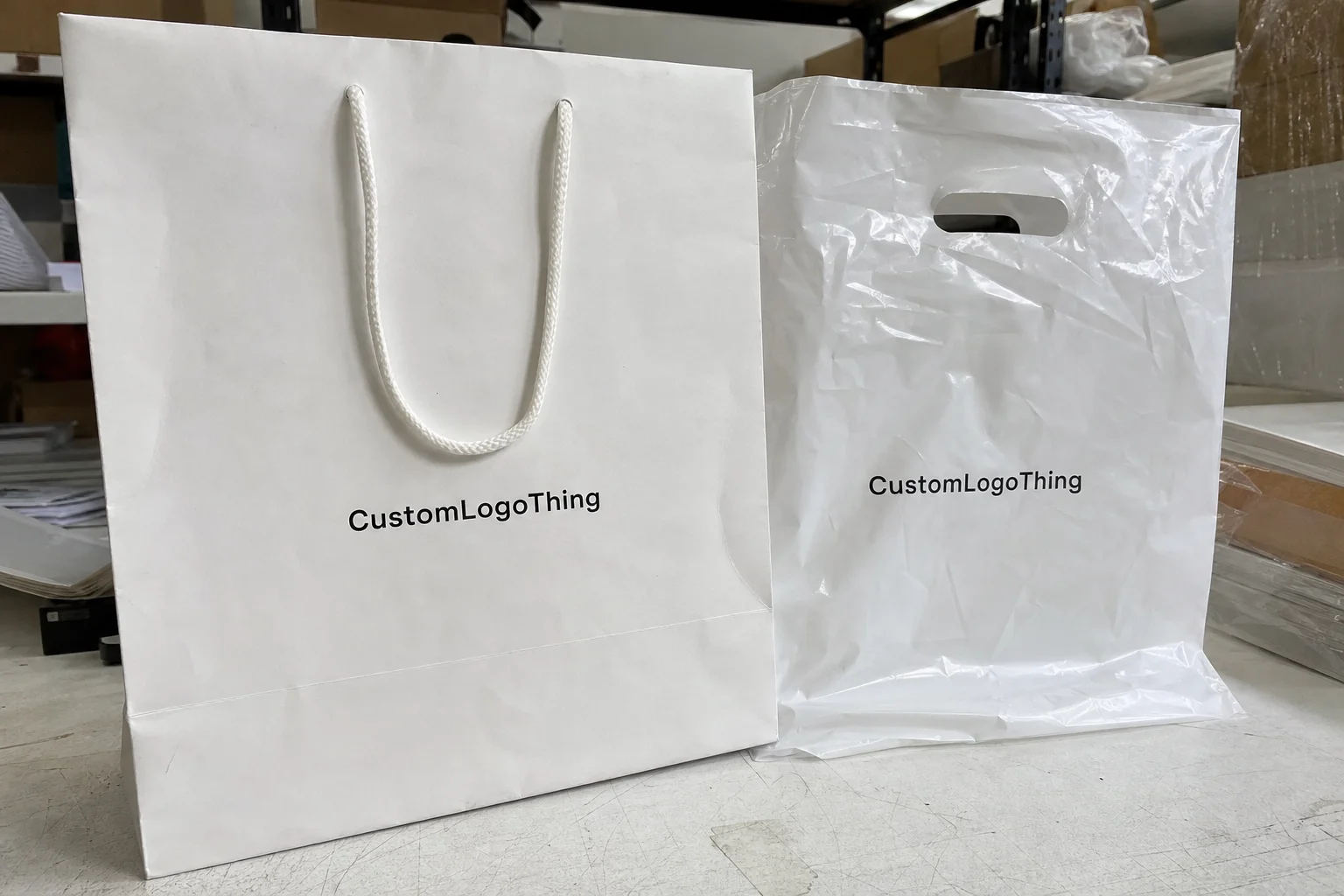
A retail bag has three jobs: carry the product, protect it during handoff and transport, and keep the brand visible after purchase. If it only does one well, the bag is underperforming.
Structure matters as much as artwork. A sharp logo cannot compensate for weak seams or handles that pull out under load. A strong bag can still feel wrong if the print is poor or the proportions do not fit the merchandise. Customers notice both.
The common mistake is treating all plastic bags as interchangeable. They are not. A small change in gauge, seal quality, or handle reinforcement can change how the bag carries weight and how it feels in hand. That difference shows up later as complaints, replacements, or reorders. On a typical retail program, a 10-15% thickness shift can be the difference between a reliable carry bag and one that fails after a few sharp-edged items are loaded.
A practical spec usually includes these items:
- Size — width, gusset, and height
- Thickness — usually in mil or microns
- Handle type — die-cut, loop, patch, or T-shirt style
- Print style — one color, multi-color, or full coverage
- Material — LDPE, HDPE, or PP based on use
- Finish — matte, glossy, or specialty surface treatment
That list is the real starting point for a useful quote. Everything else is secondary until those decisions are made. If the bags need recycled content, ask for a GRS certificate and chain-of-custody paperwork. If the program includes textile components such as cotton handles or sewn inserts, you can also ask whether the facility carries GOTS, OEKO-TEX Standard 100, WRAP, or BSCI documentation for the relevant production scope.
How the supplier process works from quote to delivery
Most suppliers follow the same sequence: request details, confirm specifications, review artwork, approve proof, produce the bags, inspect quality, and ship. The process is standard. The accuracy of the inputs is what determines whether it runs smoothly.
Fast quoting depends on complete information. If you send bag dimensions, material preference, thickness, print colors, artwork files, quantity, and delivery location in one message, you usually get a better answer faster. If you only say you need retail bags, expect follow-up questions.
- Inquiry — share the basic requirements and target timeline
- Spec confirmation — align on dimensions, film, handles, and print method
- Artwork review — check file quality, placement, and color setup
- Sampling or proofing — approve a digital proof or physical sample when needed
- Production — film preparation, printing, forming, sealing, and packing
- Quality inspection — verify dimensions, print accuracy, seal integrity, and count
- Shipping — book freight and deliver to the agreed destination
Delays usually come from the same places: vague specs, low-resolution artwork, or late changes after proof approval. A reliable custom plastic retail bags supplier should confirm the agreed details in writing so there is no ambiguity about what is being produced.
For brand-sensitive orders, the confirmation should include dimensions, quantity, material, print method, lead time, and any extra charges. When that summary is missing, mistakes are easier to make and harder to resolve. Many teams also request a digital proof within 24-48 hours and a physical pre-production sample in 5-7 business days when color matching or handle strength is critical.
If the bag is part of a larger package set, keep the colors and finish aligned with the rest of your retail packaging. A glossy bag next to matte cartons or off-tone labels can make the whole presentation feel inconsistent.
Cost, pricing, and MOQ factors that change the quote
Pricing moves with a small set of variables: size, thickness, color count, print method, finish, and volume. More material costs more. More print colors usually add setup. Smaller quantities spread setup cost across fewer units, so the unit price rises. That pattern is common across most packaging jobs.
For planning, a simple one-color bag in a standard retail size may land around $0.08-$0.18 per unit at higher volumes. A thicker bag, more complex artwork, custom handles, or premium finishing can move pricing into the $0.18-$0.45 per unit range or beyond. At a 500 MOQ, a fully custom run with heavier gauge film, multi-color print, and retail bundling can realistically land around $2.50-$4.00 per unit because setup, plates, and labor are spread across a small quantity. Freight, setup, and rush charges can push the total above the headline unit price.
MOQ matters because setup work does not disappear at smaller volumes. Plates, proofing, prepress, and press preparation still happen. If a supplier offers a lower minimum order quantity, the per-bag price is often higher. That is normal and often useful for launches, seasonal campaigns, or new-store trials.
| Order Type | Typical Quantity | Unit Price Trend | Best For |
|---|---|---|---|
| Test Order | 500-1,000 pcs | Highest | New launches, design checks, small stores |
| Mid-Size Run | 2,000-5,000 pcs | Moderate | Seasonal promotions, multi-location retail |
| Volume Run | 10,000+ pcs | Lowest | Stable programs, recurring retail usage |
There are also hidden drivers that affect the final number. Custom handles, reinforced seams, tighter tolerances, special packing, and heavier freight can change the quote quickly. A supplier that looks cheapest at first may not be cheapest once setup and shipping are included. Compare total landed cost, not just the unit line.
If you are comparing a custom plastic retail bags supplier with a provider of cartons or mailers, do not compare their quotes line by line. They use different materials and production methods, so the cost structure will not match.
Material, thickness, and print choices that affect performance
Material choice affects feel, strength, and appearance. LDPE is flexible and softer in hand. HDPE feels crisper and is often more economical. PP can look cleaner and more premium, especially for gift-oriented retail. The right choice depends on product weight, expected use, and the presentation you want at checkout.
Thickness is where many buyers under-specify. A lightweight apparel bag does not need the same gauge as a bag carrying boxed candles or jars. Many retail programs fall around 1.5-3 mil for lighter use and 3-5 mil for heavier applications, but size, seal design, and load distribution still matter. In metric terms, that often works out to roughly 25-75 microns depending on resin blend and intended use.
Handle style affects both strength and customer experience. A die-cut handle is clean and compact. A loop handle is more comfortable and often better for heavier items. Patch handles reinforce the stress point where the handle meets the bag. T-shirt style bags are practical for high-volume checkout. Gusseted formats add space for bulkier products.
- Die-cut — simple, neat, good for light to medium loads
- Loop handle — stronger carry experience and better comfort
- Patch handle — extra reinforcement for heavier retail items
- T-shirt style — economical and useful for high-traffic checkout
- Side gusset — more room for boxed or bulky products
- Bottom gusset — better base stability for stacked items
Print method also changes the result. Flexographic printing is common for high-volume runs and typically supports 1-6 colors with fast throughput. Gravure is used when the artwork demands very fine detail or long runs. Most suppliers print on a film line after a corona treatment step so ink adhesion is stable. If the artwork has tight registration, ask for a tolerance target such as 1-2 mm and confirm whether the supplier uses a 6-color flexo press or a gravure cylinder setup.
Surface finish matters too. Glossy film can make saturated colors look brighter, while matte film reduces glare and looks more understated. If you are using recycled resin, ask whether the supplier can provide GRS documents for the recycled content and whether the print inks are specified for the substrate.
Lead time and production steps to plan around
Lead time depends on whether the bags are stock-based, semi-custom, or fully custom. A simple custom print on an existing bag structure can be faster than a fully new mold or die-cut shape. For many retail programs, a realistic bulk production window is 18-22 business days after proof approval. Add time for sampling, freight booking, customs clearance, and destination delivery.
A typical production flow includes resin preparation, film extrusion, printing, slitting, bag forming, sealing, trimming, inspection, and packing. Some factories run a blown film extrusion line for LDPE/HDPE, then move the roll through a flexographic press, and finally into a bag-making machine with heat-seal or ultrasonic steps depending on the format.
Sampling should be planned as a separate stage, not treated as a formality. A good sample sequence is: confirm artwork, approve a digital proof, produce a pre-production sample, review color and dimensions, then release the bulk order. If the bag has a special handle or reinforcement, ask for a pull test on the sample before approving production.
Inspection checkpoints should be written into the order. Common checkpoints include:
- Incoming resin check for grade and consistency
- Film thickness check with a micrometer or gauge
- Ink adhesion and color registration check after printing
- Seal strength and handle pull test during forming
- Carton count verification and bundle count before shipment
- Random AQL inspection, often at 2.5 for major defects on retail orders
If the supplier ships internationally, ask for carton labels, palletization details, and moisture protection. Simple steps like poly-lined cartons, corner boards, and stretch wrap can reduce transit damage and improve receiving speed at the warehouse.
Common mistakes when choosing a supplier
The first mistake is buying on price alone. The second is sending incomplete specs and expecting the supplier to guess the rest. The third is approving artwork without checking the effective print area, safe margins, and color expectations. Those mistakes are avoidable, but they are common because the bag looks simple from the outside.
Another frequent issue is ignoring the load test. A bag that looks fine on screen may fail when filled with boxed goods, bottles, or uneven retail items. If your products have sharp corners or high point loads, ask for a thicker film, a wider seal, or a reinforced handle before you approve the design.
Some buyers also forget to confirm certification scope. A supplier may mention WRAP or BSCI audit status, but that does not automatically cover the exact factory line or product category you are buying. If your program depends on recycled content, verified labor compliance, or chemical controls, ask for the current certificate, scope, and validity dates. For textile-based bag programs, OEKO-TEX Standard 100 or GOTS may be relevant; for recycled plastic content, GRS is the more direct fit.
Finally, some teams skip the final carton and label check. That is a problem because retail bags often move through multiple locations. If counts are wrong or cartons are mislabeled, store launches can stall even when the bags themselves are good.
Expert tips for a cleaner order and better results
Use a one-page spec sheet. It should list size, material, thickness, handle style, color count, print location, finish, quantity, pack method, and requested ship date. That single document reduces confusion more than long email threads do.
Ask for a golden sample or signed approval sample before bulk production. It gives both sides a physical reference for color, thickness, handle feel, and print placement. If the supplier cannot provide a sample, request high-resolution images plus exact measurements before you release the order.
For launch programs, it helps to buy one step above the minimum you think you need. A small buffer of 5-10% can absorb spoilage, store-level overruns, and launch-week spikes without forcing a rush reorder.
If the bags will be used near apparel or gifts, align the texture and print finish with the rest of the retail set. A matte bag with crisp typography often reads more premium than a heavily saturated gloss finish. If the plan includes recycled content, ask for the actual recycled percentage, not just a marketing claim.
Also confirm the pack-out format. Retail teams often prefer 100 bags per inner pack with a clear bundle label and a barcode on the carton. That small detail speeds up receiving and store allocation.
Next steps to get a quote and place the right order
Start with the final use case: what the customer will carry, how far it will travel, and how much weight it needs to hold. Then decide on size, material, thickness, handle style, and print coverage. Once those decisions are locked, a supplier can quote accurately and tell you whether a 500 MOQ, 2,000 MOQ, or 10,000+ run makes the most sense.
Send the supplier the artwork file, target quantity, preferred lead time, delivery address, and any certification requirements such as GRS for recycled content or audit documents like WRAP and BSCI if those matter to your procurement process. If textiles are involved in the bag construction, mention OEKO-TEX Standard 100 or GOTS only where they actually apply.
Ask for three things before you approve the order: a written spec sheet, a proof or sample, and a confirmation of inspection checkpoints. That keeps the project aligned from the first quote to the final carton.
If you are comparing multiple vendors, ask each one the same questions and request the same format. That is the easiest way to compare not just the unit price, but the real value of lead time, quality control, and delivery reliability.
FAQ
What is a normal MOQ for Custom Retail Bags?
Many suppliers start around 500-1,000 pieces for custom-printed retail bags, with better unit pricing at 2,000-5,000 pieces and above.
How long does production usually take?
After proof approval, a typical custom run takes about 18-22 business days. Sampling adds time, especially if you want a physical pre-production sample.
What should I ask for in a quote?
Ask for size, material, thickness, handle style, print colors, packing format, MOQ, sample timing, inspection steps, and a landed-cost estimate that includes freight.
Which certifications matter most?
For recycled plastic content, GRS is useful. For labor and social compliance, WRAP and BSCI are common references. For textile components, OEKO-TEX Standard 100 or GOTS may apply if the bag includes textile materials.
How do I know if the bag is strong enough?
Confirm the film thickness, seam width, handle reinforcement, and ask for a sample pull test or load test before bulk approval.


