Buyer Fit Snapshot
| Best fit | Custom Poly Mailer Bags projects where brand print, material claims, artwork control, MOQ, and repeat-order consistency need to be specified before quoting. |
|---|---|
| Quote inputs | Share finished size, material target, print colors, finish, packing count, annual reorder estimate, ship-to region, and any compliance wording. |
| Proofing check | Approve dieline scale, logo placement, barcode or warning zones, color tolerance, closure strength, and carton packing before bulk production. |
| Main risk | Vague material claims, crowded artwork, missing packing details, or unclear freight terms can make a low unit price expensive after revisions. |
Fast answer: Custom Poly Mailer Bags: Material, Print, Proofing, and Reorder Risk should be specified like a repeatable production item. The safest quote records material, print method, finish, artwork proof, packing count, and reorder notes in one written spec.
Production checks before approval
Compare the actual filled-product size with the drawing, then confirm tolerance on folds, seals, hang holes, label areas, and retail display edges. Reserve space for logos, QR codes, warning copy, and material claims before decorative graphics fill the panel.
Quote comparison points
Review material grade, print process, finish, sampling route, tooling charges, carton quantity, and freight assumptions side by side. A quote is only useful when the supplier can repeat the same color, closure quality, and packing count on the next order.
Custom Poly Mailer Bags: Fit, Cost, and Practical Use
Custom poly mailer bags can look almost plain on a packing table, yet they carry a lot of weight in the shipping process. They keep soft goods clean, help keep dimensional weight under control, and put a brand in front of the customer before the parcel is ever opened. For apparel, accessories, and other lightweight products, custom poly mailer bags often separate a shipment that feels efficient from one that feels bulky and overbuilt for no good reason.
The best mailer choice is rarely the flashiest one. It is usually the bag that fits the product, seals with confidence, and survives the rough handling that comes with a sorting network, a delivery truck, and a crowded receiving dock. That is why buying custom poly mailer bags is not only a print decision. It is a packaging decision, a fulfillment decision, and, in many cases, a retail presentation decision that shapes how the brand is seen the moment the parcel lands at the door.
If you also use Custom Poly Mailers or a broader mix of Custom Packaging Products, the small details matter even more. A well-planned mailer program should fit the rest of the packaging line instead of fighting it. The right bag size, film thickness, print layout, and order quantity can reduce labor, cut waste, and make shipping easier to manage week after week.
I have seen teams overthink artwork and underthink fit, and that usually backfires. A bag that is trying to do too much is gonna frustrate someone in the warehouse sooner or later. The smarter move is to start with the product, then build the mailer around the way it is actually packed, stored, sealed, and shipped.
What follows is the practical side of the subject: where custom poly mailer bags fit best, how they perform in transit, what drives cost, and how to avoid the buying mistakes that tend to show up only after the first full production run is already moving through the supply chain.
“A mailer that fits the product pays twice: less wasted material up front and fewer headaches once orders start moving.”
What Custom Poly Mailer Bags Are and Why They Matter
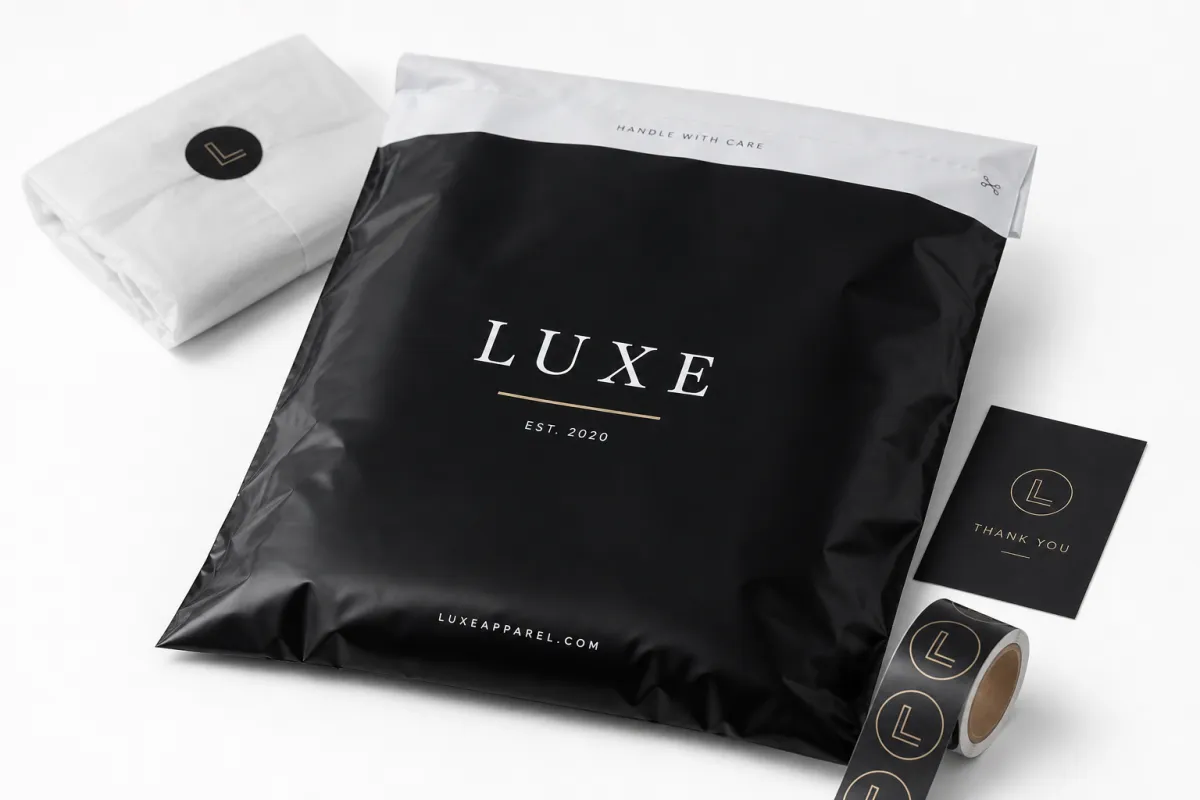
At the most basic level, custom poly mailer bags are lightweight shipping bags made from polyethylene film, usually with a self-seal adhesive strip and enough structure to hold soft goods without a rigid box. They can be printed on the outside, printed on the inside, or left plain, depending on the branding goal and the budget. In practice, they are one of the most common flexible packaging formats for e-commerce because they pack quickly, ship flat, and keep the shipment profile compact.
That compact profile matters more than many buyers expect. A carton can be the right choice for fragile or boxed items, but for apparel or other non-fragile merchandise, a box can add unnecessary void space, extra corrugate cost, and a larger parcel dimension that changes the carrier bill. Custom poly mailer bags help avoid that. They keep the package close to the actual size of the product, which often means lower dimensional weight and a cleaner pack-out process on the fulfillment line.
The strongest use cases are easy to spot: T-shirts, leggings, swimwear, socks, lightweight textiles, promotional kits, and accessories that do not need crush protection. A pair of shoes may still go in a mailer if the brand has tested the fit and the route, but a fragile candle, ceramic item, or electronics kit usually needs more structure. In those cases, custom printed boxes, inserts, or a hybrid mailer-plus-inner-pack approach usually makes more sense.
The visual side counts too. Customers see the outside of the parcel before anything else, and that surface can carry a logo, a message, or a clean branded pattern that reinforces identity without adding a second package layer. In that sense, custom poly mailer bags act as both a shipping container and a package branding tool. They turn a plain transit item into something that looks deliberate.
Working with a supplier that understands custom poly mailer bags as more than a blank envelope usually leads to better guidance on size, gauge, seal style, and print limits. That guidance matters because a lot of problems begin with a bag that is either too tight for the product or too large to look polished. A mailer that fits well tends to make the whole operation feel tighter, cleaner, and more controlled.
How Custom Poly Mailer Bags Work in the Shipping Process
The shipping sequence is straightforward. The product goes into the bag, the liner on the adhesive strip comes off, the flap is pressed down, and the package becomes a slim, sealed unit that moves through the carrier network with far less bulk than a box. The process sounds almost plain, yet that simplicity is one of the reasons custom poly mailer bags are used so widely. They reduce decision fatigue at the packing table and help staff keep pace with daily order volume.
Material choice makes a noticeable difference once the package is in motion. Polyethylene film resists moisture better than many paper alternatives and stands up well to abrasion from conveyor belts, bins, and repeated handling. Thickness, often described as gauge or mils depending on the factory and region, changes how tough the bag feels and how much abuse it can take before a corner tears or a seam stretches. For lightweight apparel, a slimmer film may be enough. For heavier textiles or multi-item orders, a thicker construction is usually the safer pick.
Printing is where custom poly mailer bags move from basic transport item to branded packaging. Some programs use surface printing for bright graphics and strong contrast, while others use reverse printing so the ink sits behind the film and is protected from scuffing. That matters if the bag will slide around inside a larger parcel or travel long distances through the sortation system. Logos, website URLs, care reminders, and return instructions can all be placed with intent, but the layout has to respect the shape of the mailer and the way the fold line sits once the package is filled.
Customization also reaches into the working details. A bag may need a strong peel-and-seal adhesive, a tamper-evident strip, an extra lip for easier opening, or a return closure for reverse logistics. Every change affects how fast the team can pack orders and how consistently the bag performs. People who talk about custom poly mailer bags being efficient are usually talking about that exact advantage: the format supports the workflow instead of slowing it down.
That workflow advantage is real. A well-fitted mailer reduces void space, cuts down on extra filler, and often shortens pack time by a few seconds per order. Over hundreds or thousands of shipments, those seconds matter. The customer receives a neater parcel, the warehouse handles fewer materials, and shipping costs stay closer to what the product actually requires.
Brands that care about handling standards should align testing with recognized methods. ISTA transit test protocols are useful for understanding how packages behave under vibration, drop, and compression, and the ISTA site is a useful reference when comparing packaging performance expectations. If the team is also thinking about broader waste reduction, the EPA recycling guidance is worth reviewing so claims about recyclability stay accurate and grounded.
Key Factors That Shape Custom Poly Mailer Bags Cost and Quality
Pricing for custom poly mailer bags usually starts with a handful of variables buyers can actually control: bag size, film thickness, print colors, print coverage, seal style, and quantity. Larger bags use more material. Thicker film uses more resin. Multi-color graphics need more setup and more careful registration. Higher volume usually lowers the per-unit cost because the setup is spread across more pieces. None of that is surprising, yet it is easy to overlook once a quote arrives with only a single unit price at the bottom.
For a practical starting point, many standard runs land in a range such as $0.18 to $0.35 per unit at 5,000 pieces, depending on size and print coverage. Heavier gauges, premium finishes, or larger artwork areas can push that higher, sometimes into the $0.30 to $0.55 range. Smaller runs may cost more per bag because tooling and press setup are not changing much, even if the piece count is lower. Those numbers are not universal, and they should not be treated like a fixed price list, but they are useful as a reality check before comparing suppliers.
Here is the part buyers sometimes miss: the cheapest quote for custom poly mailer bags is not always the least expensive choice overall. A thin bag that splits once in every few hundred shipments creates rework, replacement labor, customer service time, and maybe a lost customer. A slightly stronger bag with a better adhesive can save money simply by reducing damage and repacks. In packaging, total cost matters more than the line item.
Branding choices also shape budget. A one-color logo on a colored background is usually more economical than full-coverage artwork. Metallic effects, matte versus gloss finishes, and interior printing each add complexity. If the goal is to keep the program efficient, it often makes more sense to put effort into strong contrast, a clean layout, and the right bag size rather than piling on decorative features that do not help the shipment perform.
Minimum order quantity is another real factor. Many custom poly mailer bags programs become efficient only when the order volume is high enough to justify print setup. That can mean 1,000 pieces for a simple one-color program or 3,000 to 5,000 pieces for a more complex job, depending on the supplier. If volumes are still uncertain, ask for a pilot run, a stock-size option, or a staged order plan so cash is not tied up in inventory that may shift before it is used.
There is also a difference between a low quote and a low-risk quote. A supplier may offer a tempting unit price but bury freight, proof changes, overrun rules, or carton-pack changes in the fine print. That kind of surprise tends to show up late, and it is never fun. I prefer to compare custom poly mailer bags on landed cost, not just print cost, because the full picture tells you what the packaging is really going to cost the business.
| Option | Typical Use | Common Cost Range | Notes |
|---|---|---|---|
| Plain stock mailer | Basic shipping with no print | $0.08-$0.18 each | Lowest setup burden, limited branding |
| One-color custom poly mailer bags | Apparel, accessories, recurring e-commerce orders | $0.18-$0.35 each | Good balance of branding and cost control |
| Full-coverage printed mailer | Strong package branding and retail presentation | $0.28-$0.55 each | Higher print complexity, stronger visual impact |
| Heavy-gauge or specialty mailer | Heavier textiles, better puncture resistance | $0.30-$0.60+ each | Often chosen for durability over pure price |
That table is only a starting frame, but it helps buyers compare options in a sensible way. If one quote looks low and another looks high, ask what is actually included: film thickness, adhesive quality, artwork setup, freight, proofing, and overrun policy. A clean quote on custom poly mailer bags should show whether the offers are truly similar constructions or completely different products.
One more detail matters if the brand is also using Custom Packaging Products such as labels, cartons, tissue, or insert cards. It can pay to think about the whole packaging system together. A slightly more polished mailer may allow a reduction elsewhere, or a simpler mailer may free budget for better inserts and a stronger first-open presentation.
Choosing Custom Poly Mailer Bags Step by Step
Start with the product, not with the print. Measure the item in its packed state, because a folded sweatshirt, a rolled towel, or a bundled accessory set takes up more room than the flat merchandise on a table. For custom poly mailer bags, the goal is enough room for easy insertion without so much slack that the bag looks puffed out or awkward. That balance usually makes the shipment faster to pack and better to receive.
Next, choose the bag dimensions with a little breathing room. A mailer that is too tight stresses the seams and can warp the logo area. One that is too large wastes film and often increases shipping dimensions more than people realize. If there are multiple SKUs, choose the standard size around the most common order profile, then test the thickest item in the range. That practice avoids the classic mistake of designing a bag for the easiest item and then finding out it fails on the one that matters most.
Then look at film specification. For light apparel, a slimmer film may be enough if the route is short and the packing environment is controlled. For heavier garments, multi-piece orders, or products that pass through a more aggressive carrier network, a thicker film can be the better fit. Custom poly mailer bags should protect the contents from dirt, light moisture, and rubbing; they are not meant to replace rigid crush protection where actual impact resistance is needed.
From there, review the print layout. Keep the important elements large enough to read quickly, especially if the bag will be handled by staff, couriers, or retail customers. Tiny type that looks neat on screen often disappears on film. High-contrast logo placement, a clean background, and a clear return address area are usually more useful than a crowded graphic that tries to say too much. In packaging design, clarity usually wins over decoration.
Now set the workflow and timeline. Ask for a dieline or size recommendation, submit artwork, review the proof, approve print placement, and then schedule production plus freight. For many custom poly mailer bags runs, a realistic lead time is often 12 to 15 business days from proof approval, though that can stretch if the order is large, the artwork is complex, or the film is unusual. Add shipping time on top of that, because inventory delays tend to show up right when demand picks up.
Before the full order starts, sample the bag with real products. Flat samples are useful, but they do not show how the adhesive behaves once the bag is actually filled. They do not show how the film stretches around a thicker hem, or how the print looks when the package is folded, stacked, and handled. A test pack on your own line is the best way to catch fit problems early. In practice, that step saves more money than most buyers expect.
One useful way to think about custom poly mailer bags is to treat them as part of the broader branded packaging system, not as a separate purchase. If the mailer works with your inserts, labels, and order-handling process, the whole set of parts becomes easier to manage. If it fights the rest of the setup, the friction shows up in labor time and quality issues almost immediately.
If you are dealing with seasonal products, it also helps to map the bag choice to your sales calendar. A winter apparel line can tolerate a slightly heavier film if it needs to protect bulky knits, while a summer promotion of tees and socks may do better with a lighter bag that packs faster and costs less. That sort of seasonal thinking is practical, not fancy, and it keeps the packaging from becoming a one-size-fits-all compromise.
Common Mistakes When Ordering Custom Poly Mailer Bags
Undersizing is probably the most common problem. A tight bag can make packing staff slow down, and it can put stress on seams, especially around thick hems, sleeves, or multi-item bundles. It also distorts the print area, which is frustrating when the artwork looked clean in proof form. With custom poly mailer bags, squeezing the product into the wrong size often costs more in labor than the extra material would have cost in the first place.
Oversizing is the opposite trap. A bag that is much larger than the product may feel generous, but it wastes film, looks less polished, and can increase parcel dimensions enough to change carrier pricing. It can also make the item slide around inside the package, which creates a weaker unboxing feel. The right fit should look intentional, not loose. That is especially true in retail packaging, where the customer is judging the brand before they judge the product.
Artwork mistakes show up often as well. Low-contrast logos, tiny disclaimers, and graphics built for a laptop screen can turn muddy once they are printed on polyethylene film. If the design uses too many thin lines or too much small text, custom poly mailer bags may still print, but they will not look as crisp as expected. Ask for a print proof, check the actual color relationship between ink and film, and pay attention to how the design sits on the folded mailer.
Closure quality deserves more attention than it often gets. A weak adhesive strip can pop open in a hot truck or fail in a cold warehouse, especially if the surface is dusty or the seal area is rushed. That is not a small inconvenience. It can become a damaged parcel, a return, or a customer complaint. When ordering custom poly mailer bags, ask what adhesive is used, how the seal is tested, and whether the mailer has enough flap area to close cleanly even when the contents are close to the upper size limit.
Another mistake is ignoring the total landed cost. It is easy to focus on unit price and overlook freight, artwork revisions, setup charges, overages, and reprint risk. A quote that looks attractive can become more expensive once delays and the cost of replacing a failed run are included. For custom poly mailer bags, the smarter comparison is total value: material, labor, reliability, and the image the package sends when it reaches the customer.
Some teams skip the conversation about what the package is actually supposed to do. If moisture protection is required, say so. If the bag must fit a return label pouch, say so. If the order line needs fast pack-out, say so. The clearer the brief, the better the result. That applies whether you are buying mailers, labels, or Custom Poly Mailers in a wider family of product packaging components.
There is also a trust issue that comes up more than people admit. A supplier may describe a bag as durable, recyclable, or premium, but those words do not mean much unless the material structure and performance details are clear. If you cannot get a straight answer on film composition, seal strength, or printing method, that is a warning sign. Honest packaging work depends on specifics, not adjectives.
Expert Tips for Better Custom Poly Mailer Bags
Design for the opening moment as much as the shipping lane. A clean logo, a short message, and a layout that stays visible when the parcel is first opened can do more for brand memory than a crowded all-over print. The strongest custom poly mailer bags balance practical branding with a disciplined layout. They look confident because they are not trying to do everything at once.
Keep a modest buffer in inventory. If monthly usage is steady, a safety stock of one to two ordering cycles can prevent rush production and avoid the pressure to accept a poor substitution. That matters because custom poly mailer bags often sit in the warehouse until a promotion or seasonal spike turns them into the only thing standing between a clean pack-out and a shipping bottleneck. Running too close to zero invites trouble.
Test with real packed goods, not just flat samples. This is one of the easiest ways to improve packaging outcomes. Place the item inside, seal it, stack it, and see how it behaves on a bench or a cart. Check whether the adhesive grabs well, whether the seams stay flat, and whether the print remains legible after the bag is handled. Custom poly mailer bags need to work in the actual process, not just look good in a mockup.
Be exact about sustainability claims. Polyethylene mailers can sometimes be recyclable, but local collection rules vary a lot, and mixed-material construction can change the answer. If a bag includes adhesives, labels, or layered films, do not assume every program will accept it. If recycling is a priority, ask the supplier for the exact material structure and confirm whether it fits the local recovery stream. The FSC standard is useful for paper-based components elsewhere in the pack, but it is not a blanket answer for plastic mailers. Accuracy matters more than wishful language.
From a production-floor point of view, the best custom poly mailer bags are the ones that pack quickly, seal consistently, and arrive looking like the brand intended. That is not glamorous, but it is what keeps orders moving and customers happy. Fancy artwork can help, but only after the physical package does its job well.
It is also smart to build your mailer choices around the rest of your branded packaging. If you are using custom printed boxes for some products and flexible mailers for others, the visual system should still feel related. Same logo treatment, similar color logic, consistent messaging, and a clear hierarchy across product packaging all help the brand feel organized instead of improvised.
One practical detail I always tell teams to watch is how the bag behaves on the line after a long shift. A seal that feels fine in the morning can get annoying fast if the adhesive edge is hard to grab or the opening path is unclear. These are small, everyday issues, but they add up. Good packaging saves minutes in little ways, and that is usually where the real value hides.
What to Do Next With Custom Poly Mailer Bags
The fastest way to move forward is to measure the top three products in their packed form and decide which one should define the standard bag size. If one item accounts for most shipments, let that drive the primary spec. Then check the secondary items that need extra clearance. That approach keeps custom poly mailer bags useful across the majority of orders without overbuilding the package for every edge case.
Request samples or mockups before the full order. A sample run lets you judge fit, color, and seal performance under real conditions, which is much better than relying on a spec sheet alone. If the sample does not pack easily or the adhesive feels weak, fix that before production starts. Once a full run is complete, the cost of a mistake climbs quickly.
Build a simple comparison sheet that includes bag size, film thickness, print style, minimum order quantity, lead time, freight, and total landed cost. The point is not to make the process complicated. The point is to make sure custom poly mailer bags are compared on the same basis as every other packaging choice. A quote with a low unit price but poor freight terms can easily lose to a slightly higher unit price with better overall economics.
Bring your fulfillment team into the decision. They are the people who will feel the bag on the line, not just on a spreadsheet. If the flap is hard to peel, if the bag catches on the product, or if the size slows down pack speed, they will know right away. The best custom poly mailer bags support repeatable work, and repeatable work is what keeps the operation steady.
If you are planning a broader refresh, this is also a good time to review the rest of your packaging design system. Mailers, inserts, labels, and outer cartons should all point in the same direction. That is where package branding starts to pay off in a visible way: the parcel feels deliberate, the opening feels organized, and the customer sees a company that understands its own product packaging choices.
My practical advice is straightforward: test, compare, and place a focused pilot order. Custom poly mailer bags are one of those packaging purchases where a small amount of early discipline can save a lot of trouble later. If the fit is right, the cost structure is sensible, and the print supports the brand, the mailer becomes one of the easiest parts of the shipping process to get right.
A good next move is to lock three things Before You Buy in volume: the packed product dimensions, the minimum acceptable film thickness, and the seal performance you expect in real handling conditions. Once those are set, the rest of the decision gets a lot clearer, and the mailer program has a better chance of holding up after the first busy week rather than just looking good in the proof.
FAQ
What are custom poly mailer bags best used for?
They are best for lightweight, non-fragile products such as apparel, accessories, swimwear, and soft goods that do not need rigid crush protection. Custom poly mailer bags are also a strong fit when you want lower shipping weight, moisture resistance, and branded presentation without moving to a box.
How do I choose the right size for custom poly mailer bags?
Measure the product in its packed state, not flat on the table, and add just enough room for easy insertion without excess slack. If you ship multiple SKUs, choose a standard size based on the most common item and test a sample with your thickest product before placing the final order.
How much do custom poly mailer bags usually cost?
Pricing depends on size, film thickness, print coverage, and quantity, so higher-volume runs usually lower the unit cost. For comparison purposes, many buyers see standard custom poly mailer bags land somewhere around $0.18 to $0.35 each at moderate volume, with heavier or more complex versions costing more.
How long does it take to produce custom poly mailer bags?
Timeline usually includes artwork approval, proofing, manufacturing, and shipping, so it is safest to order before inventory gets tight. Lead time can stretch if the design is complex, the order is large, or specialty materials are needed, so it is smart to keep a buffer.
Can custom poly mailer bags be recycled?
Some poly mailers can be recyclable depending on the material mix and the local recycling program, but that varies by location. If recycling is a priority, confirm the film structure and labeling with your supplier before making sustainability claims, and make sure the message matches the actual collection pathway in your market.
What should I ask a supplier before ordering?
Ask for the exact film thickness, adhesive type, print method, proofing process, minimum order quantity, freight terms, and overrun policy. If the supplier cannot explain those basics clearly, the order probably needs more review before you commit.

