Custom popcorn boxes look simple until they are filled with warm, oily popcorn and handled in a rush. Then the weak points show up fast: soft corners, oil marks, bulging panels, or boxes that collapse before service ends. Buyers should judge the carton as working packaging, not as a printed mockup with a logo.
The box has three jobs: hold the product, keep it presentable, and support the brand. If it fails on any one of those, the failure is visible on the counter. A carton that looks good on screen but leaks oil in service is not a design win. It is a packaging spec problem.
Why custom popcorn boxes fail when the snack gets hot
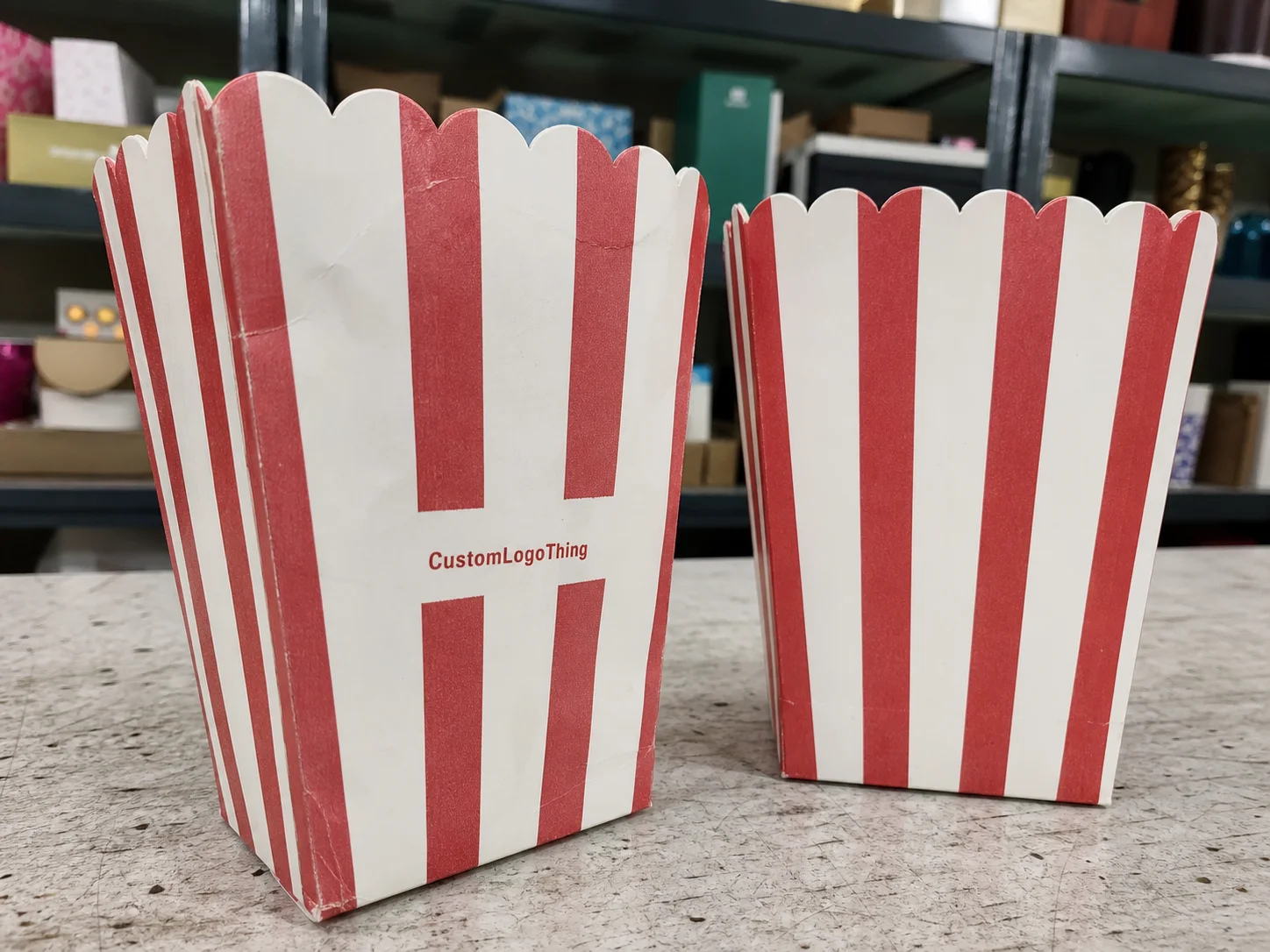
Popcorn is harder on packaging than it seems. The kernels start dry, then heat, steam, butter, seasoning, and repeated handling change the load completely. A box that survives a dry snack may still fail once the product is warm and the surface picks up oil. The first sign is often a softened panel or a corner that opens under pressure.
Most popcorn packs use paperboard in the 250gsm to 400gsm range, depending on size, fill weight, and whether the carton is for retail or foodservice. Folding cartons, open-top tubs, and tray-style containers each solve a different problem. Open-top formats fill faster. Tuck-top cartons travel better. Tray-style packs work when visibility matters more than full enclosure.
Details matter more than the mockup suggests. Board thickness affects crush resistance. Seam design affects whether the carton pops open in transit. Coating affects whether grease appears on the outside after a short hold time. A proof can look polished and still fail if the material spec is wrong.
Practical rule: if the popcorn is warm, buttered, or likely to sit for more than a few minutes, specify for oil resistance and handling stress first, decoration second.
How the structure, sizing, and print choices work
Structure should follow service reality. A tuck-top carton works well for retail shelves and take-home packs. An auto-bottom carton saves time when staff need quick assembly. An open-top tub is easier for concession service, sampling, and events. Tray-style containers suit shared serving and display-heavy setups. The question is not which shape looks best. It is which one survives the way the product is sold.
Sizing should be based on filled volume, not the outer measurements printed on a dieline. That mistake causes a lot of ordering problems. Popcorn density changes with kernel size, freshness, seasoning, and how much air is in the fill. A box that sounds right on paper can look too small in a real service line or too large once the product settles. Testing with the actual popcorn is the only reliable check.
Print choices affect both appearance and cost. CMYK full color gives the widest design range, especially for photography or gradients. Spot colors are cleaner for simple logos and can be easier to control on repeat runs. For concession packaging, a limited-color design often reads better from a distance and tends to print with fewer surprises.
Finishing changes how the package behaves in hand. A gloss aqueous coating can brighten colors and add some surface protection. Matte gives a softer look, although it can show fingerprints more easily. Food-safe barrier coatings matter whenever grease resistance is part of the requirement. Plain board may be fine for dry popcorn, but buttered or heavily seasoned product will expose the weakness quickly.
There is also a production reality that buyers sometimes miss: the more complicated the structure, the more time it takes to cut, fold, and pack. That can raise labor cost even if the print quote looks attractive. In practice, a simple format with a disciplined artwork layout often beats an elaborate carton that slows the line down.
| Structure | Best Use | Typical Strength | Tradeoff |
|---|---|---|---|
| Tuck-top carton | Retail, take-home packs | Moderate | Slower to fill than open-top formats |
| Auto-bottom carton | Fast assembly, medium volume runs | Good | Higher conversion cost than basic folds |
| Open-top tub | Concessions, events, sampling | Very good for access | Less protection during transport |
| Tray-style container | Shared serving, display-heavy service | Moderate to good | Not ideal if the product needs full enclosure |
Custom popcorn boxes pricing: what really changes the unit cost
Pricing is driven by a few ordinary variables: board grade, box size, print coverage, coating, die complexity, and quantity. If the carton needs a custom die or unusual folding sequence, tooling and conversion costs rise. If the build is standard and the artwork stays simple, the unit price is easier to control.
Quantity matters more than many buyers expect. A 1,000-piece order can cost much more per unit than a 10,000-piece run because setup, proofing, plates, cutting, and packing are spread across fewer cartons. A realistic range for smaller orders is often around $0.35 to $0.80 per unit, while larger runs can fall into the $0.12 to $0.30 range for simpler builds. Those numbers still depend on spec and market, but they are useful for early budgeting.
There are hidden costs too. Sampling, proof revisions, freight, and storage can change the final spend. A seasonal order may look cheap on the print quote and expensive once shipping is added. A repeat order can be more efficient if the structure is standardized and the artwork stays stable from run to run.
The cleanest way to compare suppliers is to give them the same input every time: same dimensions, same board, same coating, same quantity, same delivery window. A vague request for “popcorn boxes” will produce vague pricing, and vague pricing is how one supplier looks cheap until missing items show up later.
- Low volume, high design complexity: highest unit cost and most revision risk.
- Mid volume, standard structure: usually the best balance of price and speed.
- High volume, repeat orders: best chance to reduce cost per serving over time.
Another useful comparison point is conversion efficiency. Two quotes can look close on paper and still differ in what is included. One may cover only print and die cutting. Another may include coating, folding, and shipping preparation. A serious comparison needs the same line items.
Production steps and turnaround: from dieline to delivery
The production path is standard, but delays usually happen at the handoff points. It starts with a brief and a dieline selection. Artwork is placed, proofed, and revised. After approval, a sample or pre-production check may be run. Printing comes next, followed by cutting, folding, packing, and shipping.
Most delays come from late artwork changes or rushed proof approval. Missing bleed, low-resolution logos, incorrect barcode placement, and legal text that arrives after the proof are common problems. Another one is approving a flat mockup without checking how the carton performs when filled. That is how a size problem can survive every meeting and still appear right before launch.
Turnaround depends on the build and on how clean the files are. Simple stock-style cartons can often move in roughly 10 to 15 business days after proof approval if the schedule is normal. Custom dies, specialty coatings, large runs, or unusual pack-outs take longer. Shipping adds another layer, especially when pallets have to be built for distribution or retail receiving.
Quality control should not be treated as a formality. Useful checks include board caliper, print registration, coating coverage, cut accuracy, glue bond strength, and whether the carton opens and closes correctly. For food packaging, confirm that the surface is appropriate for the intended contact and that the coating does not create a smell or tacky finish under warm conditions.
Packing method matters too. Carton count per case, case labeling, and pallet configuration can change freight cost and make the packaging easier or harder to use on site. If staff have to fight through badly packed master cartons during a rush, the package system is creating labor expense. That expense usually stays hidden until the operation gets busy.
If the order is tied to an event date, build buffer time into the schedule. Custom packaging has too many steps to trust to a last-minute order. A realistic deadline should include artwork review, proof approval, production, transit, and a margin for correction.
Specification mistakes that create grease stains and waste
The most common mistake is choosing size by guesswork. If the box is too small, the product overflows or gets crushed. If it is too large, the serving looks sparse and the board cost goes up without improving the customer experience. The fix is simple: fill a sample box with the real product and watch what happens after 10 to 15 minutes.
Barrier choice is another place where budgets get cut in the wrong place. Plain board can be acceptable for dry popcorn. Buttered or heavily seasoned popcorn is different. Oil migration starts showing quickly, especially in warm service or takeout orders. A suitable coating or barrier layer is the difference between a fresh-looking carton and one that looks old before the product is finished.
Graphics can fail even when the print itself is technically good. Dense black coverage, tiny type, and weak contrast often get worse once the box is folded and handled. Lighting also changes how the carton reads. A matte black design can look elegant on a screen and muddy under event lighting. Readability matters on the counter, in the hand, and in photos.
Stackability and storage are practical specs, not side notes. Boxes that nest poorly or open unevenly slow staff during rush periods. If assembly takes too long, labor cost rises and product consistency drops. This is one reason experienced buyers keep formats simple.
Consistency across channels helps too. If retail packaging, concession packs, and event cartons all use different structures for no functional reason, reordering becomes harder than it should be. A small packaging system is usually better than a collection of one-off cartons.
For buyers who want reference points on materials and testing, the Institute of Packaging Professionals publishes practical industry information, and ISTA standards are useful if transport performance matters. For responsible sourcing questions, FSC is the baseline reference for certification details.
Expert ways to improve shelf appeal without raising cost
The easiest way to improve shelf appeal is to cut visual noise. A strong logo, one main color family, and enough whitespace usually do more than a crowded layout with too many ideas competing for attention. In a retail or concession line, clarity wins because people only glance at the box for a moment.
Reducing SKU count helps more than many brands expect. Fewer sizes and fewer artwork versions make ordering cleaner and reduce the chance of a mismatch between product and box. Standard board weights and familiar dielines also tend to print and convert more efficiently than a custom format built for novelty alone.
Testing with real product is still the most reliable move. Fill a sample, close the box if the format allows it, and observe what happens after a short hold time. Check for oil transfer. Check whether the edge softens. Check whether the carton still feels solid in the hand after it has been carried around.
- Use one hero color to make the carton easier to recognize.
- Keep the logo large enough to read across a counter or display shelf.
- Avoid tiny copy that disappears after folding and handling.
- Choose one coating strategy and keep it consistent across reorders.
There is a useful distinction here: shelf appeal is not the same thing as print complexity. A carton can look premium with two colors and disciplined spacing. It can also look cheap with full-color art if the panel is crowded and the typography is fighting itself.
One more practical point. If the packaging has to do both merchandising and foodservice, the structure should serve the operational side first. A box that photographs well but frustrates staff will cost more in the long run than the printing saved.
What to lock down before you request quotes
Before asking for pricing, build a one-page spec sheet. Include dimensions, capacity, print coverage, coating preference, quantity range, and the target delivery window. That gives suppliers a real brief instead of a vague request and makes quote comparison much more honest.
Collect the files before you start. Vector logo art, brand color targets, legal copy, barcode artwork if needed, and notes about food use should be ready before the first proof. If the design is still being developed, ask for a sample or prototype first, especially if the popcorn is oily, seasoned heavily, or sold in a fast-moving venue where assembly speed matters.
Use the same comparison sheet across vendors. Judge the custom popcorn boxes quote on the actual spec, not on broad marketing language or a low starting number that leaves out coating, freight, or sample work. Ask what is included, what is separate, and what happens if the artwork needs revision after proofing.
Good procurement is boring. The strongest orders usually come from buyers who specify clearly, test early, and avoid last-minute art changes. Simple sizes, clear artwork, and realistic timing save more money than a clever packaging concept ever will.
If the packaging program extends beyond popcorn, it helps to keep the broader carton system aligned across products. A coordinated set of Custom Packaging Products can reduce artwork duplication and make reordering less messy. That matters once a business starts carrying multiple SKUs and seasonal versions.
For comparison, the same logic applies across most food retail packaging. The box has to survive heat, grease, stacking, and customer handling. If it does that well, the branding has room to do its job. If it does not, the artwork becomes a distraction from a packaging problem.
How much do custom popcorn boxes usually cost per unit?
The price depends on size, board grade, print coverage, coating, and quantity. Small runs usually cost more per unit because setup and tooling are spread across fewer boxes. A useful quote comparison should include freight, sampling, and any finishing steps so the numbers are actually comparable.
What size custom popcorn box should I order?
Choose the size based on actual filled volume, not just the outside dimensions on a dieline. Popcorn density changes with freshness, seasoning, and how airy the fill is. A sample fill test is the fastest way to find out whether the carton looks balanced in real use.
What is the typical turnaround time for custom popcorn boxes?
Simple builds usually move faster than custom structures, specialty coatings, or large-volume orders. Proofing and artwork approval are the main schedule risks. If a launch date matters, get the lead time in writing before artwork is finalized.
Are custom popcorn boxes food safe and grease resistant?
They can be, but the board and coating need to be specified correctly. A plain printed carton may look fine and still show oil quickly with buttered popcorn. Ask for the coating and food-contact details in writing rather than assuming the package is ready for warm product.
What files do I need to print custom popcorn boxes?
Use vector logo files, approved dieline placement, and the right color specs to reduce proofing problems. Add legal text, barcodes, and any finishing notes before the first proof goes out. Cleaner files usually shorten revision cycles and reduce the risk of production delay.