Buyer Fit Snapshot
| Best fit | Custom Presentation Boxes with Foam projects where brand print, material claims, artwork control, MOQ, and repeat-order consistency need to be specified before quoting. |
|---|---|
| Quote inputs | Share finished size, material target, print colors, finish, packing count, annual reorder estimate, ship-to region, and any compliance wording. |
| Proofing check | Approve dieline scale, logo placement, barcode or warning zones, color tolerance, closure strength, and carton packing before bulk production. |
| Main risk | Vague material claims, crowded artwork, missing packing details, or unclear freight terms can make a low unit price expensive after revisions. |
Fast answer: Custom Presentation Boxes with Foam: Quote Scope should be specified like a repeatable production item. The safest quote records material, print method, finish, artwork proof, packing count, and reorder notes in one written spec.
Production checks before approval
Compare the actual filled-product size with the drawing, then confirm tolerance on folds, seals, hang holes, label areas, and retail display edges. Reserve space for logos, QR codes, warning copy, and material claims before decorative graphics fill the panel.
Quote comparison points
Review material grade, print process, finish, sampling route, tooling charges, carton quantity, and freight assumptions side by side. A quote is only useful when the supplier can repeat the same color, closure quality, and packing count on the next order.
Custom Presentation Boxes with Foam: Practical Guide
I still remember a watch launch sample that arrived after a 700-mile courier run with a dented outer carton and a flawless dial, crown, and crystal. That happened because custom presentation Boxes with Foam took the hit that would have otherwise gone straight into the product, and the brand avoided a very expensive embarrassment. I have never forgotten that box, mostly because it proved a point I keep having to explain to people who think packaging is "just packaging" — it is not, and that myth hangs around longer than it should.
That kind of result explains why Custom Presentation Boxes with foam matter so much. They are not just a shell around a product. They combine protection, display, and branded storytelling in one package, which is why I keep seeing them used for electronics, cosmetics, awards, medical kits, sample sets, and luxury gifts. They also change how people judge a product before they ever touch it. A neat reveal, a fitted cavity, and a clean lift-out sequence can add $20 of perceived value to a $6 item, which sounds irrational until you watch a buyer react at a trade show table. I have watched otherwise stoic procurement managers smile at a foam insert like it was a tiny miracle.
Why Do Custom Presentation Boxes with Foam Matter?
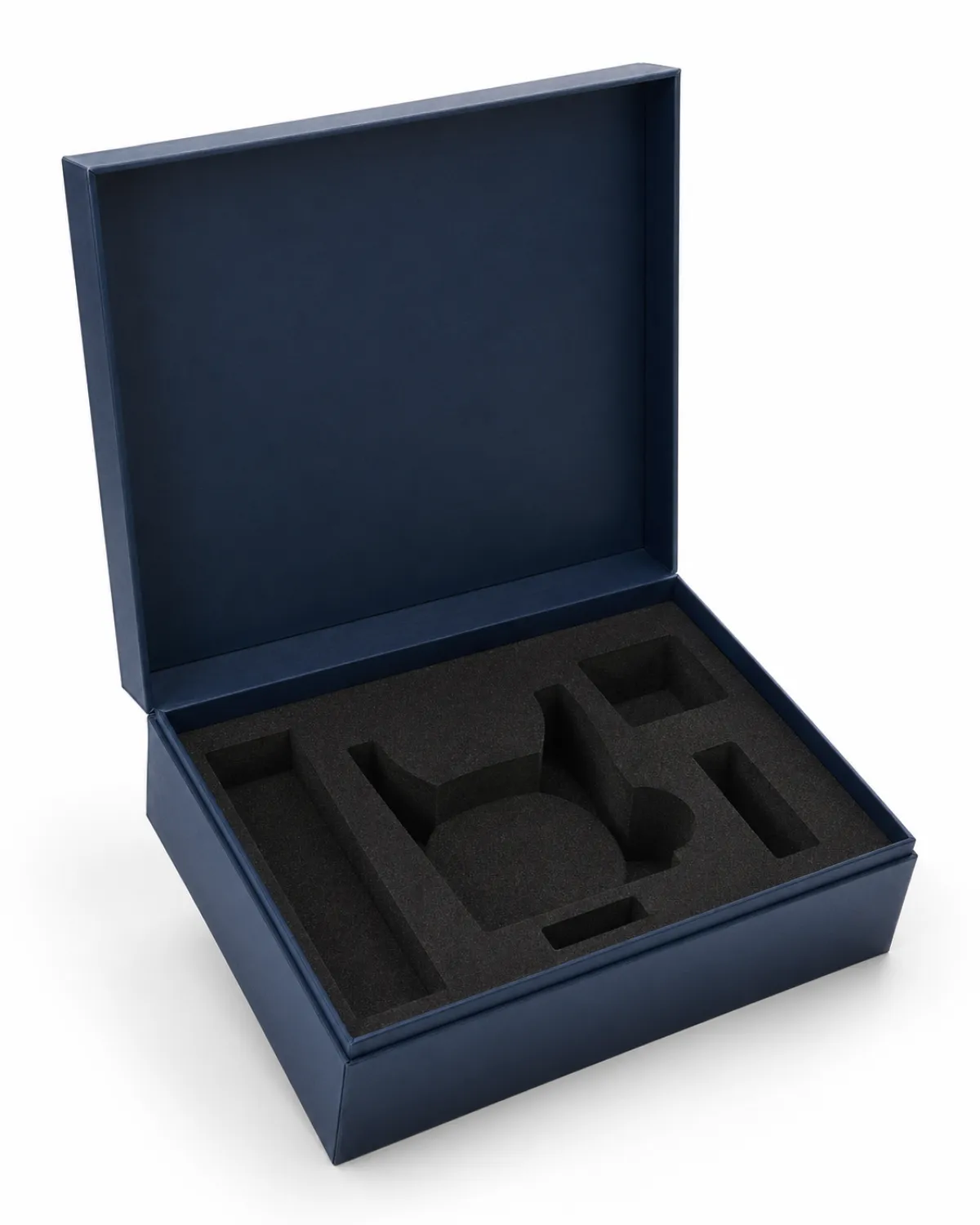
Custom presentation Boxes with Foam are rigid or semi-rigid boxes built around a shaped foam insert so the product sits still, looks organized, and survives handling. In plain language, the box is the frame, the foam is the fit, and the whole structure becomes a small stage for the product. I have seen this work especially well for items with a polished surface, a delicate finish, or multiple parts that need to stay separated during shipping. The best versions do something slightly sneaky: they make the buyer feel as though the product was made for that exact box, not the other way around.
The reason brands keep asking for custom presentation Boxes with Foam is that they solve three problems at once. First, they reduce movement, which lowers scuffs and corner damage. Second, they create a premium unboxing sequence that feels deliberate instead of random. Third, they support package branding by making the interior part of the story, not just the outer print. That matters more than people think. A customer sees the box for maybe 10 seconds before they touch the product, and those 10 seconds can shape the whole purchase memory. I have seen a 10-second reveal do more for product confidence than a 20-page brochure, and brochures, bless them, rarely get that kind of attention.
Products that benefit most usually share one trait: they are expensive, fragile, or emotionally loaded. Electronics with accessory sets, lipstick collections, watch displays, awards with metal edges, diagnostic kits, perfume samples, and gift sets are all strong candidates. I once sat in a client meeting where a cosmetics brand had 24 glass jars in one launch kit. Their old setup used paper dividers, and the breakage rate hovered near 3.5% on the first ship-out. After switching to Custom Presentation Boxes with foam and a tighter cavity layout, the damage rate dropped below 0.5% on the next two replenishment runs. That is not a tiny improvement; that is the difference between a tolerable headache and a warehouse tantrum.
"The box should protect the product, but it should also tell the buyer what kind of brand they are holding." That line came from a procurement manager in Hong Kong after we opened three prototype kits side by side, and she was right to call it out.
Foam changes the unboxing experience because it imposes order. The product lifts cleanly from a shaped cavity, accessories can sit in separate pockets, and the interior can use contrast color to guide the eye. Black foam with a white lid, or charcoal foam under a printed top tray, creates a visual rhythm that feels more expensive than plain carton partitions. That is why custom presentation boxes with foam show up in premium retail packaging, sample programs, and branded gifting. The customer is not just receiving a product; they are receiving a controlled reveal. I know that sounds a little theatrical, but theater sells better than chaos almost every time.
Here is the rough roadmap I use with clients: define the product, decide what must be protected, determine the desired opening sequence, then choose materials and test them against handling conditions. If that sounds straightforward, it is not always the case. A 2 mm board that looks elegant in a mock-up may flex too much once a 380 g item is inside, and a foam insert that feels luxurious in hand may create dust or compression issues after 50 openings. That is why custom presentation boxes with foam need design thinking, not just a pretty print file. I have seen a beautiful box fail because the lid snagged by 1 mm. One millimeter. Packaging can be very dramatic about very small numbers.
How Custom Presentation Boxes with Foam Are Built
The structure of custom presentation boxes with foam usually starts with a rigid board shell, often 1.8 mm to 3 mm greyboard wrapped in printed paper, specialty paper, PU, or fabric. For commercial runs, many factories in Shenzhen and Dongguan use 2.0 mm chipboard with a 350gsm C1S artboard wrap because it prints cleanly and holds a sharp edge at the corners. The shell provides shape, edge strength, and a stable outer face for branding. Inside that shell sits the foam insert, which may be EVA, EPE, PU, or cross-linked PE, depending on the weight and fragility of the product. A magnetic flap, ribbon pull, or lift-lid can finish the opening sequence, but the real work happens in the fit and the cut quality.
I have seen suppliers argue for an EVA insert because it gives crisp edges and a cleaner presentation. I have also seen another supplier push back, saying the client's 1.2 kg metal device needed softer EPE because the drop risk was higher than the visual weight. Both were partly right. Foam selection is not just about feel; it is about density, recovery, and the kind of force the product will see in transit. In practice, custom presentation boxes with foam can use denser foam for heavy devices and lighter foam for cosmetics or sample sets where the main goal is display rather than hard shock absorption. That argument, by the way, can turn into a surprisingly spirited debate in a meeting room. I have watched people defend foam like it was a constitutional amendment.
The design workflow usually starts with product dimensions measured to the nearest 0.5 mm, not eyeballed from a catalog sheet. Then a dieline is created for the box structure, followed by a foam layout that accounts for cavity depth, finger access, and any accessory pockets. After that comes a physical sample, which should be checked with the real product, not a dummy object of similar size. The best custom presentation boxes with foam are the result of that loop: measure, cut, assemble, test, revise.
Foam can be fabricated in several ways. It can be die-cut for simple geometric shapes, routed for smooth curves, laminated in layers to create stepped trays, or surface-wrapped with paper or fabric to match the outer finish. Routed inserts work well for odd contours, such as headphones with curved arms or serum bottles with narrow necks. Layered foam is useful for tiered reveals, especially in custom presentation boxes with foam where the first lift should uncover a second component, a card, or a refill pack beneath.
The line between protective packaging and presentation packaging is thinner than many people assume. A standard shipping carton protects a product. A luxury display box shows it off. Custom presentation boxes with foam sit between those two goals. They need enough strength to survive shipping, but they also need enough finish quality to feel intentional on a shelf, in a kit, or on a presentation table. That balance is why a nice-looking sample can still fail if the lid rubs, the foam tears, or the product sits 4 mm too high and touches the top panel.
On one factory floor in Shenzhen, I watched a technician press a prototype watch case into foam cutouts that were 1 mm too tight. The brand team loved the look, but the case scratched the foam edge during removal. We widened the cavity by 0.7 mm, lowered the top pull tab by 3 mm, and the issue disappeared. That is the practical reality behind custom presentation boxes with foam: tiny dimensions matter, and the final result depends on the smallest details. The annoying part is that the smallest details are usually the ones nobody wants to discuss until they become a problem.
Key Factors That Affect Design, Fit, and Performance
The first design input for custom presentation boxes with foam is the product itself: weight, surface finish, fragility, and shape. A matte aluminum device with squared corners behaves differently from a glass vial with a rounded base. If the product weighs 180 g, a 20 mm foam wall may be enough. If it weighs 1.4 kg, that same wall may compress too much during transport. I ask for weight, dimensions, and a few photos from three angles before I discuss any foam layout, because guessing on the phone usually costs a revision round later. I also ask for the awkward details everyone forgets at first: charging ports, caps, seams, feet, buttons, and whatever little bump the engineer swears is "not really a bump." It always matters.
Foam thickness and density drive both performance and appearance. A 15 mm foam layer can look sleek, but if the product is tall or top-heavy, you may need 25 mm or even 30 mm in the base to prevent tilt. Denser foam often gives a cleaner cut edge and a firmer hold, while softer foam provides gentler cushioning. For custom presentation boxes with foam, the trick is not to choose the strongest foam available. The trick is to choose the foam that supports the product without making the insert bulky or hard to remove.
Cut tolerance is another detail that gets overlooked until the first sample arrives. A tolerance of +/- 1 mm might be acceptable for some accessories, but it can be too loose for a polished device that must sit centered under a window cut. If the product is meant to float visually, a 2 mm shift can ruin the impression. That is why I keep saying custom presentation boxes with foam are as much a fit-engineering project as a branding exercise. The visual payoff is the part everyone notices; the tolerance is the part that decides whether the buyer trusts the package.
Branding choices also matter inside the box. Black foam feels technical and high contrast, while white foam feels clinical and clean. Grey gives a quieter, more restrained look. Some brands want embossed logos on the lid or hot-stamped foil on the top panel, while others prefer a printed interior card that explains the product in one sentence. Good packaging design makes these choices support the product instead of competing with it. If the outer box is already loud, the inside should probably slow down the visual tempo. I am biased toward that restraint because too much visual shouting gets tiring quickly.
Sustainability is part of the discussion now, and not just because buyers ask about it. FSC-certified board can help with paper sourcing, and lower-waste foam choices can reduce material use if the product allows tighter nesting. I often suggest eliminating dead space before adding more material. A box that is 15 mm too large in every direction may use 20% more board and more foam than necessary, which increases freight weight and cost. You can read more about certified paper sourcing at FSC, and I think that conversation is worth having early, not after the artwork is final.
Testing is where the theory becomes reality. For many projects, I ask for a simple drop check, a vibration check, and a fit check with the actual product. Some teams use ISTA test methods as a benchmark, especially for distribution-heavy SKUs, while others reference internal shipping profiles based on carton stack height or courier handling. Custom presentation boxes with foam do not need the same test regime as a palletized industrial product, but they do need enough validation to catch the obvious failures: lid crush, product bounce, scuffed corners, and accessory migration. I would much rather find those failures on a workbench than hear about them from a customer with a damaged sample and a very pointed email.
One supplier negotiation I still remember involved a brand owner who wanted a suede-like exterior, a deep-cut foam tray, and a hidden magnetic closure, all on a unit price that belonged to a much simpler box. I showed him two sample stacks: one at 2 mm greyboard with a stock foam insert, another at 3 mm board, wrapped in textured paper with custom routed foam. The first stack looked good in a spreadsheet; the second stack survived real use. That is the tension inside custom presentation boxes with foam: visual ambition is easy, but fit, durability, and budget all have to agree.
Custom Presentation Boxes with Foam: Cost and Pricing Factors
Pricing for custom presentation boxes with foam depends on more variables than most buyers expect. Materials are the obvious one, but tooling, labor, assembly sequence, and finishing all move the number. A 200 x 150 x 60 mm rigid box with a simple EVA insert, plain paper wrap, and one-color print will cost far less than a larger box with magnet closure, foil stamping, soft-touch lamination, and a routed multi-level foam interior. Even if the outer footprint is similar, the production time can be very different.
To make the comparison less abstract, I usually show clients a low-complexity build next to a premium build. The low-complexity version might use stock board, a simple die-cut foam cavity, and minimal exterior print. The premium version might use thicker rigid board, wrapped panels, deeper cavities, and a custom reveal sequence with two layers. Both are custom presentation boxes with foam, but they serve different roles. One protects and presents efficiently. The other adds theater, prestige, and a stronger retail story.
Here is an indicative pricing range I use for planning on an 8 x 6 x 3 inch format, excluding freight, duties, and unusual artwork changes. These numbers are directional, not a quote. Freight, tariffs, coating choices, regional labor, and rush timing can move them quickly. The pattern is stable, though: setup cost hurts small runs, and unit cost falls as volume rises. On a 500-piece project, the same box can be expensive because all the setup work is spread across fewer units. On a 5,000-piece project, the tooling and proofing are diluted, and the box becomes more efficient. In Guangdong and Zhejiang factories that run daily box lines, I have seen a quoted delta of 18% to 32% between a 500-piece run and a 5,000-piece run just from scale alone.
| Build Type | Typical Structure | Indicative Unit Price at 500 | Indicative Unit Price at 5,000 | Best Fit |
|---|---|---|---|---|
| Basic presentation box | 2 mm board, paper wrap, stock die-cut foam | $3.80-$6.20 | $1.95-$3.40 | Samples, small gifts, lower-risk product packaging |
| Mid-tier branded box | 2 mm board, printed wrap, custom foam cavity, ribbon or magnet closure | $6.40-$10.50 | $3.20-$5.60 | Electronics, cosmetics kits, branded packaging launches |
| Premium display box | 3 mm board, specialty wrap, routed or layered foam, foil or embossing | $9.80-$16.00 | $5.50-$9.20 | Luxury items, awards, medical kits, high-visibility retail packaging |
Those figures are not fixed quotes. A 12 mm change in depth, a second foam layer, or a switch from matte print to soft-touch lamination can shift the price by 8% to 18% quickly. I have seen custom presentation boxes with foam jump in cost because the artwork changed after dieline approval, which forced a new proof and delayed production by four business days. Another common surprise is the foam itself: a custom routed insert with tight cutouts can cost noticeably more than a stock insert, even when the outer box looks identical on the shelf. A routed EVA tray from a plant in Dongguan will price differently than a die-cut EPE insert from a supplier in Ningbo, even if both are packed into the same 230 x 180 x 70 mm box.
Setup charges are easy to miss. There may be a cutting die, a tooling fee for the insert, a sample charge for the first prototype, and a color proof fee if the print coverage is complex. If the client wants spot UV, foil stamping, or a specialty coating, there is often a second setup layer. That is why I advise budgeting by priority: protect the product first, present it second, and only then decide how much decorative work is left in the budget. Custom presentation boxes with foam reward disciplined decision-making far more than they reward last-minute upgrades.
There is also a labor angle. A simple fold-and-glue carton can move quickly through assembly. A rigid box with a fitted insert, internal card, accessory pocket, and ribbon pull slows the line. That labor difference is part of the quoted price, even if the buyer only sees the finished box. If you are comparing two suppliers, ask whether the quote includes hand assembly, insert placement, inner print, and final inspection. Those four items alone can explain a gap of 12% to 25% between apparently similar custom presentation boxes with foam. On a 5,000-piece order, I have seen hand-assembly costs land at roughly $0.15 per unit for a simple tray and closer to $0.42 per unit for a multi-layer insert with ribbon and magnet alignment.
My practical rule is this: if the product is worth less than the packaging, the package is too expensive. If the product can fail in transit and trigger a return or reputation issue, the package may be underbuilt. The best pricing decision usually sits in the middle, where the box gives just enough protection and just enough brand presence to support the sale. For many clients, that means starting with a sample at one quantity, then validating the cost curve at 1,000, 3,000, and 5,000 units before moving forward. I know that sounds cautious, but caution is cheaper than rework.
If you are building a larger packaging system, pairing the box with matching outer materials from Custom Packaging Products can keep the look consistent across shipping cartons, inserts, and retail-ready packs. I have seen that consistency lift a launch because the customer experiences one visual language from warehouse to shelf. That is especially useful with custom presentation boxes with foam, where the interior has to match the brand story on the outside.
Process and Timeline: From Brief to Finished Boxes
The fastest projects begin with a very complete brief. For custom presentation boxes with foam, I want product dimensions, product photos, target quantity, shipping method, target market, closure preference, and the logo files in vector format. If the product has cables, manuals, sample vials, or spare heads, those need dimensions too. When that information is ready on day one, the project can move from quote to structural concept without a three-day email chain. I have lived through the opposite version, and it is not pretty.
The usual sequence is straightforward. First comes the discovery brief and budget range. Then comes a quote that reflects size, materials, and finish. After that, the structure is drawn, the foam layout is planned, and a prototype or sample is produced. Revisions follow. Production starts only after approval, then there is assembly, packing, and final delivery. For simple custom presentation boxes with foam, I often see 12 to 15 business days from proof approval to shipment. For more complex builds with layered foam, foil, and special coatings, 18 to 25 business days is more realistic. A plant in Shenzhen may finish the structural sample in 3 business days, while printed proofing in Guangzhou can add 2 to 4 more days depending on the ink set and coating.
Delays usually come from unclear specs. A client may say the product is 82 mm tall, then send a sample that is actually 84.6 mm with a protruding cap. Another team may change the finish from matte to gloss after the first proof. Another may ask for a new accessory pocket after the foam sample is already cut. Each of those changes adds time. That is why I tell people that custom presentation boxes with foam are not slow by nature; they are slow when the brief is incomplete. The box is doing exactly what the instructions asked, which is often where the frustration begins.
Approvals also take longer than many people expect, because a presentation box is judged like a marketing asset and a protective component at the same time. The print team cares about the logo placement, the operations team cares about pack speed, and the customer service team cares about how the box opens in the field. One medical client I worked with needed three internal sign-offs before they could approve the foam cavity, because the tray had to fit a device, a sensor, and a printed instruction card in a sequence that matched their training script. That added six business days, and everyone agreed it was still worth it.
A realistic planning rule is to work backward from the launch date with a 2-week buffer. If the boxes need to arrive at a trade show, the sample should be approved at least 4 weeks earlier. If the product is for retail rollout, leave enough time for a second prototype, even if the first one looks promising. I have watched too many custom presentation boxes with foam projects get squeezed because someone assumed the first sample would be final. It rarely is. Usually, the first sample is the one that teaches everyone what they forgot to ask for.
Custom presentation boxes with foam also benefit from a tight handoff between packaging and fulfillment. If the insert is deep enough to slow packing, that matters for labor planning. If the outer box uses a magnet closure, that may affect carton stacking in the warehouse. If the foam surface sheds small particles, the fulfillment team needs a cleaning step or a liner. These are not glamorous details, but they decide whether the package works in the real world or only on a design render. Real-world packaging has a habit of ignoring elegant assumptions.
Common Mistakes When Specifying Custom Presentation Boxes with Foam
The most common mistake I see with custom presentation boxes with foam is loose measuring. Someone measures the product with a ruler, rounds up, and sends the number off by 2 mm or 3 mm. That sounds harmless until the insert arrives and the object rocks inside the cavity, or worse, the cavity is so tight that the product has to be forced in. The fix is simple: measure in three places, measure the real item, and record the exact height of any cap, base, or protruding element. I would add one more rule: do not trust memory. Memory is a liar when deadlines are involved.
Another mistake is choosing foam based only on color or touch. A soft-feel insert may look great in photos, but if the product is heavy or sharp-edged, it may break down too quickly or leave debris. I saw this in a supplier review where a brand wanted black foam because it matched the outer carton. The first sample looked elegant, but the dense metal accessory left indent marks after repeated use. With custom presentation boxes with foam, the interior finish has to support the product mechanics, not just the mood board. Mood boards are useful, but they are not allowed to argue with gravity.
Overbuilding is a quieter problem, and it is expensive. I have seen a 240 g serum kit packaged as if it were a museum artifact, with triple-wall rigidity, deep foam, a magnetic lid, and a heavy laminated wrap. The box weighed almost as much as the kit, freight cost rose by 14%, and the customer still complained that the opening sequence felt too fussy. That is a classic case where custom presentation boxes with foam solved the wrong problem. The packaging became more impressive than useful, which is a mistake brands make when they fall in love with the sample table.
Brands also forget the opening sequence. The box may protect the product beautifully, but if the user has to dig under a foam flap, peel a stubborn liner, and then tug an accessory bag from a corner pocket, the experience feels awkward. I recommend mapping the entire opening in three steps: first reveal, product access, and accessory access. If those steps are not obvious in the prototype, they will not feel obvious in the warehouse or at the customer's desk. Good custom presentation boxes with foam feel intuitive because the hand knows where to go next.
The last mistake is testing the drawing instead of the product. A dimension sheet can hide a lot of trouble: coating thickness, irregular edges, textured handles, and welded seams often change the real fit by 1 mm to 4 mm. I once watched a sample pass a paper check but fail with the actual device because the charge port had a tiny molded lip that nobody had included in the drawing. That tiny lip caused the entire tray to sit skewed. With custom presentation boxes with foam, the real item wins every argument. Paper is a helpful liar; the product is the one that tells the truth.
There is a related mistake around sustainability claims. A buyer may request "eco-friendly foam" without defining the end use, the local recycling rules, or the number of reuses expected from the package. That is not enough. A recyclable board can help, and a lower-waste insert layout can help too, but the right choice depends on the product's fragility, the shipping route, and the market. A box that saves 8 grams of material but increases damage rates by 2% is not a better decision. It is just a more tasteful waste of money.
Expert Tips for Better Custom Presentation Boxes with Foam
The best custom presentation boxes with foam use the opening as a design moment, not an afterthought. I like to think about reveal order first: what does the customer see in second one, what do they see after the first lift, and where does the eye land when the product is fully removed? A little contrast goes a long way. A dark foam tray under a white top panel, or a printed card beneath a central cavity, can make the whole package feel more disciplined and more premium. The effect is subtle, but subtle is often what premium actually looks like.
Reserve foam cutouts for true contact points. If a product only needs support under the base and one shoulder, do not carve unnecessary cavities just because the software can do it. Every extra cut adds complexity and can slow assembly. I have found that simpler layouts often outperform ornate ones, especially in custom presentation boxes with foam where the user only needs stable placement, not a puzzle. Nobody wants to solve a packaging riddle before breakfast.
Balance protection and aesthetics by putting the strongest material where the risk actually exists. A medical device with a screen may need more support on the face and corners, while the body sides can use lighter structure. A fragrance set may need rigid presentation at the lid and gentler foam below the bottles. That selective approach keeps the box from feeling overbuilt while still giving custom presentation boxes with foam the strength they need for transit and shelf presentation.
I strongly prefer a prototype-first approach for expensive launches. A sample does not just confirm dimensions; it reveals how the product behaves during removal, whether the user understands the sequence, and whether the closure feels acceptable after repeated opens. For a launch budget above $25,000, spending a few extra days on sampling is usually cheaper than fixing a bad pack-out after 3,000 units are in motion. That is one reason custom presentation boxes with foam are worth planning early, not late. I have never once met a team that regretted the extra sample after the fact.
It also helps to think in terms of branded packaging systems rather than single boxes. If the presentation box is premium but the shipping carton is plain and the accessory card is generic, the experience feels fragmented. Matching typography, consistent print tone, and a coordinated interior message create a stronger sense of package branding. In one client project, that consistency helped the sales team because the same visual language appeared on the sample box, the retail pack, and the carry case. People read continuity as quality, even when they do not consciously say so.
Honestly, I think the smartest teams treat custom presentation boxes with foam as a product decision, not just a graphics decision. They ask how often the box will be opened, who will open it, whether the product gets returned, and whether the packaging stays with the product after sale. Those four questions can change the foam density, the board thickness, and the finish choices in a very real way. If you answer them early, the box usually gets simpler and better. That simplicity is not a lack of ambition; it is proof that the design actually works.
My last practical suggestion is to request one sample with the exact product and one with the product plus all accessories. That sounds obvious, but brands skip it all the time. The accessory version often exposes the real issue: a cable pocket that steals depth, a charger that makes the tray too tall, or a manual that interferes with lid clearance. With custom presentation boxes with foam, those small findings prevent big headaches later. I have lost count of the times a "minor" accessory turned into the entire reason a prototype got redone.
What products work best in custom presentation boxes with foam?
They work best for fragile, high-value, or visually important items such as electronics, jewelry, cosmetics, awards, medical devices, and gift sets. A 180 g serum bottle, a 1.1 kg test device, or a three-piece watch set all benefit from a fitted cavity because the foam can match shape, weight, and sensitivity. If the item has multiple parts, the insert can separate components and improve the opening experience.
How do custom presentation boxes with foam protect products better than standard boxes?
The rigid outer box provides structure while the foam insert limits movement, absorbs impact, and reduces abrasion. A fitted cavity keeps the product centered, which lowers the chance of corner damage or surface scuffs. Protection improves further when the foam is cut for the exact product dimensions and tested with the real item, not a placeholder of the same size.
What affects the cost of custom presentation boxes with foam?
Main cost drivers include box size, insert complexity, foam type, finishing, print coverage, and order quantity. A 2.0 mm greyboard box with a die-cut EVA insert costs less than a 3.0 mm rigid box with routed foam, foil stamping, and a magnet closure. Custom tooling and sample rounds can add setup cost, especially for unique shapes or multi-part interiors.
How long does it take to produce custom presentation boxes with foam?
Timeline depends on design complexity, revision count, sample approval, and production capacity. Simple projects often move from proof approval to shipment in 12 to 15 business days, while more complex builds with layered foam or specialty coatings can take 18 to 25 business days. Projects move faster when product dimensions and artwork are ready at the start.
Can custom presentation boxes with foam be made more sustainable?
Yes, by choosing recyclable board options, reducing oversized packaging, and using foam only where protection is needed. An FSC-certified paper wrap and a tighter cavity layout can reduce waste without compromising performance. The best sustainable option depends on product fragility, reuse expectations, local recycling rules, and the shipping route.
If you are weighing a launch pack, a retail set, or a client gift program, custom presentation boxes with foam usually make the most sense when the product is valuable enough to justify the structure and specific enough to need a fitted interior. Start with the product in hand, measure every protrusion, test the opening sequence, and approve the real sample before production. That one habit prevents most of the expensive surprises, whether the boxes are being made in Shenzhen, Dongguan, or a print corridor in Guangzhou.