Buyer Fit Snapshot
| Best fit | Custom Printed Bubble Mailers Wholesale for Growing Brands projects where brand print, material claims, artwork control, MOQ, and repeat-order consistency need to be specified before quoting. |
|---|---|
| Quote inputs | Share finished size, material target, print colors, finish, packing count, annual reorder estimate, ship-to region, and any compliance wording. |
| Proofing check | Approve dieline scale, logo placement, barcode or warning zones, color tolerance, closure strength, and carton packing before bulk production. |
| Main risk | Vague material claims, crowded artwork, missing packing details, or unclear freight terms can make a low unit price expensive after revisions. |
Fast answer: Custom Printed Bubble Mailers Wholesale for Growing Brands should be specified like a repeatable production item. The safest quote records material, print method, finish, artwork proof, packing count, and reorder notes in one written spec.
Production checks before approval
Compare the actual filled-product size with the drawing, then confirm tolerance on folds, seals, hang holes, label areas, and retail display edges. Reserve space for logos, QR codes, warning copy, and material claims before decorative graphics fill the panel.
Quote comparison points
Review material grade, print process, finish, sampling route, tooling charges, carton quantity, and freight assumptions side by side. A quote is only useful when the supplier can repeat the same color, closure quality, and packing count on the next order.
Custom Printed Bubble Mailers wholesale is one of those rare packaging decisions that can improve transit protection, brand perception, and repeat purchase behavior at the same time. I watched two nearly identical skincare brands in Ontario ship the same 120 ml glass serum bottle, on the same courier lane, with similar volume—about 9,000 parcels a month. The brand that moved to properly spec’d custom printed bubble mailers wholesale cut replacement claims from 3.8% to 1.4% in one quarter by fixing three basics: fit, seal integrity, and visual handling cues. Same product. Same lane. Totally different outcomes.
Freight keeps getting more expensive. Customer patience keeps getting shorter. Support queues swell fast when mailers split or goods arrive scuffed. Most teams still blame “rough courier handling” first (I get it—it’s an easy villain). The floor-level reality is less dramatic: dimensional mismatch and closure failure cause a huge share of avoidable losses. I’ve stood in fulfillment sites in Shenzhen, Ho Chi Minh City, and New Jersey and watched overstuffed mailers fail at the flap during normal conveyor transitions. That failure pattern is predictable—and preventable. Honestly, I think half the industry still treats this as bad luck when it’s actually bad specs.
Anyone comparing suppliers for custom printed bubble mailers wholesale needs practical detail, not glossy brochures: resin blend, bubble profile, adhesive width, print method, MOQ logic, and documented inspection data before dispatch. You’ll find all of that below, plus transparent cost examples, implementation checkpoints, and process controls we use at Custom Logo Things to keep repeat orders stable.
Why Custom Printed Bubble Mailers Wholesale Outperform Plain Mailers
A client meeting in Carson, California still sticks with me. Two marketplace sellers were debating damage liability like it was a courtroom drama. Same phone accessory kit. Same average order value ($28). Same carrier service. Seller A bought plain commodity mailers from mixed lots. Seller B invested in custom printed bubble mailers wholesale with a fixed internal size matrix and a 10 mm hot-melt adhesive band. Over 10 weeks, Seller B’s return-related ticket volume ran 42% lower, and their service team shifted time from apology emails to upsell outreach. That’s not “branding fluff.” That’s labor reallocation you can measure.
Courier scan data showed similar transit dwell times and no unusual handling exceptions. Pack consistency made the difference: right-sized cavity, stronger seams, cleaner label panel placement. I’ve seen that pattern repeat across DTC categories shipping cosmetics, apparel add-ons, and electronics accessories under 1.2 lb.
Good custom printed bubble mailers wholesale programs also change warehouse behavior in measurable ways. A printed “Peel, Press, Hold 2 Seconds” strip and orientation icons reduce closure mistakes during peak staffing periods. On a Dallas line running roughly 2,200 orders per hour, closure defects dropped from 2.1% to 0.6% after instruction graphics were added and flap length increased from 40 mm to 50 mm. I remember when one supervisor told me, “We didn’t train harder—we just printed clearer.” That line should be framed in every packaging office.
Plain mailers may look cheaper in a unit-cost spreadsheet, yet total landed cost usually tells another story. With custom printed bubble mailers wholesale, brands frequently gain:
- Lower replacement and refund spend from stronger fit and seal performance
- Higher repeat-order potential through consistent package branding and unboxing
- Fewer customer service touches as damage and leakage complaints decline
- Cleaner pack workflows because staff can identify size and orientation instantly
Best ROI tends to appear in subscription brands, beauty and personal care, lightweight electronics, fashion accessories, nutraceutical refills, and marketplace sellers balancing branded presentation with postage efficiency. If your average parcel is under 0.8 cubic feet and needs light-to-medium puncture protection, custom printed bubble mailers wholesale can beat cartons on many lanes.
Many teams use a mixed-format strategy. Some clients run Custom Packaging Products across channels: bubble mailers for replenishment orders and Custom Printed Boxes for premium bundles or gift SKUs. One format rarely fits every order profile. The better target is cost-controlled product packaging that protects the SKU and supports reorder growth (and yes, this is less glamorous than a brand photoshoot, but far more profitable).
Product Details: Material Systems, Print Methods, and Construction Options
A high-performing mailer starts with structure. Most custom printed bubble mailers wholesale builds use an outer film—typically LDPE or co-extruded polyethylene blends in the 55–90 micron range—paired with an internal bubble layer by lamination or co-forming. For many eCommerce loads, a 70 micron outer film with a 40–50 gsm bubble liner gives a strong balance of puncture resistance and postage-friendly weight.
Adhesive selection is a core performance variable, not a minor detail. A permanent hot-melt strip in the 8–12 mm range usually delivers the strongest closure security for hand-pack lines. Low-tack pressure-sensitive options can fail in humid warehouses above 70% RH, especially with dust-heavy conditions. If stations pack near kraft chips or paper void fill, specify a contamination-tolerant hot-melt grade and run peel testing at actual line temperature. I learned this the hard way after seeing a “cost-optimized” adhesive fail during a muggy August run—nothing humbles a packaging team faster than reopening cartons you thought were done.
Bubble geometry matters more than most buyers expect. Small bubbles (about 9–10 mm diameter, 3 mm height) fit cosmetics and flat accessories well. Larger bubbles (about 18 mm diameter, 6 mm height) absorb point impact better but add parcel thickness. There’s always a tradeoff between cushioning recovery and profile. If postage tiers penalize thickness, test both profiles before locking the spec.
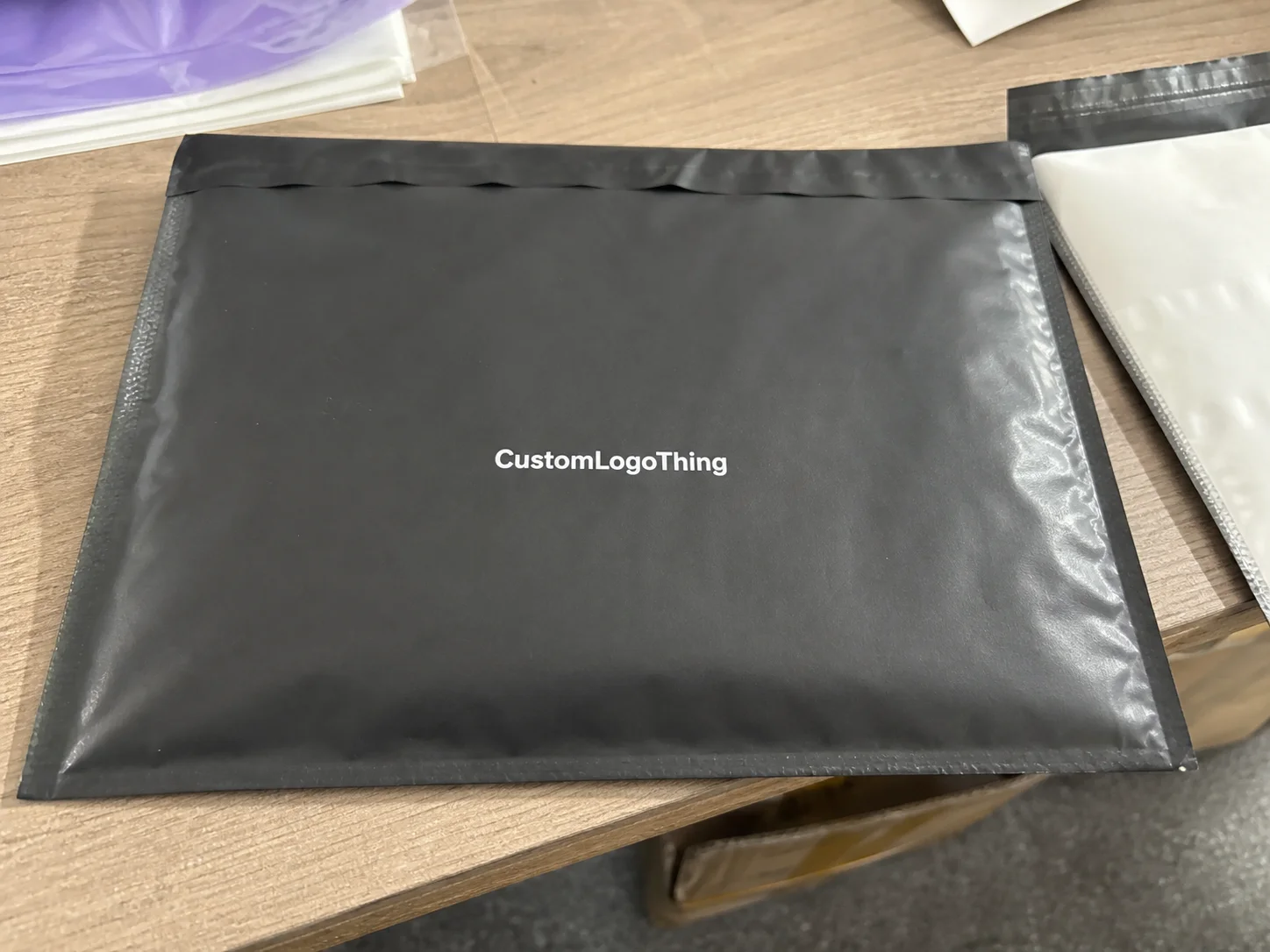
Finish options usually come down to white opaque, metallic, matte, or gloss. Matte often reads as more premium in retail packaging-style branding, while gloss boosts color pop for bold logo work. Opacity should be treated as a functional choice too. Sensitive categories benefit from opaque co-ex layers that reduce silhouette show-through from products and paperwork.
Construction style directly affects durability. Single-wall mailers are lighter and often cheaper. Reinforced seam builds with wider side welds increase seam burst resistance under overfill and corner stress. For fragile components with hard edges, reinforced seams often justify the extra $0.01–$0.03 per unit at mid-volume. I know that sounds small, but at scale those pennies are cheaper than replacement inventory, second-leg shipping, and customer churn.
Print technology for wholesale runs
Recurring custom printed bubble mailers wholesale programs usually favor flexographic printing at higher volumes. Polymer plate setups deliver stable repeat quality once registration is tuned. Rotogravure carries higher upfront cost because cylinders must be engraved, but it gives excellent dense solids and tighter color consistency over long runs.
Artwork with gradients, skin tones, and strict brand tolerances may justify gravure economics. Designs with 1–3 spot colors and repeat runs by size usually favor flexo on cost. I’ve negotiated both approaches with suppliers in Zhejiang and Gujarat; the right decision depends on annual volume and color sensitivity, not internal marketing preference. (If your design team says they “need” six spot colors on a mailer that ships refills, take a breath and re-check the objective.)
Color management and branding features
PMS spot colors on film can shift compared with coated paperboard. Set that expectation early. Ask for drawdowns and production-like proofs under D50 lighting. CMYK on polyethylene can work well, but tiny text and thin reverse lines demand caution—minimum line weights around 0.2 mm are safer for repeat clarity.
Useful branding upgrades include full-bleed exterior print, inside-print messaging for returns or loyalty prompts, QR codes linked to reorder pages, and handling icons near the seal area. I recommend one consistent label panel with lighter ink coverage to improve thermal label adhesion and scan reliability.
Sustainability questions now appear in almost every sourcing call. Recycled-content films, downgauged structures, and region-specific recycle-ready pathways may be available depending on destination infrastructure. Validate claims with supplier documentation and compare guidance with EPA recycling information and FSC for relevant paper-based components. If you’re comparing branded bubble mailers from multiple vendors, ask each one for the same documentation set so your evaluation stays objective.
Specifications That Matter Before You Buy Custom Printed Bubble Mailers Wholesale
A clean spec sheet prevents expensive confusion. Before placing a custom printed bubble mailers wholesale order, define finished size, usable internal size, flap length, adhesive band width, outer film micron, bubble diameter, and side seam width. I push procurement teams to record both flat dimensions and usable fill size because bubble volume always reduces true capacity. I remember when a team skipped this and ordered 40,000 units that were “technically correct” on paper and totally wrong on the line—nobody enjoyed that meeting.
Practical checklist:
- Finished flat width x length (example: 220 x 280 mm)
- Usable internal cavity (example: 205 x 255 mm)
- Flap length and adhesive width (example: 50 mm flap, 10 mm adhesive)
- Outer film type and thickness (example: co-ex LDPE, 70 micron)
- Bubble profile (example: 10 mm diameter x 3 mm height)
- Seam structure (single wall vs reinforced weld)
- Print spec (PMS colors, coverage %, matte/gloss, label panel)
Tolerances are operational controls, not paperwork noise. Width tolerance of ±2 mm versus ±5 mm can determine whether mailers run cleanly on semi-automatic packing fixtures. If your line uses guides or jigs, ask for tighter tolerances and request recent process capability data from the supplier.
Durability evaluation should focus on seam strength, puncture behavior, and seal peel performance—not only film thickness. Thick film with weak side welds still fails early. We typically run 180° peel tests after a 24-hour cure and random puncture checks with standardized probes.
SKU geometry drives transport risk. Hard corners, metal clips, and blister edges create stress points that burst bubbles and abrade film. In those cases, consider a slightly larger cavity plus a thin kraft wrap or sleeve. Right-size the pack, but don’t over-compress (seriously, overstuffing is the packaging equivalent of “just one more thing” before deadline).
Compliance details can derail otherwise good programs. Test shipping label adhesion on your selected finish; some high-gloss coatings require different label stock. Keep barcode quiet zones clear of heavy graphics. Place regional warning text and recycling statements away from fold distortion areas.
Artwork and prepress requirements
For custom printed bubble mailers wholesale, art files should include dielines, at least 3 mm bleed, safe zones, trapping notes, and line-weight rules. Tiny reverse text often fills in on film; positive type above 6 pt is a safer target. Multi-language legal copy needs a clean panel that does not cross seams.
Proof workflow should include:
- Preflight check for dimensions, bleed, and color assignments
- Soft proof review for layout and text accuracy
- Physical sample confirmation for color and sealing behavior
- Final sign-off with version-controlled approval record
I’ve seen brands lose three weeks because the approved PDF did not match the final plate file. Lock revision control early. Use clear naming conventions. Confirm color callouts in writing. Honestly, I think “final_FINAL_v7” should be retired as a file name forever.
Quality control checkpoints worth demanding
Request documented inspections: incoming resin checks, print registration verification at roll changes, seal-temperature logs, peel-strength records, and AQL-based final sampling before dispatch. If a supplier cannot produce inspection sheets, treat that as a warning sign.
For validation, I often reference transit simulation logic aligned with ISTA methods, especially for fragile contents. Not every program needs full lab simulation, though high-claim categories should test before scaling.
Pricing, MOQ, and Cost Drivers for Wholesale Orders
Most buyers start with one question: “What’s my unit price?” Reasonable question, but custom printed bubble mailers wholesale should be evaluated on landed cost per successful delivery. I’ve watched brands choose the lowest unit quote and then spend double in returns and support labor. That’s not savings—that’s delayed billing.
Typical cost components include plate or cylinder tooling, run price, color/station changes, packaging, and freight. Flexo plate sets often land between $120 and $450 per size, depending on design complexity. Gravure cylinders cost more upfront, yet per-unit pricing drops on long repeat programs.
MOQ reflects real manufacturing constraints: press setup time, viscosity calibration, substrate changeover, and line cleanup. If a supplier offers ultra-low MOQ on a high-volume process, verify the method. Common tactics include pooled materials, restricted customization, or setup fees hidden in unit pricing. I’m not against low MOQ, but I am against mystery math.
| Scenario | Qty | Spec Snapshot | Estimated Unit Price | Notes |
|---|---|---|---|---|
| Starter wholesale run | 5,000 pcs | 220x280 mm, 70 micron outer, 1-2 colors flexo | $0.21–$0.29 | Higher setup allocation per unit |
| Scaling reorder | 20,000 pcs | Same size/spec, repeat artwork | $0.15–$0.22 | Better material and setup efficiency |
| Multi-size strategy | 30,000 pcs total across 3 sizes | Shared design family, matched film grade | $0.14–$0.24 | Depends on size mix and print coverage |
Cost drivers you can actively control:
- Size optimization to reduce material waste and DIM exposure
- Color count and total ink coverage
- Film thickness and seam reinforcement level
- Order consolidation across SKUs and cadence planning
- Destination and shipping mode (air vs ocean vs domestic ground)
Short-run digital can work for pilots or seasonal drops. Recurring programs usually achieve better economics through wholesale flexo or gravure production. If monthly burn is stable above roughly 8,000–10,000 units per key size, traditional custom printed bubble mailers wholesale methods often outperform digital on unit cost.
Payment norms vary by supplier risk and account history: 30/70, 50/50, or net terms after repeat cycles are common. Quote validity windows often run 7–30 days because resin and freight move. Ask for line-item quotes so comparisons stay clean: material, print, setup, carton packing, palletization, and freight as separate entries.
Teams building broader mailer portfolios should review Wholesale Programs and compare adjacent formats like Custom Poly Mailers for non-fragile SKUs that do not require bubble protection. That side-by-side view is useful if you’re balancing ecommerce packaging performance against storage constraints.
Process and Timeline: From Dieline to Delivered Cartons
Predictable workflow keeps custom printed bubble mailers wholesale programs on schedule. A dependable sequence looks like this: requirement intake, technical review, artwork preflight, proofing, pilot confirmation, production scheduling, manufacturing, final QC, dispatch.
New programs commonly run 12–15 business days for production after proof approval, plus route-dependent freight time. Repeat runs with locked specs move faster. Delays usually come from revision loops, slow color approvals, and shipping bookings—not machine runtime. I’ve seen teams spend five days debating a shade shift that customers would never notice, then panic-expedite freight. Priorities matter.
Proofing and approval discipline
Color-sensitive brands should use both soft proof and physical sample. Soft proofs catch copy and layout errors quickly; physical samples show real ink behavior on film and real closure behavior under pressure. Assigning one approval owner prevents contradictory feedback and unnecessary delay.
Factory controls during production
Reliable suppliers use inline camera registration checks, seal-temperature monitoring, and roll-level batch traceability. At a Dongguan converter, I watched a supervisor stop a run when registration drift reached 0.7 mm outside tolerance on panel text. That single decision prevented 18,000 off-spec units from moving downstream.
Final QC should cover random AQL sampling, carton count verification, seal checks, and visual print audit under standard lighting. Carton labels need PO, size code, batch number, and quantity so receiving teams can reconcile quickly.
Packing, logistics, and lead-time reduction
Carton packs often run 100–250 units, depending on mailer size and compression limits. Palletization should account for humidity risk on long lanes; stretch wrap with top-sheet protection is common. Destination labels must align with warehouse WMS fields to avoid put-away errors.
To reduce lead time without creating new risk:
- Lock specifications early and avoid mid-run changes
- Maintain a pre-approved, version-controlled artwork library
- Forecast quarterly demand by size and lane
- Set reorder triggers using daily burn plus transit buffer
“After we set reorder triggers at 35 days of cover and standardized two mailer sizes, we stopped expediting air shipments and cut packaging stockouts to near zero.” — Operations Manager, apparel accessories brand
Why Choose Us for Custom Printed Bubble Mailers Wholesale
At Custom Logo Things, we run custom printed bubble mailers wholesale as an operations and engineering program, not a generic print transaction. Recommendations are tied to SKU risk, lane profile, and fulfillment behavior. I care a lot more about your claim rate trend line than fancy wording on a quote sheet.
Our team flags high-risk choices early: undersized cavities, weak seam specs, artwork details that won’t reproduce reliably, and label-panel conflicts. I’d rather challenge a concept before production than explain avoidable failures after 20,000 units land. (Trust me, nobody enjoys that postmortem—not you, not us, not finance.)
The service model stays straightforward: consultative spec review, fast line-item quoting, proof workflow support, and milestone updates. If risk appears—material variance, artwork conflict, freight timing—you get options and impact, not vague reassurance.
Quality assurance is documented. Inspections align to agreed tolerances, production samples are retained as references, and corrective-action routes are defined if results drift. Order complexity varies by SKU, but the target remains the same: consistent print, dependable seals, repeatable pack performance.
Operational support extends to scaling. If you’re moving from one hero size to a full matrix, we help rationalize the mix so inventory complexity doesn’t spiral.
From visual branding to courier performance, recommendations stay practical. Whether the goal is stronger branded presentation, cleaner packaging design, or fit with existing product packaging systems, the framework is clear: defined scope, defined tolerances, defined accountability.
What Should You Prepare Before Ordering Custom Printed Bubble Mailers Wholesale?
Preparing your first custom printed bubble mailers wholesale order starts with a procurement-ready data pack. Gather top SKUs, monthly volume, product dimensions, historical damage rate, and destination lanes. Damage history is critical—it reveals where structural upgrades will pay for themselves. I remember when one team finally mapped claims by lane and discovered 63% of damage was concentrated in two long-haul zones; that insight changed their spec strategy overnight.
For accurate quoting, provide:
- Size matrix by SKU or SKU family
- Print colors (PMS/CMYK), coverage targets, and finish preference
- Material direction (standard, recycled content, downgauged target)
- Destination and preferred Incoterm
- Required in-warehouse delivery window
A sensible pilot uses one or two high-volume sizes first. Run live orders for 2–4 weeks. Track damage claims, monitor seal-failure rates, and review customer feedback tied to unboxing and brand recognition. Expand to additional sizes only after the data confirms performance.
Before full rollout, confirm key controls: approved proof version, carton labeling format, receiving plan by warehouse, reorder threshold, and internal sign-off owner. Strong implementation timelines include purchasing handoff, production slot confirmation, inbound booking, and go-live controls.
If you want a clean launch, request a technical quote package and sample set from Custom Logo Things using your size matrix and artwork files. We’ll map options, pricing tiers, and lead-time paths so you can move forward with custom printed bubble mailers wholesale using clear targets and measurable outcomes.
FAQ
What is the typical MOQ for custom bubble mailers wholesale orders?
MOQ depends on size, print process, and color count. Flexo and gravure programs usually require higher minimums than short-run alternatives because setup and calibration time must be spread across volume. Brands running multiple sizes can group artwork families to improve efficiency and lower effective per-SKU minimums. Ask for tiered pricing at several quantity breaks, then align purchasing with replenishment cadence.
How do I choose the right size for custom printed padded mailers?
Start with product dimensions, add realistic protection allowance, and verify usable internal space rather than flat external dimensions. Test packed samples for corner and seam stress, especially for hard-edged items. In practice, a size matrix that covers 80%+ of shipments usually balances protection, storage footprint, and fulfillment simplicity.
How long does production take for custom printed bubble mailers wholesale?
Lead time includes preflight, proof approval, scheduling, manufacturing, QC, and freight. Many programs run in roughly 12–15 business days after final approval, then add transit time based on route. Most delays come from approvals and revisions rather than press speed. Locked specs and pre-approved artwork libraries can cut repeat-order lead times significantly.
What affects the price of branded bubble mailers the most?
Primary drivers are size, material thickness, print coverage and color count, order volume, and shipping destination. Unit cost alone can mislead procurement decisions. Compare landed cost that includes storage, return rates, and support overhead. Right-sizing mailers is often the fastest path to lower total spend without sacrificing protection.
Can custom printed bubble mailers be made with eco-friendlier materials?
Yes. Depending on region and supply chain availability, options can include recycled-content films and downgauged structures. Material claims should be backed by documentation, and on-pack guidance should match local recycling pathways. Any composition change should be validated with seal and puncture testing before full conversion.