Buyer Fit Snapshot
| Best fit | Custom Printed Kraft Paper Roll Bulk projects where brand print, material claims, artwork control, MOQ, and repeat-order consistency need to be specified before quoting. |
|---|---|
| Quote inputs | Share finished size, material target, print colors, finish, packing count, annual reorder estimate, ship-to region, and any compliance wording. |
| Proofing check | Approve dieline scale, logo placement, barcode or warning zones, color tolerance, closure strength, and carton packing before bulk production. |
| Main risk | Vague material claims, crowded artwork, missing packing details, or unclear freight terms can make a low unit price expensive after revisions. |
Fast answer: Custom Printed Kraft Paper Roll Bulk: Pricing and Specs should be specified like a repeatable production item. The safest quote records material, print method, finish, artwork proof, packing count, and reorder notes in one written spec.
Production checks before approval
Compare the actual filled-product size with the drawing, then confirm tolerance on folds, seals, hang holes, label areas, and retail display edges. Reserve space for logos, QR codes, warning copy, and material claims before decorative graphics fill the panel.
Quote comparison points
Review material grade, print process, finish, sampling route, tooling charges, carton quantity, and freight assumptions side by side. A quote is only useful when the supplier can repeat the same color, closure quality, and packing count on the next order.
Custom Printed Kraft Paper Roll Bulk: Pricing and Specs
Custom Packaging Products and Wholesale Programs buyers usually start with the visual finish, then the floor tells them what actually matters: width tolerance, roll stiffness, core fit, and how much scrap the line can absorb before output starts slipping. For Custom Printed Kraft paper roll bulk, the best choice is rarely the prettiest sample. It is the one that lands cleanly on the machine, feeds without drama, and holds up when the shift gets busy.
One bad roll can stall an entire shift. Two bad rolls can turn a normal dispatch window into a scramble of hand fixes, tape reruns, and operators making up time wherever they can. For high-volume teams, Custom Printed Kraft Paper Roll bulk is less about decoration and more about control. The purchase is not a mood board. It is a production choice with labor cost attached.
A strong Custom Printed Kraft paper roll bulk program behaves like a quiet efficiency upgrade. It reduces touchpoints, keeps wrap cycles predictable, and helps the line settle into a rhythm that can survive the daily messiness of warehouse work. In a lot of facilities, that is the difference between a packaging system that keeps pace and one that keeps pausing.
Is custom printed kraft paper roll bulk right for your high-volume packaging line?
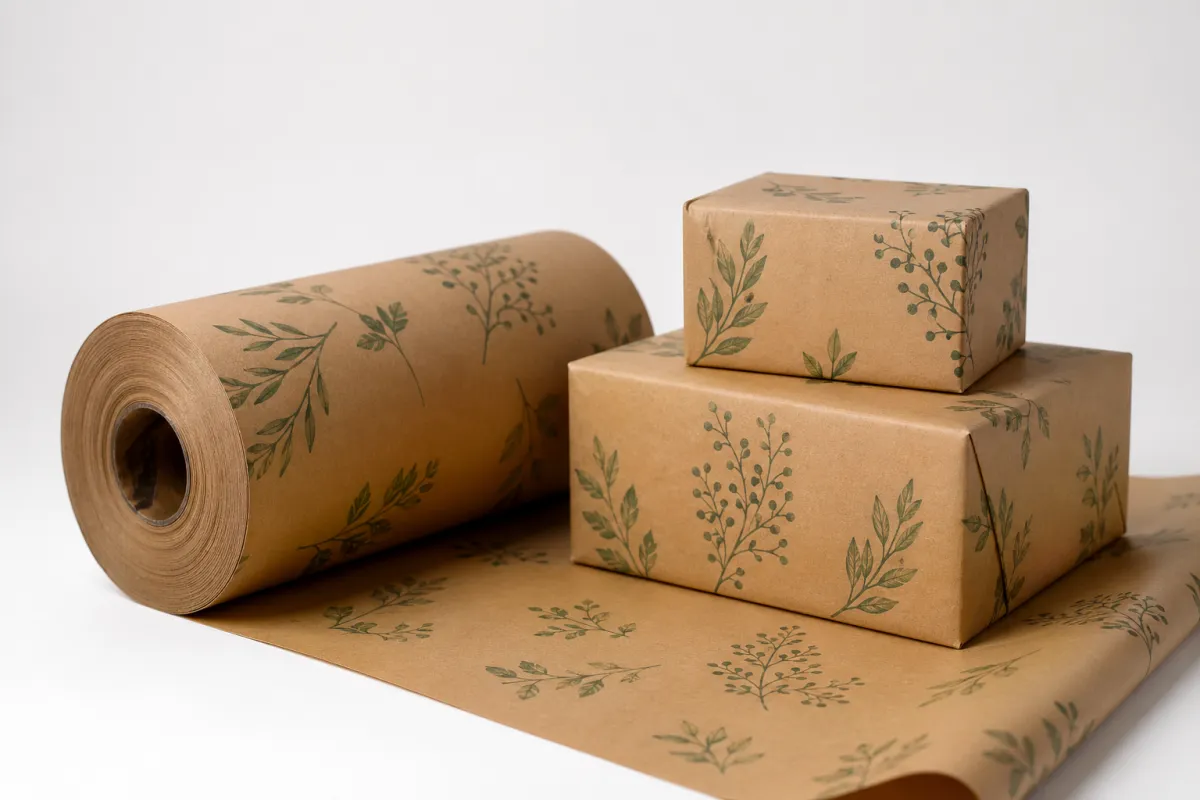
If your floor runs on repetition and timing, the answer is usually yes. Custom Printed Kraft Paper roll bulk makes the most sense when operators need to feed hundreds or thousands of packs through a consistent material profile. If your volumes are small, artwork changes constantly, or storage space is tight, it can still work, but the value shifts away from speed and toward presentation consistency.
The practical test is simple. Count how many times per shift someone repositions tape, trims excess, or waits for a conversion adjustment. If that answer is not zero, bulk custom paper rolls often earn their keep by removing variance. A Custom Printed Kraft Paper roll bulk setup is, in plain terms, a packaging control system hiding inside a purchasing category.
There is also a less obvious connection: packaging consistency and warehouse handling stability tend to rise together. A roll-fed line that gets cleaner input paper usually sees fewer reworks and fewer complaints downstream. That is true in fulfillment, retail replenishment, and mixed inventory workflows alike.
And yes, sometimes the smallest gains matter most. Save 20 seconds per pack across 6,000 parcels and you are not looking at a rounding error anymore.
Why Custom Printed Kraft Paper Roll Bulk Works for High-Volume Packaging
High-volume teams rarely buy paper for paper's sake. They buy predictability. E-commerce fulfillment, wholesale outbound hubs, and manufacturers feeding regional distribution all live on the same math: a roll that wraps cleanly, feeds steadily, and cuts without fuss saves time at every station. If one station starts drifting, that drift can repeat hundreds or thousands of times before anyone spots the pattern.
What makes custom printed kraft paper roll bulk valuable is not the ink alone. It is the reduction in handling variance. A small mismatch between roll width and carton geometry can create an invisible tax on the line. Extra trimming. Extra repositioning. Extra rework. The artwork may look perfect in approval emails while the floor absorbs the real cost.
Cheap procurement often looks clever on a spreadsheet and average on a conveyor. In one operational comparison, a lower paper quote seemed like the easy win until the wider-than-needed strip generated roughly 15-20% waste. Add two wasted minutes per order and a team pushing 6,000 parcels a day, and the lost labor gets hard to ignore. A higher-spec custom printed kraft paper roll bulk run can end up cheaper after one cycle because the line stops fighting the material.
These groups usually feel the difference first:
- E-commerce shippers that handle many similar parcels and depend on throughput.
- Fulfillment centers where cartons vary, but repeatability still matters.
- Retail brands that want branded consistency from dock to doorstep.
- Warehouses moving returns, transfer totes, and protective void fill.
From a packaging buyer's point of view, the roll works best when the design language stays steady. A lot of teams ask for fine-detail artwork and then find out, a little too late, that bold contrast outperforms delicate graphics once the paper is folded, pressed, and fed through equipment. In plenty of programs, custom printed kraft paper roll bulk is chosen not because it looks flashy, but because it behaves the same way every time.
Branding still matters, just not in the polished, showroom way people expect. Package branding builds cumulatively. A branded layer added at the last step can shape perception more than most teams predict, especially when every shipment carries the same visual cue. Retail Packaging That looks consistent also reduces confusion in marketplace drops and mixed warehouse flows where brand signals can get muddy.
Some teams also use this as a light corrugated substitute for inner protection, depending on load profile and route. In those programs, custom printed kraft paper roll bulk has less visual ambition than repeatability ambition, and honestly, that is usually the smarter move.
This is a throughput decision. It reduces waste, stabilizes line speed, and keeps brand expression coherent under load. Once that frame is clear, the remaining questions become technical: material grade, print method, minimum order quantity, and how the lead time behaves when the schedule gets crowded.
Custom Printed Kraft Paper Roll Bulk Product Details
The material comes first. Three paper families usually carry the load. Virgin kraft gives a cleaner surface, a brighter base tone, sharper text contrast, and more consistency for logo detail. Recycled kraft fits sustainability-forward packaging claims and can support ESG reporting. Blended stocks sit between the two, trading some visual uniformity for better cost control.
Material choice and practical outcomes
Virgin kraft has a more predictable print surface. That matters when a front-facing brand mark needs sharp edges and controlled ink spread. Recycled kraft can perform well too, but batch-to-batch tone variation is part of the deal. Some teams reserve recycled stock for inner cushioning and move virgin kraft to the visible outer layer. That split keeps the cost line calmer while protecting the customer-facing finish.
Blended stocks often become the compromise choice. They can lower cost per square meter while keeping enough surface smoothness for logo-level graphics. That is not the right answer for every packaging program. If the final touchpoint is visible to the customer, test it instead of assuming it will behave the same across production lots.
Color and tone affect the result more than most buyers expect. Natural kraft is not a blank canvas in the optical sense. Dark pigments over a warm substrate behave differently than the same inks on coated white stock. Matte is the default finish, and that helps with a premium feel when the artwork is simple. It also flattens subtle gradients. Full-color, photo-like designs need tighter control and a higher pigment load, so custom printed kraft paper roll bulk orders with complex art should budget for narrower tolerances.
Print methods and where each one makes sense
Most teams choose one of these methods:
- One-color logos: Lowest complexity; strong for badges, marks, and basic package branding.
- Repeat patterns: Effective for long runs where the packaging line needs a steady visual rhythm.
- Spot graphics: Useful for compliance marks, direction cues, and mid-level design detail.
- Full-roll branding: Highest cost and highest visibility; fits customer-facing moments where recognition matters.
For product packaging, visibility and elegance are not the same thing. A single-color repeat can outperform dense artwork when the rolls move quickly. A clean two-tone wrap around a plain tote often prints with better edge definition than a four-color panel that tries to do too much.
Custom printed kraft paper roll bulk buyers also use these rolls across multiple operations: wrapping bottles, books, apparel bundles, irregular electronics cases, and protective inserts where corrugated cardboard would add unnecessary weight. They also work as interior layers inside corrugated cardboard boxes, helping teams reduce the amount of plastic in the pack while keeping the brand signal visible.
A proper quote starts with accurate confirmation. Width, length, core size, print area, repeat pattern, and dispenser compatibility should all be fixed before anyone prices the job. A 50 mm versus 76 mm core mismatch sounds small until it hits the floor and forces a last-minute conversion cost nobody planned for.
Line speed changes the decision too. A plant running 24/7 with one operator per station cannot treat a "good enough" roll as cheap. Cleanup time, adjustment time, and feed problems quietly turn into labor costs. In that setting, material choice and print method should favor manufacturability, not brochure polish.
Specifications That Matter Before You Order
Most specification problems are introduced before artwork reaches the press. Teams buying custom printed kraft paper roll bulk that do not define the basics up front tend to pay later through remakes, slower conversion, and quality drift. Think in failure modes: too light, too narrow, too short, unstable registration. Those are the usual suspects.
GSM and basis weight: strength versus flexibility
GSM is the first real indicator of behavior. Low GSM, often 40-60 GSM, gives flexibility and lower cost, but stiffness and tear resistance drop. Mid-range GSM, around 70-90 GSM, is usually the productivity sweet spot for many fulfillment applications. Above 90 GSM, durability improves, fold memory gets cleaner, and edge break drops during transport, although the roll can feel stiffer depending on core and diameter.
Heavy products and routes with moisture exposure justify heavier GSM. Dense goods punish weak stock. Light returns may not need that extra weight. No one spec works for every program, which is not a dodge so much as a reminder that load profile drives the answer.
Width: usually the most underestimated variable
Width does the heavy lifting. Ask for exact carton width, flap geometry, and any clearance requirement in millimeters. A width error of 30 mm can leave exposed edges or create useless overlap. That overlap wastes material, but it also traps corners, weakens closures, and slows each station because operators keep adjusting the wrap by hand.
A useful model is simple. If a target carton perimeter is 58 cm and the chosen width adds 5 cm overlap on each end, every wrap cycle consumes more paper than necessary. Over 5,000 cycles, the waste is measurable, and so is the effect on OEE. Paper width is not a minor line item; it changes cost and speed at the same time.
At some facilities, teams monitor kraft paper roll conversion loss by week because variation in width creates tiny cumulative delays that look harmless in isolation. That is where custom printed kraft paper roll bulk earns trust: you tune one variable and remove a whole class of repetitive failure events.
Roll length and diameter
Roll length determines how often changeovers happen. Common planning buckets are 50m and 100m, with shorter formats used for small-batch touch points. Longer runs reduce interruptions, but they can create handling problems if storage racks or feeders are not built for larger spools. A long roll that is awkward to move stops feeling economical very quickly.
Core size and roll diameter belong in the same conversation. A 76 mm core fits some dispensers, while 63 mm may be the only size your system accepts. Never assume a supplier will absorb the mismatch at no cost. Confirm spool outer diameter and axle style before production starts.
Print registration, repeat tolerances, and real-world visibility
Digital files can look clean while production repeats drift. A 0.5% repeat offset may be invisible on a single sample and obvious on a 300-piece pull. Tighter alignment matters for visible retail packs, while protective-only applications can tolerate a little more slack on matte kraft.
Many buyers never ask about tolerances. Ask directly:
"What are your alignment tolerance and registration acceptance limits for this press at my chosen coverage?"
That question cuts through vague answers and usually shortens revision cycles.
Compatibility notes for real shipping abuse
Ink rub resistance, tape adhesion, and edge performance become visible only after the bad batch lands in a warehouse. If your packaging passes through humid conditions, test abrasion and moisture exposure before sign-off. ASTM D828-style tensile behavior and basic burst testing are not luxury metrics. They tell you whether the print survives line abrasion and transit shock.
If the paper touches sharp edges, edge reinforcement deserves attention. Tape can fail at the corners when coatings run too matte or the grain fights the wrap direction. Ask whether edge scoring or slit control is part of the process. If the answer is yes, include it from day one instead of patching it in after the order is already moving.
High-drop environments need the same discipline. Use ISTA-style handling logic to match the shipment profile. A package that looks perfect after first fill and tears during pallet movement is not a branding problem. It is a specification problem in custom printed kraft paper roll bulk.
Custom Printed Kraft Paper Roll Bulk Pricing and MOQ
Price creates noise fast, so break it into inputs. Custom printed kraft paper roll bulk pricing is never driven by one number. It depends on paper grade, GSM, roll size, print colors, coverage, conversion steps, and finishing complexity. Buyers who flatten those variables into one unit cost usually miss the real cost structure.
Where the cost actually comes from
Base stock cost shows up early, but it is not always the dominant cost in the first 1,000 to 2,000 rolls. Setup, proofing, press make-ready, and quality checks often carry more weight. Add coating, precision slitting, or scoring and the unit economics shift again. That is why quote requests should separate stock, printing, and converting into different line items.
A one-color 60 GSM order can come close in cost to a two-color 80 GSM order once rejects and setup inefficiency are included. The math is not intuitive. The cheapest-looking option can become the most expensive one on the floor if it slows throughput or creates more scrap.
That is why mature teams compare total landed cost per roll instead of sticker price alone. In many procurement reviews, a custom printed kraft paper roll bulk variant with a slightly higher base rate can cut overall spend because it lowers rework and missed-shift downtime.
How bulk pricing scales in the real world
Most custom printed kraft paper roll bulk runs show step-down pricing. The first tier absorbs fixed cost. Each additional block lowers per-unit cost because setup is spread across more rolls. A flatter drop is common from 500 to 1,000 rolls, then a larger shift at 2,500 or 5,000 depending on plant load and color count.
The matrix below is for planning only. It shows how pricing tends to move across common profiles and helps compare supplier offers faster.
| Specification profile | GSM / Width | Print type | Qty band | Indicative landed cost / roll (USD) | Typical use case |
|---|---|---|---|---|---|
| Economy logo tag | 60 GSM, 30 cm | 1 color repeat | 250-500 | $2.85-$3.45 | Batch filling and internal handling |
| Standard brand loop | 70 GSM, 45 cm | 1-2 colors, repeat logo | 500-1,500 | $3.90-$4.75 | Outbound wrapping and light transit protection |
| Branded protection layer | 80 GSM, 60 cm | 2-3 colors, larger coverage | 1,500-3,000 | $5.10-$6.10 | Retail packaging touchpoints and rebrand programs |
| Premium product-facing | 100 GSM, 90 cm | 4-color artwork / full branding | 3,000-5,000 | $7.80-$9.25 | High-visibility consumer shipping |
| High-strength run | 120 GSM, 75 cm | 1-2 colors + optional lamination | 5,000+ | $8.20-$9.90 | Heavy items, moisture-prone transit, warehouse loops |
The ranges are only indicative, but they reveal how volume changes the quote. Many teams learn the lesson late. They compare unit price without adding freight or remake risk. A paper quote that is $0.30 cheaper per roll can lose its edge instantly if freight adds $0.30 and 15% of the lot gets reworked.
MOQ logic without hype
MOQ exists for three practical reasons. Press setup costs money whether the run is 100 units or 1,000. Proofing and color calibration need enough material to stabilize. Conversion planning and paper scheduling require predictable floor space and cut time. A custom printing order is a system commitment, not a casual purchase.
Some suppliers set MOQ by roll count. Others use total square footage. If the design involves wide rolls and a complicated repeat, square footage may be the number that controls the deal. Ask for the exact threshold before signing. Stable demand under MOQ still leaves options: pooled runs, simplified colors, or standard-width templates that fit the line better.
The most honest comparison is total landed cost. Check these five buckets:
- Unit pricing by run tier
- Freight and handling charges
- Sample and proof fees
- Potential remake or adjustment cost
- Storage handling for oversized-diameter rolls
Packaging decisions should never come from graphics alone, and custom printed kraft paper roll bulk should not come from unit price alone. Compare the full picture.
What gets you a fast quote
Quotes move faster when core inputs arrive together. Send:
- Final artwork, ideally a print-ready PDF or AI file
- Target quantity and lead date
- Roll width, length, core, and spool diameter
- Paper grade and GSM preference
- Print colors, repeat, and placement notes
That approach usually produces a cleaner proposal on the first pass and keeps your custom printed kraft paper roll bulk decision grounded in facts instead of a week of clarification emails.
From a packaging professional standpoint, I also recommend checking FSC certification status early if sustainability claims are part of the commercial message. That links the claim to proof. For transit resilience, align the supplier's test expectations with ISTA-type handling logic so the material gets judged against what it will actually face in shipment.
Process, Proofing, and Timeline for Bulk Orders
Most timeline surprises do not come from press speed. They come from friction in the workflow. A custom printed kraft paper roll bulk run succeeds when the sequence stays disciplined:
- Request quote and confirm scope
- Confirm material and geometric specs
- Submit artwork and print files
- Review digital proof
- Approve sample or pre-production run when required
- Produce, inspect, ship
For straightforward one-color jobs with clear specs, a common timeline is 8-12 business days from approved artwork to shipment in localized production. Complex full-color or high-coverage rolls can stretch to 14-21 business days depending on plate changes and press schedule. Color-sensitive programs that need sample approval may take 18-26 days.
Where delays usually happen
Late delivery almost always follows the same pattern: incomplete artwork, unclear dimensions, and repeated correction rounds. If color values stay unresolved, the queue waits. If roll length remains undefined, conversion gets delayed. If someone asks for one more change after setup starts, the schedule shifts and the order stops being cheap.
One practical rule helps more than most people expect. Lock critical dimensions as version zero before proofing. Width, core diameter, print repeat width, and core brand marks are not optional extras. They are the foundation.
Proofing strategy by risk profile
Digital proofs are fast and inexpensive, and they work well for checking copy, placement, and margins. Color-critical or logo-critical programs need more. Ask for an approved sample before full production when brand color matters, especially if the goods reach customers directly. That extra step may add 1-3 business days, which is usually far cheaper than a reprint.
"A clean approval chain is an underrated production tool: one owner, one file set, one sign-off. It trims confusion faster than any software can."
Do not assume the latest file resolves every dispute. Keep revision naming clear and keep the approval contact singular. Two decision-makers can help in theory. Three active approvers usually double the iteration time. The lean path is the faster one.
Timeline realism for commercial buys
For transactional buys, realistic timing beats optimistic estimates every time. If a campaign needs replenishment every Monday, plan backward from freight cutoff and leave room for proofing. The fastest path looks like this: complete specifications and final artwork sent together, sample approval inside 24-48 hours, and a single correction window. That is the kind of setup where 10 business days can be believable at scale.
Custom printed kraft paper roll bulk programs do better when timing is treated like a shared contract. Ask, "what is the earliest ship date with one revision included?" and "what is the earliest ship date with no revisions?" The gap between those answers usually reveals more than any polished pitch.
Why Buyers Choose Us for Custom Packaging
Most buyer teams do not choose a supplier for nice language. They choose one for consistency: stable print, stable schedule, stable communication. In custom printed kraft paper roll bulk procurement, consistency compounds. A small defect in week one becomes a trust problem by week ten if it repeats across thousands of units.
Operational reliability as a commercial advantage
If the line runs every day, supplier reliability matters more than the lowest print rate. A partner who understands roll conversion constraints can flag impossible tolerances before press start. That is the difference between a smooth week and a week built around recovery work.
From an operations perspective, quality control is practical rather than glamorous:
- Incoming paper inspection for GSM and moisture variation
- Color checks against approved references
- Roll-to-roll consistency checks at scheduled intervals
- Final batch sampling before dispatch
Most teams underestimate that layer of work. One supplier may promise fast delivery but fall apart on consistency if incoming control is weak. A structured process does not always look shiny. It shows up in fewer production stops and cleaner handoffs into packing.
Know-how in real-world packaging conditions
Practical packaging expertise means understanding what happens after approval. Will the roll pass over sharp cardboard edges? Will humidity affect it? Will ink rub off when tape gets pulled repeatedly? Will the workforce struggle to align the repeat at speed? Suppliers who answer those questions directly are not just selling paper. They are selling operational certainty.
For custom printed branding, the mechanics matter as much as the look. Branded packaging only works if it survives the trip to the customer. Returns processing, forklift pressure, and 24-72 hours of warehouse storage can all affect the outcome before the parcel even leaves the building.
Customization support and procurement clarity
Strong suppliers do more than print what gets uploaded. They steer spec choices based on the actual order profile. If a retail packaging program needs high contrast, they may suggest a different kraft blend or a one-color adjustment that reduces ink spread. If the budget is tight, they may propose a repeat layout that preserves legibility without adding avoidable cost. That is not dilution. That is practical packaging discipline.
I keep coming back to this because the return is easy to miss. The biggest gain is often not a lower print rate per roll. It is fewer preventable delays. A supplier who spots issues early can reduce waste enough to offset a higher headline quote.
Measure the quote against the supplier's ability to explain why your product packaging and carton stack behavior need a specific width, length, and print method. If that explanation is missing, the order may look affordable until execution proves otherwise.
Actionable Next Steps Before You Place an Order
The goal now is simple: reduce uncertainty and lock the specification. If you want your custom printed kraft paper roll bulk order to run cleanly, treat the pre-order phase like a readiness audit. Skip it, and your first production day becomes the audit whether you wanted that or not.
Use this practical checklist before requesting pricing:
- Product dimension envelope and carton geometry confirmed
- Roll width and roll width allowance set
- GSM target decided by handling stress level
- Roll length and core size matched to dispensers
- Print colors and expected contrast reviewed for kraft tone
- Quantity and replenishment cadence aligned with launch windows
- Packaging line compatibility validated (feed path, brake tension, dispenser size)
Prepare your files and data first
Do not request quotes with partial specs. That is one of the strongest causes of revision loops. Provide:
- Vector artwork (print-ready)
- Exact dimensions and tolerances
- Target shipping date
- Planned storage location and handling conditions
- Packaging design goals for package branding and product packaging tiers
Get those details in place first, and turnaround improves. The loop gets shorter. The arguments shrink. Avoidable revision costs fall.
Sample, proof, then decide
For customer-facing runs, ask for a sample or at least a strict pre-production proof. This matters most when logos carry brand color constraints or subtle edge details. On kraft, thin text and delicate gradients often underperform compared with bold marks, and color balance shifts with substrate tone. If the visual intent is precise, verify it before volume starts.
Compare apples with apples
Ask at least two suppliers, then compare the same spec sheet in each response. Same width, same GSM, same print colors, same core, same destination. A quote that changes the spec is not a clean comparison.
Measured properly, total landed cost often shows that a reliable supplier with tighter quality control reduces true cost. That pattern shows up often in retail packaging and fulfillment environments. Fewer write-offs. Fewer corrections. Less labor spent repairing preventable mistakes.
Decision criteria for moving from quote to order
- Specs finalized and approved internally
- Artwork cleanly approved by one authority
- Proof/sampling risk accepted
- Timeline aligned with replenishment plan
- MOQ fits demand curve for next two run cycles
Then place the order. For custom printed kraft paper roll bulk, the right moment is when operational assumptions, brand goals, and lead-time planning all point in the same direction. That is what moves packaging teams from patchwork to controlled execution, shipment after shipment.
FAQs
What is the minimum order for custom printed kraft paper roll bulk?
Minimums vary by width, print method, and setup complexity. Many manufacturers set MOQ by roll count, often 250-500 rolls for simple one-color profiles, with higher requirements for multi-color or broad-coverage jobs. Ask for the minimum tied to your exact material and print spec before committing. Otherwise you may compare the wrong tier and miss the real tooling assumptions.
How is custom printed kraft paper roll bulk pricing calculated?
Pricing starts with paper grade, GSM, roll dimensions, and print colors. Setup, proofing, and converting steps get added next. Since those costs stay fixed across small-to-mid volumes, unit cost falls as quantity rises. The clean comparison is total landed cost: unit price plus freight, taxes, storage, and any remake risk.
Which GSM should I choose for custom printed kraft paper roll bulk in large operations?
Lighter GSM works for flexible, lower-abuse wraps and void-fill style protection where speed matters. Higher GSM is the better fit for heavy items, sharp edges, or high-friction handling in warehouses. Match the stock to product weight, route stress, and whether moisture exposure is part of the trip.
Can you match brand colors on custom printed kraft paper roll bulk orders?
Yes, though color match depends on paper tone, print method, and ink loading. Kraft carries natural variation, so hue and contrast can shift from roll to roll. A proof or production sample is the safest way to confirm logo visibility before full release.
How long does a custom printed kraft paper roll bulk order take?
Lead time is usually 8-12 business days for simple one-color runs and 14-21 business days for complex color or high-coverage jobs. The fastest path is to submit artwork, dimensions, and quantity together from the start. Delays usually come from revisions and late approvals.

