Buyer Fit Snapshot
| Best fit | Custom Rectangle Labels Price projects where brand print, material claims, artwork control, MOQ, and repeat-order consistency need to be specified before quoting. |
|---|---|
| Quote inputs | Share finished size, material target, print colors, finish, packing count, annual reorder estimate, ship-to region, and any compliance wording. |
| Proofing check | Approve dieline scale, logo placement, barcode or warning zones, color tolerance, closure strength, and carton packing before bulk production. |
| Main risk | Vague material claims, crowded artwork, missing packing details, or unclear freight terms can make a low unit price expensive after revisions. |
Fast answer: Custom Rectangle Labels Price: What Affects the Cost should be specified like a repeatable production item. The safest quote records material, print method, finish, artwork proof, packing count, and reorder notes in one written spec.
Production checks before approval
Compare the actual filled-product size with the drawing, then confirm tolerance on folds, seals, hang holes, label areas, and retail display edges. Reserve space for logos, QR codes, warning copy, and material claims before decorative graphics fill the panel.
Quote comparison points
Review material grade, print process, finish, sampling route, tooling charges, carton quantity, and freight assumptions side by side. A quote is only useful when the supplier can repeat the same color, closure quality, and packing count on the next order.
Custom rectangle labels price is not a single number with a neat little bow on top. It moves with size, stock, adhesive, finish, quantity, and a few other boring-but-critical details that decide whether the label performs or just photographs well. A label for a dry carton and a label for a chilled bottle may share artwork, but they should not share the same cost unless somebody is pretending materials do not matter.
That is the part buyers learn the hard way. The mockup is only one piece of the puzzle. Real-world use is louder. Heat, cold, moisture, rubbing, stacking, shipping, and storage all show up fast, and they all have opinions. I have seen a label look perfect on screen and then fail after two days in a cold room. Pretty does not pay the invoice when that happens.
Rectangle labels are popular because they are practical. They read well, print efficiently, and fit a lot of packaging formats without making the design feel cramped. Jars, bottles, cartons, inserts, mailers, sample kits, and event packaging all use them for a reason. Clean edges help the layout sit where it should, and straight-sided shapes usually waste less material than odd die cuts. Simple, yes. Boring, no.
The real question is not whether rectangle labels work. They do. The real question is how to read a quote without getting fooled by the big number in bold. This breakdown is here to show what actually drives custom rectangle labels price, how to compare vendors honestly, and how to choose a label that does the job instead of just surviving a design review.
Why custom rectangle labels price can vary so much
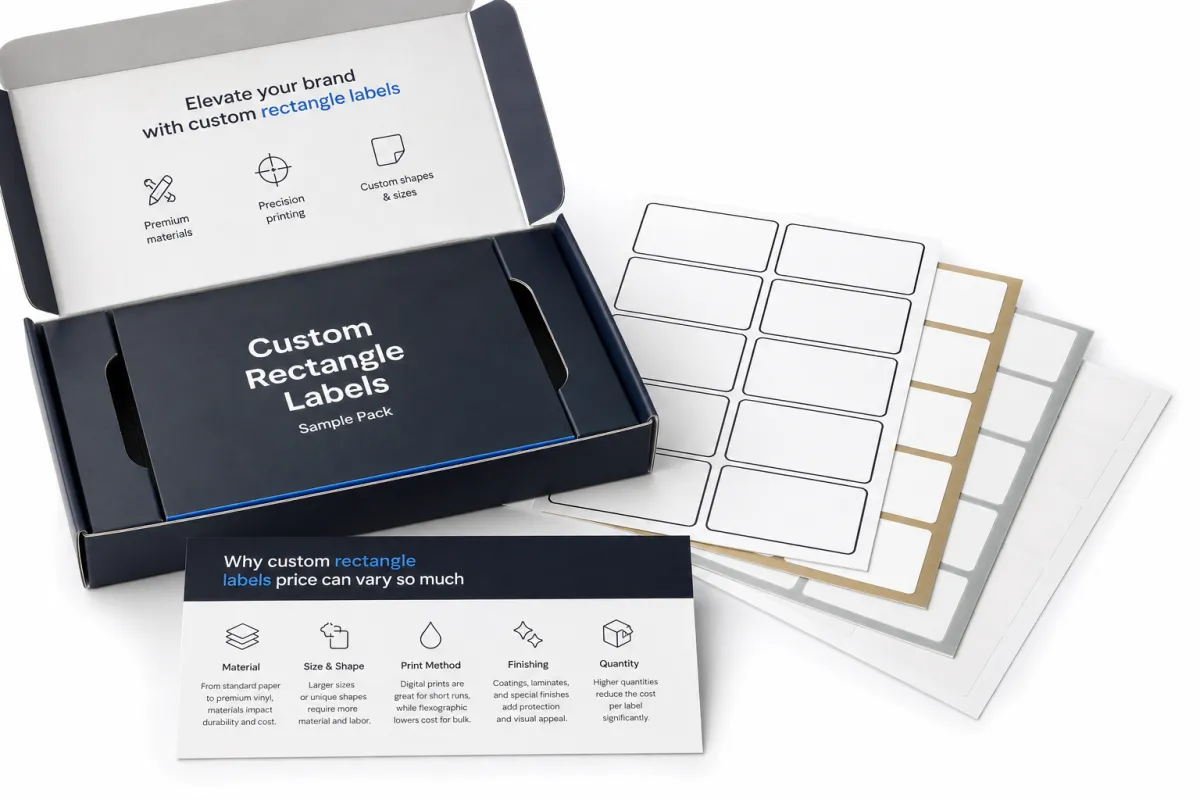
Two labels can look almost identical and still produce wildly different custom rectangle labels price quotes. One might be a basic paper label for a dry carton. The other might use moisture-resistant film, freezer-safe adhesive, and a gloss finish for refrigerated packaging. Same layout. Different job. Different cost.
That is where buyers get tripped up on the first pass. The print image is only one slice of the total. Stock choice, adhesive performance, finishing, and order quantity often move the number more than the artwork ever will. A material change can swing the custom rectangle labels price faster than a design tweak, which is annoying, but not mysterious.
Rectangle labels also show up everywhere. Jars. Seasoning bottles. Shipping cartons. Sample packs. Cosmetic tubes. Bakery trays. Promo mailers. Event packaging. The shape is flexible, and that flexibility matters because each use case asks something different from the label. Sometimes it just needs to sit on a box and behave. Sometimes it has to fight condensation and not embarrass itself.
From a packaging buyer's point of view, the label has three jobs: carry the brand, protect the package, and stay put until the product reaches the customer. If it peels in storage or smears in transit, the low quote stops looking clever real fast. The true cost shows up later as rework, replacements, and a package that no longer looks like anyone cared. That is why a fair custom rectangle labels price should be measured against performance, not just the pretty side of the proof.
A label is cheap right up until it fails. Once it starts lifting, scuffing, or clouding in cold storage, the bargain quote turns into a cleanup job.
If you are comparing custom rectangle labels price across vendors, ask what the quote actually includes. Some suppliers price only the stock. Others include die-cutting, proofing, lamination, and shipping. The lowest line item is not always the lowest real cost, especially if it creates waste or forces a second order because the first version was wrong for the job.
Rectangle formats also have a layout advantage. Straight sides usually nest better on sheets and rolls, which reduces waste and keeps production efficient. That is one reason custom rectangle labels price often stays steadier than highly irregular die cuts, especially when quantities rise and the dimensions make sense for the press.
The practical question is simple: which label spec gets the job done without padding the order with extras you do not need? If plain paper is enough, the quote should reflect that. If the label needs film stock, freezer adhesive, or a protective topcoat, the price should rise for a real reason, not because the request was vague and nobody wanted to ask follow-up questions.
What you are really paying for in custom rectangle labels
The easiest way to understand custom rectangle labels price is to break it into parts. You are paying for the substrate, the adhesive, the print method, the finishing steps, the die-cut or cut-to-size process, and the way the labels are packed for shipment. Each piece has its own cost, and each piece affects how the label behaves after it gets to your line.
Substrate is usually where the first major split happens. Coated paper is often the most economical option for dry goods. BOPP film handles moisture better and shows up a lot on bottles, personal care products, and refrigerated items. Vinyl and specialty films make sense when the label is going to take abrasion, repeated handling, or rough storage conditions. A stronger material changes more than the look. It changes the survival rate.
Print method matters too. Digital printing works well for short runs, variable data, and fast changeovers. Flexographic printing becomes more attractive at scale, especially when the artwork stays the same across a larger quantity. The method affects setup time, ink use, and how the custom rectangle labels price behaves as volume rises.
Finish is another lever. Gloss can sharpen color and give the label more shelf punch. Matte can look quieter and easier to read under bright lights. Varnish or laminate can improve scuff resistance, which matters if labels rub against cartons, sleeves, trays, or shipping materials. A finish is not just about appearance. It is about keeping the label legible after the package starts moving around.
The packaging format changes the cost too. Sheets, rolls, and fanfold stacks all suit different application methods and production flows. A label for hand application may be packed one way. A label for automatic application needs tighter roll specs, core size control, and more consistent winding. Same artwork. Different handling. Different quote.
For labels that sit alongside Custom Labels & Tags or other Custom Packaging Products, it helps to think in systems instead of isolated orders. A label that matches the rest of the branded packaging program saves time later because the same size or material can often carry across multiple SKUs with only small artwork changes.
If sustainability matters, ask for material details up front. Some buyers want paper from certified sources. Others want a film label that can be separated cleanly from the container. For chain-of-custody and fiber sourcing questions, the FSC site is a useful reference. If shipping performance is the concern, ISTA testing guidance helps frame how much protection a label or pack format may need.
My honest answer to the pricing question is this: do not ask for the cheapest label. Ask for the construction that gets the right result at the lowest total cost. That is how custom rectangle labels price stays tied to actual use instead of wishful thinking. I have had jobs where a slightly better adhesive saved more money than any discount ever would, because it cut rejects and kept the line moving. That part is kind of boring. It is also where the money hides.
Custom rectangle labels price factors: size, material, and finish
Size has a direct effect on custom rectangle labels price because larger labels use more material and fit fewer times on a press sheet or roll layout. A 2 x 3 inch label and a 4 x 6 inch label may carry the same artwork style, but the larger version burns through more stock, more ink, and usually more waste during layout.
There is a design issue buried in that math. The label needs to be large enough for the logo, product name, and required information to stay readable. It also needs to stay in proportion with the package. Oversized labels can make a product look clumsy and raise the cost for no good reason. A label sized with intent usually does a better job on both branding and budget.
Material is the next major variable. Paper is usually the budget-friendly pick for dry goods, cartons, mailing use, and short-term promotions. BOPP is a common middle ground for moisture resistance and a cleaner, more durable feel. Heavier-duty films make sense for products that face abrasion, condensation, or repeated handling. If the package sees oil, cold, or humidity, standard paper can become a very polite way to throw money away.
Adhesive should match the surface, not habit. Permanent adhesive is common for long-term applications. Removable adhesive works when the label needs to come off without drama. Freezer-grade adhesive is a different animal because it has to bond in low temperatures and keep working when condensation shows up. The wrong adhesive can create waste, returns, and labor costs that push the real custom rectangle labels price far above the quote.
Finish changes both durability and appearance. Gloss often improves color impact for bold product packaging. Matte fits a more restrained, premium presentation. Lamination and varnish can reduce scuffing and help labels survive sorting, transport, or shelf restocking. If the package gets touched a lot, performance comes first. Pretty second.
A simple buyer checklist keeps the quote honest:
- Exact finished dimensions, not "about" a size.
- Surface type, such as glass, paperboard, plastic, or coated carton.
- Storage conditions, including chilled, frozen, dry, or outdoor exposure.
- Application method, whether hand applied or machine applied.
- Preferred finish, such as gloss, matte, or uncoated.
If those details are locked in before you ask for pricing, the custom rectangle labels price will be much closer to reality. If they are vague, the quote will be built on assumptions, and assumptions are where surprise charges breed.
For tougher jobs, ask how the label performs under common adhesion testing, such as ASTM D3330-style peel evaluation, or whether the material has been used successfully in similar conditions. That does not replace your own validation, but it gives you something more useful than a catalog promise and a cheerful sales email.
A good rule: if you can describe the use case in one sentence, the supplier can usually give you a tighter quote. If you cannot describe the use case, the custom rectangle labels price will often be built around the safest, most expensive guess.
Custom rectangle labels price, MOQ, and bulk savings
MOQ, or minimum order quantity, has a big effect on custom rectangle labels price because setup time has to be paid for somewhere. Plate creation, press setup, color checks, die work, and finishing all take time even on a simple label job. When the run is tiny, those fixed costs get spread across fewer pieces, so the unit price rises fast.
That is why pricing usually falls as quantity rises. A 500-piece order can look expensive on a per-label basis, while a 5,000-piece or 10,000-piece order often gives a much lower unit cost even though the total invoice is bigger. The press is running more efficiently, and the setup cost gets shared more widely.
For buyers, the real comparison is not just total order price. It is the cost per label plus the hidden bits: proofing, tooling, shipping, rush charges, and any special finishing. A quote that looks lower can still produce a higher custom rectangle labels price if one supplier leaves out finishing or tacks on fees later. I have seen that exact trick more than once. The quote looks clean, right up until the extras show up like unpaid parking tickets.
| Order profile | Typical per-label range | Best use | Notes |
|---|---|---|---|
| Short run, paper | $0.18-$0.35 | Testing, samples, seasonal launches | Higher setup cost per piece, but flexible for small launches |
| Mid run, paper or BOPP | $0.08-$0.18 | Growing SKUs, regional retail packaging | A balanced custom rectangle labels price for many standard jobs |
| Bulk run, standard stock | $0.03-$0.08 | Established programs, repeat ordering | Best unit economics when dimensions and artwork stay stable |
| Specialty film with finish | $0.10-$0.28 | Moisture, handling, or premium presentation | Better durability, but custom rectangle labels price rises with protection features |
Those ranges are illustrative, not a promise. Every spec changes the result. Still, they show the shape of the market. If you are launching a new product line, a lower MOQ can be the safer move. If the design is already stable and the product has a clear sales pattern, bulk buying usually improves the custom rectangle labels price in a way you can actually measure.
There are also sane ways to keep the order efficient without wrecking quality. Standardizing label sizes across several products reduces waste and keeps the packaging design more consistent. Planning reprints instead of firing off tiny emergency orders spreads setup cost better. Picking a finish because it fits the use case, not because it sounds fancy, keeps the quote grounded.
For brands with multiple SKUs or frequent promo changes, the lowest MOQ is not always the best answer. A slightly larger order can reduce downtime, simplify inventory, and make purchasing easier across branded packaging, custom printed boxes, and supporting inserts. The right custom rectangle labels price is the one that works with the production rhythm you actually have.
Production process and timeline for custom rectangle labels
The production path is usually straightforward, but each step affects the final custom rectangle labels price and the delivery date. A standard job starts with a quote request, moves to artwork review, then proof approval, production, finishing, inspection, and shipment. Clear steps keep the schedule tighter and reduce the chance of a label arriving in the wrong spec.
What speeds things up? Exact artwork dimensions, clean bleed, final copy, and a settled material choice. When the file package is complete, the supplier can build the job without constant back-and-forth. That reduces delays and keeps custom rectangle labels price from creeping up because of repeated proof revisions or last-minute corrections.
What slows things down? Missing dielines, unresolved spelling changes, late color adjustments, or uncertainty about whether the label will live on glass, plastic, paperboard, or a cold surface. Even a small size change can affect layout and waste, so late edits usually carry a cost. The cleanest quotes come from the clearest briefs.
Timeline also depends on the production method. Digital label runs can move quickly, especially for smaller quantities or variable designs. Larger flexographic runs usually need more setup but can be efficient once they are rolling. Finishing details like lamination, varnish, or specialty die cutting add time. Split shipping or custom packing for multiple locations can add another layer if the order needs to go to more than one place.
For buyers who want a practical benchmark, a simple label order with a complete spec sheet usually moves faster than a complicated order with unresolved materials. A reasonable sequence for many custom jobs is proof approval first, production second, final inspection third, and shipment after that. If you need a tighter schedule, say so early. Rush service can sometimes be arranged, but it usually changes the custom rectangle labels price.
One useful habit is to treat the proof like a production document, not a design sketch. Check the dimensions, font size, margin placement, adhesive notes, and finish callouts. If the proof is right, the next steps are smooth. If the proof is wrong, everything downstream gets more expensive.
That matters even more for labels used in product packaging with multiple touchpoints. A label on a bottle, for example, may need to line up with a carton panel or a shipper insert. In those cases, packaging design should be reviewed as a system. The label, the box, and the printed messaging should work together instead of fighting for space.
If you want labels that fit the broader program, compare them with Custom Labels & Tags and other Custom Packaging Products early in planning. That helps avoid a situation where the label is fine on its own but awkward next to the rest of the branded packaging.
Why choose us for custom rectangle labels pricing and quality
Good pricing is not the lowest number on the page. It is a fair custom rectangle labels price for the material, finish, adhesive, and production method that actually fit the job. The best suppliers help you avoid unnecessary upgrades while still protecting the package from the conditions it will really face.
That is where experience earns its keep. A label can look fine in a mockup and still fail on a textured carton, a chilled bottle, or a heavy-handling mailer if the stock or adhesive is wrong. A practical vendor looks at the application first, then recommends the simplest construction that will still hold up. That protects the budget without cheaping out in the wrong place.
Quality control matters more than many buyers expect. Accurate cutting keeps the labels easy to apply. Print alignment keeps logos and copy centered. Stable adhesive performance keeps corners from lifting. Finish consistency matters across the run, especially if the order will sit beside retail packaging or custom printed boxes on a shelf.
The best value usually comes from the cleanest spec: the right size, the right stock, the right adhesive, and no extra features that do nothing for the job.
Clear communication helps too. Fast artwork review reduces the chance of expensive mistakes. Straight talk makes it easier to choose between paper and film, gloss and matte, permanent and removable, roll and sheet. That kind of support often does more for the final custom rectangle labels price than a coupon ever will.
It also helps when the supplier understands how branded packaging works in the real world. Some orders need to support a launch on a tight budget. Others need a higher-end presentation that matches premium product packaging. Some labels are purely functional. Others are part of the package branding across an entire line. A good partner should be able to spot the difference and price accordingly.
For buyers, the benefit is control. You get a quote tied to actual use, not generic assumptions. You get help choosing the economical spec that still performs. You get a cleaner path from proof to production, which matters when labels are tied to launch dates, retailer windows, or restock schedules.
That usually means fewer surprises. If the material needs to change, you know why. If the adhesive should be stronger, you know what problem it solves. If the finish can be simplified without hurting the result, that gets said early. That is how a sensible custom rectangle labels price becomes a useful purchasing tool instead of a number you have to decode with a headache.
How to get the right custom rectangle labels price next
The fastest way to get an accurate custom rectangle labels price is to send a complete spec the first time. Have the exact size, quantity, material preference, finish, adhesive requirement, and target delivery date ready before you request the quote. If the label is meant for glass, paperboard, plastic, or refrigerated packaging, say that too.
Photos help more than people expect. Two or three reference shots of the product or package can show whether the label needs to wrap a curve, avoid a seam, fit a panel, or survive handling at a particular touchpoint. That visual context often helps the supplier recommend the right stock and adhesive on the first pass, which keeps the custom rectangle labels price from shifting after the quote.
Start with the smallest quantity that still fits the launch plan. If demand is uncertain, a lower MOQ can protect cash flow and confirm the label performs in real use. If the design is stable and the product is already proven, a larger reprint can lower unit cost and improve the custom rectangle labels price over time.
Before you approve the proof, check more than the artwork. Confirm the dimensions, trim area, bleed, margins, finish details, and any application notes. If something looks fuzzy, ask for clarification before production starts. One clean approval cycle is almost always cheaper than fixing a mistake after the press has already been booked.
Think about the full packaging system too. If the label needs to work with product packaging, a shipper, or a set of custom printed boxes, the label spec should support that environment rather than sit off to the side as an afterthought. That broader view often leads to a better custom rectangle labels price because the job is planned once and ordered correctly the first time.
For a straightforward buying process, use this order of operations:
- Define the use case and surface.
- Choose size, quantity, and material.
- Select adhesive and finish based on conditions.
- Request a quote with all details included.
- Review the proof carefully before approval.
That sequence keeps the quote grounded in reality. It also makes side-by-side comparisons easier because every vendor is working from the same information. Once the numbers line up, the decision gets much clearer: choose the label that balances cost, durability, and appearance for the actual job, not the imaginary one.
Custom rectangle labels price should always be judged against the label's job on the package. If the quote reflects the right material, the right adhesive, and the right finish, it is usually the better buy even when it is not the lowest line item. That is the practical route to ordering with confidence and not paying for avoidable mistakes later.
What affects custom rectangle labels price the most?
The biggest drivers are size, material, quantity, adhesive type, and finish. Larger labels and specialty films usually cost more than standard paper stocks, and small orders have a higher per-label price because setup costs are spread across fewer pieces.
How can I lower my custom rectangle labels price without hurting quality?
Choose the smallest size that still keeps the artwork readable and balanced. Use a standard material and finish unless the application truly needs extra durability, and order in a planned quantity that reduces reprint frequency and spreads setup costs better.
Is there a minimum order for custom rectangle labels?
Most manufacturers set a minimum order quantity to cover press setup and finishing costs. The exact MOQ depends on the print method, label size, and material selected, so if you need a test run, ask for the smallest viable quantity and compare the unit cost.
How long does it take to receive custom rectangle labels?
Timeline depends on proof approval, production method, quantity, and finish complexity. A complete file package with final specs usually shortens the process, while rush needs can sometimes be handled but may change the final quote.
What details should I have ready before asking for a quote on custom rectangle labels?
Have the exact dimensions, quantity, material preference, finish, and adhesive requirement ready. Share where the label will be applied, such as glass, paperboard, plastic, or refrigerated packaging, because that helps produce a more accurate custom rectangle labels price.
The most reliable custom rectangle labels price is the one that matches your surface, storage conditions, and application method without adding unnecessary extras. Send those details up front, compare quotes on the same spec, and the final order is a lot more likely to land on budget and hold up in use.

