Recycled Poly Mailers with Logo: PCR Film, Adhesive, and Size Runs
For a lot of brands, the first meaningful packaging upgrade is not some dramatic rebrand with new typography and glossy inserts. It is a practical switch: oversized cartons out, custom recycled poly mailers in. That change can reduce void fill, trim dimensional-weight charges, and move packing stations faster on busy fulfillment days. The part that surprises people is that the biggest waste reduction often comes from right-sizing, not from recycled content alone.
If you are comparing custom recycled poly mailers, the better question is not “Are they sustainable?” It is “Sustainable for which product, under what shipping conditions, and at what total cost?” That mindset separates effective product packaging from good intentions that do not hold up in the warehouse. A mailer can support package branding, cut material use, and still fail if the film is too thin, the seal is weak, or the artwork turns a shipping tool into an expensive billboard with no practical value.
Buyer Fit Snapshot
Use this page when a brand wants recycled poly mailers that still perform under ecommerce shipping conditions.
| Decision point | What to specify before quoting |
|---|---|
| Material and structure | Board or film grade, thickness, size, closure, insert fit, and durability target. |
| Brand finish | Print coverage, color, coating, barcode or copy zones, and unboxing presentation. |
| Production control | MOQ, sample approval, packing workflow, carton marks, QC checks, and reorder plan. |
What Custom Recycled Poly Mailers Actually Are
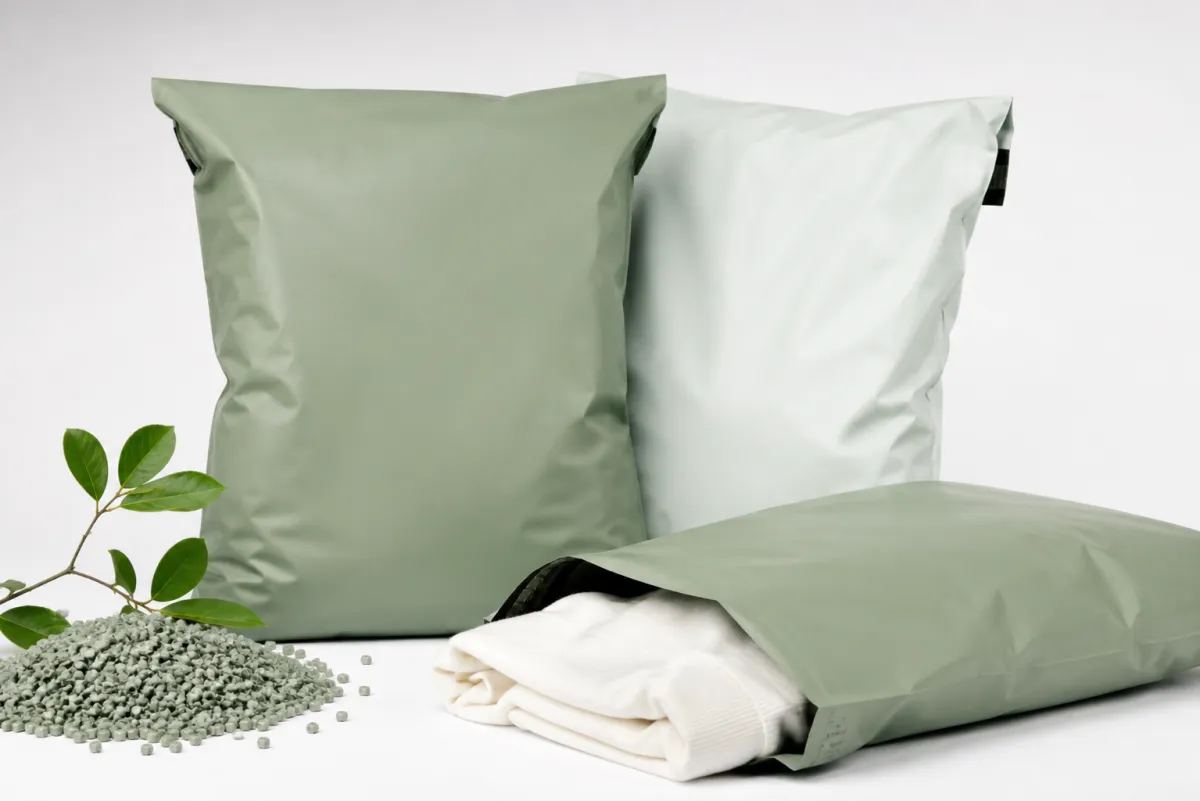
Custom recycled poly mailers are lightweight shipping bags made from polyethylene film that includes recycled plastic content, then converted into the size, print, and closure style a brand needs. In practice, they sit between plain shipping sacks and fully branded packaging. They take up less room than boxes, store more easily than corrugated cartons, and fit apparel, soft goods, accessories, and other non-fragile items with very little fuss.
I have watched teams move from a carton that was nearly three times larger than the folded product to a mailer that fit the shipment more honestly. The box may have looked polished, but the filler, tape, and cube size quietly inflated cost. Switching to custom recycled poly mailers often creates the biggest savings through right-sizing, not through recycled content alone. That matters because fulfillment labor, freight, and storage usually cost more over the life of an order than the bag itself.
These mailers can include tear resistance, puncture resistance, opaque film for privacy, or a strong peel-and-seal strip. Some brands add dual adhesive strips for returns. Others request matte surfaces, custom artwork, or interior printing to shape the unboxing experience. That is where packaging design becomes more than decoration. It becomes part of the shipping system.
One point deserves to be stated plainly: recycled does not mean compostable, and custom does not automatically mean wasteful. The value of custom recycled poly mailers comes from matching the film to the shipment profile. A lightweight garment brand has very different needs than a subscription program that includes metal hardware or sharp-edged accessories. Good decisions start with fit, not slogans.
For brands building a broader packaging program, these mailers often sit alongside Custom Packaging Products and, in some cases, Custom Poly Mailers for a more complete comparison of structures, print options, and performance levels. That comparison helps because the right answer is not always the most branded option. Sometimes the better choice is the least complicated one that still protects the product and supports the brand.
Custom recycled poly mailers also fit neatly into retail packaging decisions for ecommerce brands that want a cleaner, more controlled outward presentation. A box can signal structure and premium feel. A mailer signals efficiency. Neither is inherently better. The best choice depends on product fragility, shipping distance, and how much presentation matters relative to cost.
How Custom Recycled Poly Mailers Are Made
The production path for custom recycled poly mailers starts with recycled resin sourcing. That resin may come from post-consumer film, post-industrial scrap, or a blend of both. From there, the material is compounded and extruded into film. The film is then converted into bags, cut to size, sealed, and printed. The process sounds simple. It is not. Each step affects appearance, strength, and consistency.
Recycled content changes more than the sustainability story. It can influence gloss, opacity, odor, stretch, and the way the film behaves under tension. In some runs, higher recycled content can slightly reduce clarity or make the surface less uniform. That does not automatically make the mailer inferior. It means the buyer needs to understand the tradeoff between environmental goals and physical performance. In real shipping, the bag still has to survive conveyor contact, handling friction, and compression in transit.
Customization usually starts with size. From there, the buyer chooses thickness, often measured in mils, as well as closure style, gusseting, print coverage, and ink colors. A simple one-color logo on one side is cheaper and usually faster to produce than a full-coverage design with custom interior printing. If the mailer will be packed by hand, the adhesive strip should open and seal cleanly. If it will move through automated workflows, consistency matters even more.
Custom recycled poly mailers are also tested in ways that matter to day-to-day operations. Seal integrity is one obvious checkpoint. Puncture resistance is another. Scuffing, ink rub, and flexing during the pack-out process can reveal problems before they become customer complaints. In that sense, a mailer is not just a piece of packaging. It is a working part of a fulfillment system.
For buyers who want a technical reference point, packaging standards and transit tests matter here. The ISTA framework is often used to evaluate transport conditions, while the U.S. Environmental Protection Agency offers practical recycling guidance at EPA recycling resources. Those sources help buyers separate marketing language from operational reality.
There is also a brand side to production. A mailer can carry restrained logo placement, bright graphic treatment, or a minimal system that reflects the rest of the branded packaging program. Brands that already use custom printed boxes often discover that mailers need a different visual logic. A shipping bag has less surface area, folds differently, and shows wear faster. Artwork should be legible, durable, and efficient rather than overloaded.
Key Factors That Decide Performance and Sustainability
Buyers often ask for a recycled-content percentage as if it were the whole story. It is not. The source of the recycled resin matters. Post-consumer content and post-industrial content do not carry the same environmental profile, and they do not always behave the same in production. Post-consumer content can be more compelling for sustainability claims, but it may also come with tighter supply and more variable pricing. That is why custom recycled poly mailers should be evaluated on both claim quality and functional quality.
The tradeoff between recycled content and performance shows up quickly with heavier or sharper items. A 2-mil mailer that works perfectly for a lightweight T-shirt may fail for a stacked accessory kit with rigid edges. If the bag tears once in every few hundred shipments, the cost is not just replacement packaging. It is labor, reshipment, customer service time, and brand frustration. Sometimes a slightly thicker bag saves more money than a thinner one ever could.
Thickness is one of the most practical specs to compare. In general, buyers may see options around 2 mil, 2.5 mil, or 3 mil depending on the application. Thin film lowers material use, but it also reduces the margin for error. For custom recycled poly mailers, the right thickness is less about chasing the lightest possible bag and more about choosing the lightest bag that still survives the trip. That is a very different target.
Print and finish choices influence both presentation and recyclability. Heavy ink coverage can make a mailer look more premium, but it can also complicate material recovery depending on local recycling systems. Matte or gloss finishes affect appearance, finger smudging, and the sense of quality. Dark full-bleed designs can hide scuffs better than pale ink, though they may make carton-style branding habits feel awkward on a flexible mailer. The strongest design usually uses enough visual weight to feel intentional, then stops before it becomes expensive noise.
- Post-consumer recycled content is often better for sustainability claims, but supply can be tighter.
- Post-industrial recycled content may be easier to source consistently and can help with pricing.
- Higher mil thickness improves puncture resistance and may reduce returns caused by damaged shipments.
- Lower ink coverage can simplify production and sometimes improve recovery options.
- Dual adhesive closures support returns but add cost and slight complexity.
Documentation is where a lot of buyers get stuck. If a supplier says the film contains recycled plastic, ask what type, how it is verified, and whether supporting documents are available. FSC certification can matter for paper-based packaging components, but it is not a substitute for polymer content documentation. A recycled claim should not be accepted on faith. A buyer should ask for proof, not just a confident statement.
There is a common mistake in product packaging meetings: the team treats sustainability as a single number. In reality, the right decision is usually a balance between recycled content, thickness, print coverage, and shipping conditions. That balance is why custom recycled poly mailers can look simple on the outside and still require careful purchasing on the inside.
What Custom Recycled Poly Mailers Cost And Why
Pricing for custom recycled poly mailers usually depends on size, thickness, print coverage, recycled-content level, and order quantity. A small run with full-color printing will cost more per unit than a large reorder with a simple logo and one-size specification. That is standard across packaging, whether the format is mailers, labels, or custom printed boxes. The difference is that mailers are often bought for recurring fulfillment, so a small mistake multiplies quickly.
As a rough planning range, buyers might see prices around $0.18-$0.28 per unit for 5,000 pieces on a straightforward one- to two-color job, while more complex artwork, heavy print coverage, dual adhesives, or special finishes can push that higher. Smaller runs may climb to $0.30-$0.60 or more per bag depending on specification and supplier. These numbers are not a quote. They are a practical frame of reference. Real pricing depends on film weight, print method, and freight.
Minimum order quantity has a major effect on the unit price. Lower MOQs usually carry a higher cost because setup, plates, proofing, and material handling are spread across fewer bags. Larger runs reduce unit pricing, but they increase inventory risk. If the brand changes artwork often or cannot store pallets efficiently, the savings can disappear. The cheapest quoted bag is not always the cheapest packaging decision.
Setup expenses are another place where buyers get surprised. Plate charges, artwork preparation, proofing, and sample runs can add meaningful cost on flexographic jobs. Digital printing can reduce or eliminate some setup steps, but it is not always cheaper at scale. The economics shift based on artwork complexity, quantity, and turnaround. That is why two quotes that appear close at first glance can diverge once the full landed cost is added up.
| Option | Typical Use | Price Impact | Tradeoff |
|---|---|---|---|
| Low-MOQ, simple one-color mailer | New product launch, small test run | Higher per unit | Lower inventory risk, faster entry |
| Mid-volume, two-color recycled mailer | Core ecommerce SKUs | Moderate per unit | Good balance of cost and branding |
| High-volume, full-coverage custom recycled poly mailers | Established fulfillment programs | Lower per unit | More setup, more storage, more print cost |
| Special finishes or dual-adhesive mailers | Return-heavy categories, premium presentation | Highest per unit | Better functionality, higher budget pressure |
Freight and storage deserve real attention. A pallet that sits in a warehouse for months has a carrying cost. A bag that is slightly too large for the product raises dimensional-weight charges on every shipment. A bag that tears increases customer service time and replacement expense. Once those effects are included, custom recycled poly mailers often compare favorably against cheaper-looking alternatives.
In packaging consulting, I see the same pattern repeatedly: the buyer focuses on the printed bag price, but the true cost sits in the workflow around it. Labor, shipping, rejects, and reorder timing usually matter more than a few cents on the unit itself. That is especially true in retail packaging programs where volume grows quickly and design changes are not cheap.
Step-By-Step Order Process And Timeline
The cleanest way to order custom recycled poly mailers is to treat the project like a spec exercise, not a graphic design request. Start with the packed product dimensions, not the raw item size. Include inserts, tissue, folded edges, and any protective layers. Then define the weight range, branding goals, recycled-content target, and monthly order volume. Those details shape every quote that follows.
Next, request specs from at least two or three suppliers. Compare recycled-content claims, available thicknesses, print methods, lead times, and whether the supplier can support testing. A good supplier should be able to explain the difference between post-consumer and post-industrial content, not just send a price sheet. If the answers stay vague, that is usually a sign to keep looking.
The sample stage is where most strong decisions get made. Inspect seal strength, print clarity, bag feel, and fit using actual products. If the mailer will be used in machine-assisted packing, test it in that environment rather than on a desk. A sample that looks fine in a photo can behave differently when run through real production. Custom recycled poly mailers need to work in motion, not only in theory.
Timing is usually more predictable than buyers expect, but only if the scope stays stable. A typical order may move through quote review, artwork proofing, sample approval, production, and shipping. Straightforward jobs often take 12-15 business days from proof approval, while custom colors, special finishes, or higher-coverage artwork can extend that. Rush orders are possible, but they usually cost more and force compromises.
Here is a practical sequence many teams use:
- Define product dimensions, weight, and shipment profile.
- Choose an initial mailer size and thickness.
- Request quotes with exact print and recycled-content requirements.
- Review digital proofs and physical samples.
- Run a small pilot before full rollout.
- Lock the spec, then place the larger order.
A tight deadline often changes the scope in useful ways. Simplifying the artwork, reducing the number of print colors, or choosing a standard size instead of a fully custom dimension can save days. That is not a compromise in the wrong direction. It is often the smartest move if the shipment needs to launch on time. Custom recycled poly mailers work best when the timeline is planned as carefully as the design.
Common Mistakes When Buying Custom Recycled Poly Mailers
The most expensive mistake is often the simplest one: choosing the wrong size. An overstuffed mailer can split at the seam, look sloppy, and create returns or damage claims. An oversized mailer wastes material and can increase shipping cost if the packed dimensions push the parcel into a worse rate band. Either way, the savings disappear. Custom recycled poly mailers only work well when the bag fits the product with enough room for a clean seal.
Another common issue is vague sustainability language. Recycled content, recyclability, post-consumer claims, and compostability are not interchangeable. A brand can say a mailer includes recycled plastic and still misstate how it should be disposed of. That is risky. Buyers should ask for documentation, not adjectives. If a supplier cannot explain the claim cleanly, that claim should not appear on the packaging.
Skipping test shipments is a mistake that shows up later, usually when it costs more. Internal handling is one thing. Conveyor friction, transit compression, cold weather, and rough carrier treatment are something else entirely. A mailer that holds up on a packing table can fail after a week in real transit. That is why field testing matters. It is basic risk control for custom recycled poly mailers.
“The bag looked great in the proof, but the real lesson came from the first shipment test. Once we ran the product through our normal packing flow, the weak seam and tight fit showed up immediately.”
Brand teams also overprint. They treat the mailer like a billboard and lose the function of the bag in the process. Strong package branding does not require every inch of film to be covered. In fact, restrained artwork can look more confident, print more cleanly, and leave a smaller production footprint. The goal is not maximum ink. The goal is a clearer customer experience.
Storage and reorder planning matter too. A mailer specification that looks efficient on paper can become a headache if the warehouse has no room for pallets or the reorder cycle is too slow. Last-minute buying nearly always raises cost. It also leads to weaker compromises, such as thinner film, longer lead times, or less suitable artwork. The better plan is to set a reorder threshold before inventory gets tight.
Finally, do not assume that custom recycled poly mailers are a cure-all for every category. They are excellent for many soft goods and lighter items. They are not the answer for every product packaging challenge. Fragile goods may still need corrugated protection. High-value items may need tamper resistance or more structured packaging. The right answer is the one that protects the item and supports the brand without adding waste for no reason.
Expert Tips For Better Results And Next Steps
If you want better results from custom recycled poly mailers, start with a one-page spec sheet. Include product dimensions, packed weight, branding goals, recycled-content target, print area, and expected monthly volume. That one document saves a surprising amount of time because it gives suppliers a shared target. It also makes quote comparison far more reliable.
Run a controlled pilot before you roll out across the full catalog. Test one or two SKUs first. Measure failure rate, packing speed, customer feedback, and damage complaints. A pilot is cheap compared with a full-size mistake. It is also the easiest way to compare custom recycled poly mailers against other options in your packaging design mix, including custom printed boxes where needed and lighter mailers where the product allows it.
Ask for documentation. Not a sales pitch. Documentation. Recycled-content data, print method details, and performance testing information are all useful. If the supplier can support those with clear records, the sustainability story becomes much stronger. If they cannot, the brand should be cautious about environmental claims. That is a trust issue, not just a purchasing issue.
It also helps to compare total landed cost, not only the unit price. Include freight, warehousing, expected failure rate, and the labor needed to pack each order. A bag that costs a bit more but ships faster, packs cleaner, and reduces damage can easily beat a cheaper alternative. That is especially true for ecommerce brands where order volume makes small differences compound quickly.
- Audit current bag sizes and identify where you are overboxing or overbagging.
- Request sample kits so you can test fit, seal, and print quality on real products.
- Compare landed cost, not just the quoted price per bag.
- Verify recycled-content claims before putting them on the package.
- Build reorder buffers so you are not forced into rushed decisions.
For brands thinking more broadly about branded packaging, the best results usually come from consistency rather than complexity. A mailer, a label, and a carton do not all need the same visual language, but they should feel like they belong to the same system. That is where package branding starts to pay off. It makes the customer experience feel deliberate without wasting material or budget.
Custom recycled poly mailers also support a cleaner conversation with buyers who care about sustainability but still expect performance. That is the real test. If the packaging looks responsible and ships well, it earns trust. If it looks responsible but fails in transit, the environmental story gets lost in the service failure. Planning for both is the only durable path.
One final comparison: if your current packaging program relies on oversized boxes for lightweight products, the quickest improvement may not be a fancier print treatment. It may be a shift to better-sized custom recycled poly mailers with the right thickness, the right closure, and a print approach that fits the shipment instead of fighting it.
Frequently Asked Questions
Are custom recycled poly mailers recyclable after use?
Usually yes, but only if local film-recycling programs accept polyethylene mailers and the bag is clean and dry. Remove labels, tape, and loose inserts when possible, because contamination is the main reason film gets rejected. Recycled content and recyclability are different claims, so buyers should verify both separately before making any environmental statement about custom recycled poly mailers.
What recycled content should I look for in custom recycled poly mailers?
A practical target depends on product weight, shipping distance, and performance needs. Ask whether the content is post-consumer, post-industrial, or a blend. Higher recycled content can strengthen sustainability messaging, but the mailer still has to survive shipping without tearing. Request supplier documentation rather than relying on a percentage claim alone. That is the safest way to evaluate custom recycled poly mailers.
How much do custom recycled poly mailers typically cost?
Pricing usually depends on size, thickness, print coverage, recycled-content level, and order quantity. Smaller runs tend to cost more per mailer because setup and material costs are spread over fewer units. Buyers should compare total landed cost, not just the printed bag price, because freight, storage, and failure rates matter too. That is often where custom recycled poly mailers win or lose on value.
How long does a custom recycled poly mailer order take?
Typical timelines include quote review, artwork proofing, sample approval, production, and shipping. Straightforward jobs move faster than custom color or high-coverage print jobs, which can add extra proofing time. If the mailers support a core fulfillment SKU or seasonal launch, build in buffer stock so you are not caught waiting on a reorder of custom recycled poly mailers.
How do I size custom recycled poly mailers correctly?
Measure the packed product, not just the item itself, because inserts, folds, and protective tissue change the final dimensions. Leave enough room for a clean seal and avoid compressing items so tightly that the bag stretches or splits. Order samples in the two most likely sizes and test real shipments before placing a large run of custom recycled poly mailers.
For brands that want practical, cost-aware sustainability, custom recycled poly mailers are a strong option because they cut waste, support brand presentation, and can reduce shipping inefficiency at the same time. The best results come from matching material, print, and size to the product instead of treating recycled content as the whole answer. That is the real packaging lesson: custom recycled poly mailers work best when sustainability, cost, and transit performance are planned together, not treated like separate conversations.


