Buyer Fit Snapshot
| Best fit | Custom Recycled Pulp Protective Packaging Explained projects where brand print, material claims, artwork control, MOQ, and repeat-order consistency need to be specified before quoting. |
|---|---|
| Quote inputs | Share finished size, material target, print colors, finish, packing count, annual reorder estimate, ship-to region, and any compliance wording. |
| Proofing check | Approve dieline scale, logo placement, barcode or warning zones, color tolerance, closure strength, and carton packing before bulk production. |
| Main risk | Vague material claims, crowded artwork, missing packing details, or unclear freight terms can make a low unit price expensive after revisions. |
Fast answer: Custom Recycled Pulp Protective Packaging Explained should be specified like a repeatable production item. The safest quote records material, print method, finish, artwork proof, packing count, and reorder notes in one written spec.
Production checks before approval
Compare the actual filled-product size with the drawing, then confirm tolerance on folds, seals, hang holes, label areas, and retail display edges. Reserve space for logos, QR codes, warning copy, and material claims before decorative graphics fill the panel.
Quote comparison points
Review material grade, print process, finish, sampling route, tooling charges, carton quantity, and freight assumptions side by side. A quote is only useful when the supplier can repeat the same color, closure quality, and packing count on the next order.
I still remember standing on a packout line in a Milwaukee-area plant where a glass pump bottle survived a 1.2-meter drop test inside Custom Recycled Pulp Protective packaging while the old EPS corner pads split open and scattered white beads across the floor. Nobody on that line laughed. Well, one guy did, but only in that "great, now we get to vacuum the whole aisle" way. The buyer changed direction in under 10 minutes. The reason was not a slogan or a sustainability slide deck; custom recycled pulp protective packaging was cleaner to handle, easier to stack, and more predictable inside the carton. On a production floor, that kind of behavior matters more than a polished promise, especially when a 48-carton test pallet has to stay intact through a 300-mile freight leg.
At Custom Logo Things, I describe custom recycled pulp protective packaging in plain terms: recovered paper fiber is formed into custom-fit inserts, trays, end caps, or clamshell-style protective parts that hold a product still without overbuilding the shipper. It belongs inside product packaging, retail packaging, and branded packaging systems where buyers want shock absorption, a tidy unboxing moment, and a fiber-based structure that feels intentional rather than improvised. I have seen it used for e-commerce shipments in Nashville, cosmetics in Orange County, electronics in Suzhou, and glassware in Monterrey that needed a clean presentation in transit and a repeatable fit in the carton. Honestly, I think that last part is underrated. Predictability is boring until a pallet arrives with half the line rattling around inside it.
There is a practical way to think about custom recycled pulp protective packaging: it is a structural component, not filler. It can sit inside Custom Packaging Products programs beside custom printed boxes, sleeves, and package branding details so the inside and outside of the pack feel designed as one system. If the outer shipper uses a 350gsm C1S artboard sleeve or a 32 ECT corrugated mailer, the molded pulp insert can be tuned to the same brand story instead of fighting it. That is the difference between a box that merely arrives and a box that feels engineered for the product inside it. And yes, I mean engineered in the literal sense, not the marketing-slide sense that makes everyone in the room stare at their coffee.
What Custom Recycled Pulp Protective Packaging Really Is
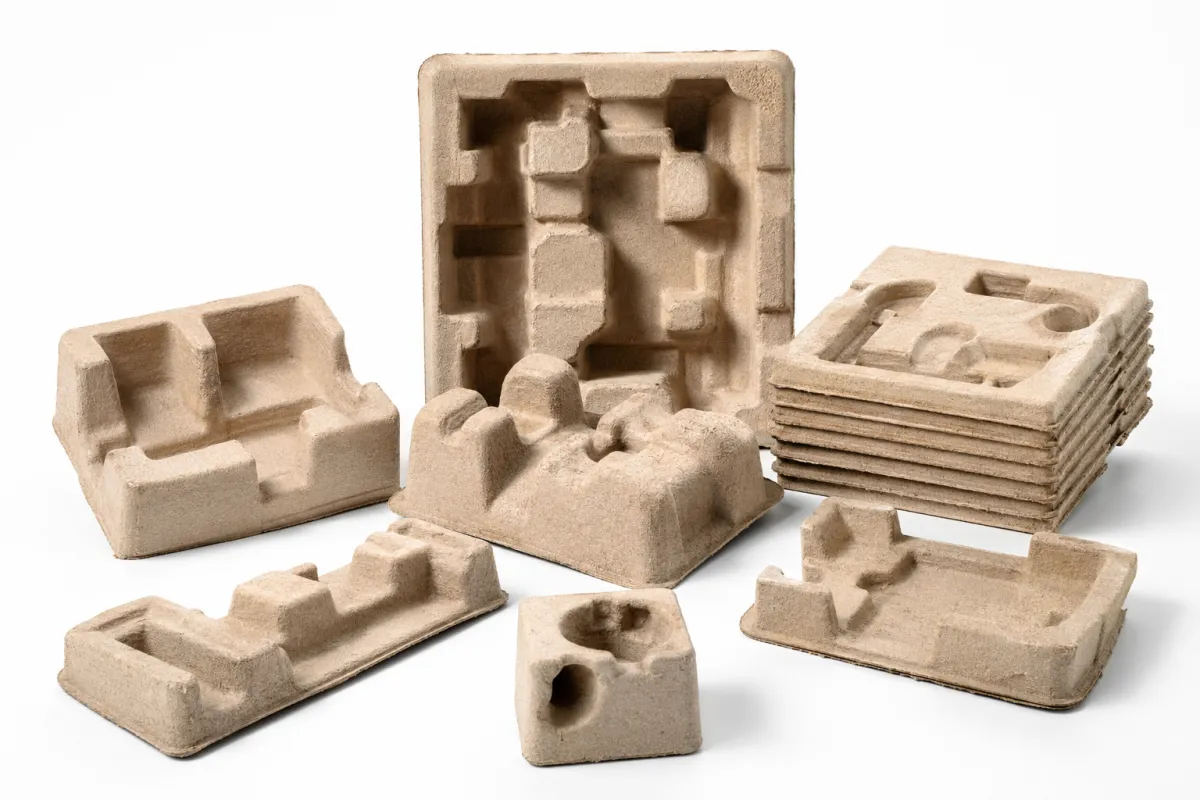
People often mistake custom recycled pulp protective packaging for a rough, industrial insert used only to keep costs down. That picture is too small. High-end personal care brands use it for gift sets with a two-piece tray, a bottle neck lock, and a precise recess that keeps the label facing forward at retail opening. I remember one buyer in New Jersey telling me, "If the label turns sideways, my merchandising team will actually call me." He was only half joking. The fit comes from the mold, then from the details: wall thickness, draft angle, cavity depth, and the amount of restraint around the product. The fiber itself usually comes from recovered paper, and in some programs the finish is bright enough that buyers are surprised when they lift the lid.
In simple language, custom recycled pulp protective packaging starts as paper fiber mixed into slurry, formed over a mold, and dried into a shape made for a specific product. That shape might be a tray for a cosmetics jar, a pair of end caps for a monitor, a bottle carrier for a spirits pack, or a clamshell-style cradle for a medical device. The fiber source is often mixed recycled paper from regional mills in Guangdong, Jiangsu, or Ohio, and procurement teams sometimes ask for FSC-related documentation so the sourcing story can stand up in branded packaging reports. I have sat in supplier meetings in Dongguan where the question was not whether pulp could work, but whether the finish should stay natural gray or move to a brighter tone for a more premium look. That conversation can go on for forty minutes, by the way, and somehow everyone still pretends the color is the only variable.
Its place in the packaging stack is broader than many teams expect. Custom recycled pulp protective packaging shows up in e-commerce mailers, retail-ready cartons, electronics, glass, cosmetics, and industrial shipments where the product needs cushioning and a controlled position inside the shipper. It can reduce plastic use, cut loose-fill clutter, and make packout benches easier to manage because the components nest neatly on pallets instead of bouncing around like irregular foam blocks. In a 40,000-unit run, a few seconds saved per pallet build adds up fast, and labor cost has a way of exposing those differences. I have watched a warehouse team in Charlotte save the equivalent of one part-time shift just by getting rid of awkward filler that nobody enjoyed touching.
"Give me the same protection as foam, but make the packout cleaner and easier to explain to retailers." That came from a cosmetic buyer in New Jersey, and the first prototype of custom recycled pulp protective packaging solved the presentation issue with a two-cavity tray and a lid lock that held steadier than anyone expected. The buyer called back later and said, "I finally stopped apologizing for the inside of the box." On the production side, the tray was sampled in 14 days from proof approval and then shipped into a 5,000-piece pilot lot.
Products with a defined silhouette usually pair well with custom recycled pulp protective packaging because the insert can cradle fragile corners, support the center of gravity, and separate accessories into their own pockets. That is also why it works so well where package branding matters. The insert can frame the product instead of hiding it. Once teams see a prototype inside the carton, the conversation shifts from "just protect it" to a more disciplined packaging design discussion. That shift is valuable. It usually means people stop guessing and start measuring, often down to the nearest 1 mm on a bottle shoulder or 0.5 mm on a nozzle collar.
- It suits bottles, jars, and pump dispensers with repeatable geometry and 2 mm to 4 mm wall contact zones.
- It handles small electronics, chargers, and camera accessories with defined edges and 6 mm corner buffers.
- It supports glass and ceramics where corner control matters more than soft bulk in a 1.2-meter drop profile.
- It can make retail packaging feel cleaner by holding the product in a fixed reveal position, often 18 mm from the front panel.
How Custom Recycled Pulp Protective Packaging Is Made
The manufacturing flow for custom recycled pulp protective packaging begins with fiber preparation, and that step is less casual than many buyers assume. Recovered paper is pulped into slurry, screened for contaminants, and adjusted for solids content so the forming line pulls the right amount of material onto the tool. On a typical line, the slurry often sits in the 3.0% to 4.5% solids range before vacuum molding defines the cavity shape, wall thickness, and surface texture. A weak fiber mix creates weak ribs and fuzzy edges, and both problems show up quickly in fit and presentation. No one wants to discover that after artwork approval and a truck booking from Jiangsu to Illinois.
After that, the mold design becomes the deciding factor. Generic cushioning parts are shaped for broad contact and loose stacking, while true custom recycled pulp protective packaging starts from a product drawing, a CAD file, or a physical sample that shows the converter exactly where the pressure points live. I once watched a supplier in Guangdong call a tray for a glass component "universal" because the footprint looked close enough, yet the first sample rocked on two corners by 4 millimeters. That would have been a shipping failure waiting to happen. We redrew the cavity, added a rib under the shoulder, and the second sample passed cleanly. I still think "close enough" is one of the most expensive phrases in packaging.
Once the part is formed, it gets dried, trimmed, and inspected. Drying may happen in heated ovens or thermal tunnel systems, with the moisture pulled down to a stable level that keeps the insert rigid without warping. Trimming removes flash and evens the perimeter. Final inspection checks dimensions, stacking, color consistency, and surface defects. In a plant in Suzhou, a standard two-cavity mold can be ready for first samples in 12 to 15 business days after proof approval, while larger tools in Dongguan may take 3 to 5 weeks before the first useful sample lands on your desk. That repeatability is one of the main reasons buyers choose custom recycled pulp protective packaging over hand-cut alternatives, because a tray that holds to tolerance on unit 1,000 should still match on unit 50,000.
The operational value is easy to miss from a spreadsheet. Properly engineered custom recycled pulp protective packaging stacks neatly in cartons, loads well on pallets, and feeds into high-volume packaging and converting facilities without much manual rework. That means fewer crushed corners during transport to the filler, fewer bins of odd-shaped scrap, and fewer slowdowns when a warehouse switches from one SKU to another. If your production line is already moving 800 to 1,200 units per hour, uniform inserts become a real production asset. If you are moving slower than that, they can still save your team from that deeply familiar warehouse sigh that means, "Here comes another fiddly part." A line that runs 900 units per hour and loses 20 seconds per pack on hand-fit foam will feel the difference by lunch.
Design Factors That Shape Performance and Fit
Good custom recycled pulp protective packaging begins with the product, not the insert. Weight matters, but so do drop height, corner vulnerability, center-of-gravity balance, and whether the product can shift inside the shipper during a 90-degree turn on a conveyor. A 420-gram glass bottle and a 420-gram power adapter do not behave the same way. One is fragile at the neck, the other may fail at a connector tab. That is why I ask for actual samples, not just a dimension sheet, before anyone commits to a mold. A ruler is not a personality test for a product, and a 3D file alone will not tell you where the label rub happens.
Surface finish, wall thickness, rib structure, and nesting geometry decide how custom recycled pulp protective packaging performs in the real world. A smoother face can reduce scuffing on printed labels, while a deeper rib can improve crush resistance when the insert sits inside a master carton. If the pieces nest too tightly, packout slows because operators have to pry each one apart; if they nest too loosely, the parts chatter in transit and mark the product finish. On one pharmaceutical accessory line in Ohio, we had to adjust a 1.6 mm rib to 2.1 mm because the first version looked fine but compressed too much after 24 hours in a humid staging room at 72% relative humidity. That one tiny adjustment saved a week of complaints that would have sounded suspiciously like "the insert is soft" repeated by five different people.
Protection Geometry
For fragile products, custom recycled pulp protective packaging often works best as a suspension or cradle system, where the item floats a few millimeters above the carton wall instead of sitting hard against it. That small gap spreads impact energy across the molded fiber rather than dumping it into one sharp corner. I have seen this on small appliance inserts where a 6 mm air gap around the product made a bigger difference than adding another layer of corrugated board. The geometry should follow the product's weakest points, not its broadest face. If the weakest point is a decorative cap, then the package needs to behave like it knows that cap exists, especially on a 24-inch monitor or a 500 mL glass bottle with a narrow neck.
Shipping Environment
The shipping route matters just as much as the design. Custom recycled pulp protective packaging that works in a local retail distribution loop may fail once it faces parcel networks, palletized freight, or warehouse humidity swings from 35% to 85%. I always ask whether the carton will move through single parcels, multi-stop distribution, or retail replenishment, because a part that is fine for hand-delivery can still scuff under automated conveyor vibration. If the program needs formal validation, I prefer to see reference testing against ISTA procedures and compression checks aligned with ASTM methods so the design is not only attractive, but defensible. Nice-looking packaging that fails on the second trailer leg is just expensive disappointment, usually the kind that shows up after 200 miles and three dock transfers.
Moisture exposure causes more trouble than many teams expect. Recycled fiber can tolerate a fair amount, yet if the carton sits in a trailer overnight or a coastal warehouse in Savannah for 48 hours, the insert can soften enough to lose compression strength. That is why custom recycled pulp protective packaging often needs a design review that includes the shipper and the storage condition, not just the product dimensions. Brands that document the environment up front usually save at least one sample revision, sometimes two. The funny part is that the "we do not have humidity problems" teams almost always call back later with humidity problems, and the fix is usually a 1 mm wall increase plus a tighter carton spec.
How Does Custom Recycled Pulp Protective Packaging Perform in Transit?
Custom recycled pulp protective packaging performs best in transit when the insert is matched to the product mass, carton strength, and shipping route. In a clean parcel lane, molded fiber can absorb shock, hold the product in place, and prevent the kind of movement that turns a good box into a damaged return. In palletized freight, the same part can help the pack survive compression and stacking because the fiber structure spreads load more evenly than loose filler or cut corners. I have seen a 6 mm design change improve drop performance and reduce scuffing at the same time, which is rare enough that people usually look suspicious when it happens.
The important variable is not the material alone. It is the full system: carton, insert, void space, and the handling environment. If custom recycled pulp protective packaging is tested inside the final shipper and not just on a bench, the results are much more honest. A part that looks perfect in isolation can still fail if the outer box flexes too much, if the product shifts after tape application, or if the warehouse sees long humidity exposure before freight pickup. That is why I prefer to evaluate transit performance with the actual carton, the final void space, and a real ship method, whether that is parcel, LTL, or retail replenishment.
Brands also tend to underestimate the human side of transit. A cleaner molded fiber insert is easier for operators to place consistently, which means fewer packing errors and fewer damaged corners caused by rushed assembly. On a 25,000-unit run, that consistency matters as much as the shock protection itself. In practice, custom recycled pulp protective packaging is not just about surviving a drop test; it is about surviving the ordinary mess of warehouses, trailers, conveyor vibration, and the occasional dock door that gets opened too fast.
Custom Recycled Pulp Protective Packaging Cost and Pricing
Pricing for custom recycled pulp protective packaging comes down to a few concrete variables: mold tooling, part size, cavity complexity, fiber grade, drying time, surface finish, and any engineering or validation work before launch. A simple two-cavity tray may need only a modest tool, while a multi-part clamshell with deep locking features and tight tolerances can require a much more expensive forming setup. On short runs, tooling feels heavy because the fixed cost sits on a small number of units. On repeat orders, that cost spreads out quickly. I have seen a team argue over a mold fee for two weeks and then quietly admit later that they were looking at the wrong line item the whole time.
| Option | Typical tooling/setup | Example unit cost at 5,000 pieces | Example unit cost at 25,000 pieces | Best fit |
|---|---|---|---|---|
| Custom recycled pulp protective packaging | $3,500-$9,500 | $0.15-$0.31 | $0.09-$0.16 | Repeat shipping, recyclable fiber presentation, custom shape control |
| EPS foam inserts | $2,000-$6,000 | $0.19-$0.35 | $0.08-$0.14 | Lightweight cushioning where plastic disposal is not a concern |
| Corrugated inserts | $800-$2,500 | $0.12-$0.24 | $0.07-$0.12 | Fast programs, flat shipment, lighter compression demands |
| Thermoformed PET | $5,000-$15,000 | $0.25-$0.45 | $0.14-$0.28 | Clear presentation, high retail visibility, plastic-based protection |
That table helps, though total landed cost is the real comparison. Custom recycled pulp protective packaging may cost more than corrugated in the first quote, yet it can reduce packout labor, lower damage claims, and improve stackability on a pallet, which changes the math over a 3,000-unit or 30,000-unit program. I have watched a buyer focus on a $0.04 unit difference and lose it in extra labor because the cheaper option needed two more hand motions per box. A good comparison looks at the whole packed product, not just the insert invoice. It is amazing how fast "cheap" turns into "why is everyone slower?"
Tooling also affects lead time. A smaller mold in Dongguan might be ready in 10 to 14 business days, while a complex multi-cavity tool in Suzhou or Ningbo can take 3 to 5 weeks before the first useful sample lands on your desk. If you want a broader starting point, browsing Custom Packaging Products can help you compare formats before you commit to custom recycled pulp protective packaging. I always advise teams to budget for at least one sample revision, because a 2 mm change in product diameter or a slightly taller cap can alter the fit completely. The part can go from perfect to useless with embarrassing speed, especially if the original carton was built around a 1 mm tolerance stack.
Secondary finishing changes the quote too. If a buyer wants tighter trimming, a smoother face, embossed branding, or a cleaner outer edge for retail packaging, labor and inspection time rise. That is not a problem if it is priced honestly. In high-volume branded packaging programs, the difference between a plain natural finish and a polished presentation can separate an insert that merely protects from one that supports the package branding story from the first lift of the carton flap. I think that matters more than most people admit out loud, especially when the outer carton is printed on 350gsm C1S artboard and the inner tray needs to look intentional beside it.
Step-by-Step Process and Timeline for a Custom Order
The order path for custom recycled pulp protective packaging usually starts with a real product sample, not a sketch. I want the actual bottle, device, jar, or component on the table, plus the shipping carton if one already exists. From there, the supplier can gather dimensions, identify fragile points, and learn whether the insert needs to lock the item, suspend it, or simply stop side-to-side movement. That first intake step often takes 2 to 3 business days if the buyer has samples ready and can answer basic questions about carton size, ship-from city, and shipping method.
- Collect product measurements, photos, and one live sample for fit review.
- Define protection requirements, including drop height, corner risk, and moisture exposure.
- Create a CAD concept or rough tool drawing for custom recycled pulp protective packaging.
- Build the mold, then pull the first sample and check wall thickness, trim lines, and stackability.
- Review fit in the actual carton, then revise tolerances if the product rocks or binds.
- Approve the final sample, lock the carton dimensions, and schedule production.
A realistic timeline for custom recycled pulp protective packaging often falls between 4 and 8 weeks from first intake to stable production, depending on how many revisions the buyer asks for. A simple part with existing tooling can move faster, but new tooling, sample adjustments, and approval cycles always add time. I have seen a cosmetics launch lose 9 days because the buyer changed the bottle shoulder radius after sample approval, and the insert had to be recut to stop label rub. That kind of delay is not unusual, which is why I push teams to freeze the product geometry before they start discussing production dates. Changing the bottle after the mold is built is, frankly, a very expensive hobby.
"The sample looked great until we put it in the real carton with the shipping void we planned to use." I have heard that line in more than one client meeting, and it is exactly why custom recycled pulp protective packaging should be tested with the final carton, not just on a bench. Bench testing is useful. Real cartons are honest, and the 8 mm difference between a loose fit and a tight one can decide whether a shipper passes or fails.
The most useful communication checkpoints are simple: tolerance sign-off, surface appearance sign-off, carton dimension sign-off, stacking orientation, and shipping method. If the supplier knows the insert has to survive parcel distribution at 16 ounces or less, that is a different brief than a palletized freight case leaving a regional plant in Columbus or Dallas. A buyer who confirms those details early usually gets a cleaner first sample, fewer loops, and a more predictable line launch. If your sourcing team is debating inserts, bring in custom recycled pulp protective packaging early rather than after the outer carton art is already locked. Otherwise everyone ends up playing packaging Tetris at the worst possible time.
One more practical note: ask for a sample shipment packed the same way the production order will ship. I have watched teams approve a perfect molded piece, then discover the outer carton was 8 mm too tight for the tray flange once the carton was taped and compressed. That is why a good supplier tests custom recycled pulp protective packaging in context, not as a standalone part. The carton, insert, and product need to behave like one system. If they do not, the freight carrier becomes your uninvited quality inspector, usually after a 900-mile lane and two dock handoffs.
Common Mistakes When Specifying Protective Pulp Packaging
The biggest mistake I see with custom recycled pulp protective packaging is designing to the product outline and ignoring how the item behaves in transit. A shape can look perfect on a CAD screen and still fail because the fragile corner sits 3 mm too close to the carton wall, or because the center of gravity shifts under vibration. I once reviewed a tray for a ceramic piece with beautiful side walls, but the base flexed under compression and let the part lean. One extra support rib fixed it, though the customer had already burned a week on the wrong assumption. That week felt very long to everyone involved, especially the person who had to explain the delay upstairs.
Skipping performance testing is the second costly error. A part that feels solid on the bench may still fail in custom recycled pulp protective packaging drop trials, vibration testing, or humid warehouse storage. I like to see at least a simple test plan that references ISTA methods or a comparable internal protocol, because 1.2-meter drops, repeated corners, and compression loads say far more than a hand squeeze ever will. If the shipper is going into a parcel network, a test protocol is not extra paperwork; it is insurance against damage claims, and a 24-hour test cycle in the lab can save a 24-day recall conversation later.
- Do not approve a tray without checking the real carton fit with tape, flap depth, and void space measured in millimeters.
- Do not ignore humidity, especially if the product sits in a warehouse for 24 to 72 hours before shipping from a coastal hub.
- Do not leave finish, tolerance, or stacking notes vague, because one supplier may read them differently from another.
- Do not assume one sample proves the whole run, because pulp behavior changes with drying, moisture, and trim quality from lot to lot.
Vague specifications are the third trap. If a drawing says "tight fit" but never names the acceptable gap, two suppliers can produce two different answers and both think they were right. That is a headache with any packaging design, and it gets more expensive with custom recycled pulp protective packaging because tooling changes move slower than knife adjustments in corrugated. I prefer notes on exact tolerances, like +/-0.5 mm on the neck cavity, acceptable surface blemishes, and whether the insert needs to be visually clean for retail packaging or simply functional for shipping. "Pretty enough" is not a spec, even if someone in marketing says it with a straight face.
There is also a sourcing mistake that shows up often in supplier conversations: buyers ask for the cheapest quote and forget to ask how the mold is built. A weak tool can make a low quote look attractive for 2,000 units, then create trim drift, edge fuzz, or uneven drying on the second production lot. That is why I respect suppliers who explain mold strategy, cavity count, and drying approach upfront. With custom recycled pulp protective packaging, the cheapest number on day one is not always the best number after 20,000 units and 6 months of real use. I have seen that story end with a retool order and a very quiet procurement room in Richmond.
FAQ
How does custom recycled pulp protective packaging compare with foam inserts?
Custom recycled pulp protective packaging is often preferred when a brand wants a fiber-based option with a more natural look and a cleaner recycling story, especially for retail packaging and e-commerce shipments that need a tidier presentation. Foam can cushion differently, and in some cases it still wins on very soft impact absorption, but pulp usually offers better shape retention and easier carton staging. On a 5,000-piece run, I have seen the cost difference land around $0.02 to $0.06 per unit either way, so the right answer depends on product fragility, drop requirements, and how the buyer wants the box to feel in the hand. I usually tell clients to compare the first unboxing moment too, because customers do notice when the inside looks thoughtful.
What products work best with recycled pulp protective packaging?
Products with a defined shape are the easiest fit for custom recycled pulp protective packaging, including bottles, small electronics, personal care items, glass components, and compact appliances with repeatable dimensions. I also see it work well for items that need corner support, suspension, or tray-style organization for accessories. Very irregular or extremely delicate products may need a hybrid approach, where pulp pairs with another cushioning layer to cover odd pressure points. That is not a failure; it is just honest engineering, and it is often the right answer for a 700-gram medical accessory or a 14-inch retail device with fragile ports.
How long does the custom recycled pulp protective packaging process usually take?
Lead time depends on whether the mold exists, how complex the cavity is, and how many sample revisions the project needs, but a new custom recycled pulp protective packaging program often runs 4 to 8 weeks from intake to production. Simple parts can move faster, while new tooling and fit changes add time. I always tell buyers to plan for at least one prototype round and a production slot at the molding facility, because sample approval tends to take longer than the first quote suggests. The quote is the easy part. The fit is where the calendar gets involved, and a 12 to 15 business day sample cycle from proof approval is common for standard parts.
Is custom recycled pulp protective packaging expensive to tool?
Tooling cost for custom recycled pulp protective packaging is usually driven by cavity complexity, part size, trim detail, and the number of custom features built into the mold. A simple tray is easier to justify on a small run, while a multi-cavity protective insert can carry a higher upfront number but better per-unit economics over time. For repeat production, the cost often becomes easier to absorb once the tooling is spread across 10,000 units or more. I have yet to meet a finance team that loves tooling fees on first sight, but when the per-unit price drops from $0.28 to $0.15 on a 5,000-piece order, the conversation usually gets calmer.
Can custom recycled pulp protective packaging be used for retail presentation?
Yes, and that is one of the most overlooked strengths of custom recycled pulp protective packaging. With the right finish, rib structure, and reveal angle, the insert can create a premium first impression instead of looking purely utilitarian. If the goal is strong package branding, ask for samples that show how the pulp part sits inside the finished shipper or retail box, because the visual relationship between insert and carton is what the customer actually sees. A good insert can make a product look more deliberate, which is a polite way of saying "less like it escaped from a warehouse" and more like it was planned from the first die line.
For teams planning a launch, the smartest next step is simple: measure the product, mark the fragile points, choose the shipping environment, and request a prototype around one real sample rather than three guessed dimensions. Then compare the insert against the carton, the handling path, and the brand story. That is usually where custom recycled pulp protective packaging earns its keep, because it protects the product, supports the presentation, and keeps the packout process under control from the first carton to the last, whether the program ships from Dongguan, Cleveland, or Querétaro. Lock those inputs before tooling, and the odds of a clean first run improve a lot. Skip that step, and you are kinda asking the freight lane to do your debugging for you.

