Buyer Fit Snapshot
| Best fit | Custom Return Labels Wholesale projects where brand print, material claims, artwork control, MOQ, and repeat-order consistency need to be specified before quoting. |
|---|---|
| Quote inputs | Share finished size, material target, print colors, finish, packing count, annual reorder estimate, ship-to region, and any compliance wording. |
| Proofing check | Approve dieline scale, logo placement, barcode or warning zones, color tolerance, closure strength, and carton packing before bulk production. |
| Main risk | Vague material claims, crowded artwork, missing packing details, or unclear freight terms can make a low unit price expensive after revisions. |
Fast answer: Custom Return Labels Wholesale: Pricing, Specs, and Timing should be specified like a repeatable production item. The safest quote records material, print method, finish, artwork proof, packing count, and reorder notes in one written spec.
Production checks before approval
Compare the actual filled-product size with the drawing, then confirm tolerance on folds, seals, hang holes, label areas, and retail display edges. Reserve space for logos, QR codes, warning copy, and material claims before decorative graphics fill the panel.
Quote comparison points
Review material grade, print process, finish, sampling route, tooling charges, carton quantity, and freight assumptions side by side. A quote is only useful when the supplier can repeat the same color, closure quality, and packing count on the next order.
One mislabeled return can turn a tidy refund into a three-way mess: delayed credit, wasted labor, and inventory parked in the wrong cage. That is why custom return labels wholesale matters; it replaces guesswork with a routing system the warehouse can actually trust. For retail, e-commerce, and 3PL teams, the label is not a small accessory tucked into the corner of the operation. It is a control point that shapes how fast a return gets back into motion.
From a packaging buyer’s point of view, the math is pretty plain. A label that costs pennies can prevent a second labor touch, a customer service ticket, and a misrouted carton that creates rework later on. The value climbs even faster when returns move through multiple locations, or when a brand uses separate receiving rules for stores, central warehouses, and liquidation partners. Custom return labels wholesale gives operations a repeatable format, and that is exactly what high-volume return programs depend on.
Why Custom Return Labels Wholesale Prevents Return Chaos
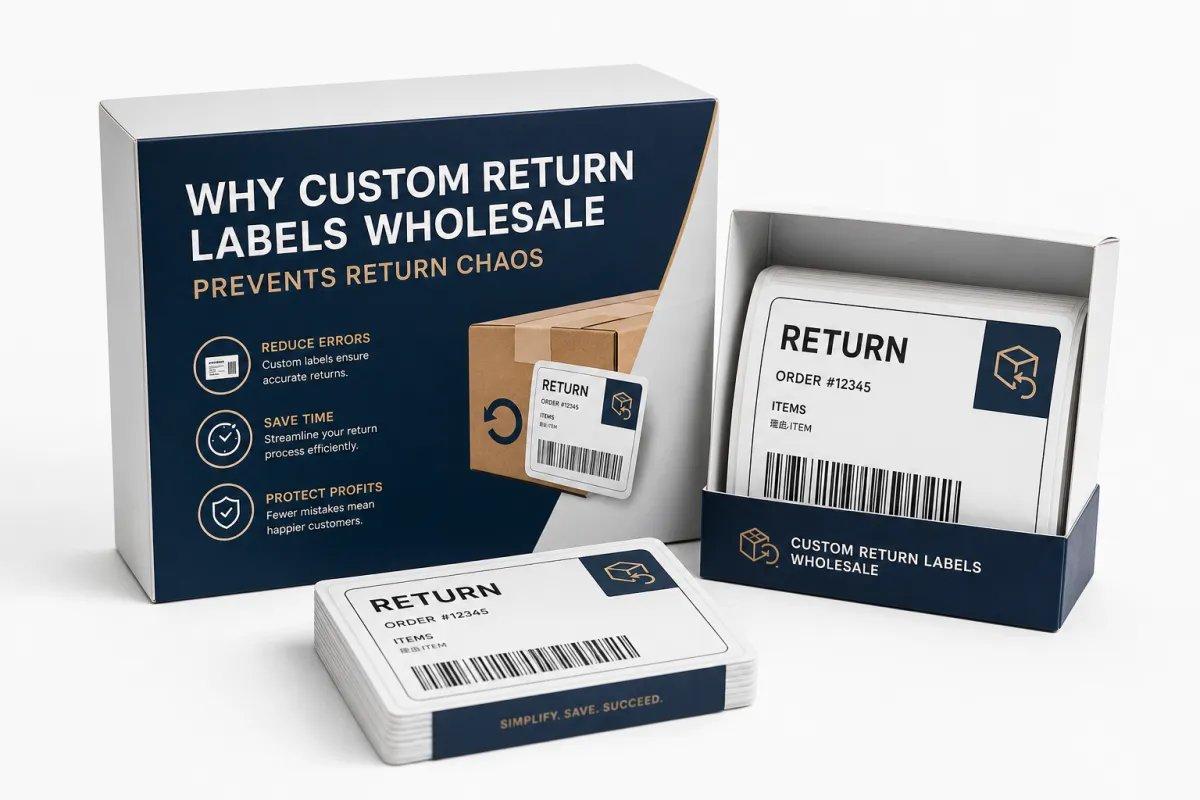
Returns tend to move slower than outbound shipping because the data trail is messier. A parcel may come back with a handwritten note, an old packing slip, or a customer-generated label that points to the wrong dock. One mislabeled parcel can delay a refund by days and send teams into a manual trace across customer service, receiving, and finance. Custom return labels wholesale cuts through that noise by standardizing the information that travels with each package.
I’ve seen this play out in operations that receive everything from apparel to accessories under the same roof. Picture a warehouse handling 1,200 returns a day across three product lines. Without a consistent label system, the receiving team has to read addresses, inspect RMA numbers, and decide whether the carton belongs in apparel, electronics, or a repair queue. That kind of judgment call slows everything down. With custom return labels wholesale, the return destination, barcode, and handling instructions are already on the label, so sorting becomes a scan-and-place task instead of a debate.
That difference matters even more for merchants running multiple sites. A brand may want store returns to move to one node, online exchange returns to another, and warranty units to a third. One label design can carry all of that routing logic. custom return labels wholesale is not just a print line item; it is a process control tool for merchants, 3PLs, and multi-location brands that need cleaner receiving and fewer exceptions.
"A return label is not paperwork; it's routing logic. If the label is unclear, the warehouse pays for it twice."
The customer experience side matters too, and it is easy to underestimate. Buyers expect a return path that feels simple, even if the operation behind it is anything but simple. A consistent label that scans cleanly and survives transit helps the refund loop close faster. That is the commercial value of custom return labels wholesale: faster intake, fewer manual checks, and less back-and-forth after the sale.
Here is the sequence most teams want to see in practice:
- Customer prints or receives a return label with clear routing.
- Warehouse scans the barcode or RMA and confirms destination.
- Receiving team sorts by site, category, or reason code.
- Finance gets cleaner verification data for refund release.
- Operations sees fewer exceptions and fewer misrouted cartons.
That is why custom return labels wholesale keeps coming up in return optimization planning. The label will not solve every issue, but it removes one of the most common failure points: ambiguity. And honestly, that’s a big deal in a process already carrying enough moving parts.
Custom Return Labels Wholesale Product Details and Use Cases
Buyers usually need one of four formats: peel-and-stick labels, linered sheets, rolls, or variable-data labels for on-demand workflows. Each format supports a different operating style. Sheets work well for office or low-volume distribution. Rolls fit thermal printers and warehouse stations. Variable-data labels are a better fit when each return needs a unique barcode, RMA, or sequence number. custom return labels wholesale gives teams a way to match the label format to the actual workflow instead of forcing the workflow to fit a generic product.
The use cases are broader than many buyers expect. Retail return authorizations often need a preprinted return address and a scan code. E-commerce exchanges may need a destination code that tells the warehouse whether the item goes back into resale, inspection, or quarantine. Warranty processing often needs a reason code and a serial-number reference. 3PL inbound routing may require site-specific instructions. In each case, custom return labels wholesale creates a cleaner path from the customer back to the correct internal team.
Operations usually cares about the receiving side, while customer service cares about the approval side. Finance cares about verification and refund timing. Good label design ties those functions together. A useful label might include:
- Return address or return center name
- RMA field or approved-return reference
- Barcode or QR code for scan-based intake
- Handling instructions such as "inspect," "restock," or "hold"
- Internal routing notes for warehouse or 3PL teams
That structure matters because the label becomes a bridge between departments. custom return labels wholesale is especially useful when customer service approves the return, operations receives it, and finance needs a clean record to release the refund. Without a standardized format, each department ends up compensating for the gaps left by the others.
Before standardization, a return workflow often looks like this: the customer prints a generic label, the carrier scans it, the package arrives at the wrong location, and the receiving team writes the destination on the carton by hand. After standardization, the label already carries the routing logic. That sounds small. It is not. At scale, even a 5% reduction in manual sorting can cut hours from weekly receiving time.
If your operation already uses Custom Labels & Tags for outbound cartons or shelf identification, return labels can be built to look and behave the same way. That consistency helps receiving teams learn one system instead of three. It also supports broader package branding, especially when the same brand uses inserts, outbound label sets, and return paperwork that all speak the same visual language.
Materials, Adhesives, Formats, and Print Specifications
Material choice should start with the environment, not the artwork. Paper labels are usually the lowest-cost option and work well for indoor return programs with normal handling. Thermal-compatible stock fits variable printing, which is useful when each label needs a unique barcode or serial number. Synthetic materials are better when moisture, abrasion, or longer transit exposure could make a paper label fail. custom return labels wholesale should be specified by use case first, then by price.
Adhesive selection matters just as much. Corrugated boxes need a different tack profile than poly mailers. Recycled packaging sometimes has a rougher or dustier surface. Cold-chain or high-humidity environments may need a stronger adhesive so the label stays readable during transit. If a label peels at the corner, the whole routing system weakens. A useful wholesale spec sheet should name the surface, dwell time, and storage conditions before the print run starts.
When buyers review specs, they should confirm the basics with precision:
- Label size and shape
- Core size for roll compatibility
- Roll direction and unwind orientation
- Perforation requirements
- Finish, such as matte or gloss
- Print method compatibility, including thermal transfer or digital print
There is another layer that too many teams skip: barcode quality. If a return label includes a barcode or QR code, the contrast has to stay strong after rubbing, bending, and courier handling. Quiet zones around the code should be preserved, and the data file should be clean before print. Good scannability is not a design nicety. It is the difference between one scan and five minutes of manual entry. For teams that want a deeper operational benchmark, the testing principles used by the ISTA packaging test protocols are a sensible reference point for handling and transit durability.
Compliance needs deserve a quick review too. Some retailers have internal routing rules. Some marketplaces impose return formatting expectations. Some companies need labels to support a specific refund or warranty process. custom return labels wholesale should be built around those constraints, not after them. That is the difference between a label that looks fine and a label that works in production.
| Label Type | Best Fit | Typical Wholesale Price Range | Notes |
|---|---|---|---|
| Paper pressure-sensitive | Standard indoor returns, low-abrasion handling | $0.03-$0.07 per label at 5,000+ pieces | Lowest unit cost; best for clean receiving areas |
| Thermal-compatible roll labels | Variable data, scan-heavy warehouse workflows | $0.05-$0.12 per label depending on print coverage | Good for on-demand printing and sequential numbering |
| Synthetic moisture-resistant | High-humidity, cold-chain, or longer transit exposure | $0.09-$0.18 per label at volume | Higher cost, but better hold on tough surfaces |
For teams that compare labels alongside broader Custom Packaging Products, the takeaway stays simple: the return label should match the rest of the packaging system. If the brand already cares about retail packaging, product packaging, or custom printed boxes, the return label should not be treated as a throwaway component. It is part of the package branding story, even if it sits on the back of the box.
Custom Return Labels Wholesale Pricing and MOQ
Pricing is driven by several variables at once: quantity tiers, substrate choice, adhesive type, number of SKUs, variable data, and whether the order needs rush production. The biggest shift in unit cost usually comes from volume. A 500-piece order may cost noticeably more per label than a 10,000-piece order because the setup work is spread across fewer units. That is why custom return labels wholesale usually beats repeated one-off reprints for recurring programs.
Minimum order quantity depends on the build. Stock-based labels with simple print can have a lower MOQ. Fully custom shapes, specialty adhesives, or variable-data runs often need a higher threshold because production setup is more involved. Buyers should expect minimums to change by size, material, and finishing method. MOQ is not just about quantity; it is about how much change the press must absorb.
Here is the practical cost equation that matters most: a slightly more expensive label can still be cheaper than a cheaper label that creates labor rework. If a label saves one manual sort, one support ticket, or one refund delay, the economics improve quickly. custom return labels wholesale should be judged against the full return-handling cost, not only the print invoice. That is the mistake many teams make when they compare vendors too narrowly.
For recurring programs, ask suppliers for tiered pricing. The best quote is not always the lowest number on the first tier. Sometimes the real break-even point sits at 3,000 pieces, sometimes at 10,000. A buyer who requests pricing by use case rather than only by piece count usually gets a more accurate comparison. If the use case involves multiple facilities, unique barcodes, or seasonally changing return destinations, then the quote should reflect that complexity.
One more point: hidden cost is real. A vendor with a lower printed price but inconsistent fit, weak adhesive, or inaccurate artwork handling can create downstream receiving issues that erase the savings. custom return labels wholesale should be selected like any other operational input: by total cost to run, not by sticker price alone.
Typical buyer questions usually sound like this:
- How much does the label cost at 1,000, 5,000, and 10,000 pieces?
- What changes the price the most: stock, adhesive, or data setup?
- What MOQ applies to my exact label size and finish?
- Can I reduce cost by standardizing one format across several return lanes?
If your team is already inside a Wholesale Programs structure for cartons, mailers, or inserts, return labels can usually fit the same procurement rhythm. That tends to shorten reorders and improves budget forecasting. It also keeps the sourcing team from juggling one-off purchase logic for a product that should be repeatable.
There is a plain truth behind all the spreadsheet work: buyers sometimes over-focus on per-label savings and under-focus on consistency. In returns, consistency is the product. The label does not need to be fancy. It needs to be reliable, legible, and aligned with the receiving workflow. That is what custom return labels wholesale is for.
Order Process, Proofing, and Production Timeline
The buying process should feel predictable. A good workflow starts with a quote request, moves into artwork review, confirms specs, sends a proof, and then goes into production after approval. If the supplier is organized, the buyer gets one clear place to catch problems before print. custom return labels wholesale should not require detective work to place correctly.
The fastest orders usually arrive when the buyer provides five things up front: dimensions, quantity, material preference, adhesive preference, and any barcode or numbering rules. If the label includes a return address, the exact copy should be supplied in editable form. If the label needs multiple SKUs or destination codes, the file should show how those variants are separated. Clean inputs cut revision cycles, and that is where time gets saved.
Proofing matters because it catches the expensive mistakes early. A good proof should confirm layout, copy, barcode placement, color treatment, and orientation. If the job includes sequential numbering or variable data, the proof should also show how the data will appear on the final label. The more moving parts there are, the more important proof discipline becomes. custom return labels wholesale often moves quickly once the proof is approved, but each extra correction step extends the timeline.
Realistic production timing depends on whether the order is a simple repeat or a custom build. Repeats can be faster because the specs are already locked. More complex orders may take longer because of file prep, prepress review, and material sourcing. As a rough expectation, simple wholesale label jobs often move in about 12 to 15 business days after proof approval, while more complex variable-data runs can take longer. Freight speed matters too, and production time should always be separated from shipping time in the quote.
That distinction gets missed more often than it should. Teams hear "two-week turnaround" and assume the boxes are already on the dock. Then the freight clock starts. The smarter way to plan custom return labels wholesale is to ask for both production lead time and transit time in writing. It prevents unpleasant surprises during a promotion, a peak season, or a major SKU launch.
Repeat ordering is where a good supplier really earns trust. Once the artwork is approved and the specs are set, replenishment should be faster and more predictable. If the vendor stores the file history cleanly and keeps material specs consistent, the buyer avoids re-explaining the same details on every order. That kind of process discipline is worth more than a flashy promise.
For sustainability-minded teams, it also helps to keep material choices aligned with broader packaging policy. Some buyers prefer FSC-certified paper where the program calls for it. If that matters to your workflow, ask for documentation and verify the source chain. A useful reference point is the FSC certification framework, especially if your packaging team already uses it for cartons, inserts, or branded packaging components.
Why Choose Us for Custom Return Labels Wholesale
What should a buyer expect from a strong supplier? Consistent print quality, straightforward reorder support, and enough operational discipline to keep the label spec stable from run to run. That matters more than glossy language. custom return labels wholesale is a supply program, not a novelty purchase. If the vendor cannot hold the line on dimensions, adhesive behavior, and artwork accuracy, the buyer will pay for it later in receiving issues.
Custom Logo Things is built for repeat commercial work, which is the right fit for return-label programs that cannot afford drift. The value is not only in the print. It is in the way the order is handled: file checks, spec confirmation, quantity discipline, and packaging formats that are easy for warehouse teams to use. That is especially useful when a customer is sourcing labels alongside Custom Labels & Tags or other items used across the same fulfillment operation.
Another practical advantage is that a good supplier reduces hidden costs before they happen. If the file has barcode problems, the issue should be caught in proofing. If the stock choice is not compatible with the receiving environment, that should be raised early. If the label format will misfeed in the printer at the 3PL, that should be addressed before production. custom return labels wholesale works best when the vendor thinks like an operations partner, not just a print shop.
Generic label vendors often look fine on paper and fail in the workflow. One label is too large for the mailer flap. Another peels when it meets corrugated dust. Another does not scan cleanly under warehouse lighting. Those are small failures with large consequences. A better source protects the buyer from those misses by matching the label to the actual receiving system. That is a real difference, and it shows up quickly.
There is also a connection to the broader package experience. Brands that invest in retail packaging, package branding, and custom printed boxes should not let the return side feel improvised. The return label is part of the post-purchase journey. If it looks like it belongs to the brand, it reinforces confidence. If it is sloppy, it suggests the operation is less organized than the box implied. Buyers notice that. So do customers.
For teams that need a broader sourcing mix, our Custom Packaging Products and Wholesale Programs pages can help align labels with the rest of the order structure. That alignment lowers friction across departments. It also keeps purchasing, operations, and design from working at cross purposes.
Here is the honest version: not every return program needs a highly engineered label. Every return program does need one that works. That is the standard worth holding. custom return labels wholesale should be chosen for fit, consistency, and process reliability before anything else. If a label does its job without creating extra handling, that is the win.
Next Steps to Launch a Wholesale Return Label Program
Start with a short spec sheet. Include label size, quantity, substrate, adhesive, artwork, destination copy, and any barcode or numbering requirements. Then identify exactly where the labels will be applied and stored. Will they go on corrugated cartons, poly mailers, or mixed packaging? Will the label be handled in a warehouse, a store backroom, or a 3PL intake station? Those details decide whether custom return labels wholesale should be paper, thermal-compatible, or synthetic.
Next, request a quote that reflects the actual use case. If there are multiple destinations, ask for pricing by lane or SKU family. If the label must survive moisture or rough handling, say so upfront. If the program includes variable data, provide the data structure before the first proof. That saves time, and it usually saves revision cost. A clean quote is more useful than a fast one.
After that, ask for a sample or proof on the exact spec whenever possible. Even small changes in adhesive or stock can alter how the label behaves on the carton. That is not theoretical. It is the sort of detail warehouse staff notice immediately. One sample can tell you more than a five-page promise. For custom return labels wholesale, fit is a field test, not a marketing claim.
If your team is comparing return labels with other branded packaging purchases, keep the same sourcing logic across the board. The label should support the brand’s packaging design, not fight it. It should also be easy to reorder. The best programs are the ones that move from quote to reorder without forcing everyone to relearn the spec every time. That is where procurement efficiency starts to compound.
Finally, compare specs, pricing tiers, and turnaround options side by side. Not every vendor will quote the same way, and not every quote will reflect the same assumptions. A buyer who asks the right questions gets a better result. If your operation is ready to reduce misrouted returns, cut handling errors, and simplify replenishment, custom return labels wholesale is a practical place to start. Lock the size, the adhesive, and the barcode rules first, then build the artwork around those choices.
What are custom return labels wholesale used for in shipping?
They standardize return routing so packages reach the correct warehouse, store, or processing center. They can include RMAs, barcodes, return addresses, and handling instructions for faster intake. They also reduce manual sorting and help customer service, finance, and warehouse teams stay aligned.
What MOQ should I expect for wholesale return labels?
MOQ depends on size, substrate, and whether the labels are stock or fully custom. Higher-volume runs usually unlock better unit pricing and more efficient production setup. Ask for tiered pricing so you can compare the break-even point between reorder sizes.
Which material is best for custom return labels wholesale orders?
Paper works well for standard indoor returns and lower-cost programs. Synthetic materials are better for moisture, abrasion, or longer transit exposure. Thermal-compatible stock is useful when variable information must be printed on demand.
How long do custom return labels wholesale orders usually take?
Turnaround depends on proof approval, artwork readiness, order size, and print complexity. Simple repeat orders move faster than variable-data or highly customized jobs. Freight speed also matters, so buyers should confirm production and delivery timing separately.
Can wholesale return labels include barcodes or sequential numbers?
Yes, many programs use barcodes, sequential numbering, or variable data for tracking and reconciliation. Good artwork setup and clean data files are important for scannability and accuracy. This is especially useful for multi-location returns, RMAs, and inventory control.

