Buyer Fit Snapshot
| Best fit | Custom Satin Inserts for Boxes projects where brand print, material claims, artwork control, MOQ, and repeat-order consistency need to be specified before quoting. |
|---|---|
| Quote inputs | Share finished size, material target, print colors, finish, packing count, annual reorder estimate, ship-to region, and any compliance wording. |
| Proofing check | Approve dieline scale, logo placement, barcode or warning zones, color tolerance, closure strength, and carton packing before bulk production. |
| Main risk | Vague material claims, crowded artwork, missing packing details, or unclear freight terms can make a low unit price expensive after revisions. |
Fast answer: Custom Satin Inserts for Boxes: Branding, Fit, and Finish should be specified like a repeatable production item. The safest quote records material, print method, finish, artwork proof, packing count, and reorder notes in one written spec.
Production checks before approval
Compare the actual filled-product size with the drawing, then confirm tolerance on folds, seals, hang holes, label areas, and retail display edges. Reserve space for logos, QR codes, warning copy, and material claims before decorative graphics fill the panel.
Quote comparison points
Review material grade, print process, finish, sampling route, tooling charges, carton quantity, and freight assumptions side by side. A quote is only useful when the supplier can repeat the same color, closure quality, and packing count on the next order.
People usually see the inside of a package before they fully process the product itself. That first look can be subtle, but it matters, and it is one reason custom satin inserts for boxes can change the way a package feels in a matter of seconds, before the item is even lifted out. A well-made interior finish turns an ordinary carton into packaging that feels considered, polished, and worth keeping around.
From a buyer’s point of view, custom satin inserts for boxes sit in a practical middle ground. They look refined, yet they still do real work. They hold the product steady, guide the reveal, and help the box feel complete whether it is going out in retail, direct-to-consumer shipping, or a gift presentation. The best insert does not shout over the product; it supports it and quietly raises the value of the whole package.
Custom Satin Inserts for Boxes: What They Are and Why They Stand Out
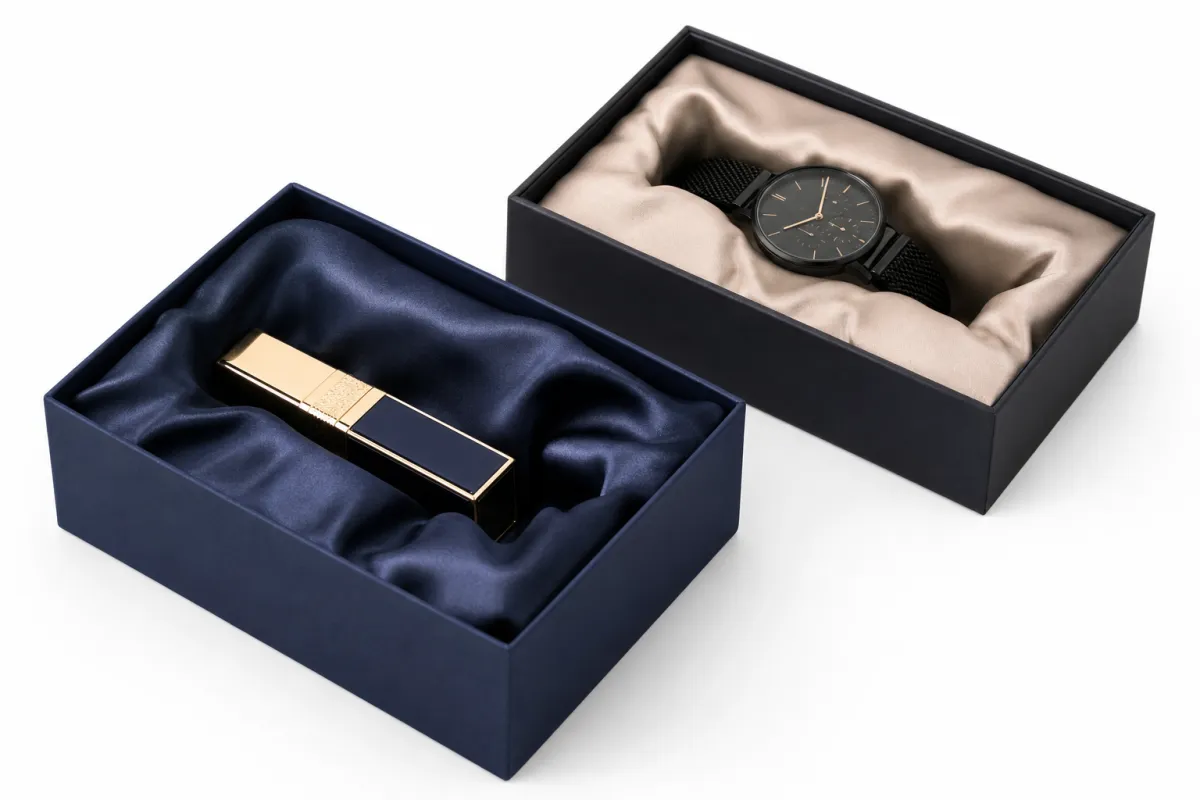
Custom satin inserts for boxes are internal packaging components shaped to fit a specific product and box size, then finished with satin fabric, a satin-like wrap, or a satin-effect laminated surface. Their job sounds simple, but the result carries a lot of weight: keep the item in place and make the opening experience feel smoother, softer, and more refined. That satin surface adds sheen and depth that plain paperboard or bare foam usually cannot match.
The difference shows up quickly. A matte paperboard cavity may be functional, but custom satin inserts for boxes create a more polished first impression because satin catches light in a controlled way. Under retail lighting, product photography lighting, and even the softer light most buyers have at home, the surface reads as deliberate. The insert becomes part of the brand story rather than a hidden support structure tucked inside the carton.
These inserts show up often in jewelry packaging, cosmetics, fragrance, fashion accessories, keepsake boxes, and premium gift sets. They also work well in custom printed boxes where the interior needs to match the exterior message. A compact bracelet box may need only one cavity and a clean lift-out feel. A luxury skincare set may need several positions, each with its own clearance, so the presentation feels balanced instead of crowded.
Another reason custom satin inserts for boxes stand out is the way they organize the reveal. When the item stays centered and the edges are finished neatly, the customer sees the product the way the designer intended. That matters more than many teams expect. A package can have strong graphics and a solid structure, but if the interior looks loose or unfinished, the entire packaging experience loses part of its value.
I have seen projects where the outer box looked excellent, then the insert fell flat because the wrap puckered at the corners or the cavity sat a touch too low. The fix was not glamorous, just careful measurement and better wrapping control. That kind of detail is what separates a decent presentation from one that feels genuinely finished.
These inserts are especially useful for brands that want elegance without adding visual clutter. They feel soft to the eye and orderly in the hand, which is kinda the point. The product gets framed instead of crowded, and the packaging reads as intentional from the moment the lid opens.
Common uses include:
- Jewelry and watch presentation
- Cosmetics and skincare kits
- Fragrance samplers and gift sets
- Fashion accessories and small leather goods
- Corporate gifting and keepsake packaging
For brands weighing options, satin is not just about appearance. It affects how people judge the whole box, which is why custom satin inserts for boxes often become a quiet but important part of premium packaging design.
How Custom Satin Inserts for Boxes Work in Real Packaging
The structure behind custom satin inserts for boxes starts with a core shape that matches the product and the inside dimensions of the box. That core may be die-cut board, molded foam, a layered board build, or a wrapped form with cavities cut to size. The satin finish is then applied over the core, and the quality of that wrapping matters a great deal. If the fabric tension is uneven, wrinkles, puckering, or soft corners can spoil the premium look.
Many production runs begin with paperboard or foam because each material handles a different job. Paperboard gives a crisp, efficient structure. Foam adds more cushioning and can be the better choice for fragile items. A satin wrap then adds the visual finish. Put plainly, custom satin inserts for boxes are usually a small system made from structure, surface, and adhesive working together.
The product cavity is where the real engineering happens. A ring, vial, compact, or pendant needs enough grip to stay stable, but not so much pressure that it becomes difficult to remove. With custom satin inserts for boxes, cavity depth, edge radius, and clearance all need to be balanced. Too tight, and the product scuffs. Too loose, and it shifts during transit or sits crooked during the reveal.
Fabric tension changes the way the insert reads once it is inside the box. A well-made satin wrap lies flat across corners and around cutouts, while a rushed wrap can create bright wrinkles under direct light. That detail matters because custom satin inserts for boxes are often photographed before they are shipped. The insert has to perform in hand and on camera, where light reflection exposes every flaw.
Color matching adds another practical wrinkle. Satin finishes can read differently depending on the light source, the surrounding print colors, and even the varnish on the outer box. A cream satin insert may look warm in daylight and cooler in a retail display. Sample approval is worth the time. With custom satin inserts for boxes, the surface tone should support the exterior packaging rather than fight it.
For brands that want a better reference point on distribution performance, the ISTA testing standards are a useful benchmark. They do not replace a physical sample, but they keep teams focused on vibration, drop risk, and handling stress, not just appearance.
Typical construction methods include:
- Die-cut board cores wrapped in satin or satin-like material
- Foam inserts with fabric wrap for extra cushioning
- Layered board builds with stepped cavities for multiple items
- Formed inserts with decorative top surfaces and hidden structural backing
That layered approach is what gives custom satin inserts for boxes their real value: the buyer sees a soft, elegant surface, while the product benefits from a structure that can stand up to shipping and storage.
Key Factors That Shape Custom Satin Inserts for Boxes
The product itself should drive the design first. Size, weight, shape, and fragility all affect the insert. A flat fragrance card needs different support than a rounded bottle or a piece of jewelry with a chain. With custom satin inserts for boxes, the design should begin with the object, not the decoration. If the cavity does not respect the product’s edges, tolerances, and handling points, the final package never feels quite right.
Clearance is more specific than many teams expect. A useful rule is to allow room for the product, the wrap thickness, and the way the customer will actually remove it. Fingers need space. Closures need room. Satin adds a bit of bulk, and that matters when the interior box depth is limited. Good custom satin inserts for boxes are measured with real use in mind, not just with a ruler against the product silhouette.
Box style is another major driver. Rigid boxes, magnetic closure boxes, drawer boxes, and lid-and-base cartons all affect how deep the insert can sit and how much room is available under the lid. A drawer box may allow a thicker presentation build, while a shallow lid-and-base box may need a thinner insert with tighter vertical tolerances. That is why custom satin inserts for boxes are best specified alongside the actual carton structure, not treated as a separate afterthought.
Material choice has a direct impact on feel and performance. Satin can be applied over board, foam, or layered substrates, but each combination changes the result. Foam feels softer and may protect better; board feels cleaner and often cuts and prints more predictably. If the brand wants a higher-end tactile impression, the satin face should be paired with a backing that resists collapsing, crushing, or showing glue marks. In short, custom satin inserts for boxes must look elegant and still survive routine fulfillment.
Brand alignment matters too. The interior should support the same visual language as the exterior. If the box uses deep black and silver foil, the insert should not read like an unrelated pastel note unless that contrast is deliberate. If the brand identity leans toward quiet luxury, a restrained satin finish can reinforce that message. If the goal is a more playful line, a brighter satin color may work. Either way, custom satin inserts for boxes should feel like part of the packaging system, not a random add-on.
Custom Packaging Products can help teams compare box structures, inserts, and presentation formats before finalizing the build. That comparison step becomes especially useful when the outside box is already fixed and the insert has to be engineered around it.
Other factors worth checking early:
- Scratch resistance on the satin surface
- Stain resistance during handling and assembly
- How the finish behaves under heat and storage pressure
- Whether the insert needs to work with a lift ribbon, thumb notch, or pull tab
- How the interior color looks against the product finish and logo placement
That last point is easy to miss. In packaging design, a satin insert can either lift the whole package or expose every mismatch in the system. That is why custom satin inserts for boxes deserve the same attention as the exterior print.
Custom Satin Inserts for Boxes: Cost and Pricing Factors
Pricing for custom satin inserts for boxes usually comes down to five things: material choice, complexity, labor, quantity, and finishing detail. A simple single-cavity insert with a satin wrap costs much less than a multi-layer build with several product positions and tightly finished corners. The more cutouts, the more hand work, and the more opportunities for sampling and assembly time to rise.
Quantity matters a lot. Small runs carry a heavier share of setup, proofing, and cutting costs, so the per-unit price is higher. Larger runs spread those fixed costs across more pieces, which improves unit economics. For many buyers, custom satin inserts for boxes become much easier to justify once the order moves from sample quantities into a full production run. That is normal, and it is one reason brands often test with a short run before committing to a bigger launch.
To make the comparison more concrete, here is a practical pricing view. These numbers are examples, not promises, because the actual spec can move the quote up or down depending on substrate, satin quality, and production method.
| Insert option | Typical build | Indicative unit cost | Best fit |
|---|---|---|---|
| Simple satin-wrapped board insert | One cavity, basic die-cut core, clean wrap | $0.18-$0.35 at 5,000 pieces | Lightweight items, gift packaging, entry-level branded packaging |
| Foam-backed satin insert | Foam core with fabric wrap and deeper cavity | $0.42-$0.85 at 3,000 pieces | Cosmetics, small bottles, items needing better cushion |
| Multi-cavity premium insert | Layered structure, several cutouts, refined edge finish | $0.85-$1.80 at 1,000 pieces | Sets, kits, watches, jewelry collections, high-touch presentation |
| Sample or prototype | Single proof, hand-built fit check | $45-$250 depending on complexity | Fit validation, color approval, unboxing review |
These ranges reflect a simple reality: the more custom the shape, the more labor is involved. Custom satin inserts for boxes with multiple product positions or unusual contours often need slower hand assembly, and that adds cost. If the insert also needs color matching, special printing, or detailed edge treatment, the price increases again. That does not mean the project is expensive in a vague sense; it means the spec is asking for more work.
There is also a hidden cost in poor fit. An insert that shifts products, scratches surfaces, or damages the reveal can cost more than a well-made one because it affects returns, rework, and brand perception. From a packaging buyer’s point of view, custom satin inserts for boxes should be judged on total value, not unit price alone. A slightly higher insert cost can be the cheaper decision if it protects the product and improves the presentation.
The paper sourcing angle matters too. If the insert uses paperboard or a paper wrap, FSC-certified material can be worth requesting. The Forest Stewardship Council helps brands and suppliers think clearly about responsible fiber sourcing, which can support sustainability goals in product packaging and branded packaging programs.
Another pricing detail is labor finish. Satin edges that are neatly folded and bonded cost more than rough edges hidden inside the box. That extra care is visible, though, and visible care is often what the customer pays for. With custom satin inserts for boxes, the quote reflects how much precision the build needs to carry.
Step-by-Step Process and Timeline for Custom Satin Inserts for Boxes
The process for custom satin inserts for boxes starts with a clean brief. You need product dimensions, box dimensions, product weight, quantity, intended use, and a clear idea of the finish you want. Photographs are helpful, especially if the product has curves, protrusions, or fragile decorative details. The more exact the brief, the less guesswork shows up later in sampling.
After the brief comes the structure concept. At this stage, the team decides whether the insert should be board-based, foam-based, or layered. They also map the cavity, the visible edges, and the method used to hold the product in place. A good concept for custom satin inserts for boxes should account for the product’s resting point and the customer’s hand movement, because the item has to lift cleanly without catching on the wrap.
Sampling is where the real learning happens. A proof can show whether the satin reflects light well, whether the color feels aligned with the box exterior, and whether the item sits at the right height. Simple custom satin inserts for boxes can sometimes move from brief to approved sample in about 5-7 business days, while more complex builds may need longer. The sample is worth the wait because digital renderings do not reveal wrinkles, edge tension, or unexpected glare in the same way a physical piece does.
Revisions usually focus on fit and finish. Maybe the cavity needs another millimeter of depth. Maybe the product sits too low and disappears visually. Maybe the satin color is slightly too shiny under bright retail lighting. These are normal adjustments. In fact, the strongest custom satin inserts for boxes often come from a sample phase that is honest about problems and quick to correct them.
Once the sample is approved, production moves into cutting, wrapping, assembly, and inspection. Simple jobs often ship about 12-15 business days after proof approval, while more intricate programs can take longer depending on quantity, tooling, and revision count. If the project requires repeated prototype changes or mixed materials, add time. Good planning beats rushed production every time, especially for branded packaging that has to arrive on schedule.
A well-specified insert does not just fit the product; it protects the presentation budget by reducing damage, improving consistency, and making each box feel like part of the brand system.
Typical workflow:
- Gather product and box measurements, reference photos, and branding notes.
- Choose the insert structure and satin finish direction.
- Review a prototype or sample for fit, sheen, and removal ease.
- Approve revisions and confirm the pre-production spec.
- Run full production, then inspect, pack, and ship.
For teams building a larger packaging program, it helps to align the insert timeline with the outer carton schedule and the launch calendar. Custom satin inserts for boxes should not be treated as a last-minute accessory; they are part of the production path, and late changes usually cost more than early ones.
Common Mistakes to Avoid with Custom Satin Inserts for Boxes
The most common mistake is measuring only the product and forgetting the real-world clearance around it. Fingers need space to lift the item. The closure needs room to close without compressing the insert. Satin adds thickness, and that thickness matters more than people expect. With custom satin inserts for boxes, a tiny measurement error can create a big feel problem once the box is assembled.
Another mistake is choosing satin for appearance alone and ignoring wear behavior. Some satin finishes look beautiful but show lint, scuff marks, or glare under strong light. Others may not hold color as consistently from one batch to the next. If the product is going through retail packaging, shipping, or repeated handling, the finish needs to perform beyond the first unboxing. Strong custom satin inserts for boxes balance beauty with realistic handling durability.
Overstuffed cavities are also a problem. If the item sits too tightly, the user has to tug or twist to remove it, which weakens the premium feel and may damage delicate edges. If the cavity is too shallow, the product can rise too high and look unstable. That is a small detail on paper, but in the hand it changes the whole experience. Good custom satin inserts for boxes support the product without making the customer fight the insert.
Skipping samples is another costly habit. A render can hide a lot of issues. It will not show fabric tension across a corner, and it will not tell you how the satin reads in daylight compared with the studio mockup. Teams that approve on screen alone often discover fit or color issues too late. For custom satin inserts for boxes, a physical sample is usually the least expensive way to catch the most expensive problems.
There is also a broader packaging mistake: treating the insert as isolated from the rest of the package. The insert should work with the box structure, the print, the product tray, and the fulfillment flow. If the outer carton is elegant but the insert looks generic, the whole package loses coherence. That is a brand issue, not just a manufacturing issue. In package branding, the interior is part of the message.
Here is a short checklist of mistakes to avoid:
- Measuring product size without allowing for wrap thickness and finger clearance
- Choosing finish before confirming structural support
- Approving from a screen instead of a physical sample
- Ignoring light reflection and color drift
- Leaving the insert out of the overall packaging design plan
For projects that need clear performance targets, it can help to think in standards rather than impressions. That is where shipping tests, material checks, and sourcing decisions become useful. Custom satin inserts for boxes should be evaluated as part of the full package system, not as a decorative afterthought that gets fixed later.
Expert Tips and Next Steps for Custom Satin Inserts for Boxes
If you want better results from custom satin inserts for boxes, start with a brief that includes exact dimensions, product photos, box style, target quantity, and the emotional tone the packaging should create. Words like premium or elegant are fine as a starting point, but they are not enough on their own. A satin insert for a luxury fragrance kit needs a different visual density than one for a playful gift set, even if the box size is similar.
Requesting material swatches is one of the smartest moves a buyer can make. Satin sheen can look subtle in one sample and loud in another, depending on the weave, coating, or wrap method. With custom satin inserts for boxes, a swatch lets you compare color accuracy, tactile feel, and how the finish reacts to light before you commit to a run. That step saves time, and it helps avoid surprises once the outer cartons are already printed.
Design for the unboxing moment, not just the closed box. Open the sample on a table and ask a few practical questions: Does the product sit centered? Can it be removed with one hand? Does the satin reflect too much glare in photos? Does the inside look as resolved as the outside? If the answer is yes, the insert is doing its job. Good custom satin inserts for boxes improve the reveal by making the product feel like it belongs exactly where it sits.
It also helps to consider sustainability early. If the build uses board, ask about FSC-certified options. If shipping performance matters, compare the design to relevant ISTA handling expectations. These choices do not make the insert fancy by themselves, but they do make the program easier to defend from a sourcing and fulfillment standpoint.
Custom Packaging Products can help teams compare presentation structures, insert styles, and finish combinations before a spec gets locked in. If the outer box is already set, a second look at the structural options can still reveal a better board thickness, cavity layout, or satin wrap choice for the product at hand.
Before you request a quote, confirm these points:
- Exact product dimensions, including any protrusions
- Exact box dimensions and closure style
- Target quantity and expected reorder pattern
- Preferred satin color, sheen level, and backing material
- Whether you need a sample, prototype, or full production proof
Once that information is organized, custom satin inserts for boxes become much easier to specify, sample, and price. The packaging team can focus on build quality instead of chasing missing details, and that usually leads to a cleaner quote and a faster approval path.
The most useful next step is not a marketing slogan; it is a measured sample against the real product, inside the actual box, under the lighting it will live in. If that sample sits right, opens cleanly, and holds its surface without odd glare or puckering, you are on solid ground. If it does not, adjust the cavity, the wrap tension, or the backing before production starts.
What are custom satin inserts for boxes used for?
They hold products securely while adding a soft, premium presentation inside the box. Custom satin inserts for boxes are common in jewelry, cosmetics, gifts, accessories, and presentation packaging because they support the product and improve the reveal.
Are custom satin inserts for boxes good for fragile products?
Yes, if the core structure is designed for the product weight and shape. Fragile items usually need a shaped cavity, stable backing, and enough clearance to avoid pressure points, which is why a sample is so useful for custom satin inserts for boxes.
How much do custom satin inserts for boxes cost?
Cost depends on material type, insert complexity, cavity count, labor, and order quantity. Simple builds cost less than layered or highly contoured designs, and small orders usually carry a higher per-unit price. Sampling and setup affect custom satin inserts for boxes more when the run is short.
How long does it take to make custom satin inserts for boxes?
Timeline varies by complexity, sample rounds, and production volume. Straightforward designs may move faster, while new shapes, specialty finishes, or multiple revisions add time. A complete brief helps shorten the path for custom satin inserts for boxes.
What should I prepare before requesting custom satin inserts for boxes?
Have product dimensions, box dimensions, quantity, and product weight ready. Share reference images, color preferences, and any Branding Details That affect the look, then ask for a sample or prototype so you can verify fit and finish before full production. That preparation makes custom satin inserts for boxes much easier to quote and build well.
With the right measurements, the right finish, and a sample that proves the fit, custom satin inserts for boxes can move from concept to production with fewer delays and a much better final presentation.

