Buyer Fit Snapshot
| Best fit | Custom Spot Uv Boxes with Logo projects where brand print, material claims, artwork control, MOQ, and repeat-order consistency need to be specified before quoting. |
|---|---|
| Quote inputs | Share finished size, material target, print colors, finish, packing count, annual reorder estimate, ship-to region, and any compliance wording. |
| Proofing check | Approve dieline scale, logo placement, barcode or warning zones, color tolerance, closure strength, and carton packing before bulk production. |
| Main risk | Vague material claims, crowded artwork, missing packing details, or unclear freight terms can make a low unit price expensive after revisions. |
Fast answer: Custom Spot Uv Boxes with Logo: Material, Print, Proofing, and Reorder Risk should be specified like a repeatable production item. The safest quote records material, print method, finish, artwork proof, packing count, and reorder notes in one written spec.
Production checks before approval
Compare the actual filled-product size with the drawing, then confirm tolerance on folds, seals, hang holes, label areas, and retail display edges. Reserve space for logos, QR codes, warning copy, and material claims before decorative graphics fill the panel.
Quote comparison points
Review material grade, print process, finish, sampling route, tooling charges, carton quantity, and freight assumptions side by side. A quote is only useful when the supplier can repeat the same color, closure quality, and packing count on the next order.
Clients comparing custom spot uv Boxes with Logo usually ask for "more premium," but the real shift often comes down to a few very unglamorous details: registration tolerance, board quality, and how the artwork handles a gloss pass. I still remember standing beside a UV line in Shenzhen's Bao'an district at 6:40 a.m., watching a plain carton change personality the second a logo caught the inspection lamp. Same base print. Same CMYK values. Different reading, almost immediately. That tiny change is often the whole assignment, and it explains why packaging teams can spend weeks on decisions shoppers judge in seconds.
The payoff can be surprisingly concrete. I have watched brands spend $8,000 on illustration and photography, then lose the retail moment because the box still looked flat from three feet away. I have also seen a $0.21 folding carton read like a far more expensive package once the spot gloss landed on a crisp logo over matte lamination. On a 5,000-piece run in Dongguan, that sort of finish can shape how buyers describe the product before they even open it. Packaging is brutally honest at that scale; it exposes disciplined design and rushed design with equal enthusiasm.
So here's the practical truth: custom spot uv Boxes with Logo are not magic, and they do not rescue a weak dieline or a blurry file exported from a 72 dpi mockup. They are a finishing move. When the structure is accurate, the paperboard is suitable, and the artwork already has restraint, spot UV can make the logo lift visually, add a tactile cue, and give the box a sharper presence without turning the whole panel into glare. That is the actual job.
What Custom Spot UV Boxes With Logo Really Do
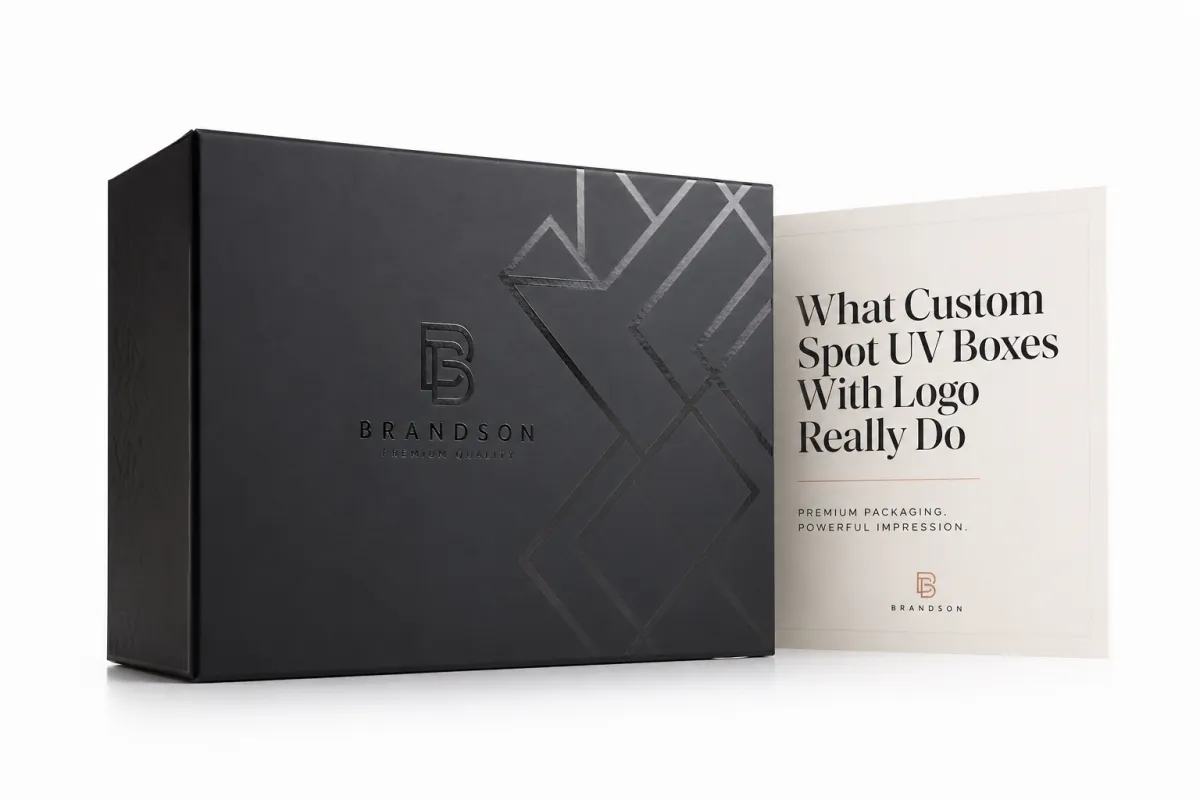
Custom Spot UV boxes with logo use a clear gloss coating on selected zones only, usually the logo, a product name, a geometric frame, or a small icon set. The printer lays the gloss exactly where the art file tells it to, often on top of a matte or soft-touch lamination, so the eye catches a bright highlight against a quieter surface. That contrast is what pulls the logo forward without coating the whole package in reflection.
People often confuse spot UV with other finishes, so I separate them by process and result. Full gloss covers the entire sheet; matte lamination flattens reflections across the full panel; foil stamping adds a metallic layer in gold, silver, black, rose gold, or holographic finishes; embossing changes the paper surface itself. Spot UV works differently because it is selective, which is why Custom Spot UV boxes with logo can feel more controlled than a box that has been coated everywhere. It is the packaging equivalent of a well-aimed light, not a floodlamp.
The effect performs well because shoppers make decisions fast, often in under two seconds at a pharmacy shelf or a beauty counter. A glossy logo on a matte field reads immediately from about six feet away, which matters in stores in London, Los Angeles, and Dubai where the packaging has to signal quality before the product is handled. On one skincare project, I cut the highlighted elements from twelve to three: the logo, the product name, and a thin border line. The sample improved right away because the eye had one clear place to land. The box stopped arguing with itself.
"We thought the whole front needed shine," a cosmetics client told me after a 5,000-piece trial in Shenzhen. "The box worked better once the logo did the talking and the rest stayed quiet." They were right, and the final reprint used 350gsm C1S artboard with matte film and a single spot UV pass.
Texture is the other reason Custom Spot UV boxes with logo work so well. Gloss reflects differently than soft-touch or satin-coated paper, and buyers pick up that difference even if they cannot name it. A 0.25 pt line can survive in the artwork file and still blur once the coating cures, especially on rough stock, so the finish rewards bold shapes and disciplined files. It does not clean up a messy layout; if anything, it exposes one faster than the pressroom can hide it. I wish that were less true, because it would save a lot of late-night production calls from factories in Dongguan and Suzhou.
The effect lands best when the logo stays simple, contrast stays strong, and the substrate supports the coating. Soft-touch laminate with a spot UV logo on top usually performs better than raw uncoated stock, especially on 300gsm to 400gsm paperboard. I have seen gloss drift by 1 to 2 mm on rejected samples, and that tiny error is enough to make a premium box feel crooked, like a jacket with one sleeve set a few millimeters too high. Precision matters because the finish only feels intentional when the edges are clean.
How Custom Spot UV Boxes With Logo Are Made
The production sequence for Custom Spot UV Boxes with logo is straightforward, but the order matters down to the day. Artwork prep and dieline approval come first, then the base print lands on coated paperboard or a laminated sheet, then the spot UV varnish is applied only to the selected zones and cured under ultraviolet light. After that, the sheet is die cut, folded, glued, and packed for shipment from the plant, whether the job runs in Shenzhen, Guangzhou, or elsewhere in the Pearl River Delta. A clean workflow produces sharp results; one sloppy step can leave the logo sitting 2 mm off the fold line and make the whole box look off in a way that is impossible to ignore under warehouse lighting.
In real production, the gloss layer is controlled with a mask, a plate, or a separate digital file, depending on the press setup. That file needs precise registration, and the tolerance can be tighter than many buyers expect. I once sat with a converter in Dongguan who insisted that 1.5 mm of drift was "acceptable." It was not acceptable on a 9 pt serif logo or a fine-line monogram. The sample looked like somebody had nudged the gloss after a lunch break. We corrected the plate, reran the sheet, and the box moved from test sample to premium packaging in one pass. Production has a habit of humbling people, especially when the ruler comes out.
Custom spot uv boxes with logo also depend on the right surface. Coated paperboard, folding cartons, and rigid boxes are usually safe territory, while uncoated kraft stock creates problems because the coating can sink unevenly and soften the gloss edge. A 400gsm art paper wrap on a rigid setup gives a much more reliable base, and a 28pt rigid board wrapped with printed paper is common for gift sets in Hong Kong, Singapore, and premium e-commerce launches. Rough kraft paper can work, but it needs a test run before 20,000 units are committed. Nothing ruins a Tuesday like discovering your "natural" look has become patchy after the second UV pass.
The workflow usually looks like this:
- Confirm the box style, dimensions, and board thickness, usually 300gsm to 450gsm for folding cartons and 1.5 mm to 2.5 mm for rigid boxes.
- Approve the dieline so the logo lands in the correct zone, not over a fold or glue flap.
- Print the base art in CMYK, then laminate or coat the sheet if the design calls for it.
- Apply the spot UV layer only to the marked areas on the separate file.
- Cure the coating with UV light so the gloss hardens instead of smearing.
- Die cut, crease, fold, and glue the cartons, then inspect registration and finish on a sample stack of at least 20 pieces.
File preparation is the part most people underestimate, and the missed details are rarely abstract. A clean spot UV file should live on a separate layer, usually a 100% spot color with a clear name like "SPOT_UV_LOGO" so the operator knows exactly what to coat. Tiny type, hairline detail, and crowded symbols can bridge under the coating and make the logo look muddy, especially if the line weight falls below 0.3 pt. I have rejected samples where a client tried to coat a 4 mm icon beside a 6 pt slogan, and the result looked clever on a laptop but clumsy in hand. Screens are generous; press is not, and the difference can cost a factory in Ningbo or Dongguan an entire rerun.
What Drives the Cost
The price of custom spot uv boxes with logo comes down to four main things: box size, board thickness, print complexity, and how much of the design receives coating. A 200-piece sample run will always feel expensive per unit because setup costs do not shrink just because the order is small. A 10,000-piece order spreads those costs out, so the unit price drops sharply. That is why small-batch buyers often feel punished by the quote sheet. They are not being dramatic; the math is simply less forgiving at 200 pieces than at 5,000.
For a realistic example, a 5,000-piece folding carton on 350gsm C1S artboard with matte lamination and one spot UV logo can land around $0.15 to $0.24 per unit in Shenzhen or Dongguan, depending on whether the factory owns the die and how many files need cleanup. Add a second coated element, and the range often moves to $0.22 to $0.36 per unit. A rigid box with wrap paper, spot UV, and insert trays can move into the $1.20 to $2.80 range quickly. None of that is unusual. What is unusual is when a buyer assumes every finish costs the same because both samples fit in the same shipping carton.
| Option | Typical Use | Estimated Unit Cost at 5,000 Pieces | Setup Cost | Notes |
|---|---|---|---|---|
| Folding carton, matte lamination, one logo spot UV | Beauty, supplements, tech accessories | $0.15 - $0.24 | $120 - $280 | Best value when the artwork is simple and the dieline is standard |
| Soft-touch carton, logo spot UV, secondary pattern highlight | Premium retail packaging | $0.26 - $0.48 | $180 - $420 | Extra prep is needed to keep registration tight on the coated surface |
| Rigid box with wrap and spot UV | Gift sets, electronics, luxury product packaging | $1.20 - $2.80 | $300 - $800 | Higher labor and material cost because of wrapping, board cutting, and assembly |
One thing I learned during a supplier negotiation in Shenzhen: the lowest quote is rarely the lowest job. A factory may price the print aggressively, then add charges for sample plates, artwork cleanup, a second UV pass, or freight from Yantian port. Add a physical prototype at $45 to $120, rush production at 15% to 25%, and export trucking at another $80 to $250, and the budget starts behaving like a stubborn machine. Custom spot uv boxes with logo need a full quote, not a headline number. If somebody gives you only the attractive number and hides the rest, keep your hand on your wallet.
Brands also overspend by stacking too many finishes on one SKU. I have seen people ask for foil stamping, embossing, soft-touch lamination, and spot UV on a $9 serum box. The box looked dramatic, sure, but the packaging cost swallowed too much margin. If the retail price is $18, packaging should not behave like the hero product. Use one premium effect, maybe two if the SKU can support it, and keep the structure honest. That usually reads more expensive than chaos, which is one of the stranger truths in retail packaging.
My budgeting rule is plain and useful: ask for quotes by SKU, not by project, and request a line item for print, coating, die cutting, inserts, and freight. If the supplier will not separate those, you are not comparing apples. You are comparing one mystery box with another mystery box. I also ask whether artwork prep is included, because on a 3-SKU line that hidden fee can add $90 to $180 before the first proof even arrives. It is the packaging version of discovering that the "free" garnish arrived on a separate invoice.
Step-by-Step Ordering Process for Custom Spot UV Boxes With Logo
The ordering process for custom spot uv boxes with logo gets easier once the sequence is clear. First, define what the box must do: ship safely, sell on shelf, or support a premium unboxing moment. Then confirm dimensions, board, closure style, and artwork zones. I have watched brands skip those first two steps and rush straight into design, which usually ends with a logo sitting over a crease or a tuck flap blocking the front panel. Expensive mistake, all because of a 1 cm oversight. The worst part is that the error looks tiny in PDF form and glaring once the cartons are stacked in a warehouse in Guangzhou or Los Angeles.
- Send the product dimensions in millimeters, plus the target quantity for each SKU.
- Ask for the supplier's dieline and confirm bleed, safe area, and fold positions.
- Place the logo and other spot UV areas on a separate layer so the operator can read the file.
- Review the digital proof for spelling, line weight, and logo placement before approving anything.
- Request a physical sample if the box has tight registration, unusual board, or a launch deadline within 30 days.
- Approve the final proof only after you check the coating map, finish notes, and shipping destination.
Proofing is where careless buyers lose money. A digital proof can show the artwork, but it does not always show the actual texture of the coating or the way a 350gsm sheet will behave after lamination. For custom spot uv boxes with logo, I recommend checking the spot UV layer at 200% zoom and confirming that the supplier marked the gloss area with a clear spot color name, not a vague label like "finish." On one food client project, the proof looked fine, but the operator read the layer wrong and coated a decorative wave instead of the logo. That mistake cost two extra days, a fresh plate, and a second approval call at 8:15 p.m. Nobody enjoyed it, but everybody remembered the file name afterward.
Production checkpoints matter too. Good suppliers show print approval, coating setup, curing, conversion, folding, and final inspection. Bad suppliers say "in process" and hope you stop asking. I once asked a factory manager for the final stack photo on a 10,000-unit run, and he sent a shot of a pallet with half the cartons still open on top. That is not quality control. That is a warehouse selfie. The difference matters. If you are comparing vendors, ask for sample photos or finish references before you sign off, especially when the order combines packaging design, die cutting, and a premium coating.
Communication saves real money. Send the printer a vector PDF, the editable AI or EPS file, and a separate spot UV layer. Ask three simple questions: what board works best, what minimum line thickness they recommend, and whether the coat is screen-printed or digital. If the supplier answers those in writing, you are already ahead of half the market. If they do not, expect confusion later when the logo comes back 2 mm off center and everyone starts blaming the "file." I have heard that blame game more times than I can count, usually from plants in Shenzhen, Jiaxing, and Ningbo.
Custom spot uv boxes with logo also benefit from one short approval checklist before production starts: dimensions correct, finish choice confirmed, coating areas marked, quantity verified, and shipping address checked. Five boxes to tick. That is all. Miss one, and the cost shows up later in reprints, delays, or a pallet sitting in the wrong warehouse because somebody typed the postcode wrong. I have seen a launch delayed because one digit was swapped on a destination label. Tiny typo, enormous headache.
Timeline and Production Lead Time for Custom Spot UV Boxes With Logo
The lead time for custom spot uv boxes with logo depends on quantity, artwork complexity, and whether the plant has to make a new plate or die. A simple folding carton with one logo highlight can move from proof approval to shipment in 12 to 15 business days. A rigid box with inserts, wrap paper, and multiple finish passes can take 18 to 28 business days. If a supplier promises every job in five days, they are either unusually lucky or not mentioning the quality-control step. Usually, they are not mentioning the quality-control step.
The slowest steps are usually dieline confirmation, proof revisions, and coating setup. Dry time or curing time matters too, even when nobody spells it out in the first email. On one cosmetic launch, the client changed a logo wordmark three times in 48 hours. Each change meant a new proof, a new alignment check, and a fresh round of sign-off. Their product launch slipped by nine days because nobody wanted to admit the logo itself was still under debate. Packaging moves at the speed of the slowest approval, and the stopwatch usually starts in the marketing department.
If your launch date is tied to a trade show in Frankfurt, a retail reset in Chicago, or a seasonal spike in Tokyo, start earlier than you think. I usually tell clients to build a seven-day buffer on top of the stated lead time for custom spot uv boxes with logo. If the supplier says 15 business days, plan for 22. That sounds conservative until you hit a holiday, a port backlog, or a Friday afternoon file change from marketing. Then it sounds practical. Marketing teams are brilliant, but they can also appear with "one small tweak" at 4:58 p.m. like a tiny tornado.
Common timeline traps are predictable. Vague coating files delay setup by one or two days. Last-minute logo changes can reset the proof stage. Slow replies on artwork approval can leave the job sitting for 72 hours while the factory waits. Shipping delays, especially on international freight through Yantian, Ningbo, or Long Beach, can add another three to eight days depending on customs and lane congestion. I have seen a 5,000-box run complete on time and still arrive late because the buyer booked freight after the cartons were already packed. That is the kind of planning error that makes everyone age a little.
The rule I use is simple: lock the artwork first, lock the quote second, and lock freight third. Follow that order and custom spot uv boxes with logo stay predictable. Reverse it, and somebody will be on the phone at 7:30 p.m. asking why the cartons are not on the dock yet. The answer is usually the same: the proof was still open, the die had not been approved, or the ship date was written on a calendar nobody checked. Packaging is patient, but only up to a point.
Common Mistakes That Ruin the Finish
The most expensive mistakes with custom spot uv boxes with logo are usually the simplest ones: low-resolution files, poor substrate choice, and trying to coat tiny details that were never meant to be highlighted. A 300 dpi raster logo can look fine on a monitor, but if the edges are soft, the UV layer exposes that weakness immediately. The same goes for paper stock that cannot hold a sharp gloss edge. The finish does not forgive sloppy prep. It is less a decoration method and more a truth serum applied at the press line.
Overusing gloss is another common failure. If every icon, line, and slogan gets the same treatment, nothing feels special anymore and the box starts reading noisy. I saw that on a protein supplement project in Guangzhou where the marketing team coated about 80% of the front panel. The result was not premium; it was crowded. We cut the coated area down to 18% of the surface, focused only on the product name and a geometric frame, and the packaging suddenly had breathing room. Restraint keeps showing up as the smarter choice, which is inconvenient for anyone who enjoys a "more is more" mood board.
Contrast carries the whole effect. If the base color is too close to the gloss area, the finish disappears. Dark charcoal on dark charcoal can look elegant, but it needs a strong light angle to show. Light gray on a pale gloss area can read unfinished. For custom spot uv boxes with logo, I usually push for contrast through color, finish, or both. A matte navy panel with a glossy white logo works. A crowded silver panel with silver gloss on top turns into a fight nobody wins. I have seen that fight on a luxury candle carton, and it was ugly by the second proof.
Skipping a physical sample is another bad habit. Digital proofs do not show how the box feels when stacked, folded, or handled for 20 seconds at a point-of-sale counter. One jewelry client approved a proof without requesting a sample and then discovered the logo sat 3 mm too close to the fold. On a 60 mm panel, 3 mm is a lot. The fix required a new plate, a new sample, and a week of wasted time. That is the kind of delay that makes people suddenly discover the word "urgent" in every email subject line.
File mistakes matter more than people admit. Missing bleeds, incorrect dielines, wrong spot UV layers, and text placed inside glue flaps can destroy a run before it starts. If the printer asks for a separate mask file, give them one. If they ask for the spot color name to be "SpotUV," do not call it "Gloss Layer 2" because it sounds more creative. Creative naming does not help on the production floor in Suzhou or Foshan. Clear naming helps, and it helps fast when the operator is checking files at 6:00 a.m. before a 9,000-piece run.
The practical advice I give before every run of custom spot uv boxes with logo is simple: keep the coated area bold, keep the board compatible, keep the text larger than 6 pt if it sits inside the gloss zone, and confirm the dieline with the person actually running the job. That last part matters. The salesperson is polite. The press operator is the one feeding the machine and watching for a 1 mm shift. Polite does not equal precise, and precision is what keeps the job alive.
One more caution: do not assume embossing and spot UV will always work together without testing. They can look excellent together, but the wrong order of operations or the wrong board thickness can flatten one effect and weaken the other. I have seen a 400gsm carton handle both beautifully, and I have seen a thinner 250gsm sheet curl after the second pass. Test first. Save the drama for the launch photos in New York or Milan. The launch team already has enough pressure without the boxes joining in.
Expert Tips and Next Steps Before You Order
If you want custom spot uv boxes with logo to look expensive, use the finish on one hero element and stop there. A logo, a product name, or a single pattern band is enough in most cases. When a buyer asks me to coat every visible corner, I usually say no, then I explain why the box needs one place for the eye to rest. Good packaging design is not louder. It is clearer. That rule survives trend cycles better than most marketing slogans, and it still holds on a shelf in 2025.
Ask for sample photos, board options, and a written cost breakdown before you send any deposit. A decent supplier should tell you whether the quote includes print, spot UV, lamination, die cutting, folding, and freight. If you want to compare suppliers fairly, compare them on the same 5,000-piece spec, not on random numbers pulled from different box styles. I have seen a $0.27 quote beat a $0.19 quote once freight and rework were added. Cheap can get strange fast, and "strange" is usually a polite word for "expensive later."
Custom spot uv boxes with logo also deserve a final checklist that sounds almost too basic, because basic is where jobs survive: confirm dimensions, board thickness, finish type, coating coverage, proof timing, destination, and carton count. I keep that list at seven points, and I still use it on every project. Not because I am forgetful. Because factories get busy, marketing changes its mind, and somebody always thinks "minor adjustment" means free. Spoiler: it never does, especially after a plate has already been made in Shenzhen or Dongguan.
Test the design on screen and in print. The glossy area often looks stronger in person than it does in a mockup, especially under a 45-degree light. That helps when you want shelf pop, and it hurts when the artwork is already crowded. If you need a rough priority list, I would rank it like this: structural accuracy, logo placement, finish choice, freight timing. Pretty boxes do not help if the carton is the wrong size or arrives after the launch event. I have seen both happen in the same quarter, and nobody was thrilled.
For brands building packaging at scale, I also recommend asking whether FSC paper is available and whether the supplier can support basic transport testing. You can review FSC chain-of-custody standards at fsc.org, and packaging professionals usually keep an eye on practical material guidance from packaging.org. I do not think every project needs a certification parade, but if you are selling into retail or subscription channels, those references help you ask sharper questions about 350gsm C1S artboard, 400gsm SBS, and rigid board options.
My last advice is plain: send the supplier a clean vector logo, the dieline, the quantity, the target ship date, and a note that says exactly where the gloss should land. That first message saves more time than three rounds of vague chat. If you are ordering custom spot uv boxes with logo for a launch, send the spec first and the inspiration board second. The factory cannot print your mood board, no matter how carefully it is arranged in Milan or Manhattan.
What Makes Custom Spot UV Boxes With Logo Work Best?
Custom spot uv boxes with logo work best when the design gives the eye one clear target and the production file gives the printer one clear instruction. In practice, that means a strong logo, a compatible board, and enough contrast between the matte base and the glossy highlight for the finish to register instantly. When the box has too many coated elements, the effect gets diluted. When the file is clean and the structure is accurate, the result feels more expensive without becoming noisy.
The best-performing jobs usually follow the same pattern: matte lamination or soft-touch film on the full panel, spot UV reserved for the brand mark or product name, and a paperboard that can hold the coating edge without fuzzing. That combination gives custom spot uv boxes with logo the kind of controlled shine that reads well in retail, on camera, and in the hand. It also keeps the budget focused where it matters most, instead of spending money on effects that the customer never notices.
What makes custom spot UV boxes with logo different from regular printed boxes?
Custom spot uv boxes with logo add gloss only to chosen areas, so the logo or pattern stands out instead of the whole box looking shiny. Regular printed boxes rely mostly on color and ink coverage, while spot UV adds contrast through both light reflection and surface texture. On a 350gsm C1S carton, that selective shine can make a logo read premium from six feet away without changing the structural design.
How much do custom spot UV boxes with logo usually cost?
The price for custom spot uv boxes with logo depends on size, quantity, box style, finish coverage, and whether the design needs extra setup or revision work. A 5,000-piece folding carton on 350gsm artboard may land around $0.15 to $0.24 per unit, while a rigid gift box can move into the $1.20 to $2.80 range. I always ask for a quote that separates printing, coating, sampling, and freight so the numbers are actually comparable.
What file do I need to create custom spot UV boxes with logo?
For custom spot uv boxes with logo, send a print-ready vector file whenever possible, plus a separate spot UV layer that clearly marks the gloss areas. Keep tiny text and very thin lines out of the coating layer, because they can fill in or lose sharpness after curing. Confirm the supplier's dieline and file specs before you lock the artwork, especially if the logo sits near a fold or glue flap.
How long does it take to produce custom spot UV boxes with logo?
Lead time for custom spot uv boxes with logo usually depends on proof approval, coating setup, order size, and shipping method. Simple folding cartons can move in 12 to 15 business days after approval, while more complex rigid jobs can take 18 to 28 business days. If you need the boxes for a launch or retail event in Frankfurt, Chicago, or Tokyo, build extra time into the schedule.
Can I use custom spot UV boxes with logo on any packaging material?
No. Custom spot uv boxes with logo work best on coated or laminated paperboard and on certain rigid box wraps. Uncoated stocks can absorb the coating unevenly and make the gloss edge look soft. Ask your supplier which board and finish combinations give the cleanest result for your product before you approve the run, and request a sample on the exact substrate if the order is larger than 1,000 pieces.
If you are serious about custom spot uv boxes with logo, treat the job like a production decision, not a decoration request. The best boxes I have seen had clean artwork, smart contrast, and a supplier who understood registration down to the millimeter. The mediocre ones had too many effects and not enough discipline, which is a tidy way of saying they looked expensive for about six seconds on a shelf in Singapore, then ordinary after that.
Send the logo, the dieline, the quantity, and the finish target first. Then ask for a sample. That is the quickest way to find out whether your custom spot uv boxes with logo idea will look premium on a shelf or just expensive in a mockup. If the supplier can quote the run at 5,000 pieces, list a 12 to 15 business day lead time from proof approval, and name the board spec in writing, you are already ahead of most first-time buyers.
My practical takeaway is simple: lock the dieline, keep the spot UV file clean, and approve a physical sample on the exact board before production starts. Do those three things and the finish behaves the way it should; skip them and the logo will tell on the whole job. That is the difference between a box that reads premium in hand and one that only looks good on a screen.

