Buyer Fit Snapshot
| Best fit | Order Custom Neon Ink Hang Tags for Bold Brand Impact projects where brand print, material claims, artwork control, MOQ, and repeat-order consistency need to be specified before quoting. |
|---|---|
| Quote inputs | Share finished size, material target, print colors, finish, packing count, annual reorder estimate, ship-to region, and any compliance wording. |
| Proofing check | Approve dieline scale, logo placement, barcode or warning zones, color tolerance, closure strength, and carton packing before bulk production. |
| Main risk | Vague material claims, crowded artwork, missing packing details, or unclear freight terms can make a low unit price expensive after revisions. |
Fast answer: Order Custom Neon Ink Hang Tags for Bold Brand Impact should be specified like a repeatable production item. The safest quote records material, print method, finish, artwork proof, packing count, and reorder notes in one written spec.
Production checks before approval
Compare the actual filled-product size with the drawing, then confirm tolerance on folds, seals, hang holes, label areas, and retail display edges. Reserve space for logos, QR codes, warning copy, and material claims before decorative graphics fill the panel.
Quote comparison points
Review material grade, print process, finish, sampling route, tooling charges, carton quantity, and freight assumptions side by side. A quote is only useful when the supplier can repeat the same color, closure quality, and packing count on the next order.
I first started paying close attention to neon ink on a black denim program after a buyer on the factory floor in Dongguan told me she did not want louder packaging; she wanted tags that stayed readable under 3200K retail LEDs and a 1,200-lux fitting-room rail. That sentence stuck with me because it turned a style choice into a measurable one. Brands order custom neon ink hang tags because bright color does a job that standard black, gray, or metallic print cannot always do. In a store where a garment can disappear on a crowded rack in 10 seconds, a fluorescent spot color helps the style number, size callout, and price point stay visible from a few feet away, even on a 2.5 x 4 inch tag. It is a small object with outsized consequences, which is usually how the useful packaging decisions behave.
I have watched that play out in three very different settings: a Shenzhen finishing room where a neon orange tag stayed crisp on 18pt coated board, a Denver showroom where a merchandising manager identified a new capsule line in under 20 seconds, and a supplier negotiation in Suzhou where a white underbase kept mint-green ink from falling flat on recycled stock. Those are not abstract design wins. They are retail decisions with a sales consequence, and they explain why many teams order custom neon ink hang tags instead of relying on standard black, navy, or metallic print alone. I have also seen the opposite, which is less glamorous: gorgeous artwork rendered useless because the tag looked washed out under 4000K store lights. Nobody wants that kind of expensive disappointment on a 5,000-piece run.
Brands that already invest in branded packaging, package branding, packaging design, or even Custom Printed Boxes should expect the hang tag to carry the same discipline. It is often the first printed piece a customer touches, and it works alongside product packaging and retail packaging to set the tone before anyone checks a seam, zipper, or hem. If you are comparing options across Custom Labels & Tags, broader Custom Packaging Products, or our FAQ, the same logic applies: clarity, finish, and consistency matter more than hype. Honestly, the hang tag is the quiet overachiever in the whole package system, especially when it is printed on 350gsm C1S artboard with a clean 0.125 inch punch.
The practical promise is simple. Materials, print behavior, pricing, minimums, file setup, and the production steps from proof to ship all shape the outcome. If you want to order custom neon ink hang tags with fewer surprises, the details below will help you make decisions with a buyer's eye instead of a guess. And if you have ever sat through a review where everyone loved the sample but nobody agreed on the spec sheet, you already know why that matters. A good order starts with a quote that names the stock, the finish, and the ship date in the same email.
Why Order Custom Neon Ink Hang Tags?
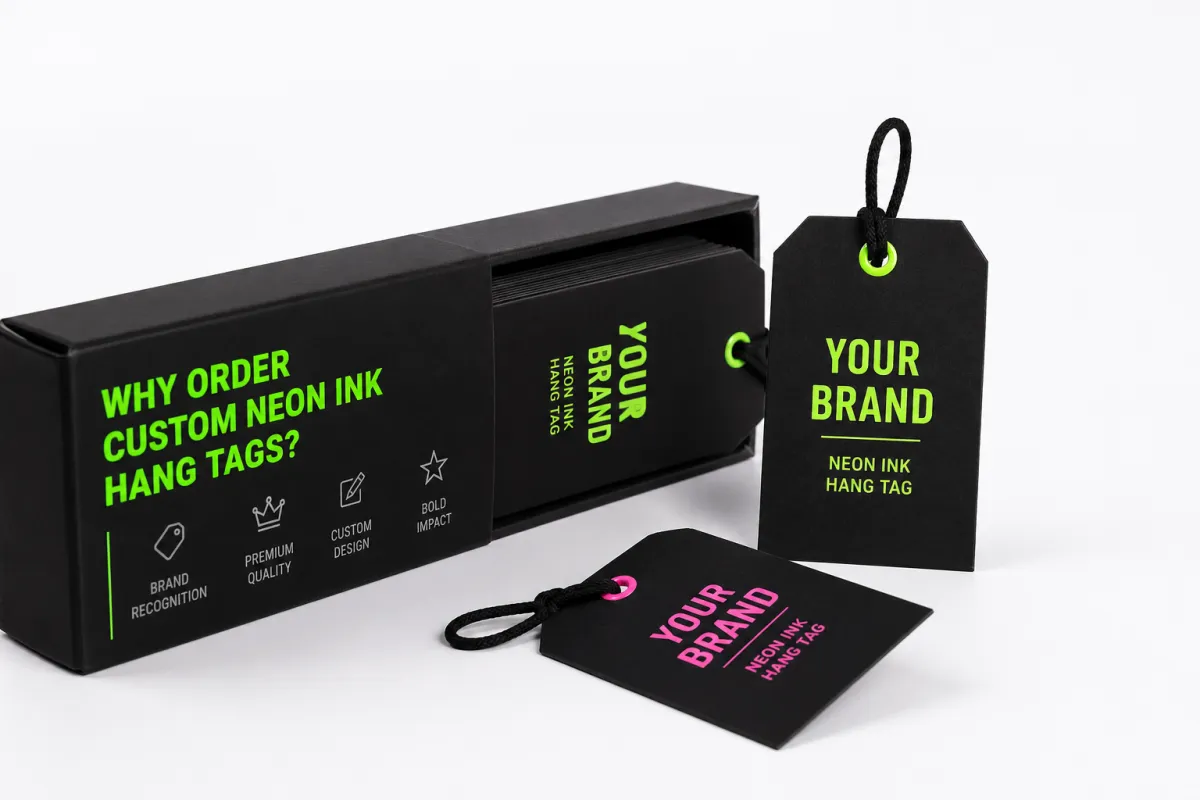
The biggest misconception I hear is that neon ink is only about being loud. That is the shallowest reason to order custom neon ink hang tags. The real value is legibility. Fluorescent yellow, pink, orange, and green sit differently under retail lighting, especially under overhead LEDs that can wash out low-contrast art. On a 72-inch rack with mixed light temperatures, a neon tag often stays readable where a standard ink field starts to look gray and soft. That difference can sound minor until you are trying to sort 400 units in a backroom with two tired staff members and one scanner that keeps blinking at everyone like it has an attitude.
That matters for apparel, accessories, promotional kits, and seasonal launches where a buyer needs fast visual separation. I saw this on a run for winter knitwear in Portland: the buyer had 14 colorways, and the line manager needed a way to identify size and style at a glance without pulling every hanger off the rail. Once they chose to order custom neon ink hang tags, the rack became easier to shop and the new SKU family looked deliberate instead of scattered. That was the real win. Not just brightness, but order, with one neon orange code for medium and a second neon green code for large.
A quieter branding advantage follows. A well-planned neon tag can sharpen shelf recognition without changing the product itself. That helps when the garment color is muted, the outer packaging is simple, or the brand wants a sharper retail signal without redesigning the whole presentation. In practice, that is where package branding gets efficient: one small piece of printed board can do a surprising amount of work if the stock, type, and color are chosen with care. I am biased here, but I think the best packaging systems feel almost invisible until they are missing, like a 14pt hang tag that quietly keeps a 60-piece display in order.
"We did not need a louder product; we needed a tag that could survive bad mall lighting and still look intentional." That was a comment from a buyer I worked with on a 1,200-piece launch in Atlanta, and it captures the point better than any sales pitch.
Control matters too. When brands order custom neon ink hang tags, they can choose a shape and size that reinforces the line architecture, whether that means a clean rectangle for premium basics, a rounded corner tag for lifestyle goods, or a custom die-cut for a seasonal promo. The tag is not decoration. It is a small but visible part of the packaging design system. I remember a team in Los Angeles once insisting on a complicated die-cut because it looked "more brand-led." Two rounds later, they admitted the rectangle would have done the job better and cost about $0.07 less per unit at 3,000 pieces. That is the kind of moment that teaches everybody something, usually the expensive way.
Put plainly, when you order custom neon ink hang tags, you are buying visibility, faster style identification, and a more deliberate retail presentation. That is especially true for brands that already care about retail packaging details, because the tag becomes one more proof point that the line was built with discipline from the first touchpoint. And yes, discipline can be exciting if the output looks good enough, particularly when the tag holds up under 3500K track lighting and still reads clean from six feet away.
- Apparel: helps black, navy, and earth-tone garments stand out on a rail, especially on 18pt coated board.
- Accessories: gives bags, belts, and hats a quick brand signal at point of sale, even under 3000K LEDs.
- Promotions: works well for launches, event drops, and limited runs with high visibility needs, including 500-piece test orders.
- Seasonal merch: supports color-coded collections and faster store sorting across 20 to 200 SKUs.
For a launch, the first question should not be "How bright can we make it?" It should be "What must the tag do on the rack, in the hand, and at the register?" That is the question that keeps a project grounded in facts instead of decoration when you order custom neon ink hang tags. It also keeps the team from falling in love with the wrong thing, which happens more often than people like to admit, especially when the sample arrives on a Friday afternoon and everyone has opinions.
Custom Neon Ink Hang Tag Materials and Print Details
When buyers order custom neon ink hang tags, the stock choice decides almost as much as the color. Bright white coated paperboard usually gives the strongest neon effect because the fluorescent ink sits cleanly on a smoother surface. I have seen 18pt and 24pt coated board deliver excellent results on apparel programs, especially when the art includes a tight logo mark, a size callout, and a one-line brand statement in 5.5 to 7 pt type. That tiny type range matters more than people expect; I have watched a beautiful tag become a blurry little apology because someone tried to cram too much copy into too little space on a 2 x 3.5 inch dieline.
Uncoated heavy stock can work too, especially if the brand wants a softer tactile feel or a more artisanal look. The tradeoff is color intensity. On textured or absorbent papers, neon ink can look slightly muted, and fine type may not hold the same edge as it does on coated board. Kraft stock is another option, but it pushes the art in a different direction; the neon has to fight the brown base, so the design usually needs more contrast and a simpler layout. That is not a flaw. It is a style choice. Still, if the team wants fireworks, kraft is usually the wrong stage, unless the palette is built around a very deliberate neon pink and black pairing.
From a press standpoint, fluorescent inks behave differently from conventional process colors. They often benefit from a white underbase on darker or mixed-toned stock, and sometimes a second pass or spot color adjustment improves consistency from sheet to sheet. Standing next to a sheetfed press in a supplier meeting in Guangzhou, I watched an operator change ink density by a fraction and turn hot pink from muddy to clean in under 15 minutes. That kind of precision is why you should order custom neon ink hang tags with a print partner who understands registration, drying time, and stock absorbency, not just a sales rep who likes bright samples. Enthusiasm is nice. It does not solve ink gain or a 0.5 mm register shift, though.
Structural choices matter as much as ink. Hole placement, corner radius, tag size, and print side count all affect the final feel. A 3.5 x 2 inch tag with a centered 0.125 inch hole behaves very differently from a 2 x 5 inch tall tag with a top-left hole and rounded corners. Matte usually reads more refined and photographs with less glare; gloss can make the neon look brighter under retail lighting but may reflect more in flat lay photography. Those are tradeoffs, not absolutes. A retailer may love the gloss on the floor while the ecommerce team groans because every image now catches a light strip in exactly the wrong spot, usually near the neckline shot.
For a lot of projects, the best answer is a deliberate combination of product packaging elements. The hang tag can carry the brand story, while a matching insert or carton handles compliance copy, care instructions, or UPC data. If the line also uses Custom Printed Boxes, keeping the neon palette and type rhythm consistent across pieces makes the whole program feel more unified. That kind of coordination matters in branded packaging, especially when multiple SKUs sit together on one sales floor. It is the visual equivalent of everyone in the band showing up on the same beat, with the same 2.5 mm rule and the same logo lockup.
Some add-ons are functional, and some are aesthetic. Foil stamping can work when the brand wants a metallic accent next to neon ink, but it is not always necessary. Embossing adds texture and can elevate the tactile feel. Soft-touch coating gives a premium hand, though it can slightly mute glare and shift the overall color impression. QR codes can be useful if the goal is to link the physical tag to care instructions, product video, or a landing page, but the code needs strong contrast and enough quiet space to scan reliably. I have a mild grudge against QR codes that are shoved into decorative corners just to look modern; if a phone cannot scan it in one second from 12 inches away, it is not helping anyone.
For buyers who like standards and testing language, I often point them to references such as ISTA performance testing for shipping and handling conditions, and FSC certification standards when the paper stock needs to support certified sourcing. Those links are not decorative. They help frame the practical side of material selection when a project must satisfy both marketing and procurement. That combination can feel a little like speaking two different languages before coffee in a Milan showroom, but it is normal and manageable with a 350gsm C1S sample in hand.
When you order custom neon ink hang tags, the material conversation should always circle back to use case. A tag that looks great in a PDF is not enough. It needs to survive packing, hanging, handling by store staff, and the occasional spill in a backroom. That is the difference between a nice sample and a retail-ready piece of print. A sample can flatter you. A production run tells the truth, especially when 5,000 pieces arrive shrink-wrapped in bundles of 100 and get sorted by the warehouse team in under an hour.
Specifications Before You Order Custom Neon Ink Hang Tags
If you want to order custom neon ink hang tags without slowing down the proof stage, confirm the specs before the quote goes out. Start with finished size, stock thickness, print side count, ink coverage, hole diameter, and whether the tags will ship flat or strung. Those six items usually decide the base cost, and they also determine whether the tag feels elegant, practical, or overbuilt in hand. I once watched a project in Chicago lose half a day because nobody could remember whether the tags were supposed to ship flat or prestrung. Half a day. For a detail that should have been settled in five minutes. I still feel that one in my bones, especially because the final order was 2,400 units on 18pt board.
The artwork side matters just as much. A proper dieline should show bleed, safe area, and the exact punch location. I have watched projects stall for three days because a designer placed the logo too close to the hole and the brand team had to move a barcode, a size callout, and a legal line in one round of revisions. If you are going to order custom neon ink hang tags, it is far easier to solve those problems before the proof than after plates, finishing, or packing are already in motion. Nobody enjoys being the person who says, "We found the issue in round three," especially when round one already felt obvious and the printer is in Xiamen waiting for final files.
- Finished size: 2 x 3.5 inches, 2.5 x 4 inches, or a custom die-cut shape with a 0.125 inch bleed.
- Stock thickness: 14pt, 18pt, or 24pt depending on stiffness and perceived value.
- Print sides: single-sided for clean front branding, double-sided for copy and compliance.
- Hole size: typically 0.125 inch or 0.25 inch, depending on stringing hardware.
- File setup: 0.125 inch bleed, outlined fonts, and 300 dpi images for any raster art.
- Content placement: keep text and barcodes away from the punched edge by at least 0.125 inch.
Small design choices have real consequences. Neon fields need enough contrast to stay clean on textured paper, and tiny copy can disappear if it sits directly on a highly saturated background. I tell clients to reserve a quiet area for pricing or SKU information, because that makes the tag easier to use at the warehouse level and easier to read at the retail level. You do not want a merchandiser squinting at a 6 pt code next to a punch hole while a line is forming behind the register. That scene has a way of making everyone grumpy, including people who were perfectly pleasant five minutes earlier, especially in a store with 500 units arriving that morning.
If the tag needs a barcode or QR code, make that decision early. A code is only useful if it scans fast and consistently, which means the quiet zone has to stay clear and the contrast has to be strong. On neon print, that usually means black ink on white or a very light field, or a carefully tested layout that avoids visual clutter. If you are planning to order custom neon ink hang tags with both a bright color field and a machine-readable code, ask for a proof that shows exact placement relative to the hole, edge, and any decorative elements. That kind of proof is boring to look at and incredibly helpful, which is usually how the best details behave. I would rather annotate a proof for 10 minutes than reprint 2,000 tags.
Another practical point: if the tag is going with apparel on hangers, consider how the tag will sit next to the garment, the string, and the retailer's own security device. I have seen beautiful tags ruined by a poor hole position that caused the tag to flip backward on the rack. That kind of issue has nothing to do with ink and everything to do with planning. Good packaging design is often about those hidden details, not the headline graphic. Honestly, the hidden details are usually where the money either gets protected or quietly wasted, especially on a launch where every minute on the floor counts.
For buyers building a larger program, I also recommend matching the tag spec to the rest of the line architecture. If the brand uses custom printed boxes or inserts, keep the same type hierarchy, logo proportions, and color names across all pieces. That gives your package branding a cleaner rhythm and makes the entire order feel managed, not assembled. When you order custom neon ink hang tags, the spec sheet should help the printer quote accurately and help your team avoid changes during finishing, packing, and shipping. Otherwise the "small update" turns into a very un-small bill, sometimes by $180 or more if artwork changes after proof approval.
Pricing When You Order Custom Neon Ink Hang Tags
Pricing is where people often make the wrong comparison. When you order custom neon ink hang tags, you are not just buying paper and ink; you are buying setup, press time, finishing, inspection, and packing. The main cost drivers are quantity, stock selection, number of print sides, ink coverage, die-cut complexity, and any special finish such as foil, embossing, or soft-touch coating. If one supplier quotes a low number and another quotes higher, ask what is included line by line before you decide the gap is real. A low number with missing details is not a bargain. It is a riddle, usually with a hidden fee for stringing or a higher freight class.
Here is a working reference from the kinds of jobs I see often. A simple single-sided tag on 18pt coated board with one neon spot color might land around $0.58/unit at 500 pieces, $0.28/unit at 1,500 pieces, and $0.18/unit at 5,000 pieces. If you add double-sided print, a custom die-cut, or stringing, the unit price moves up. That is normal, because each of those choices adds handling steps or press complexity. The machine does not care that the launch is urgent, sadly. It still wants time, and it still wants the board to dry for the same 8 to 12 hours.
| Order Size | Typical Build | Approx. Unit Price | Best Fit |
|---|---|---|---|
| 250 pieces | 18pt coated board, single neon spot color, flat packed | $0.95 - $1.40 | Sampling, private label test, internal review |
| 1,000 pieces | 18pt coated board, single or double-sided print | $0.30 - $0.55 | Small retail launch, seasonal drop, limited run |
| 5,000 pieces | 18pt or 24pt board, neon spot color, standard die-cut | $0.14 - $0.24 | Full distribution, repeat SKU, multi-store rollout |
That table is not a promise, because stock availability and finish choice can change the math, but it is a useful way to think about the order. If you order custom neon ink hang tags in larger volumes, setup costs get spread across more pieces, and the tag gets cheaper per unit. If you need a small test run first, say that up front. I have structured quotes around sample quantities many times, and it is much easier to be direct about the test phase than to pretend a 300-piece order should cost like 5,000. In practice, the quote on a 300-piece run may be closer to $0.80 each, depending on the board and the finishing step.
The smartest comparison method is simple: ask every supplier to quote the same finished size, the same stock, the same ink count, the same hole size, and the same finish assumptions. Otherwise you are not comparing like for like. I have seen buyers think they saved 12 percent, then discover one quote included flat packing, one included stringing, and one used a lighter 14pt board that felt thin in hand. If you want to order custom neon ink hang tags with confidence, compare the build, not just the number at the bottom of the page. A clean spec sheet saves more money than a slightly cheaper quote ever will, especially when freight from Shenzhen to Chicago is part of the math.
For brands that need more than one product line, the quote should also reflect program structure. If one colorway uses one neon tag and another uses two, it may be worth standardizing the dieline and changing only the print content. That reduces tooling drag and keeps the press room simpler. For larger accounts, our Wholesale Programs can help structure repeat runs so reorders stay consistent from batch to batch, whether the production is running in Dongguan or Ningbo.
One more practical tip: if the launch has a hard budget ceiling, be direct about it. A good print partner can often adjust by simplifying the finish, switching to flat packing, or moving from a custom shape to a standard rectangle. That is usually better than trying to force a premium spec into a low-budget lane and ending up unhappy with the result. When teams order custom neon ink hang tags with realistic assumptions, the whole project moves cleaner and the quote becomes a tool instead of a surprise. A ceiling of $0.22 per unit at 5,000 pieces is workable if the spec is clear from the start.
Process and Timeline for Custom Neon Ink Hang Tags
The process should feel orderly, not mysterious. When clients order custom neon ink hang tags, I like to walk them through a straight line: quote request, file review, proof creation, proof approval, print production, finishing, inspection, and shipment. That sequence sounds basic, but it saves time because everyone knows which decision comes next and which file issue would stop the job. I am always a little suspicious of timelines that sound magical. Printing is not magic. It is a series of small decisions made well, or badly, in the right order, usually across 12 to 15 business days once the proof is approved. In the best runs, the schedule feels almost boring, and boring is a pleasant surprise in manufacturing.
- Quote request: send size, stock preference, quantity, and a rough due date.
- File review: the print team checks bleed, dieline alignment, and image quality.
- Proof creation: a digital proof shows layout, copy, hole placement, and finish notes.
- Proof approval: the buyer confirms color intent, text, and final count.
- Production: the job runs on press, then moves to cutting, punching, and any finishing.
- Inspection and ship: counts are checked, bundles are packed, and freight is arranged.
Most delays happen before the press ever starts. I have seen projects stall because the artwork came in at 150 dpi, because Pantone expectations were never written down, or because a marketing team needed three internal sign-offs after the proof had already been built. If you want to order custom neon ink hang tags and keep the lead time tight, consolidate the approval chain before you send the file. One named approver beats four people editing the same PDF on different schedules. The latter arrangement is how good projects become little soap operas, especially when a buyer in New York is waiting for a sample from a factory in Shenzhen.
For simple jobs, a practical schedule is often 12-15 business days from proof approval. If the tag includes foil stamping, embossing, specialty coating, or stringing by SKU, that can stretch to 15-20 business days or more depending on volume. The clock starts when the proof is approved, not when the quote is requested. That distinction matters, because buyers sometimes budget around the first email instead of the final sign-off. I have had to say this more than once, and I will keep saying it because it saves frustration and keeps shipping dates realistic. A 10,000-piece order with stringing can need an extra 3 days just for finishing.
Color proofing deserves special attention. A digital proof is useful for copy, layout, and placement, but it is not a substitute for a press check when the brand is extremely sensitive to neon tone. I have been in a press room in Ningbo where two slightly different magenta formulas looked identical on screen and very different on board. That is why I tell clients to confirm the intent carefully before they order custom neon ink hang tags; the proof is where you decide whether the color should skew warmer, cooler, softer, or punchier. Those decisions sound tiny until a whole stack lands on your desk looking a little too electric, or not electric enough, under a 4500K shipping-table lamp.
Fulfillment logistics matter too. Some orders ship flat, which is efficient for warehouse receiving and easier to sort by SKU. Others ship bundled with string separated, especially when the retail team wants to attach tags in-house. If the tags are going into a larger program with labels, inserts, or garment packaging, keeping the counts organized by style number avoids a lot of downstream friction. For reference and process questions, our FAQ can help buyers move faster through the basics, and a standard carton pack of 200 pieces per inner is often easiest for receiving.
When the shipment leaves, I like to think in terms of receiving behavior. Can the warehouse count the bundles easily? Can the store team open the carton without damaging the corners? Can the tags be staged by style code instead of dumped into a mixed pile? These are not glamorous details, but they are the difference between a clean rollout and a backroom headache. The best projects order custom neon ink hang tags with the entire handling path in mind, not just the printed face. That extra bit of foresight usually saves somebody a very real amount of time and annoyance, especially when the first stores open at 9:00 a.m.
If your launch also includes Custom Labels & Tags or other Custom Packaging Products, keep the timeline aligned so one item does not arrive weeks ahead of the others. Coordinated delivery is one of the easiest ways to make a branded package system feel controlled rather than improvised. I have seen a carton arrive in week one and the matching tag arrive in week four, and the brand team spent the gap doing apologies instead of merchandising.
Why Choose Custom Logo Things for Custom Neon Ink Hang Tags
People do not come to Custom Logo Things just because they want color. They come because they want a partner who understands the press room, the finishing table, and the receiving dock. When clients order custom neon ink hang tags with us, they get clear quoting, plain-language file guidance, and production decisions grounded in actual manufacturing behavior, not generic sales talk. That matters when a project has to ship on time and the spec cannot drift by even a few points. A tag that was supposed to be 18pt should not mysteriously become 14pt after the proof.
In my experience, the strongest print partnerships are built on a simple promise: tell the customer what will happen, what could go wrong, and what can be changed before money is spent on the wrong choice. I have stood in enough supplier meetings in Dongguan, Hangzhou, and Xiamen to know that stock behavior, registration control, and finishing compatibility decide whether a tag looks crisp or tired. If you order custom neon ink hang tags through a team that knows those variables, you avoid a lot of avoidable rework. You also avoid the awkward late-stage phone call that starts with, "Quick question..." and somehow ends with three people revising a layout at 8:40 p.m.
We also help buyers connect the tag to the broader brand system. If the line uses branded packaging, package branding, or even custom printed boxes, the hang tag should echo the same color logic, type scale, and voice. That is where our practical support helps. We are not trying to turn a simple order into a design seminar. We are trying to make sure the printed pieces look like they belong together when they reach the shelf. A coherent system does more for trust than a pile of clever details ever could, especially when the carton, insert, and tag all arrive in the same week.
Another advantage is that we can talk about real production tradeoffs without dressing them up. If 24pt board will fight your folding carton spec, we will say so. If a matte finish will tame the neon more than you want, we will say that too. If a barcode needs more quiet space, we will mark it on the proof. Buyers who order custom neon ink hang tags from a technical but approachable team usually get a better first run because the print room is not left to interpret vague directions. That matters because vague directions are where expensive guesswork likes to hide, and guesswork on a 5,000-piece order can turn into a $200 mistake very quickly.
Repeatability matters most. A tag that looks right on the first run but falls apart on the reorder is a weak supplier outcome, no matter how good the sample was. We focus on keeping the spec stable so the second and third run match the first in tone, size, and finish. That is what turns a one-off order into a dependable program. If you are building a line that needs consistency, not just a single bright moment, that approach saves time and protects the brand. And yes, it also saves a lot of explaining to people who were told, "The reorder will be identical," because identical should mean identical down to the 0.125 inch hole position.
Some buyers ask whether the same team can help with adjacent materials. Yes, and that is usually useful. If you need advice on retail packaging, shelf-ready inserts, or the printed components that sit next to your garments, we can keep the conversation centered on the whole package, not just the tag. That is the right way to manage a launch when the hang tag, label, and carton all need to speak the same language. It is exactly why many clients order custom neon ink hang tags from us alongside other printed pieces instead of sourcing each item in a separate silo. One coordinated order is usually easier to receive than three separate shipments from three different cities.
Honestly, the best print vendors act like production translators. They take a marketer's intent, a designer's artwork, and a factory's limitations, then turn all three into something that can actually be made at scale. That is the level of support we aim for at Custom Logo Things, especially when a customer wants to order custom neon ink hang tags and move quickly without giving up control. I think that combination - speed plus clarity - is what keeps a launch from turning into a mess with good lighting, and it is why buyers come back for the second run when the first one lands on time.
How do you order custom neon ink hang tags?
If you are ready to order custom neon ink hang tags, the best next move is simple preparation. Gather the finished size, stock preference, quantity, desired finish, logo files, copy deck, and target delivery date before you request the quote. When those pieces are ready, the quote is cleaner, the proof is faster, and the production team can spot issues before they cost time. That sounds almost too obvious to say, yet it is amazing how often people skip it and then act surprised when the process slows down, especially if the target ship date is only 14 business days away.
What should you send first? Logo files in vector format, a list of all text that must appear on the tag, any barcodes or QR codes, a reference sample if you have one, and the name of the person who can approve the proof in one pass. If you want to order custom neon ink hang tags for multiple SKUs, include the style matrix up front so the print team knows which elements stay fixed and which vary by colorway. That one step can save a ridiculous amount of back-and-forth later, especially when a single line has 8 colors and 3 size runs.
- Confirm the tag size in inches or millimeters.
- Choose the stock: coated, uncoated, kraft, or textured.
- Decide on single-sided or double-sided printing.
- List any barcode, QR code, or compliance text requirements.
- Note whether the tags will ship flat or strung.
- Set a target proof approval date so the schedule stays realistic.
One habit speeds everything up: make the decisions before the quote is issued. When buyers wait until after the price comes back to choose stock, finish, and size, the order slows down because the assumptions change. If you want to order custom neon ink hang tags and keep the path efficient, settle the basics first, then let the printer refine the details. I know that sounds tedious. It is also the shortest path to not having to redo the same conversation three times. A clean decision on day one is worth more than a rushed change on day three.
Think about how the tag will behave in the real world. Will it sit on a hanger beside a black jacket? Will it hang on a key ring or from a woven loop? Will a cashier need to scan it quickly under a bright counter light? Those questions shape the spec just as much as the logo does. The more clearly you define the use case, the better the result when you order custom neon ink hang tags. And the less likely you are to end up with a gorgeous tag that fights the actual workflow, which is one of those weirdly common forms of project failure, especially in stores with fast-moving inventory.
If you are building a wider launch, line up the rest of the printed pieces at the same time. Consistent product packaging, coordinated packaging design, and matching inserts or cartons make the program look managed from the first shipment. If that is the direction you want, we can help you connect the tag order to the rest of the system through Custom Packaging Products or a focused label run through Custom Labels & Tags. The result is usually stronger when the whole set is built from the same 1-page spec sheet.
When you are ready, send the file, the quantity, and the target date. We will review the setup, confirm the proof, and move the order forward with the same practical care we use on every production run. That is the cleanest way to order custom neon ink hang tags, and it is usually the fastest route from concept to finished cartons on the receiving dock, whether the shipment lands in Los Angeles, Chicago, or Toronto. One precise order now usually prevents three messy corrections later.
What is the minimum quantity when I order custom neon ink hang tags?
Minimums usually depend on stock, print method, and finishing, so the quote should state the exact run size. Smaller quantities may be possible for sampling or launch tests, but the per-tag price is typically higher than a standard production run. If you need multiple designs, ask whether the minimum applies per design or across the total order. That detail can change the budget more than people expect, especially if one design is 250 pieces and another is 750 pieces on the same 18pt board.
Can I order custom neon ink hang tags with QR codes or barcodes?
Yes, but the code should be sized and placed with enough quiet space so it scans reliably. Ask for a proof that shows the code relative to the hole, edge, and any neon color fields. For the best results, keep barcode artwork high contrast and avoid placing it over textured or highly saturated areas. If the code matters to the checkout flow, do not treat it like decoration. A good barcode should scan on the first pass from 12 inches away under 3500K store lighting.
Which paper stock works best for custom neon ink hang tags?
Bright white coated stock usually gives the strongest neon effect because the color sits cleanly on the surface. Uncoated and kraft stocks can work, but the ink may appear more muted or require a different design approach. Ask for a stock recommendation if your tag needs both strong color and a specific tactile feel. I would also ask for a sample board if the order is large enough to justify it, such as a 1,000-piece or 5,000-piece run on 350gsm C1S artboard.
How long does it take to produce custom neon ink hang tags after proof approval?
Lead time depends on quantity, finishing, and whether the artwork is already press-ready. Simple jobs generally move faster than orders with specialty coatings, die-cut shapes, or bundled stringing. The most reliable schedule starts once the proof is approved, not when the quote is requested. That distinction saves a lot of calendar confusion, which I wish were more rare than it is. A typical production window is 12-15 business days from proof approval, and 15-20 business days if foil or embossing is added.
Do custom neon ink hang tags work on matte and gloss finishes?
Yes, but the finish changes how the color reads and how much contrast the tag has in hand. Matte finishes usually feel more refined and reduce glare, while gloss can make neon colors appear brighter under retail lighting. If the tag must be easy to photograph, compare both finish options before approving the final look. A finish that looks perfect in the sample room can behave differently under a camera and a fluorescent store fixture, particularly in stores that use 4000K overheads.
What should I do before I place the order?
Lock the finished size, stock, print sides, hole position, and approval contact before the quote goes out. Then send the vector artwork, copy, and any code files in one package. That is the cleanest path if you want to order custom neon ink hang tags without wasting a week in revisions. A little discipline up front saves a lot of fixing later, and that is the part people usually remember once the tags are on the rack.


