Buyer Fit Snapshot
| Best fit | Custom Supplement Containers with Label projects where brand print, material claims, artwork control, MOQ, and repeat-order consistency need to be specified before quoting. |
|---|---|
| Quote inputs | Share finished size, material target, print colors, finish, packing count, annual reorder estimate, ship-to region, and any compliance wording. |
| Proofing check | Approve dieline scale, logo placement, barcode or warning zones, color tolerance, closure strength, and carton packing before bulk production. |
| Main risk | Vague material claims, crowded artwork, missing packing details, or unclear freight terms can make a low unit price expensive after revisions. |
Fast answer: Custom Supplement Containers with Label: Artwork Proof, Packing Count, and Landed Cost should be specified like a repeatable production item. The safest quote records material, print method, finish, artwork proof, packing count, and reorder notes in one written spec.
Production checks before approval
Compare the actual filled-product size with the drawing, then confirm tolerance on folds, seals, hang holes, label areas, and retail display edges. Reserve space for logos, QR codes, warning copy, and material claims before decorative graphics fill the panel.
Quote comparison points
Review material grade, print process, finish, sampling route, tooling charges, carton quantity, and freight assumptions side by side. A quote is only useful when the supplier can repeat the same color, closure quality, and packing count on the next order.
Custom supplement containers with label are the kind of packaging decision that looks straightforward until the details start stacking up. Fill size, closure style, panel space, artwork, compliance copy, and shipping conditions all pull on the same package at once. A supplement can look polished in a render and still get awkward in production if the label wraps poorly, the container shape leaves too little flat space, or the finish makes small text harder to read. That gap between mockup appeal and real manufacturing is where a lot of teams are gonna lose time and money.
From a packaging buyer's perspective, custom supplement containers with label are not just a bottle and a sticker. They work as one coordinated system: the container geometry, label stock, adhesive, print process, closure, tamper evidence, and distribution path all need to fit together cleanly. One weak link can drag down the rest. A well-matched package does more than hold capsules, gummies, powders, or liquids; it supports branded packaging, protects product quality, and makes the SKU easier to move through retail and fulfillment channels.
That matters across gummies, capsules, powders, liquids, and mixed formulas because each category behaves differently. Moisture-sensitive gummies need a different barrier conversation than a dry capsule blend. Powders can create dust and static during filling. Liquids put pressure on adhesives if condensation shows up in cold-chain handling or warm-to-cold transitions. So custom supplement containers with label are really product packaging choices that have to serve marketing, operations, and compliance at the same time, which is not always a tidy balance.
For teams buying these packages, the practical question is not whether the package looks pretty on a screen. The better question is whether it will run cleanly, stay legible, ship safely, and still feel like the brand promise once it reaches the shelf. That is the standard worth using before a quote goes out, and honestly it saves a lot of backtracking later.
Custom Supplement Containers with Label: What They Are
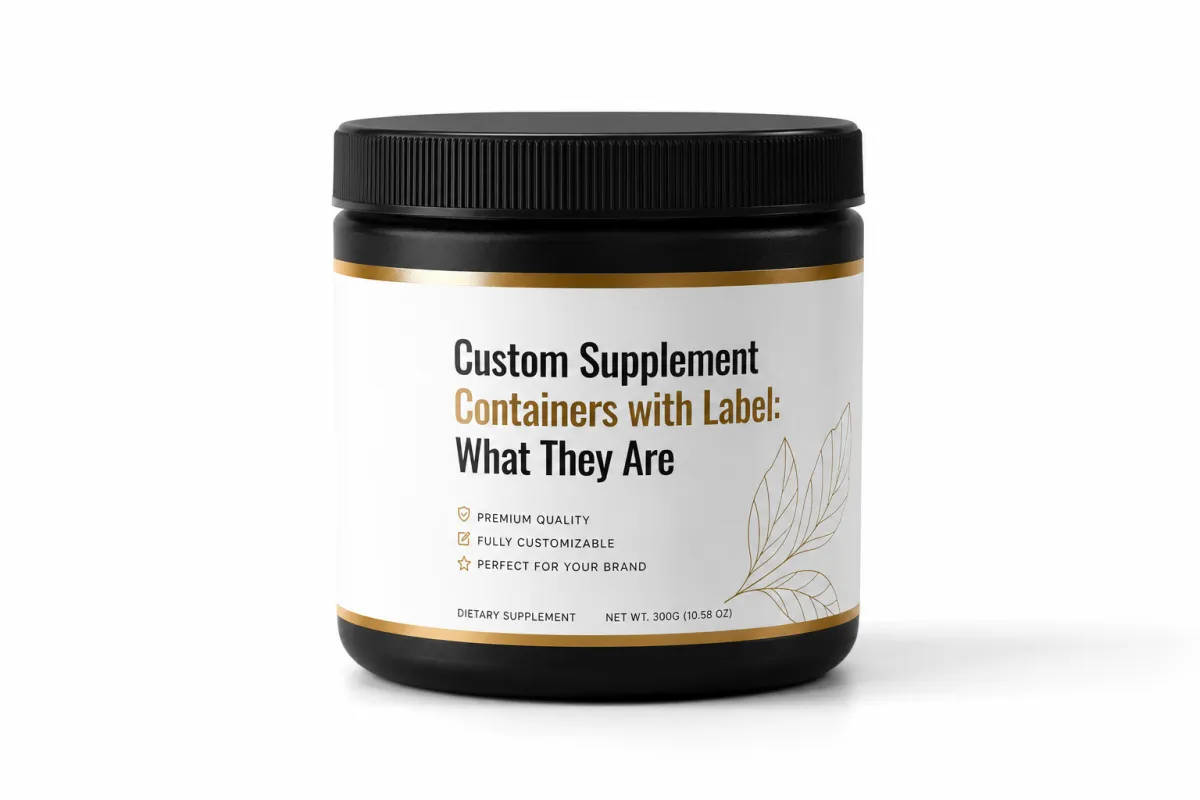
Custom supplement containers with label are a matched packaging format where the container and label are selected together instead of treated as separate decisions. That sounds simple, yet plenty of teams choose a bottle first, only to discover the label has nowhere clean to sit, the shoulder curve distorts the artwork, or the closure steals the visual space reserved for the front panel. The result usually feels like two choices stitched together rather than one package designed as a system.
Think of the package as a working relationship between parts. The bottle or jar sets the shape of the opportunity. The label sets the visual and regulatory footprint. The closure and liner decide whether the package protects the formula and survives transit. With custom supplement containers with label, the job is to coordinate those elements so the final pack feels intentional, not patched together after the fact.
That matters especially in supplement categories where consumer trust is fragile. A gummy vitamin in a clear PET jar may look approachable, yet if the label starts curling after a week in storage, the package loses credibility fast. A capsule product in a glass bottle may signal quality, but the added weight can push freight costs and damage risk higher. Custom supplement containers with label let teams manage those trade-offs instead of inheriting them blindly.
In package branding terms, the container becomes part of the message. Matte white plastic can read clinical and clean. Amber glass can read premium and protective. Clear containers can show the product color, which works well for some formulas and poorly for others if oxidation or light sensitivity is a concern. That is why custom supplement containers with label are as much about positioning as they are about mechanics.
“The strongest supplement package is the one that gets through the warehouse, the opening experience, and the compliance review without asking for a second pass.”
Here is the lens I keep coming back to: if the product will be sold online, stocked in retail, or stored in a distributor's warehouse, the container and label have to perform under real conditions. Not studio conditions. Not a polished mockup. Real handling, real freight vibration, real shelf lighting, and real temperature swings. That is where custom supplement containers with label either earn their place or start creating headaches.
For growing product lines, the format also helps with family consistency. One SKU may need a 60-count bottle, another a 180-count jar, and a third a powder tub. If the label system is planned well, the line still looks connected. That is a real advantage for retail packaging, because shoppers often read range consistency as brand confidence. If the line feels scattered, the shelf does too.
Buyers sometimes ask whether custom supplement containers with label are worth the effort. The honest answer is yes, once a product has more than one constraint. A single SKU with a short ingredient list may be fine in stock packaging. Once dosage variation, compliance text, moisture protection, or stronger shelf appeal enter the picture, the coordinated approach pays back quickly.
How Custom Supplement Containers with Label Production Works
The production flow for custom supplement containers with label usually starts with the container family. That means deciding whether the format should be a bottle, jar, tub, squeeze container, or another structure that matches how the product behaves. Once that is set, label panel dimensions, closure height, shoulder curve, and seam placement should be mapped before artwork is finalized. The sequence matters because label design is not abstract; it has to fit a real object.
After the structure is chosen, the next step is material and finish selection. A glossy polypropylene label can create a bright, retail-friendly look. A matte or soft-touch finish may feel a little more premium, yet it can change how small type reads under store lighting. With custom supplement containers with label, the finish is never just decoration. It affects scuff resistance, moisture response, and even how barcode scanners interpret contrast if the artwork is crowded.
Container finish matters too. Clear, frosted, amber, opaque white, and metalized effects all change how the label appears in the hand. A transparent bottle exposes the formula and the back side of the label, so trapped air bubbles or adhesive lines become more visible. Opaque containers hide some of that, but they shift more visual responsibility to the front panel. The goal is a package that looks stable from three feet away and still survives a warehouse pallet.
Label layout has to respect the curve of the container. Curved shoulders, tapered sides, and prominent seams can distort the art if the wrap is too aggressive. In custom supplement containers with label, a common mistake is assuming a flat label size will behave the same way on every bottle. It will not. Even a few millimeters can move the front panel off center, especially on smaller diameters where the label wraps around the body quickly.
Proofing is where real money gets saved. A good proof catches problems such as a nutrition panel that is technically compliant but difficult to read, a barcode sitting too close to a seam, or a wrap label that leaves too little gap for clean application. That proof stage is the last low-cost chance to correct expensive mistakes, and it is also where teams find out whether the ingredient deck, warnings, and net contents truly fit the package they selected. In custom supplement containers with label, the proof is not a formality.
For organizations already comparing options across a broader line, it helps to review Custom Packaging Products alongside label-specific items such as Custom Labels & Tags. That comparison usually makes the trade-offs clearer than a single SKU conversation does.
Good production also depends on testing discipline. Many packaging teams reference distribution tests aligned with ISTA protocols to understand how a package might handle vibration, drops, and compression during shipping. Not every order needs a full lab program, but the mindset matters. A package that only works in a controlled room is not enough, and it will usually come back to bite you later.
When custom supplement containers with label are produced well, the final package feels almost boring, and that is a good thing. It fills accurately, labels cleanly, scans easily, and reaches the shelf without drama. Buyers usually want that, even if they ask for "something premium." Premium is not only the look. It is the absence of avoidable failure.
Key Factors That Shape the Right Container and Label
Custom supplement containers with label need to be selected around the product's real conditions, not just the brand team's preferred color palette. Moisture exposure, light sensitivity, odor control, tamper evidence, and dosage format all influence the package choice. A powder blend stored in a humid fulfillment center has different needs from a chewable tablet sold through a refrigerated chain. Ignoring that difference is how labels begin lifting or contents start degrading.
Material choice is the first major fork. Plastic is light, widely available, and usually less expensive to ship. PET and HDPE are common because they balance cost, durability, and compatibility with a wide range of supplements. Glass can feel more premium and offer stronger barrier characteristics, but it adds breakage risk and freight cost. Specialty resins can support higher clarity or better squeeze performance, though they may cost more and require closer testing. For custom supplement containers with label, the best material is rarely the fanciest one; it is the one that fits the product and the distribution model.
Label stock is equally important. Paper labels can work in dry, low-handling environments, but film labels often hold up better against oil, condensation, and abrasion. A matte film can improve readability on crowded packages. A gloss finish can make colors feel richer. Soft-touch can elevate package branding, but it is not automatically the right choice if the package will be handled often. In custom supplement containers with label, durability should be designed, not hoped for.
Adhesive performance is one of the quietest failure points. A label that looks beautiful in the carton may still fail if the adhesive does not match the container surface and storage temperature. Cold-fill products, refrigerated products, and containers with texture or curvature need closer attention. That is why sample testing on the actual container matters so much. A label that sticks to a flat sheet does not prove anything about custom supplement containers with label on a shoulder-heavy bottle or a slick jar.
Compliance and branding need to be planned together, not in sequence. The required supplement facts panel, warnings, directions, allergen statements, batch code, and barcode all need to fit without making the package feel crowded. Good packaging design uses hierarchy and spacing so the package still reads clearly at a glance. Bad design tries to make the art win against the legal copy, and legal copy always wins eventually. With custom supplement containers with label, the smartest designs reserve space first and decorate second.
There is also the question of perceived value. A consumer may never compare resin grades, but they absolutely notice a package that feels flimsy, dents easily, or prints with fuzzy edges. That is why custom supplement containers with label are part of broader package branding. The container weight, the label texture, the closure click, and the print clarity all signal whether the brand is paying attention.
Here is a simple way to think about it: the product formula decides the technical requirements, while the brand decides the emotional ones. Custom supplement containers with label sit in the middle. If either side dominates completely, the package usually becomes lopsided. If both sides are respected, the result is usually much stronger than the sum of the parts.
Practical container and label trade-offs
- Plastic bottles are lighter and easier to ship, but they can look generic if label stock and artwork are underdeveloped.
- Glass jars improve perceived value, yet they raise freight and breakage considerations that matter at scale.
- Film labels resist moisture and abrasion better than many paper options, especially on custom supplement containers with label used in fulfillment-heavy channels.
- Opaque finishes can hide fill variation and help with light-sensitive formulas, but they reduce visibility of the product itself.
- Clear packs can sell the product visually, although they demand tighter quality control because any label defect is easier to see.
One more detail gets overlooked often: the shelf is not the same as the shipping lane. A package can look perfect in retail packaging photos and still fail after a week in a warm warehouse or after condensation forms during a weather shift. That is why custom supplement containers with label should be reviewed against the actual distribution path, not just a render.
Custom Supplement Containers with Label: Cost and Pricing
Pricing for custom supplement containers with label depends on more variables than many first-time buyers expect. Container material, decoration method, label complexity, order quantity, and specialty finishes all play a role. So do less glamorous items such as plate charges, prepress checks, freight, and revision cycles. A quote can look attractive at first glance and still land high after the full program is counted.
Volume usually lowers unit cost, but the savings are not always linear. A small run may carry a higher per-unit price because setup and proofing are spread across fewer pieces. A larger run can cut the unit cost significantly, yet it may increase storage risk if you overbuy a SKU that is still being tested. In custom supplement containers with label, the cheapest unit price is not always the cheapest decision.
Here is a practical pricing view for common scenarios. The ranges below are directional, not promises, because region, material choice, decoration, and market conditions can move them. Still, they are useful for budgeting, and they are a better starting point than guessing.
| Packaging Approach | Typical Unit Cost at 5,000 pcs | Typical Unit Cost at 20,000 pcs | Best Fit |
|---|---|---|---|
| Stock plastic bottle + standard film label | $0.22-$0.38 | $0.14-$0.24 | Fast-moving SKUs, straightforward artwork, lower decoration needs |
| Premium plastic jar + matte or soft-touch label | $0.34-$0.58 | $0.22-$0.39 | Branded packaging with stronger shelf presence |
| Glass bottle or jar + durable wrap label | $0.48-$0.82 | $0.31-$0.56 | Higher perceived value, light-sensitive formulas, premium line extensions |
| Specialty resin container + custom print or enhanced label system | $0.60-$1.10 | $0.40-$0.78 | Higher-end product packaging or performance-driven formats |
These numbers can move quickly if the label has heavy ink coverage, foil effects, or multi-panel wrap complexity. They can also move if the order needs tamper bands, desiccant insertion, or a unique closure. With custom supplement containers with label, the decoration method is often the hidden cost driver because it changes both setup and application time.
Freight is another budgeting item that gets missed. A container with a low unit price can become expensive if it ships poorly or occupies too much pallet space. Glass, in particular, can introduce a meaningful freight premium. Storage belongs in the picture too. If the first run is larger than sell-through supports, holding costs eat into the apparent savings. The smartest quote comparison for custom supplement containers with label should always include landed cost, not just factory price.
Revision cost is another real line item. One extra round of compliance changes can delay a launch and force reproofing. One barcode change can trigger a reprint. One ingredient line added too late can throw off the whole label layout. Small changes are not small in packaging. On custom supplement containers with label, even a minor copy edit can touch prepress, artwork, approval, and schedule.
For sustainability-focused buyers, material selection can influence cost as well as positioning. Containers with recycled content, FSC-aligned paper components, or lower-waste design can support a brand story, but they still need to work in the real world. If a more responsible material leads to damaged product or more rework, the math gets worse fast. For context on certified paper sourcing, the Forest Stewardship Council is a useful reference point, especially when packaging programs include cartons or insert materials alongside custom supplement containers with label.
My rule of thumb is simple: spend where the consumer can see it or the formula can feel it. Save where the change does not improve either. That is how custom supplement containers with label become a strategic packaging investment instead of a stack of disconnected purchases.
Step-by-Step Ordering Process and Timeline
Ordering custom supplement containers with label works best when the brief is complete before quotes go out. Start with the product type, fill size, format, storage conditions, required label panels, target quantity, and launch date. If the product is a gummy, capsule, powder, or liquid, say so clearly. If the package needs tamper evidence or a child-resistant closure, that should be in the first conversation. The cleaner the input, the cleaner the quote.
A workable sequence usually looks like this: brief, container selection, label spec review, artwork placement, proofing, approval, production, and shipment. For custom supplement containers with label, simple stock-based programs may move through that process in 2-4 weeks after approval. More complex orders with specialty finishes, multiple SKUs, or compliance revisions often sit closer to 4-8 weeks, and sometimes longer if material sourcing is tight. Lead times are not fixed, but they are predictable enough to plan around if you leave room.
Artwork approval is often the longest human step. The container can be chosen quickly. The label artwork is where delays usually show up. Dense regulatory text, multiple flavor variants, and product claims can create a lot of review cycles. If a barcode or lot-code area is missing, the production team has to pause. If someone changes the supplement facts layout late in the process, the proof may have to be rebuilt from the ground up. In custom supplement containers with label, a missing detail can cost days.
Here is a realistic planning framework:
- Week 1: Define product specs, choose container family, and confirm label panel size.
- Week 2: Review artwork, compliance copy, and dieline fit.
- Week 3: Approve proofs or revise one last time.
- Weeks 4-6: Production, label application, QA checks, and packing.
- Final stage: Freight, receiving, and launch preparation.
That schedule can compress if everything is ready and stock materials are on hand. It can stretch if the order needs unique bottle color, specialty coating, or custom printed boxes as part of a broader launch kit. It also stretches if approval chains are long. In most packaging programs, internal delay is a bigger timeline risk than manufacturing itself.
Shipping discipline matters too. Tests aligned to distribution expectations can reduce unpleasant surprises. Many brands reference ISTA methods when they want a better read on how a package may behave in transit. That mindset is especially useful for custom supplement containers with label because the label's performance cannot be separated from the container's ability to protect it through vibration, impact, and stacking.
For seasonal launches, reorder timing deserves its own calendar. A supplement that sells strongly in a promotion window may need replenishment before the first run is fully depleted. If you wait until inventory is almost gone, the lead time risks pile up quickly. That is why experienced buyers keep a reorder point and a backup spec ready. With custom supplement containers with label, reordering is much easier when the original documentation is complete and stored in one place.
Common Mistakes That Hurt Compliance and Shelf Appeal
The most common error is choosing the container before confirming label space. A sleek bottle can look perfect in a catalog and still leave too little flat area for required copy. Another frequent mistake is approving artwork before the compliance text is final. In custom supplement containers with label, those two errors usually produce the same result: the design has to be redone after more time and money have already been spent.
Small layout problems create outsized issues. Tiny type that is technically "legal" may still be unreadable in the field. Poor contrast can bury warnings or directions. Crowded ingredient blocks make the package feel less trustworthy, even if the content is correct. I have seen packages where the visual hierarchy was so compressed that the consumer had to rotate the bottle twice just to find the product identity. That is not good packaging design, no matter how polished the render looked.
Another trap is ignoring label performance testing. Labels can wrinkle on curved surfaces, lift in cold storage, or scuff during transit. A package that passes desk review may still fail after 24 hours in a refrigerated warehouse or after two weeks in a corrugated shipper. For custom supplement containers with label, sample testing on the actual pack is the closest thing to an insurance policy you can buy before full production.
There is also a tendency to separate design from operations. That split causes problems. The design team wants a large front panel. Operations needs seam clearance. Compliance needs room for warnings and batch data. Sales wants high shelf impact. If nobody resolves those tensions early, the package becomes a compromise assembled at the last minute. That is how custom supplement containers with label end up overworked and underperforming.
Here are the failure points I see most often:
- Label wrap lands over a seam or shoulder curve.
- Barcode contrast fails scanner checks because the background is too busy.
- Nutrition text is crammed into a panel that should have been larger.
- Adhesive choice does not match the storage environment.
- Closure style clashes with the intended shelf perception.
- Artwork revisions arrive after the proof has already been signed off.
One more issue deserves attention: treating the package as if it exists only on a screen. It does not. It lives in shipping cartons, on conveyor lines, under store lights, and in customers' hands. That is why custom supplement containers with label have to be judged by physical samples, not only by digital approval. A package can look balanced in a file and still feel awkward in person.
For brands building a broader line, these mistakes can also spill into adjacent categories like custom printed boxes or inserts. If the supplement bottle looks refined but the carton feels generic, the whole launch loses force. Consistency across the package family matters more than most teams realize.
Expert Tips and Next Steps for Custom Supplement Containers with Label
If you want custom supplement containers with label to work harder for you, start with a short checklist before requesting quotes. Include product type, fill size, target quantity, storage conditions, label panel needs, compliance copy status, and launch timeline. That single page can save a surprising amount of back-and-forth. It also helps vendors price the job more accurately, which usually means fewer surprises later.
I also recommend comparing at least two or three packaging combinations side by side. One may be lower cost, another may have stronger shelf presence, and a third may be easier to produce at scale. The right answer is rarely obvious from a photo alone. For custom supplement containers with label, the best comparison is the one that balances appearance, function, and landed cost in the same view.
Request physical samples whenever possible, especially if the label carries dense regulatory text, QR codes, or barcodes. A sample on the actual container tells you more than a spec sheet ever can. It shows whether the label edge lifts, whether the colors hold up on the chosen material, and whether the package still reads clearly at arm's length. For complex custom supplement containers with label, that one test can save an entire run.
There is a practical order of operations that keeps things moving:
- Confirm the formula and fill size.
- Pick the container family and closure.
- Set the label panel dimensions and finish.
- Finalize compliance copy and barcode data.
- Approve a proof on the actual dieline.
- Lock the production schedule and freight plan.
That sequence sounds basic, but it is where many launches get sloppy. If the package brief changes after the proof, custom supplement containers with label can turn into a chain reaction of edits. If the team decides to "just make it fit" at the end, the final pack usually looks smaller, noisier, and less reliable than it should.
For brands that want a fuller packaging program, think beyond the bottle or jar. Supplement launches often need secondary packaging, promotional inserts, or a carton for retail display. That is where custom packaging products can support the line as a whole, not just one SKU. When the container, label, and outer packaging are planned together, the brand story gets clearer and the operational flow gets simpler.
One final thought: custom supplement containers with label work best when the team treats them as a production system, not a decorative decision. The same package can feel cheap or premium depending on the label stock, the closure, the container finish, and the quality of the proofing process. That is why the smartest buyers keep asking the same question from different angles: will this package protect the formula, satisfy compliance, and sell the product without creating rework?
If the answer is yes, custom supplement containers with label are doing their job. If the answer is uncertain, slow down and fix the spec before you place the order. The most practical move is to lock the container, label panel, adhesive, and compliance copy first, then test a physical sample under the real storage and shipping conditions before the full run starts. That discipline pays off in lower waste, cleaner launches, and stronger brand perception. In a crowded category, that is not a small thing.
What makes custom supplement containers with label better than stock packaging?
They can be matched to the product's fill size, protection needs, and shelf presentation instead of forcing a one-size-fits-all fit. With custom supplement containers with label, the container dimensions and label panel are planned together, which usually reduces redesign issues. They also help multiple SKUs look related without becoming visually repetitive.
How do I choose the right label material for custom supplement containers with label?
Match the label stock to the environment. Moisture, oil, cold storage, and friction all affect performance. A matte, gloss, or textured finish should support readability and brand positioning without hurting durability. Always request samples on the actual container shape, because adhesion and wrap behavior can change on curved surfaces.
How long does production usually take for custom supplement containers with label?
Timing depends on artwork approval, material availability, and whether the order needs custom printing or assembly. Simple stock-based orders move faster than jobs with specialty finishes, complex compliance copy, or multiple label variants. A clean spec sheet and fast proof approval usually shorten the timeline more than almost any other single factor.
What affects pricing for custom supplement containers with label?
The main drivers are container material, order volume, label complexity, and any special coatings or decorative effects. Smaller runs often cost more per unit because setup and proofing costs are spread across fewer packages. Extra revisions, rush freight, and storage needs can push the total higher even if the base unit price looks attractive.
Can I include compliance details on custom supplement containers with label without cluttering the design?
Yes, but the layout has to reserve enough space for required text, warnings, barcode placement, and batch information. Using hierarchy, spacing, and contrast helps dense information stay readable without making the package look crowded. A proof against the actual dieline is the safest way to catch spacing problems before production.
Custom supplement containers with label are not the fastest packaging choice, but they are often the smartest one when shelf appeal, compliance, and protection all matter at once. If you start with the product behavior, match the container to the label system, and price the whole job instead of one line item, the package has a much better chance of doing what it should. That is the point: custom supplement containers with label should make the supplement easier to ship, easier to read, and easier to trust.

