Buyer Fit Snapshot
| Best fit | Custom Cardboard Inserts MOQ projects where brand print, material claims, artwork control, MOQ, and repeat-order consistency need to be specified before quoting. |
|---|---|
| Quote inputs | Share finished size, material target, print colors, finish, packing count, annual reorder estimate, ship-to region, and any compliance wording. |
| Proofing check | Approve dieline scale, logo placement, barcode or warning zones, color tolerance, closure strength, and carton packing before bulk production. |
| Main risk | Vague material claims, crowded artwork, missing packing details, or unclear freight terms can make a low unit price expensive after revisions. |
Fast answer: Custom Cardboard Inserts MOQ: Pricing, Specs, and Lead Times should be specified like a repeatable production item. The safest quote records material, print method, finish, artwork proof, packing count, and reorder notes in one written spec.
Production checks before approval
Compare the actual filled-product size with the drawing, then confirm tolerance on folds, seals, hang holes, label areas, and retail display edges. Reserve space for logos, QR codes, warning copy, and material claims before decorative graphics fill the panel.
Quote comparison points
Review material grade, print process, finish, sampling route, tooling charges, carton quantity, and freight assumptions side by side. A quote is only useful when the supplier can repeat the same color, closure quality, and packing count on the next order.
Custom Cardboard Inserts MOQ: Pricing, Specs, and Lead Times
From a packaging buyer's point of view, a box can look premium on the shelf and still fail in transit if the insert lets the product slide, tilt, or rub against a hard edge. I have seen that happen on runs that looked perfect on paper. The sample passed. The first shipment did not. That is why Custom Cardboard Inserts moq matters from the start. It affects how many pieces you can order, how well the structure protects the product, how the carton packs, and how the whole presentation feels when the customer opens it. The right insert does three jobs at once. It holds the product steady, supports the brand story, and keeps the unit cost under control.
The annoying part is that MOQ is usually driven less by the insert count itself and more by production reality. Setup time, die-cut layout, sheet utilization, and how efficiently the design nests on press sheets often matter more than whether the order is 1,000 or 1,500 pieces. A clean layout can make a lower custom cardboard inserts moq workable, while a complicated cavity pattern can push the threshold higher even if the quantity seems modest. Smart quote requests start with product data, carton size, and the shipping method, not just a target number. That saves everyone a pile of back-and-forth, which is nice for morale if nothing else.
For branded packaging and product packaging alike, a better insert can also cut hidden costs. Less product movement means fewer returns. Better retention means less void fill. A more polished fit improves retail packaging presentation and strengthens package branding at the same time. The first order may feel small, but if the structure is correct, it can save more money than it costs by reducing breakage and rework. Buyers who treat custom cardboard inserts moq as a design decision, not only a procurement number, usually get cleaner results.
Before requesting pricing, decide what the insert must do. Is the priority protection in transit, a tighter retail display, a multi-item kit, or a mailer that opens with a neat, controlled reveal? Those answers change the board choice, the cavity style, and the quantity threshold. They also change which products can be paired with the insert, whether you are building a complete presentation kit, matching it to Custom Shipping Boxes, or selecting other Custom Packaging Products for a broader launch.
The cheapest insert on paper is not always the cheapest order in real use. A structure that protects the product, stacks efficiently, and avoids hand-packed fixes usually lowers the total packaging cost.
Why Custom Cardboard Inserts MOQ Matters More Than You Think
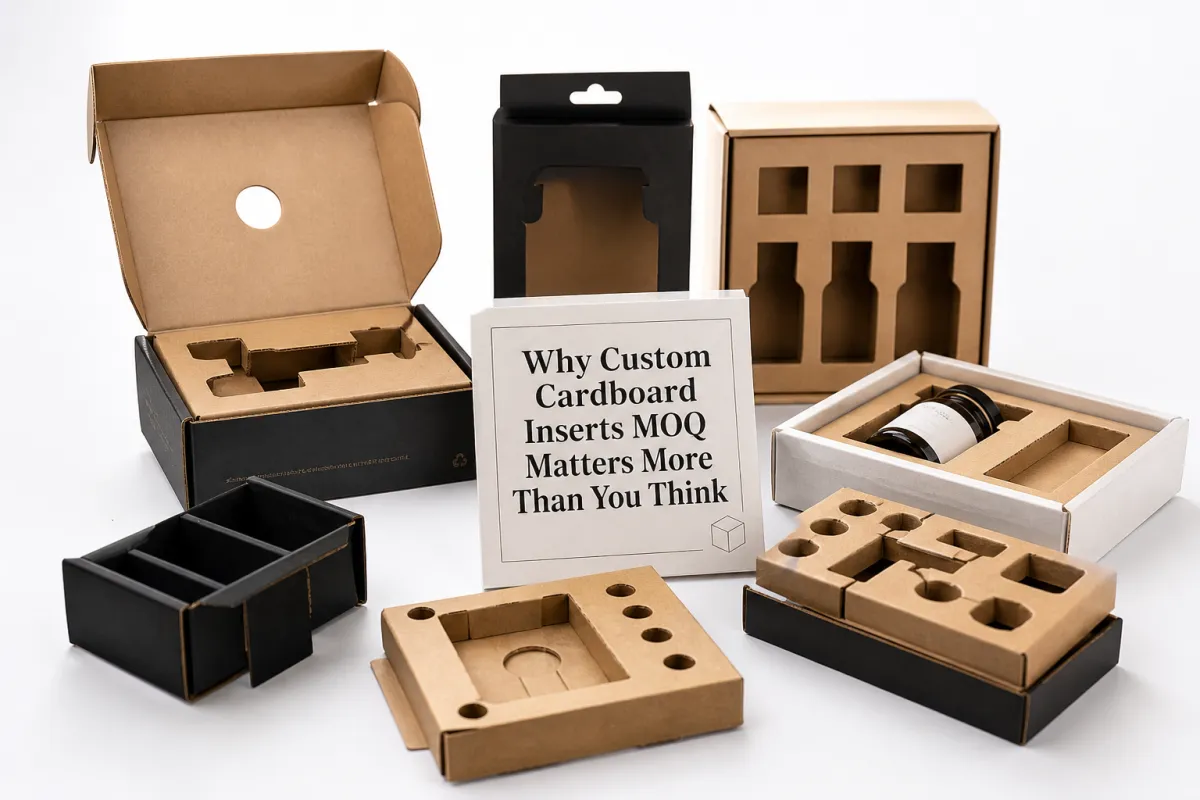
custom cardboard inserts moq affects the whole purchase decision because it sits at the intersection of design, production, and freight. A buyer may think the job is only about getting a die-cut shape into a box, yet the insert has to perform in the warehouse, during shipping, and on the shelf. If the cavity is too loose, the product moves. If it is too tight, edges scuff or the user struggles to remove the item. Either way, the packaging stops doing its job. A well-planned custom cardboard inserts moq prevents those tradeoffs from showing up after production has already begun.
There is also a simple manufacturing truth here. Every custom insert needs some form of setup: die creation, press adjustment, first-article checks, and usually a bit of scrap while the line gets dialed in. That setup cost does not vanish just because the order is small. The MOQ exists to spread fixed work across enough units to make the run practical. A higher custom cardboard inserts moq is not always a sales tactic; more often it reflects the cost of getting a precise, repeatable part off the press.
From a logistics point of view, an insert can save money even when it adds material. A shaped retention cavity may reduce the need for bubble wrap, tissue, or extra partitions. A cleaner stack-up can also make the outer carton smaller, which helps with cubic freight and shelf-ready presentation. In retail packaging, that matters more than many buyers expect. The best insert often improves the unit cost of the full pack-out even if the insert itself is slightly more expensive. That is why custom cardboard inserts moq should be judged against the whole packaging system, not just the line item for the insert.
Quote requests move faster when the buyer defines the risk. Is the product fragile? Does it have a coated surface that scratches easily? Is it shipped parcel, palletized, or both? A glass bottle needs different support than a cosmetic tube, and a molded plastic component behaves differently from a machined part with sharp edges. Those details shape the board grade, cavity depth, and retention method. They also influence whether a lower MOQ is realistic or whether a more efficient structure is the better path.
The most common mistake is asking for a generic insert and assuming the first quote will solve the fit problem. It usually does not. A precise custom cardboard inserts moq discussion starts with the product itself, then the box, then the handling method. That order saves time and usually saves money too.
Custom Cardboard Inserts: Materials, Styles, and Fit
Custom cardboard inserts come in several practical build types, and the right one depends on how the product ships. Corrugated board is common for heavier items because it gives good crush resistance and can be die-cut into strong cavities. Paperboard, including SBS or C1S cover stock, is often used for lighter retail packaging and presentation kits where print quality matters. Folded partitions work well for dividing multiple items inside one carton, while layered components can build depth and keep irregular shapes in place. The right board choice has a direct impact on custom cardboard inserts moq because some materials are more efficient to cut, crease, and assemble than others.
Fit matters more than most people think. A cavity that looks correct on a drawing can behave differently once a product with a cap, closure, trigger, or molded seam is placed inside it. That is why it helps to measure the actual sample product, not only the spec sheet. Real parts vary slightly. Caps sit a little high. Mold lines add thickness. Finishes change friction. For that reason, custom cardboard inserts should be designed with some tolerance where needed, especially if the product has a decorated surface or a glossy coating that can mark easily.
Retention points deserve careful attention. Tabs, folds, shoulder stops, and partial wraps can hold an item firmly without over-clamping it. If the insert squeezes too hard, the user may fight the pack or damage the finish. If it holds too loosely, the item rattles in transit. Good packaging design balances contact and clearance. That is why custom cardboard inserts moq can be affected by how much geometry is built into the part. More complex retention features can improve performance, but they may also require a more exact die line and a higher production threshold.
For branded packaging, the finish is part of the material choice too. An insert may remain plain and functional inside a shipping carton, or it may be printed, coated, or matched to custom printed boxes for a more polished unboxing sequence. In a retail packaging program, even the hidden components can reinforce package branding if the fit is crisp and the product sits in a predictable orientation. A clean tray, a well-scored folder, or a neatly nested partition adds to perceived quality without demanding unnecessary decoration.
Standard and fully custom layouts solve different problems. A standard template can sometimes be adapted quickly if the product dimensions are close to an existing structure, and that can help reduce lead time and soften custom cardboard inserts moq. A fully custom layout makes more sense when the product is unusual, fragile, or part of a multi-piece kit that needs exact orientation. If you are not sure which direction is best, a supplier should be able to show both options and explain the tradeoff between cost, protection, and scheduling.
For projects that need shipping validation, it helps to review recognized test methods such as those published by ISTA. And if the board source matters to your procurement policy, FSC-certified fiber can be a relevant requirement. Those standards do not design the insert for you, but they give the team a practical frame for comparing materials and shipment conditions.
Specifications That Control Custom Cardboard Inserts MOQ
If you want to understand custom cardboard inserts moq, start with the spec list. The core items are product dimensions, weight, number of cavities, product orientation, board thickness, and whether the insert needs print, coating, or a special finish. A simple single-cavity tray can often be produced at a lower threshold than a multi-cavity insert with different pocket sizes, because the layout is easier to cut and the waste rate is lower. The more variables involved, the more likely the MOQ rises.
Board thickness and flute selection affect both cost and performance. Thin paperboard can be elegant, but it will not support the same load as a corrugated structure. E-flute and B-flute each behave differently in crush resistance and fold quality. Score direction also matters, because a score that runs the wrong way can crack on the fold or weaken a wall that needs support. These details are not just technical trivia; they can change how efficiently a supplier can make the part, which in turn influences custom cardboard inserts moq.
Tolerance is another hidden driver. Tight fit requirements mean more careful die setup and more attention to the first sample. If the product must sit within a very narrow pocket, the die line often needs more fine-tuning and the press waste can climb during make-ready. That can push a project from a comfortable production quantity into a higher MOQ range. The same is true for inserts with several cavity sizes in one sheet. Nested shapes may look efficient in a drawing, but if they create complicated cuts or awkward grain direction, the practical threshold moves upward.
Real product samples are better than drawings alone. A molded part, a cap, a lid, or a closure can vary a few millimeters from the nominal dimension, and those few millimeters matter once the insert is cut. A physical sample lets the supplier test retention, friction, and pack-out sequence. It also helps confirm whether the outer carton needs a different depth or whether the insert should include more clearance. That small test-fit step can prevent a costly correction later and often gives the clearest answer on custom cardboard inserts moq.
Assembly method should not be overlooked either. A flat die-cut insert that ships unassembled is one thing. A folded or glued insert is another. Hand assembly adds labor, and labor changes the economics of the run. If the design requires multiple folds, tabs, or adhesive points, the practical MOQ usually rises because the line needs enough volume to justify the extra handling. Buyers who compare quotes without asking about assembly often miss the real reason one custom cardboard inserts moq looks lower than another.
One useful habit is to ask for a sample approval before full production. Even a short prototype run can reveal whether the insert holds the product too tightly, whether the board buckles at the corners, or whether the carton closure interferes with the top layer. The sample stage is where minor changes are cheapest. Once the full run starts, every adjustment becomes more expensive.
Custom Cardboard Inserts MOQ, Pricing, and Volume Breaks
Pricing follows the same logic as MOQ: fixed work first, variable cost second. A quote for custom cardboard inserts moq usually includes board grade, sheet size, die tooling, print coverage, finishing, labor, and shipping. The first run carries more setup cost per unit because the die and press work are spread across fewer pieces. If the insert is simple, the setup penalty may be modest. If it is highly customized, the first run can feel expensive. That does not mean the price is wrong; it means the setup is being carried by a smaller volume.
Volume breaks usually appear in steps, not smooth curves. Once the design is locked, the sheet layout improves and the unit cost drops as quantity climbs. A 1,000-piece order may have a noticeably higher unit cost than a 2,500-piece order, and a 5,000-piece order may drop again if the sheet yield is strong. That is normal. The key is to see whether the custom cardboard inserts moq is being driven by material yield, manual assembly, or cutting setup. Each driver suggests a different way to save money.
| Insert Option | Best Use | Typical MOQ | Typical Unit Cost at Scale | Production Notes |
|---|---|---|---|---|
| Die-cut corrugated insert | Heavier items, shipping protection, glass, hardware | 1,000-3,000 pcs | $0.18-$0.42 | Strong support, efficient for transit-focused product packaging |
| Folded paperboard insert | Cosmetics, retail packaging, lightweight kits | 2,000-5,000 pcs | $0.10-$0.24 | Cleaner appearance, good for branded packaging and print-heavy jobs |
| Layered or multi-piece partition | Multi-item sets, gift boxes, separated components | 3,000+ pcs | $0.22-$0.55 | More assembly time, higher setup, useful for custom printed boxes with multiple items |
Those numbers are practical ranges, not promises. Board grade, cavity count, coating, and shipping distance can move the quote up or down. A white, uncoated insert with a simple die line usually lands lower than a printed insert with a coating or a special fold sequence. If the quote seems high, ask for the breakdown. A good supplier should show where the money is going instead of hiding it inside a single line item. That transparency makes custom cardboard inserts moq easier to manage and easier to defend inside a purchasing review.
There are also straightforward ways to control spend without sacrificing fit. Simplify the cavity geometry. Reduce the number of part sizes in one layout. Use a standard board grade if the product weight allows it. Align the insert with the carton footprint so the sheet nests efficiently. Each of those decisions can lower waste, reduce assembly time, and help the project qualify at a better custom cardboard inserts moq. If a supplier suggests a small design change that lowers price without hurting protection, that is usually a good sign.
One more point matters in transaction-focused buying: compare the insert quote against the cost of damage, void fill, and labor. A slightly higher unit price can still be the better commercial choice if it reduces returns or makes pack-out faster. Many teams find that the right insert lowers the full cost of the finished pack, especially in branded packaging and retail packaging programs where presentation counts as much as protection.
Process and Timeline for Custom Cardboard Inserts
The process for custom inserts usually starts with an inquiry, moves to a quote, then into dieline development, sample approval, production, finishing, packing, and outbound freight. A simple blank insert can move faster than a printed, multi-cavity, or hand-folded structure because there are fewer variables to check. That is one reason custom cardboard inserts moq and lead time are linked. A cleaner design often means a cleaner schedule.
Complete information shortens the timeline. Product dimensions, product weight, carton size, shipping method, and branding requirements should all be included in the first request. If the insert has to fit inside a mailer, a rigid presentation box, or a standard shipper, the outer carton details matter just as much as the product itself. Missing data causes back-and-forth, and back-and-forth burns days. The quickest projects are usually the ones where the buyer sends a sample or a measured drawing immediately and asks for a practical custom cardboard inserts moq range up front.
Revisions are the biggest schedule risk. A change to cavity depth, wall thickness, or carton compatibility may require a new sample or a revised die line. Even a small change can ripple through the nesting pattern. That is not a problem if it is caught early. It becomes a problem when the team approves a concept before checking fit. In practice, the fastest path is often a narrow prototype run, then a production order once the sample is confirmed. That approach keeps custom cardboard inserts moq realistic and avoids expensive rework.
A common timeline for a straightforward project might look like this: 2-4 business days for a quote and dieline review, 3-7 business days for sampling, and 10-15 business days from proof approval to production completion. If the structure requires heavy hand assembly, a special coating, or custom printed boxes with more complex artwork, add time. Freight is separate and depends on destination and carrier selection. Buyers who need launch readiness should plan backward from the in-store or warehouse date, not forward from the day they approve the artwork.
For programs that need short-term bridge supply, ask about a pilot order or a limited run before the larger replenishment. That can be a smart way to check fit and release inventory without locking too much cash into the first run. A smaller pilot also gives the team a real-world chance to see whether the insert loads quickly on the packing line and whether the outer carton closes cleanly. If the pilot goes well, the full custom cardboard inserts moq becomes easier to commit to.
From a packaging operations standpoint, the best lead times come from clear ownership. One person should confirm dimensions, another should approve artwork, and someone should be accountable for sample acceptance. When the approval path is clean, production can stay on schedule. When it is scattered, delays tend to show up at the worst possible moment.
Why Choose Us for Custom Cardboard Inserts
A good packaging partner does more than accept an order. It helps the buyer Choose the Right board, the right structure, and the right balance between protection and presentation. That matters because custom inserts are part of a larger packaging system, not a standalone item. The best suppliers look at the carton, the product, and the shipping path together, then recommend the simplest structure that still does the job. That kind of guidance often improves custom cardboard inserts moq because it removes unnecessary complexity before production starts.
Consistency matters as much as design. If the insert has to protect products across multiple shipments, channels, or storage conditions, the board and scoring need to stay predictable from run to run. A buyer should be able to reorder six months later and get the same fit. That is especially important in product packaging programs where retail packaging and shipping packaging share the same structure. The fewer surprises there are, the easier it is to plan inventory and unit cost.
Clear communication on MOQ, lead time, and design limits is another reason buyers stay with a dependable supplier. Nobody benefits from a low quote that later grows extra charges for tooling, revisions, or hand work. Honest guidance early in the process is more useful than a polished promise that cannot survive the pressroom. If a change can lower risk or cost, it should be explained plainly. If a design is likely to push custom cardboard inserts moq higher, that should be said before the order is approved.
Another advantage is practical problem-solving. A supplier that reviews samples, checks fit, and suggests small structural edits can often save a project from avoidable damage. Sometimes that means shaving a cavity wall, changing the grain direction, or adjusting the insert so it nests better inside the outer box. Small changes like that can reduce waste, improve production speed, and make the whole order easier to handle. That is the kind of work that turns custom cardboard inserts from a commodity into a reliable packaging component.
If you are building a larger packaging program, it also helps to work with one team across multiple product lines. Matching inserts, cartons, and presentation components creates a cleaner package branding story and reduces the chance that different parts arrive with mismatched finishes or measurements. That is useful whether the order is a single launch or a broader family of custom cardboard inserts moq projects tied to seasonal or replenishment demand.
Next Steps to Get an Accurate Quote
The fastest way to get a useful quote is to send complete data. For custom cardboard inserts moq, that means product dimensions, product weight, quantity target, carton size, shipping method, branding needs, and whether the insert holds one item or several. If the product is fragile, say so. If the finish scratches easily, say that too. The more clearly the use case is described, the more accurate the first quote will be.
Whenever possible, include a sample product or a dimensioned drawing. A physical sample is better because it lets the supplier check the real fit, not just the nominal measurement. If the item has a cap, a screw top, a molded seam, or an irregular curve, the sample matters even more. A measured drawing helps when samples are not available yet, but the best quoting results come from both. That small step often narrows the custom cardboard inserts moq discussion to a practical range instead of a guess.
It is also wise to decide whether the project needs a prototype run, a pilot quantity, or full production. Those are different business decisions. A prototype is for fit and function. A pilot quantity is for line testing and market response. Production is for scale. Each one affects MOQ, timing, and price. Buyers who separate those phases usually get better control over both cash flow and inventory. They also get a cleaner answer when they ask for custom cardboard inserts moq Pricing and Lead Time.
When you compare options, ask for two versions if possible: the most economical structure and the most protective structure. That comparison makes the tradeoff visible. Maybe a lighter paperboard insert is fine for retail display, while a die-cut corrugated version is better for shipping. Maybe a simpler cavity works just as well if the carton is reinforced. Seeing both choices side by side makes purchasing decisions easier and keeps the conversation grounded in real performance rather than assumptions.
For a quick starting point, you can review the FAQ and then request a quote with the product details above. If you are building a broader launch kit, our Custom Packaging Products page can help you match inserts with cartons and presentation pieces. Once the specs are in hand, the team can evaluate sample plans, unit cost, and lead time before you commit to the final custom cardboard inserts moq.
What affects custom cardboard inserts MOQ the most?
The biggest drivers are die-cut setup, sheet layout efficiency, and whether the insert uses standard board sizes or a highly customized shape. Complex cavity patterns, tight tolerances, and manual assembly steps usually push the MOQ higher because they add time and waste to the run. If the part nests well and uses a straightforward die line, custom cardboard inserts moq can often stay within a more practical range.
Can I lower custom cardboard inserts MOQ without sacrificing fit?
Yes, often by simplifying the cavity design, using a standard board grade, or adjusting the layout so more pieces fit on each sheet. A sample-fit review is the safest way to reduce quantity pressure without losing product protection. In many cases, a small design change lowers the custom cardboard inserts moq more effectively than pushing for a smaller order on the same structure.
How does custom cardboard inserts pricing change with quantity?
The first order usually carries the highest unit cost because setup and tooling are spread across fewer pieces. As quantity rises, the per-unit cost often drops when material yield improves and setup is amortized across more inserts. That is why a quote for custom cardboard inserts moq should always be read alongside the volume break points, not as a single number in isolation.
What information do I need for a custom cardboard inserts quote?
Provide product dimensions, weight, product count per box, carton size, shipping method, and any print or finish requirements. If possible, send a physical sample or a measured drawing so the supplier can verify cavity fit before estimating MOQ. The better the input, the more accurate the custom cardboard inserts moq estimate will be, especially for fragile or unusually shaped products.
How long does it take to produce custom cardboard inserts?
Simple inserts may move faster than multi-cavity or highly engineered designs, but the timeline depends on sample approval and production queue. The fastest way to avoid delays is to submit complete specs and confirm the sample as early as possible. For many projects, the lead time is driven less by the press itself than by how quickly the buyer can approve the right custom cardboard inserts moq and the final fit.
If you want a quote that holds up in production, send the product sample or drawing, confirm the carton size, and ask for one version that favors protection and one that favors sheet yield. That single comparison usually exposes the real tradeoff behind custom cardboard inserts moq. Once the structure, board, and volume are aligned, the insert protects the product, supports the brand, and keeps the order on budget.

