Buyer Fit Snapshot
| Best fit | Custom Telescope Boxes Manufacturer projects where brand print, material claims, artwork control, MOQ, and repeat-order consistency need to be specified before quoting. |
|---|---|
| Quote inputs | Share finished size, material target, print colors, finish, packing count, annual reorder estimate, ship-to region, and any compliance wording. |
| Proofing check | Approve dieline scale, logo placement, barcode or warning zones, color tolerance, closure strength, and carton packing before bulk production. |
| Main risk | Vague material claims, crowded artwork, missing packing details, or unclear freight terms can make a low unit price expensive after revisions. |
Fast answer: Custom Telescope Boxes Manufacturer: Board, Finish, Dieline, and Unit Cost should be specified like a repeatable production item. The safest quote records material, print method, finish, artwork proof, packing count, and reorder notes in one written spec.
Production checks before approval
Compare the actual filled-product size with the drawing, then confirm tolerance on folds, seals, hang holes, label areas, and retail display edges. Reserve space for logos, QR codes, warning copy, and material claims before decorative graphics fill the panel.
Quote comparison points
Review material grade, print process, finish, sampling route, tooling charges, carton quantity, and freight assumptions side by side. A quote is only useful when the supplier can repeat the same color, closure quality, and packing count on the next order.
Custom Telescope Boxes Manufacturer: Key Buyer Guide
A custom telescope boxes manufacturer is rarely solving a simple box problem. The real challenge is movement, because telescope damage usually starts with tiny shifts inside the carton long before anything dramatic happens in transit. A tube that can slide 8 mm, a lens cap that rattles, or an accessory tray drifting into empty space will do more harm than a single rough drop.
That is why telescope packaging sits right where packaging design, engineering, and package branding meet. The box has to protect long, narrow optics, look deliberate on arrival, and hold up to warehouse handling that is often less gentle than anyone likes to admit. For Custom Logo Things, that is the part buyers tend to underestimate: the best-looking carton is not always the best-performing carton, and the cheapest shipping box can become expensive once returns, replacements, and customer complaints enter the picture.
If you are comparing options, a Custom Packaging Products page can help frame the broader packaging formats available, while the About Custom Logo Things page gives more context on the team and its approach. The real question is simple: what does a custom telescope boxes manufacturer actually do that a stock carton supplier cannot?
Why telescope packaging fails in the smallest gaps
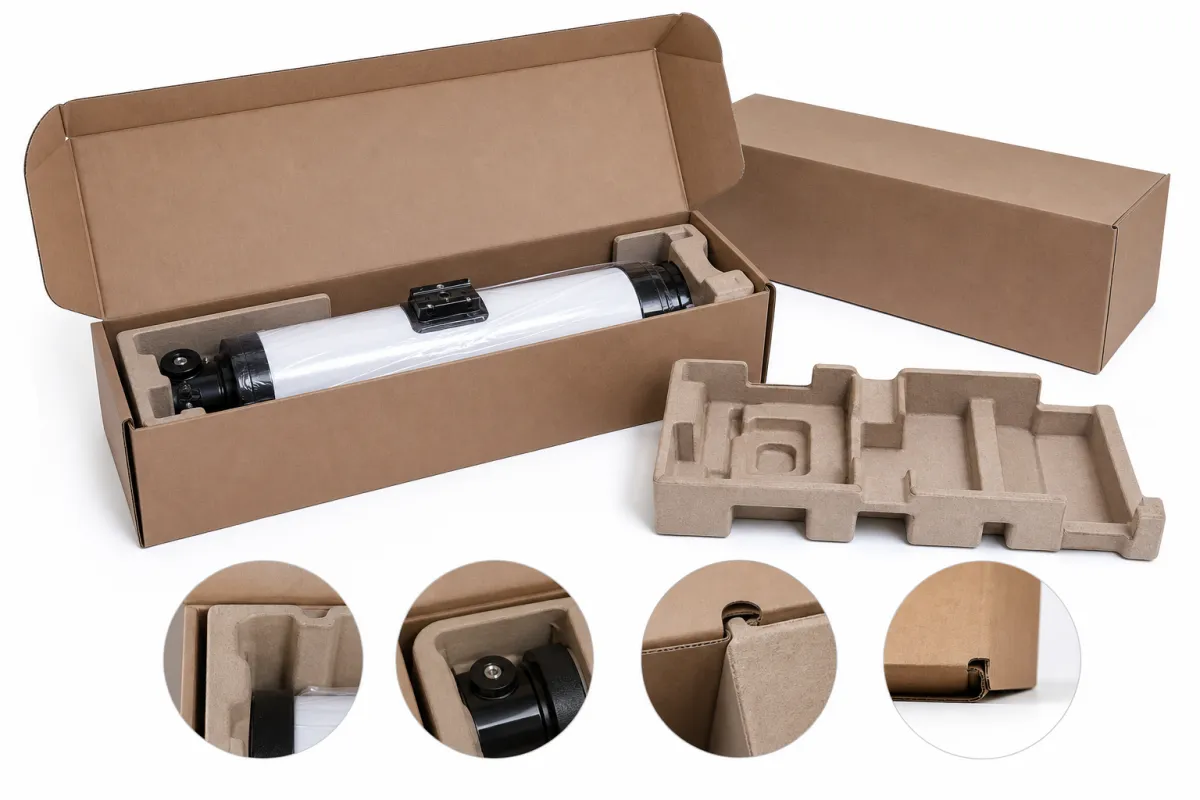
Telescope packaging fails in places people do not see. A box can survive a few cosmetic scuffs and still fail the product, because internal motion does most of the damage. Optical tubes are long, narrow, and often heavier at one end. That shifts the center of gravity, which means the same box that feels secure on a table can behave very differently on a conveyor, in a truck, or during a 36-inch drop test.
A custom telescope boxes manufacturer earns its keep in those tiny spaces. Generic cartons are built around general dimensions, not around the specific weight distribution of a telescope, finder scope, mount parts, or accessory set. If the void space is too large, the product can accelerate inside the box before it stops. If the fit is too tight, the packaging may protect well in transit but fail during pack-out, because workers need time and consistency to close it correctly. In practice, both problems cost money.
From a buyer's point of view, the business case is straightforward. A custom-fit structure usually reduces filler, lowers the chance of damage, and improves the unboxing experience at the same time. A generic carton might save a few cents on paperboard, but if it requires extra foam, more void fill, or a higher return allowance, the real cost climbs fast. That is why a custom telescope boxes manufacturer is often part engineer, part production planner, and part brand translator.
A telescope carton that looks elegant but lets the tube wander is just expensive empty space.
The strongest programs usually treat telescope packaging as a system: the outer shipper, the insert, the internal wrap, the print layer, and the fulfillment flow all need to work together. That is especially true for retail packaging and premium optics, where the packaging is not just a shipping tool. It is also a signal of care. Buyers notice that signal immediately.
For fragile optical goods, the difference between a standard carton and a well-built system can show up in return rates, not just in damage claims. A custom telescope boxes manufacturer helps close those small gaps before they become expensive ones.
What a custom telescope boxes manufacturer actually does
A custom telescope boxes manufacturer designs, samples, and produces packaging around the actual telescope, its accessories, and the shipping conditions it will face. That sounds simple until the details show up. The manufacturer has to think about dimensions, board grade, insert geometry, graphics, closing style, and how the finished package will be packed by hand or by machine.
Stock cartons only answer one question: "Will the product fit?" A custom program asks a better set of questions. How much movement is acceptable? Where does the heaviest component sit? Does the customer open the box from the side or the top? Will the package travel by parcel, pallet, or retail replenishment? A good custom telescope boxes manufacturer turns those answers into a working structure instead of a guess.
Common telescope formats need different packaging logic. A starter scope might only need a corrugated shipper with molded paper pulp or die-cut inserts. A premium optical tube may need a rigid presentation sleeve, custom printed boxes, and a layered insert that holds the tube, caps, manual, and eyepieces in place. A multi-piece kit can require a compartmental layout so accessories do not collide during transit. The packaging for each one should be different because the risk profile is different.
That is also where branded packaging comes in. The manufacturer is not just protecting product packaging; it is shaping the first physical encounter a buyer has with the brand. Clean print registration, steady color, and a clear structure tell the customer the contents were handled with discipline. That matters for specialty optics, where trust is part of the sale.
A capable custom telescope boxes manufacturer adds value beyond printing in several ways:
- It recommends material grades that fit the product weight and channel.
- It builds inserts that stop movement without making pack-out painfully slow.
- It can support transit planning using methods aligned with common industry tests such as ISTA and ASTM D4169.
- It adjusts the format for e-commerce, retail shelving, or direct-to-consumer fulfillment.
For transit confidence, the International Safe Transit Association publishes widely used test methods on ISTA. For fiber sourcing, FSC remains a reference point for responsible material choices. A strong custom telescope boxes manufacturer does not need every program to be overbuilt; it needs the right structure for the shipment profile.
If the supplier cannot explain why one insert style protects better than another, that is a warning sign. A serious custom telescope boxes manufacturer should be able to discuss board strengths, fluting, score lines, closures, and the practical side of pack-out efficiency without hiding behind vague language. I have seen otherwise good packaging fail because nobody asked how the product would behave after the third truck transfer, which is a very real thing in freight.
Custom telescope boxes manufacturer process, timeline, and production steps
The production path usually starts with three things: exact product dimensions, shipping method, and brand goals. A custom telescope boxes manufacturer cannot do useful structural work from a product name alone. It needs the tube length, diameter, weight, accessory list, and any storage constraints tied to the fulfillment line or retail display.
Once those inputs are clear, the manufacturer develops a dieline and a structural concept. That first concept may be a simple corrugated mailer, a two-piece retail setup, or a tuck-end carton with a custom insert. The point is not to make it pretty first. The point is to make it fit and perform. After that, the design can be refined for graphics, coating, and unboxing flow.
A typical custom telescope boxes manufacturer process looks like this:
- Brief and specs - The buyer shares telescope dimensions, weight, accessory count, target channel, and ship method.
- Structure development - The manufacturer creates a dieline and proposes board, flute, or rigid stock options.
- Prototype or sample - A flat or assembled sample checks fit, closure, and insert alignment.
- Artwork proof - Logos, colors, warning copy, and barcode placement are reviewed before print.
- Production - Cutting, printing, die cutting, folding, gluing, and inspection follow approved specs.
- Freight and pack-out planning - Pallet counts, bundle counts, and carton labeling are set so fulfillment stays smooth.
Lead time depends on the complexity of the job. Simple corrugated runs can move faster than premium retail packaging with specialty finishes or custom inserts. For many programs, a realistic window is often 12 to 20 business days after proof approval, but that can stretch if the buyer changes artwork late, asks for multiple samples, or needs specialty materials that are not already in stock. A reliable custom telescope boxes manufacturer will say that early and plainly, not dress it up with fluffy language.
Where do delays usually happen? Three places. First, unclear measurements. Second, accessory lists that arrive late, especially if the buyer forgot caps, manuals, cleaning cloths, or mounting hardware. Third, last-minute artwork changes that require a new proof. A custom telescope boxes manufacturer can correct technical issues, but it cannot recover time that was never scheduled in the first place.
The safest planning approach is to work backward from the launch date. If the packaging needs to be in the warehouse before the telescope ships, sample approval should happen well before the marketing calendar gets crowded. For holiday or trade-show demand, the margin is even tighter. A four-week delay in packaging can quietly become a product launch problem, and that is usually more painful than a unit-cost increase.
One practical habit helps here: ask the custom telescope boxes manufacturer which step is most likely to become the bottleneck. Sometimes it is board sourcing. Sometimes it is print approval. Sometimes it is freight booking. Good planning begins with the weakest link, not the strongest one.
Custom telescope boxes manufacturer pricing, MOQ, and unit cost
Pricing is where many buyers make their first bad comparison. A custom telescope boxes manufacturer does not price a telescope carton the same way it prices a plain shipping box, because the inputs are different. Board grade, insert style, print coverage, coatings, dimensions, and order volume all change the final number.
MOQ, or minimum order quantity, matters because setup costs have to be spread across the run. A low-volume order may carry a higher per-unit price simply because tooling, plates, and labor setup are divided across fewer boxes. That does not mean small runs are a bad idea. It means the economics are different. A good custom telescope boxes manufacturer will explain the tradeoff rather than pretending every quantity behaves the same.
For a clearer view, compare three common structures below. These are broad working ranges, not quotes, because final pricing depends on size, print coverage, and material market conditions.
| Packaging option | Typical use | Approximate unit cost | What drives the price |
|---|---|---|---|
| Plain corrugated shipper | Basic e-commerce protection | $0.55-$1.10 | Board grade, size, simple print, standard die cut |
| Printed corrugated box with insert | Balanced protection and branding | $1.10-$2.40 | Print coverage, insert complexity, coating, run size |
| Premium retail-ready telescope box | Display and presentation-led programs | $2.40-$5.50+ | Rigid stock, specialty finishes, precise fit, higher labor |
Those ranges can move up or down. A simple shipper for a short optical accessory may land lower. A rigid box with foil, soft-touch coating, and precision inserts may land higher. A custom telescope boxes manufacturer should be able to explain the drivers line by line so buyers know which choices affect cost and which ones only improve appearance.
Here is the basic pricing checklist that makes quotes easier to compare:
- Exact product dimensions and weight.
- Accessory count and accessory size.
- Box style, insert style, and closure type.
- Print colors, coverage percentage, and finish requests.
- Order quantity and expected reorder frequency.
- Shipping destination and whether freight is included.
That checklist matters because vague requests hide real costs. Two quotes can look similar on paper and still be impossible to compare. One supplier might include a basic insert; another may leave it out. One might quote freight. Another may not. One might assume the telescope ships in a single inner carton; another may design a two-part system. A good custom telescope boxes manufacturer will push for clarity before it prices the job.
There is also a smart way to reduce unit cost without weakening the package. Simplify the finish, reduce unnecessary print coverage, and standardize sizes if the product line allows it. For many buyers, the biggest savings come from better dimensional discipline, not from chasing the lowest board grade. A custom telescope boxes manufacturer can usually show where the cost is coming from if asked for a quote breakdown.
Key factors that determine box strength, fit, and brand impact
Strength starts with structure, not decoration. A custom telescope boxes manufacturer has to choose a board grade and flute profile that can handle storage compression, parcel handling, and the product's own weight. For some telescope formats, a single-wall corrugated box is enough. For heavier kits, a stronger board or a double-wall build may be safer. The decision depends on the shipping route, not just the SKU.
Fit is equally important, and too many buyers treat it like an aesthetic detail. It is not. A gap of a few millimeters can let a telescope tube build momentum before impact. A tight, well-planned fit reduces that movement, but it also needs to allow for easy insertion and removal. The best custom telescope boxes manufacturer will balance protection with practical assembly speed so the pack-out team is not fighting the carton every hour.
Brand impact matters because telescope buyers are often enthusiasts. They notice quality cues. They notice print registration, ink density, the feel of a matte finish, and whether the lid opens in a satisfying way. That is where custom printed boxes can add value without becoming flashy. Clean labeling, thoughtful copy, and a consistent design system communicate competence. A strong package can make the telescope feel more premium before the product is even assembled.
Material choices also matter for sustainability. Right-sized packaging reduces filler and can lower freight waste. Recyclable corrugated structures are common, and FSC-certified fiber can support responsible sourcing goals. A good custom telescope boxes manufacturer will not promise that every sustainability choice is free, because it is not. It can still explain where recycled content, reduced void fill, or lighter board helps the total packaging footprint.
Channel-specific needs change the equation too:
- E-commerce needs parcel durability, clean labeling, and efficient pack-out.
- Retail shelves need shelf appeal, barcode placement, and a structure that opens well in store.
- Direct-to-consumer fulfillment usually values fast assembly, strong presentation, and low damage rates.
That is why a custom telescope boxes manufacturer should ask about the channel before suggesting a format. A box designed for display may be too ornate for a high-speed warehouse. A box designed for drop protection may feel too plain for premium retail. The right answer depends on the selling motion, not on taste alone.
One useful test is to imagine the packaging after three pressures: stacking, vibration, and handling. If the structure still looks credible after those stress points, the design is probably on the right track. A custom telescope boxes manufacturer that understands this will talk about performance before finish.
Common mistakes buyers make when sourcing telescope packaging
The first mistake is measuring only the telescope tube. A custom telescope boxes manufacturer needs the full pack-out picture: caps, manuals, eyepieces, mounts, cables, protective wraps, and anything else that shares space in the box. Buyers often discover too late that the product fits, but the accessories do not. That creates a last-minute redesign or, worse, a carton that forces the packer to improvise.
The second mistake is choosing appearance first and protection second. Beautiful packaging that fails in transit is expensive theater. The product may look polished on a shelf, but if the inner structure allows motion, returns will erase the savings. A capable custom telescope boxes manufacturer should talk plainly about board strength, cushioning, and insert geometry before discussing foil or spot UV.
The third mistake is sending vague quote requests. "Need custom telescope boxes" is not enough. Neither is "need something premium." Suppliers need dimensions, volume, finish details, and whether the quote includes freight. Without that, one quote may look low because it is incomplete, while another may look high because it includes the full system. A responsible custom telescope boxes manufacturer will still ask clarifying questions even if the buyer does not volunteer them.
The fourth mistake is skipping the sample. That is the one that hurts most. A pre-production sample can reveal weak corners, bad insert alignment, or a box that looks fine in CAD but awkward in real hands. One sample run is much cheaper than correcting a full production batch. From the perspective of a custom telescope boxes manufacturer, sampling is not extra bureaucracy; it is risk control.
The fifth mistake is ignoring warehouse reality. Packaging has to work for the team that packs, labels, and ships it. If the carton takes too long to fold, or the insert blocks barcode placement, the design becomes a labor problem. If the stack height is wrong, the warehouse may crush product during storage. A thoughtful custom telescope boxes manufacturer will ask how the boxes are handled after production, not just before it.
Here is a quick way to spot trouble before it starts:
- Ask for a sample that includes all accessories.
- Test the box with the actual packing team.
- Check how the carton behaves under vibration and stack load.
- Confirm barcode, warning text, and shipping label placement.
- Review what happens if the telescope is repacked after inspection.
That small checklist can prevent a surprisingly large amount of waste. A custom telescope boxes manufacturer can only design around the facts it receives, so the better the input, the better the result.
Expert tips and next steps for choosing the right partner
Start with a packaging brief. Not a casual email. A brief. It should list telescope dimensions, weight, accessory inventory, target channel, shipping method, and brand goals. When a custom telescope boxes manufacturer receives that kind of input, the first response is usually better because the supplier can focus on structure instead of chasing missing details.
Ask direct questions about sample speed, test methods, and material options. If a supplier can explain whether it supports drop testing, vibration testing, or stack assessment, that is useful. If it cannot explain the difference between a presentation box and a transit box, keep looking. A strong custom telescope boxes manufacturer should be able to discuss the tradeoffs in plain language.
Request a quote breakdown. You want to see where the money goes: board, print, insert, finishing, tooling, freight, and setup. That level of clarity helps buyers decide which features are truly worth paying for. Maybe the matte lamination matters. Maybe it does not. Maybe the insert needs to be rigid. Maybe a simpler die cut will do. A good custom telescope boxes manufacturer should make those calls visible.
Then order a prototype and use real people to test it. Put the sample into the hands of the packers, the quality team, and, if possible, someone who has not worked on the project. That person will spot the awkward step everyone else has learned to ignore. Check the box after vibration, drop, and stack scenarios. Inspect the corners. Shake the assembly. Open and close it several times. A custom telescope boxes manufacturer worth trusting will welcome that scrutiny.
There is also a practical sourcing strategy that works well: compare two or three suppliers, not ten. Too many bids can bury the useful differences. You want enough comparison to see how each custom telescope boxes manufacturer thinks about protection, unit cost, and presentation, but not so many that the decision turns into noise.
For readers who need multiple packaging formats beyond telescope kits, the Custom Packaging Products page is a useful place to compare structures before narrowing down the specification. If you want a better sense of how the company thinks about service, operations, and support, the About Custom Logo Things page is worth a look as well.
My practical advice: choose the custom telescope boxes manufacturer that gives you the clearest protection logic, not the flashiest sales language. Packaging that protects, fits, and presents well tends to save more money than packaging that merely looks good in a mockup.
The best fit is the supplier that can prove it understands your telescope, your channel, and your cost limits. That is what separates a capable custom telescope boxes manufacturer from a printer that only happens to sell cartons. Before you approve tooling, lock the dimensions, accessory list, and shipping path, then sign off on a sample packed by the same team that will handle the real run. That one step usually tells the truth faster than any pitch deck.
Frequently asked questions
What should I ask a custom telescope boxes manufacturer before requesting a quote?
Give exact telescope dimensions, accessory counts, shipping method, and the package style you want to achieve. Ask what materials, insert options, and print finishes are included versus optional upgrades, and confirm MOQ, sample cost, lead time, and whether freight is part of the estimate. A detailed brief helps the custom telescope boxes manufacturer quote the real job instead of guessing at it.
How do I compare custom telescope box manufacturers on more than price?
Compare sample quality, structural recommendations, and how clearly each supplier explains protection choices. Review turnaround time, communication speed, and whether the manufacturer can handle revisions without dragging out the schedule. Testing capability and quote transparency matter too, because the lowest number is not useful if the custom telescope boxes manufacturer leaves out inserts, freight, or finishing details.
What is the usual lead time for custom telescope packaging?
Lead time depends on sample rounds, print complexity, and raw material availability. Simple corrugated runs can move faster than premium retail boxes with custom inserts or specialty coatings, while more complex jobs may need extra proofing. Planning ahead helps avoid delays caused by artwork changes, approval cycles, and freight scheduling, so a custom telescope boxes manufacturer can stay on schedule.
How can I lower the unit cost of custom telescope boxes without hurting protection?
Simplify finishes, reduce unnecessary print coverage, and standardize box sizes where possible. Choose a structure that minimizes filler while still protecting the optics and accessories, and increase order volume if demand is predictable so setup costs are spread across more units. A custom telescope boxes manufacturer can usually find savings in structure and specification before it touches the protection level.
Do I need a sample before placing a full order with a custom telescope boxes manufacturer?
Yes, a sample helps confirm fit, strength, insert alignment, and the customer unboxing experience. A prototype can reveal hidden issues like accessory movement, weak corners, or awkward pack-out steps, and it is usually cheaper to correct those problems before production. That is often what separates a careful custom telescope boxes manufacturer from a supplier that only prints cartons.

