Buyer Fit Snapshot
| Best fit | Custom Tissue Inserts Wholesale for Shipping Programs projects where brand print, material claims, artwork control, MOQ, and repeat-order consistency need to be specified before quoting. |
|---|---|
| Quote inputs | Share finished size, material target, print colors, finish, packing count, annual reorder estimate, ship-to region, and any compliance wording. |
| Proofing check | Approve dieline scale, logo placement, barcode or warning zones, color tolerance, closure strength, and carton packing before bulk production. |
| Main risk | Vague material claims, crowded artwork, missing packing details, or unclear freight terms can make a low unit price expensive after revisions. |
Fast answer: Custom Tissue Inserts Wholesale for Shipping Programs should be specified like a repeatable production item. The safest quote records material, print method, finish, artwork proof, packing count, and reorder notes in one written spec.
Production checks before approval
Compare the actual filled-product size with the drawing, then confirm tolerance on folds, seals, hang holes, label areas, and retail display edges. Reserve space for logos, QR codes, warning copy, and material claims before decorative graphics fill the panel.
Quote comparison points
Review material grade, print process, finish, sampling route, tooling charges, carton quantity, and freight assumptions side by side. A quote is only useful when the supplier can repeat the same color, closure quality, and packing count on the next order.
Custom tissue inserts wholesale can change how a shipping program feels almost immediately, because the insert is often the first paper component a customer touches after opening the carton. That first touch affects the perceived care of the package, the cleanliness of the presentation, and whether the product sits neatly in place or rattles around like an afterthought. For a branded packaging program, the practical value is pretty simple: better product presentation, cleaner interior branding, and less wasteful repacking across recurring orders.
From a packaging buyer's point of view, tissue is not decorative filler. It is part of the working system. The right sheet size, print style, and paper weight can reduce void space, protect finishes, and keep pack-out consistent across warehouse teams or fulfillment partners. I have seen well-chosen tissue do a lot of quiet work on the line, especially when a team is shipping multiple SKUs and trying to keep the pack stable without adding extra bulk.
Wholesale buying changes the math. It spreads setup cost across more units, makes forecasting easier, and helps teams avoid last-minute repacks when a product line changes or a launch date moves. Used well, custom tissue inserts wholesale gives you three things at once: a cleaner presentation, better product separation, and more consistent pack-out from one location to the next. In shipping-heavy programs, that combination usually beats heavier rigid components because tissue adds very little freight weight while still carrying a strong package branding role.
Why custom tissue inserts wholesale changes unboxing economics
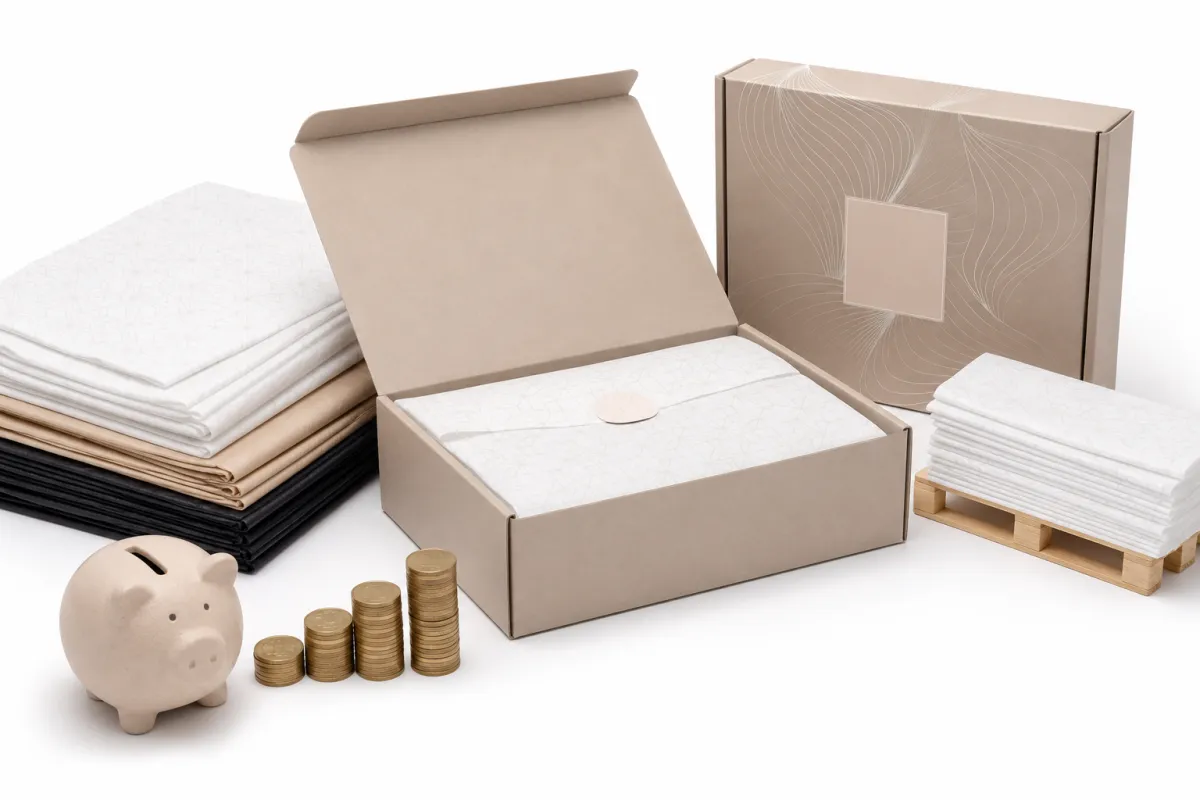
Tissue is one of the least expensive places to make a box feel more deliberate. A plain corrugated shipper can do the structural work, but a branded tissue layer does the visual work the moment the customer opens the carton. That first reveal matters in retail packaging, subscription programs, and direct-to-consumer shipping, because customers often judge the whole order by what they see in the first few seconds. If the product is sliding around in a large void or arriving loose against the carton wall, the unboxing feels unfinished even if the item itself is fine.
Custom tissue inserts wholesale changes that equation because the unit cost drops as the run size grows. The savings are not only in the paper itself. You also get fewer emergency reprints, fewer manual workarounds, and less labor spent stuffing voids with whatever is available that day. When a shipping program runs every week, that consistency adds up fast. A one-off order might look inexpensive at the quote stage, but a wholesale program is usually where the real economics show up.
Another advantage is product movement control. Tissue separates items that would otherwise scuff each other, and it creates a little friction that helps keep pieces from sliding during transit vibration. That matters for coated accessories, cosmetics, polished hardware, folded apparel, and anything with a sensitive finish. If the program uses custom printed boxes or a premium outer mailer, tissue also helps keep the inside of the pack clean and readable instead of cluttered with loose fillers.
Many teams spend more on rigid packaging than they need to. Rigid inserts have a place, yet they add cost, freight weight, and design complexity. A well-specified tissue insert can handle dust control, surface protection, and visual separation without adding much bulk. That is why custom tissue inserts wholesale works so well for shipping programs that need to scale without making the pack-out slower or more expensive.
A tissue insert that looks elegant on a flat proof but tears during pack-out is a labor problem, not just a design problem.
Buyers usually get the best result when they define the role of the insert early. Is it meant to display the product, protect the finish, fill empty space, or separate multiple items inside one carton? If the answer is all four, the sheet size, basis weight, and print coverage need to reflect that. That is the point where custom tissue inserts wholesale becomes less about decoration and more about packaging design that works every day in the warehouse.
For teams managing recurring shipments, wholesale tissue can also standardize the look across locations. One fulfillment center may pack faster than another. One team may fold more tightly. Another may tuck the ends differently. A tissue program with a clear spec reduces those variations and keeps the customer experience steadier. When the outside of the shipper and the inside presentation both feel deliberate, the whole package reads as stronger branded packaging.
There is also a small but real psychological effect here. A clean tissue wrap can make a modest product feel considered, while a messy interior can make a premium product feel rushed. That part is a little hard to quantify, but anyone who has opened enough cartons knows what I mean.
What custom tissue inserts wholesale can include
Custom tissue inserts wholesale is not a single product so much as a family of paper components that can be adapted to the job. The most common forms are sheet liners, product wraps, interleaves, and compartment separators. A liner sits flat and gives the box a finished interior. A wrap folds around the product, protecting the surface while adding a branded layer. Interleaves keep items from touching each other. Separators help in multipack kits, gift sets, and bundled promotions where several pieces need to stay visually organized.
That flexibility makes tissue useful across a wide range of shipping programs. Apparel brands use it for folded garments and accessories. Beauty companies use it around jars, palettes, and bottle sets. Food and specialty gift programs use it as a clean presentation layer between wrapped items. Jewelry, candles, ceramics, and light home goods often need that same balance of presentation and surface protection. In each case, the insert should do one job very well rather than trying to solve every packaging problem at once.
Branding options are straightforward but worth choosing carefully. A repeating logo pattern is usually the most efficient format for custom tissue inserts wholesale because it prints cleanly, folds well, and does not rely on a full-bleed image to carry the design. Single-color prints are often enough for elegant retail packaging. Border marks can keep the logo visible after folding. Full-sheet designs work when the brand wants a stronger reveal, but they need tighter control over registration and safe areas so the print still looks neat after creasing.
Layout choices matter just as much as the artwork. Tissue that wraps a product needs enough overhang for a clean tuck, but not so much that it turns bulky inside the carton. A liner inside a mailer may need a different size than the same tissue inside a rigid gift box. When buyers treat custom tissue inserts wholesale as part of the pack-out method rather than just an artwork project, they usually get better results and fewer production headaches.
The best programs start by defining the job of the insert early. A clear brief might say: protect the finish, keep dust off the product, support package branding, and reduce visible void space. That one paragraph tells the supplier more than a generic request ever could. It also keeps the project aligned with the rest of the product packaging system, including labels, tape, and any outer branded packaging components.
One more useful point: tissue can be a quiet premium signal. It is not loud. It does not need to be. A neat sheet with controlled repeat printing tells the customer that the pack was considered from the inside out. That is especially useful when the outer carton is simple or when the program already uses minimal custom printed boxes and needs the inner presentation to carry more of the brand story.
Custom tissue inserts wholesale specifications to lock down
If you want custom tissue inserts wholesale to perform well, the spec sheet has to be precise. The first item is sheet size, followed by folded size if the insert arrives pre-folded. Then comes basis weight or paper weight, print coverage, ink color, and whether the stock should be acid-free. Acid-free tissue matters more than many buyers realize, especially when the product has a sensitive finish, light-colored surfaces, or a long storage period before opening.
Paper weight changes the feel and the function. Lightweight tissue, often in the 17 gsm range, folds easily and gives a soft presentation. Midweight tissue, around 24 gsm, adds a little more body and resists tearing during handling. Heavier tissue, closer to 30 gsm, is better when the insert must hold up to repeated folding, sharper edges, or more aggressive pack-out movement. There is no universal best weight; the right choice depends on the product surface, the carton depth, and how much abuse the package sees in transit.
Finish matters too. Some tissue has a very smooth, refined hand feel. Some is slightly more crinkled and casual. That texture affects both the unboxing moment and the ease of folding on a packing line. A very soft tissue can look elegant but may slip more during assembly. A slightly firmer tissue may be easier for fulfillment teams to handle in volume. For custom tissue inserts wholesale, small differences in feel can make a real difference in labor and consistency.
Color control is another place where good buying practice pays off. If the tissue is branded to match a logo color or to coordinate with a line of custom printed boxes, the supplier should confirm how the color will be held from run to run. That means discussing approved references, acceptable tolerance, and whether the program expects the same appearance across multiple production lots. A buyer who skips that conversation often ends up with subtle shifts that do not look dramatic on press but do show up in the finished pack.
For shipping use, size logic should account for overlap and tuck space. A tissue sheet that looks right on a flat table may be too short once it wraps a product and folds into a carton. The insert should also respect the dimensions of the primary shipper or inner box. If the package uses a tuck-top mailer, for example, the tissue cannot interfere with the closure. If it is a gift-style box, the tissue may need to sit higher so the reveal feels deliberate. That is why custom tissue inserts wholesale should always be sized against the real pack-out, not just the product dimensions alone.
| Specification choice | Best use | Tradeoff to consider |
|---|---|---|
| 17 gsm tissue | Light presentation, simple liners, delicate fold behavior | Lower tear resistance during fast pack-out |
| 24 gsm tissue | Balanced wrap and liner applications, better handling strength | Slightly higher cost and a firmer fold |
| 30 gsm tissue | Heavier products, more abrasion resistance, repeated folding | More bulk inside smaller cartons |
| Simple repeat logo print | Efficient wholesale runs and clean package branding | Less visual impact than a full-coverage pattern |
| Full-sheet print | High-visibility retail packaging and reveal moments | More press time and tighter artwork control |
One design question worth asking early is how the insert will fold. A design that looks perfect as a flat proof may crowd the fold line or place the logo where it disappears under the tuck. That is not a minor detail. It changes how the customer sees the brand and how easy it is for the warehouse team to pack correctly. In a strong custom tissue inserts wholesale program, the printed area, repeat length, and safe margins are set with the fold in mind.
Where sustainability claims matter, ask for documentation rather than assumptions. If the stock is FSC-certified, confirm the chain of custody paperwork and make sure the supplier can support the claim in the way your brand team needs. For broader sustainability criteria and forest stewardship standards, see the FSC site. That kind of paperwork discipline matters when tissue is part of a larger branded packaging system and not just a standalone insert.
Another thing buyers sometimes skip is the fold test. A tissue that looks beautiful in a PDF can become awkward once it has to be packed fifty, five hundred, or five thousand times. A short sample run or even a hand-folded mockup will tell you more than a polished mockup ever will.
Custom tissue inserts wholesale pricing, MOQ, and volume breaks
Pricing for custom tissue inserts wholesale depends on a few core variables: sheet size, paper weight, number of print colors, how much of the sheet is covered, and how many total units are in the run. Setup cost is a real factor. So is sheet yield, because a larger format can waste more material if the layout is not planned well. Buyers who focus only on the unit price often miss the bigger picture, which is the total landed cost once freight, proofing, and any special packing are included.
MOQ is usually tied to production efficiency, not to a single arbitrary rule. A supplier may need enough volume to justify press setup, plate work, cutting, folding, and packing. In many wholesale tissue programs, that means a practical starting point somewhere around 2,500 to 10,000 sheets, depending on sheet size and print complexity. Larger or more heavily printed jobs may require more. If you are standardizing custom tissue inserts wholesale across several product lines, that shared demand can often push you into a better price band without changing the end use.
Here is a realistic way to think about volume breaks for a simple one-color program. These are approximate ranges, and they shift with size and print coverage, but they give a buyer a better starting point than a vague low cost promise.
| Order size | Typical unit range | What usually drives the number |
|---|---|---|
| 2,500 - 5,000 sheets | $0.18 - $0.34 each | Setup share, proofing time, smaller yield |
| 5,000 - 10,000 sheets | $0.12 - $0.24 each | Better press efficiency, lower per-unit setup burden |
| 10,000 - 25,000 sheets | $0.08 - $0.18 each | Material consistency and stronger volume economics |
| 25,000+ sheets | Quoted by spec | Freight, staging, and repeat order planning start to matter more |
Those numbers are not a promise. They are a useful frame. A full-coverage print, a larger sheet size, or a tighter color requirement can move pricing up. A simple repeat logo on a standard size often lands lower. If the program needs both presentation and surface protection, compare a lighter tissue against a slightly heavier stock before deciding. The cheapest spec is not always the lowest-cost choice once labor is included.
That labor point matters. A slightly better-fitting insert can save seconds on every pack-out. Seconds become hours when a team is shipping at scale. So when you compare quotes for custom tissue inserts wholesale, ask for the landed cost, not just the piece price. Include packaging, palletization, freight method, and any rush charges. Sometimes the quote with the lower unit cost ends up more expensive overall because the stock arrives in a configuration that is harder to receive, store, or pack.
One practical tip: build the request around the annual usage plan. If a program ships evenly, the quote should reflect that. If it spikes during seasonal launches, tell the supplier. If the insert is used across several SKUs, pool that demand in one request. Strong forecasting usually improves pricing and reduces the chance of running short right when the schedule gets tight. That is how custom tissue inserts wholesale turns into an easier procurement problem instead of a recurring scramble.
And if a quote looks strangely low, ask what got left out. Sometimes the missing piece is folding, sometimes it is freight, and sometimes it is just the reality that the paper weight is too light for the job. A cheap answer is not much help if it creates waste later.
Process and timeline for custom tissue inserts wholesale orders
The order process for custom tissue inserts wholesale should be clear from the start. It usually begins with an intake of size, quantity, product dimensions, artwork, and the pack-out method. After that comes the material recommendation, followed by artwork review, proof approval, production, finishing, packing, and shipment. If any of those steps are vague, the schedule gets fuzzy very quickly.
The most common delays are predictable. Unclear dimensions cause a second round of questions. Low-resolution artwork slows proofing. Late color changes can push the job out of its slot. Missed approvals are especially painful because print schedules are built around live jobs, not open-ended hold times. For that reason, buyers who prepare the specs before quoting usually move faster than buyers who try to solve the size and artwork problems after the quote arrives.
Proofing deserves careful attention. A flat proof or digital proof can confirm copy placement, logo repeat, safe margins, and approximate fold behavior before mass production starts. That saves time later, and it avoids expensive surprises. If the insert must line up with a branded interior or a specific fold inside a carton, the proof should be checked against the real pack-out, not viewed in isolation. That is true whether the project supports retail packaging, subscription kits, or shipping programs that already use branded packaging elsewhere in the carton.
Custom tissue inserts wholesale timelines vary, but a simple repeat order with approved artwork can often move in roughly 10 to 15 business days after proof approval. A new layout, a more complex print, or a larger quantity may push that to 15 to 25 business days or more. Material availability also matters. If the paper is standard, the schedule is easier to hold. If the program needs a specific shade, coating, or certification, build in more time.
Freight planning should happen at the same time. Tissue is light, but it is bulky. That means pallet configuration, carton count, and shipping method can influence both delivery date and cost. Air freight may make sense for a small emergency run, but most wholesale tissue orders are better planned by ground or LTL so the economics stay reasonable. If your team is validating the pack for transit durability, it can help to review transit test methods through ISTA and then match the tissue spec to the amount of movement and compression the product is expected to face.
There is also a warehouse reality that buyers sometimes miss. If the tissue arrives too early and storage is tight, the program inherits a space problem. If it arrives too late, the line slows down. A good custom tissue inserts wholesale supplier helps by aligning production to the shipping calendar and by packing the sheets in a way that is easy to receive, count, and stage. That operational support is as valuable as the printed paper itself.
When the process is set up well, the order feels routine. The artwork is approved cleanly. The material arrives on time. The team knows how many sheets are in each carton. The line can pack without rework. That is the real win. Not glamour. Not gimmicks. Just a stable component that does its job day after day.
Why buyers choose us for custom tissue inserts wholesale
Buyers usually come to custom tissue inserts wholesale with one of two problems. Either the current insert looks fine but is too costly or too inconsistent, or the current pack-out is fast but feels unfinished. The best supplier solves both sides of that equation. That means clean print registration, consistent cutting, enough paper strength for the actual folding method, and packaging that arrives ready for the warehouse instead of creating extra work.
At Custom Logo Things, the value is not just that tissue can be printed. It is that the specification can be matched to the program. A sheet that folds beautifully in a presentation box may not survive a high-speed fulfillment lane. A thicker stock may look great but create too much bulk inside a tight mailer. A weaker stock may save a little on paper but cost more in labor. Strong buying support helps balance those tradeoffs before the order is placed, which is exactly where the decision should be made.
For shipping and logistics teams, repeatability matters just as much as appearance. If a customer receives one order with a neat fold and the next order with a loose, wrinkled sheet, the brand loses some of its edge. That is why standardized custom tissue inserts wholesale programs are so useful. They reduce variation across SKUs, shift less responsibility onto the fulfillment team, and keep the presentation aligned with the rest of the product packaging system.
We also understand that tissue rarely stands alone. It works alongside labels, tape, inserts, and outer packaging such as Custom Packaging Products. If the box already carries a strong visual system, the tissue should support it. If the box is more minimal, the tissue may need to carry more of the package branding. Either way, the inside and outside should feel like they belong to the same program.
That is also where a wholesale structure helps. Our Wholesale Programs are built for recurring demand, which means reorder planning, pricing continuity, and spec consistency matter from the first run onward. A buyer should not have to relearn the same insert every time they reorder it. The goal is to make the part easy to forecast, easy to receive, and easy to use. That sounds simple, but in packaging operations, simple is often what saves the most money.
What most people get wrong is assuming that tissue is only about appearance. It is not. It is about the way the carton opens, the way the product sits inside the shipper, the way the pack-out team handles the sheet, and the way the customer reads the brand on arrival. When custom tissue inserts wholesale is specified correctly, it quietly improves all of those points at once.
We do not try to oversell the material. Tissue has limits. It is not a substitute for structural protection in every shipment. It will not solve a carton that is too large or a fragile item that needs a custom insert tray. But in the right application, it gives a lot back for the cost. That balance is why experienced buyers keep returning to it, especially when they need branded packaging that can scale without adding too much friction to the line.
In practice, the strongest programs are the ones that keep the spec steady. Once the right sheet size and weight are set, the repeat order becomes easy to manage, and nobody has to reinvent the insert every quarter. That kind of consistency is worth more than a flashy one-time design.
Next steps for custom tissue inserts wholesale buyers
If you are preparing a custom tissue inserts wholesale request, gather the basics before you ask for pricing. You will get a better quote, and you will get it faster. Start with sheet size, product dimensions, carton dimensions, target quantity, print idea, and the reorder schedule. If the insert wraps the product, note the fold direction. If it lines a box, note where it sits and how much overhang is acceptable. If it needs to support both presentation and protection, say that plainly.
A sample or proof plan helps too. Ask how the supplier will confirm fold behavior, logo visibility, and print clarity before mass production. If the team wants to compare two versions, do it early. A small change in sheet size or basis weight can affect both labor and cost. That is especially true when the insert is used in a kitting operation or in a warehouse where workers are moving quickly and do not want to wrestle with a sheet that is too soft or too bulky.
Storage planning should be part of the conversation. Tissue is not heavy, but it takes up room. If the order will sit in a warehouse for several months, the carton count and pallet configuration matter. If the program is distributed across multiple facilities, make sure replenishment is clear. That way custom tissue inserts wholesale stays a supply chain tool, not a hidden storage problem.
Before you place the order, compare the protection and presentation options side by side. Sometimes a lighter stock is enough. Sometimes a slightly heavier one cuts down on fold failure and line waste. Either way, the goal is the same: a cleaner inside presentation, less scuffing, and a stable pack-out that repeats well across shipments. That is where a thoughtful tissue program pays off.
At the final stage, approve the artwork, confirm the quote against real usage, and align the reorder plan so the first run supports the next several months instead of only the next truckload. If the program is built correctly, custom tissue inserts wholesale will feel like a dependable part of the packaging system rather than another item constantly needing attention.
For teams that want a practical, durable solution, the best move is to treat the insert like part of the shipping architecture. Confirm fit, confirm print, confirm paper weight, then move forward with the quantity that matches the business cycle. If you get those three basics right, the rest of the decision gets a lot easier.
The cleanest takeaway is simple: build the spec around the actual carton, the actual fold, and the actual finish you need to protect. Once those are set, the pricing conversation gets clearer, the pack-out gets faster, and custom tissue inserts wholesale starts doing real work instead of just looking good on a sample board.
What makes custom tissue inserts wholesale better than buying small quantities?
Wholesale buying lowers the unit cost for repeated shipments and makes forecasting easier for seasonal or ongoing programs. It also helps keep print, size, and pack-out consistent across reorders, which matters when several teams or facilities use the same insert.
What information do I need for a custom tissue inserts wholesale quote?
Provide sheet size, product dimensions, desired print coverage, quantity, target timeline, and whether the tissue needs a specific finish or paper weight. If the insert must fit inside a carton or wrap a product, include dielines, carton measurements, or pack-out photos so the quote reflects the real application.
Can custom tissue inserts wholesale be used for shipping protection as well as branding?
Yes, tissue can separate items, reduce surface scuffing, control dust, and improve presentation at the same time. The best result comes from matching the tissue weight and fold style to the product finish and the amount of movement expected in transit.
How long does a custom tissue inserts wholesale order usually take?
Timing depends on proof approval, artwork readiness, print complexity, and current production schedules. Simple repeat orders move faster than fully new layouts, so the cleanest way to speed things up is to finalize dimensions and artwork before quoting.
How do I choose the right quantity for custom tissue inserts wholesale?
Base quantity on monthly usage, seasonal peaks, storage space, and how often you want to reorder. If several SKUs share the same insert, pooling demand usually improves pricing and reduces the risk of running short during a busy shipping period.
What weight should I choose for custom tissue inserts wholesale?
Lightweight tissue is usually fine for simple presentation, while midweight or heavier tissue makes more sense if the sheet needs to survive repeated folding or help protect a delicate finish. The right answer depends on the product, the carton depth, and how much handling the pack will see before it reaches the customer.

