Buyer Fit Snapshot
| Best fit | Custom Tray and Lid Boxes projects where brand print, material claims, artwork control, MOQ, and repeat-order consistency need to be specified before quoting. |
|---|---|
| Quote inputs | Share finished size, material target, print colors, finish, packing count, annual reorder estimate, ship-to region, and any compliance wording. |
| Proofing check | Approve dieline scale, logo placement, barcode or warning zones, color tolerance, closure strength, and carton packing before bulk production. |
| Main risk | Vague material claims, crowded artwork, missing packing details, or unclear freight terms can make a low unit price expensive after revisions. |
Fast answer: Custom Tray and Lid Boxes: Board, Finish, Dieline, and Unit Cost should be specified like a repeatable production item. The safest quote records material, print method, finish, artwork proof, packing count, and reorder notes in one written spec.
Production checks before approval
Compare the actual filled-product size with the drawing, then confirm tolerance on folds, seals, hang holes, label areas, and retail display edges. Reserve space for logos, QR codes, warning copy, and material claims before decorative graphics fill the panel.
Quote comparison points
Review material grade, print process, finish, sampling route, tooling charges, carton quantity, and freight assumptions side by side. A quote is only useful when the supplier can repeat the same color, closure quality, and packing count on the next order.
Custom tray and lid boxes do something a plain carton usually cannot: they make the product feel chosen. That sounds emotional, and it is, but it also has a very practical side. The lid lifts, the tray holds steady, and the customer gets a reveal that feels controlled instead of accidental. In packaging work, that pause matters. It changes the first read of the product before anyone checks the label or turns the box over.
Buyers keep choosing custom tray and lid boxes because the structure solves a few jobs at once. The tray protects. The lid presents. The pair can be sized to fit a product tightly enough to keep it from moving, yet loose enough to open without a wrestle. Compare that with a folding carton or a basic mailer: both can get an item from A to B, but neither gives the same sense of ceremony. That difference is small on a spec sheet and huge in the hand.
They also fit the way products are judged now. A customer may see the package on a shelf, in a gift set, or in a short unboxing clip shot on a phone. One format has to hold up in all three places. Custom tray and lid boxes give brands enough surface area for package branding without turning the box into a billboard. If you are sorting through structures before committing, start with our Custom Packaging Products and compare them with other custom printed boxes to see which shape supports the product best.
There is another reason this format sells so well: people understand it fast. Retail staff know how to handle it. Warehouse teams know how to stack it. Customers know how to open it without instructions or a warning label. That sounds almost too ordinary to matter, but ordinary becomes valuable when it keeps the workflow smooth. The best product packaging often looks simple because the hard decisions were made long before production started.
Custom Tray and Lid Boxes: What They Are and Why They Sell
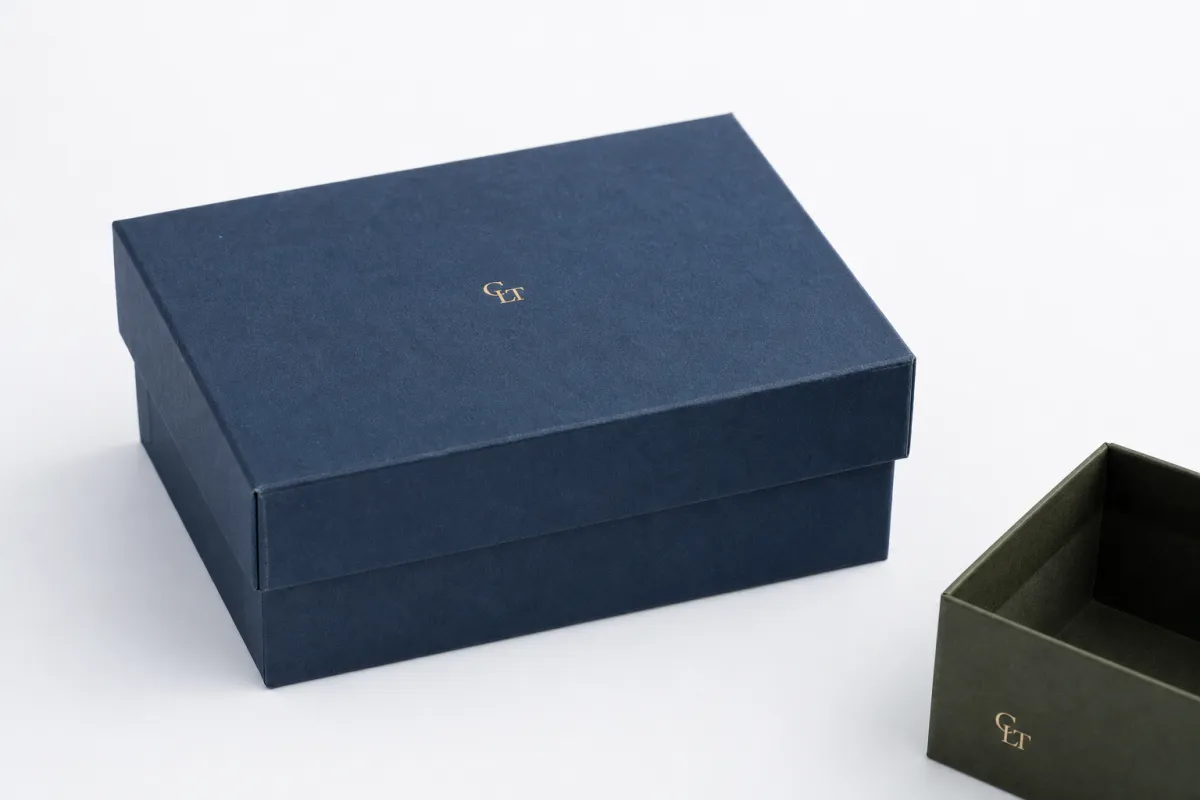
At the core, a custom tray and lid box is a two-piece structure. The tray acts as the base. The lid is a separate cover that slips over or around the tray, depending on the build. That separation creates the reveal. Instead of one flap opening in a single motion, the customer removes the lid and sees the product staged inside. The mechanics are straightforward. The effect is not.
That effect is exactly why custom tray and lid boxes perform so well in gifting and presentation categories. A fragrance set, a candle bundle, a leather accessory, or a premium apparel item feels more finished when it sits in a rigid tray with a fitted lid. The same item in a standard carton may still be protected, but it will not carry the same weight in the hand or on the shelf. People feel the difference before they can put language around it.
Retail behavior favors the format too. Custom tray and lid boxes can be built to stack cleanly, hold their shape, and keep graphics aligned on every face. That makes them practical for shelf sets, table displays, and bundled kits. Many brands choose them because one package can protect, present, and organize without looking overbuilt. That balance is hard to hit, and this structure hits it more often than most.
They show up everywhere for a reason: cosmetics, apparel, accessories, premium food, stationery, and promotional kits all benefit from the same logic. Fragile items need more control. Bundles need compartments. Presentation goods need a better opening moment. Custom tray and lid boxes handle those needs without shouting about it. They are not flashy by default. They are disciplined. In packaging, discipline usually carries more weight than decoration.
People sometimes assume a premium box needs to be loud. It usually does not. A plain lid, a crisp logo, a tight fit, and a solid board weight can feel more expensive than a crowded graphic layout. Custom tray and lid boxes are strong at this because the structure does part of the branding work. The box quietly tells the buyer the product was planned, not thrown together at the last minute. Customers notice that, even if they never say so out loud.
If the lid fit is sloppy, the whole box reads cheap. If the fit is right, the box does half the selling before the product gets a chance.
I have seen this play out in real reviews of retail samples: a box with excellent print but a loose lid lost the room fast, while a simpler version with cleaner tolerances looked far more expensive. That is the real value of custom tray and lid boxes. They create a tactile pause. In retail packaging, ecommerce gifting, and any category where first touch matters, that pause can be the difference between a product that feels ordinary and one that feels worth remembering.
How Custom Tray and Lid Boxes Work in Production
Production starts with structure, not graphics. That is the part people sometimes skip because artwork feels more exciting. It is also where custom tray and lid boxes either become straightforward or turn into a chain of avoidable problems. Tray depth, wall height, lid overlap, and internal clearance all shape whether the box feels snug, loose, or irritating. A tray that is too shallow lets the product shift. A lid with too little overlap weakens the silhouette. A fit that is too tight turns every opening into a fight. Nobody wants a premium box that behaves like a bad hinge.
Fit has to be practical, not theoretical. A good lid should resist slightly, then come off with a controlled motion. It should feel secure without forcing the customer to bend corners or pinch the lip. The best custom tray and lid boxes usually land in that middle ground. They hold shape, keep the contents in place, and still open without a struggle. That is why samples matter so much. You are gonna catch more issues in a sample than in a spreadsheet.
Typical build sequence
Production usually begins with a dieline or structural drawing. That file sets the tray size, lid dimensions, fold lines, glue areas, and panel proportions. Artwork prep follows, then print setup, cutting, folding, and finally gluing or assembly. Some custom tray and lid boxes ship flat. Others are built and packed before shipment. The right choice depends on style, quantity, freight cost, and how much assembly the end user can realistically handle.
Insert choice changes the experience faster than many buyers expect. Foam inserts hold fragile products well. Cardboard partitions fit sets and compartments. Paperboard cradles work when the item needs a cleaner, more recyclable presentation. No insert at all can be the right answer for soft goods or products that already sit securely in the tray. An insert should earn its place. It should not be added just because it sounds fancier.
For brands selling through ecommerce, the secondary shipper deserves attention too. Custom tray and lid boxes may look excellent on a counter and still fail in transit if the contents can move inside the package. Transit testing matters here. Standards from ISTA help because they force you to think beyond shelf appeal and into drop, vibration, and compression behavior. Fancy packaging that crushes in shipping is not premium. It is expensive friction.
With custom tray and lid boxes, tolerance control matters more than it does in a basic carton. A two-millimeter error might be invisible in one structure and obvious in another. Tighter tolerances give a cleaner result, yet they also raise the chance of rework if product dimensions, inserts, or material thickness are off. That is why a detailed spec sheet is not optional. It is the line between a controlled run and a stack of boxes that only kind of fit.
When a supplier talks about custom tray and lid boxes, ask how they handle corner square, wall compression, and lid overlap. Those details say more about build quality than a polished sales pitch ever will. Ask whether the quote assumes assembly, flat shipping, or both. A low unit price can disappear once labor enters the picture.
From a manufacturing standpoint, custom tray and lid boxes are not difficult. They are unforgiving when the measurements are loose. That is the part many buyers underestimate.
Custom Tray and Lid Boxes Design Factors That Change the Look
Material choice changes everything. A lightweight paperboard tray and lid box feels different from a rigid setup box wrapped in printed paper. Board grade, thickness, and wrap stock influence how the box sits in the hand, how well it protects the contents, and whether it reads as luxury, functional, or cost-conscious. If the goal is a premium impression, custom tray and lid boxes usually need enough structure to hold their shape without sagging at the corners.
Print style matters too, just not in the simplistic way people sometimes assume. More decoration does not automatically mean more value. Solid-color wraps, full-bleed graphics, restrained logo placement, foil stamping, embossing, and spot UV each create a different effect. A heavy print treatment can elevate one brand and flatten another. Some of the strongest custom tray and lid boxes use very little artwork and one sharp focal point. Loud is not the same as memorable.
Color strategy carries more weight than it first appears. The outer lid and inner tray can match for a calm, cohesive look, or contrast for a stronger reveal. A dark lid over a light tray makes the opening feel more dramatic. A natural kraft tray under a black wrap lid sends a very different message. That is package branding in practical form. The color plan should fit the product category and the emotion the brand wants the customer to feel.
Surface finish changes perceived value and how the box handles wear. Matte and soft-touch finishes feel smooth and controlled, though they can show scuffs if the material is delicate or the coating is too soft. Gloss can give stronger visual pop, but it may also reveal fingerprints. Textured wrap stocks feel craftier and often suit artisan or gift-oriented custom tray and lid boxes. Natural paper looks work well when the brand wants honesty, sustainability cues, or a less polished retail tone.
Internal layout deserves more attention than it usually gets. If the product sits off-center, the whole package feels off. If the item needs to nest into a cradle, the tray should be built around that exact geometry instead of forcing a generic cavity. Clean panel proportions matter too. A lid that is too tall can look awkward. A tray wall that is too low can make the product feel exposed. The best custom tray and lid boxes look as though the box and the product were designed together.
For brands that want a premium presentation without overdoing it, I usually point them toward three choices: one distinct visual cue, one controlled tactile finish, and one structural detail that makes the box feel custom. That could be an embossed logo, a contrasting tray color, or a precision fit that makes the lid settle with just the right friction. In custom tray and lid boxes, small decisions stack fast.
FSC-certified paper can matter if the buyer cares about sourcing and environmental claims. If that is part of the brief, the paper and wrap stock need to be certified through the chain of custody, not just described that way in a quote. The standard is a sourcing requirement, not a decorative label. You can review the organization at FSC if you need a reference point before requesting material options.
Good design is not about piling on features. It is about making custom tray and lid boxes look intentional from every angle, inside and out. That is the gap between packaging that feels expensive and packaging that merely costs more.
Custom Tray and Lid Boxes Cost and Pricing Factors
The blunt truth is that price is mostly driven by size, material, print complexity, finish level, and quantity. It is not driven by the word custom. A small run of custom tray and lid boxes with specialty wrap, inserts, and hand assembly can cost more per unit than a larger batch of plain printed cartons. That is normal. Setup costs still have to be paid somewhere.
MOQ matters because setup work does not shrink just because the order is small. Cutting dies, print plates, sample approval, glue setup, and assembly prep all carry fixed labor. Spread those costs across 300 boxes and the unit price rises. Spread them across 5,000 and the unit price drops. That is why custom tray and lid boxes can look expensive at low quantities and much more reasonable at volume.
When people ask for pricing, I usually split custom tray and lid boxes into separate buckets so the money is easier to trace. That helps avoid bad comparisons between vendors who quote in different ways. One supplier may include the insert. Another may charge separately for wrap stock or foil. If the pricing is not broken apart, the comparison gets muddy fast.
| Build Option | Best For | Typical Unit Cost at 1,000 Pieces | Notes |
|---|---|---|---|
| Printed paperboard tray and lid | Light products, promotional sets, lower budgets | $0.45-$1.10 | Good for efficient retail packaging; less rigid, lighter protection |
| Rigid tray and lid with wrapped board | Cosmetics, gifting, premium apparel, presentation goods | $1.20-$3.75 | Most common premium format; better perceived value and structure |
| Rigid box with custom insert and specialty finish | Fragile items, kits, higher-end branded packaging | $1.80-$5.00+ | Foil, embossing, soft-touch, or complex inserts push cost up fast |
| Corrugated tray and lid style | Heavier products, shipping-focused retail packaging | $0.70-$2.20 | More protective than paperboard; less refined unless finished well |
Those numbers are general ranges, not quotes. They still help frame the budget before someone asks why custom tray and lid boxes are not priced like commodity mailers. They are not commodity mailers. They use more material, more finishing, and usually more labor.
Cost drivers worth separating on a quote:
- Structure - rigid setup, folded paperboard, or corrugated build.
- Print coverage - one-color logo work costs less than full-bleed art on every panel.
- Finish - matte, gloss, soft-touch, foil, embossing, or spot UV.
- Insert - foam, molded paperboard, partitions, or no insert.
- Assembly - flat-packed versus pre-built.
- Quantity - higher runs usually bring the unit cost down.
There is a second cost that buyers forget: total project cost. A box that costs a little less per unit may still be the worse deal if the minimum order is too high, the lead time is too long, or the box requires manual assembly that slows the team down. Good custom tray and lid boxes should fit the budget, but they also need to fit the operation.
One practical move is to ask for separate pricing on the base structure, the print, the finish, the insert, and the assembly. That makes it easier to compare quotes and decide where to save money. Maybe the rigid build stays and the foil goes. Maybe the insert gets simpler. Maybe the outer artwork stays minimal while the lid keeps the premium detail. That is how custom tray and lid boxes get tailored without turning into a budget leak.
If a supplier cannot explain the price by component, keep asking. A clean quote is not a luxury. It is basic professionalism.
Custom Tray and Lid Boxes Process and Timeline
The process starts with the product, not the artwork. Measure the item, note any protective wrap, decide whether the product will sit loose or inside an insert, and define the final presentation goal. Then a supplier can recommend a structure for custom tray and lid boxes that actually fits the item instead of forcing the item to fit the box.
From there, the usual flow is brief, structural recommendation, dieline, artwork preparation, sample approval, production release, and shipment. That sounds orderly because it should be. The easiest projects are the ones where custom tray and lid boxes move through approval in steps instead of all at once. Every stage is a chance to catch a problem before it becomes expensive.
Here is what tends to slow things down:
- Missing measurements or unclear product dimensions.
- Late artwork changes after the sample is already in motion.
- Finish approvals that take longer than the production slot.
- Switching box styles midway through the job.
- Insert revisions after the fit has already been confirmed.
Lead times depend on complexity, but a practical range helps. Simple custom tray and lid boxes with standard print and no tricky finish may move through sampling and production faster than heavily finished presentation boxes. In many cases, you are looking at roughly 7-10 business days for sample work and about 12-20 business days for production after approval, with shipping on top of that. Specialty wraps, foil, or custom inserts add time. Rushing does not create more capacity. It only compresses the room for error.
That is why milestone scheduling matters. Ask when the dieline is due, when the proof is due, when the sample is expected, and when approval is needed to hold the production window. Custom tray and lid boxes are easy to manage when everyone knows the gates. They become messy when one side assumes the other side is "almost ready."
For direct-to-consumer brands, shipping method deserves early attention. If the box ships inside a mailer, the outer package may protect the finish. If the tray and lid box ships as the only carton, the board needs to be stronger and the crush resistance needs to be better. That is where custom tray and lid boxes and regular shipping cartons stop behaving like the same category.
One more practical note: if you are ordering through a packaging partner, review related options on Custom Packaging Products early in the process. A slight structure change can solve the problem better than a more expensive finish ever will. That advice is not glamorous. It saves money.
Most bad timelines are caused by indecision, not manufacturing. Once the measurements, artwork, and finish are locked, custom tray and lid boxes move much more predictably.
Common Mistakes When Ordering Tray and Lid Packaging
The most common mistake is measuring the product and forgetting the rest of the equation. If the item needs tissue, a sleeve, a foam cradle, or even a few millimeters of breathing room, the tray has to account for that. Custom tray and lid boxes should be based on usable internal space, not a vague outer size that looks right on paper.
Another mistake is choosing finishes before the structure is proven. A soft-touch wrap sounds appealing until the box starts scuffing during assembly. Spot UV sounds sharp until it clashes with a more natural brand look. With custom tray and lid boxes, the structure has to survive handling before the finish gets the credit.
Overdesign causes trouble too. A box can feel busy, expensive, and forgettable at the same time. Too many fonts, too many panels fighting for attention, too many effects, and the product disappears. The smarter move is usually restraint. A restrained box with strong proportions and one clear brand mark often outperforms a noisy layout.
Skipping a sample is another expensive shortcut. If the product is heavy, fragile, odd-shaped, or tied to a premium launch, do not guess. Test it. A sample lets you check corner fit, lid resistance, insert movement, print color, and finish handling. Custom tray and lid boxes are not the place to discover that the product rattles because the lid is off by two millimeters.
The last mistake is ignoring the actual business workflow. Where will the boxes be stored? How much assembly time is available? Who is packing them? Are they going direct to retail, fulfillment, or a photo studio? A beautiful package that slows the team down is still a problem. Custom tray and lid boxes need to work for operations, not just for a presentation deck.
There is also a sustainability angle that needs care. If the brand wants recyclable materials or FSC-certified stock, make sure the specs are documented and compatible with the rest of the build. Pretty claims without proof are a fast route to mistrust. I would rather see a clear, honest material spec than a vague "eco-friendly" label that means almost nothing.
Transit testing matters here too. If the packaging has to survive shipping, use the right test plan and do not pretend visual approval is the same as performance approval. Packaging that passes a photo review and fails a drop test is not a success. It is a remake.
Expert Tips for Better Custom Tray and Lid Boxes
Build the package around the product experience first, then use graphics to support that structure. That advice sounds plain because it is. The strongest custom tray and lid boxes do not try to hide a weak fit under decoration. They start with the fit, then add the visual layer on top.
Ask for a spec sheet before approving anything. It Should Include inner dimensions, board thickness, print method, finish, insert type, and assembly method. If a supplier cannot give that in writing, you are trusting memory, and memory is a poor production tool. Custom tray and lid boxes live or die by the details.
Test the open-and-close feel in real conditions. Try it with gloves if your fulfillment team uses them. Try it after the box has been handled a few times. Try it with the actual insert in place, not an imagined one. A box that looks elegant on screen can feel stiff, flimsy, or awkward in the hand. That is why prototypes matter even for "simple" custom tray and lid boxes.
Compare two versions of the same concept: one optimized for cost, one for presentation. The contrast makes the tradeoffs obvious. The lower-cost version may use paperboard instead of rigid board. The premium version may add soft-touch and a fitted insert. Seeing both side by side helps buyers decide whether the extra spend is doing real work or just polishing the invoice.
It also helps to think about where the money should go. Spend on structure if the box needs to hold shape. Spend on finish if the brand is selling luxury or gifting. Spend on insert design if the product is fragile or multi-piece. Do not spend on effects just because they are available. Custom tray and lid boxes should support the product, not compete with it.
For sourcing, I would rather see a clean path from concept to approval than a pile of "nice ideas." Lock the measurements, confirm the budget range, approve the sample, and then place the order with a clear sign-off path. That sequence reduces mistakes and keeps the project moving. It is not flashy. It is how good custom tray and lid boxes get made without drama.
If the brand cares about transit performance, ask for guidance aligned with recognized testing methods and do not ignore the basics of protection. If the brand cares about material sourcing, request documented certifications. If the box will sit on a retail shelf, check the print under store lighting, not just in a bright office. Small habits like these change the outcome more than most people expect in custom tray and lid boxes.
Finally, do not let the sample stage become a guessing game. A proper sample should answer one question clearly: does this box fit the product and the brand the way we need it to? If the answer is no, adjust the spec. Custom tray and lid boxes are forgiving when decisions are made early and unkind when they are made late.
In practice, the best results come from restraint, measurement discipline, and a realistic budget. That is the boring truth. It is also the truth that keeps custom tray and lid boxes looking premium instead of merely expensive.
Custom tray and lid boxes can do a lot when the dimensions are right, the board choice makes sense, and the finish supports the brand instead of fighting it. Keep the fit tight, the presentation clean, and the timeline honest, and custom tray and lid boxes become one of the most reliable ways to elevate product packaging without overcomplicating the job.
What are custom tray and lid boxes used for?
They are used for products that need a premium presentation, a cleaner reveal, or better organization than a standard folding carton. Common uses include gifts, cosmetics, apparel, accessories, and specialty retail items that benefit from a two-piece structure.
How do I measure custom tray and lid boxes correctly?
Measure the product at its widest usable dimensions, then add clearance for inserts, wrapping, and easy removal. Base the tray size on internal fit, not outer dimensions, and confirm whether the lid needs extra overlap for appearance or strength.
What affects custom tray and lid boxes pricing the most?
The biggest drivers are material choice, box size, print complexity, finish level, insert requirements, and order quantity. Low quantities usually raise unit cost because setup and production overhead are spread across fewer boxes.
What is the typical turnaround for custom tray and lid boxes?
Timeline usually depends on how fast the dieline is approved, whether a sample is needed, and how complex the print or finish specification is. Rush jobs are possible in some cases, but they usually cost more and leave less room for corrections.
Are custom tray and lid boxes good for ecommerce shipping?
Yes, if the structure is built with enough board strength and the product is protected by a proper insert or secondary mailer. For direct shipping, the box should be tested for movement, scuffing, and crush risk before production is approved.

